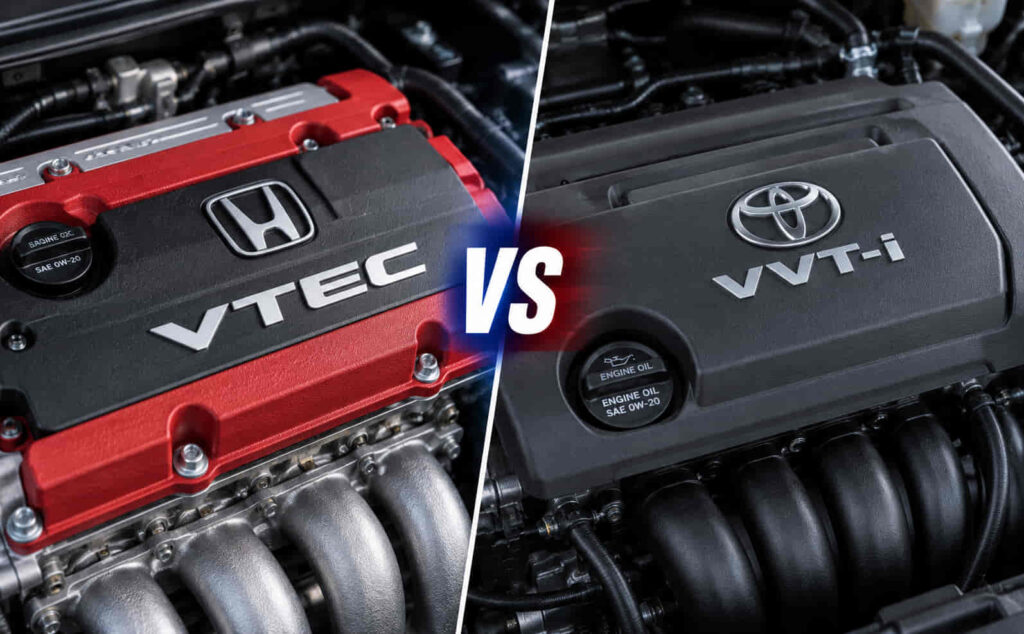
VTEC and VVT-i are both variable valve control technologies, but they optimize engine operation in different ways. Honda’s traditional VTEC system switches between different cam profiles to change valve timing and lift according to engine operating conditions, allowing the engine to balance low- and mid-range drivability with stronger airflow at higher RPM. Toyota’s VVT-i system takes a different approach by continuously advancing or retarding camshaft timing to adjust when the valves open and close.
This mechanical difference affects how each system influences torque delivery, high-RPM power, fuel consumption, emissions, and overall engine behavior. Honda developed VTEC around the ability to use different valve lift and timing characteristics across the RPM range, while Toyota designed VVT-i to continuously optimize valve timing according to engine speed and load. Toyota reported that its original VVT-i implementation improved both low- and mid-range torque and fuel economy by controlling intake valve timing more precisely.
The VTEC vs VVT-i comparison therefore cannot be reduced to which technology produces more horsepower. A useful comparison must examine how each system controls the valves, how those differences affect real-world performance and efficiency, and whether either design offers meaningful advantages in reliability, maintenance, or daily driving.
What Is the Main Difference Between VTEC and VVT-i?
The main difference between VTEC and VVT-i is the way each system changes valve operation to match engine speed and load. Traditional Honda VTEC switches between different cam profiles so the valves can operate with different timing and lift characteristics, while Toyota VVT-i continuously changes camshaft timing to advance or retard when the valves open and close. Honda therefore uses a mechanical change in cam profile as a central part of traditional VTEC operation, whereas Toyota VVT-i primarily changes the angular relationship between the camshaft and crankshaft.
This distinction matters because valve timing and valve lift control different aspects of engine breathing. Valve timing determines when an intake or exhaust valve opens and closes relative to piston movement, while valve lift determines how far the valve moves away from its seat. Honda states that the original VTEC design uses different intake and exhaust valve timing and lift profiles for low-to-mid RPM and high RPM operation. Toyota describes VVT-i as a system that continuously changes intake valve opening and closing timing according to driving conditions. These mechanisms allow both technologies to improve engine operation, but they achieve that optimization in different ways.
Traditional VTEC is especially associated with expanding the usable engine speed range. A low-lift cam profile can support stable torque and drivability at lower engine speeds, while a high-lift profile allows greater airflow when the engine is operating at higher RPM. VVT-i does not require this type of discrete cam-profile switch in its original form. Instead, the ECU continuously adjusts camshaft phase through a hydraulically controlled mechanism, allowing valve timing to change progressively as engine speed and load change. Toyota reported that its original VVT-i system increased low- and medium-speed torque by approximately 10% and improved fuel economy by about 6% in its development tests, although these figures describe that specific early implementation rather than every VVT-i engine.
The two technologies should therefore not be compared simply as competing badges from Honda and Toyota. VTEC traditionally focuses on selecting different valve operating profiles, whereas VVT-i focuses on continuously optimizing camshaft timing. Later Honda and Toyota systems combine additional forms of valve control, so the exact comparison depends on the engine generation. The fundamental difference, however, explains why traditional VTEC is strongly associated with high-RPM breathing and why VVT-i is closely associated with continuous timing optimization across a broad operating range.
How Does Honda VTEC Work?
Honda VTEC works by using multiple cam profiles and hydraulically controlled rocker arms to change how the intake and exhaust valves operate at different engine speeds. In Honda’s original B16A VTEC design, each valve group uses low-lift and high-lift cam profiles. At low and medium engine speeds, the rocker arms remain separated, so the low-lift cam lobes control valve movement. The high-lift cam rotates at the same time but does not control the valves because its rocker mechanism is not locked to the operating rocker arms.
This low-RPM configuration gives the engine a cam profile suited to lower-speed operation. Honda explains that the valves operate with relatively small lift and limited overlap during this phase. Smaller valve lift and a more conservative timing profile help maintain useful torque and stable combustion when the engine does not require maximum airflow. The mechanism therefore allows Honda to avoid designing the camshaft around a single fixed compromise between low-speed drivability and high-speed breathing.
When the ECU determines that operating conditions require the high-RPM profile, hydraulic pressure moves locking pins inside the rocker-arm assembly. These pins connect the rocker arms so that the high-lift cam lobe controls their movement as a single unit. The valves then open farther and remain open according to the more aggressive high-RPM profile. Honda states that this configuration creates greater valve lift and increased valve overlap, improving exhaust scavenging and volumetric efficiency so a larger quantity of air can pass through the engine at high speed.
The changeover is not controlled by engine speed alone. Honda describes the ECU as evaluating operating inputs such as engine RPM, engine load and vehicle speed before switching cam profiles. In the original B16A application, the transition occurred around 4,800–5,200 RPM, but that range should not be treated as a universal VTEC engagement point because different Honda engines use different calibrations and VTEC mechanisms.
The core advantage of traditional VTEC is that one engine can use valve characteristics suited to two different operating ranges instead of relying on one fixed cam profile. The low-speed profile supports torque and drivability, while the high-speed profile increases valve lift, duration characteristics and airflow when greater engine output is required. This mechanism is the technical reason classic naturally aspirated VTEC engines are closely associated with a noticeable change in behavior as engine speed rises.
Read more: Permanently Disable Toyota Highlander Auto Start/Stop
How Does Toyota VVT-i Work?
Toyota VVT-i works by continuously advancing or retarding camshaft timing so the intake valves open and close at a more suitable point for the engine’s current speed and load. Unlike traditional VTEC, VVT-i does not need to switch between separate low-lift and high-lift cam profiles to perform its primary function. Toyota’s original VVT-i system changes the rotational position of the intake camshaft relative to the crankshaft, allowing the engine control unit to alter valve timing progressively rather than relying on one fixed setting.
The original VVT-i system uses three main control elements: the engine control unit, an oil control valve, and a hydraulically operated VVT pulley or camshaft actuator. The ECU calculates the required valve timing from engine operating conditions and sends a command to the oil control valve. The oil control valve then directs engine oil pressure to the appropriate side of the actuator, which changes the camshaft position. Toyota’s first production design used a hydraulically moved piston with a helical spline and provided a variable range of up to 60 degrees of crankshaft angle. This hydraulic mechanism allows the system to advance or retard valve timing without changing the physical shape or height of the cam lobe.
Changing camshaft timing alters when the intake valve opens and closes in relation to piston movement. At part load, Toyota can increase valve overlap by advancing intake timing, allowing part of the exhaust gas to remain or return to the cylinder. This reduces pumping loss, lowers combustion temperature and allows unburned gases to pass through the combustion process again. When the engine requires greater torque and power, VVT-i adjusts intake valve closing according to engine speed so cylinder filling can take better advantage of intake-air inertia. Toyota reported that its original VVT-i development increased fuel economy by approximately 6% and low- and medium-speed torque by about 10%, although these figures apply to that specific implementation rather than every Toyota engine equipped with VVT-i.
The main advantage of VVT-i is therefore continuous timing optimization across changing operating conditions. A fixed-valve-timing engine must use one camshaft timing compromise for idle, partial load, low RPM and high RPM. VVT-i can move the camshaft toward a different timing position as those conditions change. Toyota has used this principle to improve torque, output, fuel efficiency and emissions rather than optimizing the engine for only one narrow RPM range.
Does VTEC Change Valve Lift While VVT-i Changes Valve Timing?
Traditional Honda VTEC changes both valve timing and valve lift by switching cam profiles, while Toyota VVT-i changes valve timing primarily by changing camshaft phase. This distinction is more accurate than saying that VTEC controls only lift and VVT-i controls only timing. Honda’s original automotive VTEC uses different cam-lobe profiles for low-to-medium and high engine speeds, and the shape and height of those profiles determine both when the valves operate and how far they open. Toyota’s original VVT-i retains the cam-lobe profile but rotates the camshaft relative to the crankshaft to move the valve events earlier or later.
Valve timing, valve lift and valve duration describe three related but different characteristics. Valve timing refers to the crankshaft positions at which a valve opens and closes. Valve lift is the distance the valve moves away from its seat. Valve duration is the period, normally expressed in crankshaft degrees, during which the valve remains open. The physical cam profile determines these characteristics in a conventional valvetrain. Honda VTEC can switch to a different profile with greater lift and different opening and closing characteristics, while VVT-i shifts the timing of an existing profile without independently increasing its lift. Honda specifically describes the B16A VTEC system as switching intake and exhaust valve opening and closing timing as well as lift between low-to-mid-RPM and high-RPM operation.
The mechanical difference explains why the two technologies produce different effects even though both belong to the broader field of variable valve control. When traditional VTEC engages its high-RPM profile, hydraulically actuated pins join the rocker arms so the larger central cam lobe controls valve movement. The valves open farther, their opening and closing characteristics change, and valve overlap increases. Greater lift and a high-RPM cam profile improve intake and exhaust flow when the engine requires a larger volume of air. VVT-i instead uses hydraulic pressure to change camshaft position continuously, allowing the ECU to optimize valve overlap and intake-valve closing without switching to another cam-lobe profile.
This distinction also prevents an inaccurate conclusion that Toyota engines cannot control valve lift or that every Honda VTEC engine operates exactly like the original B16A. Toyota later developed Valvematic by combining VVT-i timing control with a separate mechanism capable of continuously controlling intake-valve lift. Honda likewise developed later systems that combine VTEC with additional cam-phasing technologies. For a direct comparison of traditional VTEC vs VVT-i, however, the fundamental distinction remains clear: VTEC switches valve operating profiles that alter timing and lift, whereas VVT-i continuously changes camshaft timing without changing valve lift as its primary mechanism.
How Do VTEC and VVT-i Affect Engine Performance?
VTEC is better suited to creating distinct low-RPM and high-RPM valve characteristics, while VVT-i is designed to optimize valve timing continuously across a broader range of engine speeds and loads. This does not mean every VTEC engine produces more power than every VVT-i engine. Horsepower and torque also depend on displacement, compression ratio, cylinder-head airflow, intake and exhaust design, fuel delivery, ignition timing, forced induction, and ECU calibration. The valve-control system determines how effectively the engine can use those components under different operating conditions rather than setting the engine’s output by itself.
Traditional VTEC gives Honda engineers two different cam profiles instead of forcing one fixed profile to serve the entire RPM range. At low and medium engine speeds, the lower-lift profile maintains valve characteristics that support drivability and usable torque. At higher engine speeds, VTEC engages a cam profile with greater lift and different valve timing, allowing the valves to open farther and creating greater overlap. The resulting increase in intake and exhaust flow improves volumetric efficiency when the engine needs to move a larger volume of air through the cylinders. Honda used this principle in the 1.6-liter B16A, which produced 160 PS, or 100 PS per liter, while retaining usable low- and mid-RPM performance.
This ability to change cam profiles explains why traditional naturally aspirated VTEC engines are strongly associated with high-RPM power. A camshaft optimized only for high engine speeds would normally compromise lower-speed operation because aggressive valve lift and overlap are less suitable when airflow demand is lower. VTEC reduces that compromise by keeping a milder profile at lower RPM and activating a more aggressive profile when engine speed and load justify greater airflow. Honda applied the same principle to the 3.0-liter C30A engine in the NSX, where VTEC helped combine high-RPM output with low- and mid-RPM drivability; the manual-transmission version produced 280 PS at 7,300 RPM and had an 8,000-RPM red zone.
VVT-i improves performance through a different mechanism. Instead of changing to a higher-lift cam profile, the system continuously advances or retards intake camshaft timing according to operating conditions. At low and medium engine speeds, Toyota can adjust intake-valve closing to make better use of the incoming air and increase cylinder filling. At higher speeds, the system can retard intake-valve closing as the optimum point changes with intake-air inertia. Toyota reported that its original VVT-i development increased low- and medium-speed torque by approximately 10%, demonstrating that variable cam phasing can improve useful torque without requiring a discrete high-lift cam change.
The performance difference between VTEC and VVT-i is therefore more accurately described as cam-profile optimization versus continuous cam-phase optimization. Traditional VTEC has a clear engineering advantage when an engine needs substantially different valve lift and timing characteristics at high RPM, while VVT-i can continuously move valve timing toward a more suitable position as speed and load change. Neither mechanism guarantees greater peak horsepower or torque by itself. A well-designed VVT-i engine can produce more power than a particular VTEC engine, just as a VTEC engine can outperform a VVT-i engine, because the final output is determined by the complete engine system.
Is VTEC or VVT-i Better for Fuel Economy?
Neither VTEC nor VVT-i is inherently more fuel-efficient in every engine, because fuel economy depends on how the entire engine and vehicle are designed and calibrated. Both technologies can reduce the compromises created by fixed valve operation, but they improve efficiency through different valve-control strategies. VTEC allows engineers to use valve characteristics appropriate for different operating ranges, while VVT-i continuously adjusts camshaft timing to reduce losses and improve combustion according to engine load and speed.
VVT-i has a direct mechanism for reducing pumping loss during part-load operation. A gasoline engine operating at partial throttle must work against intake vacuum as the pistons draw air into the cylinders. Toyota explains that VVT-i can advance intake timing and increase valve overlap so a portion of exhaust gas is retained or returned to the cylinder. This reduces negative pressure in the cylinder, decreases intake pumping loss, lowers combustion temperature, and allows remaining hydrocarbons to pass through combustion again. Toyota also reduces overlap during idle to stabilize combustion and permit a lower idle speed, which contributes to lower fuel consumption.
Toyota reported an approximately 6% improvement in fuel economy during testing of its original VVT-i technology. That number should not be interpreted as a universal 6% saving for every VVT-i-equipped Toyota because engine architecture, transmission, vehicle weight, test procedure, and subsequent versions of the technology differ. Later Toyota engines continued to use variable valve timing alongside other efficiency measures. For example, Toyota attributed the efficiency of its 1-liter engine to VVT-i combined with compact combustion chambers, an offset crankshaft, and friction reduction, illustrating why fuel-economy gains cannot be assigned to valve timing alone.
VTEC can also support fuel efficiency by preventing an engine from using aggressive high-RPM valve characteristics when they are unnecessary. At lower speeds, the engine operates with a cam profile designed for lower airflow demand, while the higher-lift profile is reserved for operating conditions that require increased cylinder filling. This arrangement allows Honda to pursue high-RPM output without forcing the same high-lift and high-overlap characteristics on the engine throughout its operating range. Honda describes the original VTEC concept as a solution to the conflict between high-RPM, high-output performance and the low- to mid-RPM characteristics required in normal passenger-car operation.
Modern implementations make a simple fuel-economy comparison even less useful because manufacturers increasingly combine multiple forms of valve control. Toyota developed Dual VVT-i to control both intake and exhaust camshaft timing, while Honda has combined VTEC valve-profile control with variable cam phasing in later engine families. The efficiency of a specific vehicle therefore depends more on the complete valve strategy and engine calibration than on whether the engine cover carries a VTEC or VVT-i badge.
VVT-i has a particularly direct advantage in continuously optimizing valve timing to reduce pumping losses and improve part-load efficiency, while VTEC allows different valve profiles to serve different operating ranges. For real-world fuel economy, however, neither technology should be declared the universal winner without comparing two specific engines or vehicles under the same test conditions.
Is VTEC or VVT-i More Reliable?
Neither VTEC nor VVT-i can be considered universally more reliable based on the valve-control technology alone. Both systems have relatively compact mechanical designs, but their reliability depends on the specific engine generation, oil condition, hydraulic pressure, actuator design, sensor control, maintenance history, and total mileage. Toyota described the original VVT-i architecture as a simple design intended to provide high reliability, while Honda’s VTEC mechanism uses precisely machined rocker arms and hydraulically operated locking pins to switch valve profiles. These differences change the components involved, but they do not establish a universal reliability winner between Honda and Toyota.
Traditional VTEC depends on hydraulic pressure to move locking pins inside the rocker-arm assembly. During lower-RPM operation, the rocker arms associated with the low-lift cam lobes operate independently from the high-lift rocker arm. When the required operating conditions are reached, hydraulic pressure moves the internal pins and locks the rocker arms together, allowing the high-lift cam profile to control valve movement. Honda states that these pins require extremely precise machining, with tolerances as small as 50 μm in its described B16A mechanism. Correct hydraulic operation is therefore integral to the system rather than an optional supporting function.
VVT-i also depends on engine oil pressure, but it uses that pressure differently. Toyota’s original system consists of an ECU, an oil control valve and a hydraulically operated VVT pulley. The ECU determines the required intake-valve timing, while the oil control valve directs hydraulic pressure to move the actuator and change camshaft position. Toyota specifically notes that VVT-i uses the conventional engine oil pump rather than a separate hydraulic pump. This means the system’s ability to advance and retard camshaft timing depends directly on controlled oil flow through the VVT mechanism.
The resulting reliability comparison is therefore a comparison of different hydraulic mechanisms rather than a simple contrast between a mechanical VTEC system and an electronic VVT-i system. VTEC uses electronically commanded hydraulic action to switch mechanical valve profiles, while VVT-i uses electronic control and hydraulic pressure to continuously change camshaft phase. Both combine mechanical, hydraulic and electronic components. A fault affecting oil pressure, hydraulic control or the relevant actuator can therefore interfere with variable valve operation even when the engine remains mechanically capable of running.
There is also no sound basis for assuming that every VTEC engine has the same reliability profile or that every VVT-i engine does. Honda has applied VTEC across multiple engine architectures since the B16A, and Toyota has expanded its original intake-cam VVT-i design into technologies such as Dual VVT-i and other valve-control systems. The number of controlled camshafts, actuator design and surrounding engine architecture can differ significantly between generations. Reliability should therefore be evaluated by the specific engine code and vehicle rather than by the VTEC or VVT-i badge alone.
For a used-car buyer, engine condition and maintenance history are more useful reliability indicators than choosing VTEC or VVT-i in isolation. A properly maintained engine allows either system to operate under the oil-pressure and control conditions for which it was designed. A neglected engine may create problems that affect variable valve operation regardless of which manufacturer developed the system. No direct head-to-head evidence from Honda or Toyota establishes that VTEC as a technology lasts longer than VVT-i, or vice versa.
Does Engine Oil Affect VTEC and VVT-i Operation?
Engine oil directly affects both VTEC and VVT-i because each system uses hydraulic oil pressure to control part of its variable valve mechanism. In traditional Honda VTEC, oil pressure actuates the pins that connect the rocker arms and transfer valve control to the high-lift cam profile. In Toyota VVT-i, the engine oil circuit supplies hydraulic pressure to the actuator while the oil control valve regulates that pressure to advance or retard camshaft timing. Oil therefore performs both a lubrication function and a hydraulic-control function in these systems.
The effect of oil on VTEC can be understood from the switching mechanism itself. The high-lift cam does not control the valves at lower engine speeds because its rocker arm remains mechanically separated from the other rocker arms. When the ECU commands the transition, hydraulic pressure moves the locking pins until the rocker arms operate together. The high-lift cam can then determine valve movement. Honda’s description of this mechanism shows why adequate hydraulic action is necessary for the transition between valve profiles to occur as designed.
Oil performs a similarly direct control function in VVT-i. The ECU calculates an appropriate intake-cam position from engine conditions and sends a command to the oil control valve. The valve then distributes hydraulic pressure within the actuator so that the camshaft is rotated toward an advanced or retarded position. When the target valve timing changes, hydraulic pressure is redirected and the actuator responds accordingly. Toyota’s original design could vary intake timing through a range equivalent to as much as 60 degrees of crankshaft angle, illustrating how extensively cam position can depend on this hydraulic control circuit.
Oil condition matters because these systems depend on controlled flow through relatively precise hydraulic passages and mechanisms. From the designs described by Honda and Toyota, it follows mechanically that inadequate oil pressure or restricted hydraulic flow can prevent an actuator from responding exactly as intended. This does not mean that every VTEC or VVT-i malfunction is caused by oil. Electronic sensors, wiring, control valves, actuators and mechanical components are also part of the complete system and must be considered when diagnosing a fault.
Using the engine oil specification prescribed for a specific vehicle is therefore more important than choosing oil according to whether the engine carries a VTEC or VVT-i badge. Viscosity requirements, service intervals and oil specifications vary by engine and model year. A general comparison of VTEC vs VVT-i cannot provide one correct viscosity or replacement interval for every Honda and Toyota engine, so those values should be taken from the applicable manufacturer documentation rather than generalized across the technology family.
The practical relationship is straightforward: VTEC needs controlled oil pressure to engage its valve-profile mechanism, while VVT-i needs controlled oil pressure to position its camshaft actuator. Proper lubrication maintenance therefore supports the hydraulic functions of both technologies, but the correct maintenance specification must be determined from the individual engine rather than from the VTEC or VVT-i name alone.
What Is the Difference Between VTEC and i-VTEC?
The main difference between VTEC and i-VTEC is that i-VTEC can combine Honda’s valve-profile switching with continuously variable camshaft timing. Traditional VTEC changes valve operation by switching between different cam profiles according to engine operating conditions. Honda’s early DOHC VTEC design changes both valve timing and lift between low-to-mid-RPM and high-RPM operation. When Honda introduced its DOHC i-VTEC engine in 2000, it combined VTEC with VTC, or Variable Timing Control, which continuously adjusts intake camshaft timing according to engine load.
Traditional VTEC solves the compromise between valve characteristics required at different engine speeds. A cam profile suitable for low-RPM operation cannot provide the same high-RPM airflow as a more aggressive profile with greater valve lift and different timing. VTEC addresses this conflict by using separate cam profiles and hydraulically locking the rocker arms together when the high-speed profile is required. This creates two distinct sets of valve characteristics within the same valvetrain rather than forcing the engine to operate with one fixed cam profile across its complete RPM range.
i-VTEC adds another dimension of control. Honda states that its original DOHC i-VTEC combined VTEC, which varies valve timing and lift according to engine speed, with VTC, which continuously changes intake valve timing to match engine load. The engine can therefore select an appropriate valve profile while also changing the intake camshaft phase within its operating range. This allows valve behavior to respond more precisely to conditions such as low-speed operation, partial load, acceleration, and higher engine speeds rather than depending exclusively on a discrete change between two cam profiles.
This development also makes the VTEC vs VVT-i comparison more nuanced. Traditional VTEC and original VVT-i have clearly different primary mechanisms: VTEC switches valve profiles, whereas VVT-i continuously changes camshaft timing. Once VTC is added to Honda’s VTEC architecture, i-VTEC can provide both variable profile control and continuous cam phasing on engines designed with those functions. In functional terms, the VTC portion of an i-VTEC system performs a role closer to Toyota’s variable cam-timing strategy, while the VTEC portion retains Honda’s ability to alter valve operation through different cam profiles.
The name i-VTEC should not, however, be interpreted as proof that every Honda engine carrying the badge uses exactly the same mechanical strategy. Honda has applied VTEC technologies to different engines and performance objectives, so the specific valve-control functions depend on the engine design. For a VTEC vs VVT-i comparison, the important distinction is that traditional VTEC establishes Honda’s variable timing-and-lift concept, while i-VTEC can extend that concept with continuous intake camshaft timing through VTC. This is why comparing a modern Honda i-VTEC engine with a Toyota VVT-i engine requires examining the particular engine rather than assuming that all VTEC systems function identically.
What Is the Difference Between VVT-i, Dual VVT-i, and VVT-iE?
VVT-i, Dual VVT-i, and VVT-iE differ primarily in which camshafts they control and how the variable timing mechanism is actuated. Original VVT-i continuously changes valve timing by hydraulically adjusting camshaft phase. Dual VVT-i extends variable timing control to both the intake and exhaust sides, while VVT-iE replaces hydraulic timing actuation with an electric motor on the camshaft where the electric system is installed. These technologies represent different stages and configurations of Toyota’s variable valve timing strategy rather than three unrelated systems.
Toyota’s original VVT-i system introduced continuously variable intake valve timing. Its ECU calculates the target timing according to engine operating conditions, and an oil control valve regulates hydraulic pressure supplied by the normal engine oil pump. That pressure moves the VVT actuator and changes the rotational position of the intake camshaft relative to the crankshaft. The system can therefore advance or retard intake valve timing without changing the physical cam-lobe profile. Toyota developed this arrangement to improve torque and output while also reducing fuel consumption and emissions.
Dual VVT-i expands this concept by providing variable timing control on both the intake and exhaust camshafts. Controlling two sides of the gas-exchange process gives the engine management system greater authority over valve overlap and the timing relationships between intake and exhaust events. Toyota described the 2ZR-FE, for example, as using Dual VVT-i on both intake and exhaust sides to optimize valve timing across different engine speeds and loads. The company linked this broader timing control with stronger low- and mid-range torque, fuel efficiency, and cleaner exhaust performance, although these results also depended on the rest of the engine design.
VVT-iE changes the actuation method rather than abandoning variable cam timing. Toyota defines VVT-iE as Variable Valve Timing-intelligent by Electric motor. On engines using this system, an electric motor controls variable timing on the applicable camshaft instead of relying on oil pressure for that function. For example, Toyota’s Dynamic Force applications have used VVT-iE on the intake side while retaining hydraulically operated VVT-i on the exhaust side. Toyota states that the electric system can improve timing response and allow optimum valve timing to be achieved under a wider range of operating conditions.
The distinction becomes particularly important during operating conditions in which hydraulic control has limitations. A conventional VVT-i actuator depends on oil pressure, which varies with factors such as engine speed, oil temperature, and lubrication-system conditions. An electric actuator does not need engine oil pressure to create the camshaft movement itself. Toyota has stated that the electrically driven intake system provides responsive timing control and has associated the technology with improved efficiency, power, and emissions performance. It does not eliminate the engine’s need for proper lubrication, but it changes how the variable timing actuator is driven.
These later Toyota systems also demonstrate why VVT-i should not be treated as one unchanging mechanism across every Toyota engine. The original system controlled intake timing hydraulically, Dual VVT-i expanded timing control to intake and exhaust camshafts, and VVT-iE introduced electric actuation for variable timing on the applicable side. The common principle is variable camshaft timing, while the number of controlled camshafts and the method used to position them differ among VVT-i, Dual VVT-i, and VVT-iE.
This evolution also reinforces the central VTEC vs VVT-i distinction. Honda and Toyota have both expanded their original technologies beyond their earliest forms. Honda combined VTEC profile switching with continuous VTC cam phasing in i-VTEC, while Toyota expanded VVT-i into dual-cam and electrically actuated configurations. The correct comparison therefore depends on the specific generation being discussed. Traditional VTEC remains fundamentally associated with changing valve profiles, while Toyota’s VVT-i family remains fundamentally associated with varying camshaft phase. Later systems add more control rather than erasing that underlying difference.
Is VTEC or VVT-i Better for Daily Driving?
VVT-i generally emphasizes smooth, continuous valve-timing optimization for everyday driving, while traditional VTEC offers a more distinct change in engine behavior when the higher-performance cam profile is engaged. Neither characteristic automatically makes one technology better for every driver. Daily-driving quality depends on the complete engine calibration, transmission, vehicle weight, gearing, throttle response, and the RPM range in which the engine normally operates. The valve-control technology influences these characteristics, but it does not determine the entire driving experience by itself.
Toyota designed VVT-i to continuously adjust intake valve timing according to engine speed and load rather than waiting for one specific operating point before changing valve behavior. At low and medium engine speeds, the system can advance intake-valve closing to improve cylinder filling and increase useful torque. As engine speed rises, the optimum closing point changes, so VVT-i can retard the timing to make greater use of intake-air inertia. Toyota reported approximately a 10% increase in low- and medium-speed torque during development of its original VVT-i system, although that result applies to the tested implementation rather than every VVT-i engine. This continuous adjustment is particularly relevant to normal road use because commuting, urban acceleration, overtaking, and highway cruising require the engine to move repeatedly between different loads and speeds.
Traditional VTEC approaches the same broad problem differently. Honda designed the system so one engine could use valve characteristics appropriate for lower-speed operation and then switch to a more aggressive profile when greater airflow was required. Honda’s B16A, for example, used a torque-oriented low-lift profile at low and medium RPM before hydraulic locking pins connected the rocker arms and transferred valve control to the higher-lift profile at roughly 4,800–5,200 RPM. The result was an engine capable of producing 160 PS from 1.6 liters while retaining usable low- and mid-range performance. Honda also notes that the transition created a noticeable change in response and engine sound, which became one of the defining characteristics associated with early performance-oriented VTEC engines.
For a driver who spends most of the time in normal urban and highway conditions, continuous timing adjustment can provide useful optimization without requiring the engine to reach a high-RPM cam transition. Toyota has used VVT-i in engines specifically described as delivering easy handling, low- and medium-speed response, and linear acceleration, although those results also depended on combustion-chamber design, compression ratio, friction reduction, transmission calibration, and other engine technologies. VVT-i should therefore be viewed as one component contributing to everyday drivability rather than the sole reason a Toyota engine feels smooth or responsive.
Traditional VTEC can still work effectively in daily driving because its low-speed cam profile exists specifically to prevent the high-RPM profile from compromising operation at lower engine speeds. A driver does not need to keep the engine inside the VTEC high-speed range during routine driving. The low- and medium-RPM profile handles normal operating conditions, while the more aggressive profile becomes available when higher engine speed and load demand additional airflow. This creates a broader operating capability than would be possible with a single cam profile optimized exclusively for either low-speed torque or high-speed power.
Modern Honda and Toyota engines make the daily-driving comparison less binary. Honda’s later i-VTEC systems can combine VTEC profile control with continuous cam phasing, while Toyota expanded VVT-i into systems that control more than one camshaft and into electrically actuated versions. As variable valve technologies evolved, both manufacturers gained greater ability to optimize valve events across different operating conditions. A comparison based only on the badges “VTEC” and “VVT-i” therefore becomes less useful when evaluating two modern vehicles with substantially different engines.
For daily driving, the better choice is the engine that delivers the torque curve, fuel consumption, response, refinement, and maintenance characteristics required by the driver rather than the engine carrying a particular valve-technology badge. Traditional VVT-i has an inherent advantage in continuously adjusting cam timing throughout changing driving conditions, while traditional VTEC provides separate valve profiles that allow an engine to retain normal low-speed behavior and achieve stronger breathing at higher RPM. Drivers seeking smooth optimization across ordinary engine speeds may favor the characteristics associated with VVT-i, while drivers who value a more pronounced high-RPM performance character may prefer a traditional performance-oriented VTEC engine.
Is VTEC Better Than VVT-i?
VTEC is not universally better than VVT-i because the two technologies control valve operation in different ways and were engineered to solve different parts of the same engine-breathing problem. Traditional VTEC is particularly effective when an engine needs substantially different valve lift and timing characteristics at low and high RPM. VVT-i is particularly effective when an engine needs camshaft timing to change continuously as speed and load vary. Determining which system is better therefore requires defining whether the priority is high-RPM airflow, continuous timing control, fuel efficiency, low- and mid-range response, reliability, or everyday drivability.
VTEC has the clearer technical advantage when the required change involves the physical valve profile. Honda’s traditional system can move from a lower-lift, smaller-overlap profile to a higher-lift profile that opens the valves earlier, closes them later, and creates greater overlap. Honda explains that this high-RPM configuration improves exhaust scavenging and volumetric efficiency while greater valve lift facilitates intake and exhaust flow. The B16A demonstrated the performance potential of this approach by producing 160 PS from a naturally aspirated 1.6-liter engine, equivalent to 100 PS per liter, while maintaining low- and medium-speed usability through its separate lower-RPM cam profile.
VVT-i has the clearer advantage when continuous camshaft phasing is the objective. Toyota’s system can advance or retard intake timing according to operating conditions without requiring a discrete switch between two cam profiles. This allows the ECU to manipulate valve overlap, intake-valve closing, pumping losses, and cylinder filling across a changing range of speeds and loads. Toyota’s original development testing reported about 6% better fuel economy and approximately 10% greater low- and medium-speed torque, while also targeting lower NOx and hydrocarbon emissions. Those figures cannot be applied to every Toyota engine, but they demonstrate the types of improvements continuous valve-timing control was designed to produce.
The horsepower comparison does not produce a universal VTEC winner. Variable valve technology is only one part of an engine. Peak output also depends on displacement, bore and stroke, compression ratio, cylinder-head design, intake airflow, exhaust restriction, fuel and ignition calibration, RPM capability, turbocharging or supercharging, and multiple friction and thermal factors. A VVT-i engine with greater displacement or forced induction can easily produce more power than a smaller naturally aspirated VTEC engine, while a purpose-built high-RPM VTEC engine can produce greater specific output than another engine using VVT-i. Comparing badges without controlling for engine architecture does not isolate the effect of either valve system.
Fuel economy also does not establish one universal winner. VVT-i can directly reduce pumping losses and continuously optimize timing during part-load operation, making efficiency an important part of its original engineering objective. Traditional VTEC allows an engine to reserve more aggressive valve characteristics for operating conditions that require them instead of accepting the compromises of a permanently aggressive camshaft. Later systems from both manufacturers combine additional valve-control functions, making the efficiency result increasingly dependent on the complete engine strategy rather than the original VTEC-versus-VVT-i distinction.
Reliability provides no defensible universal winner either. Both technologies use electronically controlled mechanisms and depend on components whose operation can be affected by the condition of the specific engine. Traditional VTEC uses hydraulic pressure to engage locking pins within its rocker-arm mechanism, while original VVT-i uses an oil control valve and hydraulic actuator to change camshaft position. Toyota described the original VVT-i structure as simple and highly reliable, but that manufacturer statement does not constitute a direct durability comparison with Honda VTEC. A meaningful reliability assessment must therefore examine the exact engine generation, known failure patterns, mileage, oil-service history, and condition of the individual vehicle.
The most accurate VTEC vs VVT-i verdict is based on function rather than brand loyalty. Traditional VTEC is the stronger concept when different cam profiles and greater high-RPM valve lift are required, while VVT-i is the stronger concept when continuously variable camshaft timing is required across changing engine conditions. Neither system is inherently superior for horsepower, fuel economy, reliability, or ownership in every vehicle. Later technologies such as Honda i-VTEC and Toyota’s expanded VVT-i systems also reduce the gap by combining or extending forms of valve control that the original systems handled separately.
For a buyer comparing two actual cars, the engine itself should therefore be evaluated before the VTEC or VVT-i label. Engine output, torque delivery, fuel consumption, service history, maintenance requirements, transmission pairing, and intended driving conditions provide more useful purchasing information than the name of the variable valve system alone. VTEC and VVT-i represent two successful engineering approaches to the same fundamental objective: matching valve operation more closely to what an internal-combustion engine requires at different speeds and loads.