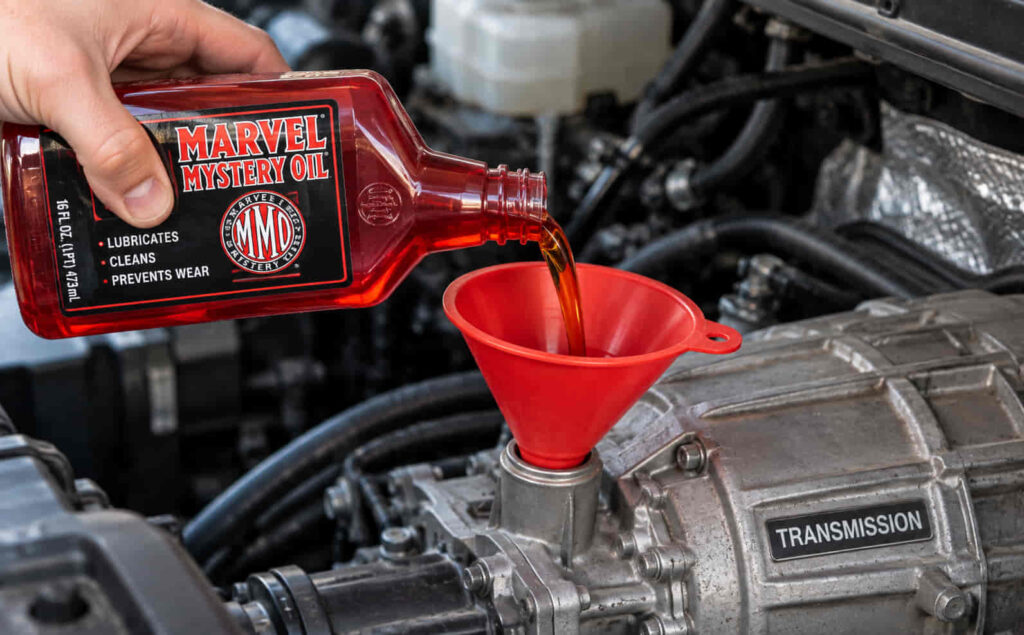
Marvel Mystery Oil can be used in a conventional automatic transmission, but it should not be treated as a universal transmission additive or a replacement for the transmission fluid specified by the vehicle manufacturer. Marvel Oil Company currently states that up to 16 ounces of Marvel Mystery Oil (MMO) can be added to an automatic transmission. The company also specifically advises against using MMO in manual transmissions, gearboxes, rear differentials, and continuously variable transmissions (CVTs).
The type of transmission therefore determines whether Marvel Mystery Oil is an appropriate application. A conventional automatic transmission uses fluid with specific lubrication, hydraulic, cooling, and friction requirements, while a CVT or manual transmission can require a substantially different fluid specification. Adding a product simply because it is suitable for one type of transmission can create an unnecessary compatibility risk in another.
Using Marvel Mystery Oil in an approved automatic transmission also does not mean it can repair every transmission problem. Symptoms such as slipping, delayed engagement, persistent hard shifting, fluid leaks, or abnormal noises can indicate problems that require diagnosis rather than an additive. This guide explains when Marvel Mystery Oil can be used in a transmission, how much to add, how to use it correctly, what it may and may not do, which transmissions should not receive it, and when a transmission problem requires repair instead.
Can You Put Marvel Mystery Oil in an Automatic Transmission?
Yes, Marvel Mystery Oil can be added to a conventional automatic transmission when the application is compatible with the vehicle, but it should be used as a supplemental product rather than as a replacement for the specified automatic transmission fluid (ATF). Marvel Oil Company currently identifies automatic transmissions as an approved application for Marvel Mystery Oil and specifies a maximum addition of 16 ounces. This guidance does not extend to every transmission design, which is why identifying the transmission type is necessary before adding MMO.
A conventional automatic transmission depends on fluid for several functions at the same time. The specified ATF provides lubrication while also supporting hydraulic operation, heat management, and the friction characteristics required by internal components. For this reason, the fact that Marvel Mystery Oil can be used in an automatic transmission does not eliminate the vehicle manufacturer’s fluid requirements. The transmission should still contain the correct type and quantity of ATF specified for that vehicle.
Compatibility should be checked at both the product and vehicle level. Marvel’s guidance establishes automatic transmission use as an application for MMO, while the vehicle owner’s manual establishes the fluid specification and service requirements for the specific transmission. These two contexts should not be treated as interchangeable. A product being approved for use in conventional automatic transmissions does not mean that it becomes the required operating fluid for a particular transmission.
This distinction becomes especially important because the word “transmission” describes several different systems. A conventional automatic transmission, continuously variable transmission, and manual transmission do not necessarily use the same fluid or depend on the same friction and lubrication characteristics. Marvel specifically advises against using MMO in CVTs and manual transmissions, so instructions for adding it to a conventional automatic transmission should not be transferred to those systems.
Marvel Mystery Oil should also not be added solely because an automatic transmission has developed a mechanical symptom. A transmission that slips, delays engagement, leaks fluid, produces abnormal noises, or repeatedly shifts incorrectly requires the cause of the symptom to be identified. MMO being compatible with an application and MMO repairing a failed component are two separate claims. Manufacturer-supported use in an automatic transmission does not establish the product as a repair for mechanical or hydraulic transmission damage.
The safest interpretation of the application is therefore narrow: Marvel Mystery Oil can be used as a supplemental product in a compatible conventional automatic transmission within the manufacturer’s stated limit, while the specified ATF remains the transmission’s primary operating fluid. The transmission type, fluid specification, existing fluid level, and condition of the transmission should all be established before MMO is added.
How Much Marvel Mystery Oil Should You Put in a Transmission?
Marvel Oil Company specifies a maximum of 16 ounces of Marvel Mystery Oil for use in an automatic transmission. The 16-ounce figure is a maximum product guideline, not a universal amount that every automatic transmission needs. Transmission fluid capacities differ between vehicles, and the existing fluid level determines whether additional liquid can be introduced without exceeding the vehicle manufacturer’s specified level.
The amount of MMO added should therefore be considered together with total transmission fluid volume. Pouring 16 ounces into a transmission that is already at its correct maximum fluid level would add volume beyond the existing fill unless an appropriate amount is removed or the service procedure otherwise accounts for it. Transmission fluid level matters because both insufficient and excessive fluid can interfere with correct transmission operation. The manufacturer’s fluid-checking and filling procedure should remain the reference for determining the final fluid level.
The 16-ounce transmission guideline should also not be confused with Marvel Mystery Oil ratios provided for other applications. MMO is marketed for more than one automotive use, but instructions associated with engine oil or fuel are not automatically transmission instructions. Each application has a different operating context, so a ratio intended for the crankcase should not be converted into a transmission dosage unless the product manufacturer explicitly provides that instruction.
Transmission capacity is another reason not to interpret the maximum as a mandatory dose. Automatic transmissions vary substantially in total fluid capacity, and the quantity replaced during a routine service can also differ from the transmission’s complete dry capacity because fluid may remain in internal components. The relevant question is therefore not simply whether 16 ounces will physically fit. The correct question is whether the intended amount can be added while maintaining the required fluid specification and final fluid level for that transmission.
The existing condition of the transmission fluid should also be considered before adding another product. An incorrect fluid level, overdue service, contamination, or an existing transmission fault should be addressed according to the vehicle’s maintenance and diagnostic requirements rather than masked by automatically adding the maximum amount of MMO. An additive does not remove the need to maintain the correct ATF or follow the transmission’s prescribed service procedure.
For practical use, treat 16 ounces as the upper limit rather than the default quantity. Confirm that the vehicle has a conventional automatic transmission, verify its required fluid specification and checking procedure, determine the current fluid level, and keep the final fluid quantity within the vehicle manufacturer’s requirements. This preserves the distinction between Marvel’s maximum MMO application guideline and the transmission manufacturer’s requirements for the fluid system itself.
Read more: How To Install Heads Up Display In Car
How Do You Add Marvel Mystery Oil to an Automatic Transmission?
Add Marvel Mystery Oil to a compatible conventional automatic transmission through the transmission’s specified fluid-fill location while keeping both the MMO quantity and final fluid level within their applicable limits. Marvel’s maximum guideline of 16 ounces does not override the vehicle manufacturer’s procedure for checking, filling, or servicing the automatic transmission. The transmission type and existing fluid level should therefore be confirmed before MMO is added.
Start by verifying that the vehicle actually uses a conventional automatic transmission rather than a continuously variable transmission or manual transmission. This distinction is necessary because Marvel permits MMO use in automatic transmissions but specifically excludes CVTs and manual transmissions. Vehicle terminology can also vary by manufacturer, so the owner’s manual or manufacturer specifications are more reliable than assuming the transmission type from the way the vehicle drives or from the gear-selector layout.
Next, determine the transmission’s required ATF specification and the correct procedure for checking its fluid level. Automatic transmissions do not all use the same checking method. Some vehicles provide an accessible transmission dipstick and fill tube, while other transmissions use plugs or service procedures that require the fluid to be checked under specified operating conditions. MMO should be introduced only through an appropriate transmission-fluid service point rather than through an unrelated engine or drivetrain opening.
Check the existing fluid level before adding MMO. This step matters because Marvel’s 16-ounce figure describes the maximum amount of MMO for the application, while the vehicle manufacturer determines the acceptable total fluid level in the transmission. If the transmission is already correctly filled, adding more liquid without accounting for the added volume can result in overfilling. The objective is not simply to pour MMO on top of a full transmission but to maintain the appropriate final fluid quantity.
The amount added should remain at or below Marvel’s stated maximum and should be considered in relation to the transmission’s existing fluid volume. Do not assume that every automatic transmission requires the full 16 ounces. The appropriate quantity can be constrained by fluid capacity, current fluid level, service procedure, and vehicle-specific requirements. A product maximum establishes an upper boundary; it does not establish a mandatory dose.
After adding MMO through the correct fill location, restore any dipstick, cap, or service component according to the vehicle’s normal procedure and verify the transmission fluid level using the method specified for that vehicle. Fluid temperature, engine operation, selector position, or other conditions can affect the checking procedure on certain automatic transmissions, so the manufacturer’s instructions should determine how the final level is verified.
Observe transmission operation after the application rather than assuming that a change in fluid composition will correct an existing fault. Normal engagement and shifting should remain consistent, and any new abnormal behavior should be investigated. Persistent slipping, delayed engagement, abnormal noises, fluid leakage, or severe shifting problems require diagnosis because adding an approved supplemental product does not establish the cause of those symptoms.
The complete application therefore depends on three limits working together: Marvel’s transmission-use guidance, the vehicle’s required ATF specification, and the vehicle manufacturer’s fluid-level procedure. Following only the 16-ounce maximum while ignoring transmission type or final fluid level does not constitute correct use.
What Does Marvel Mystery Oil Do in an Automatic Transmission?
Marvel Mystery Oil is approved by its manufacturer as a supplemental product for conventional automatic transmissions, but this application should not be interpreted as proof that MMO repairs worn transmission components or corrects every shifting problem. The strongest defensible claim is that Marvel identifies automatic transmissions as an application for the product and provides a maximum amount for that use.
This distinction matters because Marvel Mystery Oil is also promoted for engine and fuel-system applications. Product claims associated with those systems should not automatically be transferred to an automatic transmission. An engine crankcase, fuel system, and automatic transmission operate under different mechanical conditions and depend on fluids with different functions. A cleaning or lubrication claim established for one application does not by itself demonstrate the same effect inside another system.
Automatic transmission fluid has several specific functions that remain necessary after MMO is added. ATF lubricates internal components, transfers hydraulic pressure in applicable transmission designs, helps manage heat, and provides friction characteristics required for controlled operation of components such as clutch assemblies. MMO does not replace the vehicle manufacturer’s specified ATF, which is why adding it should be treated as supplementation rather than substitution.
The distinction between application and repair is equally important when evaluating transmission symptoms. If a transmission shifts differently after an additive is introduced, that observation does not establish that a worn clutch pack, malfunctioning valve body, hydraulic-pressure problem, or another internal fault has been repaired. Mechanical wear remains mechanical wear, and a component that has physically failed requires diagnosis and appropriate service.
Claims that MMO makes transmissions shift more smoothly also require the evidence type to be identified. Marvel has published user testimonials describing smoother transmission operation, but a testimonial represents an individual’s reported experience rather than controlled evidence that the same result will occur in every compatible automatic transmission. Such reports can describe user experience, but they should not be converted into a universal claim that MMO improves shifting.
Transmission condition further affects how any perceived change should be interpreted. A normally operating automatic transmission receiving a manufacturer-permitted supplemental product presents a different situation from a transmission already showing slipping, delayed engagement, abnormal noises, leaks, or repeated shift problems. In the second situation, the symptom itself provides a reason for diagnosis, and the additive should not be used as evidence that repair is unnecessary.
Marvel Mystery Oil therefore has a defined transmission application, but its role should remain narrow. It can be added within Marvel’s stated limit to a compatible conventional automatic transmission while the correct ATF remains the primary fluid. Claims that go beyond that application, particularly claims of repairing internal transmission damage, require evidence separate from the fact that the manufacturer permits the product to be used in an automatic transmission.
Can Marvel Mystery Oil Make a Transmission Shift Smoother?
Marvel Mystery Oil may be associated with smoother shifting in some user reports, but there is not enough evidence to state that it will make every automatic transmission shift more smoothly. Marvel permits MMO to be used in conventional automatic transmissions, and the company has published testimonials from users who report changes in transmission operation. These reports describe individual experiences rather than establishing a predictable improvement across different transmission designs and conditions.
Shift quality in an automatic transmission depends on more than the presence of an additive. The transmission relies on the correct fluid level, specified ATF, hydraulic pressure, friction characteristics, electronic or hydraulic controls, and the condition of internal components. A change in any of these factors can affect how quickly or smoothly a transmission changes gears. For this reason, hard or rough shifting should be treated as a symptom with multiple possible causes rather than as evidence that the transmission needs Marvel Mystery Oil.
Fluid condition is one factor that can influence transmission operation. Automatic transmission fluid changes as it accumulates service time, heat exposure, and contaminants, while an incorrect fluid level can also affect operation. If a transmission shifts poorly because its fluid is low, incorrect, degraded, or overdue for service, the underlying maintenance issue should be identified. Adding MMO does not eliminate the requirement to maintain the transmission with the ATF specification and service procedure prescribed for the vehicle.
Mechanical and control problems create a different situation. Internal wear, hydraulic problems, valve-body faults, solenoid problems, or other transmission defects can produce harsh, delayed, or inconsistent shifting. An additive cannot be assumed to restore a component that is physically worn or malfunctioning. A temporary change in how a transmission feels after adding a fluid product also does not establish that the underlying defect has been repaired.
The type of improvement reported matters when evaluating whether MMO has affected shifting. A transmission that produces consistently smoother engagement after an application represents an observation about operating behavior. It does not identify the mechanism responsible for the change or demonstrate that the same effect will occur in another vehicle. Driver perception, fluid condition, transmission temperature, previous maintenance, and transmission design can all influence the reported result.
Marvel’s user testimonials can therefore support the narrower statement that some users report smoother automatic-transmission operation after using MMO. They do not support a universal statement that Marvel Mystery Oil improves shifting in all automatic transmissions. Keeping this distinction prevents anecdotal experience from being presented as controlled evidence.
If the transmission already has persistent hard shifts, delayed gear changes, repeated hesitation, or other abnormal behavior, diagnose the symptom instead of increasing the MMO quantity in an attempt to produce a stronger effect. Marvel’s maximum of 16 ounces remains an upper limit for the approved automatic-transmission application, not a dosage that should be increased according to symptom severity.
Marvel Mystery Oil is therefore better understood as a manufacturer-permitted supplemental application than as a guaranteed shift-quality treatment. Smoother shifting may be reported in individual cases, but correct ATF, correct fluid level, proper maintenance, and the mechanical condition of the transmission remain the primary factors that determine whether an automatic transmission operates correctly.
Can Marvel Mystery Oil Fix a Slipping Transmission?
Marvel Mystery Oil should not be considered a repair for a slipping transmission because transmission slipping can result from fluid, hydraulic, electronic, or mechanical problems that an additive does not diagnose or physically repair. Although MMO can be used in a compatible conventional automatic transmission within the manufacturer’s stated limit, permission to use the product is not evidence that it can restore worn transmission components.
Transmission slipping occurs when the transmission does not maintain the expected transfer of engine power through the selected gear or operating range. A driver may notice the engine speed increasing without a corresponding increase in vehicle speed, delayed engagement, inconsistent acceleration, or abnormal changes in transmission behavior. These symptoms require diagnosis because different causes can produce a similar driving experience.
Transmission fluid should be one of the factors evaluated when slipping occurs. An incorrect fluid level can interfere with normal transmission operation, while unsuitable or deteriorated fluid can create additional problems depending on the transmission. The appropriate response is to check the fluid according to the vehicle manufacturer’s procedure and determine whether its level, specification, and service condition meet the transmission’s requirements. Adding MMO without establishing these conditions can make diagnosis less clear.
A slipping transmission can also have an internal problem that cannot be corrected by supplementing the fluid. Worn friction components, hydraulic-pressure faults, control-system problems, or other internal defects can prevent the transmission from applying and holding as designed. Adding a fluid product does not rebuild worn components, repair a failed control device, or correct physical damage inside the transmission.
This distinction also explains why a perceived short-term improvement should not automatically be interpreted as a repair. If transmission behavior changes after MMO or another additive is introduced, the observation shows that operating behavior changed under those conditions. It does not prove that the original cause of slipping has been eliminated. A transmission with internal wear can continue deteriorating even when a symptom temporarily feels less noticeable.
Repeatedly adding more MMO is not an appropriate response when slipping continues. Marvel’s maximum automatic-transmission guideline remains 16 ounces, and that maximum does not increase because the transmission has a more severe symptom. Exceeding a product-use limit also changes the fluid volume and composition without addressing the reason the transmission is slipping.
Persistent slipping should therefore shift the objective from additive selection to diagnosis. The transmission’s fluid level and specification, maintenance condition, stored diagnostic information where applicable, operating symptoms, and mechanical condition may need to be evaluated. Fluid leakage, delayed engagement, abnormal noises, severe shifting changes, or worsening slipping provide additional reasons to have the transmission inspected rather than continuing additive experiments.
Marvel Mystery Oil and transmission repair consequently serve different purposes. MMO can be a supplemental product in a compatible conventional automatic transmission, while a slipping transmission requires the underlying fault to be identified. If the cause is a maintenance issue, the appropriate transmission service can address that condition. If the cause is mechanical, hydraulic, or control-system failure, the corresponding repair is required rather than relying on MMO as a substitute.
Can Marvel Mystery Oil Damage an Automatic Transmission?
Marvel Mystery Oil is approved by its manufacturer for use in conventional automatic transmissions within the stated maximum of 16 ounces, but incorrect application can still create transmission-fluid compatibility or fluid-level concerns. The product should therefore be used within its documented application rather than treated as an additive that can be poured into any transmission in any quantity.
The first risk comes from confusing product compatibility with transmission-fluid specification. An automatic transmission is designed around a particular fluid specification that determines properties required for lubrication, hydraulic operation, heat management, and friction behavior. Marvel Mystery Oil being permitted as a supplemental product does not cancel that requirement. The specified ATF must remain the primary operating fluid in the transmission.
Quantity creates a second consideration. Marvel’s 16-ounce figure is a maximum for automatic-transmission use rather than an instruction to add 16 ounces on top of an already full transmission. Adding additional liquid changes the total fluid volume. If the transmission is already at its specified level, the added volume needs to be considered when maintaining the final fluid level required by the vehicle manufacturer.
Using more MMO than recommended should not be treated as a way to increase its effect. A transmission showing harder shifts, slipping, delayed engagement, or another symptom does not require a proportionally larger amount of additive. Increasing the quantity beyond the documented limit changes the fluid mixture while leaving the original fault undiagnosed.
Transmission type is another major source of risk. Instructions for a conventional automatic transmission cannot be transferred to a CVT simply because both vehicles may have an automatic gear selector. The internal operating principles and fluid requirements can differ, and Marvel specifically excludes CVTs from MMO use. The same restriction applies to manual transmissions according to the company’s current guidance.
Existing transmission problems should also be separated from damage caused by an additive. If a transmission was already slipping, leaking, shifting harshly, or engaging slowly before MMO was introduced, the subsequent failure of that transmission does not by itself establish that MMO caused the failure. Establishing cause requires information about the original condition, fluid specification, amount added, transmission type, maintenance history, and actual mechanical fault.
The opposite assumption is equally weak. The fact that Marvel permits MMO in conventional automatic transmissions does not establish that every possible vehicle-transmission combination is unaffected under every condition. Vehicle-specific fluid requirements still matter, particularly where the transmission manufacturer places restrictions on additives or requires a particular fluid formulation.
The practical compatibility rule is therefore specific: use MMO only in a supported transmission application, stay within Marvel’s maximum quantity, maintain the correct overall fluid level, and follow the vehicle manufacturer’s transmission-fluid requirements. If those requirements conflict with adding a supplemental product, the vehicle or transmission manufacturer’s specification should not be ignored merely because MMO has a general automatic-transmission application.
Can You Put Marvel Mystery Oil in a Manual Transmission?
No, Marvel Oil Company currently states that Marvel Mystery Oil should not be used in manual transmissions. Instructions describing MMO use in a conventional automatic transmission should therefore not be applied to a manual gearbox, even when the owner is trying to address noise, difficult shifting, or another transmission symptom.
Manual transmissions have their own lubricant requirements. Depending on the vehicle and transmission design, the specified lubricant may have particular viscosity, wear-protection, synchronizer, or friction characteristics. The correct fluid is determined by the transmission manufacturer rather than by the fact that another product works in a different part of the drivetrain.
This distinction is important because the term “transmission oil” can encourage users to group different drivetrain fluids together. Engine oil, conventional ATF, manual transmission lubricant, CVT fluid, and differential lubricant do not automatically perform interchangeable functions. A product approved for one system should not be transferred to another system without a supported application.
Marvel also distinguishes manual transmissions from its approved automatic-transmission use. That manufacturer restriction provides a more direct answer than attempting to calculate a smaller MMO quantity for a manual gearbox. There is no need to derive a manual-transmission dosage from the 16-ounce automatic-transmission maximum because the manufacturer does not recommend the application in the first place.
A manual transmission that becomes difficult to shift, produces abnormal noise, or develops a lubricant leak should instead be evaluated against its specified fluid and service requirements. Adding MMO to compensate for a symptom would introduce a product that is outside Marvel’s stated application without establishing why the symptom occurred.
If MMO has already been added to a manual transmission, do not use the automatic-transmission dosage guidance to justify adding more. Identify the transmission, determine how much product was introduced, check the manufacturer’s required lubricant, and obtain vehicle-specific service guidance for restoring the appropriate fluid condition when necessary.
Can You Put Marvel Mystery Oil in a CVT Transmission?
No, Marvel Oil Company specifically states that Marvel Mystery Oil should not be added to continuously variable transmissions (CVTs). A CVT should use the fluid and maintenance procedure specified for that transmission rather than the MMO guidance provided for conventional automatic transmissions.
The restriction matters because a CVT can appear to the driver to be another form of automatic transmission. Both can operate without a conventional manual clutch pedal and can use familiar selector positions, but that similarity does not make their fluid requirements interchangeable. A conventional automatic transmission and a CVT use different mechanisms to transmit and vary drive ratios, and their required fluids are formulated for the needs of those systems.
CVT fluid is therefore not simply generic automatic transmission fluid under another name. Its required properties are tied to the design of the transmission, and manufacturers specify particular fluids for particular CVT applications. Introducing an additive that is not approved for the application changes the fluid mixture without establishing that the resulting characteristics remain suitable for the transmission.
The 16-ounce MMO maximum for automatic-transmission use consequently should not be interpreted as a CVT dosage. For a CVT, the relevant MMO quantity is zero under Marvel’s current application guidance. This is an example of why transmission identification needs to occur before dosage is discussed: quantity recommendations only have meaning after compatibility has been established.
MMO should also not be added to a CVT in an attempt to correct slipping, juddering, delayed response, noise, or another operating problem. These symptoms can have several causes, including fluid condition and transmission faults, and introducing a product that Marvel specifically excludes from CVT use does not diagnose any of them.
If Marvel Mystery Oil has already been added to a CVT, stop treating the situation as a normal MMO application. Determine the amount introduced, confirm the exact CVT and required fluid specification, and obtain vehicle-specific service guidance. The appropriate corrective procedure depends on the transmission and amount involved, so a universal instruction to add another fluid or perform an arbitrary flush should not be substituted for the applicable manufacturer procedure.
What Should You Do if You Put Marvel Mystery Oil in the Wrong Transmission?
If Marvel Mystery Oil was added to a manual transmission, CVT, or another unsupported drivetrain component, stop adding more product, identify the exact transmission type and amount added, and follow vehicle-specific guidance for restoring the correct fluid condition. Marvel’s current guidance excludes manual transmissions, CVTs, gearboxes, and rear differentials from MMO use, so an application in one of these systems should not be treated the same as adding MMO to a supported conventional automatic transmission.
The first step is to establish exactly where the MMO was added. This matters because the corrective response depends on the system involved. A conventional automatic transmission receiving MMO within Marvel’s stated application is fundamentally different from a CVT receiving the same product. Confirm the transmission type through the owner’s manual, manufacturer specifications, or other vehicle-specific documentation rather than relying only on the gear selector or the assumption that every two-pedal vehicle has a conventional automatic transmission.
The amount introduced is the next important fact. A small quantity accidentally added to a large fluid system and a substantial quantity used as a replacement for the specified fluid represent different conditions. Record the approximate amount of MMO added and determine whether the vehicle was driven afterward. These details give a technician or manufacturer more useful information for determining the appropriate response.
Do not attempt to correct an unsupported application by adding other additives. Mixing additional products into the transmission increases the number of variables without restoring the specified fluid composition. Likewise, adding more of the correct fluid does not necessarily remove the incompatible product already present. The objective is to return the transmission to the fluid condition required by its manufacturer, not to balance one additive with another.
A fluid service may be appropriate in some situations, but the required procedure depends on the transmission. The terms drain, fluid change, and flush should not be treated as interchangeable instructions. Transmission designs differ in how much fluid can be removed during a normal service and in the procedures manufacturers specify for filling and level adjustment. Recommending an arbitrary flush for every accidental MMO application would ignore those vehicle-specific requirements.
If the vehicle develops abnormal operation after MMO has been added to an unsupported transmission, avoid assuming either that the additive definitely caused the symptom or that the symptom is harmless. Changes such as unusual shifting, delayed engagement, juddering, slipping, or abnormal noises require diagnosis in the context of the transmission type, required fluid, amount of MMO introduced, and previous transmission condition.
The appropriate corrective action is therefore based on identification rather than guesswork. Confirm the transmission, determine the amount added, check the required fluid specification, and use the manufacturer’s service procedure or qualified transmission guidance to restore the correct fluid condition. This approach addresses the actual incompatibility instead of attempting to solve it with another undocumented fluid mixture.
Should You Use Marvel Mystery Oil Instead of Transmission Fluid?
No, Marvel Mystery Oil should not replace the automatic transmission fluid specified by the vehicle manufacturer. Marvel permits MMO as a supplemental product in conventional automatic transmissions and limits that application to a maximum of 16 ounces. That guidance describes an addition to a supported transmission; it does not describe MMO as a complete substitute for ATF.
Automatic transmission fluid is an operating fluid engineered around the requirements of the transmission. Depending on the design, it contributes to lubrication, hydraulic operation, cooling, friction control, and power transfer. Vehicle and transmission manufacturers specify fluids with properties required for these functions. Using the correct ATF is therefore part of the transmission’s operating requirements rather than an optional treatment.
Marvel Mystery Oil has a different role in this context. When used in a compatible conventional automatic transmission, it is supplemental to the specified transmission fluid. This relationship can be expressed simply as specified ATF remains the primary transmission fluid, while MMO is an optional supplemental product within its supported application and quantity limit. Reversing those roles would go beyond Marvel’s stated transmission-use guidance.
Replacing a substantial quantity of ATF with MMO would also change the proportion of the transmission’s specified fluid. The fact that Marvel allows up to 16 ounces does not support replacing several quarts of ATF with the product. A maximum additive quantity cannot be extrapolated into a full-fluid substitution because those are two different applications.
The same principle applies during transmission maintenance. If the vehicle is due for a fluid service, the service should use the transmission fluid specification and procedure required for that vehicle. MMO does not extend a specified service interval, convert an incorrect ATF into the correct specification, or eliminate the need to address contaminated, deteriorated, or incorrectly filled transmission fluid.
MMO should likewise not be substituted for missing transmission fluid when the fluid level is low because of a leak. A low fluid level first requires the correct specified fluid to restore the level according to the manufacturer’s procedure, while the reason for the fluid loss should be identified. Adding an unrelated quantity of supplemental product does not repair a leaking seal, line, pan, cooler connection, or another source of fluid loss.
This distinction is especially important for drivers using MMO in response to a transmission symptom. A transmission that slips, shifts harshly, engages slowly, leaks, or produces abnormal noises does not simply need “more fluid” in a generic sense. It needs the correct fluid level and specification followed by diagnosis of any remaining fault. MMO can occupy a limited supplemental role where its manufacturer supports the application, but it cannot replace the transmission’s specified operating fluid or the maintenance and repair procedures required by the vehicle manufacturer.
When Does a Transmission Problem Need Repair Instead of an Additive?
A transmission needs diagnosis and potentially repair when symptoms such as persistent slipping, delayed engagement, abnormal noises, fluid leaks, or repeated shifting problems continue after the correct fluid level and basic maintenance requirements have been verified. Marvel Mystery Oil can be used as a supplemental product in a compatible conventional automatic transmission, but an additive should not replace diagnosis when the transmission is showing evidence of a mechanical, hydraulic, electrical, or control-system fault.
Persistent slipping is one of the clearest reasons to investigate the transmission rather than continue experimenting with additives. Slipping can appear as an increase in engine speed without a proportional increase in vehicle speed, difficulty maintaining the expected gear, or inconsistent power transfer. The first checks can include transmission fluid level, fluid specification, and visible leakage, but continued slipping after these factors have been addressed indicates that the underlying cause has not been resolved. Adding more MMO does not identify whether the problem involves friction components, hydraulic pressure, controls, or another internal condition.
Delayed engagement also deserves diagnosis when it occurs repeatedly. A noticeable delay between selecting Drive or Reverse and the transmission engaging can be related to fluid level or condition, but it can also occur with hydraulic or internal transmission problems. An additive cannot determine which cause is responsible. If the delay becomes longer, occurs consistently, or is accompanied by slipping or harsh engagement, identifying the fault is more useful than attempting to change transmission behavior with additional fluid products.
Abnormal transmission noises create another boundary between additive use and repair. Whining, grinding, clunking, or other new noises can originate from different components and operating conditions. Because a noise does not identify its own cause, treating it with an additive before determining its source can delay the diagnosis of a developing problem. A persistent or worsening noise should be evaluated according to when it occurs, such as during engagement, acceleration, deceleration, or a particular operating range.
Transmission fluid leakage requires correction at its source. Adding ATF or MMO can increase the fluid level temporarily, but neither action repairs a leaking pan, seal, line, cooler connection, or other failed component. Continued leakage can eventually reduce the fluid below the level required for correct transmission operation. If the transmission is losing fluid, locating and repairing the leak addresses the mechanism causing the problem rather than repeatedly replacing the lost volume.
Repeated hard or erratic shifting should be treated in the same way. Shift behavior depends on the correct fluid, hydraulic operation, transmission controls, and internal component condition. If the transmission continues to shift abnormally after its fluid level and required maintenance have been verified, further diagnosis is necessary. Adding increasingly large quantities of MMO is not an appropriate diagnostic method, and Marvel’s maximum automatic-transmission application of 16 ounces should not be exceeded in response to worsening symptoms.
The timing of the symptom also provides useful diagnostic context. A transmission that operated normally before a fluid service, additive application, repair, or other intervention presents a different diagnostic sequence from one that had been slipping or shifting poorly for months. Recording when the problem started, whether it occurs hot or cold, which operating conditions trigger it, and what maintenance was performed beforehand gives a technician more useful evidence than simply reporting that the transmission “doesn’t shift right.”
A transmission warning light, check-engine light associated with transmission operation, or stored diagnostic trouble code can provide additional information on electronically controlled vehicles. A diagnostic code does not automatically identify the failed component, but it can narrow the system or operating condition that requires testing. Clearing a warning or changing the fluid mixture without investigating why the code appeared does not resolve the underlying fault.
The distinction between maintenance, additive use, and repair should therefore remain clear. Correct ATF and fluid level maintain the transmission according to its specification; Marvel Mystery Oil has a limited supplemental role in supported conventional automatic transmissions; diagnosis identifies the cause of abnormal operation; and repair corrects a confirmed fault. When slipping, delayed engagement, leakage, abnormal noise, or shifting problems persist, the diagnostic and repair path should take priority over adding another transmission product.