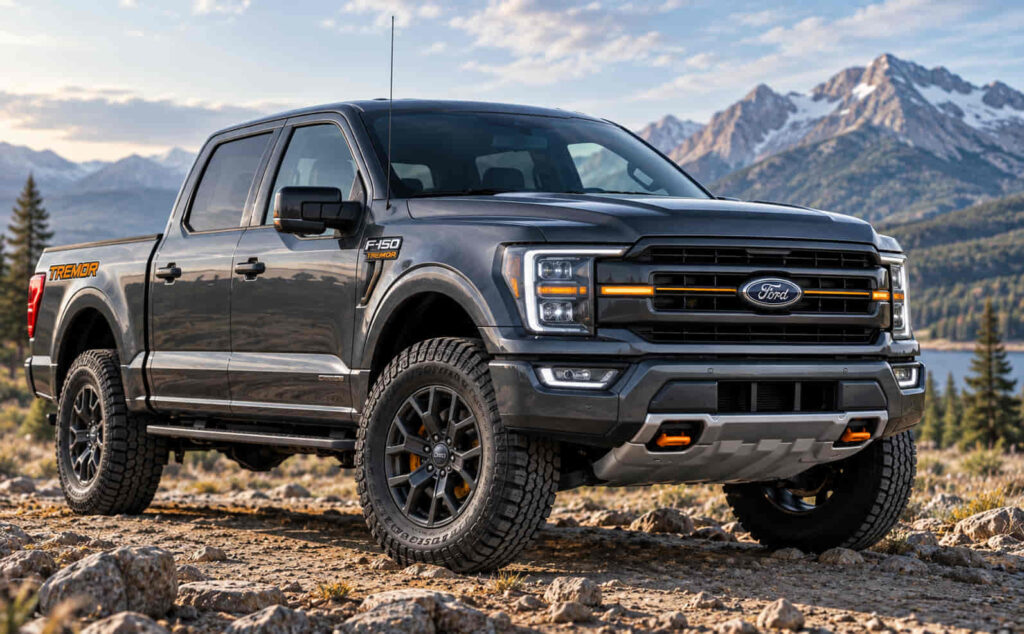
The Ford F-150 Tremor is an off-road-focused F-150 configuration that combines pickup-truck capability with hardware designed for driving beyond paved roads. The most important Ford F-150 Tremor specs cover its engine, horsepower and torque, transmission, four-wheel-drive system, towing and payload capacity, dimensions, ground clearance, wheels, tires, suspension, and additional off-road equipment. Together, these specifications explain both how the Tremor is configured and how it differs mechanically from a conventional F-150 setup.
Model year and vehicle configuration are essential when checking F-150 Tremor specifications. Engine availability, output figures, towing and payload ratings, dimensions, and individual off-road features can change between model years or configurations. A specification should therefore be connected to the vehicle it applies to rather than treated as a universal figure for every F-150 Tremor.
This guide examines the F-150 Tremor from its powertrain outward. It covers engine output and drivetrain specifications first, followed by towing, payload, dimensions, ground clearance, wheels, tires, suspension, drive modes, and off-road geometry. This structure connects each specification to its function while keeping the Ford F-150 Tremor as the central entity throughout the article.
What Are the Ford F-150 Tremor Specs?
The 2026 Ford F-150 Tremor combines a 4×4 drivetrain, 10-speed automatic transmission, 33-inch all-terrain tires, 18-inch wheels, an electronic-locking rear differential, and off-road-tuned suspension with a choice of EcoBoost V6 or V8 power. The standard powertrain is a 3.5-liter EcoBoost V6, while a 5.0-liter Ti-VCT V8 is available. This specification profile places the Tremor between a conventional F-150 configuration and the more specialized Raptor by adding off-road hardware without changing the truck into a separate F-150 platform.
The Tremor’s specifications need to be read as a connected system rather than isolated numbers. Engine output is transferred through the 10-speed automatic transmission and 4×4 drivetrain, while the electronic-locking rear differential, specialized suspension, all-terrain tires, and selectable off-road drive modes affect how that output reaches the ground. Ford also equips the 2026 Tremor with Trail Control, Trail 1-Pedal Drive, Trail Turn Assist, Hill Descent Control, and a dedicated Rock Crawl mode.
Wheel and tire specifications reinforce this off-road configuration. The 2026 F-150 Tremor uses 33-inch all-terrain tires mounted on 18-inch wheels. Its suspension includes Tremor-specific components and off-road front and rear shocks, while Ford identifies long-travel suspension with unique front upper and lower control arms, tie rods, and front knuckles as part of the Tremor chassis configuration. These components matter because ground clearance, wheel travel, traction, and drivetrain control work together when the truck travels over uneven surfaces.
Towing and payload figures require more qualification than engine output because they depend on the exact truck configuration. Ford states that maximum F-150 towing varies with factors such as vehicle configuration, cargo, accessories, and passengers, while payload also varies by configuration and installed equipment. The rating for a specific Tremor should therefore be determined from that vehicle’s configuration and certification information rather than from the maximum figure advertised for the entire F-150 lineup.
What Engine Does the Ford F-150 Tremor Have?
The 2026 Ford F-150 Tremor uses a 3.5-liter EcoBoost V6 as its standard engine and offers a 5.0-liter Ti-VCT V8 as an alternative. Both engines are paired with an electronic 10-speed automatic transmission, so the main powertrain choice concerns how the engine produces its output rather than a change to a different transmission architecture.
The 3.5-liter EcoBoost is a turbocharged V6 designed to produce substantial torque at relatively low engine speed. Ford’s 2026 towing guide rates the 3.5-liter EcoBoost at 382 horsepower at 5,250 rpm and 500 lb-ft of torque at 3,500 rpm. The high torque figure is particularly relevant to a pickup because towing, acceleration under load, and low-speed operation all place demands on the powertrain beyond peak horsepower alone. Ford notes that these ratings are based on premium fuel under the SAE J1349 standard.
The available 5.0-liter Ti-VCT V8 takes a different approach. Ford rates this naturally aspirated V8 at 400 horsepower at 6,250 rpm and 410 lb-ft of torque at 4,250 rpm in its 2026 towing guide. Ti-VCT refers to twin independent variable camshaft timing, which allows valve timing to be managed across operating conditions. Compared with the EcoBoost V6, the V8 produces slightly more peak horsepower under these published figures but less peak torque.
The engine specification should not be used by itself to determine the towing or payload rating of a Tremor. Ford explicitly treats horsepower, torque, towing, and payload as independent attributes that may not reach their respective maximum values simultaneously. Cab and bed configuration, axle equipment, towing hardware, passengers, accessories, and cargo can change the applicable vehicle rating even when two trucks use the same engine.
For that reason, the 3.5-liter EcoBoost and 5.0-liter V8 specifications establish the Tremor’s available power characteristics, while the complete vehicle configuration determines how those numbers translate into towing, payload, and off-road use. This distinction becomes especially important when comparing a specific F-150 Tremor against maximum capability figures published for the broader F-150 range.
Read more: auto lsd toyota
How Much Horsepower and Torque Does the Ford F-150 Tremor Produce?
The 2026 Ford F-150 Tremor produces 382 horsepower and 500 lb-ft of torque with its standard 3.5-liter EcoBoost V6, while the available 5.0-liter Ti-VCT V8 produces 400 horsepower and 410 lb-ft of torque. Ford lists the EcoBoost output at 5,250 rpm for horsepower and 3,500 rpm for peak torque, while the V8 reaches its published horsepower at 6,250 rpm and peak torque at 4,250 rpm. These figures are based on Ford’s published 2026 F-150 powertrain specifications using premium fuel.
The two engines produce their output differently. The 3.5-liter EcoBoost uses turbocharging to generate 500 lb-ft of peak torque, giving it 90 lb-ft more peak torque than the 5.0-liter V8 despite having two fewer cylinders. The V8 produces 18 more peak horsepower than the standard EcoBoost but reaches its horsepower and torque peaks at higher engine speeds. This distinction is more useful than comparing displacement alone because horsepower and torque describe different aspects of the engine’s output.
Torque is particularly relevant to the Tremor’s combination of truck and off-road functions. Moving a loaded vehicle, pulling a trailer, accelerating at lower engine speeds, and maintaining controlled movement over difficult terrain all place demand on available torque. Horsepower becomes increasingly relevant as vehicle speed and engine speed rise. Neither specification independently determines towing capacity or off-road capability because transmission gearing, axle configuration, traction, vehicle weight, tires, and other components also affect how engine output is used.
The 382-horsepower and 500-lb-ft figures should therefore be associated specifically with the 2026 Tremor’s 3.5-liter EcoBoost, while the 400-horsepower and 410-lb-ft figures apply to its available 5.0-liter V8. Keeping the engine attached to its corresponding output prevents a common specification error in which horsepower from one F-150 powertrain is combined with torque from another.
What Transmission and Drivetrain Does the Ford F-150 Tremor Use?
The 2026 Ford F-150 Tremor pairs its engine with an electronic 10-speed automatic transmission and a four-wheel-drive system designed to support both normal truck operation and off-road driving. The transmission provides multiple gear ratios between the engine and driven wheels, allowing the powertrain to manage low-speed torque demand, acceleration, cruising, and towing without relying on one fixed mechanical ratio.
The Tremor’s drivetrain is more significant than the presence of four-wheel drive alone. Ford equips the model with an electronic-locking rear differential, which allows the rear axle to reduce the wheel-speed difference that normally occurs across an open differential. When additional traction is required, locking the rear differential helps both rear wheels contribute more directly instead of allowing available torque to be concentrated at the wheel with less traction.
This drivetrain works with Tremor-specific off-road control systems. Trail Control manages low-speed operation in applicable terrain, Trail 1-Pedal Drive coordinates acceleration and braking through accelerator-pedal input, and Trail Turn Assist is designed to help reduce the turning radius in appropriate low-speed off-road conditions. Rock Crawl mode further changes vehicle control settings for low-speed terrain where precise wheel movement and traction are more important than road-speed performance.
The mechanical and electronic systems therefore form one drivetrain context. The engine generates torque, the 10-speed transmission changes the available gear ratio, the four-wheel-drive system distributes drive to both axles, and the electronic-locking rear differential manages traction across the rear wheels when engaged. The off-road control systems then modify how the truck responds under specific terrain conditions.
This relationship explains why the Tremor cannot be described accurately by engine output alone. Its 4×4 drivetrain, differential, transmission, tires, suspension, and electronic controls determine how the available horsepower and torque are translated into vehicle movement. These attributes become particularly important when the truck is towing, climbing, descending, or moving across a low-traction surface.
How Much Can the Ford F-150 Tremor Tow?
The towing capacity of a Ford F-150 Tremor must be determined from its exact engine, axle, cab, bed, equipment, and trailer configuration rather than from the maximum towing figure advertised for the entire F-150 lineup. Ford publishes a maximum towing capability for the broader 2026 F-150 range, but that number does not automatically represent the towing rating of every Tremor.
This distinction exists because towing capacity is a vehicle-system rating rather than an engine specification. The engine supplies power and torque, but the truck must also operate within limits established by its drivetrain, axle ratings, gross vehicle weight, combined vehicle and trailer weight, hitch equipment, tires, cargo, passengers, and installed accessories. Changing one of these variables can change the amount of trailer weight a particular truck is rated to handle.
The Tremor’s off-road equipment also means its specification profile differs from an F-150 configured specifically to achieve the highest possible tow rating. All-terrain tires, off-road suspension components, four-wheel-drive hardware, body configuration, and other equipment contribute to the complete vehicle configuration. For this reason, the highest towing figure available elsewhere in the F-150 lineup should not be transferred to the Tremor simply because both vehicles share an engine option.
Engine choice remains relevant within this configuration. The standard 3.5-liter EcoBoost produces 500 lb-ft of peak torque, while the available 5.0-liter V8 produces 410 lb-ft. Those figures describe powertrain output, but they still do not establish the final trailer rating. Two F-150 trucks using the same engine can have different towing limits when their axle, equipment, weight, or body configurations differ.
The correct towing figure for a specific F-150 Tremor should therefore be verified against Ford’s towing information and the ratings attached to the individual vehicle. Payload must also be considered because trailer tongue weight becomes load carried by the truck. A trailer may fall within a stated trailer-weight limit while passengers, cargo, accessories, and tongue weight cause the truck to approach another applicable weight rating.
For specification research, this distinction prevents the maximum capability of the F-150 nameplate from being presented as a universal Tremor specification. Engine output explains the power available to perform towing work, while the complete vehicle and trailer configuration establishes how much a particular F-150 Tremor is rated to tow.
How Much Horsepower and Torque Does the Ford F-150 Tremor Produce?
The 2026 Ford F-150 Tremor produces 382 horsepower and 500 lb-ft of torque with its standard 3.5-liter EcoBoost V6, while the available 5.0-liter Ti-VCT V8 produces 400 horsepower and 410 lb-ft of torque. Ford lists the EcoBoost output at 5,250 rpm for horsepower and 3,500 rpm for peak torque, while the V8 reaches its published horsepower at 6,250 rpm and peak torque at 4,250 rpm. These figures are based on Ford’s published 2026 F-150 powertrain specifications using premium fuel.
The two engines produce their output differently. The 3.5-liter EcoBoost uses turbocharging to generate 500 lb-ft of peak torque, giving it 90 lb-ft more peak torque than the 5.0-liter V8 despite having two fewer cylinders. The V8 produces 18 more peak horsepower than the standard EcoBoost but reaches its horsepower and torque peaks at higher engine speeds. This distinction is more useful than comparing displacement alone because horsepower and torque describe different aspects of the engine’s output.
Torque is particularly relevant to the Tremor’s combination of truck and off-road functions. Moving a loaded vehicle, pulling a trailer, accelerating at lower engine speeds, and maintaining controlled movement over difficult terrain all place demand on available torque. Horsepower becomes increasingly relevant as vehicle speed and engine speed rise. Neither specification independently determines towing capacity or off-road capability because transmission gearing, axle configuration, traction, vehicle weight, tires, and other components also affect how engine output is used.
The 382-horsepower and 500-lb-ft figures should therefore be associated specifically with the 2026 Tremor’s 3.5-liter EcoBoost, while the 400-horsepower and 410-lb-ft figures apply to its available 5.0-liter V8. Keeping the engine attached to its corresponding output prevents a common specification error in which horsepower from one F-150 powertrain is combined with torque from another.
What Transmission and Drivetrain Does the Ford F-150 Tremor Use?
The 2026 Ford F-150 Tremor pairs its engine with an electronic 10-speed automatic transmission and a four-wheel-drive system designed to support both normal truck operation and off-road driving. The transmission provides multiple gear ratios between the engine and driven wheels, allowing the powertrain to manage low-speed torque demand, acceleration, cruising, and towing without relying on one fixed mechanical ratio.
The Tremor’s drivetrain is more significant than the presence of four-wheel drive alone. Ford equips the model with an electronic-locking rear differential, which allows the rear axle to reduce the wheel-speed difference that normally occurs across an open differential. When additional traction is required, locking the rear differential helps both rear wheels contribute more directly instead of allowing available torque to be concentrated at the wheel with less traction.
This drivetrain works with Tremor-specific off-road control systems. Trail Control manages low-speed operation in applicable terrain, Trail 1-Pedal Drive coordinates acceleration and braking through accelerator-pedal input, and Trail Turn Assist is designed to help reduce the turning radius in appropriate low-speed off-road conditions. Rock Crawl mode further changes vehicle control settings for low-speed terrain where precise wheel movement and traction are more important than road-speed performance.
The mechanical and electronic systems therefore form one drivetrain context. The engine generates torque, the 10-speed transmission changes the available gear ratio, the four-wheel-drive system distributes drive to both axles, and the electronic-locking rear differential manages traction across the rear wheels when engaged. The off-road control systems then modify how the truck responds under specific terrain conditions.
This relationship explains why the Tremor cannot be described accurately by engine output alone. Its 4×4 drivetrain, differential, transmission, tires, suspension, and electronic controls determine how the available horsepower and torque are translated into vehicle movement. These attributes become particularly important when the truck is towing, climbing, descending, or moving across a low-traction surface.
How Much Can the Ford F-150 Tremor Tow?
The towing capacity of a Ford F-150 Tremor must be determined from its exact engine, axle, cab, bed, equipment, and trailer configuration rather than from the maximum towing figure advertised for the entire F-150 lineup. Ford publishes a maximum towing capability for the broader 2026 F-150 range, but that number does not automatically represent the towing rating of every Tremor.
This distinction exists because towing capacity is a vehicle-system rating rather than an engine specification. The engine supplies power and torque, but the truck must also operate within limits established by its drivetrain, axle ratings, gross vehicle weight, combined vehicle and trailer weight, hitch equipment, tires, cargo, passengers, and installed accessories. Changing one of these variables can change the amount of trailer weight a particular truck is rated to handle.
The Tremor’s off-road equipment also means its specification profile differs from an F-150 configured specifically to achieve the highest possible tow rating. All-terrain tires, off-road suspension components, four-wheel-drive hardware, body configuration, and other equipment contribute to the complete vehicle configuration. For this reason, the highest towing figure available elsewhere in the F-150 lineup should not be transferred to the Tremor simply because both vehicles share an engine option.
Engine choice remains relevant within this configuration. The standard 3.5-liter EcoBoost produces 500 lb-ft of peak torque, while the available 5.0-liter V8 produces 410 lb-ft. Those figures describe powertrain output, but they still do not establish the final trailer rating. Two F-150 trucks using the same engine can have different towing limits when their axle, equipment, weight, or body configurations differ.
The correct towing figure for a specific F-150 Tremor should therefore be verified against Ford’s towing information and the ratings attached to the individual vehicle. Payload must also be considered because trailer tongue weight becomes load carried by the truck. A trailer may fall within a stated trailer-weight limit while passengers, cargo, accessories, and tongue weight cause the truck to approach another applicable weight rating.
For specification research, this distinction prevents the maximum capability of the F-150 nameplate from being presented as a universal Tremor specification. Engine output explains the power available to perform towing work, while the complete vehicle and trailer configuration establishes how much a particular F-150 Tremor is rated to tow.
What Is the Payload Capacity of the Ford F-150 Tremor?
The payload capacity of a 2026 Ford F-150 Tremor depends on the truck’s exact configuration and should be verified from the individual vehicle rather than treated as the maximum payload rating advertised for the broader F-150 lineup. Payload represents the weight added to the truck itself, including occupants, cargo, installed equipment, and the portion of trailer weight carried by the truck through the hitch.
This distinction is important because payload and towing capacity measure different loads. Towing capacity concerns the trailer being pulled behind the vehicle, while payload concerns weight supported by the truck. When a trailer is connected, its tongue or hitch weight contributes to the truck’s payload along with passengers, cargo, and other equipment. A towing setup must therefore satisfy both trailer-related limits and the applicable weight limits of the truck.
The Tremor’s configuration also affects available payload. Its four-wheel-drive hardware, off-road suspension, all-terrain tires, underbody equipment, and other installed components contribute to the truck’s curb weight. Because payload is connected to the amount of additional weight the completed vehicle can carry within its ratings, differences in factory equipment and configuration can change the available payload from one F-150 to another.
For example, loading passengers, recovery equipment, tools, and cargo into the bed consumes available payload before a trailer is attached. Trailer tongue weight then adds another load to the truck. Looking only at the trailer’s total weight can therefore produce an incomplete picture of the towing setup even when the engine has sufficient power to move the combination.
The most reliable payload figure for a specific F-150 Tremor is the rating associated with that individual truck. This vehicle-specific approach is more useful than applying the maximum payload capability of another F-150 configuration because it connects the specification directly to the vehicle that will carry the load.
What Are the Dimensions of the Ford F-150 Tremor?
The dimensions of a Ford F-150 Tremor are determined by its body, cab, bed, chassis, and off-road configuration, so dimensional specifications should be matched to the applicable model year rather than generalized across every F-150. Length, width, height, wheelbase, bed dimensions, and track width describe different parts of the truck and each measurement affects how its physical size is understood.
Overall length and wheelbase are especially relevant because they describe two different aspects of vehicle size. Overall length determines the total space occupied from the front to the rear of the truck, while wheelbase measures the distance between the front and rear axle centers. Wheelbase influences the relationship between the axles and chassis, whereas overall length also includes the body extending beyond them.
Width and height provide another part of the dimensional profile. Width affects the physical space required when maneuvering through narrow trails, garages, parking areas, and other restricted environments. Height matters when overhead clearance is limited and also reflects the combined influence of the chassis, suspension, wheels, tires, and body. Measurements should be interpreted according to the conditions under which Ford specifies them, including whether exterior components are included or excluded.
Bed dimensions serve a different purpose from exterior dimensions. Bed length, width, and depth determine the physical cargo space available behind the cab. These measurements matter when carrying tools, recovery equipment, outdoor gear, building materials, or other loads that must fit inside the pickup box. Bed dimensions should therefore not be inferred simply from the truck’s overall length.
For the Tremor specifically, dimensional data also needs to remain connected to its off-road configuration. Tires and suspension influence vehicle height and ground relationship, while the cab and bed configuration affect overall length and wheelbase. This is why dimensions from a different F-150 body configuration should not be transferred to the Tremor without confirming that the underlying configuration matches.
The technical material available for this article does not establish one complete set of verified dimensional measurements for every 2026 Tremor configuration. Rather than combine measurements from different F-150 variants, the exact length, width, height, wheelbase, and bed dimensions should be checked against Ford’s specification data for the Tremor configuration being researched.
How Much Ground Clearance Does the Ford F-150 Tremor Have?
The Ford F-150 Tremor is configured with increased off-road clearance through its suspension, wheels, tires, and chassis setup, but the applicable ground-clearance figure should be matched to the exact model-year specification before a numerical value is assigned. Ground clearance describes the vertical space between the ground and a specified low point beneath the vehicle, making it one of several measurements relevant to obstacle clearance.
Greater clearance gives the underside of a truck more space above rocks, ruts, uneven ground, and other obstacles. This matters because an obstacle can contact a low chassis or drivetrain component even when the tires themselves can pass over it. The Tremor’s 33-inch all-terrain tires and off-road-oriented suspension contribute to the geometry that separates the chassis from the terrain.
Ground clearance does not independently define off-road capability. A truck can have substantial clearance beneath one part of its chassis while its wheelbase or front and rear overhangs still limit the obstacles it can cross without contact. Approach angle, breakover angle, and departure angle therefore provide additional geometric information that a single ground-clearance measurement cannot describe.
The suspension also affects how the vehicle interacts with uneven terrain. Tremor-specific suspension components and off-road shocks are intended to manage wheel and body movement under conditions different from ordinary paved-road driving. Tires add another layer because their outside diameter, construction, and available traction affect both physical clearance and the ability to maintain contact with the terrain.
Ground clearance should consequently be interpreted as one part of the F-150 Tremor’s complete off-road specification. Its value becomes more meaningful when considered together with tire size, suspension configuration, wheelbase, approach angle, breakover angle, departure angle, drivetrain, and differential equipment. These attributes describe how the truck fits over and moves across terrain more accurately than ground clearance alone.
What Wheels and Tires Does the Ford F-150 Tremor Use?
The 2026 Ford F-150 Tremor uses 18-inch wheels with 33-inch all-terrain tires as part of its factory off-road configuration. This wheel-and-tire combination contributes to the Tremor’s ground relationship, traction, and ability to operate on surfaces where a road-focused tire would provide a different balance of grip, sidewall characteristics, and ride behavior.
The 33-inch tire specification matters for more than appearance. Tire outside diameter contributes to the distance between the wheel hub and the ground, which means tire size forms part of the truck’s overall clearance geometry. The all-terrain tread is also intended to operate across a broader range of loose and uneven surfaces than a tire optimized primarily for paved-road use.
An 18-inch wheel paired with a 33-inch tire leaves more tire sidewall than would be available if the same outside tire diameter were combined with a substantially larger wheel. Sidewall volume is relevant in off-road use because the tire forms part of the interface between the suspension and terrain. The suspension controls wheel and body movement, while the tire must maintain contact with surfaces that can include loose soil, rocks, ruts, and other irregularities.
Tire specifications should still be interpreted as part of a complete vehicle system. All-terrain tires alone do not create the Tremor’s off-road capability. The 4×4 drivetrain, electronic-locking rear differential, suspension, ground clearance, electronic controls, and vehicle geometry determine how effectively the available tire traction can be used.
Replacement tires should therefore be selected using the specifications applicable to the exact vehicle rather than diameter alone. Tire size, load capability, construction, wheel compatibility, and other vehicle requirements remain relevant even when another tire is marketed for off-road driving. Changing tire dimensions can also affect clearance and other vehicle characteristics, so the factory 33-inch configuration provides the correct reference point when describing the 2026 F-150 Tremor’s original specification.
What Off-Road Features Come With the Ford F-150 Tremor?
The 2026 Ford F-150 Tremor combines mechanical off-road hardware with electronic terrain-control systems, including four-wheel drive, an electronic-locking rear differential, Tremor-specific suspension, off-road shocks, 33-inch all-terrain tires, Trail Control, Trail 1-Pedal Drive, Trail Turn Assist, Hill Descent Control, and Rock Crawl mode. These features address different parts of off-road operation rather than performing the same function.
The four-wheel-drive system and electronic-locking rear differential form part of the traction hardware. Four-wheel drive allows engine torque to be delivered through both axles when the selected operating mode requires it. The locking rear differential addresses another traction problem by limiting differential action across the rear axle when engaged, helping both rear wheels contribute when available grip differs from one side to the other.
Trail Control addresses low-speed vehicle-speed management. Instead of requiring the driver to continuously coordinate accelerator and brake inputs to maintain a selected low speed, the system assists with speed control so greater attention can be directed toward steering and the terrain ahead. This function is distinct from the differential because one manages vehicle speed while the other affects torque behavior across the axle.
Trail 1-Pedal Drive integrates acceleration and deceleration into accelerator-pedal operation during applicable low-speed off-road driving. Reducing accelerator input can produce controlled deceleration rather than requiring constant transitions between the accelerator and brake pedals. The feature is intended for situations where precise low-speed movement is more useful than maintaining momentum.
Trail Turn Assist addresses maneuverability rather than traction in a straight line. In appropriate low-speed off-road conditions, the system helps reduce the truck’s turning radius. This can be useful where a long-wheelbase pickup needs to negotiate a confined trail or tight obstacle. Rock Crawl mode and Hill Descent Control address additional terrain conditions by changing vehicle-control behavior for low-speed obstacle negotiation and controlled descending.
These electronic systems work with the Tremor’s physical hardware rather than replacing it. Tires establish contact with the terrain, the suspension manages wheel movement, the drivetrain supplies torque, the differential manages rear-axle traction, and the electronic controls modify vehicle response for specific situations. The result is a connected off-road system rather than a collection of unrelated features.
What Suspension Does the Ford F-150 Tremor Use?
The 2026 Ford F-150 Tremor uses a Tremor-specific off-road suspension with specialized front and rear shocks and chassis components designed around increased wheel movement and uneven-terrain operation. Ford identifies long-travel suspension and unique front upper and lower control arms, tie rods, and front knuckles as elements of the Tremor configuration.
Suspension travel matters because an off-road surface does not keep all four wheels at the same vertical position. When one wheel rises over an obstacle or drops into a depression, the suspension must allow wheel movement while controlling the motion transmitted to the chassis. Increased usable travel helps the wheel follow uneven terrain instead of requiring the entire vehicle body to move by the same amount.
The shocks perform a different function from the suspension links. Springs and suspension geometry permit and support wheel movement, while shock absorbers control the rate of that movement by damping compression and rebound. Without sufficient damping, a wheel and vehicle body would continue oscillating after a disturbance. Off-road shock tuning therefore affects how the suspension responds when the truck repeatedly encounters irregular surfaces.
The Tremor-specific control arms, tie rods, and knuckles also show why its suspension specification involves more than fitting different shocks to a standard truck. These components determine wheel location and steering relationships as the suspension moves. Their geometry must work with the tires, ride height, steering system, and available suspension travel as one chassis system.
Suspension does not operate independently from traction. A tire can transmit useful drive or braking force only while it maintains adequate contact with the surface. Suspension movement helps maintain that contact as terrain height changes beneath individual wheels, while the all-terrain tires, four-wheel-drive system, and electronic-locking rear differential manage other parts of the traction process.
The Tremor’s suspension specification should therefore be interpreted together with its 33-inch all-terrain tires, drivetrain, differential, clearance, and off-road geometry. Each attribute addresses a different mechanical constraint, and their relationship explains more about the truck’s terrain configuration than describing the suspension as simply “off-road tuned.”
What Drive Modes Does the Ford F-150 Tremor Have?
The 2026 Ford F-150 Tremor uses selectable drive modes to adjust vehicle behavior for different surfaces and operating conditions, with Rock Crawl providing a mode specifically relevant to low-speed off-road terrain. These modes work through vehicle systems such as throttle response, transmission behavior, four-wheel-drive operation, traction management, and other electronic controls rather than mechanically changing the engine itself.
Rock Crawl mode is designed around situations where controlled movement over obstacles matters more than vehicle speed. Rocks, deep ruts, and uneven surfaces can require precise torque delivery and low-speed control because abrupt wheel movement can reduce traction or make it harder to position the truck. The mode changes the vehicle’s control strategy to better suit this type of operation.
The Tremor also uses dedicated trail technologies alongside its selectable modes. Trail Control assists with maintaining low speeds, while Trail 1-Pedal Drive allows acceleration and deceleration to be managed more directly through accelerator-pedal input during applicable off-road operation. Trail Turn Assist addresses another constraint by helping reduce turning radius under appropriate low-speed trail conditions.
Hill Descent Control serves a different purpose when the truck travels downhill. Descending loose or steep terrain requires controlled vehicle speed without allowing gravity to accelerate the truck beyond the intended pace. The system assists with this low-speed control, allowing the driver to concentrate more directly on steering and vehicle placement.
Drive modes and trail technologies should therefore be understood as control layers over the Tremor’s mechanical equipment. They do not replace the 4×4 drivetrain, electronic-locking rear differential, all-terrain tires, or suspension. Instead, electronic control strategies coordinate with those components to change how the truck responds to specific terrain conditions.
What Are the Approach, Departure, and Breakover Angles of the F-150 Tremor?
Approach, departure, and breakover angles describe three different parts of the Ford F-150 Tremor’s off-road geometry and should be considered together with ground clearance and wheelbase. The exact numerical angles need to be matched to Ford’s specifications for the applicable model year and configuration rather than transferred from another F-150 variant.
Approach angle describes how steep an obstacle or incline the front of the truck can encounter geometrically before the lower front portion of the vehicle becomes the limiting point. The measurement is influenced by the relationship between the front tire contact area, front overhang, tire size, ride height, and lowest relevant front components. A larger usable approach angle generally allows the front tires to reach a steeper obstacle before front-body clearance becomes the constraint.
Departure angle applies the same geometric principle at the rear of the truck. Rear overhang and ride height affect how the vehicle can move away from an obstacle or transition without the lower rear portion approaching the terrain. This is particularly relevant to a pickup because the body and bed extend behind the rear axle.
Breakover angle concerns the area between the front and rear axles. When the truck crosses the crest of an obstacle, the tires can be positioned on opposite sides while the center of the chassis passes over the highest point. Wheelbase, ground clearance, and tire position influence whether the center section can clear that obstacle without contacting it.
These three angles explain why ground clearance alone cannot describe off-road geometry. Two vehicles can have similar clearance beneath a measured point but different wheelbases and overhangs, producing different geometric limitations. For the F-150 Tremor, ground clearance, approach angle, departure angle, breakover angle, wheelbase, tires, and suspension should therefore be evaluated as related specifications rather than isolated numbers.
How Do F-150 Tremor Specs Differ From a Standard F-150?
The F-150 Tremor differs from a conventional road-oriented F-150 configuration primarily through its off-road drivetrain, suspension, tire, chassis, and electronic-control equipment. Both remain part of the Ford F-150 platform, but the Tremor combines specific hardware and software around off-road operation rather than simply adding a visual appearance package.
The drivetrain provides one of the clearest differences. The 2026 Tremor uses four-wheel drive and an electronic-locking rear differential as part of its off-road configuration. This equipment addresses traction when the available grip varies between surfaces or wheels. A standard F-150 can be configured differently depending on trim and equipment, so the distinction should be made against the exact comparison vehicle rather than assuming every non-Tremor F-150 has one identical drivetrain.
Suspension and tires create another layer of differentiation. The Tremor combines its 18-inch wheels and 33-inch all-terrain tires with Tremor-specific off-road suspension, specialized shocks, and unique chassis components. These changes affect wheel movement, terrain contact, clearance relationships, and suspension response. They also explain why Tremor specifications cannot always be substituted with measurements or ratings from another F-150 configuration.
Electronic off-road systems further separate the Tremor configuration. Rock Crawl mode, Trail Control, Trail 1-Pedal Drive, Trail Turn Assist, and Hill Descent Control address specific low-speed terrain tasks. These systems coordinate with mechanical components rather than functioning as independent substitutes for tire traction, four-wheel drive, differential control, or suspension movement.
The Tremor’s specification differences also create tradeoffs that make direct comparison dependent on the intended use. An F-150 configuration optimized for maximum towing or payload can use a different combination of powertrain, axle, body, and equipment than a Tremor configured around off-road capability. For this reason, maximum F-150 towing or payload numbers should not be interpreted automatically as Tremor ratings.
The Ford F-150 Tremor is therefore best defined by the relationship among its specifications: available EcoBoost V6 or V8 power, 10-speed automatic transmission, four-wheel-drive system, electronic-locking rear differential, 33-inch all-terrain tires, Tremor-specific suspension, and dedicated trail technologies. These attributes create its off-road-focused specification profile while the exact towing, payload, dimensions, and geometry figures remain dependent on the applicable model year and vehicle configuration.