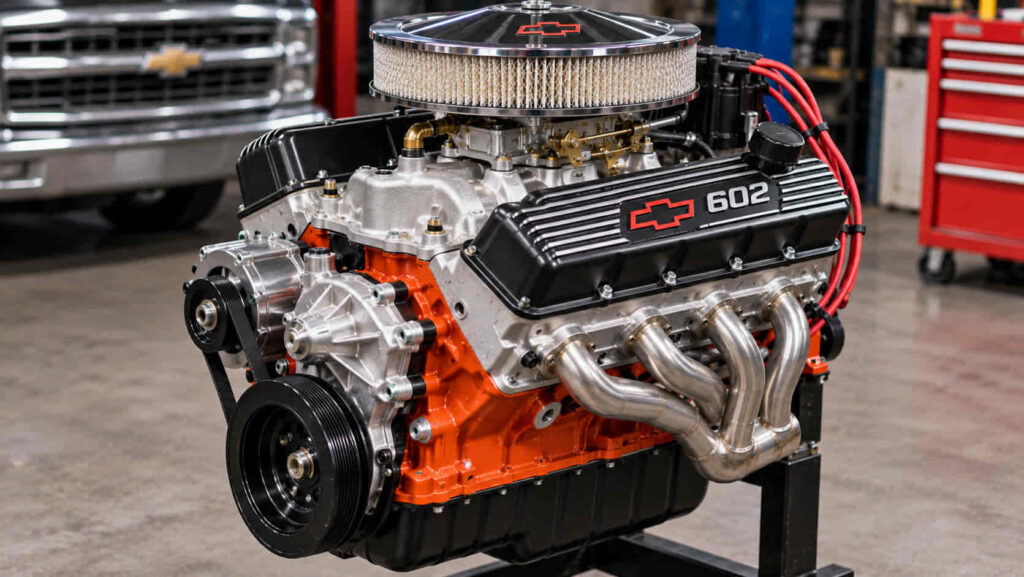
The Chevrolet 602 crate engine is a factory-sealed, 350-cubic-inch (5.7L) small-block V8 designed for circle track racing. Officially known as the Chevrolet Performance CT350, the current engine produces 350 horsepower at 5,400 RPM and 396 lb-ft of torque at 3,800 RPM, with a maximum recommended engine speed of 5,500 RPM.
The current Chevrolet Performance CT350, part number 19435602, uses a cast-iron block with four-bolt main bearing caps, a forged-steel crankshaft, forged powdered-metal connecting rods, hypereutectic aluminum pistons, and cast-iron Vortec cylinder heads.
Its bore measures 4.000 inches, while its stroke measures 3.480 inches. The current Chevrolet Performance product listing identifies a compression ratio of 9.6:1 and combustion chambers measuring approximately 62cc.
The engine also features a hydraulic flat-tappet camshaft, stamped-steel rocker arms, a dual-plane aluminum intake manifold, and an eight-quart racing oil pan.
However, 602 crate engine specifications have changed across production generations, and this is particularly important for racers purchasing used engines.
Earlier CT350 engines were commonly associated with part numbers 88958602 and 19258602. Historical documentation identifies a nominal 9.1:1 compression ratio, approximately 64cc combustion chambers, and different internal components from later versions.
Chevrolet’s 2023 technical manual also contains some specifications that differ from the current online catalog. For example, the manual identifies 9.12:1 compression, while the current product page lists 9.6:1.
The engine’s crankshaft design changed as well. Chevrolet’s technical documentation confirms that CT350 engines transitioned to a forged-steel crankshaft in 2021.
These distinctions matter for engine identification, replacement parts, technical inspections, rebuild eligibility, and race-class compliance.
This guide covers the Chevrolet 602 crate engine’s horsepower, torque, displacement, compression ratio, camshaft specifications, valve springs, cylinder heads, oil capacity, engine weight, fuel requirements, ignition timing, break-in procedure, reliability, and differences from the 604 crate engine.
What Is a 602 Crate Engine?
The 602 crate engine is Chevrolet Performance’s CT350 factory-sealed small-block V8, developed to provide affordable, standardized engine performance for circle track racing.
The 602 designation originated from the final three digits of the original GM engine part number 88958602.
Chevrolet introduced the original circle track crate engine program in 2002.
The program was developed to help racing organizations control engine costs and reduce the performance differences created by expensive custom-built racing engines.
Rather than requiring every competitor to commission a specialized engine, racers could purchase a standardized Chevrolet Performance assembly.
Factory-installed anti-tampering seals help officials determine whether the engine has been opened or modified.
The CT350 is based on the familiar Chevrolet Generation I small-block V8 architecture.
It uses 350 cubic inches of displacement, a pushrod valvetrain, and a carbureted fuel delivery arrangement.
Its relatively straightforward construction makes it suitable for entry-level and intermediate racing divisions.
However, the engine is not intended to be a universal replacement for every street-driven Chevrolet 350.
Chevrolet identifies the CT350 as a competition-only product.
The exact engine package and any permitted external components must comply with the relevant racing organization’s regulations.
Chevrolet 602 Crate Engine Horsepower
The current Chevrolet 602 crate engine produces 350 horsepower at 5,400 RPM according to the official Chevrolet Performance specifications.
This power rating applies to the CT350 configuration listed under part number 19435602.
However, historical specifications can differ.
Older GM technical manuals identify the original 602 engine as producing approximately 350 horsepower at 5,000 RPM.
Therefore, a racer comparing an early 88958602 engine with a current CT350 may encounter different published horsepower peak speeds.
The engine’s performance characteristics were developed for short-track racing.
Unlike an engine designed exclusively for maximum high-RPM horsepower, the CT350 emphasizes accessible torque across a useful operating range.
This allows drivers to maintain speed through corners and accelerate effectively without constantly using the highest possible engine speed.
However, advertised crankshaft horsepower should not be confused with rear-wheel horsepower.
Power measured at the wheels is influenced by drivetrain losses, transmission configuration, differential components, and testing conditions.
A chassis dynamometer may therefore show a lower number than Chevrolet’s published engine rating.
Actual results also depend on carburetor calibration, exhaust configuration, weather, and engine condition.
How Much Torque Does a 602 Crate Engine Make?
The current Chevrolet CT350 produces 396 lb-ft of peak torque at 3,800 RPM.
This equals approximately 537 Nm.
The engine’s torque characteristics are especially important for dirt track and asphalt circle track racing.
When a car exits a corner, the engine must accelerate the vehicle without unnecessarily disrupting traction.
A broad torque curve allows the driver to use the available gearing more effectively.
The CT350’s dual-plane intake manifold and camshaft profile help support useful torque over a relatively wide engine-speed range.
However, peak torque does not describe the entire performance curve.
The engine can produce substantial pulling force below its peak torque speed.
This is one reason Chevrolet markets the CT350 as an engine capable of maintaining useful performance through different gear selections.
Older 602 literature sometimes identifies a maximum torque of 390 lb-ft at 4,000 RPM.
That figure belongs to earlier documented configurations and should not automatically replace the current 396-lb-ft rating.
The correct specifications depend on the engine’s generation.
For racers comparing engines, both peak torque and the shape of the torque curve matter.
The best gearing choice depends on track length, tire size, vehicle weight, and the engine’s permitted operating range.
Chevrolet 602 Engine Displacement, Bore and Stroke
The 602 crate engine has a displacement of 350 cubic inches, equivalent to approximately 5.7 liters, with a 4.000-inch bore and a 3.480-inch stroke.
The bore corresponds to approximately 101.6 mm.
The stroke corresponds to approximately 88.4 mm.
These dimensions are characteristic of the traditional Chevrolet 350 small-block V8.
The engine contains eight cylinders arranged in two banks.
Each cylinder contributes approximately one-eighth of the engine’s total displacement.
The V8 configuration provides a compact arrangement suitable for the vehicle platforms commonly used in circle track racing.
However, bore and stroke also affect rebuilding requirements.
Cylinder wear can alter the effective bore dimensions.
Crankshaft damage can require machining or replacement.
For a sealed crate racing engine, such repairs are not simply ordinary mechanical decisions.
Racing organizations may restrict allowable machining or require a specifically authorized rebuilder.
Chevrolet’s technical documentation provides inspection tolerances for certain rebuild situations but does not endorse unrestricted internal modification.
The engine’s original displacement and component specifications must be preserved when the racing rules require a sealed or approved rebuild configuration.
Therefore, racers should verify the sanctioning organization’s current requirements before authorizing internal machine work.
602 Crate Engine Compression Ratio
The current Chevrolet Performance 602 crate engine is listed with a 9.6:1 compression ratio, while older CT350 technical documentation identifies approximately 9.12:1.
This is one of the most important differences between published generations.
The compression ratio describes the relationship between the cylinder’s total volume when the piston is at bottom dead center and its remaining volume at top dead center.
It influences combustion characteristics, cylinder pressure, and fuel requirements.
However, a higher compression ratio does not automatically mean an engine is more powerful.
Cylinder head airflow, camshaft timing, fuel calibration, and ignition timing also contribute.
The current CT350 product page identifies cast-iron Vortec cylinder heads with approximately 62cc combustion chambers.
Chevrolet’s revised February 2023 technical manual identifies approximately 64cc chambers and 9.12:1 compression in its CT350 specifications table.
The difference should not be ignored.
A racer inspecting a used engine should identify its actual production configuration rather than assume that every engine labeled 602 has the same compression ratio.
A sanctioning body may also specify allowable compression measurements.
Unauthorized milling or piston modifications can change compression and jeopardize engine eligibility.
The correct technical standard must match the engine version and race-class rules.
Chevrolet 602 Engine Block Specifications
The Chevrolet 602 uses a cast-iron Generation I small-block V8 engine block with four-bolt main bearing caps.
The four-bolt main design secures the crankshaft’s main bearing caps with additional fasteners compared with a conventional two-bolt arrangement.
This provides a useful foundation for the CT350’s intended operating loads.
The block also uses the traditional small-block Chevrolet cylinder layout.
Its nominal deck height is approximately 9.025 inches in Chevrolet’s technical manual.
However, engine blocks can have different casting numbers across production periods.
Therefore, the correct casting number should be checked when identifying a used CT350.
The engine also uses a one-piece rear crankshaft seal arrangement.
This affects crankshaft flange and flywheel compatibility.
An older two-piece-seal Chevrolet 350 flywheel should not automatically be considered suitable.
The correct engine block is only one part of racing eligibility.
Factory-installed seals and approved internal components are also important.
A replacement block may be mechanically compatible while failing to satisfy the rules of a sealed crate engine division.
For a competition engine, both mechanical specifications and technical inspection requirements must be considered.
Is the 602 Crate Engine Crankshaft Forged or Cast?
The current Chevrolet 602 crate engine uses a forged-steel crankshaft, but older CT350 versions used a cast crankshaft.
This distinction explains why some technical sources appear contradictory.
Chevrolet’s 2023 Circle Track Technical Manual states that both the CT350 and CT400 began using forged-steel crankshafts in 2021.
The manual’s current specifications table identifies crankshaft part number 12691722 for the relevant CT350 configuration.
Older 602 technical information describes a cast-iron crankshaft.
Therefore, it would be incorrect to say that every 602 engine ever manufactured contains a forged crankshaft.
The crankshaft converts piston movement into rotational power.
Its design must withstand repeated combustion loads and engine-speed changes.
Forged-steel construction offers different material characteristics from a cast crankshaft.
However, material strength alone does not determine overall engine reliability.
Bearing clearance, lubrication, balance, and operating speed are equally important.
The engine’s internal components must remain compatible.
An engine rebuilt with a different crankshaft may require changes to balancing or associated parts.
In a sealed racing division, such modifications may also be prohibited.
The installed crankshaft should be verified through engine identification and applicable Chevrolet documentation.
602 Crate Engine Connecting Rods and Pistons
The current CT350 uses forged powdered-metal, shot-peened connecting rods and hypereutectic aluminum pistons according to Chevrolet Performance’s current product listing.
Connecting rods transfer combustion force from the pistons to the crankshaft.
The current rod construction is designed to support the engine’s rated output and recommended RPM range.
However, the connecting rod specification has evolved through production history.
Chevrolet’s older technical documentation identifies powdered-metal rods with a nominal center-to-center length of 5.7 inches.
This length remains characteristic of the documented CT350 rotating assembly.
The engine also uses aluminum pistons.
Current Chevrolet Performance information identifies hypereutectic aluminum.
Older technical manuals describe cast aluminum dished pistons with four valve reliefs.
Piston design influences compression ratio, weight, and combustion chamber geometry.
Therefore, a piston from an older 602 should not automatically be treated as interchangeable with the latest version.
The rotating assembly also requires correct balance.
Changes to piston or connecting rod weight can affect crankshaft balance characteristics.
For racing applications, internal component replacement or modification may be restricted.
The correct parts must match the intended engine configuration and applicable technical rules.
602 Crate Engine Camshaft Specs
The Chevrolet 602 uses a hydraulic flat-tappet camshaft with 0.435-inch intake valve lift, 0.460-inch exhaust valve lift, and 212/222 degrees of duration measured at 0.050-inch tappet lift.
Chevrolet’s technical manual identifies camshaft part number 24502476 for the CT350.
The intake lobe lift is approximately 0.290 inch.
The exhaust lobe lift is approximately 0.307 inch.
The camshaft’s lobe separation angle is approximately 112.5 degrees.
These specifications influence the engine’s torque characteristics and operating range.
The intake valve opens according to the intake lobe profile.
The exhaust valve operates according to the separate exhaust lobe design.
The different intake and exhaust specifications are commonly described as a dual-pattern camshaft.
This design helps match the engine’s airflow requirements.
However, the CT350 does not use the hydraulic roller camshaft found in the CT400 604 engine.
The flat-tappet design has specific lubrication and break-in requirements.
Failure to follow the proper initial startup procedure can damage the camshaft lobes and lifters.
Camshaft replacement or modification may also violate sealed crate engine regulations.
For racing eligibility, the original camshaft specification should be preserved unless the applicable sanctioning rules explicitly permit an approved replacement.
Does the 602 Crate Engine Have a Flat-Tappet Cam?
Yes. The CT350 602 uses a hydraulic flat-tappet camshaft rather than a hydraulic roller camshaft.
This distinction is particularly important because the 602 and 604 are often confused.
A flat-tappet lifter uses a sliding contact arrangement against the camshaft lobe.
The camshaft and lifter surfaces must receive adequate lubrication, especially during the initial operating period.
A hydraulic roller lifter uses a roller that follows the camshaft lobe.
The two systems have different mechanical and wear characteristics.
Chevrolet’s CT350 uses standard hydraulic lifters with its flat-tappet camshaft.
The manufacturer emphasizes the importance of proper engine startup and break-in.
Operating the engine incorrectly during initial startup can contribute to camshaft damage.
Therefore, a new 602 should not simply be started and left idling for an extended period without following the prescribed procedure.
The correct lubricant also matters.
However, selecting any oil labeled racing oil does not automatically guarantee that its formulation is suitable.
The owner should follow Chevrolet’s current engine-specific break-in and lubrication instructions.
A 604 camshaft should not be installed into a 602 merely because both engines use a 350-cubic-inch small-block architecture.
The engines have different valvetrain systems and racing classifications.
602 Crate Engine Cylinder Head Specs
The current Chevrolet 602 crate engine uses cast-iron Vortec cylinder heads with approximately 62cc combustion chambers and 1.940-inch intake and 1.500-inch exhaust valves.
The Vortec cylinder heads are an important part of the engine’s design.
They provide airflow characteristics suitable for producing useful torque from the 350-cubic-inch displacement.
The cast-iron construction is also consistent with the engine’s emphasis on cost-effective racing performance.
However, the head specifications differ between production generations.
Chevrolet’s older CT350 manual identifies approximately 64cc combustion chambers.
The current product listing specifies 62cc chambers.
This difference is relevant to compression ratio calculations and technical inspections.
The intake port design also affects manifold compatibility.
The CT350 uses a Vortec-style intake mounting arrangement.
A traditional older small-block Chevrolet intake manifold should not automatically be assumed to fit.
Valve size is another important specification.
The 1.940-inch intake valve and 1.500-inch exhaust valve dimensions should be verified against the engine’s approved technical rules.
Cylinder head modifications can change airflow and engine output.
However, porting, milling, or replacing factory heads may violate sealed crate regulations.
For race use, maintaining the approved cylinder head configuration is essential.
602 Crate Engine Valve Spring Specs
Chevrolet’s 2023 CT350 technical manual identifies valve spring part number 10212811, with approximately 80 pounds of installed spring pressure and 195 pounds of open pressure.
The specified installed height is approximately 1.70 inches.
The open height is approximately 1.270 inches.
The listed spring diameter is 1.250 inches.
The manufacturer identifies approximately 1.20 inches as the coil-bind height for the documented spring.
Valve springs control valve movement.
They must provide enough force to keep the valve train operating correctly at the intended engine speed.
However, excessive spring pressure can increase mechanical loads on the camshaft and lifters.
This is especially important for a hydraulic flat-tappet engine.
A worn spring can also contribute to valve float at higher RPM.
However, a racing engine’s maximum speed should not be increased simply because stronger springs are installed.
The CT350 is designed around its approved camshaft, lifters, rocker arms, and valve springs.
A spring modification may violate the engine’s racing classification.
Chevrolet’s technical documentation also provides inspection guidance for spring condition.
However, valve spring measurements should be interpreted according to the exact engine version and sanctioning rules.
602 Crate Engine Rocker Arm Ratio and Valve Adjustment
The Chevrolet 602 uses stamped-steel rocker arms with a 1.5:1 rocker ratio, and its hydraulic valve train requires the correct lifter preload rather than a conventional solid-lifter clearance.
The rocker ratio describes the relationship between pushrod movement and valve movement.
A 1.5:1 rocker arm multiplies camshaft lobe lift to produce the specified valve lift.
However, rocker arm geometry must remain correct.
The CT350 uses hydraulic lifters.
These require an appropriate preload setting.
Chevrolet’s 2023 racing engine manual specifies approximately one-half to three-quarters of a turn past zero lash when the engine is at normal operating temperature.
The manufacturer describes a detailed rocker adjustment procedure using the camshaft’s base circle.
The correct procedure must be followed to avoid incorrect lifter preload.
Excessive preload can interfere with valve operation.
Insufficient preload may create abnormal valvetrain noise.
The engine’s positive-locking rocker nuts must also be secured correctly.
However, adjusting the valve train is not equivalent to changing the engine’s camshaft or rocker ratio.
Racing organizations may prohibit nonstandard rocker arms or altered valvetrain components.
The factory specifications should be preserved where required.
602 Crate Engine Oil Capacity
The Chevrolet 602 crate engine has an eight-quart oil capacity, including the filter, for the documented CT350 circle track racing oil pan.
Eight US quarts equal approximately 7.6 liters or two US gallons.
The CT350 uses a specialized racing oil pan designed to maintain oil supply during repeated cornering.
The 2023 Chevrolet technical manual identifies an approximately eight-inch-deep pan in its oil pan section.
The sump includes trap doors intended to control oil movement.
The pan also features a windage tray and crankshaft oil-control components.
These features are important in circle track racing.
During cornering, oil can move toward one side of the sump.
Without suitable oil control, the pickup may be exposed to air.
This can interrupt lubrication.
The racing pan is intended to reduce that risk under the engine’s designed operating conditions.
However, a replacement or modified pan may have a different capacity.
Therefore, the eight-quart figure should be applied only to the relevant factory racing oil pan configuration.
The final oil level must be verified according to the engine’s service instructions.
Adding more than the specified amount does not automatically improve lubrication.
Excessive oil can interfere with proper crankcase operation.
Read more: How Long Will Your Chevy 5.3 Engine Last
What Oil Does a 602 Crate Engine Use?
Chevrolet’s February 2023 CT350 racing engine manual identifies Mobil 1 Racing 0W-50 and Mobil 1 Racing 15W-50 as lubricants used in its racing engine testing and recommended service information.
However, the correct oil for a specific engine should be confirmed using the current installation instructions and the applicable racing program.
The 602 uses a hydraulic flat-tappet camshaft.
This creates important lubrication considerations.
The camshaft and lifter surfaces experience sliding contact.
They require suitable protection during initial startup and subsequent operation.
Chevrolet’s break-in instructions are therefore particularly important.
The manufacturer also emphasizes oil system priming before initial engine startup.
However, engine oil viscosity and oil capacity are separate specifications.
An engine using an eight-quart racing pan does not require a different oil quantity simply because another approved viscosity is selected.
The oil filter must also be appropriate for the installation.
Chevrolet’s 2023 manual identifies AC Delco PF454 among its recommended oil filters.
It also lists other approved filter arrangements within the break-in instructions.
However, part numbers can change over time.
The exact filter should be verified using the relevant technical documentation.
Proper oil pressure should be confirmed before the engine is subjected to racing loads.
602 Crate Engine Normal Oil Pressure
Chevrolet’s 2023 CT350 technical specifications identify approximately 40 psi of oil pressure at 2,000 RPM as a normal reference value for the documented engine.
However, oil pressure varies with temperature, RPM, and operating conditions.
The engine’s oil pump circulates lubricant through its internal passages.
The oil protects the crankshaft bearings, camshaft, lifters, and other components.
When oil temperature increases, its viscosity typically decreases.
This can affect pressure readings.
Therefore, a cold engine may show a different oil pressure from one at normal operating temperature.
The 40-psi reference should not be treated as a universal minimum under every condition.
A sudden loss of oil pressure requires immediate attention.
The engine should not continue racing when lubrication is compromised.
Possible causes include insufficient oil level, oil pickup exposure, pump problems, bearing clearance issues, and inaccurate pressure instrumentation.
The oil pan’s trap doors and windage control features help manage oil movement during cornering.
However, these components cannot compensate for a severely low oil level.
The driver and crew should monitor pressure trends and investigate abnormal readings before further operation.
602 Crate Engine Firing Order
The Chevrolet 602 crate engine uses the traditional small-block Chevrolet V8 firing order of 1-8-4-3-6-5-7-2.
This firing order determines the sequence of combustion events across the eight cylinders.
The engine uses a distributor ignition system.
The distributor must route the spark to the correct cylinder at the intended time.
Incorrect plug-wire routing can cause misfires, backfiring, or failure to start.
The cylinder numbering convention is also important.
On the traditional Chevrolet small-block V8, the driver’s-side bank contains cylinders 1, 3, 5, and 7.
The passenger-side bank contains cylinders 2, 4, 6, and 8.
However, the engine’s installed orientation and vehicle setup should be checked before identifying components.
The distributor rotation and ignition timing must follow the applicable engine instructions.
The firing order remains part of the engine’s fundamental mechanical configuration.
However, using the correct firing order alone does not guarantee that the ignition system is properly calibrated.
The spark plugs, distributor, rotor, ignition coil, and timing settings must also be suitable.
A misfire should be diagnosed rather than assuming the ignition system is correct simply because the wires appear connected.
602 Crate Engine Ignition Timing
The current Chevrolet Performance CT350 product page lists 34 degrees of total ignition timing at 4,000 RPM, while the revised 2023 technical manual recommends a maximum of 32 degrees for its documented configuration.
This difference is important.
Ignition timing influences when combustion begins relative to crankshaft position.
Correct timing helps the engine produce its intended power without abnormal combustion.
Excessive advance can contribute to detonation.
Detonation can damage pistons and other internal components.
Chevrolet’s older technical manual warns against exceeding its specified maximum.
However, the current catalog lists a different value.
Therefore, an owner should not assume that the newest timing number applies to every older CT350.
The actual engine configuration and installation documentation should determine the correct setting.
Fuel quality also matters.
The engine is intended to operate on suitable premium unleaded gasoline.
The carburetor and ignition system must be properly adjusted.
Operating temperature and environmental conditions can also influence engine behavior.
A racing organization may impose additional ignition system restrictions.
For a used 602 engine, the correct timing should be confirmed before its first competitive event.
The engine should not be tuned beyond the manufacturer’s or sanctioning organization’s permitted specifications.
What Fuel Does a 602 Crate Engine Require?
Chevrolet Performance recommends premium unleaded gasoline for the CT350 602 crate engine.
Its 2023 racing engine manual identifies approximately 91–93 octane unleaded gasoline as the recommended fuel range.
However, the exact requirement should be verified for the current engine and racing application.
The 602’s compression ratio and combustion chamber design influence its fuel requirements.
Ignition timing also affects the risk of abnormal combustion.
Using unsuitable fuel can contribute to detonation, reduced performance, or engine damage.
However, using significantly higher-octane fuel does not automatically produce additional horsepower.
Chevrolet’s technical documentation notes that very high-octane fuel is not inherently beneficial for its standard CT350 configuration.
The manufacturer also discusses the disadvantages of unnecessary leaded fuel use.
Racing sanctioning bodies may have their own fuel regulations.
Some require a specified gasoline type or approved fuel supplier.
Others restrict fuel additives.
Therefore, the most suitable fuel must satisfy both the engine manufacturer’s requirements and the racing organization’s rules.
Fuel system cleanliness is another important consideration.
A carbureted racing engine can develop starting or running problems when stale gasoline leaves deposits inside the carburetor.
Proper fuel storage and maintenance help prevent these issues.
What Carburetor Does a 602 Crate Engine Need?
Chevrolet’s CT350 technical manual identifies a Holley 650 CFM HP-series carburetor, part number 80541-1, as a recommended configuration for the documented racing engine.
However, the carburetor is not necessarily included with the crate engine.
The exact package contents must be verified before installation.
The carburetor meters fuel into the intake airflow.
Its size affects the engine’s ability to receive the intended fuel mixture across the operating range.
A larger carburetor does not automatically produce more power.
Chevrolet’s testing found that the 650 CFM configuration provided a useful match for many circle track applications.
The manufacturer also evaluated larger carburetors.
However, increasing carburetor size could reduce performance in certain conditions.
The CT350 uses a dual-plane aluminum intake manifold.
This arrangement supports the engine’s intended torque characteristics.
Carburetor calibration remains important.
Float levels, idle mixture, jetting, and throttle response should be checked.
Air temperature and altitude may influence the required settings.
However, race rules can restrict carburetor models and modifications.
The appropriate carburetor is therefore the one that meets both the engine’s operating requirements and the applicable racing regulations.
Chevrolet 602 Crate Engine Intake Manifold
The CT350 uses a high-rise dual-plane aluminum intake manifold designed for the Vortec cylinder head mounting arrangement.
Chevrolet’s technical manual identifies intake manifold part number 12366573 for the documented CT350 configuration.
The manifold distributes the air-fuel mixture to the engine’s eight cylinders.
The dual-plane design separates intake passages into groups.
This arrangement helps provide useful airflow characteristics over the engine’s intended speed range.
For short-track racing, broad torque can be particularly valuable.
However, the manifold’s performance depends on the complete engine.
Carburetor size, cylinder head airflow, camshaft timing, and exhaust design all contribute.
An aftermarket manifold may change the engine’s output characteristics.
However, modifying the intake system may also violate racing rules.
The CT350 uses the Vortec-style intake bolt pattern.
An older intake manifold designed for traditional small-block Chevrolet heads should not automatically be assumed compatible.
The correct gasket and bolt tightening procedure are also important.
An intake leak can create poor idle quality and inconsistent engine performance.
The installation should follow the specific Chevrolet instructions rather than relying on a generalized small-block torque specification.
How Much Does a 602 Crate Engine Weigh?
The weight of a 602 crate engine depends on its production version and the components included in the published measurement.
Chevrolet’s revised 2023 technical manual contains conflicting references.
Its descriptive engine section identifies a delivered weight of approximately 451 pounds.
However, its technical specifications table lists 517 pounds for the CT350 as sold.
Older GM technical documentation identifies other weights for earlier engine packages.
Because the published references are inconsistent, it would be misleading to treat one number as a universal CT350 weight.
The current online Chevrolet product page does not provide a definitive installed weight.
The engine’s cast-iron block and cylinder heads contribute substantially to its mass.
The racing oil pan, intake manifold, distributor, harmonic balancer, and other included components also affect the delivered package.
The complete installed engine will weigh more when additional equipment is fitted.
These components may include the carburetor, water pump, starter, flywheel, and exhaust equipment.
For vehicle setup, the correct mass should be established from the actual engine package and the car’s measured corner weights.
For lifting and transportation, equipment should be rated for the complete assembly with an appropriate safety margin.
A generic published engine weight should not be used as the sole basis for selecting lifting equipment.
What Is the Maximum RPM for a 602 Crate Engine?
Chevrolet Performance specifies a maximum recommended engine speed of 5,500 RPM for the CT350 602 crate engine.
This limit is one of the engine’s most important operating specifications.
The CT350 is designed to provide useful performance without requiring extremely high RPM.
Its hydraulic flat-tappet camshaft, valve springs, pistons, and connecting rods are selected for the intended operating range.
Exceeding the maximum speed can increase the risk of mechanical damage.
Valve float may occur when the valve springs can no longer maintain proper control.
High RPM also increases inertial forces acting on the pistons and connecting rods.
The manufacturer warns that excessive engine speed can significantly reduce durability.
Therefore, a racing engine should not be operated beyond its recommended RPM simply to gain a small amount of track performance.
Gear selection can help maintain the engine within its useful torque and horsepower range.
The driver should also avoid selecting a gear that forces the engine to over-rev.
A functioning tachometer and suitable engine-speed monitoring system are valuable.
Racing organizations may specify their own rev-limiter rules.
Those requirements must be followed alongside the engine manufacturer’s limits.
602 Crate Engine Break-In Procedure
The Chevrolet 602 requires a carefully controlled break-in procedure, particularly because it uses a hydraulic flat-tappet camshaft.
Chevrolet’s 2023 technical manual emphasizes priming the oil system before initial startup.
The manufacturer describes using an appropriate oil priming tool through the distributor opening.
The engine’s internal surfaces should receive lubricant before normal operation begins.
However, the exact priming direction and procedure must match the installed engine and service instructions.
The manual then specifies running the engine at approximately 2,000–2,500 RPM without load for the first 30 minutes.
This initial operating period is particularly important for the flat-tappet camshaft and lifters.
The technician must monitor oil pressure, coolant temperature, and engine operation throughout the process.
Abnormal noise or loss of oil pressure requires immediate attention.
The manufacturer also instructs the operator to check valve lash and ignition timing.
Carburetor settings should be verified.
Subsequent break-in includes controlled operation at varying loads rather than immediately subjecting the engine to maximum racing stress.
The manual includes oil and filter changes during the process.
However, the correct instructions should be obtained from the latest installation guide for the actual engine.
An incorrectly performed break-in can shorten engine life even when the engine was properly assembled.
Is the 602 Crate Engine Factory Sealed?
Yes. Chevrolet Performance supplies the CT350 as a factory-sealed racing engine, with tamper-resistant seals intended to support technical inspections and class equality.
Factory sealing is central to the crate engine program.
The objective is to reduce the performance advantages associated with unauthorized internal modifications.
Chevrolet’s technical manual describes seal caps with encrypted identification markings.
These allow technical inspectors to evaluate whether the engine retains its original factory seals.
However, seal technology has changed over time.
Older engines used different sealing methods.
Chevrolet introduced a revised seal-cap system during the 2017 production period.
Therefore, a legitimate older 602 may not have the same exterior seal appearance as a newer engine.
The exact identification requirements depend on production history and sanctioning rules.
Removing the original seals can create an eligibility problem.
Chevrolet states that it does not endorse unrestricted internal rebuilding or modifications of its sealed racing engines.
Some sanctioning bodies permit approved rebuilding programs.
However, these programs may require designated engine builders and secondary seals.
Therefore, a mechanically sound rebuilt engine is not automatically legal for every crate division.
The engine’s seal history should be checked before purchase.
Can You Rebuild a 602 Crate Engine?
A 602 crate engine can be mechanically rebuilt, but whether the rebuilt engine remains legal for competition depends on the racing organization’s rules and approved sealing procedures.
Chevrolet’s technical documentation provides dimensional and inspection information relevant to engine rebuilding.
However, the manufacturer does not endorse arbitrary internal modifications to factory-sealed engines.
A worn cylinder may require machining.
The crankshaft may also require bearing or journal inspection.
The cylinder heads, camshaft, and lifters may need service after substantial use.
However, these repairs can require removing factory seals.
That can affect race eligibility.
Some organizations permit rebuilding through approved facilities.
Others require a new factory-sealed engine or an engine carrying recognized replacement seals.
The allowable machining limits may also differ.
For example, certain organizations restrict cylinder overbore, deck machining, piston weight, or replacement component selection.
A standard automotive machine shop may be capable of rebuilding the engine mechanically but may not be authorized to preserve its eligibility for a particular racing division.
Therefore, the first step should be contacting the sanctioning body.
The exact engine part number, seal condition, and approved repair scope must be confirmed.
602 Crate Engine vs 604 Crate Engine
The Chevrolet 602 and 604 are both 350-cubic-inch factory-sealed circle track engines, but the 604 produces more horsepower and uses different cylinder heads, camshaft technology, and intake components.
The current 602 CT350 produces 350 horsepower and 396 lb-ft of torque.
The current 604 CT400 produces 404 horsepower at 5,600 RPM and 406 lb-ft at 4,600 RPM.
Both engines have a 4.000-inch bore and 3.480-inch stroke.
They also use cast-iron blocks with four-bolt main bearing caps.
However, their cylinder heads differ.
The 602 uses cast-iron Vortec heads.
The 604 uses aluminum Fast Burn cylinder heads.
The camshafts are also different.
The 602 uses a hydraulic flat-tappet camshaft.
The 604 uses a hydraulic roller camshaft.
The 604’s published valve lift is approximately 0.474 inch on the intake and 0.510 inch on the exhaust.
This is greater than the 602’s 0.435-inch intake and 0.460-inch exhaust lift.
The 604 also uses a single-plane aluminum intake manifold and roller-style rocker arms.
Its maximum recommended engine speed is 5,800 RPM, compared with 5,500 RPM for the 602.
The correct choice depends on the racing division.
A 604 engine cannot simply be substituted into a 602-only class.
Is a 602 Crate Engine Good for Dirt Track Racing?
The Chevrolet 602 is a strong option for dirt track racing classes designed around standardized engine power, controlled costs, and competitive parity.
The engine produces substantial low- and midrange torque.
This is useful when accelerating from corners on tracks where traction is limited.
The factory-sealed configuration also helps reduce the financial pressure to build increasingly expensive engines.
Drivers can focus more on vehicle setup, gearing, suspension, tires, and driving technique.
However, the best engine choice depends on the specific class.
Some tracks require the 602.
Others allow it alongside non-crate engines with different weight rules.
A racing organization may also permit a 604 in a separate division.
Therefore, the engine’s maximum horsepower is not the only consideration.
The car must satisfy the relevant class regulations.
Oil control is another advantage of the CT350 package.
The factory racing oil pan is designed for sustained cornering loads.
However, proper oil level and engine maintenance remain essential.
The engine should be operated within its recommended RPM range.
For a beginner or budget-conscious short-track racer, a correctly installed and legal CT350 can provide a predictable powertrain.
How Reliable Is a 602 Crate Engine?
The Chevrolet 602 is designed for competitive racing with controlled costs, but its reliability depends on correct break-in, oil maintenance, valve adjustment, ignition timing, cooling, and RPM control.
The engine uses a familiar small-block Chevrolet architecture.
Its cast-iron block and Vortec cylinder heads provide a robust foundation.
The current version also includes a forged-steel crankshaft.
However, racing places substantial stress on engine components.
Repeated acceleration, cornering loads, and high operating temperatures influence durability.
The hydraulic flat-tappet camshaft requires particular attention.
Incorrect break-in can damage the camshaft and lifters.
Excessive RPM can also increase valvetrain stress.
The cooling system must maintain a suitable operating temperature.
A carburetor that runs excessively lean can create abnormal combustion temperatures.
Incorrect ignition timing can contribute to detonation.
The engine must also maintain adequate oil pressure during cornering.
The racing oil pan helps manage oil movement, but it cannot compensate for neglect.
A properly maintained CT350 can provide multiple racing seasons of service in suitable conditions.
However, no fixed operating-hour or race-count lifespan is guaranteed.
The engine’s condition should be evaluated through operating data, maintenance history, and appropriate inspection.
Common 602 Crate Engine Problems
Common 602 crate engine concerns include flat-tappet camshaft wear, valve spring deterioration, oil pressure problems, overheating, carburetor calibration faults, and abnormal ignition timing.
However, the exact cause must be diagnosed before replacing components.
A worn camshaft may cause reduced valve movement and poor engine performance.
The flat-tappet design is particularly sensitive to incorrect initial lubrication and break-in.
Valve springs can also lose tension after prolonged operation.
This may contribute to valve float or inconsistent performance at high RPM.
However, stronger replacement springs may violate race rules.
Oil pressure problems are another concern.
The engine operates under sustained cornering loads.
Low oil level or a problem with the oil pickup system can affect lubrication.
Overheating may involve the radiator, water pump, cooling fan, or another supporting component.
Carburetor problems can cause hesitation, unstable idle, or incorrect fuel mixture.
Ignition timing errors can reduce power or contribute to detonation.
The correct repair should identify the underlying fault.
A sealed engine also requires special consideration before internal repairs.
Removing factory seals may create a technical inspection problem even when the mechanical repair is successful.
How Much Does a 602 Crate Engine Cost?
The price of a Chevrolet 602 crate engine depends on the current part number, retailer, availability, and whether the quotation includes required installation components.
The current engine is sold under Chevrolet Performance part number 19435602.
Some United States dealers advertise new CT350 engines in the approximate $7,000–$10,000 range.
However, these prices are retailer listings rather than a guaranteed national price.
Actual cost may vary with freight, taxes, discounts, and inventory.
The purchase price also does not include every component required to install the engine.
Chevrolet identifies several items that must be added to the standard CT350 package.
These may include the carburetor, starter, water pump, spark plugs, ignition wires, flywheel, and exhaust components.
The exact package contents should be confirmed with the seller.
Transmission compatibility is another consideration.
The engine’s one-piece rear seal and external balance arrangement require the appropriate flywheel or flexplate.
The oil pan must also fit the racing chassis.
Additional costs can include engine mounts, cooling system components, fuel plumbing, and installation labor.
For a complete race-car budget, the buyer should evaluate the full installed cost rather than the advertised engine-only price.
Does the 602 Crate Engine Have a Warranty?
Chevrolet Performance states that its circle track crate racing engines do not carry the standard limited warranty offered with certain other crate engine products.
This is important for buyers who assume all Chevrolet Performance engines include the same protection.
The CT350 is intended for competition use.
Racing subjects the engine to operating conditions that differ from ordinary road use.
Chevrolet’s technical manual expressly identifies circle track engines as products without a warranty.
Therefore, a buyer should not assume that a failed engine will be replaced at no cost.
A dealer may offer separate terms, but those should be confirmed in writing.
Engine inspection before purchase is particularly important when buying used.
The seals should be checked.
The engine’s exact part number and rebuild history should be identified.
Oil pressure, compression, and other available operating information can help evaluate condition.
However, diagnostic measurements cannot guarantee that an engine will avoid future failure.
For a new engine, correct installation and break-in are essential.
A missed break-in procedure or incorrect lubrication can create a costly failure with limited recourse.
The absence of a standard warranty should therefore be considered when comparing the 602 with other engine options.
Is a 602 Crate Engine Street Legal?
The Chevrolet 602 CT350 is marketed for off-road competition use and is not intended as a certified street replacement engine for ordinary public-road vehicles.
The engine is designed for circle track racing.
It uses a carbureted fuel system and factory-sealed competition configuration.
Chevrolet’s product information explicitly identifies the engine as intended for racing rather than street use.
Road vehicle emissions requirements depend on the jurisdiction and vehicle.
A replacement engine must generally comply with the applicable emissions and safety requirements.
An engine that can physically be installed in a road vehicle is not automatically legal for public-road operation.
The correct distinction is between mechanical fitment and regulatory approval.
A 602 engine may share mounting characteristics with other small-block Chevrolet V8 engines.
However, that does not establish emissions compliance.
For a vehicle intended to remain road legal, the owner should evaluate a suitable emissions-compliant engine replacement rather than assuming the racing CT350 qualifies.
For circle track applications, the relevant racing organization’s regulations determine engine eligibility.
The 602’s intended use remains competitive motorsports.
How to Identify an Original Chevrolet 602 Crate Engine
A genuine Chevrolet 602 crate engine should be identified using its part number, production components, factory seals, and relevant Chevrolet Performance documentation.
The original engines were associated with part number 88958602.
Later generations used additional part numbers, including 19258602.
The current Chevrolet Performance product listing identifies part number 19435602.
However, part number changes can reflect revisions to the product.
A used engine’s physical characteristics may differ from the current catalog.
Crankshaft material, piston design, and cylinder head chamber specifications have changed or appear differently in official documentation.
Factory seals are especially important for competition use.
The seals help technical inspectors assess whether the engine has been opened.
However, seal appearance has also evolved.
A legitimate older engine may have a different seal design from the current model.
A rebuilt engine may use a sanctioning body’s approved secondary seals.
Therefore, the presence of noncurrent seals is not automatically proof of illegality.
Eligibility depends on the track rules.
The best approach is to document the engine’s part number, seals, production information, and any authorized repairs.
The racing organization should verify whether the engine is approved for the intended class.
Final Verdict: What Are the 602 Crate Engine Specs?
The Chevrolet 602 crate engine is a 350-cubic-inch, 5.7-liter factory-sealed racing V8 that produces 350 horsepower and 396 lb-ft of torque in its current CT350 configuration.
The engine uses a 4.000-inch bore and a 3.480-inch stroke.
Its block is made from cast iron and includes four-bolt main bearing caps.
The current Chevrolet Performance product information identifies a forged-steel crankshaft, forged powdered-metal connecting rods, and hypereutectic aluminum pistons.
The cylinder heads are cast-iron Vortec units with approximately 62cc combustion chambers.
The intake valves measure 1.940 inches, while the exhaust valves measure 1.500 inches.
The engine uses a hydraulic flat-tappet camshaft.
Its valve lift is 0.435 inch on the intake and 0.460 inch on the exhaust.
Duration measured at 0.050-inch lift is 212 degrees on the intake and 222 degrees on the exhaust.
The rocker arm ratio is 1.5:1.
The current catalog identifies a compression ratio of 9.6:1.
However, earlier technical literature lists approximately 9.12:1, making production-version identification important.
The engine uses an eight-quart racing oil pan and has a maximum recommended speed of 5,500 RPM.
Its firing order is 1-8-4-3-6-5-7-2.
Chevrolet Performance recommends premium unleaded fuel.
Ignition timing must be matched to the correct engine documentation because current and older Chevrolet publications provide different values.
The CT350 is designed for circle track racing and features factory-installed anti-tampering seals.
It is not intended as a general road-legal replacement engine.
For racers seeking an established, cost-controlled V8 with strong torque and predictable performance, the Chevrolet 602 remains a practical circle track engine.
However, engine reliability depends on correct flat-tappet camshaft break-in, suitable lubrication, accurate valve adjustment, proper cooling, and operation within the manufacturer’s RPM limit.
The most important rule when using 602 crate engine specifications is to match the technical information to the exact engine part number and current racing organization requirements.
This ensures that the engine remains mechanically compatible, correctly maintained, and eligible for the intended competition class.