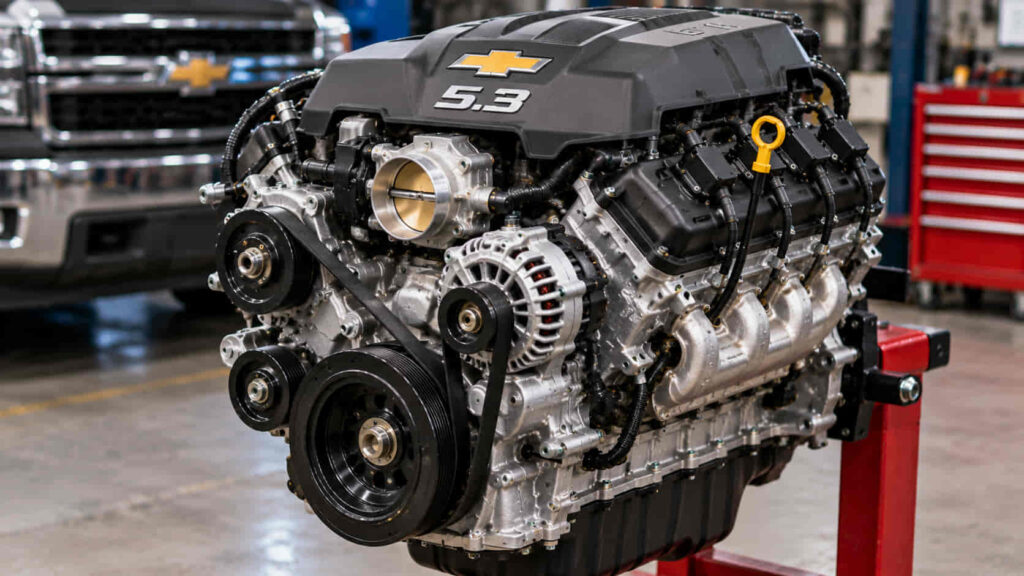
A well-maintained Chevy 5.3L V8 engine can often reach 200,000 to 300,000 miles (approximately 322,000–483,000 kilometers), and some engines continue operating beyond that range. However, the actual lifespan depends on engine generation, maintenance history, driving conditions, oil consumption, and whether the engine develops problems involving Active Fuel Management (AFM) or Dynamic Fuel Management (DFM).
The Chevrolet 5.3-liter V8 has powered millions of trucks and SUVs, including the Silverado 1500, Tahoe, Suburban, Avalanche, and related GMC vehicles. Its reputation for durability comes partly from the long-running GM small-block V8 architecture, which combines a compact pushrod design with substantial torque and relatively straightforward basic construction.
However, not all Chevy 5.3 engines have the same reliability characteristics.
Early Vortec 5300 engines, particularly the non-AFM LM7 and related versions, are often regarded as durable because they have fewer cylinder-deactivation components. Later Gen IV engines introduced AFM on many applications, creating additional mechanical complexity and documented oil consumption concerns in certain production years.
The Gen V EcoTec3 5.3L engines introduced direct fuel injection, improved combustion technology, and additional efficiency features. These versions include the L83 engine with AFM and the newer L84 engine with DFM.
Although these improvements provide better performance and efficiency, some engines have experienced collapsed lifters, misfires, abnormal ticking, and related valvetrain failures.
General Motors has published technical service information covering these conditions, including excessive oil consumption in certain 2007–2011 engines and lifter failures in selected later applications.
The 200,000–300,000-mile range is a practical ownership expectation, not a Chevrolet-certified average lifespan or a guarantee. A neglected engine can require major repairs much earlier, while a carefully maintained engine may remain serviceable well beyond 300,000 miles.
Understanding how each generation ages, which problems deserve attention, and what maintenance actually protects the engine can help owners make better decisions about repairs and long-term ownership.
How Long Will Your Chevy 5.3 Engine Last?
Your Chevy 5.3 engine may last approximately 200,000–300,000 miles when properly maintained, but individual engines can fall well below or exceed that range.
The 5.3L V8 has been installed in many vehicles used for daily transportation, towing, and commercial work. Those operating conditions create different types of mechanical stress, so mileage alone cannot predict the engine’s remaining lifespan.
An engine that accumulates most of its miles during steady highway driving may experience fewer repeated cold starts than one used for short trips. However, an engine used to tow heavy trailers may operate under greater sustained load and temperature.
Maintenance history is equally important. The crankshaft bearings, piston rings, camshaft, hydraulic lifters, and other internal components depend on consistent lubrication. Repeated operation with insufficient oil can cause damage that is not reflected by the odometer.
The engine generation also influences potential repair costs. An early non-AFM 5.3L has fewer cylinder-deactivation components than a newer engine equipped with AFM or DFM.
Nevertheless, simpler construction does not automatically guarantee a longer life. A poorly maintained early engine may be in worse condition than a newer engine with a complete service history.
For owners evaluating a high-mileage 5.3L, the most useful indicators are current oil pressure, oil consumption, compression, cooling system performance, mechanical noise, and documented maintenance.
Can a Chevy 5.3 Engine Last 300,000 Miles?
Yes. A Chevy 5.3L engine can reach 300,000 miles, but achieving that distance depends on the condition of its mechanical components and supporting systems.
The engine’s basic architecture is suitable for substantial long-term use. Its V8 configuration provides useful torque without requiring unusually high operating speeds during ordinary driving.
However, reaching 300,000 miles does not mean the engine will require no repairs. Fuel pumps, sensors, ignition components, water pumps, gaskets, and other supporting parts may need replacement during the vehicle’s service life.
Some owners also encounter major valvetrain repairs before reaching 200,000 miles, particularly on affected AFM or DFM engines.
A lifter failure does not always mean the engine block or crankshaft has reached the end of its useful life. If the damage is localized and repaired correctly, the engine may continue operating for many more miles.
The difference between engine longevity and repair-free operation is therefore important.
A 5.3L that reaches 300,000 miles after receiving a water pump, ignition repairs, and a properly completed lifter repair has demonstrated long-term service, but it has not been maintenance-free.
The most realistic goal is to preserve the engine’s internal condition while correcting developing faults before they cause extensive damage.
How Long Do First-Generation Chevy 5.3 Vortec Engines Last?
The early Gen III Chevy 5.3 Vortec engines are often considered among the strongest candidates for high-mileage ownership because many versions lack AFM cylinder deactivation.
The 5.3L Vortec 5300 was introduced for the 1999 model year in GM’s truck lineup.
Common early engine codes include LM7 and L59. Other configurations include the aluminum-block LM4 and L33.
These engines use a pushrod V8 design with conventional hydraulic roller lifters and sequential port fuel injection.
The LM7 is particularly recognizable because of its cast-iron cylinder block and widespread use in Chevrolet and GMC trucks.
Without AFM, the engine does not require the specialized deactivation lifters found in many later versions.
This reduces one category of potential mechanical failure.
However, these engines still experience normal wear. Oil pressure concerns, intake sealing problems, water pump failures, knock sensor issues, and aging gaskets can require attention.
Most early Vortec trucks are now decades old, so the condition of the complete vehicle is important.
An otherwise healthy engine may be installed in a truck with significant transmission wear, frame corrosion, or electrical problems.
For owners seeking an older 5.3L with a comparatively straightforward mechanical design, a properly maintained non-AFM version remains an attractive choice.
How Long Do 2007–2013 Chevy 5.3 Engines Last?
Many 2007–2013 Chevy 5.3 engines can provide substantial mileage, but certain AFM-equipped versions have documented oil consumption and valvetrain concerns that can shorten their useful life if left unresolved.
This period is associated primarily with the Gen IV small-block architecture.
Common 5.3L engine codes include LY5, LMG, LC9, and other application-specific variants.
Many versions use Active Fuel Management to deactivate four cylinders under suitable operating conditions.
The objective is to improve fuel economy when full V8 power is unnecessary.
However, AFM adds specialized hydraulic lifters and oil-control components.
These components introduce additional possible failure points.
General Motors Service Bulletin 10-06-01-008J specifically addresses excessive engine oil consumption in certain AFM-equipped vehicles, including affected Silverado, Tahoe, Suburban, and Avalanche models from the 2007–2011 period.
The bulletin identifies oil entering the intake through the positive crankcase ventilation system and oil spray associated with the AFM pressure relief valve as possible contributors.
Under certain conditions, carbon deposits may develop around the piston rings, contributing to increased oil consumption.
However, not every Gen IV 5.3L engine has this problem.
The exact engine code, production date, and maintenance history matter.
A properly maintained engine with controlled oil consumption can remain a practical high-mileage powertrain.
How Long Does the Chevy 5.3 EcoTec3 L83 Engine Last?
The Chevy 5.3L EcoTec3 L83 can provide long-term service, but its reliability depends partly on the condition of its AFM lifters, lubrication system, direct-injection components, and cooling system.
The L83 arrived with the redesigned Silverado and Sierra generation for the 2014 model year.
It introduced major changes compared with the older Vortec engines.
These include direct fuel injection, variable valve timing, and an aluminum cylinder block.
The engine also uses Active Fuel Management.
The L83 produces approximately 355 horsepower and 383 lb-ft of torque in common Silverado applications.
However, additional performance and efficiency come with more complex engine controls and mechanical systems.
GM Service Bulletin 15-06-01-002M documents misfire and ticking concerns involving certain L83-equipped vehicles.
The bulletin identifies collapsed AFM lifters, damaged internal locking pins, stuck lifters, and bent pushrods as possible causes.
It also instructs technicians to inspect the camshaft and lifter rollers for damage.
These problems can require expensive repairs, but they do not automatically mean every L83 will fail.
A sound L83 with normal oil consumption, correct oil pressure, and no abnormal valvetrain noise can remain a worthwhile engine.
For high-mileage ownership, early diagnosis of unusual ticking or misfires is particularly important.
How Long Does the Chevy 5.3 L84 Engine Last?
The Chevy 5.3L L84 engine can deliver substantial service life, but its newer Dynamic Fuel Management system introduces different valvetrain components and repair considerations from the earlier L83.
The L84 became available with the redesigned 2019 Silverado 1500 and related GM trucks.
It retains the 5.3-liter displacement and the familiar 355-horsepower, 383-lb-ft output in many applications.
The engine uses direct fuel injection and variable valve timing.
Its cylinder-deactivation strategy differs from traditional AFM.
Dynamic Fuel Management can operate in multiple cylinder combinations rather than switching only between eight-cylinder and four-cylinder modes.
This improves the flexibility of the system.
However, the engine uses specialized deactivation lifters.
General Motors documented collapsed lifter concerns involving certain 2019–2021 L84-equipped vehicles.
Symptoms may include a misfire, a bent pushrod, or a lifter that has collapsed or come apart.
These failures can occur well before the engine reaches a commonly expected high-mileage lifespan.
However, the service information does not establish that every L84 engine will experience a lifter failure.
The long-term durability of newer L84 engines should be evaluated through actual condition and maintenance rather than assuming that all newer engines are either completely reliable or universally defective.
Do All Chevy 5.3 Engines Have AFM or DFM?
No. Chevy 5.3 engines have been produced with conventional valvetrains, Active Fuel Management, and Dynamic Fuel Management, depending on the engine generation and application.
Early Gen III versions such as the LM7 generally do not use cylinder deactivation.
AFM became more widespread during the Gen IV generation, although not every 5.3L application used the same configuration.
The L83 EcoTec3 uses AFM.
The newer L84 uses DFM in applicable vehicle configurations.
There is also an important distinction around the 2019 model year.
The redesigned Silverado lineup included a carryover 5.3L engine identified as L82 with AFM, as well as the newer L84 equipped with DFM.
Therefore, describing every 2019 Chevrolet 5.3L as a DFM engine would be inaccurate.
The actual engine code should be verified.
Vehicle identification information and GM service documentation can establish the correct configuration.
This matters when purchasing replacement lifters, cylinder heads, engine oil components, and other parts.
An AFM lifter is not automatically interchangeable with a DFM lifter.
Correct engine identification also helps owners understand which technical bulletins may apply to their vehicle.
Read more: C12 Cat Engine Specs
How Oil Changes Affect Chevy 5.3 Engine Lifespan
Regular oil and filter changes are among the most important maintenance practices for protecting Chevy 5.3 engine longevity.
Engine oil lubricates the crankshaft bearings, camshaft, lifters, pistons, timing components, and other moving parts.
It also helps carry heat away from internal surfaces.
Over time, oil can become contaminated by combustion byproducts, fuel, moisture, and wear particles.
Its protective properties also change during use.
However, the correct oil change interval depends on the engine generation and operating conditions.
Chevrolet recommends using the vehicle’s Engine Oil Life System where equipped.
The system evaluates operating conditions instead of using only a fixed mileage number.
When the system displays a change-oil message, the oil and filter should be replaced promptly.
Chevrolet also specifies that the oil and filter must be changed at least once per year, even if the oil-life system has not requested service.
However, the oil-life monitor does not directly measure how much oil remains in the crankcase.
An engine can have acceptable remaining oil life while its oil level is dangerously low.
Therefore, oil level checks are essential between changes.
Correct lubrication helps protect engine longevity, but maintenance cannot eliminate every potential mechanical defect.
What Oil Does a Chevy 5.3 Engine Need?
The correct oil for a Chevy 5.3 engine depends on its model year and engine code, with many older Vortec engines requiring SAE 5W-30 and newer EcoTec3 versions specifying SAE 0W-20.
The distinction is important because the 5.3L name spans multiple engine generations.
Older Chevrolet 5.3 Vortec applications commonly specify SAE 5W-30.
However, the exact lubricant specification should be confirmed in the owner’s manual.
For the 2020 Chevrolet Silverado 1500 equipped with the 5.3L engine, GM specifies SAE 0W-20 full synthetic oil meeting the dexos1 standard.
The manufacturer explicitly warns that using oil outside the recommended specification can cause engine damage.
Oil viscosity affects lubrication characteristics.
However, using a thicker oil does not automatically provide better protection for a high-mileage engine.
The correct grade is selected according to the engine’s design and operating requirements.
Owners should also avoid treating oil additives as a substitute for proper mechanical repair.
A physically collapsed lifter cannot be reliably restored by adding a lubricant treatment.
The safest maintenance strategy is to use an approved oil, maintain the correct level, and follow the applicable service schedule.
How Much Oil Does a Chevy 5.3 Engine Take?
Chevy 5.3 oil capacity varies by generation, and using the wrong refill quantity can cause serious lubrication problems.
Many older Vortec 5300 truck engines use approximately 6 US quarts during an oil and filter change.
Newer EcoTec3 configurations commonly use approximately 8 US quarts.
For example, the 2020 Chevrolet Silverado 1500 owner’s manual specifies 8.0 US quarts, or approximately 7.6 liters, for the documented L84 engine.
However, that specification should not automatically be transferred to every 5.3L engine.
Some earlier EcoTec3 publications and subsequent service revisions contain different figures.
The exact vehicle and engine must be identified before adding oil.
A larger oil capacity does not automatically guarantee longer engine life.
The oil must still meet the required specification, and the maintenance interval must remain appropriate.
An engine that consumes oil between services requires monitoring regardless of sump capacity.
After an oil change, the final level should be verified using the dipstick and the manufacturer’s specified checking procedure.
Overfilling is not beneficial.
Likewise, operating below the recommended range can compromise lubrication.
The goal is to maintain the correct quantity of approved oil throughout the entire service interval.
How AFM Lifter Failure Affects Chevy 5.3 Longevity
AFM lifter failure can significantly reduce the usable life of a Chevy 5.3 engine if it damages the camshaft or prevents normal valve operation.
AFM uses specialized hydraulic lifters that can deactivate selected cylinders.
The system depends on internal locking mechanisms and engine oil control.
When a lifter collapses mechanically, it may stop transferring the correct camshaft movement to the pushrod.
The corresponding valve may not open normally.
This can create ticking, rough operation, and misfires.
A damaged pushrod may also be present.
General Motors has documented these symptoms in service bulletin 15-06-01-002M.
The bulletin identifies a range of possible mechanical causes.
It also requires inspection of the camshaft and lifter rollers.
If the camshaft lobe is damaged, replacing only the defective lifter may not be sufficient.
The repair can become more extensive.
However, a failed lifter does not automatically require replacing the entire engine.
The condition of the cylinder head, camshaft, lifter bores, and supporting components determines the appropriate repair.
Prompt diagnosis can help prevent a localized valvetrain problem from developing into more serious internal damage.
Does Dynamic Fuel Management Reduce Engine Life?
Dynamic Fuel Management adds mechanical and electronic complexity, but available evidence does not establish that every DFM-equipped Chevy 5.3 engine has a shorter lifespan than every earlier engine.
DFM was developed to improve fuel efficiency by varying the number of cylinders contributing power under different operating conditions.
The L84 engine uses components designed for this more flexible system.
However, the additional deactivation mechanisms create potential failure points.
GM’s 2021 technical information describes collapsed lifters on certain affected L84 applications.
A lifter problem may lead to a misfire and mechanical damage.
However, the existence of a documented service problem is not the same as a published failure rate for all engines.
Some engines experience early faults.
Others operate for substantial mileage without major lifter repair.
The correct ownership approach is therefore to monitor symptoms and maintain the engine correctly.
Unusual ticking, persistent misfires, or abnormal rocker arm movement should be investigated promptly.
Electronically disabling cylinder deactivation should not be assumed to repair damaged lifters or guarantee longer service life.
A mechanical defect requires an appropriate mechanical repair.
Any modification must also be evaluated for compatibility, warranty consequences, and applicable emissions requirements.
Why Do Some Chevy 5.3 Engines Burn Oil?
Excessive oil consumption in certain Chevy 5.3 engines can result from piston ring deposits, crankcase ventilation issues, AFM-related oil movement, worn internal components, or external leakage.
General Motors documented specific oil consumption concerns in service bulletin 10-06-01-008J.
The bulletin applies to certain AFM-equipped vehicles produced during the relevant 2007–2011 period.
It describes oil being drawn through the PCV system or sprayed from the AFM pressure relief valve under certain conditions.
Excessive deposits may develop in the piston ring grooves.
This can contribute to increased oil consumption.
The bulletin also identifies possible spark plug fouling and rough engine operation.
However, other causes of oil loss must be considered.
A worn valve stem seal can allow oil to enter a combustion chamber.
External leaks may develop around the valve covers, oil pan, or other sealing surfaces.
Piston ring wear can also cause consumption, especially at high mileage.
Therefore, the correct diagnosis should measure actual oil use and investigate the underlying cause.
An owner should not assume that every oil-consuming 5.3L requires a complete engine replacement.
Some problems can be addressed with a targeted repair.
How Much Oil Consumption Is Normal for a Chevy 5.3?
Some engine oil consumption can occur during normal operation, but a sudden increase or repeated loss of substantial oil deserves diagnosis.
GM’s 2013 oil consumption bulletin for certain AFM engines refers to consumption exceeding approximately one quart per 2,000–3,000 miles when determining whether the documented service procedure may be appropriate.
However, this is a diagnostic reference within a specific bulletin.
It should not be presented as a universal normal-consumption standard for every Chevy 5.3.
The exact criteria depend on the vehicle and engine.
An oil consumption test typically involves establishing the correct initial oil level and measuring the amount required to restore that level after a known distance.
The engine must be checked consistently.
Parking on a slope or using a different checking procedure can create misleading readings.
If oil consumption is confirmed, the mechanic should inspect external leaks, PCV operation, spark plugs, and other relevant systems.
An engine that consumes oil but maintains normal compression may require a different repair from one with severe cylinder wear.
Owners should never allow the oil level to fall dangerously low while conducting a consumption test.
Maintaining the correct oil level protects the engine while the cause is investigated.
What Are the Most Common Chevy 5.3 Engine Problems?
Common Chevy 5.3 engine problems include lifter failures, excessive oil consumption, oil pressure concerns, cooling system faults, ignition problems, and age-related gasket leakage.
However, the most relevant problems depend on engine generation.
Early non-AFM engines have fewer cylinder-deactivation components.
They may still develop oil leaks, sensor faults, cooling system failures, and normal internal wear.
Certain Gen IV AFM engines have documented oil consumption problems.
Later L83 and L84 engines introduce additional complexity through direct injection and cylinder-deactivation systems.
A persistent misfire may indicate an ignition coil, spark plug, injector, or mechanical valvetrain problem.
However, the fault should be diagnosed before parts are replaced.
A ticking engine may have a failed lifter.
It may also have a leaking exhaust manifold or normal direct-injection noise.
A low oil pressure warning requires immediate attention.
The engine should be safely stopped and the cause investigated.
Overheating is another serious concern because excessive temperature can damage the cylinder heads, gaskets, and internal components.
The key to long service life is identifying the actual cause of a symptom before it becomes a more expensive failure.
What Are the Signs Your Chevy 5.3 Engine Is Wearing Out?
Signs of substantial Chevy 5.3 engine wear may include persistent oil consumption, low verified oil pressure, abnormal knocking, excessive crankcase pressure, reduced compression, and recurring mechanical problems.
However, no single symptom proves that the entire engine has reached the end of its useful life.
A misfire may come from an ignition coil.
A ticking noise may result from an exhaust leak.
Oil consumption may be associated with a repairable ventilation or sealing problem.
Therefore, the engine should be evaluated systematically.
A compression test can help identify cylinders that are not sealing properly.
A cylinder leakage test may provide more information about piston ring, valve, or head gasket condition.
Oil pressure should be verified with appropriate diagnostic equipment when a low-pressure complaint exists.
The cooling system should also be inspected.
A coolant leak, overheating event, or combustion gas entering the cooling system may indicate a separate problem.
The engine’s maintenance history helps establish context.
An engine with several hundred thousand miles and normal compression may still be serviceable.
By comparison, an engine with much lower mileage but severe internal damage may require rebuilding or replacement.
Will a Chevy 5.3 Last 150,000 Miles?
A healthy Chevy 5.3 engine should be capable of reaching 150,000 miles, but that distance is not a guarantee against major repairs.
Many engines reach this point with ordinary maintenance and replacement of selected supporting components.
However, some affected engines experience lifter problems or significant oil consumption much earlier.
The manufacturer has documented examples of oil consumption concerns arising at relatively modest mileage in certain AFM-equipped vehicles.
This means that a 150,000-mile engine should be evaluated according to condition rather than simply assumed to be approaching failure.
At this mileage, maintenance records become especially valuable.
Oil changes, cooling system work, spark plug replacement, and previous mechanical repairs should be reviewed.
The engine should start normally and maintain stable operating temperature.
Oil consumption should be monitored.
Persistent misfires, unusual knocking, or unresolved warning lights require investigation.
If the engine operates normally and has been maintained correctly, there may be no reason to replace it solely because it has reached 150,000 miles.
Is 200,000 Miles Too Much for a Chevy 5.3?
Two hundred thousand miles is not automatically excessive for a Chevy 5.3L V8, but the engine and complete vehicle should be inspected carefully before purchase or continued heavy use.
A high-mileage engine may still have healthy internal components.
However, wear accumulates in supporting systems.
The cooling system, ignition components, fuel delivery equipment, gaskets, and sensors may require attention.
The transmission is another important consideration.
A truck with a healthy engine but a failing transmission can still be expensive to keep on the road.
For an engine at 200,000 miles, compression and oil consumption are useful indicators.
Normal oil pressure and stable coolant temperature are also important.
The engine should not exhibit severe mechanical knocking.
A minor external oil leak may be repairable.
However, a major internal problem can change the financial calculation.
The best approach is to estimate the remaining vehicle value and expected repair costs.
A well-maintained 200,000-mile Silverado may be a better ownership proposition than a neglected truck with substantially lower mileage.
Can a Chevy 5.3 Engine Reach 400,000 Miles?
A Chevy 5.3 engine can exceed 400,000 miles in exceptional circumstances, but this should not be treated as a typical or guaranteed service-life expectation.
Individual high-mileage examples are frequently discussed by truck owners.
These vehicles demonstrate what may be possible under favorable conditions.
However, a collection of owner reports does not establish how frequently such lifespans occur.
It also does not prove that the engines reached those distances without major repairs.
Some high-mileage trucks may have received cylinder head repairs, lifter replacements, or other substantial work.
Others may have operated for many years with only routine maintenance.
The difference is important.
An engine capable of reaching 400,000 miles may still require investment along the way.
Vehicle condition also becomes a major consideration.
Suspension, transmission, brakes, frame, and electrical systems may need extensive repairs before the engine itself wears out.
The appropriate goal is not simply to reach the highest possible odometer reading.
It is to keep the engine and vehicle operating safely and economically.
Does Towing Shorten Chevy 5.3 Engine Life?
Frequent heavy towing can increase the mechanical and thermal demands on a Chevy 5.3 engine, particularly when the truck operates near its rated limits.
Towing requires the engine to produce more power.
This increases combustion loads and heat generation.
The cooling system must remove additional heat.
The transmission also operates under greater load.
However, towing within the vehicle’s published ratings does not automatically cause premature engine failure.
The truck is designed to perform work within its approved limits.
The actual impact depends on load, road grade, ambient temperature, vehicle condition, and maintenance.
A truck towing a moderate trailer occasionally may experience different stresses from one pulling heavy equipment every day.
Chevrolet recommends paying attention to maintenance when the vehicle operates under demanding conditions.
Oil level and oil-life status should be checked before extended towing.
Cooling system problems should be repaired promptly.
The driver should also use the correct towing and transmission modes where provided.
The complete truck’s towing rating must be respected.
Engine horsepower alone does not determine the maximum safe trailer weight.
Does Highway Driving Help the Chevy 5.3 Last Longer?
Steady highway driving can be less demanding in some respects than repeated short trips and cold starts, but engine longevity still depends on load, temperature, maintenance, and driving behavior.
During a short trip, the engine may not reach its normal operating temperature.
Repeated cold starts can expose the engine to different lubrication and combustion conditions from those encountered during sustained warm operation.
Frequent stop-and-go driving also creates repeated acceleration events.
However, highway driving is not always gentle.
High-speed operation, heavy towing, and mountainous terrain can impose substantial engine loads.
Therefore, the type of highway use matters.
A lightly loaded truck cruising at moderate speed may experience different operating conditions from a truck pulling a heavy trailer uphill.
Extended idling also deserves consideration.
The engine continues accumulating operating hours even when the odometer increases very little.
A fleet vehicle may therefore have more engine use than its mileage suggests.
When evaluating a used Chevy 5.3, a complete service history and an understanding of the vehicle’s workload are more useful than mileage alone.
What Are the Best Chevy 5.3 Engines for Longevity?
Early non-AFM Gen III 5.3L engines are often attractive for owners prioritizing mechanical simplicity, while later engines can also deliver dependable service when properly maintained.
The LM7 is one of the most recognizable early versions.
Its cast-iron block and relatively straightforward valvetrain contribute to its reputation.
However, it is not automatically the best engine for every buyer.
The condition of an early 2000s truck may be affected by decades of use and aging.
Later Gen IV engines introduced cylinder deactivation in many applications.
Some have documented oil consumption concerns.
However, not every Gen IV engine experiences these problems.
The L83 EcoTec3 offers greater factory performance and more modern technology.
It also has AFM components that require attention.
The L84 introduces DFM and additional vehicle features.
However, its long-term reliability record is influenced by the specific production period and operating history.
The strongest used-engine choice is therefore not always the oldest or newest generation.
It is the engine with the best combination of known maintenance history, current mechanical condition, compatible parts support, and suitability for the owner’s needs.
How to Make Your Chevy 5.3 Engine Last Longer
The most effective way to extend Chevy 5.3 engine life is to maintain proper lubrication, protect the cooling system, diagnose valvetrain symptoms early, and operate the vehicle within its designed limits.
Oil changes should follow the applicable Chevrolet maintenance guidance. The engine should also receive the correct oil specification and viscosity.
Oil level checks are equally important, especially on engines with a history of consumption.
An engine that is low on oil can suffer damage even when the lubricant itself has not reached the end of its service interval.
The cooling system should be maintained correctly.
A small leak can become a serious problem if the engine overheats.
The radiator, thermostat, water pump, hoses, and cooling fans should operate properly.
Persistent ticking or misfires should be diagnosed promptly.
This is particularly important for AFM and DFM-equipped engines.
A failed lifter can sometimes damage the camshaft if the vehicle continues operating.
Air filters, ignition components, and fuel system components also require maintenance.
The engine should not be subjected to towing loads beyond the vehicle’s published ratings.
Finally, owners should keep detailed service records.
Documented maintenance helps identify developing problems and improves the information available to future technicians.
Can an AFM Delete Make a Chevy 5.3 Last Longer?
An AFM delete can remove certain cylinder-deactivation components when performed as a complete mechanical modification, but it does not guarantee longer engine life and may create emissions or warranty concerns.
Some owners choose to modify older AFM-equipped engines after experiencing repeated lifter problems.
However, a complete AFM delete is more extensive than disabling a feature through software.
It may require replacing specialized lifters, changing the camshaft, installing compatible valvetrain components, and modifying engine calibration.
The correct procedure depends on the engine.
A mechanically damaged lifter does not become healthy simply because cylinder deactivation is disabled electronically.
Likewise, a damaged camshaft must be inspected and repaired.
A partial or incorrectly performed conversion may introduce additional mechanical problems.
Modifications can also affect emissions compliance, inspections, and warranty coverage.
For a road vehicle, maintaining the factory-compatible system may be the most straightforward compliant option.
The correct decision depends on the engine, jurisdiction, intended use, and repair history.
No available manufacturer-backed evidence establishes that every modified AFM engine will outlast an equivalent properly maintained factory engine.
Should You Repair or Replace a High-Mileage Chevy 5.3 Engine?
Repairing a high-mileage Chevy 5.3 is often worthwhile when the damage is localized and the remaining engine components are mechanically sound.
A failed water pump, ignition coil, sensor, or external gasket does not usually justify replacing the entire engine.
A lifter failure may require more extensive work.
However, GM service information distinguishes lifter and camshaft damage from conditions requiring complete engine replacement.
The correct repair depends on inspection.
If the camshaft and lifters can be replaced while the engine block, crankshaft, and other major components remain healthy, a targeted repair may be appropriate.
However, severe cylinder wear or widespread lubrication-related damage can change the calculation.
The mechanic should evaluate compression, oil pressure, contamination, and the extent of internal wear.
The cost of repairing the engine should then be compared with the installed price of a suitable replacement.
The vehicle’s overall condition matters.
A Silverado with a sound transmission and chassis may justify an expensive engine repair.
A heavily worn truck with multiple major problems may not.
The decision should be based on the complete vehicle rather than engine mileage alone.
Is a Rebuilt Chevy 5.3 as Reliable as the Original?
A properly rebuilt or remanufactured Chevy 5.3 can provide dependable service when the machining, component selection, assembly, and installation are performed correctly.
However, rebuilt and remanufactured are not always identical terms.
A local rebuild may focus on the damaged components.
A comprehensive remanufacturing process may involve complete disassembly, machining, inspection, and replacement of wear parts.
The quality depends on the work performed.
For engines with AFM or DFM, the builder must select compatible lifters and related components.
The camshaft must also be inspected.
A replacement engine should not simply inherit the problem that destroyed the original.
For example, a cooling system that caused severe overheating must be repaired before a replacement engine is installed.
An oil cooler or other component containing debris from the previous failure may also require service.
Warranty coverage is another consideration.
A remanufactured engine may carry different parts and labor protection from a local rebuilt engine or used salvage engine.
The buyer should obtain a written description of the work and included components.
A properly rebuilt 5.3 may remain serviceable for many additional miles, but the outcome depends on workmanship and operating conditions.
How to Check a Used Chevy 5.3 Engine Before Buying
A used Chevy 5.3 should be evaluated through a cold-start inspection, maintenance records, oil consumption history, diagnostic scan, and assessment of the complete vehicle.
The engine generation should be identified first.
The RPO code can establish whether the vehicle uses a version such as LM7, LMG, LC9, L83, L82, or L84.
This helps identify the relevant maintenance requirements and potential problems.
A cold start can reveal abnormal noises that become less noticeable after warm-up.
However, normal direct-injection ticking should not automatically be mistaken for a failed lifter.
The technician should listen for persistent abnormal valvetrain sounds and exhaust leaks.
Diagnostic trouble codes should be checked.
Misfire codes require investigation.
The engine oil level should also be inspected.
A low reading may indicate neglected maintenance, leakage, or excessive consumption.
Coolant condition and operating temperature are important.
The seller should be asked about previous overheating, engine repairs, and oil usage.
A professional inspection can include compression or cylinder leakage testing when warranted.
The transmission, chassis, and suspension should also be evaluated.
A healthy engine installed in a vehicle with extensive additional problems may still be a poor purchase.
Is a Chevy 5.3 Engine Still Worth Buying in 2026?
The Chevy 5.3 remains a worthwhile gasoline V8 option in 2026, particularly for buyers who value familiar truck performance, available service support, and moderate towing capability.
Chevrolet continues to offer the 5.3L EcoTec3 engine in the 2026 Silverado 1500.
The current published output is 355 horsepower and 383 lb-ft of torque.
The engine is paired with a 10-speed automatic transmission in the applicable configurations.
It also includes Dynamic Fuel Management and automatic stop/start technology.
However, choosing a 2026 truck is different from purchasing an older used Silverado.
A new vehicle may provide warranty coverage and a known ownership history.
An older truck may cost significantly less but require more age-related maintenance.
The 5.3L should also be compared with other engine options according to the intended workload.
A buyer requiring maximum heavy-duty towing may need a different truck or powertrain.
For everyday driving, recreational towing within vehicle ratings, and general pickup use, the 5.3L provides useful performance.
However, long-term ownership still requires proper maintenance and awareness of potential valvetrain concerns.
Final Verdict: How Long Will Your Chevy 5.3 Engine Last?
Your Chevy 5.3 engine can realistically reach approximately 200,000–300,000 miles with appropriate maintenance, and some examples continue operating well beyond that range. However, no single mileage figure guarantees the lifespan of every 5.3L V8.
The engine’s generation is an important consideration.
Early non-AFM Vortec engines are relatively straightforward mechanically and have a strong high-mileage reputation.
Certain 2007–2011 AFM-equipped engines have documented oil consumption issues involving crankcase ventilation, oil spray, and piston ring deposits.
Later L83 EcoTec3 engines introduced direct injection and additional performance improvements but retained AFM lifters that can experience mechanical failure.
The L84 introduced Dynamic Fuel Management, offering more flexible cylinder deactivation while also using specialized lifter components.
General Motors has documented lifter problems in certain affected applications.
However, these concerns do not mean every modern Chevy 5.3 will fail prematurely.
The most important longevity factors are regular oil changes, correct oil level, compatible lubricants, cooling system maintenance, prompt diagnosis of abnormal noises, appropriate engine loading, and reliable service records.
A 5.3L with normal oil pressure, stable coolant temperature, acceptable compression, and limited oil consumption may continue providing dependable service even after reaching 200,000 miles.
Likewise, a truck with fewer miles can require major repairs when maintenance has been neglected or a mechanical failure develops.
For owners who want the longest practical lifespan from a Chevy 5.3 engine, the best strategy is to identify the exact engine generation, follow Chevrolet’s maintenance requirements, and address oil consumption or lifter symptoms before additional damage occurs.
With proper care and timely repairs, the 5.3L V8 can remain a practical long-term powertrain for Chevrolet trucks and SUVs.