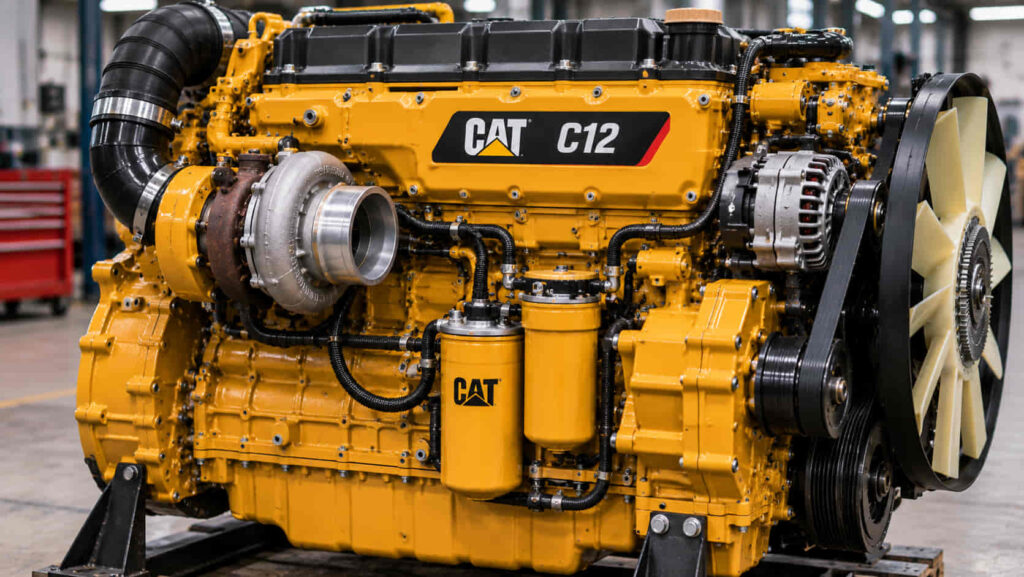
The Caterpillar C12 is a 12.0-liter inline-six diesel engine with a 130 mm bore, 150 mm stroke, turbocharging, aftercooling, and electronically controlled unit fuel injection. It was developed for heavy-duty trucks, industrial equipment, and marine applications requiring strong torque, efficient operation, and dependable performance under demanding loads.
For on-highway trucks, the Caterpillar C-12 was commonly offered with horsepower ratings ranging from 335 to 430 HP and torque ratings of approximately 1,350–1,650 lb-ft, depending on the engine calibration.
Caterpillar’s official 430 HP truck engine specification identifies a maximum torque of 1,650 lb-ft at 1,200 RPM. The same document lists a lubricant refill capacity of approximately 9.4 US gallons, or 36 liters, and a dry engine weight of 2,070 pounds.
However, C12 Cat engine specs vary significantly between truck and marine configurations.
For example, Caterpillar’s standard C12 marine propulsion range includes engines rated at 340–490 brake horsepower. High-performance C12 ACERT marine configurations can produce up to 705 brake horsepower.
These marine engines use different cooling arrangements, oil pans, and external components from the on-highway C-12.
One high-performance C12 ACERT marine specification lists an oil refill capacity of 28 liters and an approximate dry weight of 2,590 pounds.
The C12 is also important because of its fuel injection design.
Unlike the Caterpillar C7, which uses a hydraulically actuated electronic unit injector system, the C12 uses mechanically actuated electronically controlled unit injectors, commonly called MEUI.
Understanding these differences helps owners select correct replacement parts, maintain the proper oil level, diagnose injection problems, and compare the C12 with other Caterpillar diesel engines.
This guide explains the Caterpillar C12 engine’s displacement, horsepower, torque, bore and stroke, compression ratio, firing order, valve adjustment, fuel injection, oil capacity, engine weight, maintenance intervals, reliability, and common problems.
What Is the Caterpillar C12 Engine?
The Caterpillar C12 is a heavy-duty four-stroke diesel engine designed primarily for commercial truck, industrial, and marine service.
It belongs to Caterpillar’s electronically controlled inline-six engine family.
The C12 was introduced during the 1990s as part of Caterpillar’s development of more advanced electronically managed diesel engines.
It became popular in highway tractors and vocational trucks because it offered substantial pulling power without the weight of some larger engines.
The engine uses six cylinders arranged in a straight line.
Its cast-iron construction provides the rigidity required for heavy-duty diesel operation.
A large crankshaft converts piston movement into rotational output.
The cylinder head contains four valves per cylinder.
The engine also uses a mechanically actuated electronic unit injector system.
This arrangement combines camshaft-driven injection actuation with electronic control of fuel delivery.
A turbocharger increases intake airflow.
Aftercooling reduces the temperature of compressed intake air, helping support efficient combustion.
The engine control module monitors operating conditions and manages fuel injection.
However, the C12 name covers several engine arrangements.
A highway engine may use different calibration, lubrication, and cooling components from a marine version.
Consequently, an exact engine serial number is necessary when ordering parts or confirming detailed service specifications.
Caterpillar C12 Engine Displacement
The Caterpillar C12 has a nominal displacement of 12.0 liters, with a calculated swept volume of approximately 11.95 liters.
Caterpillar commonly identifies the engine as a 12-liter diesel.
Some official publications list its displacement as 732 cubic inches.
Another C12 ACERT technical document identifies approximately 729.23 cubic inches, corresponding more closely to the nominal bore and stroke dimensions.
These differences reflect the values presented in particular manufacturer publications.
They do not necessarily indicate two completely different engine architectures.
The engine contains six cylinders.
Each cylinder has a bore of 130 mm and a stroke of 150 mm.
Together, these dimensions produce approximately 11.95 liters of swept displacement.
The C12 is therefore commonly described as either an 11.9-liter or 12.0-liter engine.
The rounded 12.0L designation is appropriate for general identification.
However, precise displacement calculations and replacement component selection should use the applicable technical specifications.
Displacement alone does not determine power.
Turbocharger size, injection calibration, rated engine speed, and other components influence the output of each C12 configuration.
This explains why the same basic engine family can appear in both moderate-output commercial trucks and high-performance marine applications.
Caterpillar C12 Bore and Stroke
The Caterpillar C12 uses a 130 mm (5.12-inch) cylinder bore and a 150 mm (5.91-inch) piston stroke.
These specifications are consistent across the truck and marine arrangements documented by Caterpillar.
The bore is the diameter of each cylinder.
The stroke is the distance traveled by the piston between top dead center and bottom dead center.
Because the C12 has a longer stroke than bore, it is an undersquare engine.
This arrangement is common in heavy-duty diesels intended to deliver substantial torque at moderate engine speeds.
However, the bore-to-stroke relationship alone does not determine engine reliability or power.
Combustion pressure, piston design, crankshaft strength, lubrication, and cooling also contribute.
The bore and stroke are particularly important during an engine rebuild.
Cylinder walls must be inspected for wear.
The cylinder liners and related components must meet the manufacturer’s specifications.
The crankshaft and connecting rods also require careful inspection.
Using the wrong piston or cylinder pack can create incorrect compression or mechanical clearances.
Therefore, replacement parts should be selected according to the engine’s serial number and arrangement.
The 130 mm bore and 150 mm stroke provide the C12’s fundamental displacement, but the complete engine specification determines which internal components are compatible.
Caterpillar C12 Horsepower Specifications
The Caterpillar C12 truck engine was commonly offered with factory ratings ranging from 335 to 430 horsepower, while other applications were available with different outputs.
The exact horsepower depends on the engine rating and electronic calibration.
Caterpillar’s historical truck literature identifies a range of 335–430 HP for the C-12 family.
The company’s remanufactured heavy-duty engine reference guide also identifies replacement arrangements covering a broader 335–455 HP range.
However, that broader remanufacturing range should not be interpreted as the original rating of every production C12 truck engine.
For example, Caterpillar published a detailed specification for a 430 HP C-12.
Its rated output is 430 horsepower at a governed engine speed of 2,100 RPM.
The same performance chart identifies a maximum observed output of approximately 445 horsepower around 1,600 RPM for that particular rating.
The distinction reflects the published performance curve and rating methodology.
Other C12 engines have different governor settings and output characteristics.
Marine configurations are also different.
Caterpillar lists 340–490 brake horsepower for certain commercial marine engines.
High-performance marine versions extend the range to 705 brake horsepower.
These higher ratings operate under application-specific duty classifications.
They are not automatically suitable for continuous truck operation.
Caterpillar C12 430 HP Engine Specs
The Caterpillar C-12 430 HP truck engine is one of the best-documented configurations, producing 430 advertised horsepower and 1,650 lb-ft of peak torque.
Caterpillar’s performance brochure identifies a peak torque speed of 1,200 RPM.
Maximum rated engine speed is approximately 2,100 RPM.
The document lists an operating speed range of 1,200–2,100 RPM.
It also identifies a maximum horsepower value of approximately 445 HP around 1,600 RPM.
However, the advertised engine rating remains 430 HP.
The difference is important when comparing performance curves.
A truck should be identified according to its factory rating rather than the highest value appearing anywhere on a performance graph.
The same document lists the engine’s bore as 130 mm and its stroke as 150 mm.
The engine uses turbocharging with air-to-air aftercooling.
Its oil refill capacity is approximately 36 liters.
Dry weight with standard equipment is approximately 940 kg.
These specifications make the 430 HP C12 a useful reference when evaluating older highway tractors.
However, the exact installed engine may have different accessories, electronic parameters, or supporting components.
The engine serial number should be used to verify the original arrangement.
How Much Torque Does a Caterpillar C12 Produce?
The Caterpillar C12 commonly produces approximately 1,350–1,650 lb-ft of torque in documented truck configurations.
Torque is one of the engine’s most important performance characteristics.
Heavy commercial trucks require substantial pulling force to accelerate loads and climb grades.
The C12 delivers its peak torque at relatively low engine speeds.
For the documented 430 HP truck configuration, Caterpillar specifies 1,650 lb-ft at 1,200 RPM.
That equals approximately 2,237 Nm.
This low-speed torque can help reduce the need for frequent downshifting under load.
However, maximum torque depends on calibration.
Caterpillar’s remanufactured engine reference identifies different replacement configurations producing approximately 1,350, 1,450, and 1,650 lb-ft.
A 355 HP engine does not automatically have the same torque rating as a 430 HP version.
The torque curve is also important.
Peak torque describes only one point in the engine’s operating range.
Real-world pulling performance depends on how torque changes with RPM.
Transmission gearing and axle ratio influence the amount of force delivered to the wheels.
Therefore, comparing two trucks based solely on peak torque can be misleading.
The complete drivetrain configuration should be considered.
Caterpillar C12 Engine RPM Range
The Caterpillar C12’s operating speed depends on the application, with the documented 430 HP truck version using an operating range of approximately 1,200–2,100 RPM.
The engine produces useful torque at relatively low RPM.
This is particularly valuable for commercial trucking.
A heavy truck does not need to operate near maximum engine speed during every acceleration or grade-climbing event.
The appropriate cruising RPM depends on axle ratio, transmission gear, tire size, and engine rating.
Caterpillar’s historical performance literature includes operating recommendations for different loads and vehicle configurations.
However, a universal ideal cruising RPM should not be applied to every C12.
A truck operating with a heavy trailer may require a different gear selection from an unloaded vehicle.
Marine engines also have different rated speeds.
Caterpillar lists approximately 1,800–2,300 RPM for its commercial marine C12 product range.
The high-performance 705 bhp C12 ACERT is rated at 2,300 RPM.
These differences reflect application and duty rating.
Exceeding the appropriate engine speed can increase mechanical risk.
Likewise, operating at excessively low RPM under heavy load can place undesirable demands on the engine.
The correct operating range should follow the engine’s original rating and the vehicle manufacturer’s instructions.
Caterpillar C12 Compression Ratio
The Caterpillar C12 compression ratio varies by piston and engine arrangement, so a single compression ratio should not be assigned to the entire engine family.
The compression ratio describes the relationship between the cylinder’s maximum and minimum volumes.
Diesel engines rely on compression to increase intake air temperature before fuel injection.
The exact ratio depends on piston geometry and combustion chamber design.
Caterpillar’s replacement parts catalog identifies C12 cylinder pack configurations associated with compression ratios of 16.0:1 and 16.3:1.
These examples demonstrate that the engine family does not use one universal specification.
Other application-specific configurations may differ.
A higher compression ratio does not automatically mean an engine produces more horsepower.
Fuel injection timing, turbocharger boost, combustion chamber design, and electronic calibration also influence output.
Compression ratio becomes especially important during a rebuild.
Using a piston designed for a different engine arrangement can alter combustion pressure and temperature.
It may also affect emissions and operating performance.
Therefore, pistons and cylinder packs should be selected using the correct Caterpillar engine serial number.
A mechanic should not assume that every C12 piston is interchangeable simply because the cylinder bore is 130 mm.
Caterpillar C12 Firing Order
The Caterpillar C12 uses a firing order of 1-5-3-6-2-4.
This is the combustion sequence documented for the inline-six engine.
Cylinder number one is located at the front of the engine, opposite the flywheel end.
The firing order determines the sequence of combustion events across the six cylinders.
It helps distribute combustion forces through the crankshaft.
However, the engine’s fuel injection timing is controlled electronically.
The C12 does not use a conventional gasoline distributor.
Its engine control module manages the electronic unit injectors according to operating conditions.
The camshaft and crankshaft must remain correctly synchronized.
This relationship is important during engine assembly.
Incorrect mechanical timing can affect combustion and valve operation.
The firing order is also useful during troubleshooting.
A technician diagnosing a particular cylinder must identify the correct cylinder position.
However, the firing order alone does not provide complete instructions for valve adjustment or injector timing.
The relevant Caterpillar service procedure should be followed.
The engine’s serial number remains important because individual service details can vary by production arrangement.
How Many Valves Does the Caterpillar C12 Have?
The Caterpillar C12 has four valves per cylinder, giving the six-cylinder engine a total of 24 valves.
Each cylinder uses two intake valves and two exhaust valves.
The intake valves allow air to enter the combustion chamber.
The exhaust valves allow combustion gases to leave.
This arrangement helps provide sufficient airflow for a large turbocharged diesel engine.
Caterpillar’s C-10 and C-12 truck engine specification manual identifies four valves per cylinder.
The valve train uses camshaft-driven mechanical components.
The engine’s electronic fuel injectors are also actuated mechanically through the appropriate camshaft and injector mechanism.
This is an important distinction from engines using hydraulic injector actuation.
The valve train requires correct clearance and adjustment.
Excessive clearance can create noise and affect valve timing.
Insufficient clearance can prevent proper valve seating.
During rebuilding, the cylinder head should be inspected for worn valve guides, damaged seats, cracks, and other defects.
The appropriate rocker arms and related components must also be checked.
A replacement cylinder head must match the engine’s arrangement.
The presence of 24 valves does not establish that every C12 cylinder head is interchangeable across all production years.
Caterpillar C12 Valve Lash Specifications
For the documented C-12 truck engine configuration, Caterpillar specifies an intake valve clearance of 0.015 inch and an exhaust valve clearance of 0.025 inch when measured cold.
The corresponding metric values are approximately 0.38 mm and 0.64 mm.
These values appear in Caterpillar’s C-10 and C-12 truck engine service information.
The adjustment should be performed with the engine stopped and in the correct mechanical position.
The service procedure uses the firing order and crankshaft position to determine which valves can be adjusted.
However, these truck-engine values should not automatically be used on every C12 marine or specialized industrial arrangement.
Some application-specific documentation identifies different valve clearance specifications.
The actual engine serial number must therefore be checked.
Valve lash affects the operation of the engine.
Excessive clearance can produce abnormal noise and reduce effective valve opening.
Insufficient clearance can interfere with complete valve closure.
This may contribute to poor compression or valve damage.
The rocker arm and valve bridge mechanisms also require inspection.
A mechanic should use the correct Caterpillar adjustment sequence.
A generic inline-six valve adjustment procedure is not a substitute for the manufacturer-specific instructions.
Caterpillar C12 Fuel Injection System
The Caterpillar C12 uses a Mechanically Actuated Electronically Controlled Unit Injector system, commonly called MEUI.
This is one of the engine’s defining technologies.
The system combines mechanical injector actuation with electronic control.
The engine’s camshaft drives the injection mechanism.
An electronic solenoid controls the injection event.
The engine control module determines the appropriate fuel delivery according to engine speed, load, and other operating information.
This arrangement allows more precise injection control than a purely mechanical fuel system.
However, it differs from the HEUI design used in engines such as the Caterpillar C7.
HEUI uses high-pressure engine oil to actuate the injectors.
The C12’s MEUI design uses mechanical actuation rather than relying on a dedicated high-pressure hydraulic oil system to provide injector force.
This distinction matters during diagnosis.
A C12 injector problem should not automatically be approached using procedures intended for a C7 HEUI system.
The C12 still requires clean engine oil for lubrication.
However, oil pressure is not used in the same way to generate the injector’s operating force.
The correct fuel injection components must be identified using the engine serial number.
Read more: Crankshaft Position Sensor Relearn
How Does the Caterpillar C12 MEUI System Work?
The C12 MEUI system uses the engine’s camshaft to provide mechanical injection force while the ECM electronically controls the timing and amount of fuel delivered.
The engine’s fuel transfer system supplies diesel to the injection equipment.
Each electronically controlled unit injector is installed in the cylinder head.
The mechanical injector mechanism produces the necessary injection action.
The ECM energizes the injector solenoid according to its programmed strategy.
This allows the engine to regulate fuel delivery based on operating conditions.
The system also relies on sensors.
Engine speed and timing information are particularly important.
Other inputs can include boost pressure, coolant temperature, and fuel temperature.
The ECM uses these values to manage engine performance.
However, a problem in the system does not always mean the injector itself has failed.
A defective sensor can produce abnormal control information.
Damaged wiring can interrupt the injector command.
Fuel supply restrictions can also reduce performance.
Therefore, injector diagnosis should involve the complete system.
A compatible Caterpillar diagnostic tool can help identify fault codes and operating parameters.
The technician should also evaluate fuel pressure and the mechanical injector components according to the service instructions.
Caterpillar C12 ECM and Electronic Controls
The Caterpillar C12 uses electronic engine management to control fuel injection, engine speed, diagnostics, and selected protection functions.
Its electronic control module stores engine operating parameters.
The ECM receives signals from multiple sensors.
It then determines the appropriate fuel delivery.
Caterpillar’s electronic control system can also store diagnostic information.
This helps technicians identify abnormal operating conditions.
For example, a sensor fault may cause reduced power or another drivability problem.
However, not every electronic fault code means the engine has internal mechanical damage.
The code must be interpreted using the correct service procedure.
Caterpillar Electronic Technician, commonly known as Cat ET, is an important diagnostic platform for electronically controlled Caterpillar engines.
It allows qualified technicians to access relevant information and perform supported service functions.
However, the available functions depend on the ECM generation and engine configuration.
Electronic parameters may also be protected.
Changing the engine’s factory rating is not equivalent to simply selecting another horsepower number.
The hardware, cooling system, drivetrain, and emissions requirements must support the intended calibration.
A dependable C12 repair should preserve the correct relationship between its mechanical components and electronic controls.
Caterpillar C12 Turbocharger Specifications
The Caterpillar C12 uses turbocharging and aftercooling to provide sufficient intake airflow for its diesel combustion system.
The turbocharger uses exhaust energy to drive a compressor.
The compressor increases intake air pressure.
This allows more air to enter the engine.
The additional airflow helps support fuel combustion under load.
Caterpillar’s truck literature identifies a turbocharged engine with air-to-air aftercooling.
This system reduces the temperature of compressed air before it enters the intake manifold.
Cooler air has greater density, helping support combustion efficiency.
However, the turbocharger arrangement depends on the engine application.
A marine C12 may have a different turbocharger or cooling arrangement.
Some marine engines use seawater aftercooling.
Therefore, a turbocharger from one engine arrangement should not automatically be considered compatible with another.
Low boost pressure may cause reduced performance.
However, a damaged turbocharger is not the only possible cause.
Intake leaks, exhaust leaks, fuel system problems, and sensor faults can produce similar symptoms.
The correct diagnosis should evaluate the complete air-management system.
A replacement turbocharger must match the engine’s original rating and supporting components.
Caterpillar C12 Oil Capacity
The Caterpillar C12 truck engine has a published oil refill capacity of approximately 9.4 US gallons, or 36 liters, in the manufacturer’s documented 430 HP configuration.
This equals approximately 38 US quarts when converted from the metric value.
However, Caterpillar’s on-highway maintenance documentation also identifies a 34-liter, or 36-quart, oil sump capacity reference for certain C-10 and C-12 engines.
These figures reflect different published service references and configurations.
The 36-quart figure also appears as a default engine oil capacity setting in Caterpillar’s electronic truck engine programming literature.
However, a programmed maintenance parameter should not automatically be treated as the exact refill capacity of every installed engine.
The C12 can use different oil pan arrangements.
Additional filtration equipment may also affect the complete lubrication system.
For this reason, the engine serial number and actual sump should be checked.
The quantity required during a routine oil change may also differ from a complete dry engine fill.
After draining the oil and replacing the filter, the engine should be refilled using the appropriate service procedure.
The final oil level must be checked with the dipstick.
Adding extra oil simply to match a number found online can result in overfilling.
Caterpillar C12 Marine Oil Capacity
The Caterpillar C12 marine engine can have a different oil capacity from the on-highway version because of its specialized sump and cooling arrangements.
One high-performance C12 ACERT marine specification identifies a lubricant refill capacity of 28 liters.
That equals approximately 7.4 US gallons or 29.6 US quarts.
This is considerably less than the 36-liter refill listed for Caterpillar’s 430 HP truck engine.
The difference is associated with the actual engine configuration.
The documented marine model uses a center-sump oil pan.
It also has a different collection of external systems and accessories.
However, not every C12 marine engine necessarily uses the same sump.
Marine engines may be installed in vessels with different equipment arrangements.
The specific oil pan and filtration equipment must therefore be verified.
The 28-liter figure should not be used as a universal specification for all C12 marine installations.
Likewise, the 36-liter truck value should not be transferred to a marine engine.
The correct procedure is to identify the engine serial number and consult its Caterpillar operation and maintenance manual.
After servicing, the oil level should be checked under the specified conditions.
A correct fill is essential for reliable lubrication during vessel operation.
What Oil Does a Caterpillar C12 Use?
The Caterpillar C12 requires heavy-duty diesel engine oil meeting the applicable Caterpillar lubricant recommendations, with SAE 15W-40 and SAE 10W-30 among the viscosity grades identified in manufacturer literature.
However, the correct oil depends on engine generation, application, and ambient temperature.
Caterpillar’s C12 ACERT marine specifications identify Caterpillar Diesel Engine Oil in 10W-30 or 15W-40.
Older on-highway service literature discusses API CH-4 oils in the context of the engine’s original maintenance schedule.
However, that historical classification should not be interpreted as a universal recommendation to use an obsolete oil formulation today.
Modern replacement oils must be evaluated for compatibility with the actual engine.
The correct performance standard is more important than viscosity alone.
Lubricant formulation influences wear protection, oxidation resistance, and soot handling.
The C12’s turbocharger also depends on clean engine oil.
Insufficient lubrication can damage the turbocharger bearings.
The crankshaft and connecting rod bearings require appropriate oil pressure and viscosity.
The selected oil should follow the engine-specific Caterpillar service guidance.
Using a thicker lubricant does not automatically provide better protection.
Likewise, using synthetic oil does not automatically permit longer service intervals.
The correct lubrication program should account for engine age, operating conditions, and the manufacturer’s requirements.
Caterpillar C12 Oil Change Interval
Caterpillar C12 oil change intervals depend on engine application, operating conditions, lubricant classification, oil sump capacity, and engine generation.
For older on-highway C-12 engines, Caterpillar’s maintenance literature provides example intervals of 15,000, 20,000, and 25,000 miles under different duty categories.
These values are associated with specific historical operating conditions and lubricant standards.
Severe-duty vehicles require more frequent service.
Normal highway operation can qualify for a longer interval.
Light-duty conditions may allow the maximum interval listed in the relevant table.
However, those historical figures should not automatically be applied to every C12 operating today.
The engine’s actual oil sump and filtration arrangement matter.
Marine applications have different requirements.
For the documented 705 bhp C12 ACERT marine engine, Caterpillar specifies a 250-hour oil change interval.
This is an operating-hour requirement rather than a mileage-based interval.
The difference reflects the way marine engines are used.
A vessel may operate for extended periods under relatively high load.
The correct maintenance schedule must therefore match the application.
Caterpillar’s Scheduled Oil Sampling program can also help evaluate oil condition.
However, oil analysis should support an approved maintenance strategy rather than justify arbitrary extensions.
Caterpillar C12 Oil Filter Specifications
The Caterpillar C12 uses application-specific engine oil filtration, and the correct replacement filter should be identified using the engine serial number.
Caterpillar’s on-highway maintenance literature recommends the 1R-0716 oil filter or an equivalent meeting the required performance and durability standards for the covered applications.
However, this does not establish that every C12 oil filter arrangement uses one identical part number.
Different engine configurations may include alternative filtration equipment.
The manufacturer’s truck literature identifies a standard full-flow oil filtration system.
Optional bypass filtration was also available for certain applications.
A bypass filter can increase total oil system volume.
This may affect the amount of lubricant required during service.
However, the filter arrangement should not be changed without checking the appropriate installation requirements.
The oil filter helps remove contaminants circulating through the lubrication system.
It protects bearings, camshaft components, and other precision surfaces.
However, a high-quality filter cannot compensate for severely neglected oil changes.
Fuel filtration is equally important.
The C12’s electronic unit injectors require a reliable supply of clean diesel fuel.
Oil and fuel filters serve different functions and must not be confused.
The correct parts should be selected from Caterpillar’s engine-specific parts catalog.
Caterpillar C12 Engine Weight
The Caterpillar C-12 truck engine has a published dry weight of approximately 2,070 pounds, or 940 kg, in the manufacturer’s 430 HP specification.
This is an important advantage compared with some larger heavy-duty engines.
Lower engine weight can help preserve vehicle payload capacity.
However, dry weight does not represent the complete installed powertrain mass.
The engine may also require an air compressor, alternator, mounting hardware, flywheel housing, and other accessories.
Operating fluids add further weight.
Marine configurations are substantially different.
Caterpillar’s commercial C12 marine product information lists a dry weight of approximately 2,588 pounds, or 1,174 kg.
The documented high-performance C12 ACERT marine version weighs approximately 2,590 pounds.
The difference reflects the installed equipment and application-specific components.
Marine cooling arrangements can include seawater pumps, heat exchangers, and water-cooled exhaust components.
Therefore, a truck’s 2,070-pound figure should not be used when calculating the lifting weight of a marine engine package.
Correct lifting equipment must be selected for the actual assembly.
The engine’s weight also matters during replacement or repowering.
Engine mounts, frame capacity, and supporting structures must be appropriate.
Caterpillar C12 Engine Dimensions
The Caterpillar C12 engine dimensions vary according to whether the specification describes a truck installation or a marine package.
Caterpillar’s 430 HP truck brochure includes an approximate length of 50.6 inches for a documented overall dimension.
It also identifies a width of approximately 35.68 inches and a height of approximately 41.85 inches.
However, the brochure includes multiple dimensional references.
The exact meaning of each measurement depends on the associated engineering drawing.
The marine C12 has a different published package size.
Caterpillar identifies a length of approximately 62 inches, width of 38.1 inches, and height of 39.5 inches for the commercial marine configuration.
The engine’s accessories influence these measurements.
A turbocharger, exhaust manifold, air compressor, or cooling component can change the required installation space.
This is particularly important when replacing an engine.
A C12 from one truck may not fit directly into another vehicle without modifications.
Marine installations also require appropriate shaft alignment and service access.
The manufacturer’s general dimensions should therefore be treated as preliminary references.
Detailed installation drawings are required for engineering a replacement.
The engine arrangement number is essential when confirming physical compatibility.
Caterpillar C12 Cooling System Capacity
The Caterpillar C12 cooling system capacity varies by application and must distinguish the engine-only volume from the complete vehicle or vessel cooling system.
Caterpillar’s 430 HP truck brochure identifies an engine-only cooling system capacity of approximately 2.7 US gallons, or 10.2 liters.
However, the manufacturer specifically notes that the total system capacity varies with radiator size and cab heater equipment.
Therefore, 2.7 gallons should not be used as the complete coolant refill quantity for a heavy-duty truck.
The radiator, hoses, heater circuits, and other components contain additional coolant.
Marine engines have different cooling arrangements.
The documented C12 ACERT high-performance marine configuration identifies a cooling system refill capacity of approximately 45 liters.
This reflects the specified engine and cooling package.
It should not be applied to every marine installation.
The correct coolant formulation is also important.
Caterpillar provides specific coolant requirements for its engines.
Incorrect coolant or inadequate maintenance can contribute to corrosion, deposits, and cooling system damage.
Overheating is particularly dangerous under heavy load.
A cooling system problem should be investigated before it causes cylinder head or internal engine damage.
Caterpillar C12 Normal Oil Pressure
Normal Caterpillar C12 oil pressure varies according to engine speed, temperature, and configuration, so one universal pressure value should not be used to diagnose every engine.
The lubrication system uses an engine-driven oil pump.
Oil is delivered to bearings and other internal components under pressure.
Pressure normally increases as engine speed rises.
Oil temperature also affects the reading.
Cold oil may produce higher pressure than oil at normal operating temperature.
Freightliner operating manuals identify reference oil pressure values for C-10 and C-12 applications.
One published table lists approximately 10–20 psi at idle and 30–45 psi at rated engine speed.
However, another Freightliner manual shows different rated-speed reference values for its documented vehicle configuration.
This demonstrates why application-specific service information matters.
A sudden drop in oil pressure is more important than small differences between generalized charts.
Low pressure may indicate insufficient oil level.
However, other causes include pump wear, bearing clearance problems, or a defective pressure sensor.
The correct diagnosis should verify actual pressure.
An engine displaying a genuine low-oil-pressure warning should not be operated until the cause has been established.
Continuing to run the C12 without adequate lubrication can cause severe internal damage.
Caterpillar C12 Engine Brake Specifications
The Caterpillar C12 can be equipped with an engine compression brake to provide additional deceleration during heavy-duty truck operation.
Caterpillar’s 430 HP truck brochure identifies the Jacobs Model 312A engine brake as an available accessory.
The engine brake uses the engine’s compression process to help slow the vehicle.
This reduces dependence on the service brakes during prolonged downhill driving.
However, engine brake performance depends on engine speed and operating conditions.
The manufacturer provides an engine brake performance curve for the documented configuration.
The braking effect generally increases as engine speed rises within the appropriate operating range.
However, the engine brake must be used according to the vehicle manufacturer’s instructions.
Transmission gear selection is also important.
The engine brake is not a substitute for the service brakes.
It should also be used carefully on slippery road surfaces.
The engine brake’s mechanical components require inspection and adjustment.
However, the exact procedures depend on the installed brake model.
A Jacobs 312A adjustment specification should not automatically be used for a different engine brake.
Proper setup helps ensure dependable operation without damaging the valve train.
Caterpillar C12 Engine Applications
The Caterpillar C12 was used in heavy-duty highway trucks, vocational vehicles, and marine applications, with additional support for specialized installations.
Its on-highway use included Class 8 tractors and commercial trucks.
The engine appeared in various configurations from manufacturers such as Freightliner, Kenworth, and Peterbilt.
However, availability depended on model year and truck specification.
The C12’s relatively compact size and lower weight compared with larger engines made it attractive for certain highway operations.
Its torque output also supported heavy hauling.
Marine propulsion is another major application.
Caterpillar continues to provide commercial marine C12 product information.
The engine is available in different power ratings according to vessel use.
Certain marine versions are designed for commercial work.
Others are intended for higher-performance applications with different duty cycles.
However, a marine engine should not be installed into a highway truck simply because it shares the C12 designation.
Its cooling system, turbocharging, electronic calibration, and supporting hardware can differ.
The correct engine arrangement is essential for replacement.
A buyer should also consider whether service parts are available for the intended installation.
Caterpillar’s dealer network and remanufacturing program continue to support the C12 family.
Caterpillar C12 Marine Engine Specs
The Caterpillar C12 marine propulsion engine uses the same basic inline-six architecture but has specialized equipment and power ratings for vessel applications.
Caterpillar’s commercial marine range identifies output between 340 and 490 brake horsepower.
Rated engine speed varies from approximately 1,800 to 2,300 RPM.
The engine uses turbocharging and aftercooling.
Its displacement remains approximately 12 liters.
The bore is 130 mm, and the stroke is 150 mm.
However, the marine cooling system differs from a highway truck’s arrangement.
Caterpillar offers seawater aftercooling and other marine-specific components.
The engine may also include a seawater pump and water-cooled exhaust equipment.
These features contribute to its larger published package weight.
The commercial marine C12 has a dry weight of approximately 1,174 kg.
Caterpillar identifies counterclockwise rotation when viewed from the flywheel end.
However, the actual shaft arrangement and transmission configuration must be checked during installation.
Marine performance ratings also depend on duty category.
A vessel intended for continuous commercial service may require a different engine rating from one used for intermittent recreational operation.
The correct rating should be selected according to Caterpillar’s marine application guidance.
Caterpillar C12 ACERT 705 HP Marine Engine
The Caterpillar C12 ACERT high-performance marine engine has a published rating of 705 brake horsepower at 2,300 RPM for the documented configuration.
This is substantially higher than the common truck engine ratings.
However, the higher output is achieved under a marine-specific rating and duty classification.
The engine remains an inline-six diesel.
Its bore and stroke are 130 mm and 150 mm.
The published displacement is approximately 11.95 liters.
The engine uses turbocharging and aftercooling.
Caterpillar identifies the MEUI fuel system.
The engine also has a marine-specific cooling package.
For the documented 705 bhp version, Caterpillar lists a 28-liter lubricant refill.
The cooling system capacity is approximately 45 liters.
Dry engine weight is approximately 1,175 kg.
The manufacturer specifies a 250-hour oil change interval.
However, these maintenance requirements belong to the particular high-performance marine configuration.
The 705 bhp rating should not be used as evidence that a standard C12 truck engine can safely produce the same output.
Truck engines and marine engines have different operating requirements.
The correct duty rating is essential for long-term reliability.
Caterpillar C12 vs C12 ACERT
The C12 and C12 ACERT are related Caterpillar engine configurations, but ACERT-equipped versions can have different combustion, calibration, and supporting-system specifications.
ACERT stands for Advanced Combustion Emissions Reduction Technology.
Caterpillar used the designation across several diesel engine families.
It identifies a group of technologies intended to improve combustion efficiency and address applicable emissions requirements.
However, ACERT is not one universal hardware package.
Different engines and applications use different components.
The C12 ACERT marine engine retains the basic 130 mm bore and 150 mm stroke architecture.
Its 12-liter displacement remains similar to that of the earlier C12.
However, high-performance configurations can have different fuel injection, turbocharging, cooling, and calibration arrangements.
The manufacturer also offers different power ratings.
Therefore, C12 ACERT should not automatically be interpreted as a direct replacement for any older C12.
A component designed for a high-performance marine engine may not be appropriate for a truck application.
Likewise, an engine calibration intended for a vessel may be unsuitable for continuous highway operation.
The correct service information depends on the exact engine arrangement and serial number.
Caterpillar C12 vs C13 Engine
The Caterpillar C12 and C13 are different engine families, with the C13 offering greater displacement and different internal components in its relevant generations.
The C12 has a nominal displacement of 12 liters.
The C13 is commonly identified as a 12.5-liter engine in its earlier heavy-duty configuration.
Both use inline-six arrangements.
They also share certain Caterpillar engineering principles.
However, their rotating assemblies and other components are not universally interchangeable.
The C13 appeared in Caterpillar’s later heavy-duty engine lineup with additional engine and emissions technology.
Its output ratings also varied by generation.
A C13 with a higher factory rating may provide additional performance compared with a particular C12.
However, the correct comparison depends on the actual engines.
Weight, repair costs, emissions equipment, and service accessibility also matter.
The C12 can be attractive because of its relatively modest size and weight for the torque it provides.
The C13 may be better suited to applications requiring greater output or a newer engine configuration.
However, neither should be selected solely according to displacement.
The complete truck, operating history, and maintenance requirements determine the best ownership choice.
Caterpillar C12 vs C15 Engine
The Caterpillar C15 is a larger-displacement heavy-duty diesel engine that generally offers greater maximum torque and horsepower than the traditional C12 truck engine.
The C12 has a nominal displacement of 12 liters.
The C15 belongs to Caterpillar’s larger 15-liter class.
The C15 became especially recognizable in heavy hauling and high-output highway applications.
However, the larger engine generally carries additional weight.
This can affect payload and vehicle configuration.
The C12’s comparatively lighter construction was one of its historical selling points.
Caterpillar’s truck literature identifies a dry weight of approximately 2,070 pounds for the C12.
This helped make it attractive for line-haul and vocational applications.
The C15 may offer greater pulling power.
However, the complete vehicle determines how that power can be used.
Transmission rating, axle gearing, frame configuration, and gross combined weight limits remain essential.
Fuel consumption also depends on operating conditions.
A larger engine does not automatically use more fuel in every possible application.
Likewise, a smaller engine is not automatically more efficient under extreme load.
The correct choice depends on the route, payload, maintenance costs, and desired performance.
Caterpillar C12 vs 3406E
The Caterpillar C12 and 3406E are electronically controlled heavy-duty diesel engines, but the 3406E uses a larger engine platform and is associated with higher-output applications.
The 3406E is a well-known Caterpillar highway engine.
It uses an inline-six design with electronic fuel injection.
Its displacement is larger than that of the C12 in the commonly referenced configurations.
The C12 was developed to offer substantial power and torque with lower engine weight.
This made it suitable for trucks where payload and operating efficiency were important.
The 3406E became popular among operators seeking higher torque potential and a large heavy-duty engine platform.
However, the differences extend beyond displacement.
The engines use different blocks, rotating assemblies, and related components.
A replacement part should never be selected according to external appearance alone.
The service requirements can also differ.
The correct oil capacity, filter arrangement, and injector components must match the engine.
When comparing used trucks, overall condition matters.
A well-maintained C12 can be a better purchase than a neglected 3406E.
Likewise, a healthy 3406E may be preferable when the vehicle’s workload requires greater engine output.
Is the Caterpillar C12 a Reliable Engine?
The Caterpillar C12 is widely regarded as a durable heavy-duty diesel engine, particularly when its fuel injection, cooling, and lubrication systems are maintained correctly.
The engine uses a robust inline-six architecture.
Its construction is intended for sustained commercial operation.
Caterpillar’s electronic injection system provides controlled fuel delivery.
The turbocharger and aftercooler support useful low-speed torque.
However, reliability depends on more than basic design.
Fuel system cleanliness is important.
The electronic unit injectors contain precision components.
Contaminated diesel fuel can cause expensive problems.
The lubrication system must also function correctly.
Insufficient oil pressure can damage bearings, camshaft components, and the turbocharger.
Cooling system maintenance is equally important.
Repeated overheating can cause cylinder head damage and other internal problems.
The engine’s age also matters.
Many highway C12 installations have accumulated extensive service.
An engine may have experienced multiple owners, repairs, or modifications.
Maintenance history should therefore be reviewed carefully.
A high-mileage engine with proper service records can be a better choice than one with fewer miles but poor maintenance.
The C12’s reliability reputation is useful, but it should not replace inspection of the individual engine.
What Are Common Caterpillar C12 Engine Problems?
Common Caterpillar C12 problems include electronic injector faults, fuel supply restrictions, turbocharger issues, oil or coolant leaks, sensor failures, and age-related mechanical wear.
The MEUI system is an important diagnostic area.
A defective injector can cause rough running, misfires, or reduced power.
However, the same symptoms can result from inadequate fuel pressure.
Electrical wiring and sensor problems can also affect injection control.
The engine control module relies on accurate speed and timing information.
A sensor fault may create starting or performance problems.
Turbocharger wear is another consideration.
However, low boost pressure does not automatically prove that the turbocharger is defective.
An intake leak or fuel supply problem can produce similar symptoms.
Cooling system condition should also be inspected.
A leaking radiator or failed water pump can lead to overheating.
Oil leakage may develop around aging seals and gaskets.
However, an external leak does not necessarily mean the engine requires rebuilding.
A professional diagnosis should distinguish repairable supporting-system faults from major internal damage.
This helps avoid unnecessary replacement of expensive components.
How Long Does a Caterpillar C12 Engine Last?
A properly maintained Caterpillar C12 can provide substantial commercial service life, but no single mileage or operating-hour figure guarantees its durability.
The engine was designed for heavy-duty applications.
Its internal components are built to withstand sustained diesel combustion loads.
However, service life depends on operating conditions.
A highway truck may accumulate miles relatively quickly.
A vocational truck may spend extensive time idling or operating at low road speeds.
Marine engines are typically evaluated according to operating hours.
These workloads are not directly equivalent.
Maintenance is another major factor.
Clean oil protects bearings and turbocharger components.
Fuel filtration supports injector reliability.
A healthy cooling system helps prevent overheating.
The engine should also operate within its intended load and speed range.
Excessive tuning or poorly matched drivetrain components can increase stress.
Some owners report C12 engines operating for hundreds of thousands of miles.
However, individual examples should not be treated as a universal lifespan guarantee.
A meaningful condition assessment should include oil pressure, oil consumption, coolant condition, blow-by, electronic diagnostics, and maintenance records.
These measurements provide more useful information than odometer mileage alone.
Caterpillar C12 Rebuild and Overhaul Options
A Caterpillar C12 can be repaired, overhauled, or replaced with a remanufactured engine depending on the severity of internal damage and the condition of the existing engine block.
Caterpillar continues to provide C12 remanufacturing support.
Its heavy-duty engine repair program includes overhaul kits, short blocks, long blocks, and complete replacement engines.
However, the correct option depends on the original failure.
A leaking gasket or defective injector may be repaired without rebuilding the entire engine.
Severe cylinder wear may require cylinder pack replacement.
A damaged crankshaft can justify a more extensive repair.
A cracked engine block may make rebuilding the original assembly uneconomical.
Caterpillar’s remanufactured engine program includes C12 configurations with new engine blocks, cylinder heads, and crankshafts.
The company also offers certain rear-engine power take-off arrangements.
These options can help reduce compatibility problems during a replacement.
However, the correct engine arrangement number must be verified.
The old engine may have application-specific equipment.
The replacement must also match the required electronic calibration and supporting hardware.
A professional inspection should determine whether a localized repair, complete overhaul, or remanufactured replacement offers the best value.
Caterpillar C12 Engine Replacement Cost
Caterpillar C12 engine replacement cost varies according to the engine format, included accessories, installation labor, and the amount of supporting equipment requiring repair.
A replacement short block does not include the same components as a complete engine.
A long block may provide a cylinder block and cylinder head assembly.
A complete remanufactured engine may include more of the external equipment.
However, the exact package depends on Caterpillar’s current offering.
Core charges can also affect cost.
A rebuildable original engine may qualify for a different core credit from one with severe block damage.
Installation labor is another major expense.
Removing a heavy-duty engine requires appropriate equipment.
The transmission, cooling system, exhaust system, and electrical connections must also be managed.
A marine installation can involve different labor requirements.
Engine alignment and marine cooling components may increase the complexity.
The buyer should therefore request an itemized estimate.
The quotation should identify the replacement engine, accessories, fluids, filters, labor, shipping, and core charges.
The warranty should also be reviewed.
A lower engine-only price does not automatically mean a lower installed cost.
The best decision considers total ownership expense and the expected future service of the equipment.
How to Identify Caterpillar C12 Engine Specs by Serial Number
The most reliable way to identify the exact Caterpillar C12 specifications is to use the engine serial number and arrangement number in Caterpillar’s service and parts systems.
The C12 engine family includes multiple configurations.
Horsepower and torque vary.
Compression ratio can differ according to piston design.
Oil capacity depends on the sump and filtration arrangement.
Marine engines may use different cooling systems from highway engines.
Therefore, the C12 model name alone is not sufficient for selecting every replacement part.
The engine serial number identifies the production configuration.
The arrangement number provides additional information about installed components.
Caterpillar’s parts documentation uses these identifiers to establish compatibility.
This is especially important during rebuilding.
Cylinder packs, injectors, turbochargers, and engine control components must match the correct arrangement.
The engine may also have been replaced during the vehicle’s service life.
In that situation, the truck’s original specifications may no longer match the installed engine.
The current engine dataplate should therefore be inspected.
A Caterpillar dealer can help obtain the appropriate service information.
Using the exact engine identification reduces the risk of incorrect parts and maintenance procedures.
Final Verdict: What Are the Caterpillar C12 Engine Specs?
The Caterpillar C12 is a 12.0-liter inline-six diesel engine with a 130 mm bore, 150 mm stroke, 24 valves, turbocharging, aftercooling, and MEUI electronic fuel injection.
Its firing order is 1-5-3-6-2-4.
The engine was widely used in heavy-duty trucks and marine applications.
For conventional truck configurations, horsepower commonly ranges from 335 to 430 HP.
The documented 430 HP version produces 1,650 lb-ft of torque at 1,200 RPM.
Its operating range is approximately 1,200–2,100 RPM.
The same truck specification identifies a dry weight of approximately 2,070 pounds and an oil refill capacity of about 36 liters.
However, the engine family includes different oil sump and maintenance configurations.
The actual refill quantity should be verified before servicing.
Marine C12 engines have different power ratings.
Caterpillar identifies 340–490 bhp for certain commercial propulsion configurations.
High-performance C12 ACERT versions can produce up to 705 bhp.
The documented 705 bhp marine engine has a 28-liter oil refill and an approximate dry weight of 2,590 pounds.
These specifications are not interchangeable with those of the truck engine.
Compression ratio also varies.
Caterpillar replacement parts information identifies different C12 cylinder packs associated with 16.0:1 and 16.3:1 compression ratios.
The fuel injection system is another important characteristic.
The C12 uses mechanically actuated electronically controlled unit injectors rather than the HEUI arrangement associated with the smaller Caterpillar C7.
Long-term reliability depends on clean fuel, suitable lubrication, effective cooling, and correct engine operation.
Potential problems include injector faults, fuel restrictions, oil leaks, turbocharger wear, and electrical sensor failures.
However, many of these conditions can be repaired without replacing the complete engine.
The most important rule when using Caterpillar C12 engine specs is to identify the actual engine serial number, arrangement number, and application before selecting horsepower, torque, oil capacity, or replacement components.
This approach provides accurate service information and helps preserve the reliability of the engine throughout its operating life.