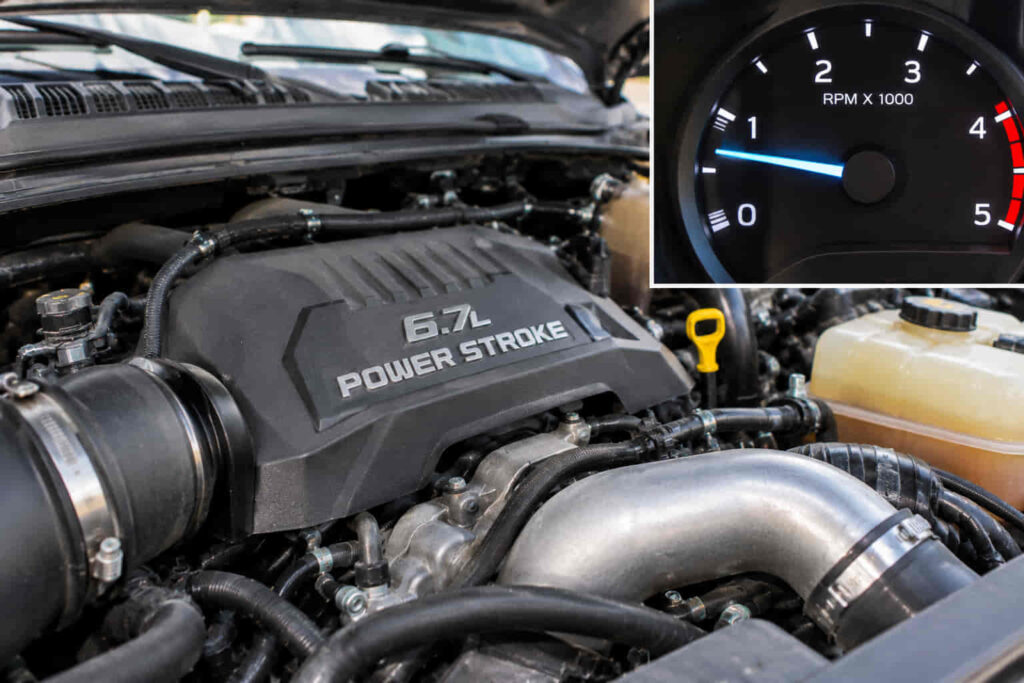
6.7 Powerstroke high idle in Park is often a normal engine management function rather than a mechanical problem. The Ford 6.7L Power Stroke diesel may automatically increase its idle speed to approximately 1,000–1,200 RPM during extended idling, cold-weather operation, or certain exhaust aftertreatment processes. High idle can also occur when the truck has an activated Stationary Elevated Idle Control system or uses power take-off equipment.
Ford Service Bulletin SSM 51691 specifically explains why certain 6.7 Power Stroke engines increase idle speed after prolonged stationary operation. The powertrain control module may raise engine speed to reduce accumulated unburned hydrocarbons within the selective catalytic reduction system. Under the conditions described by Ford, idle speed can increase to approximately 1,000 RPM at an ambient temperature of 80°F (26°C) and reach approximately 1,200 RPM in extremely cold conditions.
This elevated idle condition does not automatically indicate a defective turbocharger, fuel injector, throttle sensor, or engine control module. Ford describes the associated behavior as normal for the applications covered by its service communication.
However, not every high-idle complaint is normal. A truck that idles erratically, accelerates unexpectedly, displays warning lights, experiences excessive exhaust temperatures, or remains at an abnormal RPM without an identifiable control-system reason requires diagnosis.
The Ford 6.7L Power Stroke is a turbocharged V8 diesel engine used in Super Duty trucks, including the F-250, F-350, F-450, and F-550. Related 6.7L applications are also used in larger Ford commercial trucks.
Understanding the differences between automatic elevated idle, cold-weather warm-up, diesel particulate filter regeneration, SCR hydrocarbon management, and PTO idle control is essential for determining whether the engine is working normally or needs repair.
Why Does My 6.7 Powerstroke High Idle in Park?
The main reason a 6.7 Powerstroke increases idle speed in Park is that the engine control system has determined that a higher RPM is needed for a particular operating function.
Modern diesel engines do not maintain exactly the same idle speed under every operating condition.
The powertrain control module, commonly called the PCM, manages fuel injection and engine speed according to information from several sensors.
These inputs include engine temperature, ambient temperature, exhaust aftertreatment conditions, electrical demand, and vehicle operating status.
When the truck is in Park, the engine may operate at a higher idle speed without driver accelerator input.
One important cause is the selective catalytic reduction system.
During prolonged idling, unburned hydrocarbons can accumulate within the exhaust aftertreatment system.
The PCM may command a higher engine idle speed to reduce this buildup.
Cold weather creates another reason for increased idle speed.
A diesel engine may lose heat during prolonged idling because it produces relatively little heat at low load.
Ford therefore uses temperature-dependent operating strategies to help manage engine conditions.
Some trucks also have an optional stationary elevated idle feature.
This allows properly configured equipment to request a higher engine speed while the vehicle remains parked.
The key distinction is whether the higher RPM is being deliberately commanded or results from a malfunction.
A smooth increase to approximately 1,000 RPM with no warning lights may be normal.
An unstable idle that repeatedly rises and falls requires a different diagnostic approach.
Is High Idle Normal on a 6.7 Powerstroke?
Yes. High idle is a documented normal operating condition on certain Ford 6.7L Power Stroke diesel trucks, especially during extended idling or cold-weather operation.
Ford Service Message SSM 51691, issued on June 8, 2023, addresses elevated idle after prolonged stationary operation.
The message covers 2011–2023 F-Super Duty vehicles and specified 2016–2024 F-650/F-750 applications equipped with the 6.7L engine.
Ford explains that the PCM estimates hydrocarbon accumulation in the selective catalytic reduction system.
When appropriate, the module commands elevated idle speed to reduce the accumulated hydrocarbons.
The resulting engine speed depends partly on ambient temperature.
The bulletin identifies approximately 1,000 RPM near 80°F and as much as 1,200 RPM at minus 40°F.
Ford also notes that exhaust smoke or a smell associated with the diesel exhaust fluid system may occur during this condition.
The bulletin states that the described smoke and odor do not adversely affect engine reliability or durability.
However, owners must still follow any exhaust filter warning messages.
This distinction is important because high idle should not automatically be treated as an engine malfunction.
At the same time, Ford’s documentation does not establish that every elevated RPM condition is normal.
A truck with unusual noises, persistent fault codes, overheating, or unexpected acceleration should be evaluated separately.
The correct interpretation depends on the engine’s operating conditions and the applicable model-year service information.
What Is the Normal 6.7 Powerstroke Idle RPM?
A warm 6.7 Power Stroke typically idles well below 1,000 RPM during ordinary operation, but the exact base idle speed depends on engine calibration, model year, and vehicle operating conditions.
An unloaded engine normally requires relatively little fuel to maintain rotation.
The PCM controls injection quantity to keep the crankshaft turning at the intended speed.
However, idle speed is not necessarily fixed at one precise number.
Changes in electrical demand, operating temperature, and engine management strategy may produce small variations.
Many owners observe normal warm idle in the approximate 600–800 RPM range, although this should not be treated as a universal Ford specification.
When the PCM commands an elevated idle strategy, the engine speed may increase to approximately 1,000 RPM.
Certain documented conditions can result in approximately 1,200 RPM.
A truck equipped with properly configured PTO or stationary elevated idle equipment may use different commanded settings.
Therefore, the most useful comparison is between actual RPM and the engine’s commanded idle target.
A professional scan tool can help determine whether the PCM is requesting the higher speed.
If actual idle matches a commanded value associated with normal aftertreatment or equipment operation, replacement of engine components may not be necessary.
If the actual speed is abnormal without a corresponding valid command, further testing is appropriate.
Why Does the 6.7 Powerstroke Idle at 1,000 RPM in Park?
A 6.7 Powerstroke idling at approximately 1,000 RPM in Park may be performing an automatic SCR hydrocarbon management strategy described in Ford’s technical service information.
This condition can occur after the truck has remained stationary with the engine running for an extended period.
The aftertreatment system manages several substances within diesel exhaust.
Its selective catalytic reduction component is primarily designed to reduce nitrogen oxide emissions using diesel exhaust fluid.
However, prolonged low-temperature operation can also create concerns involving unburned hydrocarbons.
Ford’s PCM calibration monitors conditions associated with their accumulation.
When required, the control system raises engine idle speed.
The higher speed changes engine and exhaust operating conditions to help reduce the accumulated hydrocarbons.
Ford specifies approximately 1,000 RPM at an ambient temperature near 80°F.
This is particularly important because the strategy can operate even when outside temperatures are warm.
A truck does not need to be started in freezing weather to experience elevated idle.
The engine may already be at normal operating temperature when the increase occurs.
This explains why some owners notice that their Power Stroke begins idling faster after sitting parked for an extended period.
When the system completes the required operation, it can return to its normal idle target.
However, the duration may vary according to the operating conditions and calibration.
The presence of high idle alone is not sufficient evidence of a fault.
Why Does the 6.7 Powerstroke Idle at 1,200 RPM?
An idle speed near 1,200 RPM can occur during certain Ford 6.7L diesel control strategies, particularly at very low ambient temperatures or when the engine is operating under a configured elevated idle mode.
Ford’s SCR-related service communication specifically identifies approximately 1,200 RPM at minus 40°F.
This is an extreme temperature example rather than the normal operating condition for every truck.
The engine control module uses environmental information when determining the appropriate elevated idle speed.
A truck equipped with power take-off equipment may also operate at a configured idle target.
However, a 1,200 RPM reading does not independently prove that SCR management or PTO operation is active.
The driver should consider engine temperature, ambient temperature, duration, dashboard messages, and equipment settings.
Some trucks also support operator-commanded regeneration when the required conditions are met.
That process may raise engine and cooling fan speeds while the exhaust system performs a controlled cleaning operation.
The exact engine speed during manual regeneration depends on the vehicle and calibration.
If the truck idles at 1,200 RPM with no clear explanation and the condition does not follow a normal operating pattern, further diagnosis is appropriate.
An unusually high idle combined with a warning light or erratic RPM should not be dismissed as a normal Power Stroke characteristic.
Ford 6.7 Powerstroke High Idle After Extended Idling
Extended idling is a documented reason for automatic high idle on certain 6.7 Power Stroke engines because the PCM may need to manage unburned hydrocarbons within the SCR system.
Ford’s earlier SSM 49430 addressed this behavior on 2011–2021 F-Super Duty and selected medium-duty trucks.
The message explains that elevated idle may last approximately 20–40 minutes depending on ambient temperature.
However, that duration is associated with the applications and calibration covered by the earlier bulletin.
It should not be interpreted as a fixed timer for every newer truck.
The later SSM 51691 expands the documented model-year coverage but does not establish one universal duration.
The process depends on calculated aftertreatment conditions.
This explains why the truck may increase RPM after sitting in Park without showing an obvious engine problem.
The driver may notice a change in engine sound or exhaust odor.
Ford’s service guidance identifies these changes as possible normal characteristics of the documented strategy.
However, extended stationary operation remains subject to the vehicle manufacturer’s operating recommendations.
The driver must monitor exhaust filter messages and avoid unsafe idling locations.
An automatic high-idle process does not mean that leaving the truck running for many hours is recommended.
The appropriate action is to understand the purpose of the elevated idle and follow the relevant vehicle instructions.
6.7 Powerstroke High Idle in Park During Cold Weather
Cold weather is another normal reason for a 6.7 Power Stroke to increase its idle speed while parked.
Diesel engines are efficient at converting fuel energy into mechanical work.
However, this efficiency means they may produce relatively little waste heat while idling without a load.
In cold weather, the engine can lose heat faster than it would under normal driving conditions.
Ford’s 6.7L diesel owner documentation explains that the engine may gradually increase idle speed when the vehicle remains in Park at temperatures below 32°F (0°C).
This is part of the engine’s cold-weather operating strategy.
Higher idle speed can help manage operating conditions and support warm-up.
However, Ford also cautions that idling in cold weather does not necessarily bring the engine to its full normal operating temperature.
Extended cold idling can contribute to deposits and other undesirable conditions.
Therefore, a higher idle does not mean the engine must remain parked until the temperature gauge reaches its normal operating position.
The appropriate warm-up and driving procedure depends on the owner’s manual.
Drivers should use the specified engine oil and appropriate winter diesel fuel.
An engine block heater may also assist in very cold conditions.
If the truck increases idle speed smoothly during cold weather and later returns to normal, the behavior may be consistent with Ford’s intended control strategy.
Does High Idle Help Warm Up a 6.7 Powerstroke?
Elevated idle can help manage engine temperature during stationary operation, but it is not necessarily the fastest or most effective way to bring the 6.7 Power Stroke to full operating temperature.
When the engine is idling, it produces relatively little useful mechanical work.
The amount of heat generated is therefore lower than during normal driving.
This is especially noticeable in cold weather.
Ford acknowledges that its cold-weather control strategy may raise engine speed while the truck remains in Park.
However, the manufacturer also warns that prolonged cold idling can contribute to deposit formation.
The engine may take a long time to reach normal temperature without additional load.
Higher idle may help maintain more favorable conditions, but it should not be confused with driving the engine under normal, moderate load.
The owner’s manual provides the appropriate starting and operating instructions.
In extremely cold conditions, some model years use a short initial strategy that restricts accelerator response while oil circulation is established.
This is intended to protect engine lubrication during the cold-start period.
Once the vehicle is ready for normal operation, driving according to Ford’s recommendations is generally more appropriate than prolonged unnecessary idling.
The engine should not be revved aggressively while cold.
Oil pressure and normal operating conditions should be established before applying substantial load.
Is 6.7 Powerstroke High Idle Caused by DPF Regeneration?
High idle can occur during certain diesel particulate filter regeneration procedures, but the automatic 1,000–1,200 RPM condition described in Ford SSM 51691 is specifically associated with SCR hydrocarbon management rather than ordinary DPF soot regeneration.
This is an important technical distinction.
The diesel particulate filter, or DPF, captures soot particles from exhaust gases.
Over time, the accumulated soot must be removed through regeneration.
Regeneration increases exhaust temperature to oxidize the trapped soot.
The selective catalytic reduction system performs a different function.
It uses diesel exhaust fluid and a catalyst to reduce nitrogen oxide emissions.
These components operate within the broader diesel exhaust aftertreatment system.
Ford’s elevated idle bulletin specifically describes reducing unburned hydrocarbons associated with the SCR system.
It does not state that every automatic high-idle event is a DPF regeneration.
However, the two systems operate within the same exhaust aftertreatment architecture.
Some model years also support operator-commanded stationary DPF regeneration.
During that separate procedure, engine speed and cooling fan speed can increase.
Therefore, the reason for high idle should be identified from the vehicle’s operating status and diagnostic data.
An increase to 1,000 RPM after extended idling should not automatically be described as the DPF burning soot.
Correctly distinguishing these functions prevents misleading diagnosis and unnecessary repairs.
What Is the Difference Between SCR Cleaning and DPF Regeneration?
SCR hydrocarbon management and DPF regeneration are separate exhaust aftertreatment functions that can both influence engine operation but have different technical objectives.
The DPF captures soot generated during diesel combustion.
As soot accumulates, exhaust restriction can increase.
The engine control system uses regeneration strategies to remove combustible soot from the filter.
The SCR system focuses primarily on reducing nitrogen oxide emissions.
Diesel exhaust fluid is injected into the exhaust stream so the SCR catalyst can convert nitrogen oxides into less harmful substances.
However, extended low-temperature idling can also allow unburned hydrocarbons to accumulate in the aftertreatment system.
Ford’s SSM 51691 explains that the PCM may command elevated idle to manage this accumulation.
The driver may notice increased engine RPM, changes in exhaust smell, or limited smoke during the documented process.
These symptoms do not independently confirm DPF regeneration.
By comparison, an operator-commanded DPF regeneration may be accompanied by specific information display messages.
The engine and cooling fan speeds can increase during the cleaning operation.
The appropriate diagnostic method is to inspect the relevant aftertreatment data rather than infer the process from RPM alone.
This distinction is particularly useful when researching why a Power Stroke idles high in Park even when no exhaust filter cleaning message is displayed.
Can a 6.7 Powerstroke Regenerate the DPF While Parked?
Certain Ford 6.7L Super Duty vehicles support operator-commanded DPF regeneration while parked, but the function is available only when the vehicle and filter meet the required conditions.
Ford’s 2025 Super Duty owner’s manual describes a manual regeneration feature.
The system can be used when the instrument cluster displays the appropriate message and driving conditions do not allow effective filter cleaning.
For the documented 2025 application, Ford specifies that the filter load must reach the required level before manual regeneration can be requested.
The vehicle must be parked on stable, level ground.
The parking brake must be applied, and the transmission must be placed in Park.
Ford also specifies that the vehicle must remain outside, away from combustible materials and nearby obstructions.
The published clearance is approximately 10–15 feet.
A minimum amount of fuel and adequate vehicle fluid levels are required.
After the engine reaches normal operating temperature, the driver follows the instrument cluster prompts if the feature is available.
Once the process starts, engine speed and cooling fan speed increase.
The exhaust system becomes extremely hot.
The process may take approximately 30 minutes, depending on soot loading and operating conditions.
When the operation completes, engine speed returns to normal.
However, a heavily overloaded filter may require professional service instead of manual regeneration.
Drivers should never attempt to force regeneration by bypassing the vehicle’s control systems.
Why Does the 6.7 Powerstroke High Idle Without a Regen Message?
A 6.7 Power Stroke can idle high without displaying a DPF regeneration message because SCR hydrocarbon management and certain cold-weather idle strategies do not necessarily involve an operator-commanded filter cleaning event.
This is a frequent source of confusion.
Some drivers assume that any high idle must involve the diesel particulate filter.
However, Ford’s SCR service bulletin identifies a separate automatic strategy.
The PCM can raise idle speed after prolonged stationary operation to manage hydrocarbon buildup.
The system does not require the driver to initiate manual DPF regeneration.
A truck may also increase idle speed automatically in cold weather.
Likewise, properly configured stationary elevated idle equipment may command a higher speed without indicating an exhaust filter cleaning event.
The absence of a DPF message therefore does not prove that the vehicle is malfunctioning.
However, it also does not establish that everything is normal.
The engine’s actual operating status should be considered.
A diagnostic scan can help identify whether the PCM is commanding elevated idle and which systems are active.
If the vehicle displays warning lights, unusual smoke, strong raw-fuel odor, or abnormal engine behavior, the problem requires further investigation.
The correct approach is to distinguish normal control strategies from genuine engine or aftertreatment faults.
How Long Should a 6.7 Powerstroke Stay at High Idle?
The duration of elevated idle depends on which control strategy is active, ambient temperature, engine operating conditions, and the truck’s model year.
There is no universal high-idle duration that applies to every Ford 6.7L Power Stroke.
For SCR hydrocarbon management, Ford’s earlier SSM 49430 identifies elevated idle periods lasting approximately 20–40 minutes.
However, this is a documented range for the relevant applications rather than a fixed timer.
Cold-weather elevated idle may continue until the engine management system determines that the conditions for the strategy no longer apply.
A configured PTO or stationary elevated idle mode may remain active while the required equipment and safety conditions are satisfied.
Manual DPF regeneration is different.
Ford’s 2025 Super Duty manual states that an operator-commanded regeneration may take approximately 30 minutes.
This duration depends on filter soot loading, ambient conditions, and other factors.
If the truck remains at an elevated idle speed much longer than expected, it is important to determine whether the operating strategy is still being commanded.
An engine that idles high indefinitely without a recognizable reason deserves inspection.
However, duration alone is not sufficient to identify the failed component.
A diagnostic tool can help determine the commanded idle state, active aftertreatment process, and relevant sensor readings.
What Is Stationary Elevated Idle Control on a 6.7 Powerstroke?
Stationary Elevated Idle Control, commonly abbreviated SEIC, is a Ford engine control feature that allows properly configured equipment to request higher engine RPM while the truck remains stationary.
The feature is particularly useful in commercial applications.
Work trucks may use auxiliary systems that require mechanical power while the vehicle is not moving.
Examples include hydraulic equipment, generators, air compressors, and other devices driven through power take-off arrangements.
Some trucks also use elevated idle to support substantial electrical loads.
The engine control module manages the requested speed according to the configured system and safety conditions.
Ford’s documentation explains that certain Super Duty trucks may have stationary elevated idle capability connected to upfitter switches.
However, the feature must be configured for the particular vehicle.
The presence of factory upfitter switches does not automatically mean the elevated idle function is ready for use.
Additional wiring, programming, or equipment may be necessary.
Ford advises owners to consult an authorized dealer or qualified upfitter for the required configuration.
A correctly configured SEIC system is different from the automatic SCR-related high idle.
Ford’s SSM 51691 states that active PTO use and idle set point control disable the specific automatic SCR elevated-idle strategy covered by the bulletin.
Therefore, understanding the installed equipment is essential when diagnosing a high-idle complaint on a commercial truck.
Read more: Kawasaki FR730V Oil Capacity
How to Enable 6.7 Powerstroke High Idle in Park
To enable stationary high idle intentionally, the truck must support a properly configured Ford-approved idle control or PTO system, and the required vehicle safety conditions must be met.
There is no single universal button sequence that activates high idle on every 6.7 Power Stroke.
The available controls depend on production year, model, equipment package, and installed upfitter components.
Some trucks have factory upfitter switches that can be connected to an SEIC system.
Other vehicles use specialized aftermarket control modules compatible with Ford’s equipment interface.
Ford’s owner’s documentation states that the stationary elevated idle option requires configuration even when the truck was ordered with the feature.
The correct installation should be performed according to Ford’s body builder information and the equipment manufacturer’s instructions.
A typical stationary system requires the vehicle to remain in Park with the parking brake applied.
Additional conditions may involve transmission temperature, engine temperature, accelerator position, brake input, and electrical configuration.
These requirements help prevent unexpected vehicle movement or unsafe engine operation.
Owners should not attempt to activate high idle by placing an object against the accelerator pedal.
Likewise, modifying electrical circuits without the proper documentation can interfere with vehicle safety systems.
For a truck already equipped with an approved high-idle controller, the manufacturer’s operating procedure should be followed.
If the feature is not configured, an authorized Ford service provider or qualified upfitter should verify the available options.
Can You Use Cruise Control to Set High Idle on a 6.7 Powerstroke?
Cruise-control-based high-idle adjustment is not a universal factory feature on every Ford 6.7L truck, so owners should not assume the steering-wheel cruise buttons will control stationary engine speed.
Certain aftermarket idle controllers and commercial upfitter systems may use cruise-control or related switches as part of their interface.
However, the exact arrangement depends on the installed equipment.
A stock truck without the appropriate configuration may not respond to those inputs while parked.
Ford’s documentation identifies factory upfitter switches and configured stationary elevated idle systems as relevant equipment.
The owner must therefore determine whether the truck has an authorized idle set point controller.
If the system has been installed, the appropriate instructions should describe how to engage, adjust, and disable elevated idle.
Safety requirements are especially important.
The vehicle should remain stationary and secured.
An idle controller should not allow unexpected acceleration or movement.
If the control system does not behave as intended, it should be disabled and inspected before further use.
Cruise-control buttons should not be repeatedly pressed in an attempt to force a high-idle feature that the vehicle does not support.
The correct method depends on the model year and equipment configuration.
What Is the Difference Between High Idle and PTO Mode?
High idle refers to increased engine speed, while PTO mode describes a vehicle configuration that uses engine or transmission power to operate auxiliary equipment.
The two functions are related but not identical.
An engine can idle high without any PTO equipment installed.
For example, the 6.7 Power Stroke may automatically increase idle speed for SCR hydrocarbon management.
A PTO-equipped vehicle uses engine power to operate external machinery.
A hydraulic pump, generator, or compressor may require the engine to operate at a specific speed.
The PTO system and its controller can request elevated RPM.
Ford’s Stationary Elevated Idle Control allows compatible commercial equipment to manage these operating conditions.
However, not every elevated idle event indicates active PTO use.
Likewise, the vehicle’s control systems may impose speed or operating limits when auxiliary equipment is engaged.
Ford’s service information also explains that PTO operation can disable the automatic SCR elevated-idle strategy covered by SSM 51691.
This prevents the two idle control functions from being treated as identical commands.
When diagnosing a commercial truck, the technician should inspect the installed PTO controller and related inputs.
A fault in an aftermarket control module may affect engine idle without indicating any internal engine damage.
Can Low Battery Voltage Cause High Idle on a 6.7 Powerstroke?
Increased electrical demand can contribute to elevated idle under certain configured Ford battery charge protection or commercial idle-control systems.
A diesel work truck may operate several electrical accessories while stationary.
These can include work lights, auxiliary equipment, climate controls, and other power-consuming devices.
The alternator must supply electricity while maintaining battery charge.
At low engine RPM, the alternator’s available output may be limited compared with higher engine speeds.
Some stationary idle-control systems therefore use increased RPM to help support electrical demand.
Commercial equipment documentation identifies a Battery Charge Protect function for certain Ford truck applications.
The control system can consider battery voltage and temperature-related information when determining the appropriate engine speed.
However, this is not proof that every stock 6.7 Power Stroke automatically raises idle whenever battery voltage falls.
The function depends on vehicle configuration.
If the truck has an installed battery charge protection system, its operation should be checked.
A weak battery or charging system fault may also require diagnosis.
A defective alternator, damaged connection, or worn battery cannot be permanently repaired simply by increasing engine idle speed.
The proper response is to test the charging system and identify the underlying electrical issue.
Can the Air Conditioner Cause 6.7 Powerstroke High Idle?
Air-conditioning demand may influence engine load and idle control, but a sustained 1,000–1,200 RPM idle on a 6.7 Power Stroke should not automatically be attributed to the air-conditioning compressor.
The air-conditioning system places mechanical and electrical demands on the vehicle.
When the compressor operates, the engine must provide the power needed to drive it.
The control module can adjust fuel delivery to maintain smooth idle.
Cooling fans may also operate according to air-conditioning demand and engine temperature.
However, an ordinary engine load correction is not necessarily the same as a sustained high-idle strategy.
A truck that remains near 1,000 RPM for an extended period may be performing another function.
SCR hydrocarbon management is one documented explanation.
Cold-weather control and stationary elevated idle equipment are others.
To diagnose the condition, the technician should compare the actual idle speed with the PCM’s requested idle speed.
The status of the air-conditioning system can also be examined.
If the engine becomes unstable only when the compressor engages, the cause may involve excessive accessory load or an engine control problem.
A sustained elevated idle should not be diagnosed solely by switching accessories on and off.
Why Does the 6.7 Powerstroke High Idle After Driving?
A 6.7 Power Stroke may increase idle speed after the truck is shifted into Park because the engine control system is responding to operating conditions that exist at the end of the drive.
The engine and exhaust aftertreatment components may remain hot after highway operation or towing.
Certain control strategies depend on temperature and aftertreatment status.
If the truck has been idling for a prolonged period, SCR hydrocarbon management may be relevant.
However, a higher idle immediately after driving should not automatically be described as an active DPF regeneration.
Normal DPF regeneration generally depends on the system’s operating conditions, and manual stationary regeneration is a separate commanded function.
The driver should observe whether the engine is idling smoothly and whether a warning or information message is displayed.
A change in cooling fan speed may also affect the perceived engine sound.
The temperature gauge and other operating information can provide useful context.
If the engine returns to normal idle after the relevant operation finishes, the behavior may be normal.
However, a persistent high idle accompanied by overheating, warning lights, or abnormal exhaust behavior requires evaluation.
It is also important not to confuse increased fan noise with increased engine RPM.
The tachometer should be used to determine whether crankshaft speed has actually changed.
Why Does the 6.7 Powerstroke Idle High Only in Park?
High idle that occurs only in Park often indicates that a stationary operating strategy is active, rather than a problem that affects engine speed under every driving condition.
Ford’s cold-weather guidance specifically describes higher idle speed when the truck is left idling in Park.
The SCR hydrocarbon management strategy also operates during prolonged stationary conditions.
Stationary Elevated Idle Control requires particular vehicle conditions.
These may include a secured vehicle, appropriate transmission position, and specific equipment settings.
Therefore, a truck may idle normally while driving or stopping briefly in traffic but increase RPM after remaining parked.
The distinction is useful diagnostically.
If the elevated idle is smooth, repeatable, and associated with a documented control function, the behavior may be intentional.
If RPM fluctuates unpredictably in several transmission positions, the technician should investigate other possibilities.
Fuel injection control, electronic sensor information, and powertrain module inputs can affect engine operation.
However, simply observing that idle decreases after shifting out of Park does not identify one specific control strategy.
The exact reason should be confirmed using vehicle operating information.
The truck should never be shifted into Drive as a way of forcing the engine to stop a required aftertreatment process.
Normal vehicle operation and safety procedures should take precedence.
Why Does the 6.7 Powerstroke Idle High in Warm Weather?
A Ford 6.7L Power Stroke can idle high even when the weather is warm because the documented SCR hydrocarbon management strategy is not limited to cold temperatures.
Ford SSM 51691 specifically identifies an elevated idle target of approximately 1,000 RPM at an ambient temperature near 80°F.
This is an important detail.
Drivers sometimes assume that high idle occurs only when the engine is cold.
However, the SCR-related strategy can operate after prolonged idling under warmer conditions.
The PCM estimates aftertreatment conditions and commands the required idle speed.
The engine may therefore increase RPM even when coolant temperature is normal.
The driver may also notice an altered exhaust odor or engine sound.
Ford identifies these as possible characteristics of the relevant operating strategy.
However, high idle in warm weather can also have other causes.
An activated PTO system, configured battery charge protection system, or abnormal engine control input may affect RPM.
The correct diagnosis should consider how long the truck has been idling and whether the elevated speed is consistent with the applicable bulletin.
The presence of warm weather alone is not evidence that the engine is malfunctioning.
When Is 6.7 Powerstroke High Idle a Problem?
High idle becomes a concern when the engine behaves unpredictably, displays significant warnings, or cannot be associated with an appropriate control-system request.
A smooth idle increase to approximately 1,000 RPM after extended stationary operation may match Ford’s documented SCR strategy.
However, a vehicle that repeatedly surges between very different RPM values may require diagnosis.
A persistent check engine light is another reason to inspect the engine and aftertreatment systems.
If the truck displays an exhaust filter overload message, the driver must follow the specified instructions.
The engine should not be left running indefinitely in the expectation that every aftertreatment warning will resolve itself.
An oil pressure warning or excessive coolant temperature requires immediate attention.
Severe mechanical knocking, unexpected acceleration, or unusual vibration also deserves professional investigation.
A strong raw-fuel odor or signs of an active fuel leak are different from the limited exhaust odor Ford describes during the SCR-related elevated idle strategy.
A suspected fuel leak should be treated as a safety concern.
The engine should be shut off when safe, and the source should be investigated.
The important distinction is between a stable, commanded higher RPM and a genuine uncontrolled engine operating problem.
Can a Sensor Cause Abnormal High Idle on a 6.7 Powerstroke?
Incorrect sensor information can potentially affect engine control behavior, but a sensor should not be replaced solely because the truck idles at 1,000 RPM in Park.
The PCM relies on temperature, pressure, and operating-state information to manage the engine.
Inputs related to ambient temperature, engine temperature, exhaust aftertreatment conditions, and electrical demand can influence control strategies.
If a relevant sensor reports inaccurate information, the PCM may respond incorrectly.
However, the exact effect depends on the sensor and the engine calibration.
A temperature sensor problem may produce unusual operating behavior or a diagnostic trouble code.
An aftertreatment sensor fault may interfere with exhaust system management.
However, the SCR hydrocarbon management strategy described by Ford can raise idle without any failed sensor.
The correct approach is to inspect the vehicle’s diagnostic information.
A professional scan tool can identify stored codes and display available operating data.
The technician should compare sensor readings with actual conditions.
For example, an ambient temperature value that differs substantially from reality may justify further investigation.
However, replacing sensors without confirming the problem is unlikely to be an efficient repair strategy.
The engine’s operating strategy should be identified before mechanical or electronic components are condemned.
How to Diagnose 6.7 Powerstroke High Idle in Park
The most accurate diagnosis combines observation of the high-idle conditions with scan tool data, model-year service information, and checks of any installed PTO or upfitter equipment.
The first consideration is when the elevated idle begins.
A truck that increases RPM after extended idling may be performing SCR hydrocarbon management.
A truck that idles high only during freezing weather may be following a cold-weather strategy.
A commercial truck that responds to an upfitter switch may be operating through Stationary Elevated Idle Control.
The actual RPM should be recorded.
An engine running smoothly near 1,000 RPM under documented conditions differs from one that repeatedly surges or accelerates unexpectedly.
Next, the instrument cluster should be checked for messages.
Exhaust filter warnings, engine temperature alerts, and check engine lights can provide important information.
The vehicle’s operating history also matters.
Frequent short trips and extended idling may affect the diesel aftertreatment system.
A scan tool compatible with the Ford diesel powertrain can provide additional information.
Relevant data may include commanded idle speed, actual engine speed, coolant temperature, ambient temperature, aftertreatment status, and active or stored trouble codes.
The technician should also determine whether the truck has an installed PTO controller or modified idle control equipment.
This helps distinguish a deliberate control request from an electrical or engine management fault.
How to Fix 6.7 Powerstroke High Idle in Park
The correct fix for 6.7 Powerstroke high idle depends on whether the behavior is a normal commanded function or a genuine malfunction.
If the truck is performing Ford’s documented SCR hydrocarbon management strategy, no mechanical repair may be necessary.
The driver should monitor the vehicle and follow any exhaust filter messages.
If cold-weather operation is responsible, the engine should be operated according to Ford’s starting and warm-up guidance.
The correct engine oil, winter diesel fuel, and engine block heater may be relevant in extremely low temperatures.
If the truck has a configured stationary elevated idle controller, the equipment should be operated according to its instructions.
An activated PTO or upfitter function should not be mistaken for an internal engine fault.
However, abnormal high idle requires further diagnosis.
The technician should scan for trouble codes and inspect the requested idle speed.
Relevant sensors and wiring should be tested when the data suggests a malfunction.
The charging system should be checked if electrical demand or battery charge protection is involved.
If the high idle appears during an aftertreatment warning condition, the appropriate Ford DPF or SCR diagnostic procedure should be followed.
The goal is not simply to force the idle RPM lower.
The correct repair addresses the actual problem while preserving the engine’s emissions, safety, and control systems.
Should You Turn Off 6.7 Powerstroke High Idle?
Automatic high idle should not be disabled merely because the engine becomes louder or rises to approximately 1,000 RPM. The appropriate action depends on the active function and the vehicle’s operating instructions.
Ford’s SCR-related elevated idle is a factory-controlled strategy.
It is intended to manage aftertreatment conditions during extended stationary operation.
Disabling or bypassing the system can interfere with normal emissions control behavior.
The driver should monitor the vehicle and follow any messages displayed.
However, prolonged unnecessary idling is not generally recommended.
Ford warns that extended cold-weather idling can contribute to deposit formation and does not necessarily bring the engine to normal operating temperature.
For a stationary PTO application, elevated idle may be necessary to operate auxiliary equipment.
The controller should be disabled using the authorized operating procedure when its function is no longer required.
Manual DPF regeneration has different requirements.
It should be initiated only when permitted by the vehicle and performed in a suitable outdoor location.
If the vehicle develops a serious warning, excessive temperature, low oil pressure, or abnormal mechanical noise, safety takes priority.
An engine experiencing a dangerous mechanical condition should be shut down as soon as safely possible.
The correct approach is to understand the purpose of high idle before deciding whether it should continue.
Does High Idle Damage the 6.7 Powerstroke Engine?
Normal factory-commanded high idle is not inherently damaging to the 6.7 Power Stroke, and Ford specifically states that the documented SCR elevated-idle condition does not reduce engine reliability or durability.
The engine is designed to operate across a broad RPM range.
A controlled idle increase to approximately 1,000–1,200 RPM remains far below the engine speeds encountered during normal acceleration.
However, operating conditions matter.
A correctly functioning engine with proper oil pressure and cooling is different from an engine that has lubrication or temperature problems.
The engine also should not be operated indefinitely without appropriate maintenance.
Extended idling adds operating hours even when the vehicle accumulates no road mileage.
This can affect service requirements.
Exhaust aftertreatment systems are also influenced by prolonged low-load operation.
Ford’s own guidance warns that extended cold idling can contribute to undesirable deposits.
Therefore, a normal temporary high-idle event should not be confused with a recommendation to idle continuously.
The owner should maintain the engine and follow the appropriate service schedule.
The exact operating conditions should also be considered when interpreting a high-idle complaint.
A properly functioning factory strategy is different from an uncontrolled engine speed increase caused by a genuine fault.
Does High Idle Use More Diesel Fuel?
Higher idle speed generally increases fuel consumption compared with a lower unloaded idle because the engine requires additional fuel to maintain its increased rotational speed and any associated operating demands.
However, the actual fuel consumption difference depends on several factors.
Engine temperature, electrical load, auxiliary equipment, aftertreatment operation, and the commanded RPM all influence fuel use.
A truck idling at approximately 1,000 RPM may consume more fuel than one at its normal base idle.
However, it would be misleading to provide one exact gallons-per-hour figure for every 6.7 Power Stroke.
An engine operating a hydraulic pump through PTO equipment may consume substantially more fuel than the same engine idling without an external load.
Likewise, a cold-weather operating strategy may involve different conditions from an SCR hydrocarbon management event.
The appropriate comparison requires actual fuel rate data under controlled conditions.
For owners trying to reduce fuel costs, avoiding unnecessary prolonged idling is generally more useful than interfering with normal automatic elevated idle functions.
The factory strategies serve specific engine or aftertreatment purposes.
Fuel savings should not come at the expense of disabling necessary control systems.
The truck’s actual operating requirements should determine whether stationary engine operation is necessary.
Does Extended High Idle Affect DPF and DEF Systems?
Extended idling affects diesel exhaust aftertreatment conditions, but higher idle speed does not automatically mean that the DPF is being cleaned or that diesel exhaust fluid is being consumed at a fixed rate.
The diesel particulate filter collects soot from combustion.
The selective catalytic reduction system uses diesel exhaust fluid to reduce nitrogen oxide emissions.
These functions are related through the exhaust system but operate differently.
Prolonged low-load operation can influence exhaust temperature and hydrocarbon accumulation.
Ford’s SCR-related high-idle strategy is designed to address one of these conditions.
However, repeated short trips and extended stationary operation can also prevent the DPF from completing normal regeneration under some circumstances.
Ford’s 2025 Super Duty manual explains that frequent stationary use, low-speed driving, and short trips may interfere with effective filter cleaning.
The vehicle may then display a message requesting appropriate driving or manual regeneration.
A truck with an overloaded filter should follow the displayed instructions.
The driver should not assume that leaving the engine at high idle will resolve every soot-loading problem.
If the system is too heavily loaded, professional service may be necessary.
Aftertreatment problems should be diagnosed using the correct Ford procedure.
Can a 6.7 Powerstroke High Idle in Park Be a Software Issue?
Engine control software influences idle speed, and a calibration problem may affect certain PTO or stationary control functions, but a high-idle condition should not be labeled a software defect without supporting evidence.
The PCM manages idle speed through electronically controlled fuel injection.
It also communicates with other vehicle systems.
Certain commercial configurations use additional input signals to request elevated idle.
The requested behavior depends on software and equipment configuration.
Ford has published technical bulletins concerning some PTO-related operating conditions.
For example, TSB 24-2083 addresses intermittent split-shaft PTO operation on certain 2023–2024 F-Super Duty vehicles equipped with the 6.7L diesel.
The bulletin identifies a possible PCM software issue and specifies reprogramming when the documented condition is confirmed.
However, that bulletin concerns intermittent PTO operation, not every case of high idle in Park.
It should not be used as a universal repair recommendation.
Likewise, Ford’s SCR high-idle bulletin describes an intended operating strategy rather than a defective calibration.
A technician should identify the actual system requesting elevated idle before considering software updates.
Any programming should be performed using the appropriate Ford service tools and calibration information.
Unverified aftermarket changes can affect emissions controls, safety systems, or equipment compatibility.
Does the 6.7 Powerstroke High Idle Differ by Model Year?
The basic reasons for elevated idle remain similar across many 6.7L Power Stroke applications, but the available features, control calibrations, and instrument cluster information can vary significantly by model year.
The Ford 6.7L Power Stroke entered Super Duty production for the 2011 model year.
Since then, Ford has revised the engine and its electronic control systems.
Earlier vehicles may have different instrument cluster displays and equipment options.
Later vehicles incorporate updated emissions controls, diagnostics, and powertrain electronics.
Ford’s SSM 51691 documents the SCR-related elevated idle behavior for 2011–2023 F-Super Duty applications and specified 2016–2024 medium-duty trucks.
However, that bulletin’s model-year coverage should not automatically be extended to every 2025 or 2026 vehicle without checking current service information.
The 2025 Super Duty owner’s manual also describes operator-commanded DPF regeneration.
Its procedures and display prompts differ from those found in certain older vehicles.
Commercial trucks may have dedicated PTO and stationary idle configurations.
The F-250, F-350, F-450, and other Super Duty models may also differ in installed equipment.
The correct diagnosis therefore depends on engine generation, vehicle configuration, and active control functions.
An owner should consult the manual for the exact truck rather than rely on a procedure intended for another model year.
Is 6.7 Powerstroke High Idle a Recall Problem?
A high idle matching the condition described in Ford SSM 51691 is not, by itself, evidence of a safety recall or defective engine.
The document is a manufacturer service communication.
Its purpose is to explain a particular operating behavior that technicians and owners may observe.
It describes how the PCM manages hydrocarbons associated with the SCR system during prolonged idling.
Ford identifies the resulting elevated idle and certain associated exhaust characteristics as normal.
A service communication is different from a safety recall.
A safety recall addresses a defined defect or noncompliance affecting an identified vehicle population.
A technical bulletin or service message may describe normal characteristics, diagnostic methods, or repair procedures.
Therefore, the existence of SSM 51691 does not mean every 6.7 Power Stroke requires a free repair.
However, an individual truck may have separate recalls or service campaigns that should be checked using its vehicle identification number.
A dealer can also determine whether updated technical information applies to the specific engine and model year.
If the truck displays unrelated warning lights or abnormal engine behavior, those concerns require independent diagnosis.
High idle alone is not sufficient evidence of a recalled mechanical defect.
How Much Does It Cost to Fix 6.7 Powerstroke High Idle?
A normal factory-commanded high idle requires no repair, while the cost of correcting an abnormal condition depends on the actual failed system or component.
This distinction can prevent unnecessary expenses.
A truck idling at approximately 1,000 RPM because of the documented SCR strategy may not need replacement parts.
The technician may only need to verify that the behavior matches Ford’s service information.
If a warning light or abnormal operating condition is present, diagnostic testing may be necessary.
The cost depends on the repair facility and the required testing.
A wiring or sensor problem may be less expensive to correct than an extensive exhaust aftertreatment repair.
A damaged commercial idle controller may require specialized troubleshooting.
If the vehicle has been modified, the technician may also need to evaluate the installed equipment.
A DPF or SCR problem can be more costly because the components are complex and must meet emissions requirements.
However, a high-idle complaint does not justify replacing these components without evidence.
Likewise, turbocharger and fuel injector replacement should not be recommended solely because RPM increases in Park.
The most reliable estimate is obtained after confirming whether the engine speed is commanded and identifying any actual fault.
For an otherwise healthy truck performing a normal factory strategy, the appropriate repair cost is zero.
How Can You Prevent Unnecessary High Idle on a 6.7 Powerstroke?
The most practical way to reduce unnecessary high-idle operation is to avoid excessive stationary running while maintaining the diesel engine and its aftertreatment system according to Ford’s instructions.
High idle is sometimes an intended response to conditions created by prolonged stationary operation.
Reducing unnecessary idle time may reduce how often those circumstances develop.
However, this does not mean every automatic high-idle event can or should be prevented.
Cold-weather operation may require specific engine management strategies.
Commercial equipment may also depend on stationary elevated idle.
The truck’s actual operating needs should determine how long the engine remains running.
For ordinary driving, Ford’s guidance discourages unnecessarily long idling periods.
The diesel particulate filter also benefits from appropriate vehicle operation.
Frequent short journeys may prevent the exhaust system from reaching the conditions required for effective regeneration.
The driver should follow instrument cluster messages concerning exhaust filter cleaning.
Correct fuel, engine oil, and diesel exhaust fluid are also important.
Maintenance should follow the applicable severe-duty requirements when the truck accumulates substantial stationary operating hours.
The goal is to support proper system operation rather than bypass the PCM’s controls.
A truck that repeatedly enters an abnormal high-idle state should be diagnosed instead of modified to hide the symptom.
Final Verdict: Why Does a 6.7 Powerstroke High Idle in Park?
The Ford 6.7 Powerstroke high idle in Park is often normal, particularly when the engine increases speed smoothly to approximately 1,000–1,200 RPM during an intended control strategy.
Ford’s SSM 51691 confirms that certain 2011–2023 Super Duty and 2016–2024 medium-duty trucks may automatically increase idle speed after prolonged stationary operation.
The purpose is to reduce unburned hydrocarbons within the selective catalytic reduction system.
Ford identifies approximately 1,000 RPM at an ambient temperature near 80°F and as much as 1,200 RPM in extremely cold conditions.
An earlier bulletin describes elevated idle periods lasting approximately 20–40 minutes for relevant applications.
However, this SCR hydrocarbon management process should not be confused with diesel particulate filter regeneration.
DPF regeneration removes soot from the exhaust filter.
Certain newer Ford trucks also support operator-commanded stationary regeneration, which can increase engine and cooling fan speeds when the required conditions are met.
Cold-weather operation provides another reason for higher idle.
Ford’s owner’s documentation explains that the 6.7L diesel may automatically increase engine speed while parked in freezing conditions.
Commercial trucks can also use stationary elevated idle through properly configured PTO or upfitter equipment.
If the engine runs smoothly, no serious warning lights are present, and the higher RPM matches an intended Ford operating strategy, the behavior may require no repair.
However, irregular RPM changes, persistent warnings, low oil pressure, overheating, abnormal mechanical noises, or unexpected acceleration require professional diagnosis.
The technician should determine whether the PCM is commanding the elevated idle and identify the active system before replacing components.
For most owners, the key is recognizing that high idle is not automatically a defect.
Correctly distinguishing SCR hydrocarbon management, DPF regeneration, cold-weather warm-up, and stationary PTO operation provides the most reliable explanation for why a 6.7 Power Stroke idles high in Park.