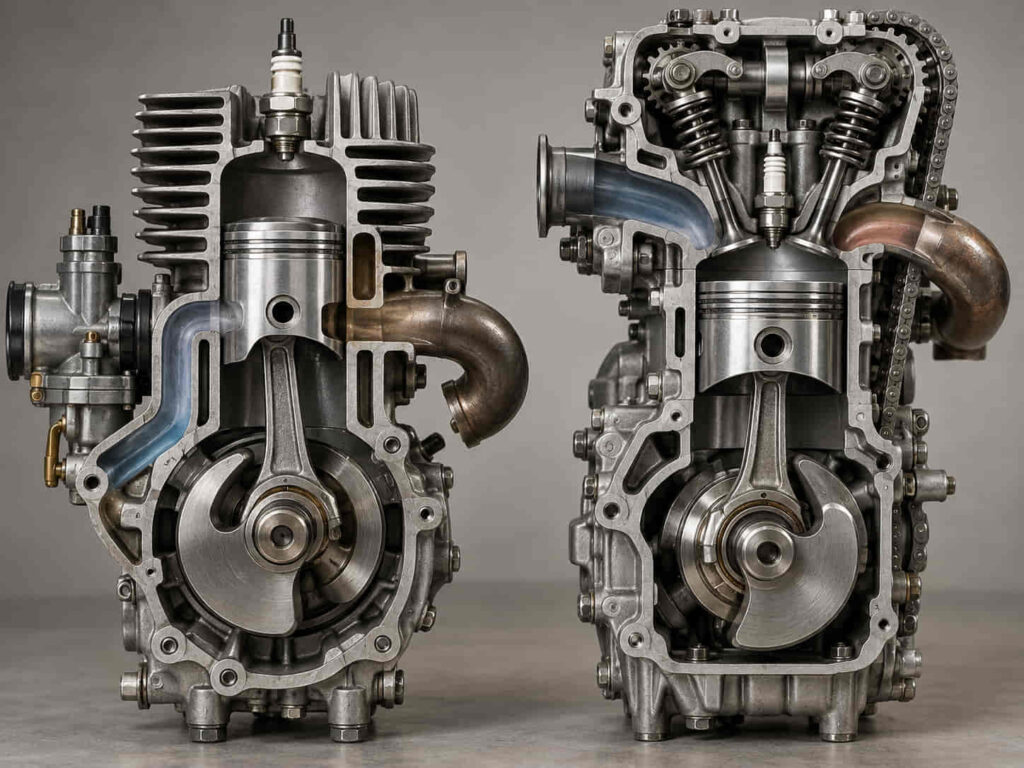
A 2 stroke engine vs 4 stroke engine comparison reveals fundamental differences in how internal combustion engines generate power, consume fuel, manage lubrication, and maintain performance. A two-stroke engine completes its operating cycle in one crankshaft revolution, while a four-stroke engine requires two crankshaft revolutions to complete the same cycle.
Two-stroke engines generally provide a higher power-to-weight ratio and a simpler mechanical design. Four-stroke engines typically offer better fuel efficiency, cleaner combustion, and more practical performance for continuous operation. However, the better engine depends on its intended application, operating conditions, and maintenance requirements.
Understanding these differences helps explain why two-stroke engines remain popular in chainsaws, dirt bikes, and certain marine applications, while four-stroke engines dominate passenger cars, modern road motorcycles, generators, and many types of outdoor power equipment.
What Is the Main Difference Between a 2 Stroke Engine and a 4 Stroke Engine?
The main difference between a 2 stroke engine and a 4 stroke engine is the number of piston strokes required to complete one combustion cycle. A two-stroke engine completes the cycle in two piston strokes and one crankshaft revolution. A four-stroke engine completes the cycle in four piston strokes and two crankshaft revolutions.
A piston stroke refers to the movement of the piston between top dead center (TDC) and bottom dead center (BDC). These positions determine how the engine compresses the air-fuel mixture, generates mechanical force, and removes exhaust gases.
In a conventional two-stroke engine, the compression and power processes occur alongside gas-exchange operations. The engine combines several functions within two piston movements, allowing it to produce one power stroke during every crankshaft revolution.
A four-stroke engine separates intake, compression, combustion and expansion, and exhaust into four individual piston movements. Consequently, each cylinder produces one power stroke for every two crankshaft revolutions.
At an engine speed of 3,000 RPM, a single-cylinder two-stroke engine theoretically completes 3,000 power strokes per minute, whereas a single-cylinder four-stroke engine completes 1,500. This difference explains the two-stroke engine’s potential for high power output relative to its displacement.
However, twice as many power strokes do not automatically mean twice as much horsepower. Actual engine output depends on combustion efficiency, cylinder filling, fuel delivery, friction, operating speed, and the amount of usable energy produced during each cycle.
The distinction also extends to engine construction. Conventional small two-stroke engines commonly use ports in the cylinder walls to control gas flow, while most four-stroke engines use camshaft-operated intake and exhaust valves. These mechanical differences affect engine weight, fuel consumption, lubrication, maintenance, and service life.
How Does a 2 Stroke Engine Work?
A two-stroke engine works by completing compression, combustion, expansion, and gas exchange during one upward and one downward piston movement. The crankshaft makes one complete revolution during this process, allowing a power stroke on every revolution.
In a conventional crankcase-scavenged gasoline two-stroke engine, the operating cycle begins as the piston moves upward from bottom dead center toward top dead center. This upward movement compresses the air-fuel mixture already inside the combustion chamber. At the same time, the increasing volume beneath the piston creates a pressure difference that draws a fresh air-fuel mixture into the crankcase through the intake system.
As the piston approaches top dead center, the spark plug ignites the compressed mixture. Combustion rapidly increases pressure inside the cylinder, forcing the piston downward and transferring mechanical energy to the crankshaft through the connecting rod.
During the downward movement, the piston compresses the fresh mixture inside the crankcase. As the piston approaches bottom dead center, it uncovers the exhaust port, allowing burned gases to begin leaving the combustion chamber. The transfer port then opens, directing the fresh charge from the crankcase into the cylinder.
This incoming mixture helps push remaining exhaust gases toward the exhaust port through a process called scavenging. When the piston begins moving upward again, the ports close and the next compression process starts.
The simplified operating cycle eliminates the need for a conventional camshaft-driven valve train in many small two-stroke engines. Fewer components help reduce engine size and weight, making this design suitable for portable equipment and lightweight performance vehicles.
However, conventional scavenging can allow some unburned air-fuel mixture to escape through the exhaust port. This process, known as short-circuiting, contributes to fuel losses and hydrocarbon emissions.
Modern two-stroke engines may use advanced scavenging arrangements, electronic fuel injection, or direct fuel injection to reduce these losses. Larger two-stroke diesel engines also use different gas-exchange and lubrication systems, so the familiar fuel-mixed, port-controlled design does not represent every two-stroke engine.
How Does a 4 Stroke Engine Work?
A four-stroke engine works through four separate piston movements: intake, compression, power, and exhaust. These movements require two crankshaft revolutions to complete one combustion cycle.
During the intake stroke, the piston moves downward while the intake valve opens. This movement draws an air-fuel mixture into the cylinder in a conventional gasoline engine with port fuel injection or a carburetor. In gasoline direct-injection engines, fuel may instead be introduced directly into the combustion chamber.
The intake valve closes as the piston begins the compression stroke. The piston moves upward, reducing the combustion chamber volume and increasing the pressure and temperature of the trapped charge. Compression prepares the mixture for efficient combustion.
Near the end of compression, the spark plug ignites the mixture in a spark-ignition gasoline engine. Expanding combustion gases force the piston downward during the power stroke, producing torque at the crankshaft.
The exhaust stroke begins when the exhaust valve opens and the piston moves upward again. This movement pushes the burned combustion gases out of the cylinder through the exhaust system. The exhaust valve subsequently closes, preparing the cylinder for the next intake stroke.
A complete four-stroke cycle therefore requires 720 degrees of crankshaft rotation, compared with 360 degrees in a two-stroke engine.
Most conventional four-stroke engines use a camshaft, valves, valve springs, and timing components to regulate gas exchange. These components make the engine mechanically more complex, but they also provide precise control over intake and exhaust timing.
By separating the intake and exhaust processes, four-stroke engines generally reduce the direct loss of fresh fuel through the exhaust system. This contributes to better fuel economy and cleaner operation in many common gasoline-engine applications.
Read more: Chevy 350 Small Block Rebuild
Which Produces More Power: 2 Stroke or 4 Stroke Engine?
A two-stroke engine generally has greater power-output potential for a given displacement and often achieves a higher power-to-weight ratio, while a four-stroke engine can provide more flexible torque delivery across a broad operating range.
The main power advantage of a two-stroke engine comes from combustion frequency. Because each cylinder can produce a power stroke during every crankshaft revolution, the design has more frequent opportunities to generate useful mechanical work.
This characteristic makes two-stroke engines attractive in applications where engine weight matters as much as maximum horsepower. Lightweight off-road motorcycles, racing machines, and portable cutting equipment can benefit from high power output without requiring a large, heavy engine.
However, conventional two-stroke engines may lose part of their fresh charge during scavenging. They also depend heavily on intake and exhaust tuning to achieve effective cylinder filling. As a result, some high-performance two-stroke engines produce their strongest output within a relatively narrow engine-speed range, commonly called the powerband.
Four-stroke engines generate fewer power strokes per crankshaft revolution, but their dedicated intake and exhaust valve events allow engineers to optimize airflow, combustion, and torque characteristics. Modern valve timing, fuel injection, and combustion technologies can further improve performance across different engine speeds.
This makes four-stroke engines particularly suitable for road vehicles that require predictable acceleration, smooth power delivery, and efficient operation under changing loads.
Engine displacement must also be considered when comparing horsepower. A 250cc two-stroke motorcycle engine and a 250cc four-stroke motorcycle engine may deliver significantly different performance even though both have the same nominal displacement.
In practical terms, two-stroke engines often excel when lightweight construction and high specific output are priorities. Four-stroke engines are frequently better suited to applications requiring controlled power delivery and efficient sustained operation. Neither engine type is inherently more powerful in every configuration.
Which Is More Fuel Efficient: 2 Stroke or 4 Stroke Engine?
A four-stroke engine is generally more fuel-efficient than a conventional gasoline two-stroke engine because it controls intake and exhaust processes separately and reduces the loss of unburned fuel.
Fuel efficiency describes how effectively an engine converts chemical energy stored in fuel into useful mechanical work. An efficient engine requires less fuel to produce the same amount of work under comparable operating conditions.
In a conventional two-stroke engine, the intake and exhaust ports may remain open simultaneously during scavenging. While this process removes combustion gases and introduces a fresh charge, part of the incoming fuel mixture can escape before combustion occurs.
The amount of fuel lost depends on port design, engine speed, exhaust tuning, and the effectiveness of the scavenging process. These losses can increase fuel consumption, particularly when the engine operates outside its optimized performance range.
A four-stroke engine has separate gas-exchange strokes and uses controlled valve operation to manage cylinder filling. This arrangement generally allows more of the supplied fuel to participate in combustion rather than escaping directly into the exhaust.
Four-stroke engines can also use advanced combustion control, variable valve timing, and electronic fuel management to improve efficiency at different engine speeds and loads.
However, the relationship between stroke cycle and fuel economy is not absolute. A modern direct-injection two-stroke engine can avoid many of the fuel losses associated with traditional carbureted designs. Engine displacement, operating load, and calibration also influence actual fuel consumption.
For equipment used over extended periods, lower fuel consumption can reduce operating expenses. This is especially relevant for generators, work vehicles, and machines that operate for several hours at a time.
Therefore, fuel efficiency should be evaluated by comparing actual fuel consumption at similar power outputs and workloads rather than relying only on engine type.
How Do Lubrication and Maintenance Differ Between 2 Stroke and 4 Stroke Engines?
Conventional small two-stroke engines commonly use oil mixed with fuel or supplied through an oil-injection system, while four-stroke engines typically circulate oil from a separate crankcase reservoir. This difference changes how each engine is maintained and protected against wear.
In many small gasoline two-stroke engines, the crankcase participates in moving the fresh charge into the cylinder. Because it forms part of the gas-flow system, it cannot function as a conventional oil sump.
Lubrication is therefore supplied through specialized two-stroke oil. Some engines require gasoline and oil to be premixed, while others use an injection system that meters lubricant into the engine automatically.
Common premix ratios include 50:1 and 40:1, but the correct ratio depends on the manufacturer’s specifications. A 50:1 ratio represents 50 parts gasoline to one part two-stroke oil by volume.
Insufficient lubrication can damage piston rings, cylinder walls, crankshaft bearings, and other moving components. Excessive or unsuitable oil may contribute to spark plug fouling, carbon deposits, and exhaust smoke.
Four-stroke engines generally store lubricating oil in a separate sump and distribute it through splash lubrication, pressurized oil passages, or a combination of both. The oil circulates through the engine without being intentionally consumed during normal combustion.
Because the oil remains in service, four-stroke engines require periodic oil changes and, where fitted, oil filter replacements. Some engines also require valve-clearance inspections and maintenance of camshaft timing components.
Two-stroke engines generally have fewer valve-train components and can be mechanically easier to disassemble. However, their piston assemblies, rings, and cylinders may require attention after demanding operation, especially in high-performance applications.
Four-stroke engines involve more mechanical components, which can increase the complexity of major repairs. Their lubrication systems can nevertheless provide effective long-term protection when the correct oil and maintenance schedule are followed.
Maintenance requirements ultimately depend on the engine model, operating environment, service intervals, and workload. A simple two-stroke design does not necessarily mean lower maintenance costs throughout its operating life.
Which Engine Lasts Longer and Has Lower Operating Costs?
Four-stroke engines often offer longer service intervals and lower fuel-related operating costs in everyday applications, while two-stroke engines may have lower initial mechanical complexity and simpler repair procedures.
Engine lifespan depends on operating temperature, lubrication quality, mechanical loading, component design, and maintenance. The stroke cycle influences these conditions, but it does not independently determine how long an engine will last.
In conventional small two-stroke engines, lubrication is delivered with the incoming charge rather than through a recirculating oil system. Piston rings and cylinder surfaces also operate around intake and exhaust ports, which can affect wear and component design.
High-performance two-stroke engines may operate at elevated speeds and loads to produce maximum power from a compact displacement. These conditions can increase the frequency of piston and ring replacement, particularly in competition motorcycles.
Four-stroke engines generally benefit from continuous oil circulation and controlled lubrication of internal components. Their separate intake and exhaust systems can also support stable combustion during extended operation.
However, four-stroke engines contain additional moving parts, including valves, camshafts, timing chains or belts, and associated mechanisms. Damage to these components may create more complicated and expensive repair work.
Purchase price also varies considerably. Some basic two-stroke engines cost less to manufacture because they require fewer mechanical components. Modern fuel injection, emissions controls, and specialized performance parts can reduce or eliminate this cost advantage.
Total ownership cost therefore includes more than the purchase price. Fuel consumption, lubricating oil, replacement parts, maintenance labor, repair frequency, and equipment downtime all affect long-term expenses.
For a machine used occasionally, low weight and simple servicing may be more valuable than a modest improvement in fuel economy. For equipment operating daily, fuel consumption and service life may have a greater financial impact.
Which Engine Produces More Emissions and Noise?
Conventional gasoline two-stroke engines typically produce more unburned hydrocarbon emissions and exhaust smoke than comparable four-stroke engines, although modern engine technology can substantially reduce these differences.
The emissions disadvantage of traditional two-stroke engines mainly results from scavenging losses and the combustion of lubricating oil.
When part of the fresh fuel mixture escapes through the exhaust port, unburned hydrocarbons enter the exhaust stream. Oil introduced through the fuel or a separate injection system can also contribute to particulate emissions and visible smoke.
Four-stroke engines generally have better separation between fresh intake gases and exhaust gases. Their circulating lubrication systems also limit the amount of engine oil intentionally entering the combustion chamber.
These characteristics help explain why four-stroke engines are widely used in applications that require low exhaust emissions, including passenger vehicles and many modern small engines.
However, four-stroke combustion still produces pollutants such as carbon monoxide, nitrogen oxides, and hydrocarbons. Actual emission levels depend on air-fuel ratio, combustion temperature, fuel type, engine condition, and exhaust aftertreatment technology.
Modern two-stroke designs can address some traditional disadvantages through direct fuel injection, improved scavenging, and electronically controlled lubrication. Consequently, emissions comparisons should distinguish older carbureted engines from newer engineered systems.
Noise characteristics also vary between the two designs. A two-stroke engine has more frequent combustion events at the same crankshaft speed, and its exhaust system may produce a sharper, higher-pitched sound.
Four-stroke engines often deliver a deeper exhaust note, although loudness depends heavily on engine speed, muffler design, displacement, and load.
A properly silenced two-stroke engine is not automatically louder than every four-stroke engine. Likewise, a high-performance four-stroke motorcycle can produce substantial exhaust noise.
Where Are 2 Stroke and 4 Stroke Engines Commonly Used?
Two-stroke engines are commonly selected for lightweight, high-output equipment, while four-stroke engines are widely used where fuel economy, sustained operation, and emissions performance are important.
Chainsaws provide a clear example of why two-stroke engines remain useful. An operator must repeatedly lift, tilt, and reposition the machine. A compact engine with a high power-to-weight ratio reduces equipment weight while providing the cutting performance required for demanding work.
Many handheld brush cutters, leaf blowers, and other portable power tools have also used two-stroke engines for similar reasons. Their relatively simple construction supports compact equipment designs.
In off-road motorcycles, two-stroke engines remain attractive for riders who prioritize low vehicle weight and responsive high-output performance. Their power delivery and mechanical simplicity are especially relevant in certain motocross and enduro applications.
Marine engines provide another example. Two-stroke outboard motors remain available in some markets because they can offer compact construction, useful acceleration, and relatively straightforward mechanical servicing.
Four-stroke engines dominate most modern passenger cars and road motorcycles. These vehicles require efficient fuel consumption, predictable torque delivery, compliance with emissions standards, and durability across a wide range of operating conditions.
Four-stroke engines are also widely used in lawn mowers, portable generators, water pumps, and agricultural equipment. Their ability to operate efficiently under sustained loads makes them suitable for many practical tasks.
There are important exceptions. Some handheld tools use specialized four-stroke designs, while large commercial ships may use highly efficient two-stroke diesel engines. These marine diesel engines differ substantially from the small gasoline two-stroke engines used in portable equipment.
Therefore, the application of an engine depends on more than its number of strokes. Equipment manufacturers must balance power output, weight, operating speed, fuel consumption, cost, reliability, and emissions requirements.
Which Is Better: 2 Stroke Engine or 4 Stroke Engine?
A two-stroke engine is generally better when low weight, compact construction, and high power-to-weight ratio are the main priorities. A four-stroke engine is usually better when fuel efficiency, controlled power delivery, cleaner operation, and sustained use are more important.
For lightweight performance equipment, a conventional two-stroke engine offers meaningful advantages. Its ability to produce a power stroke during every crankshaft revolution creates opportunities for high specific output, while its simplified mechanical layout can reduce weight.
These characteristics make two-stroke engines particularly useful in portable power tools and selected recreational vehicles where minimizing weight improves handling and usability.
For daily transportation or equipment that operates for long periods, a four-stroke engine often provides a more practical balance. Its controlled gas exchange, recirculating lubrication, and efficient combustion can help reduce fuel use and support consistent operation.
The choice also depends on maintenance expectations. Two-stroke engines may be easier to service mechanically, but they require appropriate lubrication and can experience significant wear under demanding conditions. Four-stroke engines require regular oil maintenance and may involve more complex repairs.
Environmental performance is another consideration. Conventional carbureted two-stroke engines generally produce higher hydrocarbon emissions, making four-stroke designs preferable in many emissions-sensitive applications. Modern two-stroke technologies, however, can narrow this difference.
Ultimately, the key difference between a 2 stroke engine and a 4 stroke engine is not simply which one produces more power, but how each design balances power delivery, fuel efficiency, mechanical complexity, durability, and operating requirements.
The best engine is the one whose performance characteristics match the intended workload rather than the one with the most favorable specification in a single category.