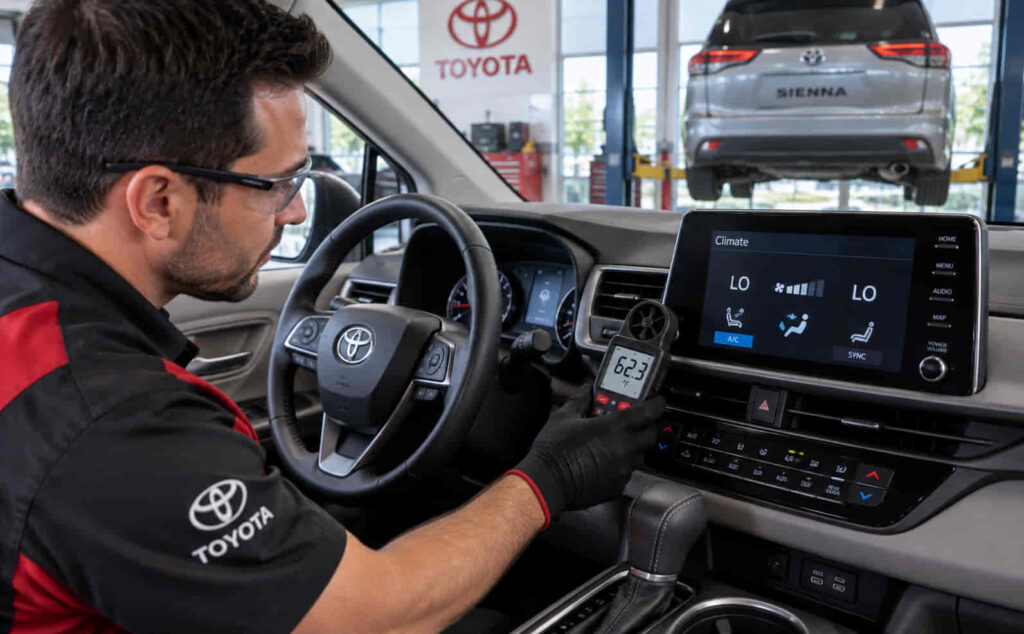
A Toyota Sienna air conditioner that is blowing air but not getting cold is usually dealing with a refrigerant problem, restricted heat transfer, weak airflow, compressor failure, or an electrical or climate-control fault. Toyota identifies low refrigerant, a dirty or clogged condenser, compressor malfunction, and a dirty cabin air filter as common causes when an A/C system feels cool but does not become properly cold. The exact cause can often be narrowed down by how the problem behaves rather than by replacing parts immediately.
Strong airflow with warm air points more toward the refrigeration side of the system, including low refrigerant, a leak, condenser performance, or compressor operation. Weak airflow even at a high fan setting makes a clogged cabin air filter, blower problem, or airflow restriction more relevant. A Toyota Sienna that cools while driving but becomes warm at idle creates a different diagnostic path because condenser airflow and cooling-fan operation become more important. If only one side or the rear climate zone stays warm, the problem may involve air distribution or climate-control components instead of the entire A/C system.
The correct repair therefore depends on the symptom pattern. This guide explains the major causes of a Toyota Sienna A/C not blowing cold, how to distinguish them, which checks are safe to perform yourself, and when refrigerant, compressor, electrical, or hybrid-system diagnosis should be left to a qualified technician.
Why Is My Toyota Sienna Air Conditioning Not Cold?
A Toyota Sienna air conditioner may stop blowing cold because the system has low refrigerant, a refrigerant leak, restricted condenser airflow, a compressor problem, restricted cabin airflow, or an electrical or climate-control fault. The symptom alone does not identify one failed component because several parts of the A/C system must work together to remove heat from the cabin. Toyota specifically identifies low refrigerant, a dirty or clogged condenser, a malfunctioning compressor, and a dirty cabin air filter as common reasons an automotive A/C system may blow air that feels cool but never becomes properly cold.
The first diagnostic distinction is whether the problem involves air temperature or airflow volume. If the vents produce strong airflow but the air remains warm or only slightly cool, the refrigeration side of the system becomes more relevant. Refrigerant charge, refrigerant leakage, compressor performance, condenser heat rejection, and related controls can all reduce the amount of heat removed from cabin air. If airflow itself is weak even with the fan set to a high speed, the diagnostic direction changes toward a clogged cabin air filter, blower-motor problem, air-distribution fault, or another restriction between the HVAC unit and the vents. Toyota likewise separates insufficient cooling from no-airflow complaints because these symptoms point toward different components.
How the cooling changes while the Sienna is being driven can narrow the problem further. An A/C system that becomes noticeably colder at road speed but turns warmer while the vehicle is stopped deserves attention to condenser airflow and cooling-fan operation. The condenser must release the heat carried by the refrigerant. Vehicle movement naturally increases air passing across the condenser, whereas a stationary vehicle depends more heavily on its fan system to maintain airflow. A blocked condenser can create a similar reduction in heat transfer because dirt and debris restrict the air needed to remove heat from the refrigerant. Toyota identifies a dirty or clogged condenser as a condition that can reduce A/C efficiency and cooling power.
The pattern is different when one climate zone stays cold while another produces warmer air. A Toyota Sienna uses a multi-zone climate-control system, so an uneven temperature between the driver side, passenger side, or rear cabin can direct diagnosis toward air-mixing and distribution controls rather than immediately toward complete compressor failure. A serious failure affecting refrigerant circulation may reduce cooling throughout the system, while a temperature difference isolated to one zone can make an actuator, air door, control input, or zone-specific airflow problem more relevant. The actual fault still requires diagnosis because temperature imbalance alone does not prove that an actuator has failed.
A dirty cabin air filter can also make the Sienna feel as though the air conditioning is weak, although its mechanism is different from low refrigerant or compressor failure. The cabin filter affects the amount of air moving through the HVAC system rather than creating the refrigeration effect itself. Toyota states that a clogged cabin filter may restrict airflow enough to reduce apparent cooling capacity, and the 2025 Sienna owner’s manual includes the air-conditioning filter as a serviceable maintenance item. Toyota documentation also advises checking the filter when airflow from the vents decreases dramatically.
The most useful first step is therefore to identify the exact behavior before assuming the Sienna needs an A/C recharge. Strong but warm airflow, weak airflow, cooling only while driving, uneven cooling between zones, and cooling that gradually became weaker are different symptom patterns. Each one changes which component should be investigated first. Replacing or recharging parts without making that distinction can temporarily mask the problem or lead to replacing a component that was not responsible for the loss of cooling.
Can Low Refrigerant Make a Toyota Sienna A/C Stop Blowing Cold?
Yes. Low refrigerant can make a Toyota Sienna A/C blow warm or insufficiently cold air because the system no longer has the correct refrigerant charge to transfer heat effectively from the cabin. Toyota identifies depleted refrigerant as one of the common reasons an A/C system loses cooling performance and notes that low refrigerant is generally associated with a leak that needs to be located and repaired.
Refrigerant is part of a closed cooling circuit. Inside that circuit, it changes pressure and physical state as it moves between the compressor, condenser, metering components, and evaporator. At the evaporator, refrigerant absorbs heat from air that will enter the passenger compartment. The compressor then helps circulate and pressurize the refrigerant, while the condenser releases heat to outside air. If the refrigerant charge becomes too low, the system cannot maintain the operating conditions needed for effective heat transfer, so vent temperature can rise even though the blower continues to move a normal amount of air.
Low refrigerant should therefore be treated as a symptom with an underlying cause, not automatically as routine maintenance. Toyota states that refrigerant leaks may occur around the condenser, O-rings, seals, fittings, and hoses. Its guidance also identifies the evaporator and compressor among components where damage or deterioration may result in leakage. This is why adding refrigerant without identifying where the original charge was lost may restore cooling temporarily without correcting the actual fault.
The rate at which cooling performance changed can provide useful diagnostic context. If a Sienna gradually became less cold over an extended period, a slow refrigerant loss is one possible direction to investigate. If the A/C was recently recharged and becomes warm again, the recurrence increases the importance of locating a leak instead of repeatedly adding refrigerant. A sudden complete loss of cooling can have other causes as well, including a compressor or electrical fault, so the speed of the change should be considered together with other symptoms rather than used as proof of a refrigerant leak.
Visible water underneath a Toyota Sienna after the A/C has been operating should not automatically be interpreted as refrigerant leakage. Toyota explains that water dripping under a vehicle after air-conditioning use is normal because moisture removed from cabin air drains from the system. Refrigerant does not normally appear as a simple puddle of water beneath the vehicle. This distinction prevents normal A/C condensation from being mistaken for evidence that the refrigerant circuit has failed.
Adding refrigerant without measuring the existing charge can also produce an incorrect diagnosis. An A/C system that does not cool properly may have the correct refrigerant quantity but suffer from poor condenser airflow, compressor failure, an electrical problem, or restricted cabin airflow. Adding refrigerant to such a system does not repair those faults and can leave the actual cause unresolved. Correct A/C diagnosis therefore requires confirming refrigerant condition and system behavior rather than assuming that every warm-air complaint requires a recharge.
Toyota recommends professional inspection of refrigerant-related cooling problems because leaks can occur at several locations and refrigerant can cause injury if accidentally released. This is especially important when diagnosis goes beyond visual inspection and requires pressure measurement, refrigerant recovery, leak detection, or opening the sealed A/C circuit. For a Toyota Sienna owner, the practical distinction is clear: low refrigerant can absolutely cause the A/C to stop getting cold, but the correct repair is to identify why the refrigerant became low and restore the system to the specified condition, not simply add refrigerant whenever cooling decreases.
Read more: Is Toyota Remote Connect Free
How Can You Tell If a Toyota Sienna Has an A/C Refrigerant Leak?
A Toyota Sienna may have an A/C refrigerant leak if cooling performance gradually decreases, the system becomes warm again after a recharge, or refrigerant testing shows the charge is below specification. Toyota identifies low refrigerant as a common reason an automotive A/C system blows cool rather than properly cold air and states that a low charge is generally caused by a leak that needs to be located and repaired.
An A/C refrigerant leak does not always produce an obvious visible sign. The refrigerant circulates inside a sealed circuit through components such as the compressor, condenser, evaporator, hoses, fittings, seals, and O-rings. Toyota notes that leakage can occur near the condenser and around O-rings, seals, fittings, and hoses. Wear or damage to the compressor can also allow refrigerant to escape, while road debris and corrosion can damage components such as the condenser or evaporator. Because these potential leak points are spread throughout the system, identifying the source requires more than confirming that the vent air is warm.
The way cooling performance changes over time provides useful diagnostic context. A Sienna that once cooled normally but becomes progressively less effective over weeks or months can be consistent with gradual refrigerant loss. A stronger clue appears when the system is recharged, produces cold air again, and then loses cooling after a relatively short period. That pattern indicates that restoring the refrigerant charge did not correct the condition that allowed the original charge to become low. The correct diagnostic path is then to locate the source of refrigerant loss instead of repeatedly adding more refrigerant.
Water dripping underneath a Toyota Sienna after the air conditioning has been running is not evidence by itself of a refrigerant leak. Normal A/C operation removes moisture from cabin air, and that condensed water drains underneath the vehicle. Toyota specifically states that water dripping below a vehicle after A/C use is normal even though leakage elsewhere in the sealed A/C system is not. Confusing normal condensate with refrigerant leakage can lead an owner toward the wrong diagnosis.
A refrigerant leak also cannot be confirmed simply because the compressor appears to run or the vents still produce slightly cool air. A system with a partial refrigerant charge may retain some cooling ability while failing to reach the expected vent temperature. Other faults can create the same warm-air complaint, including a dirty condenser or malfunctioning compressor. This overlap is why the symptom “Toyota Sienna A/C not cold” should be treated as a starting point for diagnosis rather than proof that refrigerant is leaking.
Professional leak testing becomes especially important when a Sienna repeatedly loses cooling. Toyota recommends having refrigerant levels checked professionally because refrigerant can cause injury if accidentally released, and the number of possible leak locations makes visual diagnosis incomplete. A technician can determine whether the charge is incorrect and then investigate the sealed circuit rather than adding refrigerant based solely on cabin temperature.
A recharge that temporarily restores cold air does not prove that the A/C system has been repaired. If refrigerant escaped once, the reason for that loss must still be identified. Repairing the leak and restoring the correct refrigerant charge addresses both the cause and the symptom, while repeated recharging addresses only the loss of cooling.
Can a Bad A/C Compressor Cause a Toyota Sienna to Blow Warm Air?
Yes. A faulty A/C compressor can make a Toyota Sienna blow warm or insufficiently cold air because the compressor is responsible for compressing and circulating refrigerant through the cooling system. Toyota lists a faulty or malfunctioning compressor as one of the main causes of an A/C system that produces cool air but fails to become properly cold. When the compressor cannot perform its function correctly, the refrigerant circuit cannot maintain the conditions required for effective cabin cooling.
The compressor plays a different role from the blower motor. The blower moves air through the HVAC system and into the cabin, while the compressor supports the refrigeration process that removes heat from that air. This distinction explains why a Sienna can have strong airflow from the vents while still producing warm air. In that situation, the blower may be functioning correctly even though the refrigerant circuit is not producing sufficient cooling.
Compressor problems can appear in several ways. Toyota notes that an unusual or loud noise when the air conditioning is switched on can indicate a compressor-related problem, although noise alone does not confirm compressor failure. Cooling that stops completely, becomes intermittent, or remains weak despite normal airflow can also justify compressor diagnosis, but the same symptoms may result from low refrigerant, an electrical problem, or another A/C fault. The compressor should therefore be tested rather than replaced solely because the vents are warm.
Electrical faults can create compressor-related symptoms without the compressor itself being mechanically damaged. Toyota includes electrical-system issues among the possible reasons an A/C system can blow hot air. A fault in the control circuit, wiring, switch, sensor, fuse, or related system can prevent the A/C system from operating as intended even when major mechanical components remain usable. This makes electrical diagnosis particularly relevant when cooling fails suddenly rather than degrading gradually.
Low refrigerant can also affect compressor operation, which creates another reason not to diagnose the compressor from one symptom. If the refrigerant charge is incorrect because of a leak, the A/C system may not operate normally even though the compressor was not the original cause. Replacing the compressor without first confirming refrigerant condition, pressure behavior, and related controls can therefore leave the actual problem unresolved.
The relationship between compressor failure and refrigerant leakage can also work in the opposite direction. Toyota notes that wear and damage involving the compressor can contribute to refrigerant leakage. A compressor problem may therefore affect cooling through more than one mechanism: it may fail to compress refrigerant effectively, or physical deterioration may contribute to loss of refrigerant from the sealed system.
For a Toyota Sienna owner, strong vent airflow combined with persistently warm air makes the refrigeration circuit worth investigating, but it does not identify the compressor as the failed component by itself. Refrigerant level, leak condition, condenser performance, electrical control, and compressor operation need to be considered together. Toyota recommends technician assessment for compressor and other mechanical A/C problems because accurately identifying the failed component requires diagnosis rather than symptom matching alone.
Can a Dirty Condenser Make a Toyota Sienna A/C Less Cold?
Yes. A dirty or partially blocked condenser can make a Toyota Sienna A/C feel less cold because the condenser must release heat from the refrigerant before the system can cool the cabin effectively. Toyota identifies a dirty or clogged condenser as one of the main reasons an automotive A/C system can blow air that feels cool but does not become properly cold. Dirt, insects, leaves, road debris, and other contamination can reduce both airflow and heat transfer across the condenser surface, lowering the system’s cooling capacity.
The condenser is part of the high-pressure side of the A/C circuit and works after the compressor has increased refrigerant pressure. Heat absorbed from the cabin must eventually be rejected to outside air, and the condenser performs that task. If airflow through the condenser is restricted, the refrigerant cannot release heat as efficiently. The result can be higher system temperatures and weaker cooling at the vents even though the blower inside the cabin continues to move a normal amount of air.
Condenser problems therefore produce a different symptom pattern from a clogged cabin air filter. A restricted cabin filter primarily reduces the amount of air reaching the occupants, while a restricted condenser reduces the refrigeration system’s ability to remove heat. In practical terms, a Toyota Sienna with strong airflow that remains only mildly cool is more consistent with a cooling-performance problem than a simple cabin-airflow restriction. Toyota treats dirty condensers and dirty cabin filters as separate causes of inadequate A/C performance for this reason.
The location of the condenser also makes contamination plausible. It sits in a position where outside air must pass across it, so its surface is exposed to road debris and environmental buildup. A visual obstruction on the front heat-exchanger area can therefore be relevant when a Sienna gradually loses cooling efficiency. However, visible dirt does not prove that the condenser is the only problem. Low refrigerant, compressor malfunction, electrical faults, or other restrictions can produce similar cabin symptoms, so condenser condition should be evaluated as one part of the overall diagnosis.
Physical damage to the condenser creates a second concern because it can affect both heat transfer and refrigerant containment. Toyota notes that refrigerant leaks may occur near the condenser, which means an impacted or deteriorated condenser can potentially contribute to more than one cooling problem. A system with both poor airflow across the condenser and refrigerant loss may therefore perform worse than one affected by surface contamination alone.
Cleaning visible external debris can be a reasonable preliminary inspection, but aggressive cleaning or working around refrigerant components should not replace proper diagnosis. A technician should inspect the system when cooling remains weak after obvious airflow obstructions have been ruled out, particularly if there is evidence of physical condenser damage or refrigerant loss. The important diagnostic principle is that a condenser must both receive adequate airflow and remain capable of transferring heat without leaking refrigerant.
Why Is My Toyota Sienna A/C Cold While Driving but Warm at Idle?
A Toyota Sienna A/C that becomes colder while driving but turns warmer at idle often points toward insufficient condenser airflow when the vehicle is stationary. Road speed forces outside air through the front of the vehicle and across the condenser. When the Sienna stops moving, that natural airflow decreases, so the system depends more heavily on its cooling-fan operation and an unobstructed condenser surface to reject heat.
This symptom pattern matters because the refrigeration load may not change as dramatically as the airflow across the condenser does. While the Sienna is moving, increased airflow can temporarily compensate for a partially blocked condenser or weak fan performance. Once the vehicle stops at a traffic light or remains parked with the A/C running, the missing airflow becomes more noticeable and vent temperature can rise. Toyota confirms that restricted condenser airflow reduces heat transfer and A/C cooling efficiency, which supports condenser airflow as an important diagnostic direction when cooling changes between driving and idle.
Cooling-fan operation becomes particularly relevant in this situation, but the symptom should not be used to declare that a fan has failed without testing. A fan may fail completely, run intermittently, operate at an incorrect speed, or be affected by an electrical or control problem. Similar symptoms can occur when the condenser surface is blocked enough that even a working fan cannot move sufficient air through it. The correct diagnosis therefore compares fan behavior, condenser condition, refrigerant condition, and overall A/C performance rather than replacing a fan based on cabin temperature alone.
Outside temperature can make the difference more obvious. When ambient temperature is high, the condenser must reject more heat while already operating against hot outside air. A marginal airflow problem that is barely noticeable on a mild day can produce significantly warmer vent air during hot weather or extended idling. This explains why some owners first notice the problem while waiting in traffic, using the A/C in a parking lot, or operating the Sienna during the hottest part of the day.
Low refrigerant or compressor problems can still contribute to poor cooling at idle, so the driving-versus-idle pattern is a diagnostic clue rather than a complete diagnosis. A refrigeration system that is already operating below specification may appear acceptable when road airflow improves condenser performance and then become obviously weak when that advantage disappears. This is why a technician may need to evaluate both refrigerant-side operation and condenser airflow when the symptom is repeatable.
The most useful observation for an owner is whether the temperature difference consistently follows vehicle speed. If the Sienna repeatedly blows colder air while moving and warmer air while stationary, condenser airflow and cooling-fan performance should move higher on the diagnostic list. If the air remains equally warm at every speed, low refrigerant, compressor performance, or another system-wide cooling fault becomes relatively more relevant. This symptom-based distinction narrows the diagnosis before parts are replaced and keeps the troubleshooting process focused on the component behavior that actually matches the complaint.
Can a Dirty Cabin Air Filter Make a Toyota Sienna A/C Feel Less Cold?
Yes. A dirty cabin air filter can make a Toyota Sienna A/C feel less effective by restricting the amount of cooled air that reaches the cabin, although it does not reduce cooling in the same way as low refrigerant or a failing compressor. Toyota identifies a dirty or clogged cabin air filter as one of the common causes of an A/C system that feels cool but not sufficiently cold because restricted airflow reduces the system’s effective cooling capacity.
The cabin air filter sits in the airflow path used by the climate-control system. As dust, pollen, debris, and other particles accumulate in the filter media, resistance to airflow increases. The blower must then move air through a more restricted path before it reaches the vents. Toyota’s maintenance documentation states that the air-conditioning filter should be replaced regularly to maintain A/C efficiency and specifically notes that a clogged filter should be checked when airflow from the vents decreases dramatically.
This mechanism makes airflow strength an important diagnostic clue. If a Toyota Sienna produces noticeably less air from the vents even when the fan is set to a high speed, the cabin filter should move higher on the diagnostic list. A severely restricted filter can make the cabin cool slowly because the evaporator may be producing cold air while too little of that air is reaching the passengers. Toyota also identifies a clogged filter as a possible cause when an A/C system produces little or no airflow.
A dirty filter is less likely to explain a Sienna that has strong airflow but consistently warm vent temperatures. Strong air volume indicates that air is moving through the HVAC system, so low refrigerant, poor condenser heat transfer, compressor performance, or another temperature-control fault becomes more relevant. The distinction is therefore practical: weak airflow points toward an airflow restriction, while strong but warm airflow points more strongly toward a cooling-performance problem.
Cabin-filter condition can also vary significantly with operating environment. Toyota states that inspection or replacement may be required earlier in dusty areas or locations with heavy traffic because contamination can build more quickly. A Sienna frequently driven on dusty roads or in dense urban traffic may therefore develop airflow restriction sooner than another vehicle operating under cleaner conditions.
Checking the cabin air filter is one of the more appropriate preliminary steps for an owner because Toyota includes filter inspection and replacement in its do-it-yourself maintenance guidance for applicable vehicles. The exact access procedure depends on model year, so the owner’s manual should be used for the specific Sienna. If airflow remains weak after a clogged filter is replaced, the diagnostic path should continue toward the blower motor, electrical supply, air doors, or ducting rather than assuming that the refrigeration circuit is responsible.
A cabin air filter should therefore be treated as an airflow component rather than a refrigerant component. It can make a Toyota Sienna A/C seem less cold because insufficient conditioned air reaches the cabin, but replacing the filter will not correct low refrigerant, a defective compressor, or poor condenser heat transfer. Matching the repair to the symptom prevents a simple airflow problem from being confused with a more expensive refrigeration-system fault.
Why Is My Toyota Sienna A/C Blowing Cold on One Side but Warm on the Other?
A Toyota Sienna that blows cold air from one climate zone but warm air from another is more likely to have a temperature-distribution or zone-control problem than a complete loss of A/C cooling. The Sienna has used multi-zone climate-control systems that allow different temperature settings for the driver, front passenger, and rear passenger areas. Toyota documentation for Sienna climate controls shows separate temperature controls for these zones, which means the HVAC system must regulate and distribute conditioned air differently across the cabin.
This symptom differs from a Sienna that blows warm air from every vent. If the compressor, condenser, or refrigerant circuit completely loses the ability to create cold air, cooling normally deteriorates more broadly. When one side remains clearly cold, the system is still demonstrating that it can produce cooled air somewhere in the cabin. That makes the mechanism responsible for mixing, directing, or regulating air in the warmer zone more relevant to the diagnosis.
The blend-door or air-mix system is one possible source of the difference. Toyota explains that a blend-door actuator controls airflow between portions of the HVAC system and that actuator problems can disrupt air distribution. If an air door does not move to the commanded position, one zone may receive a different mixture of heated and cooled air than another even though the A/C refrigeration circuit is still operating.
The temperature settings should be checked before assuming an actuator has failed. Multi-zone climate control is designed to permit different temperature commands, so a driver-side and passenger-side difference can sometimes result from separate settings rather than a mechanical problem. Synchronizing the zones to the same temperature provides a simple way to determine whether the temperature difference persists when the requested settings are identical. Toyota’s Sienna climate-control documentation shows both individual zone controls and a synchronization function, supporting this distinction.
A persistent difference after the climate zones are set identically deserves further diagnosis. A blend-door actuator, air-distribution mechanism, temperature sensor, wiring problem, or climate-control command fault can all affect one zone without preventing another from cooling normally. The symptom identifies the area of the system that deserves attention, but it does not establish which of those components has failed.
Refrigerant condition should not be excluded solely because one side is colder than the other. An underperforming refrigeration system can sometimes produce uneven cabin temperatures when available cooling capacity becomes marginal, particularly in a large multi-zone cabin. However, a clear and repeatable left-to-right or front-to-rear temperature difference increases the relevance of zone-control components because the system is still producing cold air in at least one location.
The most useful diagnostic question is therefore not simply whether the Toyota Sienna A/C is cold, but where it is cold and where it is warm. Warm air from every zone directs attention toward system-wide cooling problems such as refrigerant, condenser, or compressor performance. Cold air from one zone and warm air from another shifts the diagnostic focus toward air mixing, distribution, sensors, and climate-control actuators. That distinction can substantially narrow the repair path before any components are replaced.
What Can You Check Yourself When a Toyota Sienna A/C Is Not Cold?
You can safely check the climate-control settings, vent airflow, cabin air filter, visible condenser condition, and the way cooling changes between idle and driving before taking a Toyota Sienna in for A/C service. These checks do not require opening the refrigerant circuit and can help separate a simple airflow or setting problem from a refrigerant, compressor, condenser, or electrical fault. Toyota recommends professional diagnosis when refrigerant or mechanical A/C problems are suspected because the system can leak at multiple locations and accidental refrigerant release can cause injury.
Start by confirming that the symptom is reproducible under consistent climate-control settings. Set the requested cabin temperature low enough to demand cooling, make sure the A/C function is operating, and compare the result with recirculation enabled. Recirculation allows the system to cool air that has already been partially conditioned instead of continuously pulling hot outside air into the cabin. If the Sienna cools normally after correcting the settings, the problem may have been related to climate-control operation rather than a failed A/C component. If the air remains warm under the same conditions, the next step is to identify whether the problem is temperature, airflow, or both.
Airflow strength provides one of the most useful checks an owner can perform without specialized equipment. Run the blower through several fan-speed settings and compare how much air comes from the vents. Strong airflow that stays warm points more toward the refrigeration or temperature-control side of the system, while weak airflow directs attention toward the cabin filter, blower motor, ducting, or air-distribution components. Toyota identifies an extremely dirty cabin air filter as a potential cause of severely restricted airflow and also lists blower-motor, fuse, wiring, switch, blend-door, and duct problems among possible causes when little or no air reaches the vents.
The cabin air filter is therefore a practical component to inspect when airflow has decreased. Toyota advises using the vehicle’s owner’s manual to locate and access the filter and checking it for dirt, debris, and damage. A heavily contaminated filter can restrict the amount of conditioned air entering the cabin and should be replaced according to the applicable maintenance guidance. Toyota also notes that vehicles operated in dusty conditions or heavy traffic may need earlier filter attention because contamination accumulates more quickly.
You can also visually inspect the front heat-exchanger area for obvious debris that may reduce airflow through the condenser. Toyota states that a dirty or clogged condenser can interfere with airflow and heat transfer, reducing A/C cooling capacity. Leaves, insects, road debris, or heavy surface contamination therefore provide useful diagnostic information. This should remain a visual, non-invasive inspection; bent components, apparent physical damage, or suspected refrigerant leakage require a different level of diagnosis than simply removing loose external debris.
Another useful check is to compare A/C behavior while the Sienna is moving with its behavior while stationary. If vent air becomes noticeably colder at normal road speed and warms again during extended idling, the repeatable change increases the relevance of condenser airflow and cooling-fan operation. Road speed naturally moves more outside air through the condenser, while a stationary vehicle depends more on its fan system. The observation does not prove that a fan has failed, but it gives a technician a much more specific symptom than simply reporting that the A/C “sometimes does not work.”
Temperature differences between climate zones should also be recorded. Set the driver, passenger, and rear zones to equivalent cooling settings where applicable, then compare the air produced from each area. If every vent is warm, a system-wide cooling fault deserves more attention. If one side remains cold while another stays warm, air-mixing or zone-control components become more relevant. If the front system is cold but the rear remains warm, rear climate-control and airflow faults should be investigated before assuming that the entire refrigerant circuit requires service.
Owners should stop short of checks that require opening refrigerant lines, intentionally releasing refrigerant, bypassing pressure controls, or electrically testing high-voltage A/C components. Toyota recommends professional assessment for refrigerant and mechanical cooling faults and warns that accidental refrigerant release can injure skin because of its extremely low temperature. The safety boundary is even more important on current Sienna Hybrid models. Toyota identifies the air-conditioning compressor among components associated with a hybrid system that can operate at approximately 650 volts maximum, so high-voltage compressor work is not an appropriate DIY troubleshooting step.
The goal of these preliminary checks is not to produce a final diagnosis without tools. They are intended to establish whether the Toyota Sienna has an airflow problem, a system-wide cooling problem, a speed-dependent condenser-airflow problem, or a zone-specific temperature problem. That information narrows the likely cause and reduces the chance of paying for an unrelated repair.
Should You Recharge the Toyota Sienna A/C When It Is Not Cold?
You should not automatically recharge a Toyota Sienna A/C simply because it is not blowing cold air. A recharge is appropriate only when diagnosis confirms that the refrigerant charge is below specification and the reason for that loss has been addressed. Toyota states that low refrigerant is generally caused by a leak that needs to be located and repaired, making refrigerant loss a diagnostic condition rather than normal evidence that an A/C system periodically “uses up” its charge.
The A/C circuit is designed to circulate refrigerant through the compressor, condenser, evaporator, and connecting components. Refrigerant changes pressure and state during this process, but normal operation does not intentionally consume it in the way an engine consumes fuel. If the amount in the system becomes significantly low, a leak at a seal, O-ring, fitting, hose, condenser, evaporator, compressor, or another part of the sealed circuit becomes relevant. Toyota specifically identifies several of these areas as potential leakage points.
This explains why a recharge can appear to repair the problem without actually fixing it. Restoring an undercharged system to the correct refrigerant quantity can make the vent air cold again because the system regains the charge needed for effective heat transfer. If the leak remains, however, refrigerant can escape again and the same warm-air symptom returns. A Sienna that becomes cold immediately after recharge but loses cooling again after a period of operation should therefore be investigated for refrigerant loss rather than repeatedly recharged.
Warm air does not prove that the refrigerant level is low. Toyota identifies at least four separate common causes of an A/C system that is cool but not cold: low refrigerant, a dirty or clogged condenser, compressor malfunction, and a dirty cabin filter. Electrical problems, blower faults, and blend-door issues can create additional cooling complaints. Adding refrigerant to a system affected by one of these faults does not correct the underlying problem and can interfere with proper diagnosis.
For that reason, refrigerant quantity should be measured rather than estimated from how cold the cabin feels. A technician can evaluate system operation and determine whether refrigerant is actually below specification before deciding whether a recharge is necessary. Toyota recommends professional refrigerant-level inspection in part because accidental refrigerant release can cause injury. A proper service procedure also allows the technician to investigate why the charge became incorrect instead of treating refrigerant as the only variable in the system.
A repeated need for recharge is especially significant. If the Toyota Sienna has required refrigerant more than once because cooling keeps declining, the recurring loss should be treated as evidence that the system needs leak diagnosis rather than another stand-alone top-off. A leak may be small enough that cooling deteriorates slowly, but recurrence demonstrates that refrigerant is not remaining in the circuit as intended.
A recharge should also not be used to troubleshoot weak airflow. If the cabin filter is clogged or the blower does not move enough air through the vents, adding refrigerant will not restore normal airflow. Likewise, if the A/C gets colder while driving but warmer at idle because condenser airflow is inadequate, additional refrigerant does not repair the airflow problem. Matching the repair to the mechanism is more important than choosing the repair most commonly associated with “A/C not cold.”
The practical distinction is that recharging restores the correct refrigerant charge, while repairing corrects the reason the A/C stopped operating properly. Sometimes both are required: a technician may locate and repair a refrigerant leak and then recharge the system to the specified amount. In other cases, the correct repair may involve the condenser, compressor, cabin filter, blower, fan system, actuator, or electrical controls without adding refrigerant at all. Diagnosing the Toyota Sienna before recharging it is therefore the more accurate and cost-effective approach.
When Should You Take a Toyota Sienna to a Technician for A/C Repair?
You should take a Toyota Sienna to a qualified technician when the A/C remains warm despite normal airflow, repeatedly loses cooling after a recharge, develops unusual compressor noise, shows recurring electrical faults, or requires refrigerant-system or high-voltage diagnosis. These symptoms go beyond the preliminary checks an owner can safely perform because they can involve sealed refrigerant components, mechanical failures, electrical testing, or the hybrid high-voltage system. Toyota recommends professional inspection when refrigerant leaks or mechanical A/C problems are suspected because several components can produce similar cooling symptoms.
Persistent warm air with strong vent airflow is one situation where professional diagnosis becomes valuable. Strong airflow indicates that the blower is capable of moving air through the HVAC system, so the problem is more likely to involve cooling performance or temperature control. Low refrigerant, compressor malfunction, condenser problems, or electrical faults can all create this symptom. Toyota identifies depleted refrigerant, compressor problems, condenser restriction, and electrical faults among possible reasons an A/C system does not cool properly. Because these faults overlap in how they feel from inside the cabin, replacing a component based only on warm vent air can lead to an unnecessary repair.
Repeated refrigerant loss is another strong reason for professional service. A Toyota Sienna that becomes cold after a recharge but gradually returns to warm air has not necessarily been repaired. Toyota states that low refrigerant is generally associated with a leak and identifies potential leak areas around the condenser, O-rings, seals, fittings, hoses, evaporator, and compressor. A technician can verify whether the charge is actually low and investigate where refrigerant is escaping rather than continuing to add refrigerant each time cooling performance declines.
Compressor-related symptoms also justify further diagnosis. Toyota notes that a loud or unusual noise when the A/C is switched on may indicate a compressor problem and recommends technician assessment to confirm the source. The compressor is responsible for moving and pressurizing refrigerant through the system, so a malfunction can cause poor or absent cooling. However, low refrigerant, electrical control faults, and other A/C conditions can alter compressor operation as well. A compressor should therefore be tested before it is treated as the failed component.
Electrical symptoms should be handled in the same way. A blower that operates intermittently, climate controls that respond inconsistently, or a fuse that fails repeatedly can indicate an electrical problem rather than a refrigerant problem. Toyota lists faulty switches, wiring issues, blower-motor faults, and blown fuses among possible causes of airflow failure. Replacing a repeatedly blown fuse without determining why excessive current is occurring does not correct the underlying fault.
Professional inspection is also appropriate when symptom patterns conflict. For example, a Sienna might have strong airflow but insufficient cooling, become colder at highway speed, and develop uneven temperatures between the front and rear zones. More than one condition may be present, or one fault may be influencing several parts of the climate-control system. Testing system pressures, component commands, temperature behavior, and electrical operation allows the repair to be based on measured performance rather than a single symptom.
Toyota specifically recommends dealer or authorized-service-center involvement when air-conditioning components require repair or replacement. This does not mean every dirty cabin filter requires professional service. It means the diagnostic boundary changes once troubleshooting involves the sealed refrigerant circuit, compressor, electrical faults, component replacement, or systems that cannot be verified safely through normal owner checks.
For a Toyota Sienna owner, the repair decision should therefore follow the severity and mechanism of the symptom. Checking settings, airflow, the cabin filter, and visible condenser obstruction is reasonable preliminary troubleshooting. Opening refrigerant components, repeatedly recharging a system that loses cooling, diagnosing compressor electrical circuits, or working around hybrid high-voltage equipment should be left to a qualified technician.
Does the Toyota Sienna A/C Work Differently on 2021 and Newer Hybrid Models?
Yes. The 2021 and newer Toyota Sienna uses a hybrid powertrain and an electrically driven A/C compressor, so compressor diagnosis and repair should not be approached in the same way as on older gasoline-only Sienna generations. Toyota introduced the fourth-generation Sienna for the 2021 model year with a hybrid powertrain standard across every trim, and the current 2026 Sienna remains a 100% hybrid lineup.
The difference matters because the current Sienna’s A/C compressor is integrated with the hybrid high-voltage environment rather than relying on the same engine-driven compressor arrangement associated with many conventional vehicles. Toyota’s Sienna owner documentation identifies the air-conditioning compressor among the hybrid system components and warns that the hybrid system operates at approximately 650 volts maximum. Toyota’s Sienna Hybrid emergency-response documentation likewise diagrams an electric A/C compressor within the high-voltage system.
An electrically driven compressor has an important functional advantage: cabin cooling does not need to depend directly on the gasoline engine mechanically turning an accessory belt whenever cooling is required. The hybrid system can operate the electric compressor according to climate-control and vehicle operating conditions. This architecture supports the Sienna’s hybrid operation, but it also changes the safety requirements for diagnosis because compressor electrical connections are not equivalent to ordinary 12-volt accessory wiring.
This distinction is especially important when owners search for generic instructions about checking whether an A/C compressor clutch is engaging. Advice written for a conventional belt-driven compressor with an electromagnetic clutch may not describe the compressor architecture used by a 2021-and-newer Sienna Hybrid. Toyota’s own documentation identifies the Sienna component as an electric A/C compressor associated with the hybrid high-voltage system. Diagnosis should therefore follow the specific Sienna model year and system design instead of applying a generic compressor-clutch test from another vehicle.
The hybrid architecture does not change every cause of poor A/C performance. A 2021-or-newer Sienna can still experience cooling problems related to refrigerant loss, condenser heat transfer, cabin airflow, climate-control actuators, sensors, or electrical faults. Toyota’s general A/C troubleshooting guidance continues to identify low refrigerant, condenser restriction, compressor malfunction, and cabin-filter restriction as relevant causes of inadequate cooling. The difference is that compressor and high-voltage diagnosis require additional precautions because of how the hybrid vehicle supplies and controls that component.
The generation of the Sienna therefore matters when interpreting online troubleshooting advice. The fourth-generation Sienna began with the 2021 model year as a hybrid-only vehicle, while earlier Sienna generations used different powertrain and A/C configurations. A procedure that accurately describes an older Sienna does not automatically apply to a 2021, 2022, 2023, 2024, 2025, or 2026 Sienna Hybrid.
For owners of a 2021-and-newer Sienna, the safe diagnostic boundary is clear. Climate settings, airflow, cabin-filter condition, visible condenser obstruction, and symptom differences between driving and idling can still be observed without entering the high-voltage system. Testing, disconnecting, or repairing the electric A/C compressor or its high-voltage circuit requires hybrid-system knowledge and appropriate safety procedures. Toyota’s documentation treats the compressor as part of a system capable of carrying hundreds of volts, which makes professional diagnosis appropriate when the fault path reaches that component.
How Can You Narrow Down a Toyota Sienna A/C Problem From the Symptoms?
You can narrow down a Toyota Sienna A/C problem by matching the exact symptom to the part of the system responsible for airflow, refrigerant cooling, condenser heat transfer, or temperature distribution. Warm air from every vent, weak airflow, cooling that changes with vehicle speed, and uneven temperatures between climate zones do not point toward the same failure. Toyota similarly separates A/C complaints into inadequate cooling, airflow problems, refrigerant leakage, compressor faults, condenser restriction, and electrical or air-distribution problems because each symptom requires a different diagnostic direction.
Strong airflow combined with warm or only slightly cool air shifts attention toward the refrigeration side of the system. The blower is already demonstrating that it can move air through the vents, so a severely clogged cabin filter or failed blower becomes less likely to explain the primary symptom. Low refrigerant, a refrigerant leak, inadequate condenser heat transfer, compressor malfunction, or a temperature-control problem becomes more relevant. Toyota specifically identifies low refrigerant, a clogged condenser, and compressor malfunction as causes of an A/C system that produces air but does not make it sufficiently cold.
The way cooling deteriorated provides another diagnostic clue. Cooling that gradually becomes weaker over time increases the relevance of refrigerant loss, particularly when the airflow itself has not changed. Toyota states that low refrigerant is generally caused by a leak and identifies seals, O-rings, fittings, hoses, the condenser, evaporator, and compressor as possible leak locations. A Sienna that becomes cold after a recharge and then gradually loses cooling again creates an even stronger reason to investigate leakage because the restored refrigerant charge corrected the symptom without eliminating the source of refrigerant loss.
Weak airflow requires a different diagnostic path. If little air reaches the cabin even when the fan is set to a high speed, the cabin air filter, blower motor, blower electrical circuit, air doors, or ducting becomes more relevant than the refrigerant charge alone. Toyota identifies an extremely dirty cabin filter as a cause of severely restricted airflow and also lists blower-motor problems, blown fuses, faulty switches, wiring faults, blend-door actuators, and duct problems as possible sources of inadequate airflow. A refrigerant recharge will not correct an air-delivery problem if the HVAC system cannot move enough conditioned air into the cabin.
A Toyota Sienna that gets colder while driving but becomes warmer while idling creates a more specific pattern. Vehicle movement increases airflow through the condenser, while a stationary Sienna relies more heavily on the fan system to move outside air across it. Toyota confirms that dirt or debris restricting condenser airflow can reduce heat transfer and cooling performance. When the temperature improvement repeatedly follows vehicle speed, condenser condition and fan operation deserve greater diagnostic attention. Low refrigerant and compressor performance still need to be considered, but speed-dependent cooling provides information that a general complaint of “A/C not cold” does not.
Uneven cabin temperature changes the diagnosis again. If one side of the Sienna is cold while another side remains warm, the system has demonstrated that it can produce cold air somewhere in the vehicle. That makes climate-zone controls, air-mix doors, actuators, sensors, and air distribution more relevant than assuming the entire compressor has stopped working. Toyota identifies blend-door actuator faults as one condition that can disrupt HVAC airflow distribution. The climate zones should first be set to the same requested temperature so that a normal difference in driver and passenger settings is not mistaken for a mechanical fault.
The same principle applies to a cold front cabin with warm rear vents. Because the Sienna uses separate climate control for different parts of its large cabin, a rear-only complaint should be evaluated as a zone-specific problem before concluding that the entire refrigeration circuit has failed. If both front and rear vents are warm, system-wide faults such as low refrigerant, compressor performance, condenser heat transfer, or electrical control become more relevant. If the front produces properly cold air but the rear does not, rear airflow and climate-distribution controls deserve greater attention.
Complete loss of airflow points away from a simple refrigerant complaint. A failed or electrically disabled blower can leave the cabin hot even when parts of the refrigeration circuit remain functional. Toyota identifies blower-motor faults, blown fuses, wiring problems, faulty switches, and air-distribution faults among the conditions that can prevent normal airflow. A blower that operates intermittently or only at certain times should therefore be diagnosed electrically rather than treated automatically as evidence that the Sienna needs more refrigerant.
Unusual noise when cooling is requested creates another diagnostic clue. Toyota notes that abnormal noise associated with A/C operation can indicate a compressor problem, although technician assessment is recommended to confirm the source. Noise should therefore increase the relevance of compressor diagnosis without being treated as proof that the compressor must be replaced. Refrigerant condition and electrical operation can affect compressor behavior, and other rotating components may also produce noise that appears to coincide with A/C use.
The model year becomes especially important when the diagnostic path reaches the compressor. On newer Sienna Hybrid models, Toyota identifies the air-conditioning compressor among the components associated with the hybrid high-voltage system, which operates at approximately 650 volts maximum. Generic troubleshooting instructions written for a conventional belt-driven A/C compressor should therefore not be applied automatically to these vehicles. Observing airflow, climate settings, cooling behavior, and visible condenser obstruction remains reasonable, but high-voltage compressor testing requires appropriate training and safety procedures.
The most useful way to diagnose a Toyota Sienna A/C that is not cold is to define the symptom before choosing the repair. Strong but warm airflow points toward cooling performance; weak airflow points toward the filter, blower, or air distribution; cooling only while driving increases the relevance of condenser airflow and fan operation; one warm climate zone increases the relevance of zone controls; and repeated cooling loss after a recharge increases the relevance of a refrigerant leak. These patterns do not replace system testing, but they narrow the fault path and help prevent unnecessary recharging or component replacement.