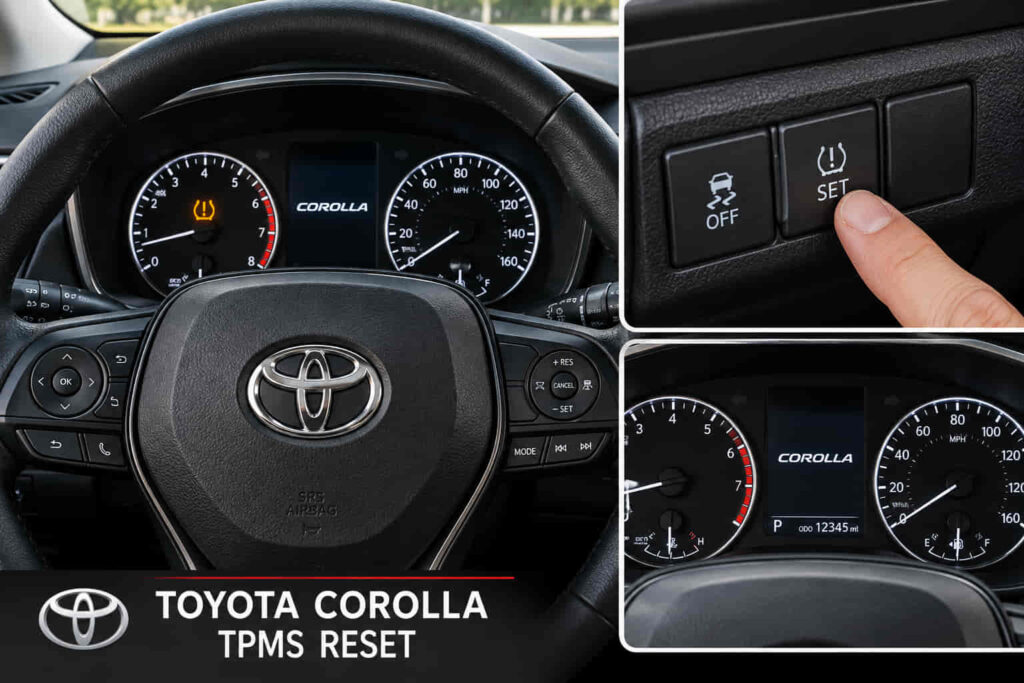
Resetting the TPMS on a Toyota Corolla allows the Tire Pressure Monitoring System to establish the correct tire pressure reference after the tires have been adjusted or certain tire-related maintenance has been performed. The exact reset or initialization procedure depends on the Corolla model year and TPMS configuration, so not every Toyota Corolla uses the same reset button or menu sequence.
Before resetting the system, check and adjust the tire pressure according to the pressure specification for your Corolla. A TPMS reset does not repair an underinflated tire, air leak, damaged tire, or failed pressure sensor. It initializes the monitoring system after the underlying tire-pressure condition has been addressed.
The TPMS warning light also provides useful diagnostic information. A warning that remains illuminated can indicate that tire pressure still requires attention, while a warning light that behaves differently during startup may indicate a problem with the monitoring system itself. This guide explains how to perform a Toyota Corolla TPMS reset, where to find the reset function on different configurations, why the TPMS light may remain on after a reset, and when the system requires further diagnosis.
How Do You Reset the TPMS on a Toyota Corolla?
To reset the TPMS on a Toyota Corolla, first adjust the tire pressure to the vehicle’s specified cold tire pressure, then use the TPMS initialization function provided for that Corolla model year. Depending on the vehicle, initialization may be performed with a physical tire pressure warning reset switch or through the vehicle settings in the multi-information display. The reset establishes the tire pressure conditions that the TPMS uses for subsequent monitoring.
Check tire pressure before starting the initialization procedure because resetting TPMS does not correct an underinflated tire. Tire pressure should be measured when the tires are cold and adjusted according to the specification provided for the vehicle. The recommended pressure is vehicle-specific and is normally shown on the tire and loading information label rather than determined from the maximum pressure printed on the tire sidewall.
After the tire pressure has been corrected, turn the vehicle on and access the applicable TPMS initialization control. A Corolla equipped with a physical tire pressure warning reset switch uses that switch to initiate the process, while a Corolla with TPMS controls integrated into the multi-information display uses the vehicle settings menu. The system then records the tire pressure conditions needed for monitoring. Because Toyota Corolla generations use different TPMS configurations, the procedure for one model year should not automatically be applied to another.
A TPMS reset should be considered complete only after the initialization procedure has been performed correctly and the system has had the required opportunity to monitor the tires. Resetting the system repeatedly without checking tire pressure can hide the actual cause of the warning rather than solve it. A warning that returns after the tires have been properly inflated and the initialization procedure has been completed requires further diagnosis.
How Do You Reset the TPMS on Different Toyota Corolla Model Years?
The Toyota Corolla TPMS reset procedure differs by model year because Toyota has used different tire pressure monitoring controls across Corolla generations. Earlier vehicles may provide a dedicated tire pressure warning reset switch, while newer configurations can place TPMS initialization functions within the instrument cluster or multi-information display. The correct procedure should therefore be matched to the specific model year rather than selected solely because it works on another Corolla.
For 2009–2013 Toyota Corolla models, the first step is to confirm the tire pressure specification and determine whether the vehicle is equipped with the applicable tire pressure warning reset control. On configurations that use a physical reset switch, initialization is started through that switch after the tires have been adjusted to the correct cold pressure. The ignition state and the time the switch must be operated are part of the model-specific procedure, so the owner’s manual for the exact year remains the controlling reference.
For 2014–2019 Toyota Corolla models, the same principle applies: correct tire pressure comes before initialization. These model years should not be treated as automatically sharing one universal reset sequence because equipment can vary by year, trim, and market. When a physical tire pressure warning reset switch is present, it provides the initialization control. When the expected switch is absent, using instructions from an older Corolla is not a reliable substitute for checking the procedure specified for that vehicle.
For 2020 and newer Toyota Corolla models, TPMS-related controls may be integrated more closely with the vehicle’s multi-information display and steering-wheel controls. On applicable configurations, the driver accesses the vehicle settings and tire-pressure-related settings rather than searching for the physical reset button found on some earlier vehicles. This change is important because instructions telling every Corolla owner to locate and hold a TPMS button can be incorrect for newer configurations.
Model year is therefore one of the primary variables in a Toyota Corolla TPMS reset. The tire pressure must be correct in every case, but the control used to initialize the system can change between generations. Matching the procedure to the exact year, trim, market, and equipment prevents an unsuccessful reset caused by following instructions intended for a different TPMS configuration.
Read more: toyota paint codes location
Where Is the TPMS Reset Button on a Toyota Corolla?
The TPMS reset button on a Toyota Corolla is not located in the same place on every model year, and some Corolla configurations do not use a separate physical TPMS reset button at all. Earlier configurations may use a tire pressure warning reset switch, while newer vehicles may provide the initialization function through vehicle settings in the multi-information display. The correct reset control therefore depends on the model year, trim, market, and TPMS configuration.
On a Corolla equipped with a physical tire pressure warning reset switch, the driver must use that switch only after the tires have been adjusted to the specified cold tire pressure. The switch is an initialization control rather than a repair control. Activating it with an underinflated tire, an air leak, or another unresolved tire problem does not correct the underlying condition.
A Corolla without an obvious physical TPMS reset button should not be assumed to have a missing switch. Newer vehicle configurations can integrate tire-pressure initialization into the instrument cluster and vehicle settings. In that case, the driver uses the steering-wheel controls and multi-information display to reach the applicable tire-pressure settings instead of looking underneath the dashboard for a dedicated button.
This difference explains why TPMS reset instructions for one Toyota Corolla can fail on another. A procedure written for an older vehicle may tell the driver to press and hold a physical reset switch, while the corresponding function on a newer Corolla may be accessed electronically. Identifying the exact model year and TPMS configuration is therefore necessary before following a model-specific reset sequence.
Why Is the Toyota Corolla TPMS Light Still On After a Reset?
A Toyota Corolla TPMS light can remain on after a reset when the tire pressure is still incorrect, initialization has not been completed correctly, or the TPMS has a sensor or system fault. Resetting the system does not eliminate these conditions because TPMS initialization establishes monitoring conditions; it does not repair the tire or the electronic components that measure tire pressure.
Incorrect tire pressure should be checked first. A tire can remain below the specified cold pressure even when it appears properly inflated from the outside. Tire pressure also changes with temperature, so a warning can appear after a substantial drop in ambient temperature. Measure the tires with a pressure gauge when they are cold and compare the readings with the vehicle’s specified pressure before attempting another initialization.
A continuing warning can also result from air loss. A puncture, leaking valve area, damaged wheel, or another source of pressure loss can cause a tire to fall below the required pressure again after inflation. In this situation, repeatedly resetting TPMS addresses the warning rather than its cause. The source of the pressure loss needs to be identified and corrected.
The TPMS itself can also require diagnosis. Tire pressure sensors are electronic components, and a system fault cannot be corrected simply by adding air or repeating the initialization procedure. Sensor-related problems become particularly relevant when the warning behavior indicates a TPMS malfunction rather than ordinary low tire pressure.
Tire or wheel service can create another reason to investigate the system. Replacing tires, wheels, or TPMS sensors can involve procedures beyond basic initialization, depending on the Corolla’s TPMS configuration. Initialization and sensor registration are not interchangeable terms: initialization establishes monitoring conditions, while registration concerns the sensor information recognized by the vehicle when that procedure is required.
Further diagnosis is appropriate when all tires have been confirmed at the specified cold pressure but the warning persists or returns after the correct initialization procedure. At that stage, repeating the reset without identifying the cause provides little diagnostic value. The TPMS sensors and related system components should instead be checked using the procedure and diagnostic equipment appropriate for the specific Toyota Corolla.
What Does the TPMS Light Mean on a Toyota Corolla?
The TPMS light on a Toyota Corolla indicates that the tire pressure monitoring system has detected a tire-pressure condition that requires attention or that the monitoring system itself requires diagnosis. The warning should therefore be treated as information about tire pressure or TPMS operation rather than simply as a light that needs to be reset.
A TPMS warning associated with low tire pressure requires the tires to be checked before initialization is attempted. Tire pressure cannot be evaluated accurately by appearance alone because a tire can lose enough air to trigger the monitoring system without looking visibly flat. Measuring cold tire pressure with a gauge and comparing it with the vehicle specification establishes whether inflation is the reason for the warning.
The behavior of the warning light also matters when diagnosing the problem. A continuously illuminated warning and a warning that flashes during startup before remaining illuminated can represent different TPMS conditions on applicable Toyota systems. The first action should therefore be to observe how the warning behaves, check the tire pressures, and then follow the diagnostic information specified for the exact Corolla model year.
Resetting the system should not be the automatic first response to every TPMS warning. The purpose of the warning system is to alert the driver to tire-pressure or system conditions that require attention. Correcting the underlying condition before initialization preserves that function and reduces the risk of treating a real tire problem as a reset problem.
When Should You Reset the TPMS on a Toyota Corolla?
You should reset or initialize the Toyota Corolla TPMS when the procedure is required after tire pressures have been correctly adjusted or after applicable tire and wheel service. The exact situations that require initialization depend on the Corolla model year and TPMS configuration, so the vehicle-specific procedure should determine whether a reset is necessary.
After correcting tire pressure, initialization may be required on configurations that use the current pressure conditions as part of the TPMS monitoring process. The tires should first be set to the specified cold pressure. Initializing the system before correcting an improperly inflated tire can establish an unsuitable reference condition rather than solve the reason for the warning.
Tire rotation, tire replacement, wheel replacement, and TPMS sensor replacement should not automatically be treated as the same reset event. These procedures affect different parts of the tire and monitoring system. A basic TPMS initialization establishes the conditions used for monitoring, whereas replacement of a pressure sensor can involve sensor identification or registration procedures on systems that require them.
This distinction is particularly important after a TPMS sensor has been replaced. A new sensor that must be recognized by the vehicle cannot necessarily be made functional by repeatedly performing a standard initialization. When registration is required, the vehicle needs the appropriate sensor information before the monitoring system can operate as intended.
A Toyota Corolla TPMS reset is therefore appropriate only when initialization addresses the actual condition being serviced. Low tire pressure requires inflation or repair, a leaking tire requires the source of the leak to be corrected, and a sensor or system malfunction requires diagnosis. Resetting TPMS is one stage of the maintenance process, not a universal method for turning off the tire-pressure warning light.
Can You Drive a Toyota Corolla With the TPMS Light On?
You can drive a Toyota Corolla with the TPMS light on only after confirming that the tires are safe to drive on and determining why the warning is illuminated. The warning should not be ignored because a TPMS alert can indicate insufficient tire pressure, while different warning behavior can point to a malfunction in the tire pressure monitoring system.
Check the tire pressure before treating the warning as a reset issue. A tire with insufficient pressure changes how the tire contacts the road and should be corrected according to the vehicle’s specified cold tire pressure. If one tire repeatedly loses pressure after inflation, the cause of the air loss needs to be identified instead of repeatedly resetting the TPMS.
The condition of the tire is also more important than whether the warning light can be cleared. A tire that is visibly damaged, substantially deflated, or rapidly losing pressure requires attention before normal driving continues. TPMS provides a warning function, but resetting that warning does not change the physical condition of the tire.
Driving also requires additional caution when the tire pressures are correct but the TPMS indicates a system malfunction. In this situation, the tires may be properly inflated while the monitoring system cannot provide its intended warning function reliably. Tire pressure should be checked manually until the TPMS fault is diagnosed and corrected.
The practical decision is therefore based on the cause of the warning rather than the warning light alone. Correct low tire pressure before driving normally, repair a tire that cannot maintain pressure, and diagnose a TPMS malfunction that remains after the tires and initialization procedure have been checked. A Toyota Corolla TPMS reset should only follow the appropriate tire or system correction; it should not be used as a substitute for that correction.