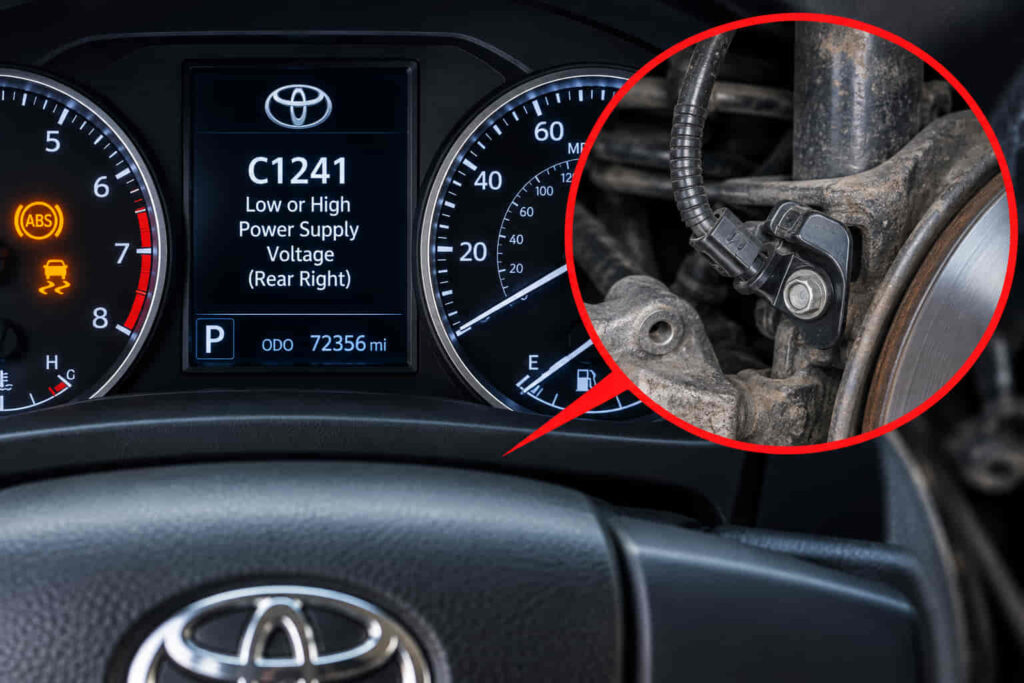
The Toyota C1241 code indicates that the vehicle’s brake control system has detected an abnormal electrical power-supply voltage condition. Because the ABS and VSC systems depend on a stable electrical supply to operate their electronic control functions, C1241 can appear with ABS, VSC, traction-control, or brake-related warning lights when the required voltage is outside the expected operating condition.
C1241 does not automatically mean that the battery or alternator is bad. A weak battery or charging-system problem can contribute to abnormal system voltage, but the actual cause can also involve battery terminals, wiring, electrical connectors, power or ground circuits, or the power supply to the relevant brake-control components. A control-module fault should be considered only after external electrical causes have been tested.
Correct diagnosis therefore begins with a complete system scan and actual voltage measurements rather than immediate parts replacement. Battery condition, charging-system performance, electrical connections, related DTCs, and the applicable brake-control power and ground circuits should be evaluated before a component is identified as defective. This guide explains what Toyota C1241 means, its common symptoms and causes, how battery and charging voltage relate to the code, and how to diagnose and repair the underlying fault correctly.
What Does the C1241 Code Mean on a Toyota?
The Toyota C1241 code means the brake control system has detected an abnormal condition in its electrical power-supply voltage. The relevant ABS/VSC control electronics require a stable electrical supply to monitor wheel and vehicle behavior, process sensor information, and control their associated functions. When the monitored power supply falls outside the expected operating condition, the system can store C1241 and illuminate related warning lights.
C1241 should be interpreted as a power-supply or voltage-related DTC rather than a direct diagnosis of a failed battery. The battery is one part of the vehicle’s electrical system, but voltage available to the brake control system also depends on charging performance, electrical connections, wiring, grounds, and the circuits that deliver power to the relevant control components. A problem at any applicable point can produce an abnormal supply condition.
The same distinction applies to the alternator. An abnormal charging condition can affect system voltage and contribute to C1241, but the presence of the code does not identify the alternator as the failed component. Actual voltage measurements and charging-system tests are required to determine whether the electrical supply is low, high, unstable, or normal when the vehicle is tested.
The operating conditions under which C1241 was stored also matter. A temporary voltage drop associated with a discharged battery can create a different diagnostic situation from a code that repeatedly returns while the engine is running and system voltage should be stable. Related DTCs and available diagnostic information help determine whether the code represents a previous electrical event or an active fault.
C1241 therefore provides a diagnostic direction: verify the electrical supply used by the brake control system and determine why the monitored voltage became abnormal. It does not provide a component replacement instruction. Battery condition, charging performance, terminals, wiring, connectors, power circuits, and grounds should be evaluated before the failed part is identified.
How Serious Is the Toyota C1241 Code?
Toyota C1241 should be diagnosed promptly because the fault involves the electrical supply used by the ABS/VSC brake control system, and an active power-supply problem can affect electronically controlled braking and stability functions. The actual severity depends on the warning lights, electrical condition, braking behavior, accompanying DTCs, and whether the voltage fault remains active.
A Toyota can retain basic mechanical braking capability while an electronic brake-control fault is present, but this does not establish that ABS, VSC, traction-control, or related electronically controlled functions are operating normally. When the corresponding warning indicators are illuminated, the vehicle should be evaluated according to the active warnings and the specific brake-control fault rather than treated as fully normal simply because the brake pedal still stops the vehicle.
Multiple warning lights increase the importance of diagnosis. ABS, VSC, traction-control, and brake-related indicators appearing together can indicate that the brake-control system has detected conditions affecting functions shared across those systems. If C1241 is present, verifying the electrical supply is particularly important because unstable voltage can affect electronic control operation and can also contribute to additional DTCs.
Charging-system symptoms make the fault more urgent because the electrical problem may extend beyond the brake control system. Dim or fluctuating lights, difficult starting, repeated battery discharge, or other evidence of unstable electrical power should be investigated together with C1241. A system-wide voltage problem can affect multiple electronic modules rather than remaining isolated to the module that stored the chassis code.
Abnormal braking behavior or a brake warning requires greater caution than an isolated stored C1241 with normal current voltage and no active symptoms. The driver should not assume that every C1241 has the same risk level because a historical low-voltage event and a continuing electrical or brake-control fault represent different conditions. Current measurements and system status determine which situation is present.
Even when the Toyota appears to operate normally, C1241 should not be ignored until the voltage condition has been checked. Confirming battery condition, charging performance, electrical connections, and the applicable brake-control power supply establishes whether the code resulted from a past voltage event or an unresolved fault that can cause the warning lights and control-system problems to return.
What Symptoms Can Appear With Toyota Code C1241?
Toyota C1241 can appear with ABS, VSC, traction-control, or brake-related warning lights because the brake control system has detected an abnormal electrical power-supply condition. The exact combination of warnings depends on the Toyota model, model year, brake-control architecture, related DTCs, and whether the voltage problem is still active. C1241 can also be stored after a temporary electrical event even when the vehicle currently shows few obvious symptoms.
An ABS warning light is relevant because the ABS control electronics require a stable electrical supply to monitor and control the system correctly. When the control system detects a voltage condition outside its expected operating range, it can store a fault and restrict functions affected by that condition. The presence of the warning does not prove that an ABS hydraulic component or wheel speed sensor has failed. The stored codes and electrical measurements determine which system requires further testing.
VSC or traction-control warnings can appear at the same time because these functions interact with the vehicle’s brake-control electronics. A common electrical supply problem can therefore create warnings across multiple related systems without requiring an independent mechanical failure in each one. This is why several warning indicators appearing together should prompt a complete system scan rather than separate parts replacement for every illuminated system.
Electrical symptoms provide additional evidence when C1241 originates from a broader voltage problem. Difficult starting, repeated battery discharge, fluctuating electrical behavior, or other signs of unstable system voltage can indicate that the brake-control code is one consequence of a vehicle-wide electrical condition. In this situation, diagnosis needs to determine why voltage is abnormal rather than focusing only on the module that stored C1241.
A brake-related warning deserves particular attention because warning indicators do not all communicate the same system condition. C1241 should be evaluated together with the other stored brake-control DTCs and the vehicle’s actual braking behavior. If braking feels abnormal or additional brake-system faults are present, the diagnostic scope extends beyond confirming battery voltage.
Some Toyota vehicles can have C1241 stored while currently operating normally. This can occur after a temporary voltage drop, such as an electrical event associated with a discharged battery, provided the original condition is no longer present. Current voltage measurements, code status, related DTCs, and post-clear verification are required to distinguish a historical event from an active electrical fault.
What Causes the C1241 Code on a Toyota?
Toyota C1241 is caused when the brake control system detects an abnormal power-supply voltage condition, and the underlying fault can originate from low or unstable system voltage, charging-system performance, battery or terminal condition, wiring, connectors, power or ground circuits, or the brake-control electrical supply itself. The failed component cannot be identified from C1241 alone because several electrical conditions can produce the same detected result.
Low system voltage is an important cause because electronic control systems require sufficient electrical supply to operate and communicate correctly. A discharged or deteriorated battery can contribute to a voltage drop, particularly during starting or when electrical demand is high. The battery should still be tested rather than replaced from the code alone because low voltage can also result from inadequate charging, poor connections, or excessive electrical resistance.
Charging-system faults can cause C1241 when system voltage is not maintained correctly while the vehicle is operating. If charging output is inadequate or unstable, the battery and electrical system may not receive the voltage needed to support the brake-control electronics consistently. Actual charging measurements are required to establish this relationship because C1241 reports the voltage condition detected by the brake system, not the internal condition of the alternator.
Battery terminals and major electrical connections can create abnormal voltage even when the battery and charging components themselves are functional. Loose, corroded, contaminated, or high-resistance connections can produce a voltage drop between the electrical source and the systems that depend on it. Measuring voltage at relevant points under the applicable operating conditions can reveal a connection problem that is not obvious from a simple visual inspection.
Power-supply wiring can produce the same effect when an open circuit, damaged conductor, excessive resistance, or intermittent connection prevents the brake-control system from receiving a stable electrical supply. Harness damage or previous electrical work can create a fault that appears only with vibration, temperature changes, or increased electrical load. An intermittent C1241 should therefore be investigated for circuit conditions capable of changing while the vehicle operates.
Ground circuits are equally important because a control module requires both an adequate power supply and a reliable ground path. Excessive resistance or a poor ground connection can create abnormal voltage conditions at the control system even when battery voltage measured directly across the battery appears acceptable. Testing the relevant power and ground paths helps distinguish system-wide voltage problems from voltage loss occurring locally at the brake-control circuit.
Electrical connectors can interrupt the power or ground path through loose terminals, corrosion, damaged pins, or poor terminal contact. A connector that maintains contact during one inspection can still fail intermittently during vehicle operation. When the battery and charging system test normally but C1241 returns, the applicable connectors and circuits become increasingly important diagnostic targets.
A fault within a brake-control component becomes relevant only after the external electrical conditions have been verified. If the required power supply, grounds, wiring, connectors, and system voltage remain within the applicable specifications but C1241 continues to be detected, diagnosis can move toward the relevant control component according to the vehicle-specific procedure. Module or brake actuator replacement should not precede these circuit checks.
The most reliable way to identify the cause is therefore to trace the electrical condition from the battery and charging system to the power and ground available at the brake-control electronics. If system voltage is abnormal at its source, diagnosis focuses on the battery, charging system, and primary connections. If source voltage is normal but the brake-control system receives abnormal voltage, diagnosis shifts toward wiring, connectors, grounds, and the local power-supply path. This voltage-based approach identifies the actual root cause instead of treating C1241 as a command to replace a battery, alternator, or ABS component.
Read more: Toyota B2799
Does Toyota C1241 Mean the Battery Is Bad?
No, Toyota C1241 does not automatically mean that the battery is bad. The code indicates that the brake control system detected an abnormal power-supply voltage condition, while battery failure is only one possible reason that the required voltage became abnormal. The battery must be tested before it is identified as the cause.
A weak or discharged battery can contribute to C1241 when its voltage drops enough to affect the electrical supply available to the brake control system. This can become especially noticeable during engine starting because the starter places a substantial electrical load on the battery. If voltage falls excessively during that period, electronic control systems can detect an abnormal supply condition even though the underlying problem originates elsewhere in the electrical system.
Battery voltage by itself does not fully describe battery condition. A battery can show an apparently acceptable voltage when the vehicle is at rest but perform poorly when placed under load. Conversely, a discharged battery can have low voltage because the charging system failed to replenish it, an electrical load drained it while the vehicle was parked, or a poor connection prevented normal charging. Replacing the battery without identifying why it became discharged can allow the same electrical condition to return.
The battery terminals and their connections also need to be separated diagnostically from the battery itself. Corrosion, loose terminals, damaged cable connections, or excessive resistance can reduce the voltage delivered to vehicle systems even when the battery remains serviceable. Testing voltage under the relevant operating conditions can reveal a connection-related voltage drop that a simple battery replacement would not correct.
The strongest evidence that the battery is responsible for C1241 comes from battery testing that confirms inadequate performance while the rest of the charging and power-distribution system is evaluated. If the battery passes the appropriate tests and system voltage remains stable, diagnosis should move toward charging performance, connections, wiring, grounds, and the applicable brake-control power-supply circuit rather than replacing the battery based on C1241 alone.
Can a Bad Alternator Cause Toyota C1241?
Yes, an alternator or charging-system fault can contribute to Toyota C1241 if it causes the vehicle’s electrical supply voltage to become abnormal while the brake control system is operating. The relationship is indirect: C1241 identifies the voltage condition detected by the brake-control electronics, while charging-system testing determines whether the alternator is responsible for that condition.
Once the engine is operating on a conventional Toyota charging system, the charging system must support vehicle electrical demand and replenish the battery. If charging output is insufficient, system voltage can decline as electrical loads continue to consume power. The brake-control electronics can then experience a supply condition outside their expected operating range and store a voltage-related fault.
Charging problems do not have to produce a complete loss of electrical power before they become relevant. Unstable output, poor charging connections, or a fault that appears under specific electrical loads can create conditions in which system voltage is acceptable during one measurement but abnormal during another. Diagnosis should therefore evaluate charging behavior under the conditions specified for the particular vehicle rather than relying on a single observation.
A discharged battery and a charging-system problem can also exist in the same diagnostic chain. For example, inadequate charging can leave the battery at a low state of charge, and the resulting low voltage can later become most obvious during starting. In that situation, replacing only the battery may temporarily improve starting performance while leaving the charging fault responsible for the original discharge unresolved.
The alternator should not be condemned simply because C1241 appears with a low-voltage condition. Charging output must be measured, major connections must be checked, and the battery itself must be evaluated because a weak battery, poor cable connection, ground problem, or circuit fault can produce electrical symptoms that resemble a charging-component failure.
The correct diagnostic question is therefore not whether C1241 is a battery code or an alternator code. The relevant question is where the abnormal voltage originates and whether the brake control system receives the electrical supply it requires. Measuring the electrical system from its source through the applicable power and ground paths establishes whether the root cause is the battery, charging system, electrical connections, or a circuit closer to the brake-control electronics.
What Other Trouble Codes Should You Check With Toyota C1241?
When Toyota C1241 is stored, check all available ABS, VSC, brake-control, engine-control, communication, and voltage-related DTCs before clearing any codes. C1241 identifies an abnormal power-supply condition detected by the brake control system, but another stored code can provide additional evidence about the electrical event or identify a separate fault that needs to be diagnosed at the same time.
A complete vehicle scan is important because an abnormal electrical supply can affect more than one control module. If system voltage becomes too low or unstable, multiple electronic systems can detect faults during the same event. The resulting DTCs may therefore share one electrical root cause rather than represent several independent component failures.
Brake-control DTCs deserve particular attention because they establish whether C1241 is isolated or accompanied by another ABS, VSC, or related system fault. If another code identifies a specific circuit or control condition, that information changes the diagnostic direction. C1241 should not be used to explain every brake-system warning when another stored DTC provides more specific evidence.
Engine-control and communication codes can also provide useful context. A system-wide voltage disturbance can interfere with normal module operation or communication and cause DTCs to appear in systems outside the brake controller. When several modules report electrical or communication problems from the same operating period, a common power-supply or ground problem becomes more relevant than unrelated simultaneous component failures.
The complete DTC record should be preserved before codes are erased. Code status and available diagnostic data can help establish whether faults occurred together and whether C1241 represents a current condition or an earlier low-voltage event. Erasing this information before diagnosis can remove evidence needed to reconstruct the electrical condition that caused the fault.
Related codes should therefore be interpreted as part of one diagnostic context rather than as a list of parts to replace. The objective is to determine which fault is primary, which codes are consequences of abnormal voltage, and whether a separate brake-control problem exists alongside C1241.
How Do You Diagnose Toyota Code C1241?
Diagnosing Toyota C1241 requires confirming the stored fault, measuring the vehicle’s electrical supply, evaluating battery and charging-system performance, and testing the applicable brake-control power and ground circuits before replacing any control component. The exact test points, operating conditions, specifications, and procedures depend on the Toyota model, model year, powertrain, and brake-control configuration.
Diagnosis should begin with a complete system scan rather than clearing C1241 immediately. Record C1241 together with all related ABS, VSC, engine-control, communication, and electrical DTCs. Current, history, or other available code-status information can help determine whether the abnormal voltage condition remains active or occurred during an earlier electrical event.
The vehicle’s current electrical condition should then be established. Battery state and battery performance need to be evaluated because a discharged or weak battery can reduce the voltage available to electronic control systems. The battery terminals, cables, and major connections should also be inspected because a serviceable battery cannot provide a stable electrical supply through a loose, corroded, or high-resistance connection.
Charging-system performance should be evaluated when applicable to the vehicle configuration. The purpose is to determine whether the electrical system maintains the required supply under the specified operating conditions rather than simply confirming that the engine is running. A charging problem can leave the battery undercharged, produce unstable system voltage, or create an electrical condition that appears only when system load changes.
Voltage measurements should be interpreted according to the applicable Toyota service information instead of applying one universal threshold to every model. Different models, generations, powertrains, and operating states can use different diagnostic procedures. This is particularly important when comparing a conventional gasoline Toyota with a hybrid vehicle whose electrical and charging architecture does not operate in exactly the same way.
If battery and system-level voltage are acceptable, diagnosis should move closer to the control system that stored C1241. The applicable power-supply circuits need to be checked to confirm that the brake-control electronics receive the expected voltage. A normal measurement directly at the battery does not prove that the same electrical condition exists at a control component after current has passed through cables, connectors, junctions, and wiring.
Ground circuits require the same level of verification. A poor ground can create an abnormal electrical condition at a control module even when the positive supply appears normal. Testing the relevant ground path under appropriate conditions can reveal excessive resistance that a visual inspection alone may not identify.
Wiring and connectors should then be evaluated for opens, damaged conductors, poor terminal contact, corrosion, loose connections, or other conditions capable of changing the electrical supply. Intermittent faults deserve additional attention because a connection may test normally while the vehicle is stationary and fail when vibration, temperature, harness movement, or electrical load changes.
Diagnostic scan data should be compared with direct electrical measurements when the applicable scan tool provides relevant brake-control information. This comparison helps establish whether the control system is reporting a voltage condition consistent with what is measured in the circuit. A basic engine-only OBD-II reader may not provide sufficient access to the ABS/VSC system for a complete C1241 diagnosis.
The brake actuator, skid-control ECU, or other relevant control component should move higher in the diagnostic hierarchy only after its external power supply, grounds, wiring, connectors, battery condition, and charging system have been verified according to the vehicle-specific procedure. Replacing an expensive brake-control component before completing these tests can leave the original electrical fault unchanged.
After the confirmed fault is repaired, clear the stored DTCs and operate the vehicle under the conditions needed to verify the repair. Confirm that the electrical supply remains stable, the applicable warning indicators behave normally, and C1241 does not return. A final system scan should also verify that related electrical, communication, ABS, or VSC codes have not reappeared. The repair is confirmed only when the underlying voltage condition has been corrected rather than temporarily hidden by clearing the code.
How Do You Fix the C1241 Code on a Toyota?
Fixing Toyota C1241 requires correcting the electrical condition that caused the brake control system to detect abnormal power-supply voltage. The correct repair depends on whether diagnosis identifies the battery, charging system, electrical connections, wiring, power or ground circuits, or the brake-control system itself as the source of the fault. C1241 should not be repaired by replacing a component solely because it appears on a list of possible causes.
If battery testing confirms that the battery cannot maintain the required electrical performance, replacing the failed battery can correct the voltage condition. The new battery should not be treated as the end of the repair until the reason for the original low-voltage condition is understood. A charging problem, poor connection, or abnormal electrical drain can discharge a replacement battery and allow the same fault to return.
When testing identifies a charging-system problem, the confirmed charging fault must be repaired so the vehicle can maintain the required electrical supply during operation. The repair should address the actual failed component or circuit rather than assuming the alternator is defective from C1241 alone. Battery condition should also be reassessed because prolonged undercharging can leave the battery discharged or degraded even after charging performance has been restored.
Loose, corroded, or high-resistance battery terminals and major electrical connections need to be cleaned, repaired, tightened, or replaced as required by their measured condition. A connection fault can create a substantial voltage difference between the electrical source and the brake-control system while the battery itself remains functional. Repair effectiveness should therefore be confirmed electrically rather than judged only by the appearance of the connection.
If the fault is located in the brake-control power or ground path, the damaged circuit must be restored before the code can be considered repaired. Wiring damage, poor terminal contact, connector corrosion, open circuits, and excessive resistance can prevent the control system from receiving stable power. Repairing these conditions restores the electrical path instead of masking the resulting DTC.
Replacement of a brake actuator, skid-control ECU, or related control component should occur only when vehicle-specific testing identifies that component as the failed part after its external circuits have passed inspection and electrical testing. These components can be considerably more expensive than repairing a connection or power-supply problem, making accurate circuit diagnosis especially important before replacement.
The repair is complete only after the electrical condition has been verified. Battery and system voltage should meet the applicable requirements, the relevant power and ground circuits should remain stable, and the ABS/VSC system should operate without the original warning condition. After clearing the stored DTCs, the vehicle should be tested under appropriate operating conditions and rescanned to confirm that C1241 and related faults do not return.
Can You Clear Toyota C1241 Without Fixing the Problem?
Toyota C1241 can be erased with an appropriate diagnostic tool, but clearing the code does not repair an active power-supply or voltage fault. If the battery, charging system, wiring, electrical connections, grounds, or brake-control power supply still produces the abnormal condition, the control system can detect it again and C1241 can return.
The stored diagnostic information should be recorded before the code is cleared. Related DTCs and available fault information can help establish whether C1241 occurred during a broader electrical event. Erasing the information too early can make diagnosis more difficult, particularly when the original voltage problem is intermittent and is not present when the vehicle reaches the workshop.
Clearing C1241 becomes diagnostically useful after the electrical system has been inspected and the suspected cause has been corrected. The code can then be erased so the vehicle can be operated and monitored for recurrence. If the electrical supply remains normal and C1241 does not return after appropriate verification, the result supports the conclusion that the triggering condition is no longer present.
A previous low-voltage event creates an important distinction. For example, C1241 may remain stored after a battery was deeply discharged even though the electrical system currently operates normally. In that situation, recording the original code, verifying current battery and charging conditions, clearing the DTC, and checking whether it returns can help distinguish a historical voltage event from an active fault.
Disconnecting the battery should not be treated as a repair strategy for C1241. Removing electrical power can erase or reset information on some vehicle systems, but it does not restore a weak battery, repair an unstable charging system, reduce resistance in a damaged connection, or correct a defective power or ground circuit. It can also remove diagnostic evidence that would otherwise help identify the original problem.
If C1241 returns after being cleared, the recurrence indicates that the detected condition requires further diagnosis. The technician should compare the new fault information with the previous electrical measurements and determine under which operating condition the voltage becomes abnormal. A code that repeatedly returns should be resolved by finding its electrical root cause rather than by repeating the clearing procedure.
Can a Dead or Weak Battery Trigger Toyota C1241?
Yes, a dead, discharged, or weak battery can trigger Toyota C1241 if battery voltage drops enough to create an abnormal power-supply condition at the brake control system. This relationship explains why C1241 can appear after a vehicle has experienced starting problems, a deeply discharged battery, or another event that temporarily reduces the electrical supply available to its control modules.
Starting places a significant electrical demand on the battery. If the battery is discharged or cannot support that demand correctly, system voltage can fall while the vehicle attempts to start. Electronic control systems operating during the voltage drop can detect an electrical supply outside their expected range and store voltage-related DTCs. C1241 can therefore be associated with the low-voltage event even when the brake-control system itself has no internal component failure.
A dead battery does not necessarily mean the battery itself is defective. A serviceable battery can become discharged because the charging system did not replenish it, an electrical load remained active while the vehicle was parked, a poor connection interfered with charging, or the vehicle remained unused long enough for its state of charge to decline. Diagnosis needs to separate the battery’s current state of charge from its actual ability to perform correctly.
The timing of C1241 provides useful diagnostic context. If the code appeared immediately after a known battery-discharge event and the electrical system now tests normally after the battery has been properly restored, the stored DTC may represent the earlier voltage condition. Clearing the code after recording the diagnostic information and then checking for recurrence can help establish whether an active fault remains.
If C1241 returns after the battery has been charged and verified, the diagnosis should not continue to blame the previous discharge automatically. System voltage, charging performance, battery connections, power and ground circuits, and the electrical supply reaching the brake-control system need to be tested. A recurring code indicates that the system is still detecting a condition that requires explanation.
A weak battery should therefore be treated as a possible root cause only when testing supports that conclusion. The relationship between the battery and C1241 is based on the voltage supplied to the brake-control electronics, not on the DTC directly identifying battery health.
Can Toyota C1241 Appear After Replacing the Battery?
Yes, Toyota C1241 can remain stored or appear after battery replacement if the code resulted from the previous low-voltage event or if the underlying electrical problem was not corrected by installing the new battery. Battery replacement changes one component in the electrical system; it does not automatically verify the charging system, terminals, grounds, wiring, or brake-control power-supply circuits.
A code found immediately after battery replacement may have been stored before the new battery was installed. If the old battery was deeply discharged, the brake-control system could have recorded C1241 during the low-voltage condition. The stored code can remain available for diagnosis even though the replacement battery currently provides a normal electrical supply.
The correct response in this situation is to establish the current electrical condition rather than assuming the new battery has failed. Battery installation and terminal connections should be checked, system voltage should be measured under the applicable conditions, and charging performance should be verified. Related DTCs should also be reviewed because they can indicate whether several modules experienced the same earlier voltage disturbance.
C1241 can also return after battery replacement when the old battery was a consequence rather than the original cause of the electrical problem. For example, inadequate charging can leave the battery repeatedly undercharged. Installing a new battery can temporarily restore normal voltage, but the new battery can eventually lose charge if the charging fault remains unresolved. C1241 may then reappear as system voltage becomes abnormal again.
Battery replacement can also disturb terminals, cables, and nearby connections. A terminal that is not properly secured or a connection with excessive resistance can prevent the electrical system from receiving the stable supply expected from a healthy new battery. The battery’s age therefore provides less diagnostic value than measurements showing what voltage actually reaches the relevant circuits.
If C1241 is present after battery replacement, the code should be recorded, current electrical conditions should be verified, and the DTC can then be cleared when appropriate for the diagnostic procedure. Repeated operation followed by a system rescan determines whether the code represented a previous low-voltage event or an active problem. If C1241 returns, further diagnosis is required because installing a new battery did not eliminate the condition detected by the brake-control system.
Can You Drive a Toyota With the C1241 Code?
A Toyota with C1241 may still be able to drive, but the vehicle should not be considered fully normal until the electrical fault and the status of the ABS/VSC brake-control system have been diagnosed. C1241 involves an abnormal power-supply condition detected by the brake control system, so the practical risk depends on whether the fault is historical or active and which warning lights or system problems are present.
The ability to move and stop the vehicle does not prove that all electronically controlled braking and stability functions are available. Basic braking and functions such as ABS, VSC, and traction control are related but not identical. When an electrical fault causes the control system to disable or restrict an electronic function, the vehicle can still respond to the brake pedal while operating without the same electronic assistance expected during wheel slip or loss of stability.
The warning indicators provide important diagnostic context. An isolated stored C1241 following a known low-voltage event represents a different situation from C1241 accompanied by active ABS, VSC, traction-control, or brake warnings. If a brake warning remains illuminated or braking behavior is abnormal, the condition requires greater caution because another brake-system fault may exist in addition to the voltage-related DTC.
Charging-system symptoms also change the driving risk. If C1241 appears with a battery or charging warning, repeated battery discharge, fluctuating electrical operation, or other evidence that system voltage is unstable, continued driving can allow the electrical supply to deteriorate further. A vehicle-wide charging problem can eventually affect systems beyond the brake controller.
The vehicle should therefore be evaluated according to its current condition rather than the C1241 code alone. A known historical low-voltage code that does not return after the electrical system has been verified is not equivalent to an active C1241 accompanied by brake or charging problems. Current DTC status, warning lights, voltage measurements, and actual brake-system behavior establish the level of urgency.
If the vehicle displays abnormal braking behavior, significant electrical instability, or active brake-system warnings, driving should be avoided until the cause is evaluated. When the vehicle operates normally but C1241 remains stored, diagnosis is still necessary to confirm that the original voltage condition has ended and that the ABS/VSC system is functioning without an unresolved electrical fault.
How Much Does It Cost to Fix Toyota Code C1241?
The cost to fix Toyota C1241 depends on the confirmed electrical cause because the code can result from conditions ranging from a connection problem to battery or charging-system failure, wiring damage, or a brake-control component fault. C1241 does not identify one mandatory replacement part, so a reliable repair estimate cannot be determined from the DTC alone.
Diagnostic labor is often the first relevant cost because the electrical source needs to be identified before parts are replaced. A technician may need to scan the brake-control system, test the battery and charging system, inspect electrical connections, measure voltage at relevant circuits, and verify power and ground paths. The amount of diagnostic time increases when the fault is intermittent or appears only under specific operating conditions.
A battery-related repair can be comparatively straightforward when testing confirms that the battery itself has failed. However, battery replacement may not solve C1241 if the battery became discharged because of inadequate charging or another electrical problem. The total repair cost then depends on correcting the condition that caused the battery voltage to fall rather than simply installing another battery.
Charging-system repairs can cost more because the required work depends on the component or connection responsible for abnormal output. An alternator should be replaced only when testing confirms that it cannot provide the required charging performance. If the actual problem is a poor cable connection, terminal fault, ground issue, or related circuit, repairing that electrical path can require a different amount of labor and fewer replacement parts.
Wiring and connector faults have a wide cost range because repair complexity depends on their location and accessibility. A loose or corroded connection can require relatively limited work, while an intermittent fault inside a harness can require additional diagnostic time to reproduce and locate. The price of the visible damaged part alone therefore does not represent the full cost of an electrical diagnosis.
Brake actuator, skid-control ECU, or related control-component replacement generally belongs near the expensive end of the repair hierarchy and should be considered only after the external electrical supply has been verified. Replacing a high-cost brake-control component before testing its power, grounds, wiring, battery supply, and charging conditions creates a substantial risk of paying for a part that does not correct C1241.
The most cost-effective repair strategy is to pay for enough diagnosis to identify the root cause before authorizing component replacement. Confirming whether abnormal voltage begins at the battery or charging source, develops across an electrical connection, or exists only at the brake-control circuit narrows the repair to the actual failure. This approach prevents C1241 from becoming an unnecessary sequence of battery, alternator, and brake-control component replacements.
Why Can Toyota C1241 Turn On the ABS and VSC Lights?
Toyota C1241 can appear with the ABS and VSC lights because these electronically controlled systems depend on the brake control electronics receiving a stable electrical power supply. When the control system detects an abnormal voltage condition, it can store C1241 and activate warning indicators to show that one or more electronically controlled brake or stability functions require diagnosis.
ABS relies on electronic monitoring and control to respond when wheel behavior indicates that a tire is approaching lockup during braking. VSC also uses electronic information and brake-control functions to help manage vehicle stability under applicable conditions. Because these functions share or interact with brake-control electronics, an electrical supply problem affecting that control environment can influence more than one system at the same time.
This relationship explains why several warning lights can appear from one electrical event. If voltage becomes too low or unstable for the brake-control electronics to operate within their expected conditions, the system does not need a separate mechanical failure in ABS and another separate failure in VSC before both warnings become relevant. A common power-supply condition can affect functions that depend on the same control architecture.
The warning lights do not prove that an ABS hydraulic component, wheel speed sensor, or VSC-specific component has failed. C1241 directs diagnosis toward the abnormal electrical supply condition, while additional DTCs determine whether another brake-control fault is present. Replacing an ABS-related component because the ABS light is illuminated can therefore miss the actual electrical cause.
The opposite assumption should also be avoided. C1241 should not automatically be used to explain every ABS or VSC warning simply because it is stored. Another brake-control DTC can identify a separate sensor, circuit, communication, or control problem that requires its own diagnosis. A complete scan establishes whether the warning strategy is associated primarily with the voltage fault or with multiple active conditions.
After the electrical problem has been corrected, the ABS and VSC warning condition should be verified rather than assumed to be resolved. The relevant system should receive stable voltage, C1241 should remain absent after clearing and testing, and any additional brake-control DTCs should be addressed according to their own diagnostic evidence. This confirms that the warning lights were corrected by restoring the underlying system condition rather than simply resetting them.
Does Toyota C1241 Differ on Camry, Corolla, Prius, and RAV4?
The basic C1241 fault remains associated with an abnormal power-supply voltage condition, but the diagnostic procedure can differ between Toyota Camry, Corolla, Prius, and RAV4 models because their electrical, charging, brake-control, and powertrain architectures vary by generation and model year. The same DTC should therefore provide the diagnostic context, not a universal test procedure for every Toyota.
Camry and Corolla models span multiple generations with changes in ABS/VSC control systems, electrical distribution, powertrains, and charging strategies. The location of relevant components, circuit design, test conditions, and accompanying DTCs can therefore differ even when both vehicles store C1241. The exact model year and powertrain should be established before service information and electrical specifications are selected.
RAV4 diagnosis requires the same model-specific approach. Different RAV4 generations and powertrain configurations can use different electrical and brake-control arrangements. A voltage problem still needs to be traced from its electrical source toward the system that detected the fault, but the applicable wiring diagram determines which power supplies, grounds, connectors, and control components belong to that path.
Prius requires additional attention because its hybrid electrical architecture should not be diagnosed by automatically applying assumptions from a conventional gasoline vehicle. The 12-volt electrical system remains important to control electronics, but the method used to support low-voltage electrical operation differs from a traditional alternator-based charging arrangement. Diagnosis should therefore follow the procedure and electrical specifications for the specific Prius generation rather than treating C1241 as proof of a conventional alternator problem.
Hybrid versions of other Toyota models create the same need for configuration-specific diagnosis. A model name alone does not establish the complete electrical architecture. Model year, engine or hybrid configuration, brake-control system, and applicable service information determine how voltage should be tested and which circuits participate in supplying the control system.
Vehicle-specific differences also matter when interpreting measurements. A voltage value that appears unusual without context cannot be declared defective simply because it differs from a generic number found in an unrelated diagnostic procedure. The correct comparison is between the measured condition and the specification Toyota provides for that model, system, operating state, and test point.
The most reliable approach across Camry, Corolla, Prius, and RAV4 is therefore to keep the meaning of C1241 consistent while adapting the diagnosis to the exact vehicle. C1241 establishes that an abnormal brake-control power-supply condition requires investigation; the vehicle-specific electrical architecture determines where that supply originates, how it reaches the control system, how it should be measured, and which repair is appropriate.
How Can You Prevent Toyota C1241 From Returning?
The most effective way to prevent Toyota C1241 from returning is to correct the confirmed source of the abnormal power-supply voltage and verify that the brake control system receives a stable electrical supply after the repair. Clearing C1241 or replacing a battery without determining why the voltage became abnormal does not prevent recurrence when the original charging, connection, wiring, ground, or brake-control power-supply fault remains present.
Battery condition should be addressed when testing confirms that the battery contributed to the voltage problem. A replacement battery should also be supported by a correctly operating electrical system because a charging fault or poor connection can leave a new battery undercharged. Verifying battery performance after the repair establishes that the electrical source can support the vehicle under the applicable operating conditions.
Charging-system performance should be confirmed whenever diagnosis identifies charging voltage as part of the original fault. Repairing the failed charging component or circuit is only one part of verification; the electrical system should also demonstrate stable operation after the repair. This prevents a temporary improvement in battery state from being mistaken for correction of the underlying charging problem.
Battery terminals, grounds, connectors, and power-supply wiring should remain electrically sound because resistance or intermittent contact can allow C1241 to return even when the battery and charging source are functional. A connection that appears clean can still create an excessive voltage drop under load. When a connection or circuit was identified as the root cause, post-repair measurements provide stronger evidence than visual inspection alone.
Intermittent faults require additional verification because they may disappear while the vehicle is stationary. Harness movement, vibration, temperature changes, or variations in electrical load can expose a connection that operates normally under other conditions. If C1241 was intermittent before the repair, testing should reproduce the relevant operating conditions as closely as practical to confirm that the voltage supply remains stable.
After the root cause has been repaired, C1241 and related DTCs should be cleared and the vehicle should be operated under appropriate verification conditions. The ABS, VSC, and related warning indicators should behave normally, and the electrical supply should remain within the requirements specified for the particular Toyota. A complete rescan should then confirm that C1241 and related voltage or brake-control faults have not returned.
If C1241 reappears, the recurrence indicates that an active or intermittent electrical condition still requires diagnosis. The new code status, related DTCs, voltage measurements, warning-light behavior, and operating conditions should be compared with the original diagnostic evidence. Preventing Toyota C1241 from returning ultimately depends on restoring a reliable electrical supply to the brake control system and proving that the repaired system remains stable during actual vehicle operation.