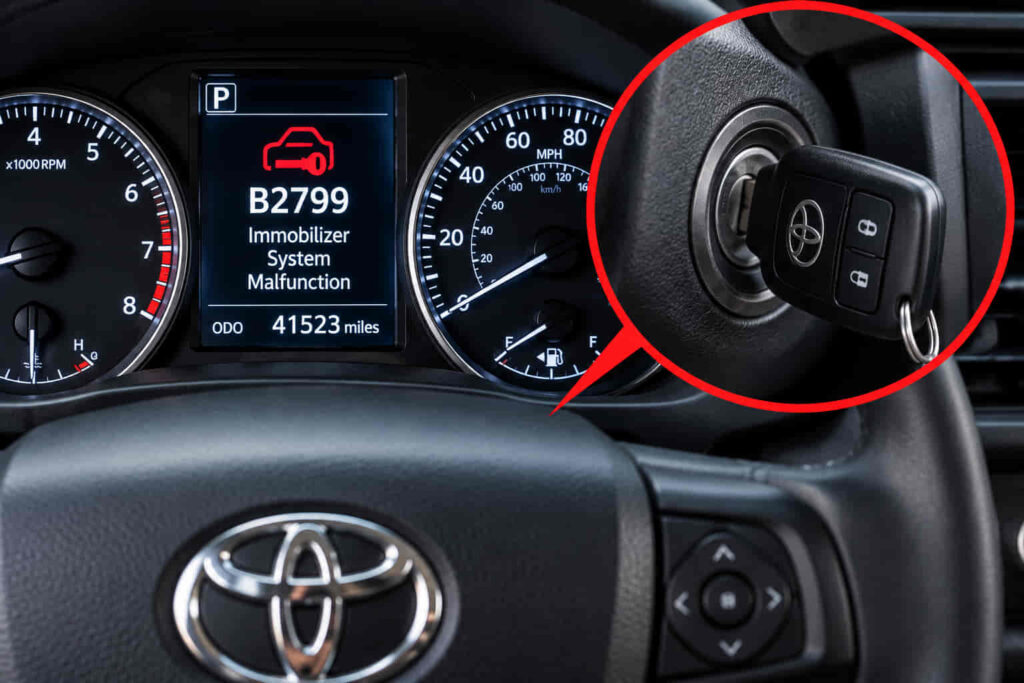
The Toyota B2799 code indicates a malfunction involving the engine immobilizer system and the communication required for proper engine start authorization. When this fault is present, the vehicle may experience a no-start condition, abnormal security indicator behavior, or other starting problems because the immobilizer and engine control systems cannot complete the expected authorization process.
B2799 does not automatically mean that the transponder key, immobilizer ECU, or engine control module has failed. The actual cause can exist in the communication circuit, wiring or electrical connectors, key recognition process, immobilizer-related components, or the ECM communication path. The exact diagnostic procedure also depends on the Toyota model, model year, and whether the vehicle uses a conventional transponder-key or smart-key configuration.
Correct diagnosis starts with retrieving all available trouble codes and determining whether the vehicle recognizes the key and completes the expected immobilizer communication. The relevant wiring, connectors, power and ground circuits, immobilizer data, and related control modules can then be tested before any key or ECU is replaced. This guide explains what Toyota B2799 means, the symptoms and causes associated with the code, how it can contribute to a no-start condition, and how to diagnose and repair the underlying fault without unnecessary parts replacement.
What Does the B2799 Code Mean on a Toyota?
The Toyota B2799 code indicates a malfunction involving the engine immobilizer system and the communication used to authorize engine operation. The immobilizer is designed to verify that an accepted key is being used and to exchange the information required for the vehicle to permit normal engine operation. When the expected communication or authorization process does not occur correctly, B2799 can be stored.
The important distinction is that B2799 describes a detected system condition rather than identifying one failed component. A problem can exist between immobilizer-related control components and the ECM, within the associated wiring or connectors, or elsewhere in the process used to recognize the key and authorize engine operation. For this reason, retrieving B2799 does not provide enough evidence to immediately condemn the transponder key, immobilizer ECU, or ECM.
Key recognition and engine authorization are related but separate diagnostic concepts. The immobilizer system first needs valid information associated with an authorized key, and the relevant control systems then need to process or exchange the information required for engine operation. A malfunction at either stage can produce a starting problem, but determining which stage failed requires additional diagnostic evidence.
The exact signal and communication path depends on the Toyota model, model year, and security-system configuration. A conventional transponder-key system and a smart-key-equipped vehicle do not necessarily use identical components or diagnostic procedures. The correct interpretation of B2799 therefore combines the DTC with vehicle-specific wiring information, related trouble codes, immobilizer data, and the actual starting condition.
B2799 should ultimately be treated as evidence that the immobilizer/start-authorization process requires diagnosis. It is not an instruction to program a key or replace an ECU. Identifying where recognition or communication stops is what converts the trouble code into a confirmed repair.
How Serious Is the Toyota B2799 Code?
Toyota B2799 can be a serious fault because an immobilizer or start-authorization malfunction can prevent the engine from starting even when other vehicle systems appear to operate normally. Its practical severity depends primarily on whether the vehicle currently starts, whether the fault is intermittent, and whether additional immobilizer or communication codes are present.
A no-start condition makes B2799 immediately significant. The vehicle can have electrical power and functioning accessories while the immobilizer-related authorization process remains incomplete. This distinction explains why a vehicle that appears electrically active can still be unable to achieve normal engine operation. Diagnosis must therefore separate a security-system authorization problem from unrelated starting faults such as a conventional battery, starter, fuel, or ignition problem.
An intermittent B2799 also deserves prompt attention even if the Toyota currently starts. An electrical connection or communication problem can disappear temporarily and return when operating conditions change. A vehicle that starts successfully during one attempt has not necessarily proven that the immobilizer system is fault-free, particularly when the code repeatedly returns or starting behavior has already been inconsistent.
The severity also increases when B2799 appears with other immobilizer, communication, or electrical DTCs. Those codes can show that the malfunction extends beyond an isolated stored code and can help identify the system preventing normal authorization. Security indicator behavior and scan-tool data provide additional context because they can reveal whether the vehicle is recognizing the key and whether the relevant control systems are communicating as expected.
A Toyota that currently starts and operates normally may not require the same immediate response as a vehicle that cannot start, but B2799 should not be ignored. An unresolved authorization or communication fault can create a future restart problem after the engine is switched off. The appropriate response is to diagnose the stored condition while the available DTCs and system data can still be used to identify the root cause.
Read more: Toyota P0500
What Symptoms Can Appear With Toyota Code B2799?
Toyota B2799 can cause a no-start condition, abnormal security indicator behavior, starting problems, and warning lights when the immobilizer system cannot complete the expected key recognition or engine authorization process. The exact symptoms depend on the Toyota model, security-system configuration, and point at which immobilizer communication fails. B2799 therefore does not produce an identical starting condition on every Toyota.
A no-start condition is one of the most important symptoms because the immobilizer system is directly connected to engine authorization. When the required security information is not recognized or exchanged correctly, the vehicle can restrict normal engine operation. This can create a situation in which electrical accessories operate and the vehicle appears to have power, yet the engine does not start normally. The symptom should still be diagnosed rather than automatically attributed to the key because conventional starting, electrical, fuel, or ignition faults can also produce a no-start condition.
The security indicator can provide additional diagnostic context. Its behavior reflects the operating state of the vehicle’s security system, so an abnormal indication combined with B2799 can support further investigation of key recognition and immobilizer operation. The indicator alone does not identify the failed component. Its behavior needs to be interpreted together with the stored DTCs, vehicle-specific diagnostic information, and the actual start condition.
Intermittent starting is also possible when the underlying problem involves an unstable electrical connection or communication path. A loose terminal, damaged wire, or other intermittent circuit condition can allow the authorization process to succeed during one start attempt and fail during another. This explains why clearing B2799 or successfully starting the vehicle once does not prove that the root cause has disappeared.
Warning lights can accompany B2799 when the relevant control system records the malfunction, while additional communication or immobilizer-related codes may be stored at the same time. These accompanying DTCs are diagnostically valuable because they can identify which part of the authorization process requires further testing. A complete system scan is therefore more useful than evaluating B2799 as an isolated code.
A Toyota can also store B2799 while showing fewer obvious symptoms, particularly when the fault is intermittent or occurred under conditions that are not present during the current inspection. In this situation, code history and system data become especially important. The absence of an active no-start condition does not establish that the immobilizer communication problem has been permanently resolved.
What Causes the B2799 Code on a Toyota?
Toyota B2799 is caused by a malfunction in the immobilizer-related recognition or communication process required for engine authorization, with the root fault potentially involving the communication circuit, wiring and connectors, key recognition, immobilizer-related control components, or the ECM side of the system. The code does not identify which of these elements has failed, so the cause must be established through vehicle-specific testing.
A communication-circuit problem is a primary diagnostic area because immobilizer-related control systems must exchange the information required for authorization. If the expected information cannot reach its destination, the receiving control system can identify the communication as abnormal and store a DTC. The diagnostic objective is to determine whether the required information was never generated or whether it was generated correctly but failed to travel through the expected path.
Damaged wiring can interrupt this communication even when the key and control modules operate correctly. An open circuit can stop information from reaching another component, while a short or other electrical fault can make the communication unusable. Harness damage, previous electrical work, physical abrasion, or an intermittent internal wire failure can therefore create B2799 without requiring replacement of the key or an ECU.
Electrical connectors and terminals can create a similar condition. Loose terminals, corrosion, contamination, damaged connector housings, or inadequate terminal contact can interrupt communication permanently or intermittently. A connector fault becomes particularly relevant when the vehicle starts normally at some times but stores B2799 or develops a no-start condition at others. Inspection should focus on the applicable circuit rather than treating every connector in the vehicle as equally relevant.
A transponder-key or key-recognition problem can become a possible cause when diagnostic evidence shows that the immobilizer system is not recognizing the expected key information. This possibility should be separated from the assumption that any B2799 code means the key is defective. The key itself, its registration status, the components responsible for reading its identification information, and the communication that follows recognition represent different stages of the authorization process.
Immobilizer-related control components can also cause B2799 when they fail to process or communicate the information required by the system. A component should become a replacement candidate only after its associated circuits, electrical conditions, connectors, and inputs have been tested. This order matters because replacing a functioning immobilizer component cannot correct a broken communication wire or poor terminal connection outside the module.
The ECM side of the communication path also requires consideration when testing shows that immobilizer information is being produced but the expected authorization exchange does not complete correctly. The relevant wiring, connectors, power supplies, grounds, and communication conditions need to be verified before ECM failure is considered. The module that reports or participates in a fault is not automatically the module that caused it.
Electrical supply problems can broaden the investigation when supporting DTCs or measurements indicate unstable power or ground conditions. Immobilizer and engine-control electronics require proper electrical conditions to recognize, process, and exchange information. A voltage or ground fault should therefore be repaired when testing confirms it, but B2799 alone does not prove that the battery, charging system, or a specific power-supply component is defective.
The root cause of B2799 is ultimately identified by tracing the authorization process from key recognition through immobilizer communication to the engine-control side of the system. If recognition fails, diagnosis concentrates on that stage and its related components. If the key is recognized but the required information does not reach or match at the next control stage, the communication circuit and participating control systems become more relevant. This process-based diagnosis prevents B2799 from being reduced to an unsupported “replace the key” or “replace the ECU” repair.
What Other Trouble Codes Should You Check With Toyota B2799?
When Toyota B2799 is stored, check for additional immobilizer, key-recognition, communication, ECM, and electrical DTCs because another code may identify the specific stage of the authorization process that has failed. B2799 establishes that an immobilizer-related malfunction requires diagnosis, but evaluating the complete code set provides more context than treating B2799 as an isolated instruction to replace a key or control module.
Immobilizer-related DTCs are particularly important because they can provide more specific information about key recognition or the communication required for engine authorization. If another security-system code appears with B2799, the two codes should be interpreted together. A more specific code can direct testing toward a particular circuit or system condition and prevent diagnosis from starting with an unsupported component replacement.
Communication codes can change the diagnostic direction when the participating control systems cannot exchange information correctly. If immobilizer data is available at one stage but the expected information does not reach another module, the fault may exist in the communication path rather than in the key itself. Related communication DTCs help establish whether B2799 is part of a broader network or circuit problem.
ECM and electrical codes also require attention when they appear at the same time. A control system cannot process immobilizer information correctly if its required power, ground, or communication conditions are not present. Supporting voltage or electrical DTCs should therefore be investigated when measurements confirm an abnormal condition. B2799 alone, however, is not sufficient evidence to diagnose a battery, charging-system component, or ECM failure.
The complete DTC record should be preserved before codes are erased. Available diagnostic data and the vehicle’s actual starting condition can help determine whether B2799 is the primary fault or a consequence of another problem. The objective is to identify the code and system condition that best explain why the normal recognition and authorization process cannot be completed.
How Do You Diagnose Toyota Code B2799?
Diagnosing Toyota B2799 requires confirming the starting condition, determining whether the key is recognized, evaluating immobilizer communication, and testing the relevant circuits before replacing or registering any key or control module. The exact procedure must match the Toyota model, model year, and immobilizer or smart-key configuration because the components and communication path are not identical across all vehicles.
Diagnosis begins with a complete system scan before B2799 is cleared. The technician should preserve B2799 and all related immobilizer, communication, engine-control, and electrical DTCs, then compare them with the vehicle’s current symptoms. A Toyota that consistently fails to start provides a different diagnostic condition from one that currently starts normally but has stored B2799 intermittently.
The next diagnostic question is whether the vehicle recognizes the key as expected. This distinction is essential because failure to recognize valid key information and failure to communicate authorization information after recognition are not the same fault. When the available diagnostic data shows that the key is recognized, replacing or programming the key without additional evidence moves diagnosis in the wrong direction. When recognition itself fails, the key and the system responsible for reading or validating it become more relevant.
Immobilizer-related scan data should then be evaluated with a diagnostic tool capable of accessing the required Toyota systems. A basic generic OBD2 scanner may retrieve an engine-related DTC but may not expose the security-system information needed to determine where authorization fails. Access to the relevant control modules allows the technician to compare DTCs and system states rather than relying only on the presence of B2799.
The communication architecture should be identified before electrical testing begins. Vehicle-specific service information and wiring diagrams establish which components participate in key recognition, which control systems exchange authorization information, and which circuits connect them. This prevents a diagnostic procedure from one Toyota generation or security configuration from being incorrectly applied to another vehicle.
Once the relevant path is known, its wiring and connectors can be inspected and electrically tested. Damaged wiring, open or shorted circuits, loose terminals, corrosion, poor connector contact, and previous electrical repairs can interrupt otherwise valid immobilizer communication. Visual inspection can identify obvious damage, but electrical measurements are required when the circuit appears normal while B2799 remains active or intermittent.
Power and ground conditions should be verified for the components involved in the affected circuit when the vehicle-specific procedure requires them. A control component cannot reliably recognize or exchange information without the correct electrical supply. Testing these conditions before replacing a module separates an external electrical problem from an internal component failure.
The key or immobilizer-related component should be tested only after the diagnostic evidence points toward that stage of the system. If key recognition is abnormal, the technician should determine whether the condition follows the key, its registration state, the component responsible for reading the key information, or another part of the recognition process. A known-valid registered key can provide useful diagnostic comparison when the applicable vehicle and service procedure support that test.
Control-module failure should remain near the end of the diagnostic hierarchy. Before an immobilizer-related ECU or ECM is condemned, its relevant power supplies, grounds, connectors, wiring, communication circuits, and required inputs should test correctly. A module participating in the authorization process can store or respond to B2799 without being the component that originally caused the malfunction.
Key or ECU registration should also be separated from physical fault diagnosis. Registration is appropriate when the repair procedure requires synchronization or registration of a replacement or affected component. It is not a universal reset for B2799. If a communication wire is open or a connector cannot maintain electrical contact, programming the key cannot restore that circuit.
After the confirmed fault is repaired and any required registration procedure is completed, the codes can be cleared and the starting system verified. The vehicle should recognize the authorized key, complete the expected immobilizer authorization process, and start consistently under the conditions relevant to the original fault. A final scan should confirm that B2799 and related DTCs remain absent. If the code returns, the remaining evidence should be used to continue tracing the recognition or communication stage that is still failing.
How Do You Fix the B2799 Code on a Toyota?
Fixing Toyota B2799 requires restoring the key-recognition and immobilizer communication process that allows the vehicle to authorize normal engine operation. The correct repair depends on where diagnosis identifies the failure. A damaged communication circuit requires an electrical repair, a confirmed key-recognition problem requires correction at the recognition stage, and a failed control component should be replaced only when testing proves that the component itself is defective.
Wiring faults should be repaired when testing identifies an open circuit, short circuit, excessive resistance, or another condition that prevents the required immobilizer information from reaching its destination. The repair must restore electrical integrity throughout the affected section of the circuit. Replacing a key or ECU cannot correct a communication path that remains physically interrupted.
Connector and terminal faults require the same root-cause approach. Corrosion, damaged terminals, loose connections, or inadequate terminal contact can prevent otherwise functional control components from communicating reliably. Repairing or replacing the affected terminal or connector can restore the authorization path without replacing the immobilizer-related components connected to it. The circuit should be retested afterward to confirm that the repair remains stable.
A key-related repair becomes appropriate when diagnosis demonstrates that the system cannot correctly recognize or validate the key and the problem has been isolated to that stage. Depending on the specific Toyota system and repair scenario, this can involve addressing the key itself or completing the required registration procedure. The presence of B2799 alone is not sufficient evidence to order a replacement key because the same code can result from faults elsewhere in the immobilizer communication process.
Key registration or programming should be performed when the vehicle-specific repair procedure requires it. Registration establishes the required relationship between an authorized key and the relevant security system, but it cannot repair damaged wiring, restore a poor connector, or correct a failed communication circuit. Repeated programming attempts are therefore not an effective substitute for electrical diagnosis when the physical signal path is defective.
An immobilizer-related control component should be replaced only when its external circuits and required operating conditions have been verified and testing identifies an internal failure. The replacement process may require registration, synchronization, initialization, or another vehicle-specific procedure before normal engine authorization can occur. Installing the component without completing the required setup can leave the vehicle unable to start even when the original physical fault has been corrected.
ECM replacement should remain a later repair possibility rather than a default response to B2799. The ECM participates in the authorization process, but participation does not prove failure. Its relevant power, ground, wiring, connectors, communication path, and immobilizer-related inputs should be confirmed before replacement. When ECM replacement is genuinely required, the applicable registration or synchronization procedure must also be completed according to the specific Toyota system.
The repair is complete only after the authorization process is verified. Once the confirmed fault has been corrected and any required registration has been completed, B2799 and related DTCs can be cleared. The authorized key should be recognized consistently, the vehicle should complete the expected start process, and the relevant security-system behavior should return to normal. A final scan should confirm that B2799 does not return.
Can You Clear Toyota B2799 Without Fixing the Problem?
Toyota B2799 can be erased with an appropriate diagnostic tool, but clearing the code does not repair the immobilizer or communication fault that caused it. If the authorization process remains abnormal, B2799 can return when the control systems encounter the same fault condition again.
The stored diagnostic information should be preserved before clearing the code because it can help identify the failed stage of the system. Related immobilizer, communication, ECM, or electrical DTCs may provide more specific diagnostic direction than B2799 alone. Erasing those codes before recording them can remove useful evidence while leaving the underlying starting problem unchanged.
Clearing B2799 can also create the false impression that an intermittent fault has been repaired. A loose terminal or unstable electrical connection may function correctly during one start attempt and fail during another. If the vehicle starts immediately after the code is erased, that successful start proves only that the authorization process succeeded at that moment. It does not prove that the original fault can no longer recur.
Disconnecting the battery should not be treated as a repair for B2799. Removing power cannot permanently repair damaged wiring, restore a defective connector, correct an internal component failure, or solve an unresolved key-recognition problem. Depending on the Toyota model and electronic configuration, battery disconnection can also create additional initialization or setup requirements without addressing the original immobilizer fault.
Code clearing becomes useful after diagnosis and repair because it creates a clean condition for verification. The vehicle can then be started repeatedly under appropriate conditions while key recognition, immobilizer operation, and related diagnostic information are monitored. B2799 should remain absent after the system has completed the relevant checks.
If B2799 returns after clearing, the recognition or communication problem remains active or intermittent. The next step is not to repeatedly erase the DTC but to use the returning code, current symptoms, related DTCs, and circuit measurements to locate the unresolved fault. A successful repair is demonstrated by consistent engine authorization and the continued absence of B2799, not simply by turning off a warning indicator.
Can You Drive a Toyota With the B2799 Code?
A Toyota with B2799 may continue to drive if the engine is already running and the vehicle otherwise operates normally, but an unresolved immobilizer fault can create a risk that the engine will not start again after it is switched off. The practical concern with B2799 is therefore not limited to driving behavior. The ability of the immobilizer system to consistently complete engine start authorization is also important.
If the vehicle currently has a no-start condition, driving is obviously not possible until the underlying problem is diagnosed. Electrical accessories or instrument-panel functions may still operate even though the immobilizer-related authorization process does not complete correctly. This distinction helps separate a security-system start restriction from the assumption that the entire vehicle has lost electrical power.
A Toyota that is already running presents a different situation. The fact that the engine continues to operate does not prove that the immobilizer fault has disappeared. An intermittent wiring connection, communication problem, or key-recognition fault may become relevant again during the next start attempt. Switching the engine off before the problem is diagnosed can therefore leave the driver with a vehicle that will not restart.
Repeated or intermittent starting problems increase the importance of prompt diagnosis. If the vehicle sometimes recognizes the authorized key and sometimes does not complete the expected start process, the fault is demonstrating that the system cannot operate consistently. Clearing B2799 or successfully starting the engine once does not establish that the next authorization attempt will also succeed.
Additional symptoms should also influence the decision to continue using the vehicle. Communication or electrical DTCs, abnormal security indicator behavior, or other starting-system faults can show that B2799 is part of a broader problem requiring investigation. The complete diagnostic condition is more useful for assessing the vehicle than the B2799 code by itself.
For a Toyota that currently starts and drives normally, B2799 should still be diagnosed before the vehicle is relied on for normal use. The key question is whether the system can repeatedly recognize the authorized key and complete the required immobilizer communication. Consistent restart verification provides stronger evidence of normal operation than the simple fact that the engine is running at the moment.
How Much Does It Cost to Fix Toyota Code B2799?
The cost to fix Toyota B2799 depends on the confirmed cause because B2799 identifies an immobilizer-related malfunction rather than a specific part that must be replaced. A wiring or connector repair, key-related service, registration procedure, and confirmed control-module failure can involve substantially different parts and labor requirements. Diagnosis is therefore necessary before an accurate repair estimate can be produced.
Diagnostic labor can represent an important part of the total cost. A technician may need to retrieve codes from multiple systems, verify key recognition, inspect immobilizer data, identify the vehicle-specific communication path, and test wiring, connectors, power, and ground circuits. An intermittent B2799 can require additional diagnostic time because the system may operate normally during inspection and fail only under particular conditions.
A wiring or connector fault can require relatively inexpensive replacement materials but more labor to locate the exact failure. An accessible damaged terminal can be considerably simpler to repair than an intermittent problem located deeper within a wiring harness. The cost therefore depends on where the communication path fails and how much disassembly or testing is required to reach it.
Key-related costs depend on what diagnosis actually proves. A problem requiring an authorized key to be registered is different from a physically defective key, and both differ from a fault in the system responsible for recognizing key information. Paying for a new key and programming does not guarantee a repair if the actual problem is a damaged communication circuit or control-system fault.
Control-module replacement can increase repair cost because the component may be more expensive and the repair can require registration, synchronization, initialization, or other vehicle-specific procedures. This is one reason module replacement belongs near the end of the diagnostic process. Confirming external wiring and electrical conditions first reduces the risk of paying for a control module that does not correct B2799.
Toyota model, model year, security-system configuration, labor rates, diagnostic time, and the required replacement components all influence the final amount. For this reason, a single universal price for B2799 would be misleading. The most reliable estimate is produced after diagnosis identifies the exact point where key recognition or immobilizer communication fails.
An evidence-based diagnosis can also reduce the total repair cost by preventing unnecessary parts replacement. Replacing a key, immobilizer-related ECU, and ECM in sequence until B2799 disappears can become far more expensive than tracing the authorization path first. The correct repair targets the failed circuit or component once testing has established the root cause.
Does Toyota B2799 Mean the Key Is Bad?
No, Toyota B2799 does not automatically mean that the key is bad. The code indicates a malfunction involving the immobilizer-related recognition or communication process, and the transponder key represents only one part of that process. The key should become the suspected cause only when diagnostic evidence shows that the vehicle cannot correctly recognize or validate its identification information.
A functioning key can be present while B2799 is caused elsewhere in the system. The vehicle still needs the appropriate components to read the key information, process it, and complete the communication required for engine authorization. A damaged wire, poor connector terminal, electrical supply problem, or communication fault can interrupt that process even when the transponder key itself is operating correctly.
This distinction becomes clearer when the diagnostic process separates key recognition from subsequent immobilizer communication. If scan data shows that an authorized key is recognized correctly but the expected authorization exchange does not complete, replacing the key does not address the stage where the fault has been detected. Diagnosis should instead follow the communication path and determine why valid information is not being processed or transferred as expected.
A second properly registered key can provide useful comparative evidence when the vehicle configuration and diagnostic procedure support that test. If one authorized key consistently works while another does not under the same conditions, the result can shift attention toward the affected key or its registration. If neither key works and the same communication condition remains present, the shared vehicle-side components and circuits become more significant diagnostic targets.
The key becomes a confirmed repair target only after testing isolates the failure to the key or its applicable recognition state. Even then, the technician must distinguish a defective key from a key that requires the correct registration procedure. Those conditions can produce similar starting symptoms but require different repairs.
Replacing a key solely because B2799 is stored is therefore an incomplete diagnostic strategy. The correct question is not whether B2799 is an immobilizer code, but where the immobilizer authorization process stops. Identifying that point determines whether the repair involves the key, key recognition system, wiring, communication circuit, immobilizer-related control component, or another part of the authorization path.
Can Toyota B2799 Be Fixed by Programming the Key?
Programming or registering the key can fix Toyota B2799 only when diagnosis confirms that the fault involves key registration or recognition and the vehicle-specific repair procedure requires registration. Key programming is not a universal fix for B2799 because software registration cannot repair a damaged electrical circuit or restore communication through a defective connection.
Key registration establishes the relationship required for the security system to recognize an authorized key. This procedure becomes relevant after certain key-related repairs or when diagnostic evidence shows that the vehicle does not have the expected registered-key relationship. When that is the actual cause of the authorization failure, completing the correct registration procedure can restore normal starting operation.
A communication-circuit fault produces a different diagnostic condition. If a wire between participating components is open, shorted, or unable to carry the required information reliably, programming the key leaves that physical fault unchanged. The same principle applies to loose connector terminals, corrosion, poor electrical connections, or missing power and ground conditions. Software procedures cannot restore electrical integrity to a defective circuit.
Programming can also fail to solve B2799 when the vehicle already recognizes the key correctly. If diagnostic data confirms successful key recognition but authorization communication fails afterward, repeatedly registering the same key targets the wrong stage of the process. Testing should move toward the communication path and the control systems that process the recognized key information.
Component replacement can create a legitimate need for registration or synchronization. Depending on the specific Toyota immobilizer or smart-key configuration, replacement of an affected key or control component may require an additional setup procedure before the vehicle can authorize engine operation normally. In that situation, programming is part of completing the confirmed repair rather than an alternative to diagnosing the original fault.
The distinction between repair and registration is therefore essential. Physical and electrical faults must first be corrected when they cause B2799, while registration should be performed when the system configuration or replacement procedure specifically requires it. Afterward, the vehicle should consistently recognize the authorized key, complete engine authorization, start normally, and remain free of B2799 during verification.
How Does the Immobilizer System Cause a Toyota No-Start With B2799?
Toyota B2799 can contribute to a no-start condition when the immobilizer system cannot complete the recognition and authorization process required for normal engine operation. The system is designed to distinguish an authorized key from an unrecognized one and ensure that the required security information is processed before normal engine operation is permitted. A failure within this process can prevent successful authorization even when other electrical systems remain functional.
The process begins with information associated with the authorized key. The vehicle must obtain and recognize the expected identification information through the applicable immobilizer or smart-key system. Successful recognition establishes that the correct key information is available, but recognition alone does not complete every stage of engine authorization. The relevant control systems must also process and exchange the information required for the vehicle to permit normal engine operation.
B2799 becomes diagnostically important when this authorization-related process does not occur as expected. If key information cannot be recognized, diagnosis needs to focus on the recognition stage. If the key is recognized but the necessary information cannot be communicated between the participating control systems, the fault moves farther along the authorization path. This distinction explains why two Toyota vehicles with B2799 can both have starting problems while requiring different repairs.
A communication failure can prevent authorization even when the individual components appear functional. For example, a control component may receive valid information but be unable to transfer the required data because the relevant wiring or electrical connection is defective. In this situation, replacing the recognized key does not restore communication because the failure occurs after the key-recognition stage.
This mechanism also explains why a Toyota with B2799 can have functioning lights, accessories, and instrument-panel electronics while still experiencing a no-start condition. The immobilizer fault concerns authorization for engine operation rather than a universal loss of electrical power. Electrical activity elsewhere in the vehicle therefore does not prove that the security-related start process has completed successfully.
A no-start condition should still be confirmed diagnostically rather than attributed to B2799 solely because the code is stored. Starting problems can also originate from battery, starter, engine-management, fuel, ignition, or other electrical faults. The strongest relationship between B2799 and the no-start condition exists when diagnostic data shows that key recognition or immobilizer authorization is failing at the same time the vehicle refuses to start.
Once the failed stage is identified and repaired, verification should reproduce the complete authorization process. The authorized key should be recognized consistently, the participating control systems should complete the expected communication, and the vehicle should start normally on repeated attempts. This confirms that the no-start condition was corrected at its source rather than temporarily bypassed by clearing the DTC.
Does Toyota B2799 Differ on Camry, Corolla, Prius, and RAV4?
The basic B2799 fault remains related to Toyota immobilizer and engine-authorization communication, but the diagnostic path can differ between Camry, Corolla, Prius, and RAV4 models because their security systems, control modules, wiring, and key configurations vary by generation and model year. The same DTC should therefore not be treated as evidence that the same component has failed on every Toyota.
Toyota Camry and Corolla vehicles span multiple generations with changes in electronic security and engine-control architecture. A diagnostic procedure that applies to an earlier transponder-key configuration may not match a later vehicle equipped with a different immobilizer or smart-key arrangement. The exact model year and system configuration need to be identified before the communication path is tested.
The RAV4 requires the same vehicle-specific approach. Different generations and powertrain configurations can use different electronic arrangements even though the vehicle carries the same model name. The applicable wiring diagram establishes which components participate in recognition and authorization and which circuits should be inspected when B2799 is present.
The Toyota Prius requires particular attention to vehicle-specific diagnostic information because its hybrid and electronic architecture differs from a conventional gasoline-only Toyota. Its starting process should not be interpreted solely through the behavior expected from a traditional starter-based vehicle. Immobilizer and smart-key diagnosis must be matched to the specific Prius generation and its control-system configuration before B2799 is assigned to a particular component.
Key type also changes the diagnostic context. A conventional transponder key and a smart-key system can involve different recognition methods, components, and registration procedures. Advice to replace or reprogram a particular component based on a repair performed on another Toyota can therefore be incorrect even when both vehicles display B2799.
Model-specific differences are especially important when control components have been replaced. Registration, synchronization, or initialization requirements can depend on the exact security-system configuration and repair performed. A procedure that successfully completes a repair on one model year should not automatically be assumed to apply to another generation.
The correct diagnostic starting point is therefore the exact Toyota model, model year, key or smart-key configuration, related DTCs, and applicable service information. B2799 defines the fault context, while vehicle-specific architecture determines how the technician traces the recognition and authorization path. This approach prevents a valid diagnosis from being replaced by a model-independent parts recommendation.
How Can You Prevent Toyota B2799 From Returning?
The most effective way to prevent Toyota B2799 from returning is to repair the confirmed cause of the immobilizer malfunction and verify that key recognition and engine authorization operate correctly after the repair. Clearing the code, disconnecting the battery, programming an already recognized key, or replacing an untested component does not prevent recurrence when the original recognition or communication fault remains present.
A complete repair must address the exact stage where the authorization process fails. If damaged wiring prevents communication between participating control systems, the affected circuit must be restored and electrically verified. If loose, corroded, or damaged connector terminals interrupt communication, repairing the connection is necessary to maintain a stable signal. If diagnosis confirms a key-recognition or control-component fault, that specific condition must be corrected rather than bypassed with repeated code clearing.
Intermittent electrical faults require particular attention because they can make B2799 disappear temporarily. A terminal can maintain contact during a stationary inspection but lose its connection because of vibration, harness movement, temperature changes, or another operating condition. When B2799 has appeared intermittently, the relevant wiring and connectors should be evaluated for conditions capable of producing an unstable communication path instead of assuming that a successful start proves the problem has disappeared.
Registration or synchronization should be completed when the confirmed repair and vehicle-specific procedure require it. Replacement of an affected key or control component can create a legitimate need for system registration before normal authorization is restored. Registration should therefore complete an appropriate repair rather than serve as a universal response to B2799. A physical communication fault must still be repaired before a software or registration procedure can provide a reliable result.
Repeated start verification is especially important after repairing an immobilizer-related fault. The authorized key should be recognized consistently, the expected authorization process should complete, and the vehicle should start normally across repeated attempts. This testing matters because one successful start demonstrates only that the system worked once, while repeated successful authorization provides stronger evidence that an intermittent problem has been eliminated.
A final system scan should confirm that B2799 and related immobilizer, communication, or electrical DTCs remain absent after the repaired system has been tested. Security-system behavior should also correspond with normal operation for the specific Toyota configuration. When these conditions are present together, the repair has addressed both the stored DTC and the system malfunction responsible for it.
If B2799 returns, the recurrence is evidence that the authorization process still contains an active or intermittent fault. The new code status, starting behavior, key-recognition information, related DTCs, and electrical measurements should then be compared with the original diagnostic evidence. Preventing Toyota B2799 from returning ultimately depends on restoring reliable immobilizer communication and proving that the complete engine-authorization process continues to operate correctly.