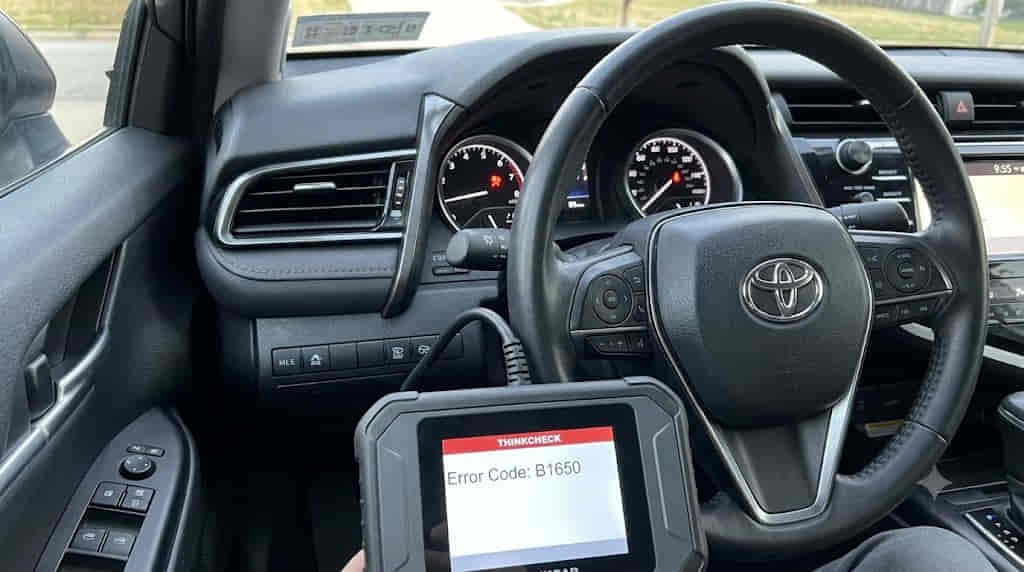
Seeing Toyota B1650 on a diagnostic scan can be more concerning than a typical engine fault because this code is associated with the vehicle’s occupant classification system on many Toyota applications. The occupant classification system helps determine the status of the front passenger seat and provides information used by the airbag system to make appropriate deployment decisions. When B1650 is stored, the problem is not simply a generic electrical warning. It indicates that the vehicle has detected a malfunction within a system that can affect how the passenger restraint system operates.
The difficulty is that Toyota B1650 does not automatically identify one failed part. The fault can involve the occupant classification system itself, its wiring, connectors, communication with the airbag control system, or another related condition detected by the vehicle’s diagnostic strategy. Toyota service information for several models describes B1650/32 as an occupant classification system malfunction and directs technicians to check the occupant classification ECU and related diagnostic information before replacing components.
This distinction matters because replacing a passenger seat sensor, occupant classification ECU, or another SRS component without identifying the actual cause can lead to unnecessary expense and may leave the original fault unresolved. In some Toyota applications, B1650 can also be stored when the airbag sensor assembly receives information that another occupant classification fault is present, meaning related DTCs can be more useful than B1650 alone when determining the root cause.
This guide explains what Toyota B1650 means, how the occupant classification system works, the symptoms and causes associated with the code, and how the fault should be diagnosed. It also examines the appropriate repair approach, whether driving with B1650 is advisable, and why SRS-related diagnosis requires greater care than a conventional body or engine electrical fault.
What Does Toyota B1650 Mean?
Toyota B1650 is commonly associated with an Occupant Classification System Malfunction, often shown in Toyota service information as B1650/32. The occupant classification system is part of the supplemental restraint system and works with the airbag control system to determine how the front passenger restraint system should operate. Depending on the Toyota model, the system can use information from the occupant classification ECU to help the airbag sensor assembly determine whether the front passenger airbag, passenger-side seat airbag, and seat belt pretensioner should be activated during a collision.
The important point is that B1650 does not simply mean that one particular passenger seat sensor has failed. Toyota service procedures describe the code as a malfunction within the occupant classification system circuit. Depending on the vehicle, the monitored circuit can include the occupant classification ECU, center airbag sensor assembly, seat wiring, floor wiring, connectors, and the communication or signal circuits connecting these components.
The occupant classification system has an important safety function. The airbag system needs to receive reliable information about the passenger seat before it can make decisions about restraint-system operation. When the airbag sensor assembly detects an abnormal signal or receives information indicating that the occupant classification system has a fault, it can store B1650/32. On some Toyota platforms, the condition can involve an open circuit, a short circuit, a short to ground, a short to battery voltage, or a malfunction within the airbag sensor assembly itself.
This explains why diagnosing Toyota B1650 requires more than clearing the SRS warning light. A damaged wire underneath the passenger seat, a loose or damaged connector, a fault inside the occupant classification ECU, or a problem with the airbag sensor assembly can create different diagnostic paths even though the scan tool displays the same main B1650 code. Toyota service procedures therefore begin by checking for additional DTCs stored by the occupant classification ECU before moving deeper into the circuit diagnosis.
The exact relationship between B1650 and other codes can also vary between Toyota generations. On some newer Toyota applications, for example, the airbag sensor assembly communicates with the occupant detection ECU over the vehicle’s communication network. In that type of system, B1650/32 can be stored because the occupant detection ECU has already stored another specific DTC. In such a case, B1650 may be more of a system-level indication than the original root fault.
This distinction is critical when interpreting the code. If another occupant classification DTC is present, that code may provide the more direct explanation for the malfunction. If no additional code is present, the diagnostic process can move toward checking connectors, wiring continuity, shorts, power or signal conditions, and the relevant control modules according to the Toyota-specific procedure.
The passenger seat itself can also become part of the diagnostic picture because the occupant classification system and its wiring are associated with the front passenger seating assembly. Moving the seat, performing seat repairs, installing aftermarket equipment, or disturbing wiring underneath the seat can potentially affect connectors or harnesses. However, the presence of wiring under the seat should not lead to an assumption that the harness is automatically defective. Proper circuit testing is still necessary.
Safety precautions are particularly important when diagnosing Toyota B1650 because the code belongs to the SRS environment. Toyota service procedures commonly require the ignition to be switched off and the negative battery terminal to be disconnected for the specified waiting period before certain SRS connectors or circuits are inspected. The purpose is to reduce the risk of unintended airbag deployment while work is being performed.
In practical terms, Toyota B1650 means that the vehicle has detected a malfunction involving the occupant classification system or its related circuit. It does not identify one universally failed component. The correct repair depends on the specific Toyota model, the additional DTCs present, the condition of the wiring and connectors, and the results of the occupant classification and SRS diagnostic procedures.
Read more: Toyota P2445
How the Toyota Occupant Classification System Works
The Toyota occupant classification system is designed to provide the airbag control system with information about the condition of the front passenger seat. Rather than treating every passenger seat situation in exactly the same way, the system evaluates information from the passenger seat and communicates the resulting classification to the airbag sensor assembly. This information can then be used as part of the vehicle’s overall supplemental restraint system strategy.
At the center of this process is the occupant classification ECU. Depending on the Toyota model, the system can use sensors associated with the passenger seat to determine the occupant condition. The sensors and ECU work together to generate and process signals that represent the condition detected on the passenger side. The airbag sensor assembly then receives the relevant information through the vehicle’s SRS communication and control architecture.
The passenger seat therefore plays a more important role in the restraint system than simply providing a place for an occupant to sit. Changes in the seat, its wiring, sensor signals, or the occupant classification ECU can affect the information available to the SRS system. This is why a fault underneath the passenger seat can sometimes result in an SRS warning even when the engine, transmission, and other vehicle systems operate normally.
The system continuously depends on reliable electrical communication. Power, ground, signal circuits, connectors, and communication lines must remain within the expected operating conditions. A broken conductor, corroded terminal, loose connector, short circuit, or abnormal signal can interrupt the information exchanged between the occupant classification system and the airbag control system.
When the system detects an abnormal condition, the airbag sensor assembly or occupant classification ECU can store a diagnostic trouble code. Toyota B1650 is one such system-level indication on applicable Toyota vehicles. Importantly, the code may not identify the original failed component by itself. Additional DTCs stored in the occupant classification ECU can sometimes provide a more specific indication of what caused the malfunction.
The system’s diagnostic logic is therefore different from a simple sensor circuit in which one code directly identifies one component. The airbag sensor assembly may detect that the occupant classification system is reporting a malfunction, while the occupant classification ECU contains another code that identifies the underlying electrical or sensor problem. Reading all available SRS-related codes can consequently be much more informative than scanning only for B1650.
The occupant classification system also has to account for changes in the passenger seat environment. Seat position, occupant presence, and conditions affecting the seat or its sensors can influence the signals being processed. This is one reason Toyota service procedures may require inspection or initialization of the occupant classification system after certain repairs involving the passenger seat or related components.
Calibration and initialization are particularly important after certain occupant classification system repairs. Depending on the Toyota application, replacing an occupant classification ECU, passenger seat component, or related sensor may require the system to be initialized or zero-point calibrated according to the manufacturer’s procedure. Installing a component without completing the required initialization can leave the system unable to correctly process passenger-seat information and may cause diagnostic codes to remain stored.
The electrical connectors used by SRS and occupant classification components also require careful handling. SRS connectors are designed with specific locking and safety features, and improper connection can create an intermittent or permanent circuit fault. A connector that appears physically connected may still have a terminal problem that affects electrical continuity. Diagnosis should therefore rely on the appropriate Toyota testing procedure rather than visual inspection alone.
Because the occupant classification system contributes information to the restraint system, its operation should be considered separately from ordinary body convenience electronics. A malfunction does not necessarily mean that an airbag will deploy unexpectedly, but it can indicate that the SRS system is not operating according to its intended diagnostic and control strategy. This is why an illuminated SRS warning should not be treated as a cosmetic issue.
The overall operating sequence can be understood as a communication chain. The passenger-seat sensors provide information, the occupant classification ECU processes that information, and the airbag sensor assembly uses the resulting data as part of the SRS control strategy. Electrical circuits and communication pathways connect these components, while the diagnostic system monitors them for abnormal conditions.
Understanding this relationship makes Toyota B1650 easier to diagnose. The code should be viewed as an indication that the occupant classification system is not functioning as expected, not as proof that one particular sensor or ECU has failed. The next step is to determine which component or circuit is preventing the system from producing the correct information and communication.
What Are the Symptoms of Toyota B1650?
The most recognizable symptom of Toyota B1650 is an illuminated SRS or airbag warning light. Because the code is associated with the occupant classification system on applicable Toyota vehicles, the warning indicates that the restraint system has detected a problem that requires diagnosis. The engine may continue to start and drive normally because B1650 is not an engine-management fault, which can make the problem easy to underestimate.
The passenger airbag status indicator may also behave differently from what the driver normally expects. Depending on the Toyota model and the condition detected by the occupant classification system, the passenger airbag indicator may display an unexpected status or fail to change as expected. The exact behavior depends on the vehicle’s occupant classification strategy and should be interpreted together with the stored SRS codes.
Some vehicles may show additional warning messages or indicators related to the restraint system. When the airbag sensor assembly detects a problem with information received from the occupant classification system, it can illuminate the SRS warning indicator to alert the driver. The presence of the warning does not necessarily identify the failed component, but it confirms that the restraint system should be investigated.
An important characteristic of Toyota B1650 is that there may be no noticeable change in engine performance. Acceleration, fuel economy, transmission operation, and engine idle can remain completely normal because the occupant classification system is separate from the systems responsible for normal engine operation. This can create a false sense that the vehicle is safe simply because it drives normally.
Intermittent symptoms are also possible when the underlying cause involves a connector, wiring harness, or electrical connection. A loose connection beneath the passenger seat may respond differently as the seat moves, the vehicle vibrates, or the temperature changes. In such cases, the SRS warning may appear intermittently or the stored code may return after being cleared.
Seat-related work can provide an important diagnostic clue. If the B1650 warning appeared after removing, replacing, adjusting, or repairing the front passenger seat, the related wiring and connectors deserve careful inspection. However, timing alone does not prove that the seat caused the fault. The system should still be tested according to the appropriate Toyota diagnostic procedure.
A weak or recently interrupted electrical supply can sometimes complicate SRS diagnosis as well. Battery replacement, low-voltage conditions, or electrical work may result in stored diagnostic information on some vehicles. If B1650 appears together with multiple unrelated communication or voltage-related codes, the broader electrical condition should be considered rather than treating the occupant classification system in isolation.
The presence of additional DTCs is particularly significant. B1650 can function as a system-level indication while another code stored in the occupant classification ECU identifies a more specific problem. For example, a separate code may point toward a sensor circuit, communication problem, or internal ECU condition. Ignoring those additional codes can make the diagnosis considerably more difficult.
A change in the passenger airbag indicator should therefore not automatically be interpreted as proof that the passenger airbag itself has failed. The occupant classification system supplies information used by the SRS control system, and an error anywhere in that information chain can affect the status displayed to the driver.
The severity of the symptoms depends largely on what caused the code. A temporary connector issue may produce an intermittent warning, while an internal ECU fault or persistent sensor circuit failure may keep the SRS warning illuminated continuously. In either case, the warning should be investigated because the occupant classification system is part of the vehicle’s restraint-system architecture.
Unlike many engine-related diagnostic codes, Toyota B1650 can exist without obvious drivability symptoms. The vehicle may feel completely normal while the SRS warning remains active. That absence of engine symptoms should not be used as a reason to ignore the fault. The relevant question is whether the occupant classification and restraint systems can correctly monitor and control the passenger-side safety functions when they are needed.
What Causes Toyota B1650?
The causes of Toyota B1650 depend on the specific occupant classification system used by the vehicle, but the fault generally develops when the system cannot correctly process or communicate the passenger-seat information expected by the SRS control system. Because B1650 is a system-level code on applicable Toyota vehicles, identifying the root cause requires examining the related components and circuits rather than assuming that one particular sensor has failed.
A problem with the occupant classification ECU is one possible cause. The ECU processes information from the passenger-seat sensing system and communicates the resulting classification to the airbag sensor assembly. An internal malfunction can prevent the ECU from generating or transmitting the expected information. However, ECU failure should normally be considered only after the external circuits and related components have been verified.
The occupant classification sensors can also contribute to B1650. These sensors provide information used by the system to determine passenger-seat conditions. If a sensor develops an internal electrical fault, produces an abnormal signal, or becomes affected by a related circuit problem, the occupant classification ECU may no longer be able to process the expected information correctly.
Wiring problems are another important source of the code. The occupant classification system relies on multiple electrical circuits running between the passenger seat, sensors, occupant classification ECU, and other SRS components. A broken wire, short circuit, excessive resistance, or damaged insulation can interrupt the expected signal. Wiring beneath the passenger seat can be particularly relevant because it may be exposed to repeated seat movement, vibration, and physical disturbance.
Connector problems can create similar symptoms. An SRS connector may appear connected while a terminal inside the connector has poor contact, corrosion, damage, or an improper locking condition. Even a small change in electrical resistance can affect a sensitive sensor or communication circuit. A connector problem may also create an intermittent B1650 condition that appears and disappears depending on seat movement or vehicle vibration.
A poor power or ground connection can also interfere with occupant classification operation. Electronic control modules require stable electrical supply and grounding to process signals correctly. If the relevant ECU does not receive the expected voltage or has an abnormal ground connection, the system may store a diagnostic code even though the sensors themselves are functional.
Communication problems are another possible cause on Toyota platforms where the occupant classification ECU exchanges information with the airbag sensor assembly through a vehicle communication network. A communication interruption can prevent the airbag control system from receiving the expected occupant classification information. In this situation, B1650 may be accompanied by additional communication-related DTCs that provide more useful information about the actual fault.
Seat replacement or repair can also be relevant. The occupant classification system is closely associated with the front passenger seat, and certain repairs involving the seat, cushion, sensors, or wiring may require initialization or calibration after the work is completed. If the required procedure is not performed, the system may not correctly recognize its new or repaired components and a diagnostic fault can remain.
Physical damage to the passenger seat assembly can contribute to the problem as well. Pressure, impact, modification, or improper installation can affect components associated with the occupant classification system. Aftermarket seat modifications should be treated carefully because changes to the seat structure or wiring can interfere with the original sensing and restraint-system design.
Low-voltage conditions can sometimes complicate the diagnostic picture. If the vehicle has experienced a severely discharged battery, battery replacement, or another electrical event, multiple control modules may store temporary or communication-related faults. B1650 should therefore be evaluated alongside the complete set of DTCs rather than assuming that every stored code represents a separate failed component.
The airbag sensor assembly itself can be involved in some Toyota diagnostic paths. This component acts as a central part of the SRS control system and may store B1650 when it detects that the occupant classification system has reported a malfunction. That does not necessarily mean the airbag sensor assembly is defective. The diagnostic procedure must establish whether the problem originates from the occupant classification system, its circuits, or the receiving control module.
Improper previous repairs can also lead to a recurring B1650. A connector that was not fully secured, wiring that was repaired incorrectly, or a component that was replaced without completing the required initialization procedure can leave the underlying system condition unresolved. If the code appeared shortly after another SRS or passenger-seat repair, the repair history should be considered as part of the diagnosis.
The most important point is that Toyota B1650 is not synonymous with a failed passenger airbag or a single defective sensor. The root cause can exist anywhere within the occupant classification information chain, from the passenger-seat sensing components and wiring to the occupant classification ECU, communication circuits, or airbag sensor assembly. Correctly identifying where the expected information is being lost is the key to avoiding unnecessary parts replacement.
How to Diagnose Toyota B1650
Diagnosing Toyota B1650 requires more care than diagnosing a typical engine or body electrical code because the occupant classification system is part of the vehicle’s supplemental restraint system. The first objective is not to replace a component but to determine where the expected passenger-seat information is being interrupted or becoming invalid. A systematic approach can distinguish a wiring problem from a sensor, ECU, communication, or calibration issue.
The diagnostic process should begin with a complete scan of the SRS system using a scan tool that can communicate with the relevant Toyota control modules. Simply reading generic OBD-II engine codes may not provide enough information because B1650 belongs to the body and restraint-system diagnostic environment. The technician should identify which module stored the code and retrieve any additional DTCs associated with the occupant classification ECU or airbag sensor assembly.
Additional codes can be especially valuable because B1650 may act as a system-level indication rather than the original root fault. If the occupant classification ECU has stored another DTC that identifies a specific sensor or circuit, that code may provide a much more direct diagnostic path. Clearing B1650 before recording all available codes can remove information that could otherwise help identify the original problem.
The vehicle-specific service information should then be consulted. Toyota has used different occupant classification architectures across model years and vehicle platforms, so the wiring configuration, sensor arrangement, ECU location, connector design, and diagnostic procedure can vary. The exact meaning of B1650 should be confirmed for the specific Toyota rather than applying a generic procedure from another model.
A visual inspection of the passenger-seat area is a useful next step. The technician should look for damaged wiring, disconnected connectors, signs of corrosion, evidence of seat removal, or other physical conditions that could affect the occupant classification system. Particular attention should be given to wiring that moves with the passenger seat because repeated adjustment can place mechanical stress on harnesses and connectors.
SRS safety procedures must be followed before handling applicable connectors or components. Toyota service information commonly specifies turning the ignition off and disconnecting the negative battery terminal for the required waiting period before working on certain SRS circuits. This procedure is intended to reduce the possibility of unintended airbag deployment. The exact safety procedure should always come from the service information for the vehicle being repaired.
After the physical inspection, the electrical circuits can be tested according to the applicable wiring diagram. Power and ground should be verified at the relevant occupant classification ECU and other components where specified. Wiring should be checked for opens, shorts, abnormal resistance, and connector terminal problems. A circuit that looks intact visually may still have an electrical fault, so proper measurement is more reliable than appearance alone.
The occupant classification sensors may then require testing. Depending on the Toyota application, the diagnostic procedure can involve checking sensor resistance, signal values, circuit continuity, or data reported by the occupant classification ECU. The exact test method and acceptable values are vehicle-specific, so generic resistance specifications should not be applied across different Toyota models.
Communication should be investigated when the system uses networked communication between the occupant classification ECU and airbag sensor assembly. If the ECU is not communicating correctly, the technician needs to determine whether the problem originates from the module itself, its power and ground, the communication wiring, another network component, or a broader vehicle communication fault.
Calibration and initialization are also important when the passenger seat, occupant classification ECU, or related sensing components have been replaced or disturbed. Some Toyota systems require zero-point calibration or initialization so the ECU can establish the correct reference condition. A replacement component may therefore not function correctly simply because it has been physically installed. The required initialization procedure must be completed using the appropriate Toyota diagnostic process.
If B1650 appeared after seat work, the timing can help narrow the investigation. A recently removed passenger seat, replaced seat cushion, repaired harness, or disconnected connector can point toward an installation or connection problem. Nevertheless, the repair history should be treated as a diagnostic clue rather than proof that a particular component is defective.
The airbag sensor assembly should only be considered the root cause after the occupant classification system, wiring, power supply, communication circuits, and related components have been tested. Replacing an SRS control module without confirming the failure can be expensive and may require additional programming or calibration procedures.
Once the identified problem has been repaired, the diagnostic codes should be cleared and the system retested. The scan tool should confirm that the occupant classification ECU and airbag sensor assembly communicate correctly and that no related DTCs return. Where required, the appropriate initialization or calibration procedure should be performed before the vehicle is returned to normal service.
The most reliable approach to Toyota B1650 diagnosis is therefore to follow the information path through the passenger-seat sensing system, occupant classification ECU, electrical circuits, communication network, and airbag sensor assembly. The code should be treated as a starting point rather than a diagnosis in itself. Finding the exact point at which the system loses valid information is what determines the correct repair.
How to Fix Toyota B1650
Fixing Toyota B1650 begins with identifying the component or circuit responsible for the occupant classification malfunction. Because B1650 can represent a system-level fault, replacing the passenger seat sensor, occupant classification ECU, or airbag control module without completing the diagnostic process can result in unnecessary expense and may leave the SRS warning active.
If the diagnosis identifies damaged wiring, the affected circuit should be repaired according to the Toyota wiring specification for that vehicle. Wiring beneath the passenger seat can be exposed to movement, vibration, and physical stress, so the repair should restore both electrical continuity and appropriate harness routing. A temporary connection that leaves the wiring vulnerable to future movement may allow B1650 to return.
Connector problems should be corrected when poor terminal contact, corrosion, physical damage, or an incomplete connection is responsible for the fault. SRS connectors have specific locking mechanisms and should not be treated like ordinary electrical plugs. The connector must be properly secured after inspection or repair, and any damaged terminal should be handled according to the appropriate service procedure.
If a faulty occupant classification sensor or related sensing component is confirmed, replacement with the correct component for the specific Toyota may be required. The component should not be replaced solely because B1650 is stored. A sensor-related DTC or test result should provide evidence that the component is outside its specified operating condition.
An occupant classification ECU may also require replacement when testing confirms an internal malfunction. However, installing an ECU is not necessarily the final step. Depending on the Toyota application, the replacement unit may require initialization, zero-point calibration, registration, or another configuration procedure before the occupant classification system can operate correctly.
Calibration becomes especially important when work has been performed on the passenger seat. The occupant classification system relies on a defined reference condition, and changes to the seat, sensing components, or ECU can affect that reference. If Toyota specifies an initialization or zero-point calibration after the repair, completing that procedure is essential rather than assuming that clearing the DTC will restore normal operation.
If the problem originates from the airbag sensor assembly or another SRS control component, that component should be replaced only after the relevant circuits and occupant classification system have been verified. SRS modules can be expensive and may require additional programming or configuration. A module should therefore not be replaced simply because B1650 remains after another component has been changed.
A communication fault requires a different repair approach. If the occupant classification ECU and airbag sensor assembly cannot exchange the required information, the communication circuit, module power supply, ground connections, and related network conditions should be investigated. Repairing the communication path may resolve B1650 without replacing either control module.
When low voltage or a recent battery event is suspected, the vehicle’s electrical condition should also be evaluated. If multiple unrelated DTCs were stored during a low-voltage event, those codes may need to be cleared after the electrical system has been restored. B1650 should then be reassessed to determine whether it returns under normal operating conditions.
After the physical repair, clearing the stored DTC is only part of the process. The occupant classification system should be checked again with the scan tool, and any required calibration or initialization should be completed. The vehicle should then be rescanned to confirm that B1650 and any related codes have not returned.
A recurring B1650 after repair is an indication that the original diagnosis may have been incomplete. For example, replacing a sensor without repairing damaged wiring can leave the same circuit fault in place, while replacing an ECU without completing calibration can prevent the system from operating correctly. If the warning returns, the complete diagnostic path should be reviewed instead of replacing another component at random.
Because Toyota B1650 is associated with the occupant classification and SRS environment, repairs should be performed using the correct Toyota service information and appropriate safety procedures. Work on airbag and occupant classification circuits should not be approached as a routine electrical repair. Correct component identification, circuit testing, initialization, and post-repair verification are all part of a complete repair.
Ultimately, the right fix for Toyota B1650 depends on the verified root cause. Wiring and connector faults require circuit repair, failed sensing components require replacement, communication problems require network diagnosis, and defective control modules may require replacement and calibration. The goal is not simply to make the warning light disappear but to restore the occupant classification system so that the SRS can correctly receive and process passenger-seat information.
Can You Drive With Toyota B1650?
Driving with Toyota B1650 requires more caution than driving with a typical engine or emissions-related diagnostic code because the code is associated with the occupant classification system and the supplemental restraint system on applicable Toyota vehicles. The engine may continue to run normally, but the absence of drivability symptoms does not mean that the underlying safety-system fault can be ignored.
When B1650 is stored and the SRS warning light is illuminated, the vehicle is indicating that a fault has been detected within the restraint-system architecture. The exact effect on airbag operation depends on the nature of the malfunction and the specific Toyota system. Because the occupant classification system supplies information used by the SRS control system, an unresolved fault can affect how the passenger-side restraint system determines and manages occupant-related conditions.
This is why a Toyota that feels completely normal while driving can still require prompt attention. B1650 generally does not cause engine hesitation, transmission problems, poor acceleration, or stalling. The vehicle can therefore appear mechanically healthy while an important safety system is not operating according to its intended diagnostic state.
A short drive to a repair facility may be reasonable when the vehicle has no other serious symptoms, but the fault should be diagnosed as soon as practical. The purpose of the drive should be to reach a qualified repair location rather than continuing to use the vehicle indefinitely while the SRS warning remains illuminated.
Extra caution is appropriate if the SRS warning appeared together with other airbag-related codes, a passenger airbag indicator behaving abnormally, or evidence of a recent accident or seat-related repair. These conditions can provide additional clues about the system’s state and may increase the importance of having the restraint system inspected before normal use continues.
The situation becomes particularly concerning if the vehicle has been involved in a collision or if an SRS component has recently been removed or replaced. Airbag and occupant classification systems can require specific inspection, initialization, or calibration procedures after certain repairs. A vehicle should not be considered fully restored simply because the warning light has temporarily disappeared.
It is also important not to attempt to solve B1650 by repeatedly clearing the code. Clearing a DTC does not repair the circuit or restore the occupant classification system. If the underlying malfunction remains, the code can return when the system performs its diagnostic checks again.
Because the occupant classification system is associated with passenger restraint operation, professional diagnosis is preferable when the owner does not have the appropriate SRS diagnostic equipment or service information. Testing airbag-related circuits without following the manufacturer’s safety procedures can create unnecessary risks.
Ultimately, Toyota B1650 should not be treated as a normal “drive until convenient” warning simply because the engine runs normally. The vehicle may remain operational from a mechanical standpoint, but the SRS fault deserves timely diagnosis. The safest approach is to identify the cause of B1650, complete the required repair and calibration, and verify that the restraint system has returned to its expected operating condition before considering the problem resolved.
Toyota B1650 Repair Cost
The cost to repair Toyota B1650 can vary substantially because the code can originate from different parts of the occupant classification system. A damaged connector or wiring circuit may require a relatively simple repair, while a failed occupant classification ECU or another SRS component can involve considerably higher parts and labor costs. The Toyota model, model year, seat configuration, component availability, and diagnostic requirements all influence the final price.
Diagnostic labor is an important part of the repair cost. B1650 does not automatically identify one defective component, so a technician may need to scan multiple SRS modules, retrieve additional DTCs, inspect the passenger-seat wiring, test electrical circuits, and evaluate communication between the occupant classification ECU and airbag sensor assembly. Paying for accurate diagnosis can prevent the much more expensive mistake of replacing a functioning component.
Wiring and connector repairs are generally less costly than replacing an electronic control module, although the actual labor depends on accessibility and the extent of the damage. A damaged connector beneath the passenger seat may be relatively straightforward to correct when the problem is clearly identified. More extensive harness damage can require additional labor if sections of the wiring need to be repaired or replaced.
A faulty occupant classification sensor can increase the parts cost because the correct replacement component must match the vehicle’s specific system. The repair may also require initialization or calibration after installation. The cost therefore includes more than the physical component itself when Toyota’s service procedure requires additional diagnostic equipment or setup.
Occupant classification ECU replacement can be more expensive because the ECU is a specialized SRS-related component. Depending on the Toyota application, the replacement may require configuration, initialization, zero-point calibration, or other procedures before the system can operate correctly. A quote that includes only the physical ECU price may therefore not represent the complete repair cost.
The airbag sensor assembly or another SRS control module can represent an even larger expense when it is confirmed as the root cause. These components should not be replaced based solely on the presence of B1650 because a wiring, sensor, connector, or communication fault can produce the same system-level indication. Confirming the module failure before replacement is particularly important because of the cost and additional setup that may be involved.
Labor rates also differ between Toyota dealerships and independent repair facilities. A dealership may have direct access to Toyota-specific diagnostic equipment and service information, while an experienced independent shop may offer lower labor rates. The most useful comparison is therefore not simply the total quoted price but whether the shop has the equipment, information, and experience required to diagnose SRS and occupant classification faults correctly.
Previous repairs can also affect the final cost. If B1650 appeared after passenger-seat removal, seat replacement, upholstery work, or another interior repair, the technician may need to investigate the related connectors and harnesses before considering component replacement. If the original repair left a connector improperly secured or required calibration that was never completed, correcting that condition may resolve the fault without replacing an expensive module.
A recurring B1650 can increase costs when parts are replaced without addressing the underlying cause. For example, installing a new occupant classification component while leaving damaged wiring in place can result in another diagnostic failure. The same issue can occur when a replacement ECU is installed without completing the required initialization procedure.
The most practical way to control Toyota B1650 repair cost is to obtain a vehicle-specific diagnosis before purchasing parts. The owner should know which module stored the code, whether additional DTCs are present, which circuit or component failed testing, and whether calibration or initialization is required after the repair. This information provides a much more meaningful estimate than a generic price associated with the B1650 code.
Ultimately, there is no single repair price that applies to every Toyota with B1650. A minor wiring or connector fault can require a very different repair from a failed occupant classification ECU or SRS control module. The actual cost is determined by the root cause, the vehicle configuration, parts required, labor, and any post-repair calibration needed to restore the occupant classification system.
Frequently Asked Questions About Toyota B1650
What does Toyota B1650 mean? Toyota B1650 commonly indicates an occupant classification system malfunction on applicable Toyota vehicles. The system is associated with the front passenger seat and communicates information used by the SRS control system. The exact definition and diagnostic procedure can vary by model year and vehicle configuration, so the code should be confirmed against Toyota-specific service information.
Is Toyota B1650 an airbag code? B1650 is associated with the occupant classification system within the SRS environment on many Toyota applications. It does not necessarily mean that the passenger airbag itself has failed. The actual fault may involve the occupant classification ECU, sensing components, wiring, connectors, communication circuits, or another related SRS component.
Can a damaged wire cause Toyota B1650? Yes. Open circuits, shorts, excessive resistance, damaged insulation, and poor electrical connections can interfere with the signals exchanged within the occupant classification system. Wiring beneath the passenger seat can be particularly relevant when the fault appears after seat movement, seat removal, or interior repair.
Can a bad connector cause Toyota B1650? A damaged, corroded, loose, or improperly locked connector can interrupt the electrical connection required by the occupant classification system. Connector inspection and circuit testing should be performed before replacing an ECU or other expensive SRS component.
Does Toyota B1650 mean the passenger seat sensor is bad? Not necessarily. Although the sensing system can be involved, B1650 is a system-level indication on applicable Toyota vehicles and does not by itself prove that one specific sensor has failed. Additional DTCs and circuit test results are needed to identify the root cause.
Can I drive with Toyota B1650? The vehicle may continue to drive normally because B1650 does not typically affect engine performance. However, because the code is associated with the occupant classification and SRS systems, it should not be ignored. Timely diagnosis is recommended, particularly when the SRS warning light is illuminated or additional restraint-system codes are present.
Does Toyota B1650 require calibration after repair? Some repairs involving the occupant classification system, passenger seat, sensors, or ECU can require initialization or zero-point calibration depending on the Toyota model. The applicable Toyota service procedure should be followed after component replacement or related seat work.
Can a weak battery cause Toyota B1650? A low-voltage event can sometimes create additional electrical or communication-related diagnostic codes. If B1650 appears together with several unrelated codes after a battery problem, the vehicle’s electrical condition should be evaluated before assuming that the occupant classification ECU has failed.
How do you clear Toyota B1650? A compatible scan tool can generally clear the stored DTC after the underlying fault has been repaired. However, clearing the code alone does not fix the occupant classification system. If the malfunction remains, B1650 can return when the SRS system performs its diagnostic checks again.
How much does it cost to fix Toyota B1650? Repair cost depends on the root cause. Wiring or connector repairs may require considerably less expense than replacing an occupant classification ECU or another SRS control component. Diagnostic labor, parts availability, labor rates, and required calibration can also affect the final cost.
Conclusion
Toyota B1650 is an important diagnostic code because it can indicate a malfunction within the occupant classification system that forms part of the vehicle’s supplemental restraint system. Although the engine may continue to operate normally, the presence of an SRS-related fault should not be dismissed simply because there are no noticeable drivability problems.
The most important distinction is that B1650 does not automatically identify one failed component. The root cause may be associated with the occupant classification ECU, passenger-seat sensing components, wiring, connectors, power and ground circuits, communication pathways, or another part of the SRS system. On some Toyota applications, additional DTCs can provide a more specific explanation of the underlying fault.
Correct diagnosis should therefore begin with a complete SRS scan and identification of the module that stored B1650. From there, the technician can follow the vehicle-specific diagnostic procedure, inspect the relevant circuits and components, test communication where applicable, and perform the required initialization or calibration after repairs.
Replacing parts without establishing the root cause can increase repair costs and may leave the SRS warning active. A proper diagnosis provides a clearer path from the original fault to the appropriate repair and helps ensure that the occupant classification system returns to its intended operating condition.
If your Toyota displays B1650, the most useful information for further diagnosis is the vehicle’s model year, model, engine or hybrid configuration, the exact SRS codes stored, and whether the warning appeared after seat removal, battery work, an accident, or another repair. With that information, the generic B1650 definition can be narrowed to the specific system and diagnostic path used by your Toyota.