A Mercon ULV equivalent must meet the fluid requirements of transmissions that specify MERCON ULV. Manufacturers may offer aftermarket ATFs for these applications. However, a similar viscosity alone does not make an ATF equivalent. The fluid must also provide suitable friction performance, lubrication, and thermal stability.
Ford developed MERCON ULV for specific automatic transmission applications that require ultra low viscosity fluid. These transmissions rely on precise fluid properties to control hydraulic pressure and clutch operation. The correct ATF supports smooth shifts and protects internal components during normal operation.
MERCON LV and MERCON ULV belong to the same MERCON fluid family, but they follow different specifications. Drivers should not treat MERCON LV as a direct replacement based on the MERCON name alone. The same rule applies to multi vehicle ATFs. Check whether the fluid manufacturer specifically lists MERCON ULV among its recommended applications before using the product.
This guide explains which fluids can serve as MERCON ULV alternatives and what specifications matter. It also compares MERCON ULV with MERCON LV, explains mixing risks, and identifies relevant vehicle applications. You will also learn how to verify the correct transmission fluid before a fluid change or top off.
What Is Equivalent to Mercon ULV Transmission Fluid?
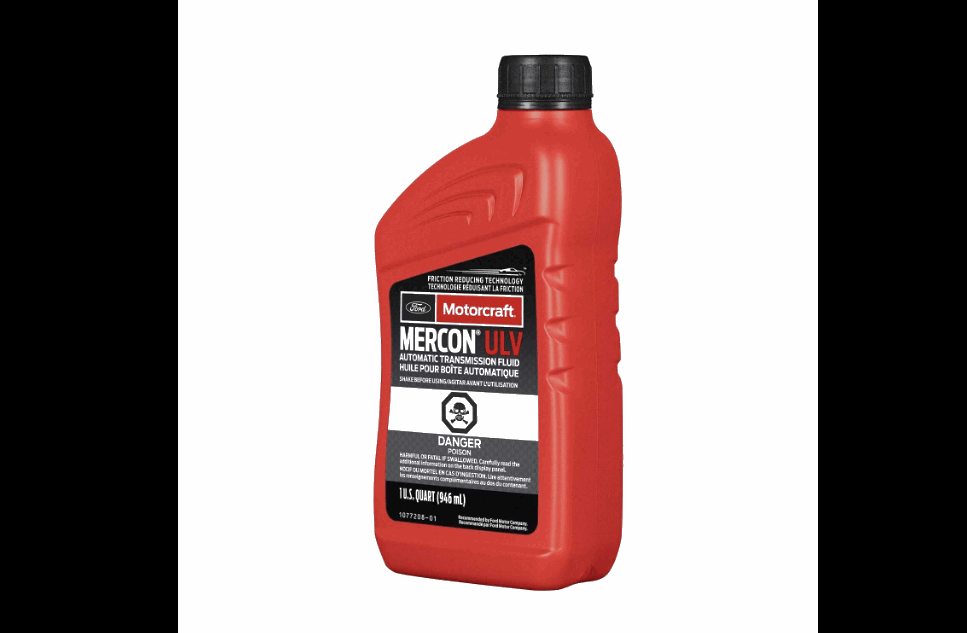
A Mercon ULV equivalent is an automatic transmission fluid that meets the requirements of the MERCON ULV application. Motorcraft MERCON ULV is the OEM reference fluid and carries part number XT 12 QULV. Ford identifies WSS M2C949 A as the required specification in current vehicle documentation.
Several aftermarket manufacturers also produce fluids for MERCON ULV applications. Phillips 66 VersaTrans ULV ATF is one example. Phillips 66 states that Ford has approved this full synthetic fluid for vehicles that require MERCON ULV. AMSOIL also offers an ultra low viscosity synthetic ATF for MERCON ULV applications. Its manufacturer identifies the product as suitable for transmissions that call for MERCON ULV.
These products do not qualify simply because they have low viscosity. A suitable fluid must provide the friction performance, shear stability, thermal resistance, and lubrication that the transmission requires. Modern automatic transmissions use fluid to operate hydraulic controls and manage clutch engagement. Changes in fluid properties can therefore affect shift quality and component protection.
Drivers should check the product documentation before choosing an alternative. Ford also advises owners to use transmission fluid that conforms to the specification listed for their vehicle. This approach provides a more reliable compatibility test than choosing an ATF by brand, color, or viscosity alone.
What Specifications Should a Mercon ULV Equivalent Meet?
A Mercon ULV equivalent should satisfy the fluid requirements associated with the MERCON ULV specification and the intended transmission application. Ford lists WSS M2C949 A for vehicles that require Motorcraft MERCON ULV. The correct specification matters because automatic transmission fluid performs several functions at the same time.
Viscosity is one important property. MERCON ULV uses an ultra low viscosity formulation that reduces internal fluid resistance. However, viscosity does not determine compatibility by itself. The fluid must maintain suitable performance as transmission temperatures change during driving.
Friction performance also affects transmission operation. Automatic transmissions use clutches that engage and release during gear changes. The ATF influences this process through its friction characteristics. A suitable formulation helps the transmission produce consistent shifts while controlling shudder and wear.
Thermal and oxidation stability provide another layer of protection. Transmission fluid operates around moving components and experiences repeated heating cycles. Motorcraft states that its MERCON ULV formulation provides thermal and oxidation performance, shear stability, wear protection, and low temperature fluidity.
For these reasons, drivers should evaluate the complete specification rather than one physical property. Two fluids can have similar viscosity values without serving the same application. The safest choice is a fluid whose manufacturer clearly identifies MERCON ULV compatibility or approval for the transmission in question.
Which Aftermarket Transmission Fluids Are Compatible With Mercon ULV?
Several aftermarket ATFs support applications that require MERCON ULV, but their manufacturer claims differ. Phillips 66 VersaTrans ULV ATF provides one of the clearest examples. Phillips 66 describes it as a full synthetic, ultra low viscosity ATF with Ford MERCON ULV approval. The company recommends it for newer Ford and GM vehicles that specify MERCON ULV or an equivalent fluid.
Valvoline ULV ATF provides another option for relevant Ford applications. Valvoline designed this full synthetic fluid for modern 9 speed and 10 speed automatic transmissions. The company specifically recommends it for Ford and GM 10R80 transmissions. It also lists select Ford F 150 and Raptor applications. Valvoline highlights stable viscosity, thermal stability, wear protection, and controlled friction performance.
These products illustrate why drivers should check the exact application claim before buying an aftermarket fluid. One manufacturer may hold a formal OEM approval. Another may recommend its product for specific transmissions or vehicles. Those claims do not mean exactly the same thing.
The table below summarizes the distinction.
| Transmission Fluid | Manufacturer Claim | Fluid Type | Key Consideration |
|---|---|---|---|
| Phillips 66 VersaTrans ULV ATF | Ford MERCON ULV approved | Full synthetic ULV ATF | Suitable for applications requiring MERCON ULV |
| Valvoline ULV ATF | Recommended for specific Ford and GM applications | Full synthetic ULV ATF | Check the exact transmission and vehicle application |
Always verify current product documentation before use. Fluid formulations and application lists can change over time.
Can You Use Mercon LV Instead of Mercon ULV?
You should not use MERCON LV instead of MERCON ULV unless the vehicle or fluid manufacturer specifically allows that substitution. Ford treats MERCON LV and MERCON ULV as different transmission fluid applications. A shared MERCON name does not make the two fluids interchangeable.
The main issue involves more than fluid thickness. Modern automatic transmissions rely on ATF to create hydraulic pressure, lubricate components, and control clutch operation. The fluid also influences shift feel through its friction characteristics. A transmission designed around MERCON ULV therefore expects a specific combination of fluid properties.
Product application guides reinforce this distinction. For example, Red Line D6 ATF lists Ford MERCON LV among its suitable replacement applications. It does not list MERCON ULV. This difference shows why drivers should not assume that an ATF designed for MERCON LV also covers MERCON ULV.
Check the owner’s manual or Ford service information before adding transmission fluid. Then compare the required specification with the ATF manufacturer’s current application guide. Use a product that clearly covers the required application.
This process matters during both a complete fluid service and a simple top off. Adding the wrong ATF can alter the properties of the existing fluid. Choosing the specified fluid avoids an unnecessary compatibility risk.
What Is the Difference Between Mercon ULV and Mercon LV?
MERCON ULV and MERCON LV are different automatic transmission fluids designed for different transmission requirements. The main distinction involves their intended applications and fluid characteristics. Ford does not treat the two fluids as interchangeable.
MERCON ULV uses an ultra low viscosity formulation. Ford recommends Motorcraft MERCON ULV for specific transmissions that require this fluid, including the 10R80 in certain Ford applications. Its formulation supports hydraulic operation, clutch control, lubrication, and shifting across a wide temperature range.
MERCON LV serves a different group of Ford and Lincoln transmissions. Ford introduced it for applications that require a low viscosity ATF rather than MERCON ULV. The company maintains separate product categories for MERCON LV and MERCON ULV. This separation reflects different transmission requirements.
The table below summarizes the main differences.
| Attribute | MERCON ULV | MERCON LV |
|---|---|---|
| Fluid category | Ultra low viscosity ATF | Low viscosity ATF |
| Ford fluid specification | MERCON ULV | MERCON LV |
| Motorcraft product | XT 12 QULV | XT 10 QLV |
| Intended use | Transmissions that specify MERCON ULV | Transmissions that specify MERCON LV |
| Direct interchangeability | Do not substitute with MERCON LV | Do not substitute with MERCON ULV |
Motorcraft specifically warns against using MERCON ULV in applications that specify MERCON LV. This guidance also shows why drivers should not select fluid based only on the MERCON name. Use the specification assigned to the exact transmission and vehicle application.
Can You Mix Mercon ULV With Other Transmission Fluids?
You should not intentionally mix MERCON ULV with another ATF unless the manufacturer confirms compatibility for the required application. Mixing fluids changes the final formulation inside the transmission. That change can affect viscosity, friction behavior, and other performance characteristics.
MERCON LV presents a clear example. Motorcraft states that drivers should not use MERCON ULV in applications that require MERCON LV. Ford also lists these fluids separately in its transmission fluid charts. This guidance supports treating them as application specific fluids rather than interchangeable members of one product family.
Multi vehicle ATF requires the same level of attention. Some manufacturers list MERCON ULV among the applications for a specific product. Others only cover MERCON LV, MERCON V, or different specifications. Read the current product data before adding any aftermarket ATF.
A top off also requires the correct fluid. Adding a small quantity of incompatible ATF still changes the fluid mixture. Use the specification listed in the owner’s manual or service information whenever possible.
A normal drain and fill presents a different situation. Some old fluid remains inside the transmission because a basic drain does not remove every drop. This residual fluid is not the same as deliberately adding an incompatible ATF. Refill the transmission with the specified fluid and follow the correct service procedure.
The practical rule remains simple. Match the replacement ATF to the transmission specification before mixing, topping off, or refilling it.
What Happens If You Use the Wrong Fluid Instead of Mercon ULV?
Using the wrong fluid instead of MERCON ULV can change shift performance, lubrication, and transmission protection. The exact result depends on the fluid, transmission design, driving conditions, and amount added. A small top off does not create the same situation as a complete fill with the wrong ATF.
Automatic transmissions depend on fluid for several functions. The ATF transfers hydraulic pressure, lubricates moving components, and affects clutch engagement. MERCON ULV applications require fluid properties that support these functions. An incompatible ATF can change how the transmission responds during operation.
Shift problems may provide an early warning. A driver may notice delayed engagement, harsh shifts, slipping, or unusual shift behavior. These symptoms do not prove that the fluid caused the problem. However, incorrect fluid should become part of the diagnosis when symptoms appear soon after a transmission service.
Long term use creates a greater concern. Incorrect viscosity or friction characteristics can affect lubrication and clutch operation over repeated driving cycles. Heat and mechanical load can increase the effect as mileage accumulates. Ford therefore instructs owners to use fluid that meets the specification assigned to the vehicle.
Check the fluid specification and service history when you suspect an incorrect fill. A qualified technician can then determine the appropriate correction. Avoid adding another fluid simply to change the mixture. The correct response depends on the transmission, the fluid already inside it, and the amount used.
Which Vehicles and Transmissions Require Mercon ULV?
MERCON ULV serves specific Ford and Lincoln vehicles with automatic transmissions designed for this ultra low viscosity fluid. Ford introduced the specification for newer transmission applications rather than for every automatic transmission in its vehicle range.
The 10R80 provides a major example. Ford uses this 10 speed automatic transmission in several rear wheel drive and four wheel drive applications. Depending on model year and configuration, these applications include vehicles such as the Ford F 150, Ford Mustang, Ford Expedition, and Lincoln Navigator. Some Ford Ranger applications also use a 10 speed automatic transmission with MERCON ULV requirements.
Vehicle name alone cannot confirm the correct fluid. Ford may offer different transmissions across model years, engines, drivetrains, and vehicle configurations. Two vehicles with the same model name can therefore require different service fluids.
Owners should identify the exact vehicle and transmission before buying ATF. Start with the model year, engine, and drivetrain. Then check the transmission specification in the owner’s manual or Ford service information. The manual may list Motorcraft MERCON ULV and the corresponding Ford specification for the application.
This verification prevents a common selection error. Do not assume that every modern Ford needs MERCON ULV or that every 10 speed transmission uses the same fluid. The transmission specification, not the vehicle badge, determines the correct ATF.
How Can You Check Whether Your Vehicle Requires Mercon ULV?
Check the transmission fluid specification in your owner’s manual to confirm whether your vehicle requires MERCON ULV. The required specification provides more reliable guidance than the vehicle brand, fluid color, or transmission fluid viscosity alone.
Start with the exact model year and vehicle configuration. Manufacturers can use different transmissions within the same model line. Engine choice and drivetrain can also affect the transmission application. For this reason, another vehicle with the same model name may not require the same ATF.
Next, identify the transmission when the owner’s manual does not provide enough information. Ford service information, transmission identification data, or a qualified technician can help confirm the unit. Compare that information with the fluid specification for the transmission.
Then check the documentation for the replacement ATF. Look for a clear MERCON ULV application statement or the relevant Ford specification. Do not assume compatibility because the bottle says low viscosity, multi vehicle, or MERCON. Those descriptions can cover several fluid standards with different application requirements.
Use the same verification process for aftermarket products. Check the manufacturer’s current product data sheet or application guide before purchase. Product recommendations can change when manufacturers revise formulations or application lists.
This process creates a clear selection path. Identify the vehicle, confirm the transmission, find the required specification, and choose an ATF that clearly covers that requirement. Following these steps reduces uncertainty before a fluid change or top off.
Should You Use OEM Mercon ULV or an Aftermarket Equivalent?
You can use OEM MERCON ULV or a suitable aftermarket alternative when the fluid carries appropriate documentation for the required application. The specification and application claim matter more than the brand name alone.
Motorcraft MERCON ULV provides the most direct choice for a Ford application that specifies this fluid. Ford identifies the product for transmissions that require MERCON ULV. Choosing the OEM fluid also removes much of the uncertainty involved in comparing aftermarket application claims.
An aftermarket ATF can provide another valid option when its manufacturer clearly supports MERCON ULV applications. However, drivers should distinguish between different types of claims. Formal OEM approval provides stronger evidence than a general statement about low viscosity performance. A manufacturer’s recommendation for MERCON ULV applications can also provide useful compatibility information, but it does not automatically represent Ford approval.
Price and availability can influence the final choice. Aftermarket products may offer broader availability or cover several transmission specifications in one formulation. These benefits do not replace the need to verify compatibility.
Choose the fluid by following a simple priority order. Confirm the transmission requirement first, verify the product’s MERCON ULV application second, and compare price or availability third. Do not reverse this process by choosing an inexpensive ATF first and checking compatibility later.
Both OEM and aftermarket fluids can therefore serve the application when their documentation supports the required specification. The correct choice starts with the transmission requirement rather than the label on the front of the bottle.
Which Mercon ULV Equivalent Should You Choose?
Choose a transmission fluid that clearly supports the MERCON ULV requirement for your specific transmission. Motorcraft MERCON ULV provides the direct OEM option for Ford applications that specify this fluid. An aftermarket ATF can also serve as an alternative when its manufacturer provides clear documentation for MERCON ULV applications.
Do not choose a replacement based only on viscosity or the MERCON name. MERCON ULV and MERCON LV follow different application requirements. A multi vehicle ATF also needs specific compatibility documentation before you use it in a transmission that requires MERCON ULV.
Follow a clear order when selecting the fluid. First, identify the exact transmission in your vehicle. Second, confirm its required ATF specification in the owner’s manual or service information. Third, check the fluid manufacturer’s current application guide. Compare price, availability, and brand only after you confirm compatibility.
This process applies to a complete fluid service and a simple top off. It also reduces the risk of choosing an ATF that does not match the transmission’s operating requirements. The best MERCON ULV equivalent is not simply the fluid with the closest viscosity. It is the fluid with documented suitability for the required MERCON ULV application.