Have you noticed the Jeep ESP BAS Light On warning illuminate on your dashboard and wondered whether it’s safe to keep driving? You’re not alone. This warning is one of the most common concerns among Jeep owners, especially those driving models like the Wrangler, Grand Cherokee, Compass, Patriot, Liberty, and Renegade. While the vehicle may continue to run normally in some cases, the illuminated ESP BAS light often indicates that an important safety system is no longer functioning as intended.
The Electronic Stability Program (ESP) and Brake Assist System (BAS) work together to help maintain vehicle stability during sudden maneuvers, slippery road conditions, and emergency braking situations. When the Jeep ESP BAS Light On warning appears, it usually means one or more components within these systems have detected a fault. The issue could be as simple as a faulty brake light switch or low battery voltage, or as serious as a failed ABS module or steering angle sensor.
Ignoring this warning can reduce your Jeep’s ability to maintain traction and stability, increasing the risk of losing control during adverse driving conditions. The good news is that many ESP BAS issues are relatively straightforward to diagnose and repair once the root cause is identified.
In this comprehensive guide, you’ll learn what the Jeep ESP BAS Light On warning actually means, the most common causes behind it, how to diagnose the problem, proven methods to reset the warning light, estimated repair costs, and practical tips to prevent the issue from returning. Whether you’re a DIY enthusiast or simply want to understand what your mechanic is talking about, this guide will help you make informed decisions and keep your Jeep operating safely.
What Does the ESP BAS Light Mean on a Jeep?
When the ESP BAS light appears on your Jeep’s dashboard, it means the vehicle has detected a problem within the Electronic Stability Program or the Brake Assist System. These systems are designed to help you maintain control of the vehicle during sudden steering movements, emergency braking, or slippery road conditions.
In many Jeep models, the ESP, BAS, ABS, and traction control systems share information from the same sensors. Because of this, a single faulty component can trigger several warning lights at the same time. You may notice the ESP BAS light together with the ABS light, traction control light, or stability control warning.
The warning does not always mean that your Jeep has suffered a major mechanical failure. In some cases, the cause may be a weak battery, a dirty wheel speed sensor, or a brake light switch that is no longer sending the correct signal. However, the light should not be ignored because the affected safety systems may be partially or completely disabled.
What Is ESP?
ESP stands for Electronic Stability Program. It is designed to help prevent skidding and loss of control when the vehicle begins to move in a direction different from the driver’s intended path.
The system constantly monitors information such as wheel speed, steering angle, vehicle rotation, and throttle position. If it detects that the Jeep is understeering, oversteering, or beginning to slide, it can reduce engine power and apply braking force to individual wheels.
For example, if you turn sharply on a wet road and the rear of the Jeep begins to slide outward, the ESP system may apply the brake to one or more wheels to help bring the vehicle back under control.
This technology is especially important in SUVs because their higher center of gravity can make them more sensitive to sudden direction changes. When the Jeep ESP BAS light is on, this electronic assistance may not be available when you need it most.
What Is BAS?
BAS stands for Brake Assist System. Its purpose is to increase braking force during an emergency stop.
Many drivers do not press the brake pedal hard enough during a sudden emergency. The BAS system monitors how quickly and forcefully the pedal is pressed. If it detects panic braking, it automatically increases brake pressure to help shorten the stopping distance.
The system works closely with the anti lock braking system. ABS helps prevent the wheels from locking, while BAS helps deliver stronger braking force. Together, they allow the driver to maintain steering control while slowing the vehicle as quickly as possible.
If the BAS portion of the system develops a fault, the normal brakes may still function, but the extra emergency assistance may no longer be available.
Why ESP and BAS Work Together
ESP and BAS rely on many of the same sensors and control modules. These may include wheel speed sensors, the steering angle sensor, the yaw rate sensor, the brake light switch, and the ABS control module.
The steering angle sensor tells the system where the driver intends to go. The wheel speed sensors report how fast each wheel is rotating. The yaw rate sensor measures how the vehicle is turning around its vertical axis. The brake light switch tells the system when the brake pedal is being pressed.
When these signals match, the system can react accurately. When one sensor sends incorrect or missing information, the control module may disable ESP and BAS as a safety precaution. This is why diagnosing the Jeep ESP BAS light requires more than simply clearing the warning code.
Why Is My Jeep ESP BAS Light On?
The Jeep ESP BAS light can come on for several reasons. Some causes are inexpensive and easy to fix, while others require professional diagnosis and replacement of electronic components.
The most common causes include faulty wheel speed sensors, steering angle sensor problems, defective brake light switches, low battery voltage, damaged wiring, clock spring failure, and ABS control module issues.
1. Bad Wheel Speed Sensor
A faulty wheel speed sensor is one of the most common causes of the Jeep ESP BAS light.
Each wheel has a sensor that monitors its rotational speed. The ABS and stability control systems compare the readings from all four wheels. If one wheel appears to rotate faster or slower than the others, the system may assume that the vehicle is slipping.
A damaged, dirty, or disconnected sensor can send incorrect information. As a result, the ESP BAS light, ABS light, and traction control light may appear together.
Common symptoms include intermittent warning lights, traction control activation at low speeds, ABS activation on dry roads, or a speedometer that behaves unusually on certain Jeep models.
The sensor may fail because of corrosion, road debris, damaged wiring, moisture intrusion, or a cracked tone ring. Before replacing the sensor, the wiring and connector should be inspected carefully.
2. Faulty Steering Angle Sensor
The steering angle sensor measures the position and movement of the steering wheel. It helps the ESP system understand where the driver wants the vehicle to go.
If the sensor loses calibration or begins sending inaccurate data, the stability control module may compare the wrong steering direction with the vehicle’s actual movement. This can trigger the ESP BAS warning.
A steering angle sensor problem may appear after a wheel alignment, battery replacement, steering repair, suspension work, or clock spring replacement. In some cases, the sensor is not damaged and only needs to be recalibrated.
You may notice that the light appears after turning the steering wheel fully in one direction or after starting the vehicle. Some drivers also report that the traction control system activates unexpectedly during normal driving.
3. Defective Brake Light Switch
The brake light switch is located near the brake pedal. It tells the vehicle’s computers when the driver is applying the brakes.
Although it is a small and relatively inexpensive component, it plays an important role in the BAS, ABS, cruise control, and traction control systems. If the switch fails or becomes misadjusted, the control module may not know when the brake pedal is being pressed.
Possible symptoms include brake lights that stay on, brake lights that do not work, cruise control that stops functioning, difficulty shifting out of Park, or an ESP BAS warning.
Because this part is easy to overlook, it is often one of the first components that should be checked during diagnosis.
4. Low Battery Voltage
Modern Jeep safety systems depend on stable electrical voltage. A weak battery, failing alternator, loose terminal, or poor ground connection can cause temporary communication errors between control modules.
Low voltage is especially likely to trigger warning lights during startup. The ESP BAS light may appear after the engine has been difficult to start, after the battery has gone flat, or after the vehicle has been parked for a long period.
In some cases, the light disappears after the battery is charged or replaced. However, the stored fault codes should still be scanned to confirm that no other problem is present.
Battery terminals should be clean and tight. The charging system should also be tested because replacing the battery will not solve the issue if the alternator is not charging correctly.
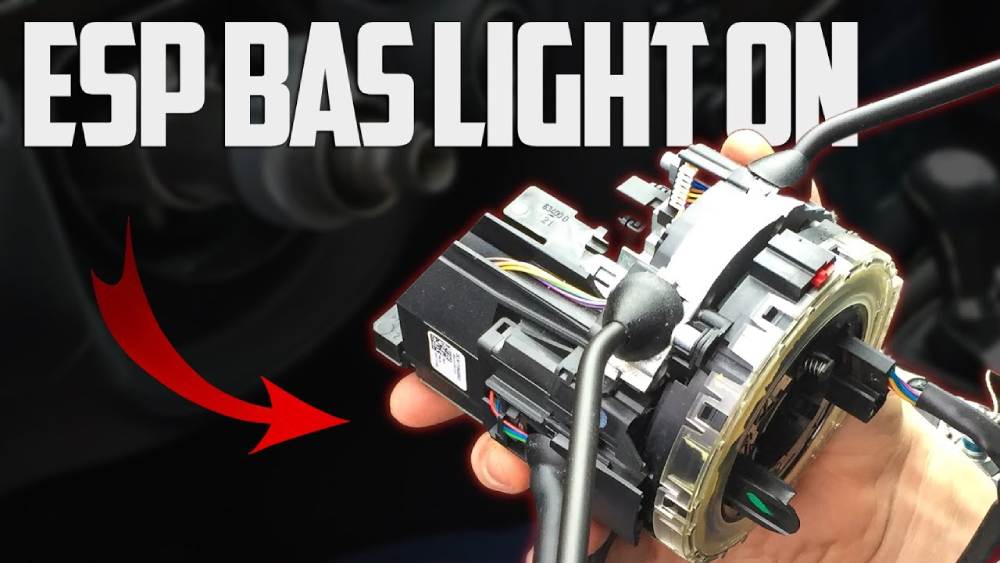
5. Clock Spring Failure
The clock spring is a flexible electrical connection located inside the steering wheel. It allows electrical signals to pass between the steering wheel and the vehicle while the wheel is turning.
It may carry signals for the airbag, horn, steering wheel controls, and steering angle sensor. If the clock spring becomes damaged, the ESP system may lose steering angle information.
Common symptoms include an airbag warning light, a horn that does not work, steering wheel buttons that stop responding, or an ESP BAS light that appears when the wheel is turned.
Clock spring replacement requires care because the driver’s airbag must be handled correctly. For most owners, this repair is better left to a qualified technician.
6. ABS Control Module Problems
The ABS control module manages information from the wheel speed sensors and coordinates the ABS, ESP, traction control, and brake assist functions.
If the module fails, several dashboard warnings may illuminate at once. The vehicle may lose anti lock braking assistance, traction control, and stability control.
Module failure can result from internal electronic damage, moisture, corrosion, overheating, or poor electrical connections. Because replacement can be expensive, the module should not be replaced until the sensors, wiring, grounds, and power supply have been tested.
In some cases, the module can be repaired or reprogrammed instead of replaced.
7. Damaged Wiring or Loose Connections
The ESP BAS system depends on a network of sensors and electrical connections. A broken wire, loose connector, corroded terminal, or damaged ground can interrupt communication.
Wiring near the wheels is particularly vulnerable because it is exposed to water, dirt, salt, road debris, and suspension movement. A wire may look intact on the outside while the conductor inside is broken.
Intermittent warning lights are often a sign of a wiring issue. The light may appear after driving over bumps, turning the steering wheel, or traveling in wet weather.
A visual inspection can reveal obvious damage, but a multimeter may be needed to test continuity and resistance.
8. Tire Size or Tire Pressure Issues
The stability control system compares wheel speed data to determine whether a tire is slipping. If one tire has significantly lower pressure or a different overall diameter, it may rotate at a different speed.
This difference can confuse the control module and trigger the Jeep ESP BAS light.
The problem is more likely after installing mismatched tires, replacing only one tire, fitting oversized off road tires, or driving with uneven tire pressure.
All four tires should be the correct size, similar in tread depth, and inflated to the recommended pressure. Modified Jeeps with larger tires may require recalibration of the vehicle’s computer.
9. Faulty Yaw Rate Sensor
The yaw rate sensor measures how quickly the Jeep is rotating around its vertical axis. It helps determine whether the vehicle is following the direction selected by the driver.
If the yaw sensor sends incorrect data, the ESP system may think the Jeep is sliding even when it is traveling normally.
Symptoms may include unexpected braking at one wheel, traction control activation during normal cornering, or warning lights that appear after a collision, suspension repair, or water intrusion.
Yaw sensor problems are less common than wheel speed sensor faults, but they can be difficult to diagnose without a professional scan tool.
10. Software or Control Module Errors
Sometimes the Jeep ESP BAS light is caused by a software issue rather than a failed physical component.
A temporary communication error, outdated module software, interrupted battery connection, or incorrect calibration can trigger warning lights. Certain repairs may also require the steering angle sensor, ABS module, or tire size settings to be relearned.
Clearing the codes without correcting the underlying issue may turn the light off briefly, but it will return if the fault is still present.
A dealership level or advanced diagnostic scanner may be required to perform software updates, module programming, and sensor calibration.
Common Symptoms That Appear With the ESP BAS Light
The ESP BAS warning often appears with other symptoms because the stability control, ABS, traction control, and braking systems share sensors and control modules.
Recognizing these related symptoms can help narrow down the likely cause.
ABS Light Is Also On
When the ABS light and ESP BAS light appear together, a wheel speed sensor, ABS module, wiring fault, or low voltage issue is often involved.
The normal braking system may still work, but anti lock braking assistance could be disabled. During hard braking, the wheels may lock more easily, especially on wet or loose surfaces.
Traction Control Light Stays On
The traction control light may remain illuminated because the system has been disabled. In some cases, the light flashes while driving because the system believes a wheel is slipping.
If traction control activates on dry pavement or during gentle acceleration, a wheel speed sensor may be reporting incorrect information.
Cruise Control Stops Working
Many Jeep models disable cruise control when a brake switch, wheel speed sensor, or stability control fault is detected.
This prevents the vehicle from maintaining speed when the control module cannot accurately monitor braking and wheel movement.
Cruise control failure combined with the ESP BAS light may point toward a defective brake light switch.
Steering Feels Different
A steering angle sensor problem does not usually cause a direct mechanical steering failure. However, the driver may feel unusual stability control intervention, unexpected braking, or reduced electronic assistance.
If the steering feels heavy, loose, or physically difficult to control, the issue may be unrelated to ESP and should be inspected immediately.
Stability Control Is Disabled
When the Jeep ESP BAS light remains on, the vehicle may no longer correct understeer, oversteer, or wheel slip.
This may not be noticeable during normal driving on dry roads. The loss of assistance becomes more important during rain, snow, ice, gravel, emergency lane changes, or sharp turns.
Warning Lights Appear Intermittently
An intermittent ESP BAS light often suggests a loose connector, damaged wire, weak battery, dirty sensor, or fault that occurs only under specific conditions.
Pay attention to when the warning appears. Useful details include whether it happens during startup, after turning, while driving over bumps, in wet weather, or after braking.
These patterns can help a technician identify the source more quickly.
Vehicle Enters Reduced Power Mode
In more serious cases, the Jeep may enter a reduced power or limp mode. Acceleration may become limited, throttle response may feel weak, and transmission behavior may change.
This can happen when several control modules lose communication or when the system detects a fault that could affect vehicle stability.
If reduced power is accompanied by multiple warning lights, poor braking, unusual steering, or engine problems, the vehicle should be inspected as soon as possible.
Can You Drive With the ESP BAS Light On?
One of the first questions most Jeep owners ask after seeing the warning is whether it is still safe to drive. The answer depends on the underlying cause of the problem and whether other warning lights are illuminated at the same time.
In many situations, your Jeep will continue to operate normally even though the ESP BAS light is on. The engine, transmission, and standard braking system may still function correctly. However, important electronic safety features may no longer be available when you need them the most.
The Electronic Stability Program and Brake Assist System are designed to improve vehicle control during emergency situations. If either system is disabled, your Jeep may be more likely to skid, lose traction, or require a longer stopping distance on slippery roads.
Situations Where It May Be Safe to Drive
If the ESP BAS light is the only warning displayed and the vehicle drives normally, you can usually continue driving for a short distance while arranging for a proper diagnosis.
Your Jeep may still be safe to drive if the following conditions are true.
The brake pedal feels firm and responsive.
The steering feels normal.
There are no unusual noises coming from the wheels.
The ABS warning light is not illuminated.
The Check Engine Light is off.
The vehicle accelerates and shifts normally.
There is no noticeable reduction in engine power.
Even in these situations, you should drive cautiously and avoid high speeds, sudden lane changes, aggressive cornering, or driving in heavy rain, snow, or icy conditions because the stability control system may not be available to assist you.
Situations Where You Should Avoid Driving
The warning becomes much more serious if it appears together with other dashboard lights or abnormal vehicle behavior.
You should avoid driving if you notice any of the following.
The ABS warning light is illuminated.
The red brake warning light appears.
The brake pedal feels soft or spongy.
The steering suddenly becomes difficult to control.
The Jeep enters limp mode or reduced power mode.
The vehicle pulls to one side during braking.
The traction control activates unexpectedly on dry pavement.
You hear grinding or clicking noises from the wheel area.
The engine stalls or loses power.
These symptoms may indicate a more significant problem affecting the braking or stability systems. Continuing to drive could increase the risk of losing vehicle control.
When You Should Stop Driving Immediately
There are a few situations where driving should stop immediately because the vehicle may no longer be safe.
Pull over as soon as it is safe if you experience complete brake failure, severe steering problems, smoke coming from the brakes or wheels, repeated warning chimes accompanied by multiple critical warning lights, or sudden loss of braking performance.
If your Jeep becomes difficult to control or you suspect a brake system failure, have the vehicle towed to a qualified repair facility instead of attempting to drive it.
How to Diagnose the Jeep ESP BAS Light
Proper diagnosis is essential because dozens of different faults can trigger the same warning light. Simply replacing random parts often leads to unnecessary expenses without solving the actual problem.
The most efficient approach is to begin with the simplest and least expensive checks before moving on to more advanced testing.
Step 1. Scan the Vehicle for Diagnostic Trouble Codes
The first step is connecting an OBD II scanner capable of reading ABS and stability control modules. Basic code readers may only display engine related codes, while advanced scanners can access the ABS, ESP, and Body Control Module.
Common diagnostic trouble codes may indicate problems with the steering angle sensor, wheel speed sensors, brake switch, yaw sensor, or ABS module.
Record every stored and pending code before clearing them. Freeze frame data can also help identify when the fault occurred.
Step 2. Inspect the Brake Light Switch
A faulty brake light switch is inexpensive and surprisingly common.
Press the brake pedal and verify that the brake lights turn on immediately. If they remain off, stay on continuously, or work intermittently, inspect the switch for damage or incorrect adjustment.
Many Jeep owners have resolved the ESP BAS warning simply by replacing this small component.
Step 3. Test Battery Voltage
Modern electronic control modules require stable voltage.
With the engine turned off, a healthy battery should typically measure around 12.6 volts.
With the engine running, charging voltage should generally remain between approximately 13.7 and 14.7 volts.
Low voltage, poor battery connections, or a failing alternator can generate communication errors that trigger multiple warning lights.
Inspect the battery terminals for corrosion and make sure all connections are secure.
Step 4. Check the Wheel Speed Sensors
Inspect each wheel speed sensor for physical damage, dirt buildup, broken wires, or loose connectors.
Road debris, mud, rust, and moisture can interfere with sensor operation.
If available, use a scan tool to compare live wheel speed data while driving slowly. One sensor showing significantly different readings usually indicates the faulty component.
Step 5. Inspect the Steering Angle Sensor
If the warning appeared after a wheel alignment, suspension repair, battery replacement, or steering repair, the steering angle sensor may simply require recalibration.
Use a professional scan tool to verify that the steering angle changes smoothly while turning the wheel from lock to lock.
Sudden jumps, incorrect readings, or no signal at all usually indicate a faulty sensor or clock spring.
Step 6. Inspect Wiring and Connectors
Electrical problems can mimic sensor failures.
Carefully inspect wiring harnesses near each wheel, under the vehicle, and around the steering column.
Look for cracked insulation, corrosion, loose connectors, broken retaining clips, or evidence of rodent damage.
Repairing a damaged wire may solve the issue without replacing expensive electronic components.
Step 7. Diagnose the ABS Control Module
If all sensors appear to function correctly, the ABS control module becomes the next suspect.
A professional technician can verify module communication, internal faults, and software integrity using factory level diagnostic equipment.
Since replacement costs can be significant, the module should only be replaced after every other possible cause has been eliminated.
How to Reset the Jeep ESP BAS Light
Resetting the warning light without fixing the underlying problem will usually provide only temporary results. If the fault remains, the light will return after a short drive.
However, once the issue has been repaired, several reset methods can clear the warning.
Method 1. Steering Wheel Reset
Some Jeep models allow the steering angle sensor to recalibrate automatically.
Start the engine while the vehicle is parked.
Turn the steering wheel completely to the left until it reaches the stop.
Turn it completely to the right.
Return the steering wheel to the center position.
Drive the vehicle for several minutes.
If the warning was caused by a steering angle calibration issue, the light may disappear.
Method 2. Disconnect the Battery
A battery reset may clear temporary electronic faults.
Turn the ignition off.
Disconnect the negative battery terminal.
Wait approximately fifteen to twenty minutes.
Reconnect the battery securely.
Start the engine and verify whether the warning has cleared.
Keep in mind that this method will not fix failed sensors or damaged components.
Method 3. Clear Codes With an OBD II Scanner
After repairing the faulty component, connect a diagnostic scanner and erase the stored fault codes.
Restart the vehicle and perform a short road test.
If the repair was successful, the Jeep ESP BAS light should remain off.
If the warning immediately returns, additional diagnosis is still required because the original fault has not been fully corrected.
Method 4. Perform Professional Sensor Calibration
Certain repairs require electronic calibration before the system can operate normally.
Examples include replacing the steering angle sensor, ABS module, clock spring, yaw sensor, or performing some suspension and alignment repairs.
A dealership or qualified repair shop can complete these procedures using manufacturer approved diagnostic equipment.
Attempting to skip calibration may result in the warning light returning even after all defective parts have been replaced.
Jeep ESP BAS Light Repair Costs
The cost of repairing a Jeep ESP BAS warning depends entirely on the component that has failed. Fortunately, many of the most common causes are relatively inexpensive to fix, while more complex electronic components can significantly increase the repair bill.
The table below provides average repair costs in the United States. Actual prices may vary depending on your Jeep model, labor rates in your area, and whether you choose OEM or aftermarket replacement parts.
| Problem | Estimated Parts Cost | Estimated Total Repair Cost |
|---|---|---|
| Brake Light Switch | $15 to $60 | $80 to $180 |
| Wheel Speed Sensor | $30 to $150 | $120 to $350 |
| Steering Angle Sensor | $120 to $350 | $250 to $700 |
| Clock Spring | $100 to $300 | $250 to $700 |
| Battery Replacement | $150 to $350 | $180 to $450 |
| Alternator Replacement | $250 to $700 | $450 to $1,000 |
| Yaw Rate Sensor | $150 to $400 | $300 to $800 |
| ABS Control Module | $300 to $900 | $600 to $1,500 |
| Wiring Repair | $50 to $300 | $100 to $600 |
| ABS Module Programming | N/A | $100 to $250 |
Before replacing expensive components such as the ABS control module or steering angle sensor, always confirm the diagnosis using a professional scan tool. A simple brake light switch or damaged wheel speed sensor can produce symptoms that closely resemble a much more serious failure.
If multiple warning lights appear simultaneously, ask the repair shop to provide a complete diagnostic report before authorizing repairs. This helps avoid replacing parts that are still functioning properly.
For Jeep owners who perform their own maintenance, replacing a brake light switch or wheel speed sensor is often within the capability of an experienced DIY mechanic. However, repairs involving airbags, steering components, or module programming should generally be left to qualified technicians.
How to Prevent the Jeep ESP BAS Light From Coming Back
Although not every ESP BAS warning can be prevented, regular maintenance greatly reduces the likelihood of unexpected failures. Most problems develop gradually, allowing attentive owners to identify minor issues before they become expensive repairs.
Keep the Battery in Good Condition
Modern Jeep vehicles rely heavily on stable electrical voltage.
Test the battery annually, especially if it is more than three years old. Clean any corrosion from the battery terminals and ensure all connections remain tight. A weak battery is one of the most common causes of intermittent electronic warning lights.
Inspect the Brake System Regularly
Check the brake pedal feel, brake lights, brake fluid level, and brake switch during routine maintenance.
Replacing a worn brake light switch before it completely fails can prevent unnecessary dashboard warnings and maintain proper operation of the Brake Assist System.
Maintain Proper Tire Pressure
Incorrect tire pressure changes the rolling diameter of the tires and can confuse the stability control system.
Check tire pressure at least once a month and before long trips. Always inflate the tires according to the pressure specified on the driver’s door jamb rather than relying solely on the maximum pressure printed on the tire sidewall.
Use Matching Tires
Installing tires with different sizes or significantly different tread depths can affect wheel speed calculations.
Whenever possible, replace tires as a complete set. If only one tire must be replaced, ensure its size closely matches the remaining tires.
Clean Wheel Speed Sensors
Mud, snow, road salt, and metallic debris can accumulate around the wheel speed sensors.
During brake service or tire rotation, inspect the sensors and tone rings for contamination or physical damage. Cleaning these components can sometimes prevent false sensor readings.
Protect Electrical Connections
Jeep vehicles frequently encounter mud, water crossings, snow, and rough off road conditions.
Periodically inspect exposed wiring harnesses for abrasion, corrosion, loose connectors, or moisture intrusion. Applying dielectric grease to electrical connectors can help reduce corrosion in harsh environments.
Perform Wheel Alignment When Needed
Improper wheel alignment affects handling and may influence steering angle sensor calibration.
After replacing suspension components or experiencing a significant impact with a curb or pothole, have the alignment checked by a qualified technician.
Keep Vehicle Software Updated
Manufacturers occasionally release software updates for electronic control modules to improve system performance or address known issues.
Ask your dealership during routine service whether any software updates or technical service bulletins apply to your Jeep model.
Frequently Asked Questions
Why did my Jeep ESP BAS light come on suddenly?
The warning can appear unexpectedly due to several reasons, including a faulty wheel speed sensor, brake light switch failure, low battery voltage, steering angle sensor issues, damaged wiring, or an ABS module fault. A diagnostic scan is the fastest way to determine the exact cause.
Can I drive with the Jeep ESP BAS light on?
In many cases, yes, provided the vehicle drives normally and no additional brake related warning lights are present. However, the Electronic Stability Program and Brake Assist System may be disabled, reducing vehicle stability during emergency maneuvers or slippery road conditions.
If the ABS warning light, brake warning light, or reduced power mode also appears, the vehicle should be inspected immediately.
Will disconnecting the battery reset the ESP BAS light?
Disconnecting the battery may clear temporary electronic faults, but it will not repair a failed sensor or damaged component.
If the underlying problem still exists, the warning light will usually return after the vehicle is restarted or driven for a short distance.
Can low battery voltage trigger the ESP BAS warning?
Yes.
A weak battery or failing alternator can cause communication errors between electronic control modules, leading to the ESP BAS light even though no sensor has actually failed.
Testing the charging system is one of the first diagnostic steps recommended by professional technicians.
Can low tire pressure cause the ESP BAS light?
It can.
If one tire rotates significantly faster than the others because of low pressure or an incorrect tire size, the stability control system may interpret the difference as wheel slip and illuminate the warning.
Does replacing a wheel speed sensor always fix the problem?
Not necessarily.
Although wheel speed sensors are among the most common causes, damaged wiring, corroded connectors, a defective ABS module, or steering angle sensor problems can produce similar symptoms. Proper diagnosis should always be completed before replacing parts.
How long does it take to diagnose the problem?
A basic diagnostic scan usually takes between 30 and 60 minutes.
More complicated electrical faults involving wiring or intermittent communication problems may require several hours of testing.
Is repairing the Jeep ESP BAS light expensive?
It depends on the cause.
Simple repairs such as replacing a brake light switch may cost less than $150, while replacing and programming an ABS control module can exceed $1,000.
Accurate diagnosis is the key to avoiding unnecessary repair costs.
Conclusion
Seeing the Jeep ESP BAS Light On warning can be concerning, but it does not automatically mean your vehicle has a major mechanical problem. In many cases, the issue is caused by a faulty wheel speed sensor, brake light switch, weak battery, or steering angle sensor. These problems are often straightforward to diagnose and repair when addressed promptly.
The most important step is identifying the root cause rather than simply resetting the warning light. Clearing the code without repairing the faulty component will usually result in the warning returning. Using a quality OBD II scanner, inspecting the battery and brake switch, and checking the wheel speed sensors can often save both time and money.
If your Jeep displays additional warning lights, experiences reduced braking performance, enters limp mode, or becomes difficult to control, discontinue driving and have the vehicle inspected by a qualified technician as soon as possible. Electronic stability and brake assist systems play a critical role in keeping you safe during emergency situations.
With regular maintenance, proper tire care, healthy electrical connections, and timely diagnostics, most ESP BAS problems can be prevented before they become costly repairs. By understanding what causes the Jeep ESP BAS Light On warning and knowing how to diagnose and fix it, you can keep your Jeep performing safely and confidently on every journey.