A clogged car AC condenser is fixed by identifying whether the blockage is external or internal before choosing a repair method. External blockages such as dirt, insects, leaves, and road debris can often be removed by carefully cleaning the condenser fins. An internal restriction is different because it affects the refrigerant passages and may require professional AC service or condenser replacement rather than simple exterior cleaning.
The condenser removes heat from the high-pressure refrigerant after it leaves the AC compressor. Air must pass freely through the condenser fins for this heat-transfer process to work efficiently. When debris blocks the fins, airflow decreases and the AC system cannot reject heat effectively. Internal contamination can also restrict refrigerant flow, creating a different problem that requires further diagnosis.
Fixing the problem therefore starts with confirming that the condenser is actually clogged. Poor cabin cooling alone does not prove condenser blockage because a faulty cooling fan, compressor, expansion valve, low refrigerant charge, or another AC system fault can produce similar symptoms. This guide explains how to identify a clogged car AC condenser, clean an external blockage, evaluate an internal restriction, determine when replacement is necessary, and prevent the problem from recurring.
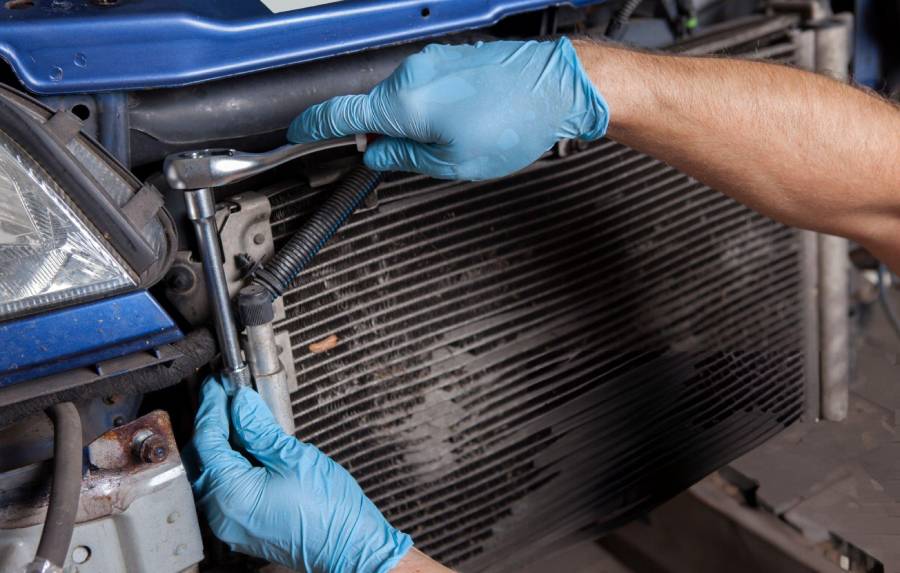
What Are the Symptoms of a Clogged Car AC Condenser?
The main symptoms of a clogged car AC condenser are reduced cabin cooling, weak cooling at idle, restricted airflow through the condenser, and abnormal AC system operation. These symptoms occur because the condenser must transfer heat from the refrigerant to the outside air. A blockage reduces this heat-transfer capacity, so the refrigerant cannot release heat as efficiently before continuing through the AC system.
An externally clogged condenser commonly develops when dirt, insects, leaves, or road debris accumulate between or on the condenser fins. The debris reduces the amount of air passing across the condenser surface. The problem may become more noticeable when the vehicle is stopped or moving slowly because there is less natural airflow through the front of the vehicle. At highway speed, increased airflow may partially compensate for a moderate external blockage, causing the AC to feel colder while the car is moving.
An internal condenser restriction produces a different problem. Instead of blocking outside airflow, contamination or debris restricts refrigerant movement through the condenser passages. This restriction can interfere with normal pressure and temperature changes across the high-pressure side of the AC system. An internal restriction cannot be confirmed simply by looking at the condenser, so further AC system diagnosis is required.
Poor cooling alone does not confirm a clogged condenser. A faulty condenser or radiator fan, low refrigerant charge, compressor problem, expansion valve or orifice tube restriction, and other refrigerant-system faults can produce similar cooling complaints. For this reason, the condenser should be inspected and tested before cleaning or replacing it.
How Can You Tell If the AC Condenser Is Clogged?
You can identify a clogged AC condenser by inspecting its fins for physical blockage, checking airflow through the condenser, verifying cooling-fan operation, and evaluating the AC system when an internal restriction is suspected. Start with a visual inspection because external blockage is easier to identify and does not require opening the refrigerant circuit.
Locate the condenser at the front section of the vehicle’s cooling assembly, typically near the radiator. Inspect the exposed surface for dirt, leaves, insects, plastic, and other road debris. Pay particular attention to material lodged between the fins rather than judging the condenser only by how dirty its surface looks. A thin layer of dust is different from a blockage dense enough to substantially restrict airflow.
Inspect the condenser fins for bending or physical damage at the same time. The fins create a large surface area for transferring heat to passing air. When a substantial section is flattened, airflow through that area decreases even when no dirt is present. Cleaning will remove debris, but it will not correct severe structural damage to the condenser.
Next, check whether air can move through the condenser and whether the electric cooling fan operates as required when the AC system is running. A condenser with clean fins can still have inadequate airflow if the cooling fan is not operating correctly. This distinction prevents a fan failure from being misdiagnosed as a clogged condenser.
An internal restriction requires a different diagnostic approach because it cannot normally be seen from outside the component. AC pressure and temperature behavior can help a qualified technician locate a restriction within the refrigerant circuit. Pressure readings should be compared with the specifications and operating conditions for the particular vehicle rather than with one universal pressure value. Refrigerant type, ambient temperature, engine speed, system design, and AC operating conditions all affect normal readings.
Do not release refrigerant or disconnect AC lines simply to check whether the condenser is clogged. Visual inspection and airflow checks can be performed without opening the sealed system, while refrigerant recovery and internal AC-system diagnosis require appropriate equipment and service procedures. The goal is to determine whether the problem is an external airflow blockage or an internal refrigerant restriction before selecting a repair method.
How Do You Fix an Externally Clogged AC Condenser?
You fix an externally clogged AC condenser by removing debris from the condenser surface and restoring airflow through its fins without damaging them. External cleaning is appropriate when dirt, insects, leaves, or road debris are restricting airflow. It does not require opening the refrigerant circuit because the blockage is on the outside of the condenser.
Start with the engine off and allow the vehicle to cool before working around the condenser, radiator, or cooling fans. Access the condenser through the grille or by removing the necessary trim or covers according to the vehicle design. Inspect the entire accessible surface before cleaning so you can identify concentrated debris, bent fins, leaks, or physical damage that may require more than routine cleaning.
Remove loose leaves, insects, and larger debris carefully. A soft brush or controlled airflow can help dislodge material caught on the surface. Avoid scraping the condenser with screwdrivers or other hard tools because the thin fins bend easily. Damaged fins reduce the open area available for airflow and can make the original cooling problem worse.
Clean remaining dirt from the fins with a method suitable for automotive heat exchangers. Work carefully across the condenser rather than forcing dirt deeper between the fins. Do not direct a concentrated high-pressure water stream at the condenser fins. Excessive pressure can flatten the fins and restrict airflow instead of restoring it.
Check the fins again after the debris has been removed. Minor bent sections may be corrected carefully with an appropriate fin tool, but widespread crushing, corrosion, impact damage, or refrigerant leakage indicates a different problem. Cleaning restores airflow through a dirty condenser; it does not repair a leaking or structurally damaged condenser.
Reassemble any covers or trim removed for access, then operate the AC and evaluate its cooling performance. Also verify that the cooling fan operates correctly. If the condenser is clean and airflow has been restored but the AC still performs poorly, continue diagnosis rather than repeatedly cleaning the component. The fault may involve an internal restriction or another part of the AC system.
Can You Flush an Internally Clogged Car AC Condenser?
An internally restricted AC condenser should not automatically be flushed because the correct repair depends on condenser construction, the type of contamination, and the cause of the restriction. Flushing is fundamentally different from cleaning the condenser fins. External cleaning removes material blocking airflow, while flushing attempts to remove contamination from inside the refrigerant circuit.
Internal contamination can occur when debris circulates through the AC system after a component failure. This creates a larger repair problem because replacing or cleaning one component does not necessarily remove contamination elsewhere in the refrigerant circuit. The source of the debris therefore needs to be identified before deciding whether the condenser can remain in service.
When Should You Flush an AC Condenser?
An AC condenser should be flushed only when its design and the applicable repair procedure allow effective internal cleaning. The purpose is to remove suitable contaminants from passages that can actually be cleaned rather than treating flushing as a universal solution for every condenser restriction.
The condenser design matters because internal passages vary between vehicles and AC systems. A flushing procedure that can move cleaning material effectively through one component may not adequately clean another with narrow or complex passages. Follow the service requirements for the specific vehicle and replacement components when determining whether flushing is permitted.
Flushing also requires the refrigerant to be properly recovered before the sealed AC circuit is opened. The system must subsequently be serviced using the correct procedures and equipment. For this reason, internal flushing is substantially different from DIY cleaning of dirt on the condenser fins.
When Should You Replace the Condenser Instead of Flushing It?
Replace the condenser when an internal restriction cannot be reliably removed, contamination cannot be adequately cleared, or the condenser is physically damaged or leaking. Replacement is also important when the repair procedure for the specific condenser does not support flushing.
Severe system contamination deserves particular attention after an AC compressor failure. Debris generated by a failed component can circulate with refrigerant and lubricant and become trapped inside other parts of the system, including the condenser. Installing another compressor without addressing remaining contamination can compromise the repair.
A leaking condenser also requires a different decision from an externally clogged condenser. Dirt removal may improve airflow, but it cannot seal a refrigerant leak or restore damaged internal passages. Visible impact damage, corrosion-related failure, or a confirmed leak therefore shifts the repair from cleaning toward component repair or replacement according to the vehicle’s service requirements.
The key distinction is where the restriction exists. Clean an external blockage when debris is preventing air from passing through otherwise serviceable condenser fins. Treat a suspected internal restriction as a refrigerant-system fault that requires diagnosis before flushing or replacement is selected.
When Should You Replace a Clogged AC Condenser?
Replace a clogged AC condenser when cleaning cannot restore proper operation, an internal restriction cannot be reliably removed, or the condenser has a refrigerant leak or significant physical damage. External dirt does not normally justify replacement because debris can often be removed from serviceable fins. Replacement becomes appropriate when the problem affects the condenser itself rather than material accumulated on its exterior.
An internal restriction is one reason replacement may be required. Refrigerant must travel through small passages inside the condenser while releasing heat to outside air. Contamination trapped within these passages can restrict flow, and some condenser designs cannot be cleaned effectively enough to guarantee that the restriction has been removed. In this situation, installing a serviceable condenser provides a more reliable repair than repeatedly attempting to clear the restricted component.
Physical condition also determines whether a condenser should remain in service. Road debris and front-end impacts can crush fins, deform the condenser, or damage refrigerant passages. Minor fin damage does not automatically require replacement, but extensive deformation that restricts airflow or compromises the refrigerant circuit cannot be corrected by exterior cleaning.
A confirmed refrigerant leak is another reason to evaluate replacement. Look for signs of physical damage or oily residue around suspicious areas, but do not assume residue alone confirms a leak. The AC system should be leak-tested using an appropriate diagnostic method. Cleaning a leaking condenser may improve exterior airflow, but it does not correct the loss of refrigerant from the sealed system.
Compressor failure can also affect the replacement decision. A mechanically damaged compressor may introduce debris or contaminated lubricant into the refrigerant circuit. If this material reaches the condenser and cannot be reliably removed, leaving the contaminated condenser in the system can compromise replacement components. The complete AC system therefore needs to be evaluated rather than treating the condenser as an isolated component.
How Do You Replace a Clogged Car AC Condenser?
Replacing a clogged car AC condenser involves recovering the refrigerant, removing the damaged or restricted condenser, installing the replacement component, evacuating and leak-testing the system, recharging it with the specified refrigerant amount, and verifying AC performance. Unlike exterior condenser cleaning, replacement opens the sealed refrigerant circuit and requires appropriate AC service equipment.
The first step is confirming that replacement is actually necessary. A condenser should not be removed simply because the cabin AC is not cold. Verify external airflow, cooling-fan operation, condenser condition, and relevant AC system behavior first. Correct diagnosis prevents a functional condenser from being replaced when the actual problem is a fan, compressor, refrigerant-charge, or metering-device fault.
The refrigerant must then be properly recovered before refrigerant lines are disconnected. Do not intentionally vent refrigerant from the AC system. Refrigerant recovery requires suitable service equipment, and refrigerant handling requirements vary by location and refrigerant type. DIY work should stop before opening the sealed circuit when the necessary equipment, procedures, or qualifications are not available.
Once the refrigerant has been recovered, access to the condenser depends on vehicle design. Components such as covers, grille sections, cooling fans, brackets, or other front-end parts may need to be removed before the condenser can be reached. The refrigerant lines are then disconnected according to the vehicle-specific service procedure, and their open ends should be protected from dirt and moisture.
Remove the old condenser without damaging nearby components such as the radiator, refrigerant lines, electrical connectors, or cooling fans. Compare the replacement condenser with the removed unit before installation, including its mounting points and refrigerant connections. Install new seals or O-rings where required by the repair procedure and use the correct lubricant and specifications for the AC system.
After the condenser is installed and the refrigerant circuit is closed, the system must be evacuated with appropriate equipment. Evacuation removes air and moisture that entered while the system was open. The system should also be checked for leaks before the repair is considered complete. A condenser installation that leaks at a fitting or seal still requires correction even when the new component itself is undamaged.
Recharge the AC system with the refrigerant type and specified charge quantity for the particular vehicle. Do not determine the charge by a universal pressure reading or by adding refrigerant until the vent temperature feels cold. Correct refrigerant quantity is part of the vehicle’s AC system specification, and both incorrect charging and unresolved faults can affect system performance.
Finally, run the AC under the appropriate test conditions and verify cooling performance, condenser airflow, cooling-fan operation, and system behavior. Inspect the serviced connections for evidence of leakage. A condenser replacement is complete only after the entire AC system operates correctly; installing the component itself is only one stage of the repair.
What Causes a Car AC Condenser to Become Clogged?
A car AC condenser becomes clogged in two main ways: external debris restricts airflow through the condenser fins, or internal contamination restricts refrigerant flow through the condenser passages. These problems affect the same component but require different repairs. External blockage is primarily an airflow problem, while internal restriction is a refrigerant-circuit problem.
External blockage develops because the condenser is positioned where outside air can pass across its fins. This location exposes it to insects, leaves, dirt, mud, plastic, and road debris. Material that accumulates between the fins reduces the open area available for airflow. The condenser then has less moving air available to carry heat away from the refrigerant.
Bent or crushed fins can create a similar airflow restriction without an actual buildup of dirt. The fins are thin so they can transfer heat efficiently, but this construction also makes them vulnerable to impact and improper cleaning. Road debris, front-end damage, or a concentrated high-pressure water stream can deform the fins and reduce airflow through affected areas. Cleaning removes contamination from the surface, but it does not restore severely damaged condenser structure.
Internal restriction has a different cause because contamination is located inside the refrigerant circuit. Debris or contaminated lubricant associated with an AC component failure can circulate through the system and become trapped in condenser passages. The resulting restriction interferes with refrigerant flow rather than outside airflow. This is why an externally clean condenser can still have an internal problem.
Identifying the cause determines the repair. Remove external debris when airflow is physically blocked, evaluate damaged fins when the condenser structure is restricting airflow, and diagnose the refrigerant circuit when an internal restriction is suspected. Treating every clogged condenser with the same cleaning procedure can leave the actual fault unresolved.
What Happens If You Drive With a Clogged AC Condenser?
Driving with a clogged AC condenser can reduce cabin cooling and force the AC system to operate under unfavorable conditions because the condenser cannot reject heat effectively or refrigerant flow is restricted. The severity depends on whether the blockage is external or internal and how much it interferes with normal condenser operation.
With an external blockage, reduced airflow limits heat transfer from the condenser to outside air. The AC may consequently struggle to maintain the requested cabin temperature, particularly when airflow through the front of the vehicle is limited. A heavily restricted condenser can continue to perform poorly even when the cooling fan is operating correctly because air cannot move freely through enough of the condenser surface.
An internal restriction interferes with refrigerant circulation instead. Because the condenser is part of a closed refrigerant circuit, abnormal flow through one component can affect operating conditions elsewhere in the system. Continued AC operation without identifying the restriction can therefore place unnecessary stress on other AC components rather than limiting the problem to weak cabin cooling.
Do not use the amount of cold air from the vents as the only measure of severity. Intermittent or partially reduced cooling can still justify diagnosis, especially when condenser blockage, physical damage, abnormal system operation, or a refrigerant leak is suspected. Early inspection also makes an external accumulation of debris easier to address before airflow becomes more restricted.
How Much Does It Cost to Fix a Clogged Car AC Condenser?
The cost to fix a clogged car AC condenser depends on whether the repair requires external cleaning, AC diagnosis and service, or complete condenser replacement. There is no single accurate repair price for every vehicle because labor requirements, condenser design, refrigerant type, parts prices, and the cause of the restriction vary between models and repair situations.
External cleaning is generally the least complex repair because the sealed refrigerant circuit remains closed. Cost is mainly determined by access to the condenser and the amount of labor required to remove debris and inspect the fins. A condenser that can be reached through the grille requires less disassembly than one located behind multiple covers or front-end components.
An internal restriction adds diagnostic and AC service requirements. The technician may need to evaluate refrigerant-system pressures, temperatures, component condition, and the source of contamination before deciding whether the condenser can remain in service. Refrigerant recovery and other service procedures also require specialized equipment when the sealed circuit must be opened.
Condenser replacement has more cost components because the job can include the condenser itself, seals or O-rings, labor, refrigerant recovery, evacuation, leak testing, and recharging. Vehicle design has a substantial effect on labor because some condensers are easily accessible while others require removal of additional front-end components.
The total repair can increase further when condenser contamination results from another AC component failure. For example, debris associated with compressor damage can require a broader system repair rather than condenser replacement alone. In that situation, quoting only the price of a condenser does not represent the complete repair.
For an accurate estimate, identify the vehicle’s year, make, model, engine configuration, refrigerant specification, and diagnosed failure before comparing repair prices. The repair method should determine the cost estimate; price alone should not determine whether a clogged condenser is cleaned, serviced, or replaced.
Read more: Tundra Cam Tower Leak: Symptoms, Causes, Repair, and Cost
How Can You Prevent the AC Condenser From Getting Clogged Again?
You can reduce the risk of another clogged AC condenser by keeping the condenser surface free of debris, protecting the fins from damage, maintaining proper airflow, and correcting AC system contamination at its source. Prevention needs to address both types of restriction. Exterior maintenance helps prevent airflow blockage, while correct AC repairs reduce the risk of contamination inside the refrigerant circuit.
Inspect the condenser periodically through the front grille or other accessible openings. Look for leaves, insects, dirt, mud, and road debris collecting across the fins. Vehicles driven frequently on dusty roads, through areas with heavy insect activity, or around vegetation may require more frequent inspection because the condenser receives the incoming airflow at the front of the vehicle.
Remove accumulated debris before it covers a substantial section of the condenser. Use cleaning methods that protect the thin fins rather than concentrated high-pressure water or hard tools. Keeping the fins open allows air to pass across a larger condenser surface, which supports the heat-transfer process required for normal AC operation.
Protecting the condenser from physical damage is equally important. Bent fins can restrict airflow even when the condenser is clean. Inspect the condenser after front-end impacts or noticeable contact with road debris, and avoid pressing tools directly against the fins during other engine-bay repairs. Minor fin deformation and extensive structural damage should not be treated as the same condition.
Cooling-fan problems should also be corrected when identified. Cleaning the condenser will not restore normal airflow if the fan responsible for moving air through the condenser at low vehicle speeds is not operating correctly. Checking both condenser cleanliness and fan operation helps maintain the airflow needed for effective heat rejection.
Preventing an internal restriction requires a different approach. If an AC compressor or another refrigerant-system component fails and introduces contamination into the circuit, the contamination needs to be addressed as part of the repair. Replacing only the failed component while leaving debris elsewhere in the system can allow contamination to remain in or reach the condenser.
What Other AC Problems Can Look Like a Clogged Condenser?
A faulty cooling fan, failing AC compressor, and refrigerant-flow problem elsewhere in the system can produce symptoms that resemble a clogged condenser. Poor cabin cooling therefore does not identify the condenser as the failed component by itself. Diagnosis should determine whether the fault involves condenser airflow, refrigerant flow through the condenser, or another part of the AC system.
Can a Bad Cooling Fan Cause Symptoms Similar to a Clogged Condenser?
A bad cooling fan can cause symptoms similar to an externally clogged condenser because both faults reduce effective airflow across the condenser. The difference is the source of the airflow problem. A clogged condenser physically obstructs air moving through the fins, while a fan fault reduces the forced airflow available to pass through an otherwise unobstructed condenser.
The difference may become particularly relevant when the vehicle is stationary or traveling slowly. Natural airflow increases as vehicle speed rises, whereas the cooling fan provides airflow when vehicle movement alone is insufficient. If AC performance is poor at idle but improves while driving, inspect both the condenser surface and cooling-fan operation instead of assuming the condenser is clogged.
Visual inspection helps separate the two conditions. A condenser covered with insects, leaves, dirt, or other debris has an identifiable external restriction. A clean condenser combined with a fan that does not operate when required points diagnosis toward the fan system rather than condenser cleaning.
Can a Bad Compressor or Expansion Valve Mimic a Clogged Condenser?
A failing AC compressor or a restriction at the expansion valve or orifice tube can mimic a clogged condenser because each fault can reduce cooling and alter normal refrigerant-system operation. These components perform different functions, so identifying the location and mechanism of the fault is necessary before replacing the condenser.
The compressor circulates refrigerant and creates the pressure conditions required for the refrigeration cycle. A compressor that cannot perform correctly can result in weak or absent cabin cooling even when the condenser has unrestricted airflow. Compressor damage can also become relevant to the condenser if the failure introduces debris into the refrigerant circuit.
The expansion valve or orifice tube controls refrigerant flow into the evaporator side of the system. A restriction at this point can affect refrigerant flow without the condenser itself being internally clogged. Pressure and temperature diagnosis can help locate where abnormal behavior occurs in the circuit, but readings need to be interpreted according to the vehicle, refrigerant, ambient conditions, and system specifications.
The repair should therefore follow the diagnosed failure rather than the most obvious symptom. Clean the condenser when external debris restricts airflow, address an internal condenser restriction when diagnosis confirms it, repair the cooling-fan system when airflow generation is inadequate, and diagnose other refrigerant-system components when the condenser is not the source of the problem. This approach prevents unnecessary condenser replacement and addresses the actual cause of poor AC performance.