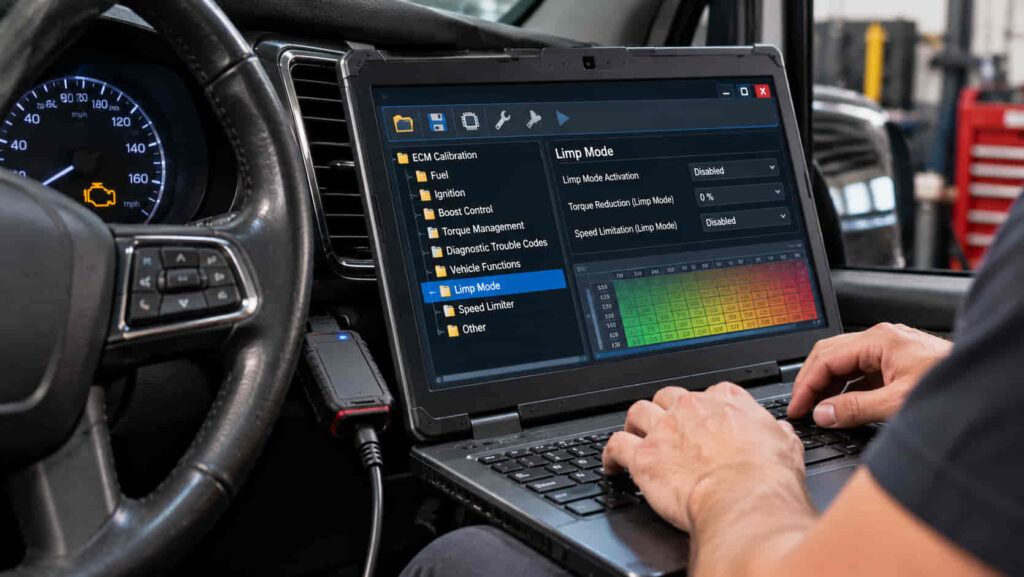
The safest way to disable limp mode permanently is to identify and repair the underlying engine, transmission, or electronic fault that triggers it. Limp mode is a protective function controlled by the vehicle’s Engine Control Unit (ECU), Powertrain Control Module (PCM), or Transmission Control Module (TCM). It restricts engine power, acceleration, RPM, or transmission shifting when certain malfunctions are detected. Permanently bypassing this protection is not a reliable repair because the original problem can continue damaging critical vehicle components.
Common causes of limp mode include faulty sensors, throttle body malfunctions, turbocharger boost problems, transmission faults, and engine overheating. Restarting the engine, disconnecting the battery, or clearing diagnostic trouble codes may temporarily restore normal performance, but limp mode generally returns when the control system detects the unresolved fault again. A lasting solution requires identifying the relevant fault codes, testing the affected components, completing the necessary repairs, and verifying that the problem no longer occurs.
This guide explains how to fix limp mode permanently through proper vehicle diagnostics and targeted repairs. It covers common causes, OBD-II troubleshooting, engine and transmission problems, temporary reset limitations, and repair costs. It also explains when driving in limp mode is unsafe and how to confirm that normal vehicle operation has been restored.
How Can You Disable Limp Mode Permanently?
To disable limp mode permanently, you must diagnose and repair the fault that causes the vehicle’s control system to restrict engine or transmission performance. There is no universal reset procedure that permanently eliminates limp mode across all vehicles. The Engine Control Unit (ECU), Powertrain Control Module (PCM), or Transmission Control Module (TCM) activates a protective strategy when it detects specific operating conditions or system failures. Removing the underlying fault allows the vehicle to return to normal operation without intentionally bypassing its safety mechanisms.
The repair process begins with identifying the conditions that triggered limp mode. If the engine is overheating, the oil pressure warning light is illuminated, or the transmission shows signs of serious damage, stop driving and arrange an appropriate inspection. Otherwise, a compatible diagnostic scanner can retrieve stored and pending Diagnostic Trouble Codes (DTCs) from the relevant control modules. These codes narrow the investigation to a particular system, but they do not always identify the failed component. For example, diagnostic trouble code P0299 indicates an underboost condition on vehicles that support that code. The cause might be an intake leak, a boost-control problem, or a turbocharger malfunction, so replacing the turbocharger without testing the system may not resolve the fault.
Once the affected system has been identified, the next step is to test its components against manufacturer specifications. A throttle-related fault may require inspecting the throttle body, electrical connectors, and sensor signals, while a transmission-related fault may require checking speed sensor readings, fluid condition, or electronic controls. Repairing damaged wiring, replacing a confirmed faulty component, or correcting a mechanical problem addresses the condition that caused limp mode rather than merely concealing its symptoms.
After completing the repair, use the manufacturer’s recommended procedure to clear applicable fault codes and verify the result. Review live diagnostic data, confirm that the relevant warning indicators behave normally, and perform a controlled road test only when the vehicle is safe to operate. The repair is supported when the original fault does not recur under comparable operating conditions. This approach provides a lasting solution to the specific malfunction, although a new fault could still activate limp mode in the future.
What Is Limp Mode and How Does It Work?
Limp mode, also called limp home mode, is a protective operating strategy that reduces vehicle performance when the engine or transmission management system detects certain faults. Its purpose is to limit potentially harmful operating conditions and, in some situations, allow the vehicle to move a short distance to a safe location. Limp mode does not guarantee that continued driving is safe, especially when a warning indicates overheating, insufficient oil pressure, or a serious transmission malfunction.
Modern vehicles use sensors to monitor operating conditions such as engine temperature, throttle position, airflow, boost pressure, and transmission speed. These signals are evaluated by control modules, which compare the readings with expected operating ranges and programmed fault-detection criteria. When a qualifying fault is detected, the system may reduce available engine torque, limit accelerator response, restrict engine speed, or command a specific transmission operating mode. The exact response depends on the vehicle manufacturer, powertrain design, and detected malfunction.
For example, a turbocharged engine experiencing an underboost condition may deliver substantially less power when the control system limits torque. A vehicle with a transmission control fault may instead restrict available gears to reduce the risk of additional damage. Both situations can feel like a sudden loss of performance, but they involve different systems and require different diagnostic procedures. Understanding this distinction is essential because limp mode describes the vehicle’s response to a problem, not the specific problem that needs repair.
Read more: how to reset computer on car
What Causes a Car to Go Into Limp Mode?
A car enters limp mode when its engine or transmission control system detects a malfunction that requires reduced performance to protect critical components. The most common fault categories involve electronic throttle control, engine sensors, turbocharger boost regulation, transmission operation, and excessive engine temperature. Modern vehicles use the Engine Control Unit (ECU), Powertrain Control Module (PCM), and Transmission Control Module (TCM) to monitor these systems. When sensor readings or operating conditions fall outside specified limits, the relevant control module may restrict engine torque, limit RPM, or alter transmission shifting. The exact response depends on the vehicle and the fault detected.
Engine management problems are a significant cause of reduced-power operation. A malfunctioning electronic throttle body, inconsistent accelerator pedal signals, or incorrect airflow measurements can interfere with the ECU’s ability to calculate and control engine output. For example, when the throttle position signals disagree beyond an acceptable threshold, the control system may limit throttle response rather than continue operating with unreliable information. Faults involving the Mass Air Flow (MAF) sensor or Manifold Absolute Pressure (MAP) sensor can also affect fuel delivery and load calculations. However, a sensor-related fault code does not automatically prove that the sensor itself has failed, because damaged wiring, air leaks, and connector problems can produce similar symptoms.
Turbocharged engines may enter limp mode when actual boost pressure differs significantly from the pressure requested by the ECU. This condition can result from leaking intercooler hoses, defective boost-control components, sticking turbocharger mechanisms, or other intake system faults. For example, a cracked charge-air hose may allow pressurized air to escape during acceleration, producing an underboost condition that causes the ECU to reduce available power. Transmission faults can trigger a different protective response. Incorrect speed sensor readings, solenoid malfunctions, or hydraulic pressure problems may cause the transmission controller to restrict gear selection or shifting.
Serious operating conditions can also lead to protective power restrictions, although not every vehicle uses limp mode for every warning condition. Excessive coolant temperature, certain fuel system faults, and electrical supply problems can interfere with normal powertrain operation. An overheating engine requires particular attention because continued driving may cause severe mechanical damage even if the vehicle remains capable of moving. Determining the actual cause requires evaluating diagnostic trouble codes, symptoms, and operating data together rather than assuming that every loss of power is limp mode.
How Do You Diagnose Limp Mode With an OBD-II Scanner?
To diagnose limp mode with an OBD-II scanner, retrieve the vehicle’s diagnostic trouble codes, review available fault-related data, and test the system identified by those results. A diagnostic scanner communicates with supported vehicle control modules and reports faults detected by their monitoring systems. Basic OBD-II scanners primarily access standardized emissions-related powertrain information, while more advanced tools can retrieve manufacturer-specific codes from additional modules, including transmission control systems. Selecting a scanner with appropriate vehicle coverage is important because a generic code reader may not display every fault responsible for a reduced-power condition.
Begin the diagnosis by connecting the scanner to the vehicle’s diagnostic port and reading the available stored, pending, and permanent trouble codes. Stored codes indicate faults recorded by a control module, while pending codes identify conditions that have been detected but may not yet meet the criteria for a confirmed fault. Permanent codes, where supported, remain recorded until the vehicle completes the required monitoring conditions and confirms that the fault has been resolved. Record the retrieved codes before clearing anything because deleting diagnostic information can make an intermittent malfunction harder to investigate.
Diagnostic trouble codes identify detected conditions rather than providing definitive instructions to replace particular components. For example, code P0299 generally indicates that measured turbocharger or supercharger boost pressure is lower than expected. The underlying cause may involve a boost leak, faulty pressure measurement, boost-control failure, or a turbocharger problem. Similarly, code P2135 identifies a correlation problem involving throttle or pedal position signals on applicable vehicles, but the fault may originate from a sensor, connector, wiring circuit, or another related component. Correct diagnosis requires checking the relevant circuits and mechanical systems rather than replacing the first component mentioned in a code description.
Freeze-frame data and live sensor readings provide additional information about when and why limp mode occurred. Freeze-frame records may show engine speed, load, coolant temperature, and other operating conditions at the time a qualifying fault was detected. Live data allows a technician to compare actual measurements with expected values while the system operates under appropriate test conditions. For example, an underboost fault that appears during acceleration but not at idle suggests that testing should focus on boost performance under load. After identifying the suspected system, compare its readings and components with manufacturer specifications, complete the necessary repairs, and verify that the original fault does not recur. This diagnostic approach addresses the cause of limp mode instead of temporarily hiding its symptoms.
Which Engine Problems Must Be Fixed to Stop Limp Mode?
Engine problems that trigger limp mode must be diagnosed and repaired before the vehicle can reliably return to normal performance. Common causes include electronic throttle control faults, incorrect airflow or boost pressure readings, turbocharger control problems, and engine overheating. These conditions interfere with the Engine Control Unit’s (ECU) ability to regulate engine torque and maintain safe operating conditions. The required repair depends on the malfunction detected, not simply on the reduced-power symptom. Replacing unrelated components or repeatedly clearing fault codes will not correct the underlying problem.
Electronic throttle control faults can cause limp mode when the ECU cannot reliably determine or control throttle opening. Modern electronic throttle systems use accelerator pedal sensors, throttle position sensors, an electric throttle actuator, and associated wiring to manage engine output. If the signals disagree beyond manufacturer-defined limits, the control system may restrict throttle movement or engine torque. For example, a damaged throttle body connector can interrupt sensor communication and trigger reduced-power operation even when the throttle body itself is functional. A correct repair therefore requires checking electrical connections, sensor signals, actuator operation, and any applicable throttle adaptation procedures before deciding which component needs replacement.
Turbocharger and intake system problems are another source of engine-related limp mode. The ECU monitors boost pressure to determine whether the engine is receiving the expected amount of compressed air. A leaking intercooler hose, malfunctioning wastegate actuator, defective boost-control solenoid, or faulty pressure sensor can cause actual boost pressure to differ from the requested value. For example, a turbocharged vehicle that loses power during highway acceleration may have a boost leak that becomes significant only under load. Repairing the damaged hose or confirmed faulty boost-control component can eliminate the triggering condition without replacing the entire turbocharger.
Engine temperature and other critical operating conditions must also be evaluated. A cooling system malfunction involving low coolant, a thermostat, a radiator fan, or a water pump can cause overheating and may trigger reduced-power protection on applicable vehicles. Severe overheating can damage cylinder heads, head gaskets, and other engine components, so it requires immediate attention rather than continued driving. Similarly, a low oil pressure warning requires stopping the engine safely and investigating the lubrication system, regardless of whether limp mode is active. A lasting repair restores the affected system to its specified operating condition and confirms that the original fault no longer occurs.
Can Replacing a Faulty Sensor Permanently Fix Limp Mode?
Replacing a faulty sensor can permanently resolve limp mode when diagnostic testing confirms that the sensor is responsible for the malfunction and no related faults remain. Engine management sensors provide information about throttle position, accelerator input, airflow, manifold pressure, temperature, and other operating conditions. The ECU uses these signals to calculate fuel delivery, ignition timing, boost control, and available engine torque. When a critical sensor sends incorrect or inconsistent information, the control system may restrict performance because it can no longer regulate the affected function reliably.
However, a sensor-related diagnostic trouble code does not always indicate a defective sensor. Damaged wiring, corroded connectors, poor electrical grounds, incorrect reference voltage, and mechanical problems can produce readings that appear to originate from sensor failure. For example, an abnormal manifold pressure reading may result from a faulty MAP sensor, but it can also reflect an intake leak or another pressure-related problem. Replacing the sensor without identifying the actual cause may leave the original fault unresolved and allow limp mode to return.
A reliable sensor diagnosis compares the sensor’s signals with manufacturer specifications and verifies the integrity of its electrical circuit. Depending on the system, testing may involve reviewing live diagnostic data, checking reference voltage and ground connections, inspecting the wiring harness, and comparing readings under known operating conditions. If testing confirms that the sensor has failed, installing a compatible replacement and completing any required calibration or relearn procedure can restore normal operation. The repair should then be verified by checking relevant diagnostic data and confirming that the fault does not recur under the conditions that originally triggered limp mode.
How Do You Know Limp Mode Has Been Permanently Fixed?
Limp mode has been successfully resolved when the underlying fault has been repaired, normal vehicle performance has returned, and diagnostic testing confirms that the original malfunction is no longer present. A vehicle operating normally after an engine restart or diagnostic code reset does not necessarily indicate a permanent repair. The Engine Control Unit (ECU), Powertrain Control Module (PCM), or Transmission Control Module (TCM) may require specific operating conditions before it can detect certain faults again. For this reason, verifying a repair involves more than confirming that the check engine light is off.
The first indication of a successful repair is that the affected system operates within the manufacturer’s specifications. A vehicle that previously entered limp mode because of insufficient turbocharger boost should demonstrate appropriate boost pressure under relevant engine load conditions. Similarly, a repaired electronic throttle system should show consistent accelerator input and throttle position signals without triggering correlation faults. Technicians can evaluate these measurements through live diagnostic data and compare them with the expected operating ranges for the vehicle. When the original symptoms disappear and the measured values return to normal, the results support the effectiveness of the repair.
Diagnostic trouble codes provide another important verification method. After completing the repair and following the manufacturer’s code-clearing or reset procedure, check for stored, pending, and recurring faults. On vehicles that support OBD-II readiness monitors, confirm that the relevant monitors have completed their required operating checks where applicable. Some faults only become detectable after the engine reaches operating temperature, during acceleration, or after a particular driving cycle. A short period of normal idling is therefore insufficient to prove that an intermittent malfunction has been corrected.
A controlled road test provides the final confirmation when the vehicle is safe to drive. The test should reproduce the operating conditions associated with the original fault without placing the engine or transmission at unnecessary risk. For example, if limp mode previously occurred during moderate acceleration, the repaired vehicle should maintain normal power delivery during a comparable, safe test. A repair can be considered successful when the original malfunction no longer appears during appropriate verification. However, this does not guarantee that unrelated faults will never activate limp mode in the future.
Can You Reset Limp Mode Without Fixing the Problem?
Some vehicles can temporarily exit limp mode after an engine restart or diagnostic reset, but resetting the system does not repair the malfunction that triggered reduced-power operation. Limp mode is controlled by software strategies designed to respond to specific fault conditions. Depending on the manufacturer and the type of fault, switching the ignition off and restarting the engine may temporarily restore normal throttle response or transmission operation. If the control module detects the same malfunction again, the vehicle can re-enter limp mode immediately or after the relevant operating conditions occur.
Clearing diagnostic trouble codes with an OBD-II scanner is another action that may temporarily remove warning indicators or reset certain fault-related states. However, deleting a code does not restore a damaged sensor, repair a leaking boost hose, or correct a transmission pressure problem. It can also remove stored diagnostic information that would otherwise help identify an intermittent fault. For example, a vehicle with a recurring turbocharger underboost condition may appear to operate normally after codes are cleared, only to lose power again during acceleration when the ECU detects insufficient boost pressure.
Disconnecting the vehicle’s battery is also not a reliable permanent limp mode fix. Depending on the vehicle, battery disconnection may reset certain learned settings or electronic states, but it will not correct mechanical damage or defective electrical components. Some vehicles also require initialization or relearning procedures after power interruption. Furthermore, fault information may remain stored in nonvolatile memory or be recorded again once the control system detects the original problem. The effects of battery disconnection vary by vehicle and should not be treated as a universal reset method.
Temporary resets must never be used to justify continued driving when serious warning conditions are present. An overheating engine, low oil pressure warning, severe transmission slipping, or abnormal mechanical noise requires appropriate inspection rather than repeated restart attempts. If the vehicle is unsafe to operate, stop in a safe location and arrange professional assistance or towing. The reliable way to keep limp mode from returning because of an existing malfunction is to diagnose and repair that malfunction, then verify the repair under the conditions that previously triggered the fault.
Why Does My Car Keep Going Into Limp Mode?
A car repeatedly enters limp mode when an unresolved or intermittent malfunction continues to trigger the engine or transmission control system’s protective response. Recurring limp mode does not necessarily mean that the same component fails every time. The underlying fault may become detectable only under specific operating conditions, including acceleration, high engine temperature, increased transmission load, or changes in electrical voltage. When those conditions occur, the Engine Control Unit (ECU), Powertrain Control Module (PCM), or Transmission Control Module (TCM) may restrict vehicle performance again. Identifying the conditions associated with the repeated fault is essential for achieving a lasting repair.
Intermittent electrical problems are a common reason that limp mode disappears and later returns. Loose connectors, damaged wiring insulation, corrosion, and unstable sensor signals can interrupt communication between components and control modules. For example, a throttle position sensor circuit with an intermittent connection may operate normally while the engine is idling but produce inconsistent signals when vibration increases during driving. The control module may then detect an implausible relationship between sensor readings and restrict throttle response. A technician must inspect the electrical circuit and reproduce the fault when possible rather than assume that replacing the sensor will eliminate the problem.
Mechanical problems can also produce recurring limp mode when they become noticeable only under load. A small leak in a turbocharger charge-air hose may have little effect during gentle driving but prevent the engine from reaching its requested boost pressure during acceleration. Similarly, a transmission fault involving hydraulic pressure or a temperature-sensitive electronic component may appear after extended operation rather than immediately after startup. These examples explain why a vehicle can drive normally for several miles before suddenly losing power or restricting gear selection.
Diagnosing recurring limp mode requires correlating diagnostic trouble codes with the operating conditions in which the malfunction occurs. Freeze-frame data can reveal engine speed, load, temperature, and other recorded measurements when a qualifying fault was detected. Live diagnostic data can then help identify abnormal readings during controlled testing. When a fault is intermittent, a technician may also need to inspect connectors, perform appropriate circuit tests, or evaluate the affected system under manufacturer-approved conditions. Recording the original symptoms and fault information before resetting the vehicle improves the likelihood of identifying the actual cause.
How Do You Fix Transmission Limp Mode Permanently?
Transmission limp mode is resolved by identifying and repairing the transmission control or mechanical fault responsible for restricted shifting, limited gear selection, or reduced powertrain performance. Many electronically controlled transmissions use a Transmission Control Module (TCM) or integrated powertrain controller to regulate gear changes based on sensor inputs and operating conditions. When the controller detects certain failures, it may restrict available gears, inhibit particular shifts, or use a fallback operating strategy to reduce the risk of additional damage. The specific behavior depends on the transmission design and the detected fault.
Transmission speed sensors and shift-control circuits are important diagnostic targets. Input and output speed sensors provide information that the controller uses to evaluate transmission operation, including the relationship between commanded and actual gear ratios. If a sensor produces an implausible signal or a shift solenoid circuit develops an electrical fault, the controller may be unable to regulate shifting reliably. For example, a damaged output speed sensor connector can produce intermittent speed readings and trigger a transmission fault even when the transmission’s internal mechanical components remain functional. Repairing the connector or replacing a sensor confirmed to be defective can restore the controller’s ability to manage shifting correctly.
Hydraulic and mechanical faults require a different repair approach. Incorrect transmission fluid level, degraded fluid, internal pressure loss, worn clutch components, or malfunctioning valve-body assemblies can interfere with gear engagement. A transmission that slips under acceleration may generate an incorrect gear-ratio fault because the measured input and output speeds no longer match the expected relationship. In this situation, replacing an external sensor or clearing the fault code will not correct the internal problem. Diagnosis may require checking fluid level and condition according to the manufacturer’s procedure, reviewing transmission-specific diagnostic codes, evaluating commanded gear changes, and performing appropriate pressure or mechanical tests.
A permanent transmission limp mode repair must address the confirmed fault and restore normal shifting under the conditions specified by the manufacturer. Electronic repairs may involve correcting wiring faults, replacing a defective solenoid or sensor, or completing a required control-module programming or adaptation procedure. Internal mechanical damage may require valve-body service, transmission repair, or replacement, depending on the extent of the failure. After the repair, a technician should verify transmission operating data, check for returning faults, and confirm appropriate gear engagement during a safe road test. Severe slipping, overheating, fluid leakage, or abnormal mechanical noises warrant professional inspection before further driving because continued operation may increase transmission damage.
How Do You Fix Limp Mode on a Diesel Engine?
To fix limp mode on a diesel engine permanently, identify and repair the fault affecting the engine management, turbocharger, fuel delivery, or emissions-control system. Diesel vehicles use electronic control modules to monitor boost pressure, exhaust conditions, fuel injection, and other operating parameters. When certain faults are detected, the engine controller may reduce available torque or restrict acceleration to protect powertrain components or respond to emissions-system malfunctions. The correct repair depends on the diagnostic trouble codes, operating conditions, and affected system rather than the presence of limp mode alone.
Turbocharger and boost-control problems are common diagnostic considerations when a diesel engine loses power under acceleration. The engine controller compares requested boost pressure with readings from the intake pressure sensors. If a damaged intercooler hose allows compressed air to escape, actual boost pressure may remain below the expected range, potentially triggering an underboost fault and reduced engine power. Similar symptoms can result from a sticking variable-geometry turbocharger mechanism, faulty actuator, or boost-pressure sensor problem. A technician should inspect the intake system, evaluate commanded and actual boost values, and test the relevant components before replacing the turbocharger.
Diesel particulate filter (DPF) restrictions and exhaust gas recirculation (EGR) faults can also contribute to reduced-power operation on applicable vehicles. The DPF captures soot from exhaust gases and requires periodic regeneration to manage accumulated particulate matter. If regeneration is repeatedly interrupted or the filter becomes excessively restricted, the engine management system may register related faults and limit performance. EGR malfunctions can disrupt expected exhaust flow and produce diagnostic errors. Resolving these conditions requires identifying whether the problem involves soot accumulation, failed sensors, an EGR valve, or another underlying malfunction. Forced regeneration is not appropriate for every DPF fault and should only be performed when the manufacturer’s specified conditions are satisfied.
Some diesel vehicles also impose performance restrictions when faults occur in the selective catalytic reduction (SCR) system or its associated sensors and diesel exhaust fluid supply. These restrictions vary by manufacturer and may operate differently from conventional engine-protection limp mode. Permanently resolving the issue requires restoring the affected system to its intended operating condition. Removing a DPF, disabling EGR monitoring, or modifying ECU software to defeat emissions controls does not repair the original malfunction and can violate applicable emissions regulations. After the necessary repair, verify relevant sensor readings, complete any required service procedures, and confirm that the original warning or reduced-power condition does not return.
How Much Does It Cost to Fix Limp Mode?
The cost to fix limp mode depends on the underlying fault, the vehicle’s make and model, diagnostic labor, replacement parts, and the complexity of the required repair. Limp mode is a protective operating state rather than a specific defective component, so it does not have a single repair price. A damaged wiring connector may require a relatively limited electrical repair, while a failing turbocharger or internally damaged automatic transmission can involve substantially greater parts and labor expenses. The vehicle’s diagnostic results determine which repair category is relevant.
Diagnostic labor is an important part of the total repair cost because retrieving a trouble code does not necessarily identify the failed component. For example, an underboost code might result from a leaking intake hose, an actuator fault, or a turbocharger problem. These faults can produce similar symptoms but require different repairs. Replacing the turbocharger before checking the intake system could create a major unnecessary expense if the actual problem is a damaged hose. Paying for accurate testing can therefore reduce the risk of replacing functional components.
Repair complexity also affects labor requirements. Replacing an accessible sensor or repairing a damaged electrical connector may involve less disassembly than servicing a transmission valve body or removing a turbocharger. Some repairs also require specialized diagnostic equipment, control-module programming, transmission adaptations, or manufacturer-specific verification procedures. Diesel vehicles can involve additional costs when the fault concerns DPF restrictions, SCR components, or exhaust sensors. Parts availability, vehicle age, local labor rates, and whether original-equipment or compatible replacement components are used further influence the final price.
The most reliable way to estimate limp mode repair costs is to obtain a diagnosis that identifies the confirmed fault and the work needed to correct it. A written repair estimate should distinguish diagnostic charges, parts, labor, and any required programming or verification procedures. For expensive repairs, a second assessment from a qualified automotive technician can help confirm that the proposed work addresses the detected malfunction. Comparing repair estimates without considering the underlying diagnosis can be misleading because two vehicles displaying reduced engine power may require entirely different repairs.
When Should You Stop Driving a Car in Limp Mode?
You should stop driving a car in limp mode when the vehicle shows signs of overheating, low oil pressure, severe engine malfunction, transmission damage, or unsafe driving performance. Limp mode is designed to reduce certain risks by restricting engine or transmission operation, but it does not guarantee that continued driving is safe. A vehicle may still move while experiencing a mechanical problem that can worsen with additional operation. The appropriate response depends on the warning indicators, symptoms, road conditions, and manufacturer’s instructions.
Engine temperature and oil pressure warnings require particular attention. If the temperature gauge enters the danger zone, a coolant temperature warning appears, or steam comes from the engine compartment, pull over safely and shut off the engine according to the vehicle manufacturer’s guidance. Continuing to operate an overheating engine can cause serious damage to cylinder heads, head gaskets, and internal components. Similarly, a low oil pressure warning may indicate insufficient lubrication of critical engine parts. Even if the vehicle remains drivable, reduced oil pressure can lead to rapid mechanical damage, making further driving unsafe.
Severe engine misfires, abnormal knocking noises, visible smoke, and major transmission problems are additional reasons to stop driving. A transmission that slips excessively, produces grinding noises, or shows an overheating warning may suffer further damage if the vehicle continues moving. Reduced acceleration can also create a traffic hazard when the car cannot maintain an appropriate speed or respond predictably. For example, a vehicle that suddenly loses substantial power while merging onto a highway may be unsafe to operate even when no temperature warning is present.
If limp mode occurs without signs of an immediate mechanical emergency, move the vehicle to a safe location and assess the warnings before deciding whether any further travel is appropriate. Some manufacturers permit limited operation under specific fault conditions, but those instructions must be followed rather than assuming that limp mode always allows a safe trip to a repair shop. When the vehicle cannot operate safely or the severity of the fault is unknown, arrange professional assistance or towing. A qualified technician can identify the malfunction, evaluate the risk of further operation, and determine the repairs required to restore normal vehicle performance.