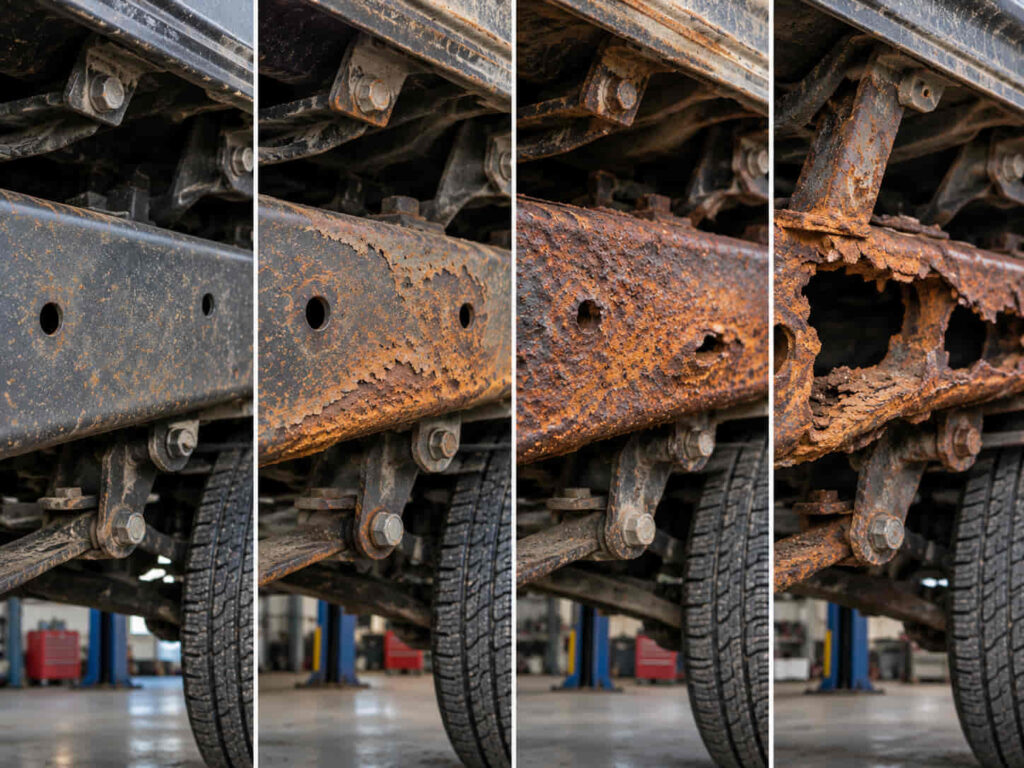
Frame rust becomes too much when corrosion weakens load-bearing metal, creates holes in structural components, or damages critical connections such as frame rails, crossmembers, and suspension mounting points. Light surface rust does not necessarily make a vehicle unsafe, but deep pitting, severe scaling, and metal perforation indicate deterioration that requires professional inspection. There is no universal percentage of rust that determines whether a vehicle frame is safe because structural integrity depends on the location, depth, and extent of metal loss.
The difference between acceptable and excessive frame rust lies in how corrosion affects the vehicle’s structural strength. Surface rust develops on exposed metal without necessarily compromising its load-bearing capacity. As corrosion progresses, it can penetrate deeper into the steel, reduce material thickness, and weaken components responsible for supporting the vehicle’s weight and suspension loads. For example, superficial oxidation along an accessible frame rail presents a different risk from corrosion that has perforated the metal surrounding a suspension mounting bracket.
Identifying excessive frame rust requires more than checking the color or size of visible rust patches. This guide explains the different levels of frame corrosion, warning signs of structural damage, and areas where rust poses the greatest safety risks. It also examines whether a rusted vehicle is safe to drive, when structural repairs are appropriate, and how to prevent further corrosion.
How Much Frame Rust Is Too Much?
Frame rust is too much when corrosion causes significant metal loss, creates holes in load-bearing components, or weakens critical structural connections. Surface discoloration alone does not establish that a vehicle is unsafe, but deep pitting, metal flaking, perforation, and deterioration around suspension mounting points are warning signs of potentially serious structural damage. There is no universal percentage of frame rust that separates acceptable corrosion from dangerous corrosion because the safety threshold depends on the affected component, its remaining metal thickness, and the loads it must support.
A vehicle frame is designed to distribute forces generated by the vehicle’s weight, acceleration, braking, cornering, and road impacts. Corrosion becomes a structural concern when it removes enough metal to reduce a component’s ability to withstand these forces. For example, a frame rail with light oxidation across a large exterior surface may retain its original structural function, while a smaller area of deep corrosion near a suspension attachment can compromise a critical load-bearing connection. The depth and location of the damage therefore matter more than the visible area covered by rust.
Surface rust is generally considered less concerning when oxidation remains on the exterior of the metal without substantial pitting, scaling, or material loss. It commonly appears as reddish-brown discoloration on exposed steel components, particularly on vehicles operated in humid climates or regions where road salt is used. Although surface corrosion does not automatically indicate structural weakness, it should still be addressed because continued exposure to moisture and corrosive contaminants can allow deterioration to progress. Protective coatings and proper surface preparation can help limit further corrosion when the underlying metal remains structurally sound.
Frame rust becomes more concerning when corrosion produces thick scales, deep pits, or visibly deteriorated metal edges. These conditions indicate that oxidation has progressed beyond superficial discoloration and may have reduced the original thickness of the steel. Metal thickness matters because a structural component depends on its cross-sectional dimensions and material properties to carry loads. As corrosion removes material, the component’s resistance to bending, twisting, and localized stress can decrease. A frame rail that has lost substantial metal around a mounting hole, for instance, may no longer distribute forces through that connection as originally designed.
Rust perforation in a structural frame component is a serious warning sign that requires professional evaluation before the vehicle is considered safe to drive. A hole indicates that corrosion has penetrated through the metal, and the surrounding material may also be weakened even if it appears intact. Perforation near suspension mounts, crossmembers, steering-related attachments, or other load-bearing connections is particularly concerning because these locations experience repeated mechanical forces. Covering the opening with filler, rust converter, or undercoating does not replace the missing metal or restore the component’s original strength.
The location of corrosion can make a relatively small damaged area more dangerous than widespread surface rust. Frame rails and crossmembers contribute to the vehicle’s structural support, while suspension mounting points transfer forces between the wheels and the chassis. Body mounts and other structural connections also perform specific load-bearing functions depending on the vehicle’s design. For example, severe corrosion around a leaf spring hanger on a pickup truck can weaken the connection between the rear suspension and the frame. Even when the surrounding frame appears relatively sound, deterioration at this attachment point can create a significant safety concern.
Visible rust does not always reveal the full extent of structural deterioration. Boxed frame rails and enclosed structural cavities can retain moisture, dirt, and road salt, allowing corrosion to develop on internal surfaces that are difficult to inspect. A frame may show limited external discoloration while experiencing substantial metal loss inside a concealed section. Conversely, a heavily discolored exterior surface may remain structurally serviceable if the corrosion has not significantly affected the underlying metal. This difference explains why appearance alone cannot establish whether frame rust has exceeded a safe level.
Vehicle construction also influences how corrosion affects structural integrity. Body-on-frame trucks and SUVs use a separate chassis to support major vehicle components, while unibody passenger vehicles incorporate structural rails and reinforced sections into the body. Corrosion in either design can be dangerous when it affects critical load paths, but the inspection methods and repair procedures differ. A rusted structural component must be evaluated according to the specific vehicle’s design and manufacturer repair requirements rather than a general rule based on the size of the rusted area.
The practical threshold for excessive frame rust is evidence that corrosion may have compromised structural strength, not a specific amount of visible rust. Deep metal deterioration, perforation, weakened mounting points, and damage to critical structural sections warrant inspection by a qualified automotive structural repair professional. If these conditions are present, the vehicle should not be driven until its safety has been assessed. A professional inspection can determine whether the corrosion is limited to treatable surface damage, requires an approved structural repair, or makes the vehicle unsuitable for continued use.
Read more: why do lesbians drive subarus
What Are the Different Levels of Frame Rust?
Vehicle frame rust can be divided into three main levels: surface rust, scale rust, and structural rust. These categories describe how corrosion progresses from exterior oxidation to deeper metal deterioration that can compromise the frame’s load-bearing capacity. Surface rust primarily affects the exposed metal surface, scale rust involves more advanced corrosion and material loss, and structural rust affects the strength of critical chassis components. These descriptions are useful for understanding corrosion severity, but they are not a universal safety classification established by every vehicle manufacturer.
Surface rust is the earliest visible stage of frame corrosion and generally appears as reddish-brown discoloration on exposed steel. It develops when iron reacts with oxygen and moisture, forming iron oxides on the metal surface. At this stage, corrosion may remain superficial without significantly reducing the thickness of the underlying steel. For example, a pickup truck operated on salted winter roads may develop light oxidation along exposed frame rails while the metal beneath remains structurally sound. Surface rust still requires attention because continued exposure to moisture and road salt can accelerate deterioration, particularly where protective coatings have worn away.
Scale rust develops when corrosion progresses beyond surface discoloration and begins producing rough, layered deposits of oxidized metal. As rust forms and expands, it can lift protective coatings and separate deteriorated material from the underlying steel. This process exposes additional metal to moisture and oxygen, allowing corrosion to penetrate deeper into the component. Scale rust may appear as thick flakes, uneven surfaces, or areas of pronounced pitting. For example, a frame crossmember with peeling undercoating and multiple layers of rust scale may have experienced measurable metal loss even if no holes are visible.
The structural significance of scale rust depends on the amount of sound metal remaining beneath the corrosion. Thick rust deposits do not necessarily indicate how much original steel has been lost because corrosion products occupy a different volume from the metal that formed them. A technician must evaluate the condition of the underlying material rather than estimate structural strength from the thickness of the visible rust layer. Deep pitting is particularly concerning near mounting holes, brackets, and other locations where mechanical forces concentrate. If corrosion has reduced the effective thickness of a load-bearing component, the damage requires structural assessment.
Structural rust occurs when corrosion compromises the strength or integrity of a component responsible for supporting vehicle loads. It can involve extensive metal thinning, deep localized deterioration, perforation, or damage around critical connections. Frame rails, crossmembers, suspension mounts, and reinforced structural sections are especially important because they transfer forces generated during driving, braking, cornering, and road impacts. For example, corrosion that has perforated a frame rail near a suspension attachment can weaken the surrounding connection even when other sections of the chassis appear relatively intact.
Structural corrosion does not always produce an obvious hole or visible deformation. Enclosed frame sections can deteriorate internally when moisture and corrosive contaminants remain trapped inside. Rust may also develop beneath brackets or protective coatings, concealing the extent of metal loss. A vehicle with limited visible rust can therefore have more serious structural deterioration than one with widespread exterior discoloration. This is why the location and depth of corrosion must be evaluated alongside its visible appearance.
The progression from surface rust to structural rust is determined by metal deterioration, not simply by the amount of reddish-brown material visible on the frame. Surface corrosion may be suitable for cleaning and protective treatment when the underlying metal remains sound. Advanced scaling requires closer inspection to determine whether significant thickness has been lost. Structural corrosion demands professional evaluation because coatings, rust converters, and ordinary surface cleaning cannot restore missing load-bearing material. Identifying the correct level of deterioration helps determine whether the frame needs preventive maintenance, an approved structural repair, or replacement.
What Are the Signs That Frame Rust Is Too Severe?
The clearest warning signs of severe frame rust are metal perforation, deep pitting, extensive rust scaling, deteriorated structural connections, and visible damage around suspension mounting points. These conditions indicate that corrosion may have progressed beyond superficial oxidation and affected the metal responsible for carrying vehicle loads. A rusted frame does not need to show every warning sign before it becomes unsafe. Significant deterioration in a single critical structural location can justify immediate professional inspection.
Rust perforation is one of the most serious visible indicators because it means corrosion has penetrated completely through a metal component. A hole in a frame rail, crossmember, or structural mounting area shows that material has been lost, and the surrounding metal may also be thinner than its original specification. For example, a perforated frame section near a leaf spring hanger can compromise the connection between the suspension and chassis. The visible opening may represent only part of the damage because corrosion can extend beneath nearby coatings or into concealed sections. Filling or covering the hole does not restore the missing structural material.
Deep pitting is another warning sign because localized corrosion removes metal from concentrated areas rather than evenly across a surface. These depressions reduce the remaining thickness of the steel and can create stress concentrations where mechanical loads are transferred. Pitting becomes especially concerning around bolt holes, suspension brackets, and structural joints. For example, a frame rail with deep corrosion pits surrounding a control arm mounting bracket may have weakened metal at a location subjected to repeated suspension forces. The severity cannot be established by measuring the visible diameter of the pits alone; the remaining material and component requirements must also be considered.
Extensive rust scaling indicates advanced corrosion, particularly when thick layers of deteriorated metal separate from the underlying structure. Flaking rust can conceal additional pitting and material loss, making the frame appear thicker or more intact than it actually is. A crossmember covered with heavy scale may require careful cleaning and inspection before its structural condition can be determined. Although rust scale does not automatically prove that a component has failed, substantial scaling on load-bearing metal should not be treated as a cosmetic defect without further assessment.
Deterioration around structural connections is particularly dangerous because these areas transfer concentrated forces between vehicle components. Suspension mounts, body mounts, spring hangers, and crossmember attachments rely on sound metal and secure connections to perform their intended functions. Corrosion can weaken the surrounding steel, damage mounting holes, and reduce the ability of fasteners or brackets to maintain their designed positions. For example, severe rust around a rear suspension mounting point can threaten the stability of the attachment even when the adjacent frame rail shows only moderate exterior corrosion.
Visible deformation, unusual separation at structural joints, or movement around a corroded mounting point can indicate that damage has progressed beyond ordinary surface deterioration. However, these symptoms are not specific to rust and may also result from collision damage, failed fasteners, or other mechanical problems. A vehicle may also have serious corrosion without displaying unusual handling or obvious structural movement. The absence of noise, vibration, or visible deformation therefore does not establish that a rusted frame is safe.
Fresh undercoating or thick protective material can make severe rust harder to identify when it conceals existing corrosion. Protective coatings are intended to reduce exposure to moisture and contaminants, but they cannot restore metal that has already deteriorated. Applying coating over loose rust or trapped moisture can also conceal continuing corrosion beneath the surface. For example, a used vehicle may have a uniformly black underbody while significant scaling remains around frame brackets or inside enclosed structural sections. A professional inspection should evaluate the underlying metal rather than relying on the appearance of the coating.
Any evidence of perforation, substantial metal loss, or deterioration around a critical frame connection should be treated as a potential structural safety problem. Vehicle owners should not attempt to confirm frame strength by striking or puncturing corroded components with sharp tools, since these methods cannot establish the remaining load-bearing capacity and may cause additional damage. A qualified automotive structural repair technician can inspect the affected components, consult manufacturer repair information, and determine whether further evaluation or an approved repair is necessary. If serious structural deterioration is suspected, the vehicle should not be driven until its condition has been professionally assessed.
Where Is Frame Rust Most Dangerous?
Frame rust is most dangerous around suspension mounting points, frame rails, crossmembers, steering system attachments, and other structural connections that support vehicle loads. Corrosion in these areas can weaken the metal responsible for maintaining chassis stability, transferring suspension forces, and supporting critical vehicle components. The severity of rust depends on how much structural material has deteriorated and the function of the affected component. Even a relatively small area of corrosion can present a significant safety risk when it damages a connection subjected to concentrated mechanical forces.
Suspension mounting points are among the most critical locations because they transfer forces between the wheels and the vehicle structure. These connections experience repeated loads during acceleration, braking, cornering, and travel over uneven roads. Corrosion around control arm mounts, leaf spring hangers, shock absorber mounting brackets, and other suspension attachments can weaken the surrounding metal or compromise the security of the connection. For example, severe rust around a rear leaf spring hanger on a pickup truck can reduce the strength of the frame section supporting the rear suspension. If the mounting area deteriorates sufficiently, the suspension may no longer remain securely attached in its intended position.
Frame rails are another high-risk location because they form major load-bearing members in body-on-frame vehicles and contribute to structural support in unibody designs. Longitudinal frame rails help distribute forces along the vehicle and support components attached to the chassis. When corrosion reduces their effective metal thickness, their resistance to bending and twisting can decrease. A frame rail with extensive internal corrosion may be structurally compromised even when its exterior shows limited deterioration. Rust near bends, mounting holes, and structural joints deserves particular attention because these areas can experience concentrated stresses under normal operating conditions.
Crossmembers are important because they connect structural sections, support attached components, and contribute to the overall stiffness of the chassis. Their exact functions vary by vehicle design, but some crossmembers support transmission mounts, suspension components, or other major assemblies. Corrosion that weakens a crossmember or its attachment points can affect how loads are transferred between frame sections. For example, severe deterioration around a crossmember connection may reduce the strength of the joint even if the central portion of the crossmember remains relatively sound. The condition of both the component and its mounting areas must therefore be considered.
Steering system attachment points require careful evaluation because they help maintain the position of components responsible for directional control. Depending on the vehicle, steering gear, steering racks, and related brackets may attach to structural members that are vulnerable to corrosion. Metal deterioration around these connections can compromise mounting integrity and affect the ability of the structure to support steering loads. A rusted mounting bracket should not be evaluated solely by its appearance because the surrounding structural metal and fastener connections may also be affected. Any suspected corrosion-related weakness in a steering attachment warrants professional inspection before continued operation.
Body mounts and reinforced structural connections also deserve attention, particularly on vehicles with separate frames. Body mounts secure the vehicle body to the chassis and help maintain the intended relationship between these assemblies. Corrosion around mounting brackets or adjacent frame sections can weaken the attachment, while deterioration in reinforced unibody areas can affect structural connections between integrated components. For example, extensive rust around a body mounting point may damage both the bracket and the frame material supporting it. The consequences depend on the vehicle’s construction and the specific role of the affected connection.
Rust inside enclosed frame sections can be especially difficult to assess because visible surfaces may not reflect the condition of the internal metal. Boxed rails, overlapping structural panels, and concealed mounting areas can trap moisture and road salt, creating conditions that promote corrosion. Internal deterioration may progress beneath protective coatings or between joined components without producing obvious external warning signs. A frame that appears relatively clean from underneath can therefore contain serious corrosion in a critical structural location. This makes vehicle-specific inspection procedures important when evaluating suspected hidden damage.
The most dangerous frame rust is corrosion that weakens components responsible for suspension attachment, steering support, chassis load distribution, or structural connections. A large patch of superficial oxidation on an accessible metal surface may be less concerning than deep corrosion around a single suspension bracket. Determining the actual risk requires identifying the component’s structural function, evaluating the remaining metal, and consulting applicable manufacturer specifications. When significant deterioration is found in a critical location, the vehicle should not be driven until a qualified professional has assessed its safety.
How Can You Tell Whether Frame Rust Is Structural?
Frame rust is structural when corrosion reduces the strength or integrity of a load-bearing vehicle component, rather than affecting only its exterior surface. Warning signs include deep metal pitting, perforation, substantial material loss, and deterioration around frame rails, crossmembers, or suspension mounting points. However, visual inspection alone cannot reliably determine the remaining strength of a corroded component. A qualified automotive structural repair technician must evaluate the affected metal and its function within the vehicle’s structure.
The first distinction is whether corrosion has affected the underlying metal or remains limited to surface oxidation. Surface rust generally produces discoloration without substantial loss of material, while advanced corrosion can create pits, scaling, and reduced metal thickness. Structural deterioration becomes a concern when this material loss affects a component responsible for carrying loads. For example, light rust on the exterior of a frame rail does not necessarily compromise its function, but deep corrosion surrounding a suspension mounting hole can weaken a connection subjected to repeated mechanical forces. The location and depth of corrosion are therefore more informative than the size of the visible rust patch.
Metal thickness loss is an important indicator because the load-bearing capacity of a structural component depends partly on its remaining cross-sectional dimensions. As corrosion removes steel, the component may become less resistant to bending, twisting, or localized stress. The relationship is not determined by thickness alone, since component geometry, material grade, loading conditions, and attachment design also influence structural performance. A technician must assess whether the remaining material satisfies the requirements of the specific vehicle structure. A general visual estimate cannot establish a universal safe thickness for every frame rail or crossmember.
Rust perforation provides stronger evidence of advanced deterioration because it shows that corrosion has penetrated through the metal. A hole in a structural component indicates material loss, but the full extent of damage may extend beyond the visible opening. Corrosion can spread beneath protective coatings, along overlapping joints, or inside enclosed frame cavities. For example, a small opening near a crossmember attachment may be surrounded by metal that has also lost significant thickness. Treating the visible hole without evaluating adjacent material can leave underlying structural weakness unresolved.
The condition of mounting points provides additional information about whether corrosion has become structural. Suspension brackets, steering attachments, body mounts, and other critical connections rely on surrounding metal to transfer forces safely. Rust that damages mounting holes, weakens welded joints, or causes deterioration around fastener locations can compromise these connections. A frame section may appear largely intact while corrosion has significantly affected the smaller area supporting an essential bracket. Inspecting the attachment and its surrounding structural material is therefore necessary to understand the extent of the problem.
Professional inspection involves identifying the affected components, evaluating accessible corrosion, and determining whether further examination is required. Depending on the vehicle and the suspected damage, a qualified technician may need to remove deteriorated coatings, inspect concealed areas, or use appropriate measurement and assessment methods. The objective is to determine the extent of material loss and whether the component remains suitable for service. Vehicle manufacturer repair information is essential because different structural materials and component designs have different repair restrictions. An inspection should establish whether the corrosion is treatable, whether an approved structural replacement procedure exists, or whether the vehicle is unsuitable for continued use.
Vehicle construction also affects how structural rust is identified. Body-on-frame vehicles use separate frame rails and crossmembers, while unibody vehicles incorporate load-bearing members into the body structure. Corrosion affecting a unibody rocker reinforcement, structural rail, or suspension attachment can be just as significant as corrosion in a conventional truck frame. The absence of a separate chassis does not mean that visible underbody rust is merely cosmetic. Each affected component must be evaluated according to its structural role and the manufacturer’s repair requirements.
The most reliable way to determine whether frame rust is structural is to have the affected components inspected by a qualified automotive structural repair specialist. Visible holes, severe scaling, deep pitting, and deteriorated mounting points justify professional assessment, but the absence of these signs does not guarantee that concealed structural sections remain sound. Surface coatings, rust converters, and cosmetic repairs cannot restore metal that has already lost its required strength. If structural deterioration is suspected, the vehicle should remain out of service until a professional determines whether it is safe to operate.
Is It Safe to Drive a Car With a Rusted Frame?
A car with a rusted frame may be safe to drive if corrosion is limited to the metal surface and the underlying structure remains sound. However, driving becomes unsafe when rust weakens frame rails, suspension mounting points, steering attachments, or other load-bearing components. The presence of rust alone does not determine whether a vehicle is roadworthy. Safety depends on the extent of metal deterioration, the structural function of the affected area, and whether the remaining components can withstand normal driving forces.
Surface rust does not automatically compromise vehicle safety because oxidation can develop on exposed steel without significantly reducing its structural thickness. A vehicle driven in regions with frequent rain, snow, or road salt exposure may develop reddish-brown discoloration along its underbody and frame rails. When the underlying metal remains intact, these areas may still perform their intended structural functions. For example, light surface corrosion on an accessible truck frame rail does not necessarily affect its ability to support vehicle loads. Nevertheless, untreated surface rust can progress into deeper corrosion as moisture and contaminants continue to reach the metal.
Driving becomes dangerous when corrosion reduces the strength of components responsible for supporting the suspension or maintaining chassis stability. Suspension mounting points experience repeated forces during braking, acceleration, cornering, and travel over uneven roads. If rust weakens the metal surrounding these connections, the affected components may no longer remain securely attached under operating loads. For example, severe corrosion around a control arm mounting bracket can compromise the structural connection between the suspension and vehicle body. This type of damage creates a safety concern even when the vehicle appears to handle normally during everyday driving.
Frame rails and crossmembers also contribute to vehicle safety by distributing loads and supporting attached mechanical components. Corrosion that causes significant metal thinning or perforation can reduce their ability to resist bending, twisting, and localized stress. The consequences depend on the affected component and the vehicle’s structural design. A severely corroded frame rail may experience additional deformation under loads that an undamaged structure was designed to withstand. Structural deterioration can also affect the vehicle’s performance during a collision because damaged load-bearing members may no longer respond as intended.
A vehicle with serious frame corrosion may not display obvious symptoms before structural integrity becomes compromised. Unusual noises, changes in alignment, or movement around mounting points can indicate mechanical or structural problems, but their absence does not prove that the frame is sound. Corrosion can develop inside boxed frame rails, beneath protective coatings, or around concealed structural joints without producing noticeable changes in normal driving. For example, a pickup truck may continue operating despite significant internal deterioration around a rear suspension attachment. A routine road test cannot establish the remaining strength of that connection.
The decision to continue driving must also account for the difference between visible corrosion and confirmed structural damage. Light oxidation on noncritical surfaces may require preventive maintenance rather than immediate removal from service. In contrast, rust perforation, substantial metal loss, or deterioration around suspension and steering attachments warrants professional assessment before further operation. Owners should not rely on cosmetic appearance, temporary reinforcement, or the absence of driving symptoms to determine whether the vehicle remains safe.
A car with suspected structural frame rust should not be driven until a qualified automotive structural repair professional determines that it is safe. If severe deterioration is visible around load-bearing components, arranging professional transport to a repair facility is safer than driving the vehicle for an inspection. A technician can evaluate the affected structure, consult manufacturer repair information, and determine whether an approved repair is available. Surface rust may require cleaning and corrosion protection, while significant structural deterioration can require component replacement or make continued vehicle use inappropriate.
How Much Rust Is Too Much on a Truck Frame?
Truck frame rust becomes excessive when corrosion significantly reduces the thickness of frame rails, creates perforations, or weakens crossmembers, suspension mounts, and other load-bearing connections. A truck frame can develop widespread surface oxidation without necessarily losing structural integrity, but localized corrosion around a critical attachment point may create a serious safety risk. There is no universal percentage of visible rust that determines whether a truck frame is safe because the acceptable condition depends on its design, material, remaining strength, and intended operating loads.
Most conventional pickup trucks use body-on-frame construction, which separates the structural chassis from the vehicle body. The frame consists of longitudinal rails connected by crossmembers that help support the drivetrain, suspension, body, and other components. This structure must withstand forces generated during normal driving as well as additional loads associated with carrying cargo and towing trailers. Corrosion becomes particularly concerning when it affects sections responsible for transferring these forces. For example, substantial metal loss near a rear suspension mounting point can weaken a connection that supports part of the truck’s loaded weight.
Rust along the main frame rails requires careful evaluation because these components contribute to the truck’s longitudinal strength and resistance to bending and twisting. Light oxidation on an exposed rail surface may remain a maintenance issue when the underlying steel is structurally sound. However, deep pitting, extensive scaling, and perforation can indicate that corrosion has removed material from the load-bearing section. A frame rail with significant metal loss may no longer provide the strength intended by its original design. The risk increases when deterioration occurs near mounting holes, structural joints, or locations subjected to concentrated forces.
Leaf spring hangers and other suspension mounting points are especially important on trucks because they transfer suspension forces directly into the chassis. These connections experience changing loads as the vehicle accelerates, brakes, turns, or travels over uneven terrain. Corrosion around a spring hanger can weaken both the mounting bracket and the frame material supporting it. For example, severe rust surrounding the rear leaf spring attachment of a pickup truck can compromise the connection even when adjacent frame sections appear relatively intact. A small perforated area at this location may present a greater safety concern than a large patch of superficial rust elsewhere on the chassis.
Crossmembers and their attachment points also require inspection because they connect frame rails and support specific vehicle systems. Depending on the truck’s design, a crossmember may contribute to chassis stiffness or support components such as the transmission and suspension. Corrosion affecting these areas can weaken structural connections and alter how loads are distributed through the frame. For example, extensive rust around a crossmember mounting bracket may reduce the integrity of the connection even if the central portion of the crossmember remains sound. Both the component and its surrounding attachment areas must be evaluated.
Truck frame corrosion can be particularly difficult to assess when it develops inside boxed rails or beneath accumulated road debris. Moisture, mud, and deicing chemicals can remain trapped in enclosed sections, allowing corrosion to progress where the metal is not readily visible. A frame may appear moderately rusted from the outside while experiencing more substantial deterioration internally. Conversely, a truck with extensive exterior discoloration may retain sound structural metal beneath the oxidation. This difference explains why the visible amount of rust cannot establish a reliable safety threshold.
Towing and hauling place additional demands on a truck’s structural components, making the condition of the frame particularly important. Trailer tongue weight, cargo weight, road impacts, and suspension forces must be transferred through the chassis and its connections. Corrosion that reduces structural strength can compromise the frame’s ability to support these loads as designed. However, reducing the cargo weight or avoiding towing does not make a structurally weakened truck frame safe for ordinary driving. The underlying deterioration must be evaluated and addressed before the vehicle returns to service.
A truck frame has too much rust when corrosion compromises its load-bearing structure or creates credible evidence of structural weakness. Deep pitting, perforation, severe scaling, and deterioration around frame rails, crossmembers, or suspension attachments require inspection by a qualified structural repair specialist. The technician should assess the remaining metal and determine whether the manufacturer permits an appropriate repair. If the frame has suffered extensive structural deterioration and no approved restoration procedure is available, replacing the affected assembly or retiring the truck may be necessary.
Can a Car Frame With Severe Rust Be Repaired?
A car frame with severe rust can be repaired only when the damaged structural components can be restored or replaced using manufacturer-approved procedures and the surrounding metal remains structurally sound. Extensive corrosion does not automatically make a vehicle irreparable, but deep metal loss, perforation, and deterioration across multiple load-bearing sections can make restoration unsafe or economically impractical. The decision depends on the location of the damage, the amount of usable metal remaining, the vehicle’s construction, and the availability of approved repair methods.
The first requirement for repairing severe frame rust is determining whether the affected structure retains enough sound material to support an appropriate repair. Corrosion removes metal from frame rails, crossmembers, and structural connections, reducing their ability to withstand operating loads. If deterioration is limited to a component that the manufacturer permits technicians to replace, structural restoration may be possible. For example, a corroded crossmember on a body-on-frame truck may be replaceable when an approved procedure and compatible replacement part are available. However, extensive corrosion extending into adjacent frame rails or mounting points can make a localized replacement insufficient.
The repair method must match the vehicle’s structural design and material specifications. Conventional steel frames, high-strength steel structures, and aluminum components have different requirements for cutting, joining, and replacement. Welding introduces heat that can alter the mechanical properties of certain automotive materials, while unapproved reinforcement can change how loads travel through the structure. For example, welding a steel plate over a perforated frame rail does not automatically restore the rail’s original strength or crash performance. A qualified technician must follow vehicle-specific repair information rather than selecting a method solely because it is inexpensive or technically possible to perform.
Severe rust around suspension mounting points presents additional challenges because these connections transfer repeated forces between the wheels and the chassis. Corrosion can weaken the mounting bracket, surrounding structural metal, and fastener locations simultaneously. Replacing a visibly damaged bracket may not be sufficient when the frame material supporting it has also deteriorated. For example, extensive rust surrounding a rear leaf spring hanger can affect the attachment point and the adjacent frame rail. A successful repair must address the complete damaged load path using an approved procedure, not merely restore the external appearance of the mounting area.
The extent of corrosion throughout the vehicle also determines whether frame repair is practical. A vehicle with one damaged structural section may be a better candidate for restoration than a vehicle with widespread deterioration across frame rails, crossmembers, suspension mounts, and body attachments. Corrosion in enclosed sections creates further uncertainty because the visible damage may not reveal how much metal has been lost internally. A professional inspection may identify additional deterioration that changes the original repair plan or makes the proposed work unsuitable.
Surface treatments cannot substitute for structural repairs when severe rust has removed load-bearing material. Rust converters, primers, and undercoating products are intended to manage corrosion or protect properly prepared metal surfaces. They do not replace missing steel or restore the mechanical properties of a weakened component. Likewise, cosmetic fillers cannot repair perforated structural sections. These treatments may form part of the corrosion protection process after an approved repair, but they cannot independently make a severely rusted frame safe.
Repair cost and vehicle value become relevant only after a technically acceptable repair has been identified. Extensive structural restoration can require specialized labor, replacement components, disassembly, alignment verification, and corrosion protection. If several structural areas are damaged, the combined expense may exceed the value of a comparable vehicle with a sound frame. A repair that is financially attractive but does not satisfy manufacturer requirements is not an acceptable alternative. Structural integrity must remain the primary consideration when deciding whether to restore a severely corroded vehicle.
A severely rusted car frame is beyond practical repair when the damage cannot be corrected through an approved structural procedure or when the required restoration is economically unreasonable. A qualified automotive structural repair specialist should evaluate the affected components, inspect surrounding metal, and determine whether replacement parts and repair procedures are available. If the frame has suffered extensive structural deterioration and no safe restoration method exists, the vehicle should not return to service. Replacing the affected assembly or retiring the vehicle is preferable to relying on unapproved welding or cosmetic repairs.
How Much Frame Rust Is Acceptable When Buying a Used Car?
Light surface rust may be acceptable when buying a used car if the underlying metal remains structurally sound and corrosion has not weakened critical components. Deep pitting, extensive scaling, perforation, and deterioration around suspension mounting points are warning signs that require professional evaluation before purchase. There is no universal amount of visible rust that makes a used vehicle acceptable because the risk depends on corrosion depth, location, remaining metal thickness, and the vehicle’s structural design.
Surface oxidation is common on vehicles exposed to moisture, winter road salt, and changing weather conditions. It typically appears as reddish-brown discoloration on exposed steel components, including accessible frame rails and underbody brackets. When corrosion remains superficial, the affected metal may retain its intended structural function. For example, a used pickup truck with light exterior rust along otherwise sound frame rails may not have a structural problem. However, the buyer should still consider whether the corrosion requires cleaning, protective treatment, or further inspection to prevent deterioration.
Advanced rust scaling deserves closer attention because it can indicate that corrosion has progressed beneath the original metal surface. Thick flakes, rough metal edges, and deep pits suggest material deterioration that may extend beyond the visible area. The structural significance depends on how much sound metal remains and whether the affected section carries vehicle loads. For example, scaling on an accessible noncritical bracket presents a different concern from deep corrosion around a control arm mounting point. Buyers should not assume that two areas with similar visible rust have the same effect on vehicle safety.
The location of corrosion is particularly important during a used car inspection. Frame rails, crossmembers, suspension mounting points, steering attachments, and structural body connections should be evaluated because they support critical vehicle functions. Rust around these areas can weaken mounting holes, welded joints, or the surrounding metal. A relatively small perforation near a suspension bracket may be more serious than widespread surface discoloration elsewhere on the underbody. Buyers should therefore prioritize the condition of load-bearing components rather than judge the vehicle by the total area covered in rust.
Fresh undercoating can make corrosion assessment more difficult when it conceals deteriorated metal or existing rust deposits. Protective coatings are useful when properly applied to prepared surfaces, but their appearance does not establish the condition of the underlying structure. A uniformly black underbody may still contain rust beneath coatings, around overlapping panels, or inside enclosed frame sections. For example, a truck advertised as having a recently treated frame may require closer examination if thick coatings obscure structural joints and mounting areas. Buyers should request information about previous corrosion treatment and any structural repairs rather than assuming the coating confirms the frame is sound.
The vehicle’s geographic history provides useful context because prolonged exposure to road salt and moisture can accelerate steel corrosion. Vehicles operated in regions with frequent winter deicing may experience greater underbody exposure to corrosive contaminants. However, geographic history alone cannot establish the condition of an individual frame. A vehicle from a dry climate may still develop corrosion through water accumulation, damaged coatings, or poor maintenance, while a vehicle from a snowy region may retain a sound structure after consistent care. The actual metal condition must determine the purchase decision.
A pre-purchase inspection is particularly important when a vehicle shows substantial frame rust or signs of previous structural work. A qualified technician can examine accessible structural components, identify suspicious corrosion, and determine whether additional assessment is necessary. The inspection should consider the vehicle’s construction and manufacturer repair requirements. If significant corrosion is found around critical mounting points or enclosed structural sections, a specialized structural inspection may be required before the vehicle can be considered suitable for purchase.
The financial implications of frame rust extend beyond the cost of removing visible corrosion. Advanced deterioration can indicate additional problems affecting suspension hardware, brake line supports, body mounts, and other underbody components exposed to the same environment. A vehicle with a low purchase price may become expensive if it requires extensive structural restoration or related mechanical repairs. For example, purchasing a used truck at a substantial discount may offer little financial benefit if its frame requires major component replacement. Buyers should compare the total expected repair expense with the price of a similar vehicle that has a structurally sound chassis.
The acceptable amount of frame rust on a used car is corrosion that has not compromised structural integrity and can be managed through appropriate maintenance or approved repairs. Light surface oxidation may be reasonable, but perforation, significant metal loss, and deteriorated structural connections should never be dismissed as cosmetic defects. If a seller cannot provide access for an independent inspection or serious structural corrosion remains unresolved, declining the purchase is the safer decision. A structurally sound frame is more important than cosmetic appearance or a discounted asking price.
How Much Does It Cost to Repair Excessive Frame Rust?
Repairing excessive frame rust can cost several hundred dollars for extensive surface corrosion treatment and several thousand dollars when structural components require replacement. The final expense depends on the severity of metal deterioration, the location of the damage, the vehicle’s construction, and whether a manufacturer-approved repair procedure is available. Severe corrosion does not have a standard repair price because the amount of visible rust does not reliably indicate how much structural material has been lost.
Surface rust treatment is generally less expensive than structural restoration because it does not require replacing load-bearing metal when the underlying frame remains sound. The work typically involves removing corrosion, preparing the exposed steel, and applying suitable protective coatings. For example, treating surface oxidation along an accessible frame rail requires fewer operations than restoring several corroded mounting areas. Costs increase when technicians must remove deteriorated undercoating, clean concealed surfaces, or disassemble nearby components to access the affected metal.
Advanced corrosion requires a more detailed assessment because scaling and deep pitting can indicate significant metal loss. Before estimating the repair, a technician must determine whether the remaining structure is suitable for treatment or whether damaged components require replacement. This distinction directly affects the total expense. Cleaning and coating a structurally sound frame section involves different materials, equipment, and labor requirements from replacing a weakened crossmember or suspension mounting bracket. If corrosion extends beneath adjacent components, additional work may become necessary after disassembly.
Structural rust repairs are typically the most expensive because they involve components responsible for supporting vehicle loads and maintaining chassis integrity. Repairing an approved structural section may require specialized equipment, replacement parts, extensive disassembly, and post-repair measurements. For example, replacing a severely corroded crossmember can involve removing attached mechanical assemblies, positioning the replacement component, and verifying the integrity of its connections. Corrosion protection must also be restored after the structural work is completed. These operations increase labor time and material expenses beyond the cost of treating the visible rust.
Vehicle construction influences both repair feasibility and cost. Body-on-frame trucks use separate structural frames, while unibody vehicles incorporate major load-bearing components into the body. A damaged frame section on a truck may have an approved replacement procedure, whereas corrosion affecting an integrated unibody rail may require a different repair process. Manufacturer restrictions on cutting, welding, and structural section replacement determine which methods are permitted. A lower-cost repair is not appropriate when it fails to meet the vehicle’s structural requirements.
Labor rates and parts availability further affect the final estimate. Automotive structural repair facilities may require specialized technicians and equipment to inspect and restore load-bearing components. The number of labor hours depends on accessibility, disassembly requirements, corrosion extent, and the procedures needed to complete the work. Replacement frame sections, brackets, and crossmembers may also vary considerably in price and availability. If suitable components are unavailable or the manufacturer does not permit the required repair, the vehicle may not be a practical candidate for restoration.
The cost of excessive frame rust should be evaluated only after a professional inspection establishes whether the damaged structure can be safely repaired. A written estimate should identify the affected components, approved repair procedures, replacement parts, labor requirements, and corrosion protection work. When structural damage is widespread, the total repair expense may approach or exceed the vehicle’s market value. In that situation, replacing the vehicle may be more economical than attempting extensive restoration, particularly when other underbody components have also deteriorated.
How Can You Stop Frame Rust From Getting Worse?
You can help stop frame rust from getting worse by removing corrosive contaminants, treating existing surface corrosion, restoring protective coatings, and preventing moisture from accumulating around structural components. These measures reduce the conditions that accelerate metal deterioration, but they cannot restore steel that has already lost significant thickness. Effective rust prevention begins with determining whether the corrosion is superficial or has affected the frame’s structural integrity.
Removing road salt, mud, and accumulated debris is an important preventive measure because these contaminants retain moisture against metal surfaces. Road salt accelerates corrosion by increasing the electrical conductivity of water, allowing electrochemical reactions to proceed more readily. Frame rails, crossmembers, suspension brackets, and enclosed underbody sections can collect these materials during normal driving. For example, a truck operated on salted winter roads may accumulate corrosive deposits around rear suspension mounts and frame connections. Cleaning the underbody according to the vehicle manufacturer’s recommendations helps reduce prolonged exposure to these contaminants.
Existing surface rust should be treated before corrosion progresses into deeper metal deterioration. Proper treatment involves removing loose rust, preparing the affected surface, and applying compatible corrosion-resistant products. The exact process depends on the condition of the metal and the manufacturer’s requirements. For example, light oxidation on an accessible steel frame rail may be suitable for mechanical cleaning and protective refinishing when the underlying metal remains sound. Applying paint or undercoating directly over loose rust and contamination can reduce coating adhesion and allow corrosion to continue beneath the surface.
Protective coatings help limit contact between exposed metal, oxygen, and moisture. Suitable primers, chassis coatings, and corrosion protection products form barriers that reduce environmental exposure when applied to properly prepared surfaces. However, protective materials must be compatible with the underlying metal and any existing coatings. A damaged or peeling coating can create locations where moisture enters and remains trapped against the steel. Regular inspection of coated frame surfaces helps identify areas requiring maintenance before corrosion spreads beneath the protective layer.
Moisture control is particularly important inside boxed frame rails and other enclosed structural sections. These areas can retain water, road salt, and debris because they are difficult to access during routine cleaning. Drainage openings allow accumulated water to escape, while suitable cavity protection products may help reduce corrosion on internal surfaces when their use is permitted by the manufacturer. For example, a blocked drainage opening in a frame section can allow moisture to remain in contact with steel for extended periods. Maintaining the intended drainage system reduces this exposure without altering the frame’s structural design.
Regular inspections help identify corrosion before it develops into extensive structural damage. Vehicle owners should pay particular attention to frame rails, crossmembers, suspension mounting points, body mounts, and areas where protective coatings have deteriorated. Changes such as increased scaling, deeper pitting, or visible perforation indicate that corrosion may be progressing. An inspection is especially important after prolonged exposure to road salt or when a vehicle has a history of underbody corrosion. A qualified technician can determine whether the affected metal remains structurally sound or requires additional evaluation.
Preventive maintenance has clear limitations when corrosion has already compromised load-bearing components. Rust converters, protective coatings, and cleaning products cannot replace missing steel or restore weakened structural connections. For example, applying undercoating to a perforated frame rail may conceal the opening, but it does not restore the metal required to support vehicle loads. Structural deterioration must be addressed through an appropriate manufacturer-approved repair procedure before corrosion protection becomes the primary concern.
The most effective approach to frame rust prevention is to treat surface corrosion early, maintain protective coatings, and inspect vulnerable structural areas regularly. When rust remains superficial, these measures can help slow further deterioration and preserve the existing metal. When corrosion causes perforation, substantial material loss, or damage around critical mounting points, professional structural evaluation takes priority over preventive treatment. Addressing corrosion according to its actual severity helps protect vehicle safety and reduces the likelihood of more extensive frame damage.