Seeing the Honda Accord TCS light on can be confusing, especially when the car still seems to drive normally. Many drivers immediately worry about an expensive repair, a major braking problem, or the risk of losing control on the road. In reality, the warning can appear for several reasons, ranging from a simple button press to a faulty wheel speed sensor or an engine related problem.
The Traction Control System helps your Honda Accord maintain grip when the tires begin to slip. It works closely with the ABS, engine control system, wheel speed sensors, and other electronic components. When one of these systems sends incorrect data, the vehicle may disable traction control and turn on the warning light.
A flashing TCS light usually means the system is actively reducing wheel spin on a wet, icy, or loose surface. A light that stays on often means the system has been switched off or a fault has been detected. In some cases, the TCS light may also appear with the ABS light, VSA light, or check engine light.
This guide explains the most common causes, safe driving advice, diagnostic steps, repair options, reset methods, and expected costs. It will help you understand what the warning means and what to check before replacing parts or visiting a repair shop.
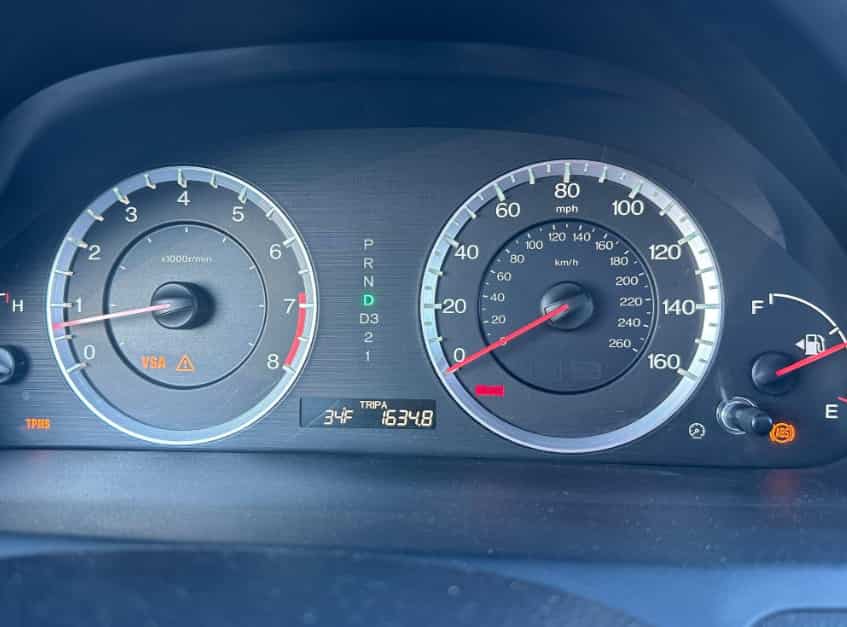
What Does the TCS Light Mean on a Honda Accord?
The Traction Control System, or TCS, helps your Honda Accord maintain grip during acceleration. It monitors the speed of each wheel and reacts when it detects wheel slip. Instead of allowing the tires to spin freely, the system reduces engine power or applies braking force to the affected wheel. This quick response helps the vehicle stay stable on wet roads, snow, ice, and loose gravel.
A flashing TCS light usually indicates that the system is working properly. It appears when the tires lose traction and disappears after the wheels regain grip. Drivers often notice this behavior while accelerating on slippery roads or making sharp turns in poor weather. In most situations, a flashing light is not a sign of a mechanical problem.
A TCS light that stays on requires more attention. It often means the traction control system has been turned off manually or has detected a fault. Some Honda Accord models display a VSA warning instead of a dedicated TCS light because Vehicle Stability Assist includes traction control functions.
Several components work together to keep the system operating correctly. Wheel speed sensors measure tire rotation and send data to the ABS module. The engine control module adjusts engine output when necessary, while the steering angle sensor helps calculate the vehicle’s intended direction. If any of these components stops working correctly, the system may disable traction control and illuminate the warning light.
The warning light does not identify the failed component by itself. It simply tells you that the system has detected an issue. A proper diagnostic scan is the fastest way to locate the fault and avoid replacing parts unnecessarily.
Honda Accord TCS Light and Check Engine Light On Together
Many Honda Accord owners become concerned when the TCS light and the check engine light appear at the same time. Although this combination looks serious, it does not always mean the traction control system has failed. In many cases, the engine control system detects a fault first and then disables traction control to protect the vehicle.
The traction control system relies on the engine control module to manage engine power during wheel slip. When the engine cannot respond correctly, the system can no longer control traction as designed. As a safety measure, Honda automatically turns off traction control and illuminates the TCS warning light.
Several engine related problems can trigger both warning lights. A faulty throttle body may prevent the engine from delivering smooth power. An ignition misfire can reduce engine performance and increase emissions. Problems with the accelerator pedal position sensor, mass airflow sensor, or manifold absolute pressure sensor may also interrupt communication between the engine and traction control systems. Even a small sensor failure can cause both warning lights to appear.
Drivers should avoid clearing the warning lights before identifying the root cause. Resetting the system without making repairs only hides valuable diagnostic information, and the lights usually return after a short drive. Reading the stored diagnostic trouble codes provides a much faster and more accurate way to locate the problem.
If the check engine light flashes instead of staying on, stop driving as soon as it is safe to do so. A flashing light often indicates an active engine misfire that can damage the catalytic converter. Repairing the engine fault usually restores normal traction control operation and turns off the Honda Accord TCS light after the system completes another self check.
Several issues can trigger the Honda Accord TCS light on warning. Some causes are simple and easy to fix, while others require professional diagnosis. Understanding the most common problems helps you identify the issue faster and avoid unnecessary repairs.
A driver may accidentally turn off the traction control system by pressing the TCS or VSA button. When this happens, the warning light stays on until the system is activated again. This is one of the easiest problems to solve and does not indicate a mechanical failure.
Faulty wheel speed sensors are another common cause. These sensors monitor how fast each wheel rotates and send that information to the ABS and traction control systems. Dirt, moisture, damaged wiring, or internal sensor failure can interrupt the signal. As a result, the control module can no longer calculate wheel speed accurately, so it disables the system and turns on the warning light.
The warning may also appear when the ABS system develops a fault. Since traction control depends on the ABS module, a damaged sensor, faulty wiring, or a failed control module can affect both systems at the same time. Many drivers also notice the ABS warning light together with the TCS light in these situations.
Engine related problems can produce the same warning. The traction control system works with the engine control module to reduce wheel spin. If the engine stores fault codes, the vehicle may disable traction control to protect important components. Low battery voltage, incorrect tire size, uneven tire pressure, or a steering angle sensor that needs calibration can also trigger the warning.
Although these causes are common, the warning light cannot identify the exact fault. A diagnostic scan remains the most reliable way to confirm the problem before replacing any parts.
Honda Accord TCS Light and ABS Light On Together
When the TCS light and ABS light turn on together, the problem usually involves a component shared by both systems. Since traction control depends on the Anti Lock Braking System, a fault in the ABS can also disable traction control. This combination is more common than many drivers realize and often points to a problem that requires attention.
A faulty wheel speed sensor is the most common cause. Each sensor measures how fast a wheel rotates and sends that information to the ABS control module. If one sensor fails or sends incorrect data, the module cannot calculate wheel speed accurately. It responds by turning off both ABS and traction control to prevent unexpected system behavior.
Damaged wiring can create the same warning. The wiring harness near each wheel faces water, dirt, road salt, and constant movement. Over time, connectors may corrode, wires may break, or insulation may wear out. These issues interrupt communication between the sensors and the control module.
Other possible causes include a damaged tone ring, low brake fluid, a blown fuse, or a failing ABS module. In some cases, a worn wheel bearing can also affect sensor readings because excessive movement changes the signal received by the control unit.
Your Honda Accord will usually retain normal braking even when both warning lights remain on. However, the vehicle loses anti lock braking and traction control assistance. During hard braking or on slippery roads, the tires may lock more easily and the vehicle may become harder to control.
The safest approach is to scan the ABS system as soon as possible. A diagnostic scan identifies the affected component and helps prevent unnecessary repairs. Fixing the underlying fault usually restores both systems and turns off the warning lights after the next system check.
Is It Safe to Drive With the TCS Light On?
Yes, you can often drive a Honda Accord with the TCS light on, but the answer depends on what caused the warning. If the vehicle drives normally and no other warning lights appear, you can usually continue driving with extra caution. However, you should diagnose the problem as soon as possible because the traction control system may no longer protect you on slippery roads.
When the system is disabled, your Honda Accord loses an important safety feature. The vehicle can no longer reduce wheel spin automatically during acceleration. As a result, the tires may lose grip more easily on wet pavement, snow, ice, or loose gravel. The risk becomes even higher if you accelerate quickly or make sudden steering movements.
You may continue driving if the engine runs smoothly, the brakes feel normal, and the check engine light is not flashing. A TCS light caused by a manually disabled system or a minor sensor issue usually does not prevent normal driving. Even so, you should avoid harsh acceleration and leave extra space between your vehicle and the traffic ahead.
Some situations require immediate attention. Stop driving if the red brake warning light appears, the check engine light starts flashing, or the vehicle enters limp mode. You should also pull over if the engine misfires, the brakes feel weak, or the steering becomes unstable. These symptoms may indicate a more serious problem that affects both safety and vehicle performance.
Ignoring the Honda Accord TCS light on warning can lead to additional risks, especially during poor weather. A professional inspection helps identify the exact cause before it develops into a larger and more expensive repair. Fixing the problem early also restores full traction control and improves overall driving safety.
How to Diagnose the Honda Accord TCS Light
Diagnosing the Honda Accord TCS light on warning does not always require advanced mechanical knowledge. You can begin with a few simple inspections before replacing any parts. These basic checks often reveal the problem and may save both time and money.
Start by checking whether the traction control system has been turned off manually. Many Honda Accord models include a TCS or VSA button on the dashboard. Press the button once and restart the vehicle. If the warning light disappears, the system was simply disabled.
Next, inspect all four tires. Make sure they have the correct air pressure and match the manufacturer’s recommended size. Uneven tire pressure or mismatched tires can confuse the wheel speed sensors and trigger the warning light. You should also look for excessive tire wear because large differences in tread depth may affect sensor readings.
The battery is another component worth checking. A weak battery or poor charging system can cause communication errors between electronic control modules. Inspect the battery terminals for corrosion or loose connections. If possible, test the battery and alternator to confirm they provide the correct voltage.
After completing the basic inspections, connect a diagnostic scanner to the vehicle. A standard OBD2 scanner can read engine fault codes, but it may not detect ABS or traction control problems. An advanced scanner with ABS and VSA functions provides much more useful information. Record every diagnostic code before clearing the system because those codes help identify the root cause.
Finally, inspect the wheel speed sensors and their wiring. Look for damaged connectors, broken wires, dirt, or metal debris around the sensors. If the warning light remains on after these checks, a professional technician should perform advanced testing to verify the ABS module, steering angle sensor, and other electronic components.
How to Fix the Honda Accord TCS Light
The correct repair depends on the cause of the Honda Accord TCS light on warning. Some problems require only a simple adjustment, while others involve replacing damaged components. Identifying the root cause before making repairs helps prevent unnecessary expenses.
If the traction control system was turned off manually, press the TCS or VSA button to enable it again. Restart the engine and confirm that the warning light no longer appears. This quick check can solve the problem without any additional work.
Replace a faulty wheel speed sensor if diagnostic testing confirms it has failed. Inspect the wiring harness and electrical connectors at the same time. Repair any damaged wires and clean corroded terminals to restore a reliable signal between the sensor and the control module.
Correct any tire related issues before replacing electronic parts. Inflate all four tires to the recommended pressure and verify that they match in size and tread pattern. Replace severely worn tires if the difference in tread depth exceeds the manufacturer’s specification.
Repair engine related faults as soon as possible. Problems such as an engine misfire, a faulty throttle body, or a failed sensor can disable the traction control system. Once the engine operates normally, the TCS warning often disappears after the control modules complete another self check.
Replace a weak battery if testing shows low voltage or poor charging performance. Modern Honda Accord models rely on stable electrical power for proper communication between control modules. Low voltage can trigger multiple warning lights even when other components work correctly.
After completing the repair, clear the stored diagnostic codes with a compatible scan tool and test drive the vehicle. Confirm that the TCS light remains off under normal driving conditions. If the warning returns, perform another diagnostic scan instead of replacing additional parts without evidence.
How to Reset the Honda Accord TCS Light
You should reset the Honda Accord TCS light only after fixing the underlying problem. Resetting the warning without making repairs does not solve the issue. In most cases, the light will return after the system detects the same fault during the next drive.
Begin by turning the engine off and checking that all repairs are complete. Make sure every electrical connector is secure and all related components operate correctly. If you replaced a wheel speed sensor or repaired damaged wiring, inspect the area one more time before starting the engine.
Connect a compatible scan tool to the OBD2 diagnostic port. Read and record all stored trouble codes before clearing them. This information can help if the warning returns later. After saving the codes, use the scan tool to erase them and restart the vehicle.
Some minor faults clear automatically after several normal driving cycles. If the system no longer detects a problem, the TCS light may turn off without using a scan tool. This automatic reset does not occur for every fault, so you should not rely on it as the primary solution.
Take the vehicle for a short test drive after resetting the system. Drive at different speeds and make several gentle turns to allow the control modules to complete their self checks. Watch the instrument panel throughout the drive. If the TCS light remains off, the repair was likely successful.
If the warning light comes back, avoid clearing it repeatedly. A recurring warning usually indicates that the original problem still exists or that another component has failed. Perform another diagnostic scan and repair the confirmed fault before attempting another reset.
Honda Accord TCS Light Repair Cost
The cost to fix the Honda Accord TCS light on warning depends on the failed component and the labor required. Some repairs are inexpensive, while others require specialized equipment and additional diagnostic time. An accurate diagnosis helps you avoid replacing parts that still work properly.
A wheel speed sensor is one of the most common repairs. The replacement cost typically ranges from $100 to $300, including parts and labor. The final price depends on the model year, the sensor location, and local labor rates.
Repairing damaged wiring may cost $100 to $250 if the damage is easy to access. More extensive electrical repairs can increase the total cost because technicians need extra time to locate broken wires or corroded connectors.
An ABS control module is one of the most expensive components in the traction control system. Replacing the module may cost $600 to $1,500 or more, depending on the vehicle model and whether the replacement unit requires programming.
Engine related repairs vary widely. Replacing a faulty sensor may cost less than $200, while repairing a throttle body or resolving an ignition problem can cost several hundred dollars. The total expense depends on the failed part and the complexity of the repair.
Most repair shops charge a diagnostic fee before performing any work. This inspection often costs $75 to $150, but many shops apply the fee toward the final repair bill if you approve the service. Spending money on a proper diagnosis usually saves more than replacing parts through trial and error.
Routine maintenance can reduce the risk of future traction control problems. Regular brake inspections, healthy electrical connections, correct tire pressure, and timely engine repairs help keep the system operating as designed.
Frequently Asked Questions
Can I drive my Honda Accord with the TCS light on?
Yes, you can usually continue driving if the vehicle operates normally and no other critical warning lights appear. However, you should drive carefully because the traction control system may not help prevent wheel slip on wet or slippery roads. Schedule a diagnostic inspection as soon as possible to identify the cause.
Will the TCS light reset itself?
Sometimes. The warning light may turn off automatically after the vehicle completes several normal driving cycles if the system no longer detects a fault. However, most problems require a repair before the light disappears permanently.
Can a bad battery cause the TCS light to come on?
Yes. A weak battery or unstable charging system can interrupt communication between electronic control modules. Low voltage may trigger the TCS light along with other warning indicators. Testing the battery and charging system is a good first step during diagnosis.
Does the TCS light affect braking?
The standard braking system continues to work in most situations. However, the vehicle may lose traction control and anti lock braking assistance if the ABS system also has a fault. Drive with extra caution until you repair the problem.
Can I clear the TCS light without fixing the problem?
You can erase the warning with a compatible scan tool, but the light will usually return if the underlying fault remains. Repairing the confirmed problem is the only reliable way to keep the warning from coming back.
Conclusion
A Honda Accord TCS light on warning does not always indicate a major mechanical failure, but you should never ignore it. The warning often points to problems involving the wheel speed sensors, ABS system, engine control system, battery, or related electrical components. Identifying the root cause early can prevent unnecessary repairs and reduce long term maintenance costs.
Simple issues, such as a disabled traction control system or low battery voltage, may have an easy solution. More complex faults require a diagnostic scan and professional testing to confirm the failed component. Replacing parts without evidence often increases repair costs and does not solve the problem.
Regular maintenance plays an important role in keeping the traction control system working correctly. Inspect your tires, maintain the braking system, and address engine warning lights as soon as they appear. These simple habits improve vehicle safety and reduce the chance of future warning lights.
If the Honda Accord TCS light on remains illuminated after basic checks, schedule a professional inspection. A correct diagnosis restores full system performance, improves driving confidence, and helps keep your Honda Accord safe in all road conditions.