Seeing the AC light blinking on your GMC Acadia can be both confusing and frustrating, especially when you’re expecting cool air on a hot day. While a flashing AC indicator doesn’t always mean an expensive repair is around the corner, it does signal that the vehicle’s heating, ventilation, and air conditioning (HVAC) system has detected a problem that requires attention. Ignoring the warning may lead to reduced cooling performance, increased wear on the air conditioning system, or even compressor damage if the underlying issue isn’t addressed promptly.
The good news is that a blinking AC light can be triggered by a wide range of problems, many of which are relatively straightforward to diagnose. Common causes include low refrigerant levels, refrigerant leaks, a faulty pressure sensor, compressor clutch issues, blown fuses, electrical faults, or HVAC control module malfunctions. In some cases, the system may disable the air conditioner as a protective measure to prevent further damage.
This guide explains why the GMC Acadia AC light is blinking, what symptoms you should watch for, and how to troubleshoot the problem step by step. You’ll also learn how to reset the AC system, estimate potential repair costs, and determine when a professional diagnosis is the safest and most cost-effective solution. Whether you’re dealing with intermittent flashing or an AC system that refuses to cool altogether, this article will help you identify the most likely cause and choose the right fix.
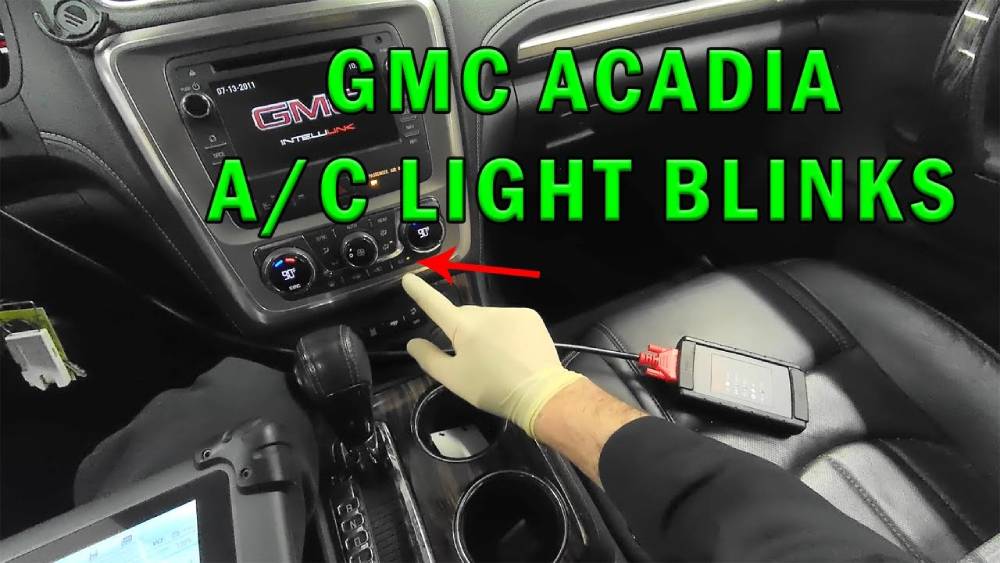
What Does a Blinking AC Light Mean on a GMC Acadia?
A blinking AC light on a GMC Acadia is more than just an indicator on the dashboard or climate control panel. It is the HVAC system’s way of alerting the driver that it has detected an abnormal operating condition. Depending on the model year, the air conditioning system continuously monitors components such as refrigerant pressure, compressor operation, temperature sensors, and electrical circuits. When one or more of these components fail to operate within the expected range, the control module may cause the AC button to flash and temporarily disable the air conditioning system.
In many cases, the blinking light appears because the compressor is prevented from engaging. This protective feature helps reduce the risk of internal compressor damage caused by insufficient refrigerant, excessive system pressure, or electrical faults. Instead of allowing the compressor to continue running under unsafe conditions, the HVAC module shuts it off until the problem is resolved.
It’s also important to distinguish between a solid AC indicator and a blinking one. A solid light simply means the air conditioning system is switched on and operating normally. A flashing light, however, usually indicates that the system has detected a fault and cannot function as intended.
Although a blinking AC light typically doesn’t affect the vehicle’s ability to drive, it should not be ignored. If left unresolved, a minor issue such as low refrigerant or a failing pressure sensor can develop into a more expensive repair involving the compressor or other HVAC components. Identifying the root cause early can help restore cooling performance while preventing unnecessary damage and repair costs.
8 Common Causes of a GMC Acadia AC Light Blinking
Several different problems can cause the AC light to blink on a GMC Acadia. Some issues are inexpensive to fix, while others require more extensive repairs. Understanding the most common causes can help narrow down the diagnosis before replacing any parts.
1. Low Refrigerant Level
Low refrigerant is one of the most common reasons for a blinking AC light. Refrigerant circulates through the air conditioning system, absorbing heat from the cabin and releasing it outside the vehicle. When the refrigerant level drops below the manufacturer’s specifications, the pressure inside the system decreases, triggering the pressure sensor to send a warning signal to the HVAC control module.
In response, the system may disable the compressor and flash the AC indicator to prevent compressor damage caused by insufficient lubrication. Drivers often notice that the air conditioner blows warm or only slightly cool air before the warning light begins blinking.
Low refrigerant is rarely caused by normal consumption. Instead, it usually indicates a small leak somewhere in the system, such as an O-ring, hose connection, condenser, evaporator, or compressor seal. Simply adding more refrigerant without locating and repairing the leak will often result in the same problem returning after a short period.
Common symptoms include:
• Warm air from the vents
• Compressor cycling on and off rapidly
• Reduced cooling performance
• Hissing sounds from leaking refrigerant
The solution typically involves identifying the leak, repairing the damaged component, evacuating the system, and recharging it with the correct amount of refrigerant.
2. Refrigerant Leak
A refrigerant leak is closely related to low refrigerant levels but deserves separate attention because it is the underlying cause in many AC system failures. Modern GMC Acadia models use a sealed air conditioning system, meaning refrigerant should not decrease under normal operating conditions. If the AC light begins blinking due to low pressure, a leak is often responsible.
Leaks can develop from aging rubber seals, damaged hoses, road debris striking the condenser, corrosion in aluminum components, or worn compressor shaft seals. Even a very small leak can gradually reduce refrigerant pressure enough to trigger the HVAC control module.
Drivers may initially notice that the air conditioner takes longer to cool the cabin before the cooling performance steadily declines. Eventually, the AC light may begin flashing as the system detects pressure outside its acceptable operating range.
Professional technicians typically diagnose refrigerant leaks using UV dye, electronic leak detectors, or nitrogen pressure testing. These methods help pinpoint the exact leak location before repairs are performed.
Ignoring a refrigerant leak can increase compressor wear because refrigerant also carries compressor oil throughout the system. Repairing the leak promptly helps protect expensive components while restoring proper cooling performance.
3. Faulty Refrigerant Pressure Sensor
The refrigerant pressure sensor plays a critical role in protecting the air conditioning system. It continuously measures refrigerant pressure and sends this information to the HVAC control module. If the sensor detects pressure that is too low or too high, the module may disable compressor operation and cause the AC light to blink.
However, the sensor itself can also fail. A faulty pressure sensor may send inaccurate readings even when refrigerant levels are perfectly normal. As a result, the control module interprets the incorrect data as a system fault and prevents the compressor from engaging.
Symptoms of a failing pressure sensor often include intermittent AC operation, random blinking of the AC button, inconsistent cooling, and diagnostic trouble codes stored in the vehicle’s control module. In some cases, the air conditioner may work normally after restarting the engine before the warning returns later.
A qualified technician can compare sensor readings with actual system pressure using manifold gauges and a scan tool. If the sensor readings are inaccurate, replacing the pressure sensor is usually a relatively straightforward and affordable repair compared to replacing larger HVAC components.
4. AC Compressor Failure
The air conditioning compressor is the heart of your GMC Acadia’s HVAC system. Its primary job is to compress and circulate refrigerant through the condenser, expansion valve, and evaporator, allowing the system to remove heat from the cabin. When the compressor begins to fail, the HVAC control module may detect abnormal operating conditions and trigger the blinking AC light as a protective measure.
Compressor failure can occur for several reasons. Internal wear caused by high mileage, contaminated refrigerant, insufficient compressor oil, or prolonged operation with low refrigerant can all shorten the compressor’s lifespan. In some cases, internal components seize completely, preventing the compressor from turning. In others, the compressor may still rotate but fail to generate adequate refrigerant pressure.
Drivers often notice additional warning signs before complete compressor failure occurs. The air conditioner may cool intermittently, produce unusual grinding or squealing noises, or stop cooling altogether. Metallic debris inside the refrigerant system is another indication of severe compressor damage and often requires replacing additional components such as the condenser, receiver drier, and expansion valve to prevent contamination of the new compressor.
A technician will typically inspect compressor operation using manifold gauges, pressure readings, and a scan tool while checking for unusual noises and clutch engagement. If internal damage is confirmed, replacing the compressor is usually the only reliable solution. Although this is one of the more expensive AC repairs, delaying replacement can increase repair costs if metal particles spread throughout the entire refrigeration system.
5. Compressor Clutch Not Engaging
In many GMC Acadia models equipped with a traditional belt driven compressor, the compressor clutch is responsible for connecting the spinning pulley to the compressor shaft whenever air conditioning is requested. If the clutch fails to engage, the compressor cannot circulate refrigerant, causing the HVAC system to stop producing cold air and potentially triggering the blinking AC indicator.
Several issues can prevent the clutch from engaging properly. A worn clutch coil may no longer generate enough magnetic force to pull the clutch plate into position. Excessive clutch gap caused by normal wear can also reduce engagement. Electrical problems such as a failed relay, blown fuse, damaged wiring, or poor ground connection are equally common and should always be inspected before replacing the compressor itself.
One of the easiest ways to diagnose this problem is to observe the compressor while someone switches the air conditioner on and off. Under normal conditions, the outer clutch plate should engage with a noticeable click, causing the compressor shaft to rotate with the pulley. If the pulley spins continuously while the clutch remains stationary, the clutch is likely not engaging.
Because clutch failure and compressor failure often produce similar symptoms, accurate diagnosis is essential. Replacing an entire compressor when only the clutch or relay has failed can result in unnecessary repair expenses. A qualified technician can verify clutch voltage, resistance, and system pressure before recommending replacement of any major components.
6. HVAC Control Module Malfunction
The HVAC control module serves as the brain of the climate control system. It processes information from temperature sensors, refrigerant pressure sensors, sunlight sensors, blower controls, and various actuators to regulate cabin comfort. If the module receives incorrect information or develops an internal fault, it may flash the AC light even when other components appear to be functioning normally.
Control module problems are less common than refrigerant or compressor issues, but they do occur, particularly in older GMC Acadia models or vehicles that have experienced battery voltage fluctuations, water intrusion, or electrical problems. Software glitches, corrupted calibration data, and communication failures with other vehicle modules can all prevent the air conditioning system from operating correctly.
Symptoms of a faulty HVAC control module may include an AC light that flashes randomly, temperature settings that change unexpectedly, inconsistent blower speeds, incorrect airflow direction, or an air conditioner that works intermittently without any obvious mechanical failure. In some situations, the system may temporarily return to normal after restarting the vehicle, only for the blinking light to reappear later.
Diagnosing a control module issue usually requires a professional scan tool capable of reading HVAC specific diagnostic trouble codes and live sensor data. Technicians may also perform software updates or module recalibration before recommending replacement. Since HVAC control modules are significantly more expensive than sensors or relays, confirming the diagnosis is critical to avoid replacing parts unnecessarily.
7. Blown Fuse or Electrical Problems
Modern GMC Acadia models rely on a network of electrical components to operate the air conditioning system. If any part of this circuit is interrupted, the HVAC control module may detect the fault and cause the AC light to blink. Although electrical problems are often overlooked, they are among the most common reasons an air conditioner suddenly stops working without any obvious mechanical failure.
A blown fuse is usually the simplest issue to diagnose. The AC compressor, HVAC control module, blower motor, cooling fans, and various sensors are all protected by dedicated fuses. If one of these fuses blows due to age, a power surge, or a short circuit, the system may disable the compressor to prevent additional damage. Before replacing a blown fuse, it is important to determine why it failed. Simply installing a new fuse without addressing the underlying cause may result in the replacement fuse blowing immediately.
Damaged wiring is another common culprit. Engine heat, vibration, road debris, and moisture can gradually wear down wiring insulation, leading to exposed conductors, loose connections, or intermittent electrical faults. Corroded connectors are especially common in regions with high humidity or where road salt is frequently used during winter. Even minor corrosion can increase electrical resistance enough to disrupt communication between sensors and the HVAC control module.
Faulty relays may also prevent the compressor from receiving power. The AC relay acts as an electronic switch that delivers battery voltage to the compressor clutch whenever cooling is requested. If the relay sticks, fails internally, or develops poor electrical contacts, the compressor may never engage despite the rest of the system functioning correctly.
When diagnosing electrical problems, technicians typically begin by inspecting fuses, relays, and visible wiring before using a digital multimeter to verify voltage, continuity, and ground integrity. Scan tools can also reveal communication faults between the HVAC control module and other onboard systems. Because electrical issues can mimic compressor or sensor failures, a systematic diagnosis is essential before replacing expensive components.
8. Blend Door Actuator Failure
Although the blend door actuator is not directly responsible for compressor operation, it can sometimes contribute to symptoms that make it appear as though the air conditioning system has failed. In certain GMC Acadia models, a malfunctioning actuator may also trigger HVAC diagnostic codes that cause the AC light to blink.
The blend door actuator is a small electric motor that controls the position of the blend door inside the HVAC housing. By adjusting this door, the system regulates how much air passes through the heater core versus the evaporator, allowing the driver to select the desired cabin temperature. If the actuator becomes stuck, loses calibration, or experiences an internal gear failure, the blend door may remain in the wrong position.
One of the most common symptoms is warm air blowing from the vents even though the compressor is operating normally. Drivers may also hear repetitive clicking or knocking noises from behind the dashboard immediately after starting the vehicle or changing the temperature settings. These sounds often indicate stripped plastic gears inside the actuator attempting to reposition the blend door.
Dual zone climate control systems may display additional symptoms. For example, the driver’s side may produce cold air while the passenger side remains warm, or vice versa. Airflow direction may also become inconsistent if multiple actuators are affected.
Diagnosis usually involves commanding the actuator through a professional scan tool while monitoring its movement and position feedback. Some actuators can also be visually inspected after removing dashboard trim panels. If the actuator fails to respond or produces abnormal noises, replacement is generally the most effective repair. After installation, many GMC Acadia models require an HVAC recalibration procedure to ensure the new actuator communicates correctly with the control module.
Symptoms That Often Accompany a Blinking AC Light
A blinking AC light rarely appears by itself. In most cases, drivers will notice one or more additional symptoms that can provide valuable clues about the underlying problem. Paying attention to these warning signs can significantly narrow the diagnosis and reduce unnecessary repairs.
| Symptom | Most Likely Cause |
|---|---|
| Warm air from the vents | Low refrigerant, compressor failure, refrigerant leak |
| AC compressor does not engage | Faulty pressure sensor, bad relay, compressor clutch failure |
| AC cools intermittently | Low refrigerant, electrical issue, failing compressor |
| AC cycles on and off rapidly | Low refrigerant, pressure sensor malfunction |
| Clicking noise behind the dashboard | Blend door actuator failure |
| Grinding or squealing noise | Worn compressor bearings or internal compressor damage |
| Burning smell when AC is turned on | Overheated compressor clutch or electrical short |
| Uneven cabin temperature | Blend door actuator or HVAC control module malfunction |
| Flashing AC light after battery replacement | HVAC module calibration required |
| AC works after restarting the engine | Intermittent sensor or control module fault |
It is important to remember that the same symptom can be caused by multiple components. For example, warm air may result from low refrigerant, a failed compressor, or a faulty blend door actuator. Likewise, a compressor that refuses to engage may be caused by a blown fuse, a defective relay, low system pressure, or an electrical communication problem.
For this reason, replacing parts based solely on symptoms can become expensive very quickly. A systematic diagnosis that includes pressure testing, electrical inspection, and HVAC fault code scanning is the most reliable way to identify the actual cause of a blinking AC light on a GMC Acadia.
How to Diagnose the Problem Yourself
Before scheduling an appointment with a repair shop, there are several basic inspections you can perform to narrow down the cause of a blinking AC light. While these checks won’t replace professional diagnostic equipment, they can help determine whether the issue is something simple or a problem that requires expert attention.
Step 1: Check Whether the Compressor Engages
Start the engine and allow it to idle. Turn the air conditioning to its coldest setting and set the blower fan to high speed. Open the hood and locate the AC compressor.
Watch the front of the compressor while someone presses the AC button. Under normal conditions, the compressor clutch should engage with an audible click, and the center portion of the pulley should begin rotating.
If the pulley spins but the center hub remains stationary, the compressor clutch is not engaging. This may indicate a faulty clutch, a blown fuse, a defective relay, low refrigerant pressure, or an electrical problem.
If the compressor engages normally but the air remains warm, the problem may involve low refrigerant, restricted refrigerant flow, or a malfunctioning blend door actuator.
Step 2: Inspect Cooling Performance
Observe how the air conditioner behaves during operation.
Ask yourself the following questions:
• Is the air completely warm?
• Does the air become cold for only a few seconds?
• Does the cooling improve while driving but disappear at idle?
• Does one side of the cabin remain warmer than the other?
These symptoms often provide valuable clues.
Warm air from every vent usually indicates low refrigerant or compressor failure.
Uneven temperatures between the driver and passenger sides often point to a blend door actuator problem.
Cooling that disappears while idling may suggest condenser fan issues or inadequate refrigerant pressure.
Step 3: Inspect the Fuses and Relay
Locate the HVAC and AC compressor fuses using the owner’s manual or the fuse box diagram.
Remove each related fuse and inspect the metal element inside. A broken or burned element indicates a blown fuse.
Also inspect the AC compressor relay. If another identical relay exists in the fuse box, such as the horn relay, you may temporarily swap them for testing purposes.
If the AC begins working after the relay swap, replacing the faulty relay is usually an inexpensive repair.
Never install a higher-amperage fuse than specified by the manufacturer, as doing so may damage the electrical system.
Step 4: Look for Signs of Refrigerant Leaks
Although refrigerant itself is colorless, many repair shops add ultraviolet dye during previous services.
Inspect common leak locations, including:
• AC hose connections
• Compressor fittings
• Condenser
• Service ports
• Aluminum refrigerant lines
Oily residue around these components often indicates refrigerant escaping along with compressor oil.
If a UV flashlight is available, fluorescent dye may reveal even very small leaks.
Never assume refrigerant simply “runs low” with age. In a properly sealed air conditioning system, refrigerant should remain at the correct level for many years.
Step 5: Listen for Unusual Noises
Abnormal sounds frequently reveal failing components.
Grinding noises from the compressor may indicate worn internal bearings.
Repeated clicking behind the dashboard often suggests a defective blend door actuator.
A squealing belt may point to excessive compressor resistance.
Hissing sounds near refrigerant lines can indicate an active refrigerant leak.
Documenting when these noises occur can help a technician identify the source more quickly.
Step 6: Scan for Diagnostic Trouble Codes
Many HVAC faults do not illuminate the check engine light.
Instead, they are stored inside the HVAC control module.
Using an advanced OBD-II scan tool capable of reading body and HVAC modules allows you to retrieve these fault codes.
Common HVAC-related codes may identify:
• Pressure sensor failures
• Blend door actuator faults
• Communication errors
• Temperature sensor failures
• Control module malfunctions
Reading these codes before replacing parts can save both time and money.
Step 7: Decide Whether Professional Diagnosis Is Necessary
If the compressor fails to engage, refrigerant pressure appears low, electrical faults are present, or diagnostic trouble codes indicate multiple system failures, professional diagnosis is recommended.
Certified technicians have access to manifold gauge sets, refrigerant recovery equipment, leak detectors, scan tools, and factory service information that allow them to diagnose the system accurately without unnecessary parts replacement.
Attempting to replace expensive components based solely on symptoms may solve nothing while significantly increasing repair costs.
How to Reset a Blinking GMC Acadia AC Light
Once the underlying issue has been repaired, the blinking AC light often disappears automatically. However, in some situations the HVAC control module may continue displaying the warning until the system is reset or recalibrated.
It is important to understand that resetting the AC light does not repair the actual problem. If low refrigerant, a failed sensor, or compressor damage still exists, the warning will usually return shortly after the reset.
Method 1: Restart the Vehicle
Some temporary software glitches disappear after shutting off the engine for several minutes.
Turn the ignition off.
Remove the key or turn off the push-button ignition.
Wait approximately five minutes.
Restart the vehicle and activate the air conditioning.
If the blinking light was caused by a temporary communication error, normal operation may resume.
Method 2: Disconnect the Battery
Disconnecting battery power resets several electronic control modules.
Turn off the ignition.
Disconnect the negative battery cable.
Wait at least fifteen minutes.
Reconnect the battery.
Start the engine.
Allow the HVAC system several minutes to complete its initialization.
Keep in mind that disconnecting the battery may erase radio presets, clock settings, and adaptive memory on certain vehicle systems.
Method 3: Check and Replace Blown Fuses
If a blown fuse caused the AC system to shut down, replacing the failed fuse after repairing the underlying electrical problem may restore normal operation immediately.
Always replace the fuse with one that matches the factory specified amperage.
If the replacement fuse blows again, discontinue testing and inspect the circuit for a short or damaged wiring.
Method 4: Perform HVAC Recalibration
Certain GMC Acadia model years require recalibration whenever battery power has been disconnected or HVAC components have been replaced.
The recalibration process allows the HVAC control module to relearn the positions of the blend doors and mode doors.
Depending on the model year, recalibration may occur automatically after starting the engine or require a professional scan tool.
If calibration fails, the AC light may continue blinking until the faulty actuator or control module is repaired.
Method 5: Clear Diagnostic Trouble Codes
If the problem has already been repaired but the warning remains, an advanced scan tool can erase stored HVAC diagnostic trouble codes.
After clearing the codes, operate the air conditioner through several complete cooling cycles to verify that the blinking light does not return.
If the warning reappears immediately, the original fault has not been fully corrected.
Estimated Repair Costs
The cost of repairing a blinking AC light varies depending on the failed component, labor rates, and the model year of your GMC Acadia. The following estimates represent common repair ranges in the United States and may differ by location and repair facility.
| Repair | Estimated Cost (Parts and Labor) |
|---|---|
| Refrigerant recharge | $150 to $350 |
| Refrigerant leak diagnosis | $100 to $250 |
| Refrigerant leak repair | $250 to $1,000+ |
| Pressure sensor replacement | $180 to $400 |
| AC relay replacement | $50 to $150 |
| Fuse replacement | $20 to $60 |
| Compressor clutch replacement | $350 to $700 |
| AC compressor replacement | $900 to $1,800 |
| Blend door actuator replacement | $250 to $700 |
| HVAC control module replacement | $500 to $1,200 |
| Electrical wiring repair | $150 to $800 |
These estimates should be viewed as general guidelines rather than fixed prices. Labor costs, parts availability, and the severity of the underlying issue can all affect the final repair bill. Investing in an accurate diagnosis before authorizing repairs is often the most cost effective approach, as it helps avoid replacing components that are still functioning properly.
Can You Drive With a Blinking AC Light?
In most situations, you can continue driving your GMC Acadia with a blinking AC light because the problem is usually limited to the air conditioning system rather than the engine or transmission. A flashing AC indicator does not normally affect the vehicle’s ability to accelerate, brake, or steer safely. However, that does not mean the warning should be ignored.
The most immediate consequence is reduced or completely lost cooling performance. During hot summer weather, this can make driving uncomfortable and increase driver fatigue, especially on long trips or when transporting children and pets. In humid conditions, a malfunctioning air conditioner can also reduce the effectiveness of the windshield defroster, making it more difficult to remove interior fog and affecting visibility.
Whether it is safe to continue driving largely depends on the underlying cause of the blinking light.
If the problem is related to low refrigerant, the HVAC control module will often disable the compressor automatically to prevent damage. While you may still be able to drive normally, operating the system repeatedly without correcting the refrigerant leak can eventually shorten the life of the compressor.
If the compressor is making grinding, squealing, or knocking noises, it is advisable to stop using the air conditioning immediately. Continuing to operate a damaged compressor may spread metal debris throughout the refrigerant system, significantly increasing repair costs.
Electrical issues should also be taken seriously. A blown fuse may simply indicate an isolated failure, but repeated fuse failures can point to a wiring short that requires professional inspection. Likewise, the smell of burning insulation or visible smoke should never be ignored. If either occurs, turn off the air conditioning and have the vehicle inspected as soon as possible.
The following table summarizes whether it is generally safe to continue driving under different conditions.
| Condition | Safe to Drive? | Recommended Action |
|---|---|---|
| AC light blinking but vehicle drives normally | Yes | Diagnose the AC system as soon as possible |
| Warm air only | Yes | Check refrigerant level and inspect for leaks |
| Compressor does not engage | Yes | Inspect fuses, relay, and pressure sensor |
| Loud grinding or squealing from compressor | No | Stop using the AC and schedule repairs immediately |
| Burning smell from engine compartment | No | Turn off the AC and inspect the electrical system |
| Repeated fuse failures | Use caution | Diagnose wiring before further operation |
| Refrigerant leak confirmed | Yes, temporarily | Repair the leak before continued AC use |
Although many drivers postpone AC repairs because the vehicle still runs normally, delaying diagnosis often results in higher repair costs. A relatively inexpensive sensor or refrigerant leak can eventually lead to compressor failure if left unresolved.
When Should You See a Mechanic?
While basic inspections can identify obvious issues such as blown fuses or visible refrigerant leaks, some air conditioning problems require specialized equipment and professional expertise. If the blinking AC light persists after completing the basic troubleshooting steps, scheduling a diagnostic inspection is the most reliable way to prevent further damage.
One of the clearest signs that professional service is needed is when the air conditioner no longer produces cold air even though all visible components appear normal. This often indicates problems with refrigerant pressure, compressor performance, or internal HVAC controls that cannot be confirmed without manifold gauges and advanced diagnostic tools.
You should also consult a qualified technician if the AC light continues flashing immediately after resetting the system. A recurring warning usually means the HVAC control module is detecting an active fault rather than a temporary software glitch.
Professional diagnosis is strongly recommended under the following conditions:
- The compressor never engages.
- The AC blows warm air continuously.
- Refrigerant leaks are visible or confirmed.
- The compressor produces grinding, knocking, or squealing noises.
- Diagnostic trouble codes remain after clearing.
- Multiple HVAC functions stop working at the same time.
- The AC light begins flashing repeatedly after battery replacement or electrical repairs.
- Burning smells or repeated blown fuses occur.
Technicians use equipment that is unavailable to most vehicle owners, including refrigerant recovery machines, electronic leak detectors, factory scan tools, pressure gauges, and service information specific to GMC vehicles. These tools allow them to pinpoint the exact cause of the problem instead of replacing parts through trial and error.
Although professional diagnosis involves an initial inspection fee, it often reduces the overall repair cost by ensuring that only defective components are replaced.
Frequently Asked Questions
Why is my GMC Acadia AC light blinking?
The AC light usually blinks because the HVAC control module has detected a fault within the air conditioning system. Common causes include low refrigerant, refrigerant leaks, a faulty pressure sensor, compressor failure, electrical problems, or a malfunctioning HVAC control module.
Can low refrigerant cause the AC light to flash?
Yes. Low refrigerant is one of the most common reasons for a blinking AC light. When refrigerant pressure falls below the specified range, the pressure sensor signals the HVAC control module to disable compressor operation in order to protect the system from damage.
Will adding refrigerant stop the blinking AC light?
Only if low refrigerant is the actual cause of the problem. If the refrigerant level dropped because of a leak, simply recharging the system without repairing the leak will usually provide only temporary relief before the warning returns.
Can I reset the blinking AC light myself?
In some cases, yes. Restarting the vehicle, disconnecting the battery, replacing a blown fuse, or performing an HVAC recalibration may clear temporary faults. However, if the underlying mechanical or electrical problem has not been repaired, the blinking light will likely return.
Is a blinking AC light dangerous?
The warning itself is not usually dangerous because it primarily affects the air conditioning system rather than vehicle safety. However, ignoring the warning can allow minor problems to develop into more expensive repairs, particularly if the compressor continues operating under abnormal conditions.
How much does it cost to repair a blinking AC light?
Repair costs vary depending on the underlying fault. Minor repairs such as replacing a fuse or relay may cost less than $100, while compressor replacement can exceed $1,500 including labor. An accurate diagnosis is the best way to avoid unnecessary expenses.
Final Thoughts
A blinking AC light on your GMC Acadia should never be dismissed as a harmless inconvenience. Although the vehicle may continue to drive normally, the warning indicates that the HVAC system has detected a condition preventing it from operating correctly. In many cases, the issue is caused by something relatively straightforward, such as low refrigerant, a faulty pressure sensor, a blown fuse, or a failing compressor clutch. However, more serious problems involving the compressor, electrical system, or HVAC control module are also possible.
The key to minimizing repair costs is identifying the root cause as early as possible. Begin with simple inspections by checking cooling performance, listening for unusual noises, inspecting fuses and relays, and looking for visible signs of refrigerant leaks. If these basic checks do not reveal the problem, a professional diagnosis using specialized HVAC equipment is the safest and most accurate next step.
Prompt attention to a blinking AC light can help prevent additional damage, restore reliable cooling performance, and extend the lifespan of your GMC Acadia’s air conditioning system. By understanding the most common causes and following a systematic troubleshooting process, you can make informed repair decisions and avoid replacing expensive components unnecessarily.