You press the ECT Power button on your Toyota Tacoma and immediately notice a difference. The truck feels more responsive. Acceleration becomes sharper. The transmission holds gears longer, making merges, hill climbs, and passing slower vehicles feel easier and more confident. To many drivers, it almost feels like the truck suddenly gained extra power.
Then a common question appears:
Does ECT Power reduce fuel economy on Toyota Tacoma?
This is one of the most misunderstood features among Tacoma owners. Some drivers believe ECT Power acts like a performance upgrade that boosts horsepower. Others leave it turned on all the time because they enjoy the more aggressive driving feel. After a while, many start wondering whether their gas mileage has changed.
If you are trying to balance performance with fuel efficiency, understanding how this feature actually works matters. Fuel costs add up quickly, and no driver wants to sacrifice unnecessary MPG for a setting they may not fully understand.
In this guide, we will break down the relationship between ECT Power and Fuel Economy on Toyota Tacoma, explain what the mode really does, and help you determine when using it makes sense and when it may be costing you extra fuel.
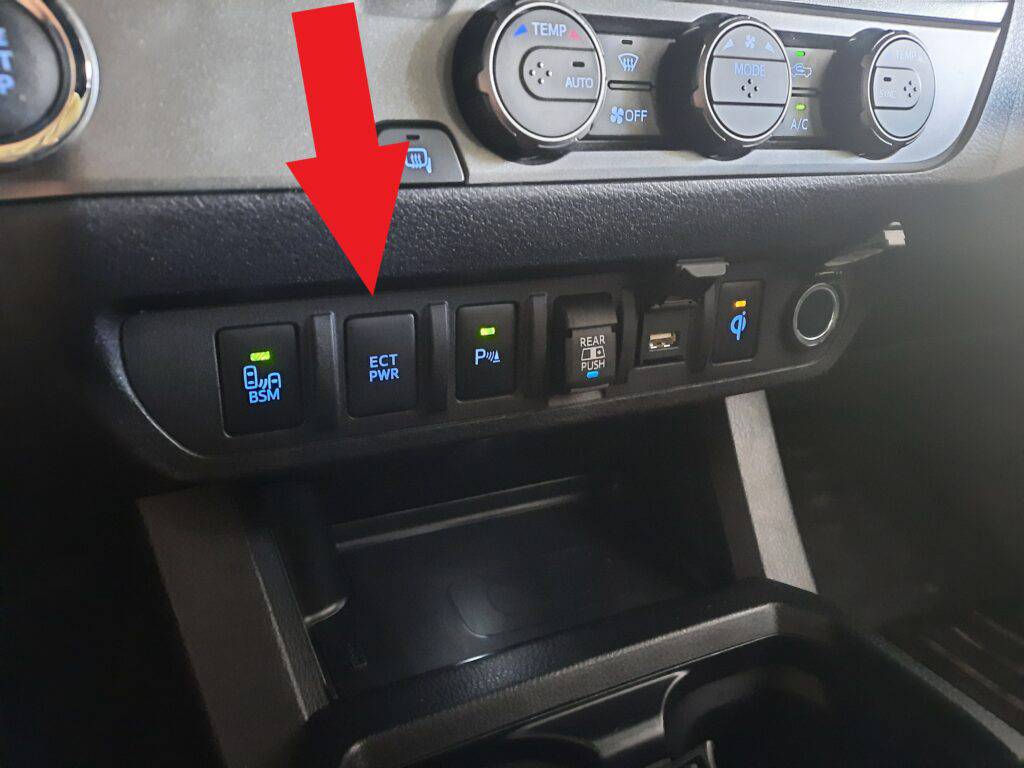
What Does ECT Power Actually Do on Toyota Tacoma?
Before discussing fuel economy, it is important to understand what ECT Power really does. ECT stands for Electronically Controlled Transmission, and despite what many Tacoma owners initially assume, pressing the ECT Power button does not increase engine horsepower or add extra torque.
Instead, the system changes how the transmission and throttle respond to driver input.
When ECT Power is activated, the Tacoma adjusts shift behavior in several ways:
- Holds gears longer before shifting
- Delays upshifts during acceleration
- Improves throttle response
- Keeps engine RPM higher
- Makes acceleration feel quicker
This is exactly why many drivers think the truck suddenly becomes more powerful. The engine is operating at a more aggressive RPM range, making power available sooner. The result is a more responsive driving experience.
The confusion often comes from perception. Feeling faster and actually producing more power are two different things. Toyota designed ECT Power primarily to improve responsiveness in demanding situations rather than create additional engine output.
For drivers towing trailers, climbing steep hills, carrying heavy loads, or needing stronger acceleration, this can be very useful. However, changes in transmission behavior also create questions about fuel consumption.
Does ECT Power Reduce Fuel Economy?
The short answer is: it can, depending on how and where you drive.
Because ECT Power keeps the engine operating at higher RPM levels and delays shifting into higher gears, the engine may consume more fuel than it would in standard driving mode.
Higher RPM generally means:
- Increased fuel usage
- More aggressive throttle response
- Longer periods before transmission upshifts
- More engine activity during acceleration
In stop and go city traffic, these changes can become noticeable. Every acceleration cycle may keep the engine working harder than necessary. Over time, small increases in fuel use can add up.
On the highway, however, the difference can be much smaller. Once cruising speed is reached, the transmission behavior stabilizes, and some drivers report almost no measurable MPG change.
This explains why opinions among Tacoma owners vary widely. Driving habits often influence fuel economy more than the ECT setting itself.
Real World Tacoma Owner Experiences
Manufacturer specifications only tell part of the story. Real world owner experiences often provide a clearer picture.
Among Tacoma drivers, reports on ECT Power fuel economy tend to fall into several patterns:
Some owners report:
- Fuel economy dropping by approximately 1 to 3 MPG
- Increased fuel usage during city driving
- More noticeable differences with aggressive acceleration
Others report:
- Little or no MPG change
- Better overall driving confidence
- Improved responsiveness worth the small tradeoff
The variation makes sense because no two drivers use their Tacoma in the same way.
Someone commuting through heavy urban traffic every day may notice fuel economy changes much faster than a driver spending most of the time on open highways.
Many Tacoma owners ultimately conclude that ECT Power does not dramatically hurt fuel economy by itself. Instead, it encourages a driving style that often uses more fuel.
You can think of it this way:
ECT Power opens the door to more aggressive vehicle behavior. Your right foot often determines the final result.
Best Situations to Use ECT Power
One of the biggest mistakes Toyota Tacoma owners make is assuming ECT Power should stay on all the time. While the feature improves responsiveness, it was designed for specific driving situations where quicker transmission behavior provides a real advantage.
Here are scenarios where ECT Power makes the most sense:
Towing Heavy Loads
Towing places additional stress on the engine and transmission. Standard shift programming may upshift too early, causing the truck to hunt between gears or feel sluggish.
ECT Power helps by:
- Holding lower gears longer
- Keeping RPM in a stronger power range
- Improving throttle response
- Reducing unnecessary gear changes
For drivers pulling boats, campers, or utility trailers, this can make the Tacoma feel more stable and predictable.
Climbing Steep Hills
Anyone who drives through mountainous areas understands the frustration of losing momentum during climbs. When a transmission shifts too early, the engine may struggle to maintain speed.
ECT Power allows the truck to maintain stronger acceleration by delaying shifts and keeping usable power available.
Passing and Merging
Quick acceleration matters when entering highways or passing slower vehicles. Delayed throttle response can create hesitation during these situations.
With ECT Power enabled, the Tacoma reacts more immediately, helping drivers feel more confident.
Carrying Heavy Cargo
A loaded truck behaves differently than an empty one. Extra passenger weight, tools, equipment, or cargo can make acceleration feel slower.
ECT Power compensates by adjusting transmission behavior to match the additional load.
The common factor in all these situations is increased demand. Under normal commuting conditions, many drivers may never fully benefit from ECT Power.
Should You Leave ECT Power On All the Time?
This question appears repeatedly in Tacoma forums and owner discussions:
Should ECT Power stay on permanently?
The answer depends largely on your driving habits.
Keeping ECT Power on full time offers some advantages:
Pros:
- Faster throttle response
- More engaging driving feel
- Improved acceleration confidence
- Better performance under load
However, there are also tradeoffs:
Cons:
- Potential reduction in fuel economy
- Higher RPM operation
- More aggressive shifting behavior
- Often unnecessary during routine driving
For city commuters who spend most of the day in traffic, leaving ECT Power enabled continuously may not provide meaningful benefits. Instead, it can encourage more aggressive acceleration patterns that slowly reduce MPG.
Drivers focused on maximizing Tacoma fuel economy usually prefer normal mode for daily use and switch to ECT Power only when conditions demand extra responsiveness.
Think of ECT Power as a tool rather than a permanent upgrade. Using it strategically often delivers better results than simply leaving it activated all day.
Common Misconceptions About ECT Power and MPG
Several myths continue to circulate among Tacoma owners, creating confusion around ECT Power and fuel economy.
Myth 1: ECT Power Adds Horsepower
Reality:
ECT Power does not increase engine output. It only changes transmission and throttle behavior.
The truck feels faster because power becomes more accessible, not because the engine suddenly produces more power.
Myth 2: ECT Power Always Hurts Fuel Economy
Reality:
Fuel economy changes depend heavily on driving conditions and driver behavior.
Some owners see a reduction in MPG while others notice almost no measurable difference.
Myth 3: ECT Power Is Basically Sport Mode
Reality:
While similarities exist, ECT Power primarily adjusts transmission logic. It is not a complete performance mode that changes suspension, steering, engine tuning, or vehicle dynamics.
Understanding these differences helps owners use the feature correctly and avoid unrealistic expectations.
Conclusion
So, does ECT Power reduce fuel economy on Toyota Tacoma?
The answer is not as simple as yes or no.
ECT Power does not magically make your truck burn excessive fuel, nor does it create extra horsepower. What it actually does is change transmission behavior and throttle response, allowing the Tacoma to hold gears longer and stay in higher RPM ranges. This creates a more responsive and confident driving experience, especially when towing, climbing hills, carrying heavy loads, or accelerating quickly.
However, higher RPM operation can naturally lead to increased fuel consumption in certain situations. Drivers who spend most of their time in stop and go traffic or who frequently accelerate aggressively may notice lower MPG over time. Meanwhile, highway drivers may experience little to no difference in fuel economy.
The key takeaway is simple:
ECT Power itself is not necessarily the reason for lower gas mileage. In many cases, the driving style it encourages plays a much larger role.
For everyday commuting and maximum fuel efficiency, normal mode is often enough. When extra responsiveness matters, ECT Power becomes a valuable tool rather than a feature that needs to stay on permanently.
Are you using ECT Power every day on your Tacoma? Share your real world MPG results and driving experience. Many Tacoma owners discover that their personal driving habits reveal more than any factory specification ever could.