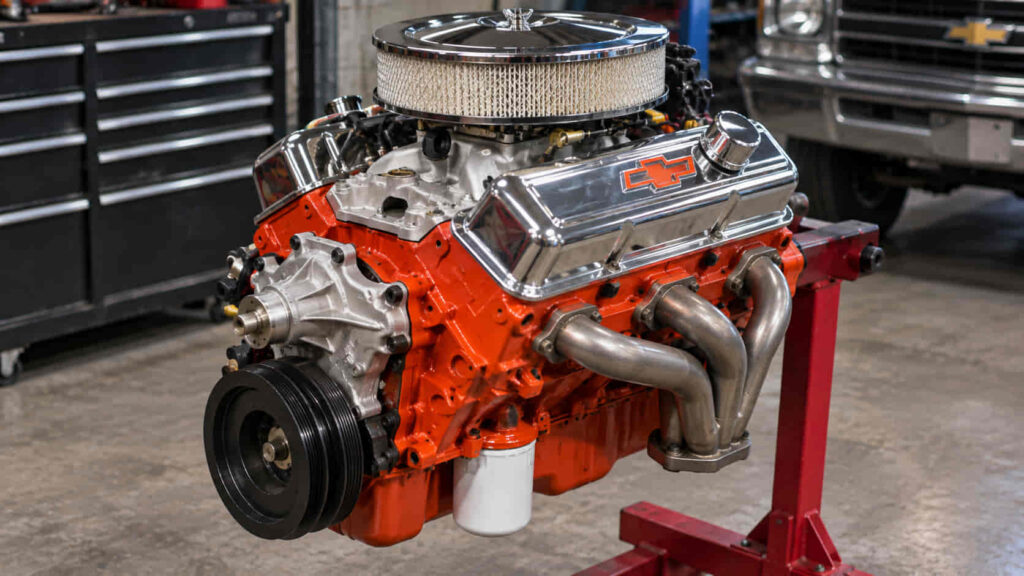
The Chevy 350 engine typically weighs around 550–575 pounds (249–261 kg) in a traditional cast-iron configuration with major engine components installed. However, the exact weight depends on whether the engine is a bare block, short block, long block, or complete assembly. A Chevy 350 with aluminum cylinder heads, a lightweight intake manifold, or fewer external accessories can weigh less than an otherwise comparable all-cast-iron engine.
The Chevrolet 350 is a 5.7-liter small-block V8, but its displacement alone does not determine its weight. The cylinder block, cylinder heads, crankshaft, intake manifold, exhaust manifolds, and attached accessories all contribute to the total. For example, a long block generally includes the assembled cylinder heads and valvetrain, while a complete engine may also include components such as the water pump, starter, alternator, and flywheel. Because suppliers use different definitions of a complete assembly, published weight figures are not always directly comparable.
Understanding these differences matters when planning an engine swap, selecting an engine hoist or stand, or arranging freight transportation. This guide explains Chevy 350 engine weight by assembly type, identifies the components that affect it, compares the engine with other Chevrolet V8s, and shows how to determine the actual weight of a specific engine before lifting or shipping it.
How Much Does a Chevy 350 Engine Weigh?
A traditional Chevy 350 small-block V8 weighs approximately 550–575 pounds (249–261 kg) in a relatively complete cast-iron configuration, although the actual weight depends on the components included in the assembly. This range is a general reference rather than a universal factory specification. A Chevrolet 350 equipped with cast-iron cylinder heads and a cast-iron intake manifold will generally be heavier than a comparable engine fitted with aluminum components. The weight also changes when external accessories, exhaust manifolds, or a flywheel are included or removed.
The Chevrolet 350 has a displacement of 350 cubic inches, equivalent to approximately 5.7 liters, and belongs to General Motors’ traditional small-block V8 engine family. Its basic architecture includes a cylinder block, two cylinder heads, a crankshaft, eight pistons, connecting rods, and a valvetrain. These components account for much of the engine’s mass, particularly when the block and heads are made from cast iron. However, displacement does not establish a fixed engine weight because different versions of the 350 use different component materials, accessory arrangements, and assembly specifications.
For example, a rebuilt Chevy 350 long block sold without an intake manifold, exhaust manifolds, starter, or alternator will weigh less than a complete engine equipped with those components. A performance-oriented 350 with aluminum cylinder heads and an aluminum intake manifold may also be lighter than a similarly equipped factory-style cast-iron engine. Therefore, the most useful weight figure is one that identifies the engine’s exact assembly configuration. When planning an engine swap or selecting lifting equipment, the weight of the specific engine being handled is more important than a general figure associated with the Chevy 350 name.
Why Does Chevy 350 Engine Weight Vary Between Configurations?
Chevy 350 engine weight varies because different configurations contain different components, use different materials, and are measured under different conditions. The term Chevy 350 engine can describe anything from a bare cylinder block to a fully assembled V8 with external accessories. These assemblies share the same basic engine family but do not contain the same amount of material. Consequently, two published weight figures can both be reasonable while describing substantially different engine assemblies.
The largest configuration differences arise from the components installed around the cylinder block. A short block generally includes the assembled rotating components but excludes the cylinder heads, while a long block adds the heads and associated valvetrain components. A more complete assembly may include an intake manifold, water pump, exhaust manifolds, ignition components, and other accessories. Each additional component contributes weight, and the amount depends on its construction. For example, replacing a cast-iron intake manifold with an aluminum version changes the engine’s total mass without changing its 350-cubic-inch displacement.
Measurement conditions create another source of variation. Dry engine weight generally excludes operating fluids, while an engine measured with oil or other retained fluids will be heavier. Published shipping weight may include a pallet, wooden crate, protective packaging, and additional parts that are not part of the engine itself. Manufacturers and engine suppliers may also define their assemblies differently, making direct comparisons unreliable unless the included components are identified.
For this reason, Chevy 350 weight specifications should always be interpreted alongside the assembly description and measurement method. A long-block specification should not be treated as the weight of a complete, accessory-equipped engine, and a freight weight should not be used as the engine’s installed weight. Matching the measurement to the actual configuration provides a more accurate basis for mechanical planning, lifting, and transportation.
Read more: where is lojack located on a car
How Much Does a Chevy 350 Bare Engine Block Weigh?
A traditional cast-iron Chevy 350 bare engine block generally weighs approximately 150–200 pounds (68–91 kg), depending on the casting design and the components included. This is an estimated range rather than a universal Chevrolet specification. A bare block is the main structural casting of the engine without the crankshaft, pistons, connecting rods, cylinder heads, or external accessories. Its weight represents only a portion of the complete Chevy 350 engine weight, making it important to distinguish the cylinder block from an assembled engine.
The cylinder block forms the foundation of the Chevrolet 350 small-block V8. It contains the eight cylinder bores, crankshaft bearing supports, coolant passages, and oil passages required for engine operation. Traditional production blocks use cast iron because it provides the strength and rigidity needed to support combustion pressure and rotating components. However, differences in casting thickness, reinforcement, and block design affect the amount of metal used. A heavy-duty aftermarket casting may therefore weigh more than a standard production block, even when both are designed for a 350-cubic-inch engine.
The definition of a bare block also affects published specifications. A supplier may include the main bearing caps, core plugs, or installed bearings in its listed weight, while another may describe a more extensively stripped casting. These differences are smaller than the weight added by a complete rotating assembly, but they still matter when comparing individual products. For example, a machine shop handling an empty Chevy 350 block needs the weight of the actual casting and attached hardware, not the weight of a rebuilt short block.
For accurate planning, the bare block weight should be verified using the casting identification and the supplier’s component specifications. This is particularly relevant when transporting a block for machining or comparing a factory cast-iron casting with an aftermarket aluminum replacement.
How Much Does a Chevy 350 Short Block Weigh?
A Chevy 350 short block typically weighs approximately 300–350 pounds (136–159 kg) in a conventional cast-iron configuration, although the actual weight depends on the rotating assembly and included components. A short block is heavier than a bare engine block because it contains the principal internal components required to convert combustion pressure into crankshaft rotation. It does not normally include the cylinder heads or the complete upper engine assembly, which are added when building a long block.
A conventional Chevy 350 short block includes the cylinder block, crankshaft, connecting rods, pistons, and associated bearings. Depending on the builder’s definition, it may also include the camshaft, timing components, oil pump, and oil pan. These components contribute substantial weight beyond the cast-iron block itself. The crankshaft is particularly significant because it must withstand repeated combustion loads while transmitting torque to the drivetrain. Pistons and connecting rods add further mass, while the camshaft and timing assembly contribute smaller amounts.
Short block weight also changes with the components selected during an engine rebuild. A factory-style assembly with a cast-iron block and conventional steel or cast crankshaft will have a different total weight from a performance assembly using lightweight pistons, specialized connecting rods, or an aftermarket block. For example, two Chevy 350 short blocks can share the same displacement while using different rotating assemblies and oiling components. Their published weights should not be treated as interchangeable without checking the assembly specifications.
When purchasing a replacement Chevy 350 short block, the supplier’s stated weight should be matched to the exact assembly being delivered. This is especially important when comparing short blocks with long blocks or complete engines. Cylinder heads, intake components, and external accessories can add significant mass during the remaining stages of assembly, so short block weight alone does not represent the final weight of the engine installed in a vehicle.
How Much Does a Chevy 350 Long Block Weigh?
A traditional cast-iron Chevy 350 long block is commonly estimated to weigh approximately 400–500 pounds (181–227 kg), depending on the cylinder heads, internal components, and the supplier’s assembly specifications. This range is a planning estimate rather than a verified weight for every Chevrolet 350 long block. A long block includes the main engine assembly with the cylinder heads and valvetrain installed, making it heavier than a comparable short block. However, it generally excludes several external components required to complete the engine installation.
The main difference between a Chevy 350 short block and long block is the addition of the upper engine assembly. A conventional long block includes the cylinder heads, valves, valve springs, rocker arms, and associated valvetrain components. Depending on the product, it may also include valve covers, the timing cover, and an oil pan. Traditional cast-iron cylinder heads add substantial mass because they contain the intake and exhaust ports, combustion chambers, and structural material needed to withstand combustion temperatures and pressures. Their installation increases the engine’s weight without changing its 350-cubic-inch displacement.
Long block weight also depends on the materials used during assembly. A rebuilt Chevy 350 equipped with factory-style cast-iron cylinder heads will generally weigh more than a comparable long block fitted with aluminum heads. Differences in head design, valvetrain hardware, and other installed components can further affect the total. For example, a performance long block with aluminum cylinder heads may be lighter than a stock-style assembly even though both use a cast-iron cylinder block. The actual difference must be determined from the specifications of the components installed.
A long block’s published weight should not be treated as the weight of a complete Chevy 350 engine. Intake manifolds, exhaust manifolds, ignition components, water pumps, starters, and other accessories may be excluded from the quoted assembly weight. Engine builders and replacement-engine suppliers also use different definitions of what their long block packages include. When comparing products or preparing to lift an engine, checking the exact assembly description provides a more reliable weight estimate than relying on the term long block alone.
How Much Does a Complete Chevy 350 Engine Weigh?
A relatively complete Chevy 350 engine with a traditional cast-iron block and cylinder heads commonly weighs around 550–575 pounds (249–261 kg), although the total can fall outside this range depending on the installed accessories and component materials. This estimate is most useful for understanding the approximate mass of a conventional small-block Chevrolet V8 with major external components attached. It is not a fixed specification for every factory engine, crate engine, or aftermarket assembly.
A complete Chevy 350 engine contains the major components of a long block along with additional equipment needed for operation or vehicle installation. Depending on how the assembly is defined, these components may include the intake manifold, carburetor or fuel-injection hardware, distributor, water pump, exhaust manifolds, starter, and alternator. A flywheel or flexplate may also be included in the measured weight. Each component contributes to the total mass, and the combined effect becomes important when comparing a complete engine with a stripped long block.
The materials used for these external components can change the finished engine’s weight substantially. For example, a Chevy 350 equipped with cast-iron cylinder heads, a cast-iron intake manifold, and cast-iron exhaust manifolds will generally be heavier than a comparable engine using aluminum heads, an aluminum intake manifold, and lighter exhaust components. The weight of accessory brackets, pulleys, and other attached equipment also varies between vehicle applications. As a result, two complete Chevy 350 engines with similar displacement and internal architecture may have different total weights.
The definition of a complete engine also differs between original equipment, crate-engine suppliers, and individual engine builders. One supplier may describe an assembled long block with an intake manifold as a complete engine, while another may include additional accessories or a ready-to-run ignition and fuel system. Operating fluids introduce another distinction: an engine weighed dry will not have the same mass as an otherwise identical assembly containing oil or retained coolant. These differences explain why published complete-engine weights should be interpreted alongside the list of included components.
For engine swaps, lifting operations, and shipping estimates, the relevant figure is the weight of the actual Chevy 350 assembly being handled. A conventional 550–575-pound estimate provides a useful starting point, but it should not replace a verified assembly weight when equipment capacity or freight calculations depend on an accurate measurement. Checking the engine’s component configuration and the supplier’s specifications helps establish whether the published weight represents the complete assembly or only part of it.
How Do Cast-Iron and Aluminum Components Affect Chevy 350 Weight?
Cast-iron components generally make a Chevy 350 engine heavier than equivalent aluminum components because cast iron has a higher density than aluminum. The difference is particularly important in the cylinder heads, intake manifold, and cylinder block, which contain substantial amounts of material. Traditional Chevrolet 350 engines commonly use a cast-iron block and cast-iron cylinder heads, while performance builds may replace selected components with aluminum alternatives. These changes reduce the engine’s total mass without changing its basic 350-cubic-inch displacement.
Cylinder heads are among the most significant components affecting the weight of a Chevy 350 long block. A conventional small-block Chevrolet V8 uses two cylinder heads, so replacing a pair of cast-iron heads with aluminum versions can produce a meaningful reduction in total engine weight. However, the exact difference depends on the design, casting thickness, valve size, and installed valvetrain components. For example, a performance aluminum cylinder head with larger ports and reinforced construction may weigh more than another aluminum design, even though both are lighter than many comparable cast-iron heads.
The intake manifold also influences complete engine weight. Factory-style cast-iron intake manifolds are generally heavier than comparable aluminum manifolds because of their material density. Replacing the intake manifold can reduce weight in the upper portion of the engine, while changing cylinder heads affects a larger portion of the assembled long block. Aftermarket aluminum engine blocks can produce an even greater change in overall mass, but they are not representative of the traditional production Chevy 350 configuration. An engine built around an aluminum block should therefore be evaluated separately from a conventional cast-iron small-block.
The total weight reduction depends on the actual parts replaced, not simply on whether an engine is described as lightweight or performance-oriented. Aluminum components can have different dimensions and structural requirements from their cast-iron counterparts, so their weight difference cannot be calculated accurately from material density alone. For example, a Chevy 350 fitted with aluminum heads and an aluminum intake manifold may be noticeably lighter than a stock-style engine, but the final weight still depends on its crankshaft, exhaust components, accessories, and other installed equipment. Comparing the manufacturers’ published component weights provides a more reliable estimate than applying a fixed weight-saving figure to every build.
How Does Chevy 350 Engine Weight Compare With Other Chevrolet Engines?
The Chevy 350 generally weighs about the same as a similarly equipped Chevy 305 small-block, less than a traditional cast-iron Chevy 454 big-block, and a variable amount compared with GM LS engines. These differences reflect engine architecture, block dimensions, component materials, and accessory configurations rather than displacement alone. A meaningful comparison requires engines to be measured in equivalent assembly conditions, such as complete dry engines with comparable external equipment.
The Chevrolet 305 and 350 belong to the same traditional small-block V8 engine family and share closely related external architecture. Although the 350 has a larger displacement, its cylinder block and major external components are similar in overall size to those of the 305. Consequently, the two engines can have comparable weights when equipped with the same types of cylinder heads, intake manifolds, and accessories. For example, a cast-iron Chevy 305 with factory-style equipment may weigh more than a modified Chevy 350 using aluminum heads and a lightweight intake manifold. The larger engine displacement does not automatically make the 350 heavier in every configuration.
The Chevy 454 belongs to Chevrolet’s traditional big-block V8 family and uses a larger engine architecture than the small-block 350. Its block, cylinder heads, and other major components are designed around larger dimensions and greater displacement. As a result, a conventional cast-iron 454 generally weighs substantially more than a similarly equipped cast-iron 350. This difference matters during an engine swap because the additional engine mass can affect front suspension loading and vehicle weight distribution. However, comparing a complete 454 with a stripped Chevy 350 long block would exaggerate the difference between their equivalent assemblies.
GM LS engines require a more specific comparison because the LS family includes both aluminum-block and iron-block designs. Many aluminum-block LS engines can weigh less than a traditional cast-iron Chevy 350 despite having similar or greater displacement. Iron-block LS engines, however, may weigh closer to the older small-block, depending on their cylinder heads and installed accessories. For example, an aluminum-block LS1 and an iron-block truck LS engine should not be assigned the same weight simply because both belong to the LS family. Their block materials and equipment configurations create different total masses.
For an accurate Chevrolet engine weight comparison, the engine family, block material, cylinder head material, and assembly completeness must all be considered. A published weight for a bare long block cannot be compared directly with the weight of an accessory-equipped engine. When evaluating a Chevy 350 against a 305, 454, or LS engine for a vehicle project, the most useful figures are those describing the exact assemblies that will be installed. This approach produces a more dependable comparison for suspension planning, engine mounting, and overall vehicle weight distribution.
How Does Chevy 350 Engine Weight Affect an Engine Swap?
Chevy 350 engine weight affects an engine swap by changing the load supported by the vehicle’s chassis, suspension, engine mounts, and front axle. A traditional cast-iron Chevy 350 is a relatively heavy V8, so its installed weight must be considered when replacing a smaller engine or switching between different engine families. The effect depends on the weight difference between the original and replacement engines, their mounting positions, and the components included in the finished installation. A successful swap therefore requires more than confirming that the engine physically fits inside the engine bay.
Front suspension loading is one of the primary considerations. When a Chevy 350 replaces a lighter engine, the additional mass can increase the load carried by the front axle and change the vehicle’s ride height. This affects suspension behavior because springs and dampers are designed to operate within specific load ranges. For example, installing a cast-iron Chevy 350 in a vehicle originally equipped with a lighter four-cylinder engine may require an assessment of spring rates, suspension travel, and front axle capacity. However, the actual effect depends on the vehicle’s original engine weight and the position of the replacement V8.
Engine placement also influences vehicle weight distribution. The farther an engine’s mass is positioned toward the front of the vehicle, the greater its potential contribution to front-heavy handling characteristics. Moving the engine rearward within an appropriately engineered installation can change that distribution, but engine position is constrained by transmission alignment, firewall clearance, steering components, and drivetrain geometry. The Chevy 350’s total installed mass must also account for the transmission and associated equipment when evaluating the complete powertrain. Comparing bare engine weights alone does not establish how a swap will affect the finished vehicle.
Engine mounts and supporting structures must be suitable for the actual Chevy 350 installation rather than selected solely from an approximate engine weight. Mounting systems must accommodate static loads, engine torque reactions, and forces generated during vehicle operation. For example, a custom swap into a lightweight chassis may require different mounting hardware and structural considerations from replacing one small-block Chevrolet engine with another. The appropriate approach is to verify the replacement engine’s configuration, compare it with the original powertrain, and evaluate the vehicle manufacturer’s load limits and the requirements of the intended swap components.
What Size Engine Hoist Do You Need to Lift a Chevy 350?
A properly rated 1-ton or 2-ton engine hoist may be suitable for lifting a Chevy 350, but the hoist’s actual capacity at the required boom extension must exceed the complete suspended load. A conventional Chevy 350 may weigh approximately 550–575 pounds (249–261 kg) in a relatively complete cast-iron configuration, yet that figure does not automatically establish which hoist is safe to use. Engine hoists are rated according to their design, and many folding hydraulic models have different lifting capacities at different boom positions. The manufacturer’s load chart is therefore more important than the maximum capacity advertised on the equipment.
Boom extension directly affects lifting capacity because extending the boom increases the leverage exerted by the suspended load. A hoist advertised with a 2-ton maximum rating may support considerably less weight at its longest reach. For example, an engine removal that requires the boom to extend farther into the engine bay must be evaluated using the capacity specified for that exact boom position. Selecting a hoist based only on its highest rating can result in inadequate lifting capacity even when the engine itself weighs less than the advertised maximum.
The suspended load must also include everything being lifted with the engine. If the Chevy 350 remains attached to its transmission, the combined assembly will weigh more than the engine alone. Attached accessories, retained fluids, lifting fixtures, and other components also contribute to the load. The lifting chain, sling, leveler, attachment hardware, and designated engine lifting points must be compatible with the intended operation and have appropriate working load limits. For example, a hoist with sufficient capacity does not make an underrated lifting chain or unsuitable attachment point safe.
The safest hoist selection is based on a verified load estimate, the required lifting reach, and the manufacturer’s rated capacity for the complete lifting arrangement. The equipment must also be used on a suitable supporting surface, with the load kept stable and no person positioned beneath a suspended engine. A qualified technician should assess unfamiliar lifting arrangements, particularly when removing an engine and transmission together or working in a confined engine bay. Confirming these conditions helps prevent equipment overload and provides a more reliable basis for handling a Chevy 350 than relying on a generic engine-weight estimate.
What Engine Stand Capacity Is Suitable for a Chevy 350?
A properly rated 1,000-pound engine stand can accommodate many conventional Chevy 350 engine assemblies, while a 1,500- or 2,000-pound stand provides a higher rated capacity for heavier configurations. However, the appropriate stand must be selected according to the actual engine weight, the manufacturer’s load rating, mounting compatibility, and stability requirements. A Chevy 350 weighing approximately 550–575 pounds in a relatively complete cast-iron configuration is below the nominal capacity of a 1,000-pound stand, but that comparison alone does not establish whether a particular stand is suitable for the job.
An engine stand supports the engine differently from an engine hoist. A hoist suspends the load during lifting and positioning, whereas a stand supports the engine through a mounting head connected to its frame. Many automotive engine stands attach to the rear of the engine block using appropriate mounting points and hardware. Because the engine extends outward from the mounting head, its weight creates a bending moment that depends on the distance between the mounting connection and the engine’s center of gravity. The stand must be designed to resist these forces while remaining stable during maintenance.
Mounting compatibility is especially important when working with a Chevy 350 small-block V8. The stand’s mounting arms must align with suitable attachment points, and the fasteners must have the correct dimensions, thread engagement, and strength for the application. A stand with sufficient nominal capacity can still be unsuitable if its mounting arrangement does not securely support the engine. For example, an engine fitted with heavy accessories may place additional load farther from the stand’s mounting head, changing the balance of the supported assembly. Removing or repositioning components should follow the stand manufacturer’s instructions rather than an assumed universal procedure.
The safest engine stand is one whose manufacturer explicitly supports the intended load and mounting arrangement. Before placing a Chevy 350 on a stand, the owner or technician should verify the stand’s rated capacity, structural condition, approved mounting hardware, and operating instructions. The supporting floor must also be level and capable of carrying the load. A higher-capacity stand may offer a more suitable configuration for a particular engine, but its rating does not eliminate the need for correct mounting and stable load distribution. These considerations are especially relevant when rotating the engine during rebuilding or performing maintenance that changes its balance.
How Much Does a Chevy 350 Engine Weigh for Shipping?
The shipping weight of a Chevy 350 engine is the combined weight of the engine, its packaging, and any additional items included in the shipment. It is therefore higher than the engine’s net weight whenever a pallet, crate, protective materials, or separate components are added. A conventional complete Chevy 350 may have an estimated engine weight of approximately 550–575 pounds, but this figure should not be entered as the shipment’s gross weight without accounting for the actual packaging and contents.
Freight shipments commonly require the engine to be secured to a suitable pallet or placed inside a protective crate. These materials help prevent movement and protect exposed engine components during handling and transportation. The packaging method depends on the engine’s condition, dimensions, and the carrier’s requirements. For example, a rebuilt Chevy 350 long block shipped in a wooden crate will have a different gross shipping weight from an unpackaged engine of the same configuration. The difference comes from the crate, supporting structure, protective materials, and any additional hardware included with the shipment.
The engine’s assembly configuration also affects freight calculations. A bare Chevy 350 cylinder block, an assembled short block, and a complete engine represent different loads and may require different packaging arrangements. A shipment containing a complete engine with accessories or additional replacement parts will weigh more than one containing only a long block. Some suppliers also provide shipping weights that already include a pallet or crate, while others list the net product weight separately. For this reason, published product weights should be checked against the supplier’s description before they are used to arrange transportation.
Accurate freight planning requires the gross shipment weight and the packaged dimensions, not just the estimated Chevy 350 engine weight. Freight carriers use shipment characteristics to determine handling requirements, applicable service conditions, and transportation charges. An inaccurate weight declaration can lead to billing adjustments or handling problems, particularly when heavy automotive components require specialized equipment. For example, a seller arranging shipment of a rebuilt Chevy 350 should confirm the finished package’s weight and dimensions after the engine has been secured for transport rather than relying exclusively on the original engine specification.
When a precise shipping weight is required, the packaged engine should be weighed using equipment suitable for the expected load. The resulting measurement should include the complete crate or pallet assembly and all accompanying parts. This provides a more dependable figure for freight documentation and helps ensure that the selected transportation and handling equipment is appropriate for the shipment.
How Can You Determine the Actual Weight of Your Chevy 350 Engine?
The most reliable way to determine the actual weight of a Chevy 350 engine is to identify its exact assembly configuration and obtain a verified weight from the manufacturer, engine builder, or a suitable weighing system. General weight estimates are useful for preliminary planning, but they cannot account for every combination of cylinder heads, internal components, accessories, and aftermarket modifications. A traditional cast-iron Chevy 350 may fall within a commonly cited weight range, yet the weight of an individual engine must be established from the components it actually contains.
The first step is to identify the engine and determine which components are installed. Chevrolet small-block casting numbers, engine identification information, and documented part numbers can help establish the block design and the specifications of major components. However, a casting number alone does not reveal the weight of the complete assembly, particularly if the engine has been rebuilt or modified. For example, a Chevy 350 originally equipped with cast-iron cylinder heads may have received aluminum replacements, a different intake manifold, and aftermarket accessories. Its current weight will reflect those changes rather than the specifications of its original factory configuration.
Manufacturer and engine-builder documentation can provide a more useful reference when the assembly is identifiable. A crate-engine supplier may publish a weight for a specific engine package, while component manufacturers may provide individual product weights. These figures should be interpreted according to their stated measurement conditions. An engine listed without accessories cannot be assumed to weigh the same as one equipped with a starter, alternator, exhaust manifolds, and flywheel. Similarly, dry weight should not be confused with the weight of an assembly containing operating fluids. If individual component weights are used to estimate the total, the calculation must avoid counting components already included in the published assembly weight.
When an accurate measurement is required for lifting, engine stand selection, or freight transportation, the actual assembly should be weighed using properly rated and suitable equipment. A professional engine shop or freight facility may have access to weighing systems designed for heavy mechanical assemblies. The measurement should reflect the exact load being handled, including attached equipment where relevant. For example, an engine shipped inside a crate must be weighed as a packaged shipment, while an engine being installed in a vehicle should be evaluated according to its intended installed configuration. Establishing the correct measurement basis ensures that Chevy 350 engine weight is used accurately for mechanical planning and safe equipment selection.