Yes, a car can get hit by lightning, whether it is moving on the road or parked outdoors during a thunderstorm. However, a fully enclosed, metal-roofed car generally protects its occupants from a direct lightning strike because the conductive vehicle body carries much of the electrical current around the passenger compartment. This protection comes from the car’s metal structure, not its rubber tires.
When lightning strikes a vehicle, the electrical discharge can travel across its exterior and reach the ground through multiple paths. The intense current and heat can damage electronic control units, wiring, tires, windows, and body panels. Although passengers inside a properly enclosed vehicle are generally safer than people standing outdoors, injuries remain possible through contact with conductive components, electrical arcing, or secondary damage.
Vehicle design also affects lightning protection. Sedans, SUVs, and other fully enclosed metal-roofed vehicles provide better shelter than soft-top convertibles or open vehicles. Drivers should remain inside a suitable vehicle during an active thunderstorm, avoid touching exposed metal components, and inspect the car for damage after a suspected strike.
This article explains how lightning strikes cars, why metal vehicle bodies protect passengers, which automotive components can be damaged, and what drivers should do during and after a lightning strike.
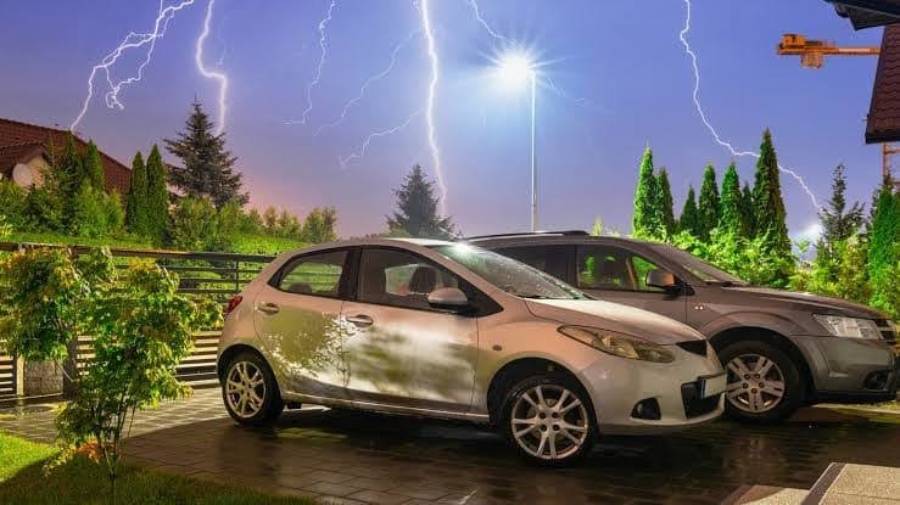
Can a Car Get Hit by Lightning?
Yes, lightning can strike a car whether it is moving, parked, or stopped in traffic. A vehicle’s metal body does not prevent lightning from striking it. Instead, the conductive structure helps direct electrical current around the passenger compartment, reducing the risk of injury to occupants inside a fully enclosed, metal-roofed vehicle.
Lightning occurs when electrical charge builds up between storm clouds and the ground or within clouds, creating an electrical discharge. According to the National Weather Service (NWS), lightning can strike vehicles during thunderstorms, and fully enclosed metal-topped cars provide substantial protection for occupants. However, the vehicle itself can still sustain electrical and structural damage.
Both moving and stationary vehicles are exposed to lightning because vehicle movement does not prevent an electrical discharge from reaching the car. A sedan traveling on a highway and an SUV parked in an open parking lot can both be struck during a thunderstorm. Lightning does not always strike the tallest object, although an object’s height, shape, and surrounding environment can influence where a strike occurs.
A car’s location affects its exposure, but no outdoor parking position guarantees protection from lightning. Vehicles in open fields, elevated areas, and exposed roads remain vulnerable during thunderstorms. The safest approach is to seek shelter inside a substantial building or remain inside a fully enclosed, metal-roofed vehicle when a safer building is unavailable.
What Happens When Lightning Strikes a Car?
When lightning strikes a car, a large electrical current travels through conductive parts of the vehicle and may cause electrical, thermal, and mechanical damage. In a fully enclosed metal-bodied car, much of the current follows the exterior structure rather than passing directly through the passenger compartment. However, the exact current path depends on the vehicle’s construction, strike location, and conductive connections.
A lightning discharge produces intense heat and a rapid electrical surge. These effects can damage exterior paint, deform metal components, break glass, and disrupt vehicle electronics. For example, a strike near the roof or antenna may produce localized damage while electrical surges affect connected wiring, sensors, or electronic control modules.
How Does Lightning Travel Through a Car?
Lightning current primarily travels along the conductive exterior of a metal-bodied car before reaching the ground through available discharge paths. This behavior is associated with the Faraday cage effect, in which a conductive enclosure helps shield its interior from external electrical discharges.
When lightning contacts a vehicle’s roof, antenna, or another exterior component, the current can spread through connected metal structures, including the roof, pillars, and body panels. It may then reach the ground through electrical arcs involving the wheels, tires, or other components. Rubber tires cannot reliably block lightning because the extremely high voltage can overcome their insulating properties.
Not all lightning current remains outside the passenger compartment. Electrical energy can enter through wiring, conductive fittings, or damaged components, particularly when the vehicle lacks a continuous metal enclosure. This explains why occupants should avoid touching exposed metal parts during a thunderstorm, even inside a vehicle that provides substantial lightning protection.
The vehicle may continue operating after a strike, but normal engine operation does not confirm that every component is undamaged. Electrical faults, tire damage, and other hidden problems can remain after the initial discharge, making a professional inspection important following a suspected direct lightning strike.
Are You Safe Inside a Car During a Lightning Strike?
Yes, occupants inside a fully enclosed, metal-roofed car are generally protected from lightning strikes because the vehicle’s conductive exterior directs much of the electrical current around the passenger compartment. This protection significantly reduces the risk of direct lightning injury, although it does not eliminate every hazard associated with a strike.
The protection comes from the vehicle’s metal enclosure rather than its rubber tires. When lightning strikes the roof or another exterior component, electrical current spreads through conductive parts of the body and follows available paths toward the ground. This process reduces the amount of current passing through the occupied interior. Sedans, SUVs, and hardtop vehicles with continuous metal structures generally provide effective lightning shelter.
According to the National Weather Service (NWS), fully enclosed metal-topped vehicles are suitable lightning shelters when substantial buildings are unavailable. However, occupants should keep the windows closed and avoid touching exposed metal components or conductive accessories connected to the vehicle’s structure. These precautions reduce the possibility of contact with electrical current during a strike.
Vehicle construction determines the level of protection. A conventional metal-roofed sedan provides a conductive enclosure around its occupants, while a soft-top convertible, motorcycle, or open utility vehicle lacks equivalent protection. Even in a properly enclosed car, lightning can damage electrical systems or create secondary hazards that require attention after the storm.
Can Lightning Injure Someone Inside a Car?
Yes, lightning can injure someone inside a car, although the risk is substantially lower in a fully enclosed, metal-roofed vehicle than in an unprotected outdoor location. Injuries can occur when occupants contact conductive components, encounter electrical arcing, or are exposed to secondary effects such as shattered glass or damaged vehicle equipment.
Direct contact with metal components creates a potential pathway for electrical current. For example, touching exposed metal door frames or other conductive structures during a lightning strike may increase the risk of electrical injury. The vehicle’s protective enclosure reduces exposure, but it does not guarantee that every interior surface remains electrically isolated.
Secondary injuries are another concern. A powerful lightning strike can break glass, damage tires, or disable vehicle electronics. If a tire fails or critical electrical systems malfunction while the car is moving, the driver may lose control. These hazards demonstrate why passenger protection and vehicle protection must be evaluated separately.
Occupants should remain inside a suitable vehicle during an active thunderstorm unless an immediate danger, such as fire, makes evacuation necessary. The National Weather Service recommends waiting at least 30 minutes after the last thunder before leaving lightning shelter.
Can Lightning Damage a Car?
Yes, lightning can damage a car’s electrical systems, tires, windows, paint, and metal body components. The severity depends on the strike location, electrical current paths, vehicle construction, and the components exposed to the discharge. Damage ranges from localized exterior marks to extensive electrical failures that prevent the vehicle from operating.
A lightning strike produces a high-energy electrical discharge accompanied by intense heat. When current travels through the vehicle’s conductive structure, localized heating can damage paint, deform metal, or affect nearby materials. Electrical surges can also reach sensitive components through wiring and conductive connections, causing failures without obvious exterior damage.
Vehicle damage does not always correspond to passenger injuries. A fully enclosed metal-bodied car can protect its occupants while sustaining expensive electrical or mechanical damage. For example, the passenger compartment may remain intact while an electronic control module fails or a tire develops damage from the discharge.
Can Lightning Damage a Car’s Electrical System?
Yes, lightning can damage a car’s electrical system by producing voltage surges that exceed the operating limits of electronic components. Modern vehicles contain interconnected control modules, sensors, wiring harnesses, and communication networks that are vulnerable to abnormal electrical currents.
Electronic control units (ECUs) manage essential vehicle functions, including engine operation, transmission control, and safety-related systems. A lightning-induced surge entering the wiring network can damage semiconductor circuits, interrupt communication between modules, or cause electronic components to fail. Depending on the affected systems, the vehicle may display warning lights, fail to start, or experience intermittent electrical problems.
Other vulnerable components include infotainment displays, navigation systems, cameras, parking sensors, and charging electronics. For example, a lightning strike affecting an antenna or connected wiring may damage communication equipment even when the engine continues operating normally. The battery and alternator can also be affected by electrical faults associated with a strike.
Electrical damage may remain hidden because some components continue functioning despite partial circuit damage. A diagnostic scan can identify stored fault codes, but it cannot independently rule out every lightning-related defect. A qualified automotive technician should inspect the affected circuits, wiring connections, and safety-critical electronic systems after a suspected direct strike.
Can Lightning Damage Car Tires?
Yes, lightning can damage car tires through intense heating, electrical arcing, and rapid pressure changes associated with the discharge. Although tires contain rubber, their construction does not make them reliable lightning insulators. The voltage of a lightning strike is high enough to create discharge paths around or through tire materials.
When lightning current travels from the vehicle toward the ground, electrical arcs may develop near the wheels and tires. Heat generated along these paths can damage rubber compounds, internal reinforcing materials, or nearby wheel components. In severe cases, the resulting damage can cause a sudden loss of tire pressure or structural failure.
Tire damage is particularly dangerous when a vehicle is moving. A rapid pressure loss can affect steering stability, braking performance, and vehicle control. For example, a tire damaged during a highway lightning strike may become unsafe even if its exterior initially appears intact.
Drivers should check for visible tire damage, abnormal pressure, exposed reinforcing materials, and unusual wheel conditions after a suspected lightning strike. However, internal tire damage is not always visible from the outside. A professional tire inspection is necessary when there is evidence that lightning current passed through the wheel or tire assembly.
Lightning can also damage windows and exterior body panels. Localized heating and electrical arcing may leave burn marks, chipped paint, damaged trim, or broken glass near the strike location. These visible signs help identify affected areas, but the absence of exterior damage does not guarantee that the vehicle’s electrical and mechanical systems are safe.
What Should You Do If Lightning Strikes Your Car?
If lightning strikes your car, maintain control of the vehicle, stop in a safe location, and remain inside the enclosed metal-roofed cabin unless an immediate hazard requires evacuation. Lightning can damage tires, electrical systems, and safety-critical components, so continuing to drive without assessing the vehicle may increase the risk of an accident.
If the strike occurs while driving, hold the steering wheel as needed to maintain control, reduce speed gradually, and move away from traffic when conditions permit. Avoid sudden braking or steering movements, particularly if the vehicle begins handling abnormally. Activate the hazard lights when appropriate and stop in a safe location away from moving traffic, flooded roads, and other immediate hazards.
Once stopped, assess the vehicle for smoke, fire, unusual odors, dashboard warnings, and visible damage. Keep the windows closed and avoid unnecessary contact with exposed metal components while lightning remains nearby. A fully enclosed metal-roofed car generally provides better protection during an active thunderstorm than standing outside beside the vehicle.
If the vehicle catches fire or another immediate danger develops, occupant safety takes priority over remaining inside for lightning protection. Contact emergency services and evacuate when necessary, moving toward a substantial building if a safe route is available. Otherwise, remain sheltered until at least 30 minutes after the last thunder before conducting an exterior inspection.
Can You Drive a Car After It Has Been Struck by Lightning?
A car should only be driven after a suspected lightning strike if it shows no signs of damage affecting safe operation, and even then, a professional inspection is advisable. Lightning can cause electrical faults and tire damage that are not immediately apparent, making normal engine operation an unreliable indicator of overall vehicle safety.
Check the dashboard for warning lights related to braking, steering, engine management, and electronic stability control. Observe whether the vehicle starts and operates normally without unusual sounds, smoke, burning odors, or electrical malfunctions. These checks can reveal obvious problems, but they cannot confirm that every electronic component is functioning correctly.
Tires require particular attention because lightning-related heating or electrical arcing can damage their internal structure. A tire with visible deformation, rapid pressure loss, or suspected structural damage should not be used. Similarly, a vehicle showing steering problems, brake warnings, or significant electrical failures should not be driven.
Arrange professional recovery or towing when the vehicle’s condition is uncertain or safety-critical damage is suspected. An automotive technician can inspect the tires, electrical wiring, electronic control modules, and other affected components before determining whether the car is safe to return to service.
How Can You Stay Safe in a Car During a Thunderstorm?
To stay safe in a car during a thunderstorm, use a fully enclosed metal-roofed vehicle as shelter, keep the windows closed, avoid exposed conductive components, and remain inside until the lightning threat has passed. These precautions reduce exposure to electrical current while protecting occupants from the hazards of standing outdoors during lightning activity.
A substantial enclosed building is the preferred lightning shelter. However, a conventional hardtop car provides substantial protection when a suitable building is unavailable. According to the National Weather Service, fully enclosed metal-topped vehicles offer lightning protection because their conductive exterior helps carry electrical current around the occupants. Soft-top convertibles, motorcycles, and open vehicles do not provide equivalent protection.
Drivers should monitor road conditions and stop when heavy rain, poor visibility, strong winds, or other hazards make continued driving unsafe. Choose a legal stopping location away from active traffic, low-lying flooded areas, and objects that may fall onto the vehicle. Avoid stopping beneath trees when a safer location is available because falling branches can damage the car or injure occupants.
Inside the vehicle, keep the windows closed and avoid touching exposed metal surfaces, wired accessories, or conductive components connected to the exterior structure. These precautions reduce the possibility of contact with lightning current traveling through the vehicle. Normal interior materials provide some separation from the metal body, but they should not be treated as guaranteed electrical insulation.
Remain inside the vehicle throughout the thunderstorm unless fire, flooding, or another immediate threat makes the cabin unsafe. Lightning can occur even when rainfall has weakened or stopped, so the absence of heavy rain does not indicate that the danger has passed. The National Weather Service recommends waiting at least 30 minutes after the last thunder before leaving a safe shelter.
After the storm, inspect the vehicle before resuming travel if a lightning strike was suspected. Look for damaged tires, broken glass, exterior burn marks, and dashboard warnings. If the car shows signs of electrical or mechanical damage, arrange a professional inspection rather than assuming it is safe because the engine still runs.
Do Rubber Tires Protect a Car From Lightning?
No, rubber tires do not protect a car from lightning. The primary protection comes from the vehicle’s conductive metal body, which directs much of the lightning current around the passenger compartment. Although rubber is an electrical insulator under ordinary conditions, the extremely high voltage associated with lightning can overcome the insulating properties of automotive tires.
When lightning strikes a metal-roofed vehicle, electrical current travels through conductive exterior components and reaches the ground through available discharge paths. These paths can include electrical arcs near the wheels and tires. The National Weather Service explains that the metal shell of a fully enclosed vehicle, rather than its rubber tires, is responsible for protecting occupants during lightning strikes.
Automotive tires also contain materials beyond rubber, including steel belts and other reinforcing components. Their construction does not make them reliable barriers against lightning current. For example, a car with four properly inflated rubber tires can still experience a direct lightning strike that damages its electrical systems or tire assemblies.
The distinction matters because tire insulation and passenger protection are separate concepts. A fully enclosed metal-roofed car generally provides substantial lightning protection, while a motorcycle with rubber tires does not offer an equivalent protective enclosure. Vehicle body construction is therefore more important than tire material when evaluating lightning safety.
Can an Electric Car Get Struck by Lightning?
Yes, an electric car can get struck by lightning, just like a gasoline-powered or diesel-powered vehicle. Electric vehicles are not immune to atmospheric electrical discharges, and their electric motors or high-voltage batteries do not inherently attract lightning. The likelihood of a strike depends on environmental exposure and lightning conditions rather than the vehicle’s propulsion system alone.
Electric vehicles with fully enclosed metal-roofed passenger compartments generally provide lightning protection through the same conductive enclosure principle found in conventional cars. When lightning contacts the vehicle, much of the electrical current can travel along its exterior structure. However, the protection depends on the vehicle’s design and does not guarantee that its electronic systems will remain undamaged.
An electric vehicle contains several electrical systems that may be affected by lightning-induced voltage surges. These include the battery management system, power electronics, charging equipment, sensors, and electronic control modules. A sufficiently severe surge can damage sensitive circuitry, interrupt communication between components, or prevent the vehicle from operating normally. Such damage is possible rather than inevitable after every strike.
The high-voltage battery requires particular attention following suspected lightning damage. Electric vehicles incorporate electrical isolation and safety systems, but these features do not eliminate every possible fault caused by an external electrical discharge. For example, damage to high-voltage wiring or battery-related electronics may require specialized diagnostic equipment to identify.
Owners should avoid touching exposed high-voltage cables, damaged charging connectors, or compromised battery components after a suspected lightning strike. If the vehicle displays high-voltage warnings, shows signs of battery damage, or operates abnormally, it should be assessed by a technician qualified to work on electric vehicle systems. A vehicle with suspected high-voltage damage should not be driven or charged until it has been evaluated.
Are Convertibles Safe During a Lightning Storm?
Soft-top convertibles and open-roof vehicles are not considered reliable lightning shelters because they lack the continuous metal enclosure that protects occupants inside conventional hardtop cars. A fabric or vinyl roof does not provide the same conductive structure as a fully enclosed metal roof, even when the convertible top is closed.
The lightning protection of a conventional car depends primarily on its conductive exterior structure. During a strike, the metal roof, pillars, and body help direct electrical current around the passenger compartment. A soft-top convertible has a different roof construction, which limits the protective enclosure surrounding its occupants. Closing the fabric roof protects against rain but does not make the vehicle equivalent to a metal-roofed sedan.
Hardtop convertibles require a more specific assessment because their roof materials and structural designs vary. A retractable metal roof may contribute to a conductive enclosure when fully closed, but its presence alone does not establish the same level of lightning protection as a conventional fixed metal roof. Roof joints, conductive connections, and overall vehicle construction affect how electrical current travels during a strike.
Drivers of soft-top convertibles should seek shelter inside a substantial enclosed building when thunderstorms approach. A fully enclosed metal-roofed vehicle is another suitable shelter when available. If lightning is already occurring nearby, avoid unnecessary exposure outdoors while moving to safer shelter. Remaining in an open or soft-top convertible should not be treated as equivalent to sheltering inside a conventional metal-roofed car.
Read more: How to Remove Mold From Interior of Car: 5 Steps
How Can You Tell If Your Car Was Struck by Lightning?
You can identify a possible lightning strike by checking for exterior burn marks, damaged tires, broken glass, electrical malfunctions, and sudden failures of vehicle components. However, no single symptom conclusively proves that lightning struck a car. A professional inspection is necessary to assess the damage and determine whether it is consistent with an electrical discharge.
Exterior damage provides one of the most visible indicators. Lightning can produce localized heating and electrical arcing that leave scorched paint, melted plastic trim, or marks on metal body panels. Damage may appear near the roof, antenna, windshield, or other locations where electrical current entered or traveled through the vehicle. For example, a small burn mark near an antenna combined with sudden electronic failures may indicate a possible lightning-related event.
Electrical problems are another important warning sign. Lightning-induced voltage surges can damage electronic control units, sensors, wiring harnesses, and infotainment equipment. A vehicle may develop dashboard warning lights, malfunctioning displays, communication errors, or starting problems immediately after a thunderstorm. These symptoms also occur with ordinary electrical failures, so their timing and accompanying physical evidence are important when evaluating the cause.
Tires and wheels should also be examined for damage associated with electrical arcing or intense heat. Warning signs include sudden pressure loss, visible rubber damage, and abnormal tire deformation. Because internal tire damage may not be visible, a tire that appears normal externally is not automatically safe following a suspected direct strike.
A qualified automotive technician can inspect the vehicle’s electrical circuits, retrieve diagnostic trouble codes, examine damaged components, and evaluate safety-critical systems. Photographs of exterior damage, the approximate time of the storm, and records of sudden malfunctions can help document the incident. These findings support repair decisions and may also be useful when submitting an insurance claim.
Does Car Insurance Cover Lightning Damage?
Yes, lightning damage is generally covered by comprehensive car insurance in the United States, provided the policy includes this coverage and the claim meets its terms. Comprehensive coverage protects against qualifying non-collision events, which commonly include lightning strikes, hail, falling objects, fire, and theft. Liability-only insurance generally does not pay for lightning damage to the policyholder’s own vehicle.
The amount an insurer pays depends on the policy’s coverage limits, deductible, exclusions, and assessment of the damage. For example, if covered lightning repairs cost $3,000 and the comprehensive deductible is $500, the insurer would generally pay $2,500, assuming no other limitations apply. If the cost of repairs exceeds the vehicle’s actual cash value, the insurer may determine that the car is a total loss under applicable policy terms and state rules.
Documenting the damage is an important part of the claims process. Vehicle owners should photograph visible strike marks, damaged tires, broken glass, and dashboard warnings. A repair facility can provide a diagnostic report and estimate identifying affected electrical or mechanical components. Weather records and the approximate location and time of the incident may provide additional supporting evidence.
Contact the insurance provider promptly to confirm coverage and obtain claim instructions. Avoid authorizing extensive repairs before understanding the insurer’s inspection requirements, except when immediate action is necessary to prevent additional damage or protect safety. Keep receipts for towing, diagnostics, and emergency services because reimbursement depends on the specific policy.
Lightning damage can be expensive when several electronic control modules or safety-related systems require replacement. Comprehensive insurance can reduce the financial impact of qualifying repairs, but coverage is not automatic for every vehicle or every type of damage. Reviewing the policy and obtaining a professional damage assessment are essential steps before proceeding with a claim.