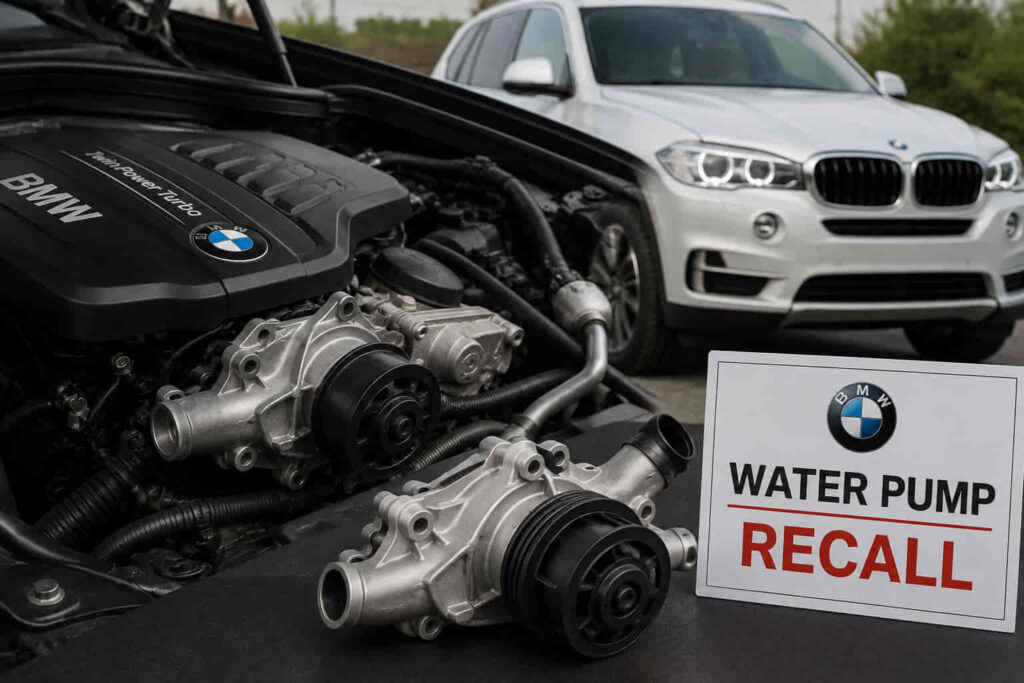
The BMW water pump recall addresses a safety defect involving the electric coolant pump’s electrical connector on certain 2012–2018 BMW vehicles, where fluid intrusion can lead to a short circuit and, in rare cases, a thermal event or fire. The recall is identified in the United States as NHTSA Campaign 24V-608. BMW’s current owner notice covers certain 2 Series, 3 Series, 4 Series, 5 Series, Z4, X1, X3, X4, and X5 vehicles, but inclusion in one of these model lines does not automatically mean a specific vehicle has an open recall. Recall status must be verified by VIN.
There are 7 key things BMW owners need to know about the water pump recall: what component is affected, why fluid can reach the connector, how the condition can cause an electrical short, why it creates a fire risk, which vehicles are potentially affected, how VIN-specific eligibility is confirmed, and what BMW repairs at no charge. Importantly, this campaign should not be confused with an ordinary failed or leaking water pump. BMW’s service information explicitly states that standalone electric coolant pump failure is not the focus of this recall.
This guide explains the BMW water pump recall from an owner’s perspective, including affected vehicles, warning signs, safety considerations, VIN verification, and the recall remedy. BMW currently instructs owners who notice smoke from the engine compartment not to continue driving and to move occupants to a safe location.
What Are the 7 Things to Know About the BMW Water Pump Recall?
The 7 key things to know about the BMW water pump recall are that it involves the electric coolant pump’s electrical connector, fluid can enter the connector, contamination can lead to a short circuit, the short circuit increases fire risk, only certain BMW vehicles are affected, eligibility must be confirmed for the individual vehicle, and the recall remedy is performed without charge. In the United States, this issue is covered by NHTSA Safety Recall 24V-608, which originally included 720,796 vehicles.
The first point is that this recall should not be interpreted as a general recall of mechanically failing BMW water pumps. BMW’s service bulletin identifies the affected area as the electric coolant pump’s engine wiring-harness socket and plug-pin connector. It also specifically states that the electric coolant pump itself has not been recalled and that standalone repairs for failed or leaking electric coolant pumps are not the focus of the campaign. This distinction matters because an ordinary coolant-pump failure and recall eligibility represent two different repair contexts.
The second point is fluid intrusion. BMW states that small droplets of liquid from the positive crankcase ventilation system can drip onto and penetrate the coolant pump’s electrical socket and plug connector. The recall population was identified because the connector sealing could be insufficient under the affected configuration. The safety defect therefore develops through the relationship between fluid exposure and the electrical connection rather than through normal coolant-pump wear alone.
The third point is the electrical consequence of that contamination. Over time, fluid entering the connector can create conditions that lead to an electrical short circuit. This explains why the recall appears under both cooling-system and electrical-system component categories in NHTSA documentation. The water pump is the physical location associated with the campaign, while the connector and its susceptibility to fluid ingress form the central defect mechanism.
The fourth point is safety risk. An electrical short at the affected connector increases the risk of a fire. BMW describes a thermal event as a rare potential outcome, while NHTSA identifies increased fire risk as the consequence of the electrical short. This does not mean that every recalled BMW will experience a thermal event, but the potential consequence is sufficient for the condition to be addressed through a safety recall rather than ordinary maintenance.
The fifth point is that the recall does not apply to every BMW with an electric coolant pump. NHTSA’s campaign covers certain vehicles from model years 2012 through 2018, including specified versions of the 2 Series, 3 Series, 4 Series, 5 Series, Z4, X1, X3, X4, and X5. BMW’s recall FAQ further identifies the potentially affected U.S. vehicles as configurations using the N20 or N26 four-cylinder engine. Other BMW models can use different design configurations and are not automatically part of this campaign.
The sixth point is that matching a model and model year does not establish recall eligibility for an individual vehicle. Recall populations are determined from vehicle assembly information and supplier production records, which means only vehicles within the affected production population require the campaign. The vehicle identification number is therefore the correct vehicle-level identifier for checking whether a BMW has an open water pump recall. BMW allows owners to check open recalls using the 17-digit VIN through its recall system or through the My BMW App.
The seventh point concerns the remedy. BMW’s campaign procedure calls for inspection of the affected water-pump area and connector, replacement where necessary, and installation of a protective shield or splash-protection cap intended to divert fluid away from the pump connector. The pump is therefore not automatically replaced on every recalled BMW. The required action depends on the inspection and recall procedure for the affected vehicle. Recall repairs are performed free of charge at an authorized BMW Center.
Together, these seven facts establish the correct context for the BMW water pump recall. A failed BMW water pump does not automatically mean the vehicle is covered by Recall 24V-608, and a vehicle does not need to experience water-pump failure before it can qualify for the recall. The recall addresses a defined safety defect in a specific vehicle population, so VIN-specific campaign status is more authoritative than diagnosing eligibility from water-pump symptoms alone.
Which BMW Models Are Affected by the Water Pump Recall?
BMW Water Pump Recall 24V-608 affects certain U.S. BMW vehicles from model years 2012 through 2018, including specified versions of the 2 Series, 3 Series, 4 Series, 5 Series, Z4, X1, X3, X4, and X5. NHTSA’s recall acknowledgement identifies affected nameplates including the 228i/228xi, 328i/328xi, 428i/428xi, 528i, X1, X3, X4, X5, and Z4 in applicable model years and configurations. The original recall population was 720,796 vehicles.
The affected years are not identical for every model. NHTSA identifies, for example, certain X1 vehicles from 2012–2015, Z4 and several passenger-car variants from portions of 2012–2016, X3 vehicles through 2017, and applicable X4 and X5 vehicles through 2018. This is why describing the campaign simply as a “2012–2018 BMW recall” can be misleading: that range describes the overall campaign span, not the affected years of every BMW model.
BMW’s campaign documentation further connects the affected population with vehicles equipped with N20 or N26 four-cylinder engines. However, engine family, model name, and model year should still be treated as population context rather than final proof of eligibility. BMW determined the affected population using production and supplier information, so two apparently similar BMWs can have different recall status.
This distinction is especially important for owners shopping for or already driving a used BMW. A listing that identifies a vehicle as a 2015 X3 or 2016 328i does not establish whether Recall 24V-608 remains open, has already been completed, or does not apply to that VIN. The vehicle’s current recall record provides that information.
For an individual BMW, VIN lookup is more authoritative than a generic affected-model list. BMW’s official recall system accepts the 17-digit VIN and reports open recalls for the specific vehicle; BMW also provides recall information through the My BMW App. Recall work that applies to the vehicle is performed without charge at an authorized BMW Center.
Why Is BMW Recalling the Water Pump?
BMW is recalling certain vehicles because fluid can enter the water pump’s electrical plug connector, potentially causing a short circuit that can lead to a thermal event or fire. The central defect is therefore not ordinary mechanical wear of the coolant pump. It is the relationship between fluid exposure, insufficient connector sealing, and the electrical condition that can develop at the affected connection.
BMW’s recall investigation traced the condition to liquid associated with the positive crankcase ventilation system. Small amounts of fluid can drip onto the electric coolant pump connector, and the affected connector can be susceptible to fluid ingress. NHTSA’s recall documentation identifies insufficient sealing of the water pump electrical plug connector as the difference between the recall component and a non-recall component.
The defect develops over time rather than requiring the water pump to suddenly stop circulating coolant. Fluid that reaches the connector can compromise the electrical connection and create a short-circuit condition. This is why the campaign should not be interpreted as a conventional water-pump failure recall. A mechanically failed pump can require repair for cooling-system reasons, while Recall 24V-608 addresses a defined electrical safety condition associated with the pump connector.
BMW’s investigation also provides context for why the issue became a safety recall. According to the chronology submitted to NHTSA, BMW investigated thermal events, collected electric water pumps and associated connectors, conducted laboratory analyses, and evaluated fluid ingress as a potential root cause. BMW decided to conduct the voluntary safety recall in August 2024 after determining the potentially affected production population.
The causal relationship is therefore specific: fluid reaches the water pump electrical connector, the affected sealing can allow ingress, and the resulting electrical condition can lead to a short circuit and increased fire risk. This mechanism is what makes a vehicle eligible for the recall campaign when it belongs to the affected production population; ordinary water-pump age, leakage, or failure alone does not establish recall eligibility.
Can the BMW Water Pump Recall Cause a Fire?
Yes. The BMW water pump recall addresses a defect that can increase the risk of a vehicle fire, although a fire is described as a rare potential outcome rather than an expected result for every recalled BMW. BMW states that fluid entering the water pump’s electrical connector can eventually cause a short circuit and, in rare cases, a thermal event or fire.
The fire risk originates from the electrical side of the affected water-pump assembly. The recall does not require the coolant pump to seize or stop circulating coolant before the safety condition can develop. Instead, fluid contamination at the connector can create an electrical short. This distinction explains why an owner should not rely on conventional symptoms of a failed water pump to determine whether the recall condition is present.
The available recall history also provides scale without implying that every affected vehicle will experience a fire. BMW reported to NHTSA that, as of August 2024, it was aware of approximately 18 U.S. customer complaints, concerns, or field instances that related or potentially related to the identified issue. At that point, BMW reported no known accidents or injuries related to the condition. The recall population, by comparison, is 720,796 vehicles, illustrating why recall inclusion represents exposure to a defined safety defect rather than evidence that a particular vehicle has already experienced a thermal event.
Owners should respond differently when there is evidence of an active thermal event. BMW’s current recall notice states that smoke from the engine compartment can indicate that the vehicle is experiencing the recalled issue. BMW instructs the driver not to continue driving in that situation, to have all occupants exit the vehicle and move to a safe location away from traffic, and to contact emergency services if necessary.
An open recall and an active fire-related symptom therefore represent different levels of urgency. An open VIN means the vehicle needs the recall remedy. Smoke from the engine compartment requires the owner to follow BMW’s immediate safety instructions rather than driving the vehicle to a repair facility.
What Are the Warning Signs of the BMW Water Pump Recall Problem?
Smoke from the engine compartment is the clearest warning sign specifically identified in BMW’s current owner notice for Water Pump Electrical Connector Recall 24V-608. BMW states that a vehicle showing this condition may be experiencing the recall issue and instructs the driver not to continue driving.
This is narrower than the symptom lists commonly associated with a failing water pump. Coolant leaks, overheating, cooling-system warnings, or abnormal pump operation can be relevant to ordinary cooling-system diagnosis, but BMW’s recall documentation does not make those symptoms the criteria for determining whether a vehicle belongs to Recall 24V-608. Adding every general water-pump symptom to the recall warning-sign section would therefore mix two different source contexts: mechanical cooling-system failure and electrical connector safety recall.
The absence of smoke also does not establish that a BMW is unaffected. A recall exists to correct a defined safety defect before every vehicle necessarily develops the final hazardous outcome. An affected BMW can therefore have an open campaign without displaying an obvious warning sign. Waiting for smoke or another severe event before checking recall status would reverse the intended purpose of VIN-based recall identification.
For the same reason, warning signs should not be used as a substitute for recall lookup. A driver who experiences an ordinary water-pump problem may have a BMW that is outside the affected recall population, while another BMW can have an open recall even though the water pump appears to operate normally. Symptoms indicate what the vehicle is doing; the VIN determines whether the vehicle is included in the recall campaign.
The practical distinction is therefore straightforward. If there are no obvious symptoms, the owner should still verify recall status by VIN and complete the remedy if the campaign is open. If smoke appears from the engine compartment, BMW’s safety instructions take priority: do not continue driving, have occupants move away from the vehicle to a safe location, and obtain appropriate emergency or roadside assistance.
Read more: How to Reset Steering Angle Sensor Without Scanner
Is It Safe to Drive a BMW With an Open Water Pump Recall?
An open BMW Water Pump Recall 24V-608 means the vehicle should receive the recall remedy as soon as possible, while smoke from the engine compartment is a specific condition in which BMW instructs the driver not to continue driving. BMW’s current recall notice says owners with an affected vehicle and an available remedy should contact an authorized BMW Center immediately to schedule the recall work.
This distinction is important because an open recall and an active thermal event are not the same vehicle condition. An open recall identifies a BMW that belongs to the affected safety-recall population and still requires the prescribed remedy. It does not establish that the electrical connector is currently shorting or that a fire is occurring. At the same time, the absence of visible symptoms does not remove the need to complete an open recall because the campaign is intended to correct the defect before a severe event develops.
The safety response changes when smoke appears from the engine compartment. BMW states that smoke can indicate the vehicle is experiencing the recalled issue and instructs the driver not to continue driving. Occupants should leave the vehicle and move to a safe location away from traffic, with emergency services contacted when necessary. BMW also identifies Roadside Assistance as the contact for a non-emergency situation requiring assistance.
Owners should therefore avoid using normal water-pump operation as evidence that the recall can be ignored. The recalled condition involves fluid intrusion into an electrical connector, so a vehicle does not need to display a conventional mechanical water-pump failure before the safety defect becomes relevant. Conversely, an ordinary failed coolant pump does not prove that the vehicle is experiencing Recall 24V-608.
The appropriate decision is based on two pieces of information: recall status and current vehicle condition. An open VIN requires completion of the campaign remedy. Evidence of an active thermal event, particularly engine-compartment smoke, requires the immediate safety response specified by BMW rather than driving the vehicle to the dealership.
How Can You Check If Your BMW Has the Water Pump Recall?
The most reliable way to determine whether a specific BMW has an open water pump recall is to enter its 17-digit VIN into BMW’s official recall lookup. BMW states that owners can also view applicable recall information through the My BMW App. This vehicle-specific check is more authoritative than relying only on model, engine, or model year.
The VIN matters because Recall 24V-608 applies to a defined production population rather than every example of every model named in the campaign. A BMW can match the general model and year range but have a different campaign status because recall eligibility is assigned at vehicle level. The same lookup can also establish whether an applicable recall remains open or has already been completed.
This is especially important when evaluating a used BMW. Knowing that a vehicle is an affected-generation X3, 3 Series, or another listed model does not establish its current recall status. A VIN check can determine whether the specific vehicle has an open campaign requiring attention instead of forcing the owner or buyer to infer eligibility from broad model information.
BMW identifies the VIN as a 17-digit number and notes that it can be found at locations including the driver’s side dashboard near the windshield or the driver’s side door jamb. Owners can then use the recall lookup to check the vehicle. Recall repairs identified as open are performed free of charge at an authorized BMW Center.
BMW Safety and Emission Recall Lookup
The VIN check should therefore come before symptom-based conclusions. Symptoms tell you what the BMW is currently doing; the VIN recall record tells you whether the vehicle is included in the safety campaign. These two forms of information answer different questions and should not be substituted for one another.
Is the BMW Water Pump Recall Repair Free?
Yes. BMW performs the Water Pump Electrical Connector Recall 24V-608 remedy free of charge on eligible vehicles through an authorized BMW Center. BMW’s current owner notice states that the water pump and connector will be inspected, replaced if necessary, and a shield will be installed to divert fluid that could otherwise reach the pump area. BMW estimates the recall procedure at approximately one hour, although actual service timing can depend on the vehicle and dealership circumstances.
Free recall repair should not be confused with free coverage for every water-pump problem. BMW’s service documentation explicitly distinguishes this campaign from standalone repairs involving an electric coolant pump that has failed or is leaking. The campaign addresses the electrical connector and fluid-ingress safety condition. A separate mechanical cooling-system repair therefore needs to be evaluated according to its own diagnosis and applicable warranty or repair coverage.
The remedy itself also does not mean every recalled BMW automatically receives a new water pump. BMW’s service procedure begins with inspection of the connector contacts and coolant-pump connection for contamination such as moisture, oily residue, or corrosion. Additional connector, cleaning, or pump-related work is performed according to the findings and campaign procedure. The protective measure is then used to address the fluid-exposure pathway that created the recall condition.
Owners who previously paid for a repair related to the recalled defect have a separate reimbursement consideration. BMW states that owners who paid for the repair described in the recall notification can request reimbursement consideration through an authorized BMW Center, subject to BMW’s reimbursement requirements. This does not mean every previous water-pump replacement qualifies; the prior repair needs to correspond to the issue covered by the safety recall.
The financial distinction is therefore straightforward: an eligible recall remedy is free, while an unrelated water-pump repair is not automatically converted into recall work simply because it involves the same general component area. VIN eligibility and the nature of the repair determine which context applies.
What Does BMW Replace During the Water Pump Recall?
BMW does not automatically replace the electric coolant pump on every vehicle affected by Water Pump Electrical Connector Recall 24V-608. The recall remedy centers on inspecting the water pump and its electrical plug connection, correcting affected components when necessary, and installing a protective shield intended to divert fluid away from the pump connector. The exact repair therefore depends on what technicians find during the recall inspection.
This distinction follows directly from the defect mechanism. The recall was initiated because fluid associated with the positive crankcase ventilation system can reach an insufficiently sealed electrical connector at the coolant pump. Over time, contamination at that connection can contribute to an electrical short circuit and increase the risk of a thermal event or fire. Replacing every pump regardless of its condition would not accurately describe a campaign whose remedy is designed around inspection of the affected connection and prevention of further fluid exposure.
BMW’s service procedure provides more detail about that inspection. Technicians examine the coolant-pump connection and connector contacts for evidence of contamination, including moisture, oily residue, or corrosion. The findings determine what additional corrective work is required under the campaign. This means two recalled BMWs can receive different component-level work while both receive the remedy prescribed by the same safety campaign.
The protective measure addresses the causal pathway rather than merely the final symptom. BMW specifies installation of shielding intended to divert fluid that could otherwise reach the affected pump area. Semantically, the remedy follows the same mechanism that created the recall: fluid exposure → connector contamination → electrical short risk, so the corrective strategy addresses both the condition of the affected connection and future exposure to fluid.
This is also why the phrase “BMW water pump recall” can create a misleading expectation. The water pump identifies the component area associated with the campaign, but recall eligibility does not guarantee a free replacement water pump regardless of condition. The authorized BMW Center follows the campaign procedure and replaces affected components when the inspection and recall instructions require it.
What If Your BMW Water Pump Was Already Replaced?
A previous BMW water pump replacement does not automatically mean Recall 24V-608 has been completed, and it does not automatically make the owner eligible for reimbursement. A conventional water-pump repair and the safety-recall remedy address different conditions, even though both can involve the same general component area.
The reason depends on what was repaired. A water pump can previously have been replaced because it failed, leaked, or developed another ordinary cooling-system problem. BMW’s recall documentation distinguishes standalone electric coolant-pump failure from the connector and fluid-ingress condition addressed by the safety campaign. A receipt showing that a water pump was replaced therefore does not by itself establish that the recall defect was corrected.
Recall completion should instead be checked against the vehicle’s campaign record. If the VIN still shows an open recall, the owner should contact an authorized BMW Center even when the pump has previously been replaced. The dealer can determine which campaign work remains applicable to that specific vehicle. This is more reliable than assuming that previous component replacement addressed the connector condition and protective measures specified by the recall.
Reimbursement is a separate question. BMW states that an owner who previously paid for a repair described by a recall notification can submit the repair for reimbursement consideration through an authorized BMW Center. Eligibility depends on whether the previous repair corresponds to the recalled issue and satisfies the applicable reimbursement requirements. It should therefore not be presented as automatic reimbursement for every earlier BMW water pump invoice.
For example, an owner who previously paid to replace a mechanically failed pump is in a different factual position from an owner who paid for repairs directly related to the connector condition later covered by the recall. Both repairs can mention the water pump, but only the underlying defect determines whether the previous work corresponds to the recall.
The correct sequence is therefore to check the VIN, determine whether Recall 24V-608 remains open, and have BMW evaluate any previous repair documentation when reimbursement may apply. Previous pump replacement should not be used as a substitute for vehicle-specific recall verification.
What Should You Do If Your BMW Has an Open Water Pump Recall?
If your BMW has an open Water Pump Electrical Connector Recall 24V-608, contact an authorized BMW Center and arrange the recall remedy at no charge. An open campaign means the specific VIN has been identified as requiring the recall action, so there is no need to wait for the water pump to fail or for a warning sign to appear before scheduling the work.
VIN verification should remain the starting point because model and model year alone do not determine the status of an individual BMW. An owner can use BMW’s official recall lookup to check the 17-digit VIN and determine whether a safety campaign remains open. This also prevents an owner from confusing a general water-pump repair with the vehicle-specific recall.
Once the recall is confirmed, the authorized BMW Center performs the campaign procedure. The affected pump area and electrical connector are inspected, corrective work or component replacement is completed when required, and the specified protective measure is installed. Recall remedy work is provided without charge to the owner.
The response becomes more urgent if the BMW shows evidence of an active thermal event. BMW specifically states that smoke from the engine compartment can indicate the recalled condition and instructs the driver not to continue driving. Occupants should exit the vehicle and move to a safe location away from traffic, with emergency services contacted if necessary. In a non-emergency situation requiring vehicle assistance, the owner can use appropriate roadside support rather than driving a smoking vehicle to the dealership.
Owners should also keep the recall separate from unrelated cooling-system diagnosis. An open recall should be completed even if the water pump appears to operate normally because the campaign addresses an electrical safety defect that can exist before ordinary pump failure. Conversely, overheating, coolant leakage, or a failed pump still requires proper diagnosis rather than being automatically attributed to Recall 24V-608.
The final distinction is therefore component failure versus campaign eligibility. A failed water pump tells the owner that the vehicle requires cooling-system diagnosis and repair. An open VIN for Recall 24V-608 tells the owner that BMW has identified the vehicle for a specific safety-recall remedy. The VIN determines recall eligibility, while the diagnosed vehicle condition determines whether additional repairs outside the recall are required.