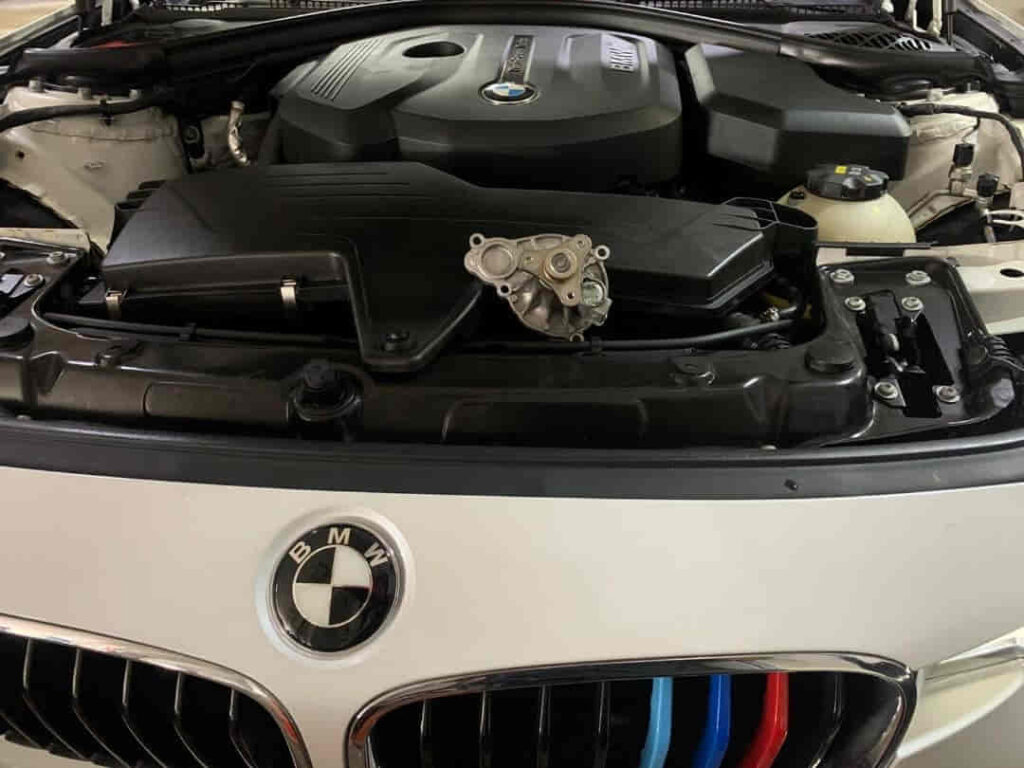
A BMW coolant leak usually comes from a cooling-system component, connection, or seal that can no longer maintain a closed coolant circuit, allowing coolant to escape and the system level to drop. Common leak sources include the expansion tank, radiator hoses and their connections, radiator, water pump area, thermostat housing, coolant fittings and seals, as well as less-visible locations that require further diagnosis. The exact source matters because each failure requires a different repair.
A BMW coolant leak may appear as wet coolant under the vehicle, dried residue around a cooling-system connection, repeated low-coolant warnings, or a coolant level that continues to fall after being refilled. The leak may also be difficult to see if it occurs mainly when the cooling system is hot or pressurized, or if escaping coolant travels across engine components or the underbody before reaching the ground. For that reason, the location of a puddle does not necessarily identify the component where the leak started.
Finding and repairing the source is important because continued coolant loss can reduce the cooling system’s ability to control engine temperature and eventually contribute to overheating. Adding coolant restores the fluid level, but it does not fix the component or seal that allowed the coolant to escape. A permanent repair requires locating the leak, confirming its cause, repairing the affected component, restoring the cooling system correctly, and verifying that coolant loss does not continue.
What Are the 7 Common Causes of a BMW Coolant Leak?
The 7 common causes of a BMW coolant leak are a leaking expansion tank, damaged radiator hoses or connections, radiator leakage, water pump leakage, a leaking thermostat housing, deteriorated coolant fittings or seals, and an internal or otherwise difficult-to-see coolant loss. Each problem allows coolant to leave the sealed cooling system through a different path, so identifying the actual source is more reliable than replacing the component closest to where coolant appears under the vehicle.
The coolant expansion tank is one potential leak source because it stores coolant while remaining part of the pressurized cooling circuit. A leak can develop at the tank itself or around a connection associated with it, allowing coolant to escape as system temperature and pressure change. Evidence can include visible wetness or dried coolant residue around the tank and nearby connections. Because escaping coolant can run downward across surrounding components, residue close to the expansion tank provides more useful diagnostic information than the final location of a puddle on the ground.
Radiator hoses and their connection points create another group of possible leak sources. A hose needs to contain hot, pressurized coolant while its connections maintain a seal between cooling-system components. Deterioration of the hose, a damaged connection, or failure of the sealing interface can allow coolant to escape. A small leak may leave residue around a joint before it produces a large puddle, while a more significant failure can cause coolant level to fall quickly. The diagnostic focus should therefore include both the hose material and the connection where the hose meets another component.
The radiator can leak when its coolant-containing structure or a sealing area can no longer maintain the closed circuit. Coolant found around the front of the vehicle can make the radiator a relevant suspect, but location alone does not confirm radiator failure. Fluid leaking from a hose or another component above the radiator can travel across its surface and create the appearance of a radiator leak. The source should be traced toward the highest point of fresh wetness or residue and confirmed before the radiator is replaced.
Water pump leakage is another possible cause of coolant loss, but a BMW coolant leak should not automatically be diagnosed as a failed water pump. The water pump operates within the cooling circuit, and leakage associated with the pump or its sealing area can allow coolant to escape. However, a water pump can also develop functional problems without producing an obvious external leak, while coolant from another component can travel toward the pump area and make the source difficult to identify visually. Evidence at the pump therefore needs to be distinguished from coolant that originated elsewhere.
The thermostat housing and its associated sealing points can also become a leak source because coolant passes through this area as part of temperature regulation within the cooling system. If the housing, joint, or seal no longer maintains its sealing integrity, coolant can escape and spread across nearby engine surfaces. This can make the leak appear to originate lower in the engine bay than it actually does. Tracing residue back toward the housing or confirming leakage while the cooling system is under appropriate diagnostic conditions helps separate a thermostat-area leak from a leak below it.
Coolant fittings, flanges, O-rings, and other sealing interfaces create additional potential failure points throughout the cooling circuit. These smaller components matter because the cooling system depends on multiple connections remaining sealed, not only on major parts such as the radiator and water pump. A deteriorated seal can produce a slow leak that initially causes only gradual coolant loss. As coolant escapes and dries, residue around the connection can reveal the path even when no liquid is present during inspection.
The final category is coolant loss that is internal or otherwise difficult to observe externally. If the coolant level repeatedly decreases but inspection does not reveal an external source, the diagnosis needs to expand rather than assuming that coolant loss is normal. A small external leak may occur only when the system reaches a particular temperature or pressure, coolant can collect on an undertray instead of reaching the ground, or the loss can originate from a location that is not visible during a basic inspection. Internal coolant loss is another diagnostic possibility, but it should be confirmed through appropriate testing rather than automatically attributed to a head-gasket problem.
These seven causes demonstrate why the place where coolant becomes visible is not necessarily the place where the BMW coolant leak started. Gravity, airflow, engine surfaces, and underbody panels can move escaping coolant away from its source. The correct diagnosis therefore follows the evidence back to the component or sealing point where coolant first leaves the closed cooling circuit.
Why Is My BMW Losing Coolant but There Is No Visible Leak?
A BMW can lose coolant without leaving a visible puddle when the leak is small, develops mainly while the cooling system is hot or pressurized, dries on surrounding components, collects on an underbody panel, or occurs in a location that is difficult to see. Repeated coolant loss without visible fluid should therefore be treated as an unresolved cooling-system problem rather than proof that no leak exists.
Temperature and system pressure can explain why a leak is not visible during a cold inspection. A compromised seal or connection may remain relatively dry while the vehicle is parked and reveal itself only as operating conditions change. By the time the BMW is inspected later, a small quantity of escaped coolant may have dried and left residue rather than an obvious wet area. This makes evidence of the coolant’s path important even when active dripping cannot be observed.
Vehicle surfaces can also hide or redirect the leak. Coolant escaping higher in the engine compartment can run along housings, hoses, brackets, or other surfaces before collecting elsewhere. An undertray can retain fluid and prevent it from immediately reaching the ground. As a result, the absence of a puddle beneath the parking location does not establish that the cooling system is retaining all of its coolant.
Repeated top-ups provide another diagnostic clue. A sealed cooling system should not be assumed to require unexplained, recurring coolant additions as normal operation. If the level falls again after coolant has been restored correctly, the system needs to be evaluated for the source of that loss. The rate of coolant loss, operating conditions when the level changes, and any residue or temperature-related symptoms help define the diagnostic context.
When no external source can be confirmed, the investigation may need to consider less-visible or internal coolant loss. That possibility should not immediately be translated into an expensive engine diagnosis such as a failed head gasket. Internal leakage is a category that requires evidence, just as an expansion-tank, radiator, hose, or water-pump leak requires evidence. Appropriate cooling-system testing is needed to distinguish between these possibilities.
The key distinction is visible leak versus confirmed coolant loss. A puddle makes coolant loss easier to observe, but it is not required for a leak to exist. If a BMW repeatedly loses coolant, the objective is to determine where the coolant is going and under what conditions it escapes rather than continuing to refill the system without identifying the cause.
Read more: BMW Water Pump Recall
How Can You Find Where a BMW Is Leaking Coolant?
To find where a BMW is leaking coolant, trace visible wetness or dried coolant residue back toward the highest plausible source and confirm which cooling-system component or sealing point actually allows coolant to escape. The location where coolant reaches the ground is only evidence of its path. Gravity, airflow, engine surfaces, and underbody panels can move the fluid away from the original leak.
The coolant-loss pattern provides the first diagnostic context. A leak that appears shortly after driving can behave differently from one that becomes visible while the vehicle is parked, and a slow leak may leave residue without producing an obvious puddle. Repeated low-coolant warnings or a level that falls again after being restored also indicate that the system needs further investigation even when active dripping cannot be seen during a cold inspection.
Visible evidence should then be traced through the cooling circuit. Wetness, staining, or dried residue around the expansion tank, hose connections, radiator, water pump area, thermostat housing, fittings, and sealing interfaces can help narrow the source. The useful evidence is where the coolant first appears, not simply which component is closest to the puddle. Coolant running down from a higher connection can make a lower component appear to be leaking when it is only receiving fluid from above.
The condition under which the leak occurs also matters. A compromised connection can remain dry when the BMW is cold and begin leaking only as coolant temperature and system pressure change. This explains why an inspection performed long after the engine has cooled can fail to reveal an active leak. Dried residue around the source can remain as evidence after the liquid itself has disappeared.
An underbody panel can further complicate diagnosis by catching coolant and redirecting it before the fluid reaches the ground. A puddle near the center or side of the vehicle can therefore originate from a component located elsewhere in the engine compartment. Removing assumptions based solely on puddle location prevents unrelated parts from being replaced before the actual leak has been confirmed.
The cooling system should also be inspected safely. A hot, pressurized cooling system should not be opened simply to search for the leak. Hot coolant can escape rapidly when system pressure is released. Diagnosis should be performed under appropriate conditions, and a leak that appears only under pressure can be investigated using a controlled cooling-system test rather than opening a hot expansion tank.
The objective is to move from a broad symptom—coolant is disappearing—to a specific failure point. Once the source is confirmed, the repair can target the expansion tank, hose or connection, radiator, pump area, housing, seal, or other affected component instead of treating repeated coolant top-ups as the solution.
Can a Cooling System Pressure Test Find a BMW Coolant Leak?
A cooling-system pressure test can help find a BMW coolant leak by applying controlled pressure to the cooling circuit so a compromised component or sealing point can reveal coolant loss without relying only on the conditions present during normal driving. It is particularly useful when coolant level repeatedly falls but the leak is too small or intermittent to remain visible during a basic inspection.
The test works by creating pressure within the cooling system under controlled diagnostic conditions. If a hose connection, expansion tank, radiator, housing, fitting, seal, or another external point cannot maintain that pressure, coolant may become visible at the failure location. This allows the technician to inspect the system while the leak is occurring rather than trying to reconstruct its path from a puddle found after the vehicle has been driven.
Pressure behavior also provides diagnostic information when an obvious leak is not immediately visible. If the system does not maintain the expected test condition, further investigation is required to determine where pressure or coolant is being lost. A pressure change is evidence of a problem; it does not by itself identify the failed component. The source still needs to be located and confirmed.
A pressure test is especially valuable for leaks that depend on sealing conditions. A connection can appear dry during a static visual inspection while failing when pressure is applied. Likewise, a small crack or deteriorated seal can release enough coolant over time to cause repeated low-coolant warnings without creating a large puddle after every drive.
The test should be performed according to the cooling-system specifications for the particular BMW rather than using one universal pressure value. Different vehicles and cooling-system configurations can have different test requirements. Applying excessive pressure does not improve diagnosis and can create conditions outside the system’s intended test procedure.
Pressure testing also does not replace other forms of diagnosis when the result does not reveal an external source. If coolant loss continues and the external cooling circuit does not provide a confirmed leak location, additional testing may be necessary to determine whether the coolant is escaping in a less-visible location or through an internal path. The diagnostic process should follow evidence rather than assuming that a hidden leak automatically means major internal engine damage.
The value of pressure testing is therefore its ability to convert an intermittent symptom into a condition that can be examined. The test helps expose the leak; the visible or otherwise confirmed failure point determines the repair. Once the source is identified, the affected component or seal can be corrected and the cooling system can later be verified to ensure it maintains integrity without continued coolant loss.
Can a BMW Coolant Leak Cause Overheating?
Yes. A BMW coolant leak can cause overheating when enough coolant escapes that the cooling system can no longer absorb and transfer engine heat effectively. The leak does not need to release all of the coolant at once. A small but persistent leak can gradually lower the coolant level until the system no longer maintains normal temperature control.
Coolant level matters because the cooling system depends on a sufficient volume of fluid circulating through the engine and heat-exchange circuit. When coolant escapes through an expansion tank, hose connection, radiator, water pump area, thermostat housing, seal, or another leak point, the available coolant volume decreases. Continued loss can also interfere with stable coolant circulation, increasing the risk that engine temperature will rise beyond its normal operating range.
The size of the puddle is not a reliable measure of overheating risk. A slow leak may release only a small quantity during each drive but produce significant cumulative coolant loss over days or weeks. Conversely, coolant can collect on an undertray or dry on hot components instead of forming a large puddle. Coolant level and engine-temperature behavior therefore provide more useful information than puddle size alone when evaluating severity.
A faster leak creates a more immediate problem because the system can lose coolant faster than the driver realizes. If the vehicle displays an overheating or high-temperature warning, the problem has progressed beyond simply identifying where a small leak originates. Continuing to operate an overheating engine can expose engine components to temperatures outside their intended operating conditions and turn a cooling-system repair into a more extensive engine problem.
However, overheating does not automatically prove that a BMW has a coolant leak. Cooling-system performance can also be affected by circulation, temperature-control, airflow, or other faults. The correct relationship is one-directional for diagnosis: coolant loss can lead to overheating, but overheating alone does not identify coolant leakage as its cause. Coolant level, leak evidence, and cooling-system operation still need to be evaluated.
This distinction prevents the diagnosis from being reduced to a single symptom. A confirmed coolant leak explains where fluid is being lost, while an overheating condition describes the thermal consequence that can develop when cooling capacity becomes inadequate. Repairing the leak before substantial coolant loss occurs reduces the chance that the original sealing failure will progress into an overheating event.
Can You Drive a BMW With a Coolant Leak?
Driving a BMW with a coolant leak is risky because continued coolant loss can reduce cooling-system capacity and cause the engine to overheat. Whether the vehicle can be moved safely depends on the severity of the leak, the remaining coolant level, and the current engine-temperature condition, so a coolant leak should not be treated as harmless simply because the BMW still drives normally.
A slow leak can create a misleading sense that the vehicle remains safe to use indefinitely. The cooling system may initially retain enough coolant to control temperature, while each drive allows additional fluid to escape. Once the level becomes sufficiently low, the system can lose its ability to maintain normal temperature. This transition can occur after the leak has existed for some time, which is why repeated coolant loss should be diagnosed before overheating becomes the first obvious consequence.
A rapid leak requires greater urgency because cooling capacity can deteriorate over a much shorter period. Visible coolant escaping quickly, a coolant level that drops substantially, or an engine-temperature warning indicates that continued driving can expose the engine to overheating. A BMW displaying an overheating warning should not be driven as though the problem can be managed simply by adding more coolant and continuing the trip.
The absence of a temperature warning does not make a known leak a permanent driving condition. A warning system reports vehicle conditions according to its monitoring strategy; it does not repair the opening through which coolant is escaping. If the leak remains active, the underlying failure continues each time operating conditions allow coolant to leave the system.
Safety also matters when inspecting or refilling the vehicle. The cooling system can remain hot and pressurized after the engine has been operating. Opening the expansion tank or cooling system while it is hot can release hot coolant and steam. A suspected low coolant level should therefore be handled under appropriate safe conditions rather than immediately opening a hot reservoir after a warning appears.
The appropriate response is to treat driving as a question of current cooling-system integrity rather than distance alone. A known coolant leak requires diagnosis and repair, while a vehicle showing overheating or substantial coolant loss requires a more urgent response. The goal is to repair the leak before coolant loss becomes an engine-temperature problem, not to determine how long the vehicle can continue operating with an unresolved leak.
Does Adding Coolant Fix a BMW Coolant Leak?
No. Adding coolant does not fix a BMW coolant leak because it replaces the fluid that has escaped without repairing the failed component, connection, or seal that allowed the coolant to leave the system. The coolant level may return to its correct range after a refill, but the cooling circuit remains compromised until the actual leak source is repaired.
This distinction explains why repeated top-ups can temporarily hide the progression of a leak. If an expansion tank, hose connection, radiator, water pump sealing area, thermostat housing, fitting, or O-ring continues to leak, newly added coolant can escape through the same failure point. The interval between refills may indicate how quickly fluid is being lost, but adding coolant does not change the mechanism causing that loss.
Restoring the coolant level can still form part of proper service after the source has been diagnosed or repaired. The cooling system needs the correct coolant level and must be restored according to the applicable BMW filling and bleeding procedure. However, refilling and repairing are two different actions: refilling corrects fluid quantity, while repair restores the sealing integrity of the cooling circuit.
Repeatedly adding coolant without finding the source can also delay diagnosis until the leak becomes more severe. A small connection leak that initially requires occasional topping up can progress, while an owner may continue treating the falling level as the primary problem. The falling level is actually an effect; the failed sealing point is the cause that needs correction.
Coolant type and mixture also matter when fluid must be restored, but choosing the correct coolant does not change the need to repair an active leak. The appropriate specification should be determined for the particular BMW rather than assuming that any coolant is interchangeable. This is a separate service requirement from locating the failed component.
The permanent distinction is therefore simple: adding coolant restores what was lost; repairing the leak stops the loss from continuing. If the coolant level repeatedly falls after being correctly restored, the cooling system still has an unresolved condition that requires diagnosis.
How Much Does a BMW Coolant Leak Cost to Repair?
The cost to repair a BMW coolant leak depends primarily on the component that is leaking, the labor required to access and replace it, and whether continued coolant loss has caused additional cooling-system or engine damage. There is no single meaningful repair price for every BMW coolant leak because a leaking hose connection and a difficult-to-access water pump, radiator, housing, or internal engine problem involve different parts, labor, and diagnostic requirements.
A leak involving an accessible hose, fitting, O-ring, or connection can have a relatively limited repair scope when the surrounding components remain serviceable. The technician still needs to confirm the actual failure point because replacing a nearby hose without identifying the leaking seal or connection can leave the original coolant loss unresolved. The cost therefore reflects both the replacement component and the work required to establish and restore a reliable seal.
Expansion tank and radiator leaks create a different repair scope because the affected component may require replacement rather than a simple sealing correction. Labor depends on the BMW model, engine configuration, surrounding components, and accessibility. The cooling system must also be restored correctly after the repair, which can include replacing lost coolant and completing the applicable filling and bleeding procedure before verifying normal operation.
A water pump or thermostat-area leak can involve greater labor when access requires removal of additional components. Diagnosis remains important because visible coolant near the pump or thermostat housing does not prove that either component is the original source. Coolant can travel from a higher connection and collect around a lower component, so replacing an expensive assembly based solely on where fluid accumulates can increase repair cost without fixing the leak.
The cost can increase substantially when coolant loss has been allowed to progress into overheating. At that point, the repair question is no longer limited to replacing the component that originally leaked. The engine and related cooling-system components may require additional evaluation to determine whether excessive temperature caused secondary damage. This is why repairing a confirmed leak before repeated coolant loss produces overheating can reduce both mechanical risk and repair scope.
Internal coolant loss can also require a different level of diagnosis and repair than an external leak. A falling coolant level with no obvious external source does not by itself prove an internal engine failure, so major repairs should not be assumed without supporting evidence. Pressure testing and other appropriate diagnostic procedures should establish where the coolant is going before repair decisions are made.
Location and labor rates further change the final invoice, which makes a broad average price less useful than a component-specific estimate. The most accurate BMW coolant leak repair estimate comes after the leak source has been confirmed. Diagnosis converts a broad symptom—coolant loss—into a defined repair involving a specific component, sealing point, and labor requirement.
How Do You Permanently Fix a BMW Coolant Leak?
To permanently fix a BMW coolant leak, identify the exact component or sealing point where coolant escapes, repair or replace the failed part, restore the cooling system with the appropriate coolant and filling procedure, and verify that the system no longer loses coolant. Repeatedly topping up the expansion tank cannot provide a permanent repair because it replaces the consequence of the leak without correcting its cause.
The first requirement is a confirmed leak source. Visible wetness, dried coolant residue, leak-path evidence, and controlled pressure testing can help distinguish between an expansion tank, hose connection, radiator, water pump area, thermostat housing, fitting, seal, or another cooling-system source. Diagnosis should follow the coolant path back to where it first exits the sealed circuit rather than assuming that the component directly above a puddle has failed.
The failed component or sealing interface must then be corrected. A deteriorated O-ring requires a different repair from a cracked expansion tank, damaged radiator, leaking hose connection, or water-pump-related leak. The purpose of the repair is the same in each case: restore the cooling circuit’s ability to contain coolant under its intended operating conditions. Replacing unrelated components does not improve the repair if the actual failure point remains open.
The cooling system must be restored correctly after the leak has been repaired. Coolant lost during the failure or repair needs to be replaced with the specification appropriate for the vehicle, and the system needs to be filled and bled according to the applicable BMW procedure. This step matters because trapped air or an incorrectly restored coolant level can interfere with cooling-system operation even after the original leak has been eliminated. The exact filling and bleeding procedure should be matched to the BMW model and cooling-system configuration rather than treated as one universal sequence.
Verification is the final part of the repair. The system should maintain its integrity without fresh wetness, recurring residue, or unexplained coolant-level reduction. When appropriate, pressure testing can help confirm that the repaired circuit holds pressure and that another leak has not been overlooked. Coolant level should also remain stable after the vehicle has completed the applicable operating and cooling cycles.
If the BMW previously overheated, eliminating the visible leak does not automatically establish that no secondary problem exists. The overheating event may require additional evaluation depending on its severity and duration. Likewise, if coolant continues to disappear after an external leak has been repaired, the diagnosis needs to continue rather than treating repeated top-ups as normal.
A permanent repair therefore follows a clear causal sequence: locate the coolant-loss source, confirm the failed component or seal, correct that failure, restore the cooling system properly, and verify that coolant loss has stopped. The amount of coolant added after the level dropped does not determine the repair; the component or sealing point that allowed the coolant to escape does.