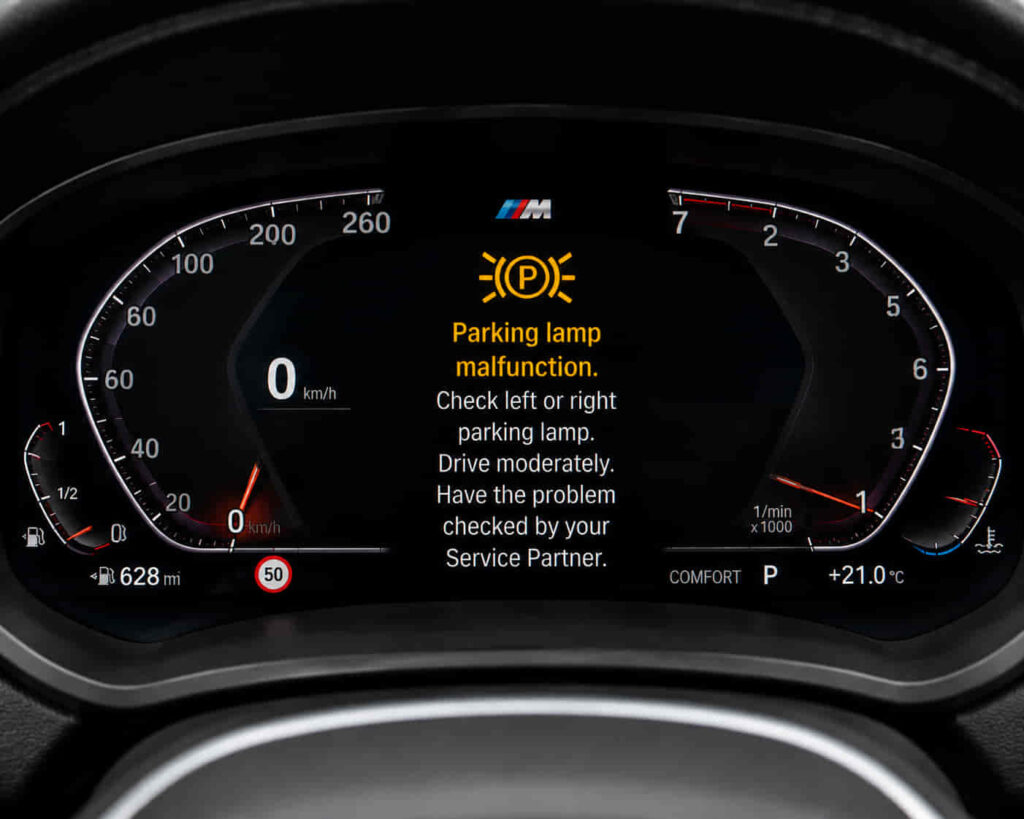
BMW Parking Lamp Malfunction means the vehicle has detected a condition affecting the operation of the parking lamp circuit or related lighting components. The warning indicates that BMW’s lighting system has identified an abnormal condition, but it does not specify that one particular bulb or component has failed.
The parking lamp system is part of BMW’s larger vehicle lighting network, which is controlled through electronic modules rather than simple mechanical switches. When the driver activates the parking lights, the lighting control system sends power and control signals to the parking lamp circuit, monitors electrical feedback, and determines whether the light components are operating correctly.
Modern BMW parking lamps may use traditional bulbs, LED units, or integrated lighting modules depending on the vehicle model and production year. These components work together with lighting control modules, wiring circuits, connectors, and the vehicle’s electrical network to maintain proper operation and detect faults.
A common misunderstanding is that BMW Parking Lamp Malfunction always means the bulb has burned out. In reality, the warning can be caused by several different conditions, including a failed bulb or LED unit, damaged wiring, faulty connectors, lighting control module problems, voltage issues, or communication errors within the vehicle’s electrical system.
The symptoms can vary depending on the source of the problem. Some BMW owners may notice that one parking lamp is not working, a light flickers intermittently, the warning appears after replacing a bulb, or the message remains even though the lamp appears to function normally.
The correct repair approach begins with identifying which part of the lighting system has failed. Replacing bulbs without checking the electrical circuit may not solve the problem if the actual cause is related to the lighting module, wiring, or power supply.
This guide explains the common causes of BMW Parking Lamp Malfunction, how the parking lamp system works, how to diagnose each possible failure, and when professional lighting system diagnosis is required.
Can BMW Bulb or LED Unit Problems Cause Parking Lamp Malfunction?
BMW bulb or LED unit problems can cause Parking Lamp Malfunction because the lighting control system continuously monitors whether the parking lamp circuit is operating within the expected electrical range. When a bulb fails, an LED module becomes defective, or the lighting component cannot produce the expected electrical response, the vehicle detects the abnormal condition and displays a warning.
The parking lamp system does not only provide illumination; it also includes a monitoring process that checks whether the lighting circuit is functioning correctly. When the driver activates the parking lamps, the lighting control module sends power to the lamp circuit and evaluates feedback from the connected lighting components. If the system detects an open circuit, incorrect resistance, or abnormal current flow, it may activate the malfunction warning.
A failed parking lamp component does not always mean the issue is a simple burned-out bulb. The problem may involve a damaged LED module, internal electronic failure inside an integrated lamp assembly, incorrect bulb installation, poor contact between the bulb and socket, or compatibility issues after replacing lighting components.
BMW owners may experience different symptoms depending on the type of failure. The parking lamp may stop working completely, become dim, flicker intermittently, display a warning even while the light still operates, or fail after a recent bulb replacement.
Diagnosing BMW parking lamp component problems requires checking the lighting fault codes, inspecting the bulb or LED assembly, verifying electrical values, and confirming that the lighting control module receives the correct feedback. Identifying whether the problem comes from the lamp unit itself or another part of the circuit prevents unnecessary replacement of functional components.
Can BMW Lighting Control Module Problems Cause Parking Lamp Malfunction?
BMW lighting control module problems can cause Parking Lamp Malfunction because the module controls power distribution, monitors lighting circuits, and communicates with the vehicle’s electronic network. The lighting control module acts as the central controller between the driver’s lighting command and the individual lamp circuits.
When the driver activates the parking lights, the lighting switch input is processed by the control module. The module then supplies power to the appropriate circuit and monitors whether the lamps respond correctly. If the module detects abnormal electrical conditions or cannot control the circuit properly, it may disable the affected lighting function and store a fault code.
A lighting module problem does not automatically mean the module hardware has completely failed. Similar symptoms can occur because of software faults, coding issues after component replacement, internal electronic damage, voltage instability, water intrusion, or communication problems with other vehicle modules.
Module-related parking lamp faults may appear as repeated warning messages, multiple lighting functions becoming unavailable, lights operating intermittently, or a malfunction warning that returns after the bulb has already been replaced.
Diagnosing BMW lighting control module problems requires scanning lighting system fault codes, checking module communication, verifying power supply, inspecting related circuits, and confirming whether the module can correctly control the parking lamp output. Proper diagnosis ensures that the control module is replaced only when it is the actual cause of the lighting failure.
Read more: BMW DSC Malfunction
Can Wiring Problems Cause BMW Parking Lamp Malfunction?
Wiring problems can cause BMW Parking Lamp Malfunction because the parking lamp system depends on stable electrical connections between the lighting control module, lamp assembly, and power supply circuits. The lighting system requires continuous electrical communication to deliver power to the parking lamps and confirm that the circuit is operating correctly.
The parking lamp circuit works through a controlled electrical process. The lighting module sends power to the lamp unit, the lamp operates, and the system monitors electrical feedback to detect whether the expected current and resistance values are present. If a wire becomes damaged, a connector becomes loose, or corrosion affects the electrical connection, the vehicle may detect an abnormal condition and activate the warning.
A wiring-related parking lamp problem does not always create a complete lighting failure. The issue may appear intermittently depending on vibration, temperature changes, moisture exposure, or movement affecting the connection. This is why some BMW owners may experience a warning that appears and disappears even though the lamp sometimes works normally.
Wiring faults can also create symptoms that appear similar to a failed bulb or lighting module. For example, a damaged connector near the lamp assembly can prevent power from reaching the light unit even when the bulb or LED component itself is functioning correctly.
Diagnosing BMW parking lamp wiring problems requires inspecting connectors, checking circuit continuity, testing power supply, and reviewing lighting system fault codes. Identifying the exact location of the electrical interruption prevents unnecessary replacement of bulbs, LED units, or lighting modules that are still operating correctly.
Can Low Battery Voltage Cause BMW Parking Lamp Malfunction?
Low battery voltage can cause BMW Parking Lamp Malfunction because the vehicle lighting system depends on stable electrical power to operate control modules, LED units, and electronic monitoring functions correctly. Modern BMW lighting systems are electronically controlled, meaning voltage stability affects both lamp operation and the vehicle’s ability to detect lighting conditions accurately.
The parking lamp system requires reliable power from the vehicle electrical network. When voltage drops below the expected level, lighting control modules may detect abnormal operation, reduce available functions, store fault information, or temporarily disable certain lighting circuits to protect electronic components.
A low-voltage condition does not automatically mean that the parking lamp components are damaged. The issue may occur because of a weak battery, charging system problems, poor ground connections, extended vehicle inactivity, or a previous battery replacement event that interrupted electronic module operation.
Voltage-related parking lamp warnings often appear together with other BMW electrical warnings because multiple vehicle systems depend on the same power supply. In some cases, the warning may remain stored even after battery voltage returns to normal until the lighting system fault memory is cleared.
Diagnosing BMW parking lamp problems related to voltage requires checking battery condition, charging system performance, electrical connections, and stored lighting module fault codes. Confirming the electrical condition helps determine whether the issue is an actual lighting component failure or a temporary power-related fault.
Can Fuse or Power Supply Problems Cause BMW Parking Lamp Malfunction?
Fuse or power supply problems can cause BMW Parking Lamp Malfunction because the parking lamp circuit requires a consistent electrical supply to operate the lighting components and allow the control module to monitor system performance. Although modern BMW lighting systems use electronic control modules instead of relying only on traditional fuses, power distribution problems can still interrupt normal parking lamp operation.
The parking lamp system depends on several electrical conditions being correct. The lighting control module must receive stable power, the lamp circuit must deliver the correct voltage, and the lighting component must respond within the expected electrical range. If the power supply is interrupted or reduced, the vehicle may detect that the parking lamp circuit is not operating correctly.
A power supply problem does not always mean the fuse itself has failed. The issue may involve a weak electrical connection, damaged fuse contact, wiring resistance, poor ground connection, battery-related voltage instability, or a problem inside the lighting control system.
Power-related parking lamp failures may create symptoms such as one side of the parking lamp not working, repeated warning messages after replacing a bulb, intermittent lighting operation, or multiple lighting functions becoming unavailable at the same time.
Diagnosing BMW parking lamp power supply problems requires checking circuit voltage, inspecting fuse and connection points, testing ground quality, reviewing lighting fault codes, and confirming that the lighting module receives and delivers the correct electrical signals. Identifying the real source of the power interruption prevents unnecessary replacement of lighting components.
Can Communication Errors Cause BMW Parking Lamp Malfunction?
Communication errors can cause BMW Parking Lamp Malfunction because modern BMW lighting systems rely on electronic communication between the lighting control module and other vehicle control systems. The parking lamp system is not an isolated circuit; it is connected to the vehicle’s electronic network, which allows modules to exchange commands, status information, and fault data.
When the driver activates the parking lamps, the lighting command is processed by the relevant control system before power is delivered to the lamp circuit. The module also monitors the lighting operation and reports abnormal conditions through the vehicle network. If communication between modules is interrupted, the vehicle may not correctly process lighting commands or verify lamp operation.
A communication-related parking lamp problem does not automatically mean that the lamp assembly or control module has failed. The issue may involve CAN communication faults, software errors, module synchronization problems, low voltage events, damaged wiring, or another electronic module affecting the lighting network.
Communication faults may cause symptoms such as parking lamp warnings that appear without a visible lamp failure, multiple lighting warnings appearing together, lights operating inconsistently, or faults returning after the system has been reset.
Diagnosing BMW parking lamp communication problems requires scanning the vehicle lighting modules, checking stored fault codes, verifying module communication, inspecting electrical connections, and confirming that lighting commands are transmitted correctly. Finding the communication issue prevents replacing working bulbs or lighting modules unnecessarily.
Can LED Module Problems Cause BMW Parking Lamp Malfunction?
BMW LED module problems can cause Parking Lamp Malfunction because many modern BMW parking lamps use integrated LED systems that depend on electronic control components rather than simple replaceable bulbs. The LED unit and its control electronics must communicate correctly with the lighting system to provide proper illumination and allow the vehicle to monitor operation.
Unlike traditional bulbs, LED parking lamps often contain internal electronic components that regulate current, control brightness, and communicate operating status back to the lighting module. When an LED driver, internal circuit, or integrated lighting component fails, the vehicle may detect an abnormal condition and display a parking lamp warning.
An LED-related fault does not always mean the entire lamp assembly has failed. The problem may involve internal LED electronics, overheating damage, moisture intrusion, connector issues, voltage instability, or a communication problem between the LED unit and the lighting control module.
LED failures may create symptoms such as one parking lamp becoming dim, flickering, failing completely, or showing a warning message even when part of the lighting function still operates. Because LED systems are electronically monitored, the vehicle may detect problems that are not immediately visible to the driver.
Diagnosing BMW LED parking lamp problems requires checking lighting fault codes, testing electrical supply, inspecting the LED assembly and connectors, and verifying communication with the lighting control module. Accurate diagnosis helps determine whether the repair requires a lamp unit replacement, wiring repair, or another electrical solution.
Why Is My BMW Parking Lamp Warning On After Replacing a Bulb?
BMW Parking Lamp Malfunction can remain after replacing a bulb because the original fault may involve another part of the lighting system or the vehicle may still have stored fault information. Replacing a bulb only resolves the problem when the bulb itself is the actual cause of the warning.
The lighting control system monitors electrical characteristics such as current flow and resistance. If the replacement bulb has incorrect specifications, poor connection quality, or does not match the vehicle’s expected electrical values, the system may continue detecting an abnormal condition.
A warning after bulb replacement may also indicate a deeper problem, such as a damaged socket, wiring fault, LED module failure, lighting control module issue, or voltage-related problem. In some cases, the bulb replacement fixes the physical light issue, but the stored fault remains until the system is checked and cleared.
BMW owners may experience situations where the parking lamp works normally but the warning message continues to appear. This usually indicates that the vehicle detected a previous fault or that another part of the lighting circuit is still outside the expected operating range.
Diagnosing a BMW parking lamp warning after bulb replacement requires checking lighting fault memory, confirming bulb compatibility, inspecting electrical connections, and verifying that the lighting module recognizes normal operation. Proper diagnosis ensures that the warning is removed for the correct reason rather than temporarily hidden.
Can You Drive With BMW Parking Lamp Malfunction?
Driving with BMW Parking Lamp Malfunction is usually possible, but the issue should be diagnosed because the warning indicates that part of the vehicle lighting system may not operate correctly. Parking lamps help improve vehicle visibility and position recognition, especially in low-light conditions or when the vehicle is stationary.
The severity of the problem depends on the actual cause. A failed bulb may only reduce visibility from one lighting position, while a wiring problem, lighting module failure, or electrical issue may affect additional lighting functions.
A parking lamp warning does not normally indicate a direct engine or braking problem, but ignoring the issue can create safety concerns because other road users may not see the vehicle as intended. It may also allow an electrical fault to develop into a larger lighting system problem.
Continuing to operate the vehicle without diagnosis may make it harder to identify intermittent issues, especially when the problem involves wiring connections, voltage instability, or communication faults.
BMW Parking Lamp Malfunction should be checked when the warning remains active, the light does not operate correctly, multiple lighting functions fail, or the problem returns after repair. Identifying the cause ensures that the vehicle lighting system continues to provide reliable visibility.
How Do You Reset BMW Parking Lamp Malfunction?
Resetting BMW Parking Lamp Malfunction can clear stored lighting faults after a repair, but it does not fix failed bulbs, damaged LED units, wiring problems, or lighting control module failures. The lighting system stores fault information when it detects abnormal electrical conditions, and the warning may remain until the system confirms normal operation.
A reset may help after resolving temporary issues such as voltage interruptions, communication errors, or previous lighting repairs. However, if the vehicle continues detecting an active problem, the warning will return because the underlying condition remains unresolved.
Clearing the warning without identifying the cause can hide important information about the lighting circuit. A proper repair requires understanding whether the fault originated from the lamp component, electrical supply, wiring, or control system.
BMW parking lamp reset should be treated as the final step after diagnosis and repair. The correct process is to identify the fault, repair the affected component or circuit, clear stored codes, and verify that the parking lamp operates correctly.
How Do You Diagnose BMW Parking Lamp Malfunction?
Diagnosing BMW Parking Lamp Malfunction requires identifying whether the failure comes from the lamp component, LED system, wiring, power supply, lighting control module, or communication network. The warning message only indicates that the lighting system has detected an abnormal condition and does not identify the exact failed component.
The diagnostic process begins by scanning the vehicle lighting system and retrieving stored fault codes. These codes provide information about the affected circuit, electrical condition, communication problem, or lighting component involved.
After identifying the affected area, the technician must test the related components. This may include checking bulb or LED operation, measuring electrical supply, inspecting connectors, testing wiring continuity, verifying lighting module output, and confirming communication between control systems.
A common mistake is replacing the bulb immediately because it is the most visible component. However, many BMW parking lamp problems are caused by wiring faults, LED module failures, voltage issues, or control module problems rather than the lamp itself.
The correct BMW parking lamp diagnostic sequence is: scan lighting system → identify fault codes → inspect lamp components → test power and wiring → verify module operation → repair cause → confirm lighting performance.
How Much Does BMW Parking Lamp Repair Cost?
BMW Parking Lamp repair costs depend on the failed component, vehicle model, lighting technology, and whether the issue involves bulbs, LED units, wiring, or electronic modules. A simple bulb replacement requires a different repair approach compared with replacing an integrated LED assembly or diagnosing a lighting control module.
The cost is determined by the actual failure source rather than the warning message itself. A wiring repair or connector issue may require a different solution from an LED module replacement or lighting controller repair.
Accurate diagnosis is important because replacing expensive lighting components without confirming the cause can increase repair costs unnecessarily.
BMW Parking Lamp repair costs are based on the diagnosed lighting system failure, not the malfunction warning alone.
When Should BMW Parking Lamp Problems Be Diagnosed Professionally?
Professional diagnosis is recommended when BMW Parking Lamp Malfunction warnings remain active, the light failure returns after replacement, multiple lighting functions stop working, or electronic module faults are suspected. Modern BMW lighting systems depend on electronic control modules and monitored circuits, making accurate diagnosis more important than simply replacing visible components.
A professional evaluation becomes especially important when the problem involves LED assemblies, lighting control modules, wiring faults, communication errors, or repeated warnings after repairs. These issues often require specialized diagnostic equipment to identify the exact failure source.
Ignoring repeated parking lamp warnings may allow electrical problems to continue developing and may reduce vehicle visibility in certain driving conditions. Even when the vehicle remains operational, the warning indicates that the lighting system has detected an abnormal condition.
The correct diagnostic path is:
warning appears → scan lighting system → identify affected component → test circuit and module → repair cause → verify parking lamp operation
BMW Parking Lamp Malfunction is a lighting system warning, not a specific component diagnosis. Understanding the relationship between the lighting control module, lamp units, LED systems, wiring, electrical supply, and vehicle communication network is essential for restoring reliable parking lamp operation.