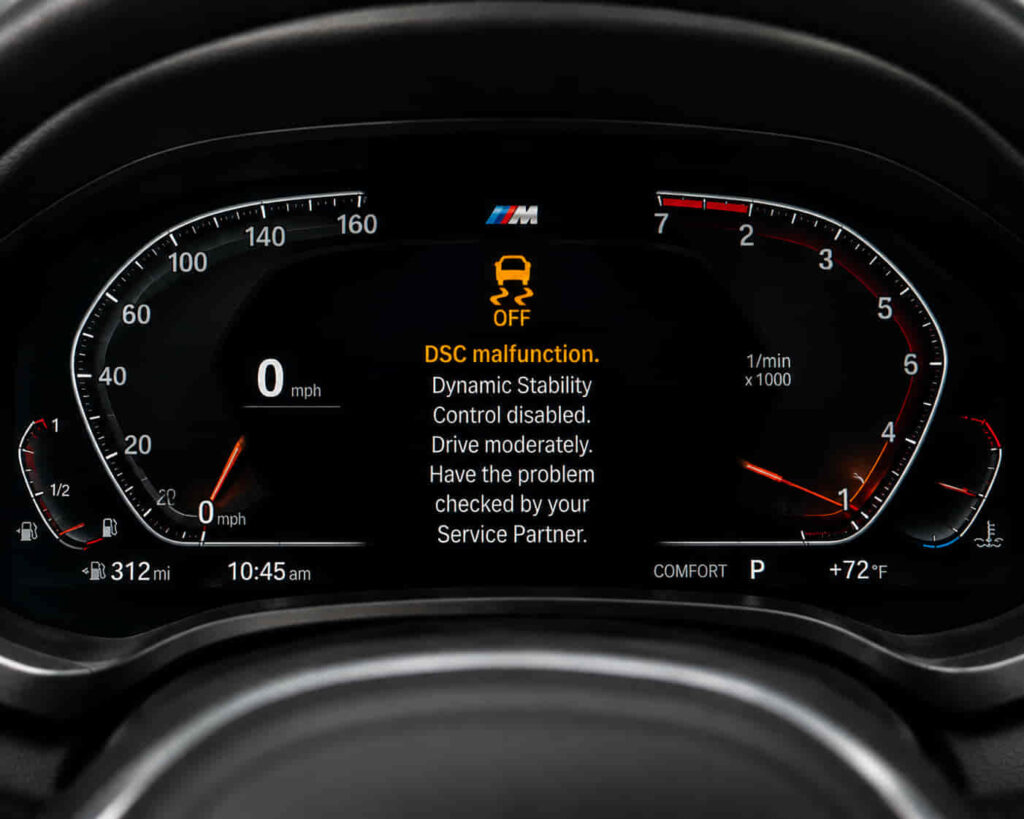
BMW DSC Malfunction means the vehicle has detected a condition affecting the Dynamic Stability Control system responsible for maintaining traction, stability, and controlled vehicle movement. The warning indicates that BMW’s electronic stability system has identified an abnormal condition, but it does not specify which individual component has failed.
Dynamic Stability Control (DSC) is one of BMW’s primary vehicle safety systems. It works by monitoring vehicle movement, wheel rotation, steering input, and driving conditions to detect situations where the vehicle may lose stability. When the system identifies wheel slip, oversteer, understeer, or reduced traction, it can apply individual brake intervention and adjust engine torque to help maintain control.
The DSC system depends on multiple electronic components working together. Wheel speed sensors provide information about wheel rotation, the steering angle sensor monitors driver direction input, the yaw rate sensor measures vehicle movement, and the DSC module processes this information to determine how the vehicle should respond.
A common misunderstanding is that BMW DSC Malfunction means the vehicle’s brakes have completely failed. In reality, DSC is a stability control system that supports vehicle control rather than replacing the main braking system. A DSC warning usually means that electronic stability functions, traction control, or related safety features may be limited or unavailable.
The cause of a DSC warning can come from many different areas. A faulty wheel speed sensor, steering angle sensor problem, yaw sensor issue, DSC module fault, low battery voltage, wiring problem, or communication error between control modules can all trigger the same warning message.
The symptoms can also vary depending on the source of the problem. Some BMW owners may only see the DSC warning light, while others may experience ABS warnings, traction control limitations, reduced stability assistance, or multiple electronic system alerts appearing at the same time.
The correct repair approach begins with identifying which part of the stability control system has failed. Replacing sensors or modules without proper diagnosis can lead to unnecessary repairs because the actual cause may be an electrical or communication issue rather than a failed component.
This guide explains the common causes of BMW DSC Malfunction, how the Dynamic Stability Control system works, how to diagnose each possible failure, and when professional diagnosis is required.
Can BMW Wheel Speed Sensor Problems Cause DSC Malfunction?
BMW wheel speed sensor problems can trigger DSC Malfunction because the Dynamic Stability Control system depends on accurate wheel rotation data to evaluate traction, stability, and vehicle movement. Wheel speed sensors are essential inputs for BMW’s ABS and DSC systems because they provide real-time information about how fast each wheel is rotating.
The DSC system uses wheel speed data to determine whether one or more wheels are losing traction. When the vehicle detects wheel slip, differences in wheel rotation, or unstable movement, the DSC module can intervene by applying individual brake pressure and reducing engine torque. If a wheel speed sensor sends incorrect information or stops communicating, the system cannot accurately calculate vehicle stability.
A wheel speed sensor problem does not automatically mean that the sensor itself has completely failed. The issue may involve damaged wiring, connector corrosion, contamination around the sensor area, incorrect sensor readings, reluctor ring problems, or communication faults between the sensor and ABS/DSC module.
Wheel speed sensor failures often affect multiple safety systems because the same data is shared between ABS, traction control, and stability control functions. BMW owners may see DSC Malfunction appear together with ABS warnings, traction control alerts, or stability system messages.
Diagnosing BMW wheel speed sensor problems requires checking DSC and ABS fault codes, comparing individual wheel speed readings, inspecting sensor wiring and connectors, and verifying communication with the control module. Identifying whether the problem comes from the sensor, wiring, or control system prevents unnecessary replacement of functioning components.
Can BMW Steering Angle Sensor Problems Cause DSC Warning?
BMW steering angle sensor problems can cause DSC warnings because the Dynamic Stability Control system requires accurate steering input information to determine the driver’s intended direction of travel. The steering angle sensor measures how much and how quickly the steering wheel is turned, allowing the DSC system to compare driver input with actual vehicle movement.
The DSC system continuously analyzes the relationship between steering direction, wheel speed, vehicle rotation, and road behavior. When the steering angle information does not match the vehicle’s actual movement, the system may interpret the data as unreliable and disable stability control functions to prevent incorrect intervention.
A steering angle sensor issue does not automatically mean that the sensor hardware has failed. The problem may involve calibration loss, incorrect initialization after battery service, software-related faults, wiring issues, or communication problems between the steering sensor and DSC module.
Steering angle sensor problems can create symptoms such as DSC warning lights, traction control becoming unavailable, stability functions activating incorrectly, or warnings appearing after wheel alignment, steering repairs, or battery disconnection.
Diagnosing BMW steering angle sensor problems requires checking DSC fault codes, verifying steering angle readings, performing calibration when required, inspecting electrical connections, and confirming communication between the steering sensor and stability control system. Accurate steering input data is essential because DSC can only maintain vehicle stability when it understands the driver’s intended direction.
Read more: BMW DBC Malfunction
Can BMW Yaw Rate Sensor Problems Cause DSC Malfunction?
BMW yaw rate sensor problems can cause DSC Malfunction because the Dynamic Stability Control system depends on accurate vehicle movement information to determine whether the vehicle is maintaining the intended direction of travel. The yaw rate sensor measures how quickly the vehicle rotates around its vertical axis, providing important data about oversteer, understeer, and changes in vehicle stability.
The DSC system does not rely only on steering input and wheel speed information. It compares multiple signals, including steering angle, wheel rotation, and vehicle rotation data, to understand how the vehicle is behaving. If the yaw rate sensor provides incorrect information, the DSC module may not be able to accurately determine whether stability intervention is required.
A yaw rate sensor problem does not always mean that the sensor itself has completely failed. The issue may involve sensor calibration problems, incorrect initialization after repairs, electrical connection faults, low voltage events, or communication problems between the sensor and DSC module.
Yaw rate sensor faults can create symptoms such as DSC warning lights, traction control becoming unavailable, stability control limitations, or multiple warning messages appearing together with ABS-related faults. Because the sensor provides critical information about vehicle movement, incorrect data can cause the DSC system to disable itself.
Diagnosing BMW yaw rate sensor problems requires checking DSC fault codes, reviewing sensor data, verifying calibration values, inspecting electrical connections, and confirming communication with the stability control module. Accurate vehicle movement information is essential because DSC must understand how the vehicle is moving before it can apply corrective action.
Can BMW DSC Module Problems Cause Stability Control Failure?
BMW DSC module problems can cause stability control failure because the DSC control unit processes sensor information and manages the electronic systems responsible for maintaining vehicle stability. The DSC module acts as the central controller that receives data from wheel speed sensors, steering angle sensors, yaw rate sensors, and other vehicle systems before deciding how to respond.
The Dynamic Stability Control system operates through a continuous decision-making process. The module analyzes vehicle movement, compares actual behavior with driver input, and controls functions such as brake intervention and engine torque adjustment when it detects instability. If the DSC module cannot process information correctly, the stability system may become unavailable.
A DSC module problem does not automatically mean that the control unit itself has completely failed. The issue may involve internal electronic faults, software problems, communication errors, unstable voltage, damaged connectors, or incorrect information from another sensor causing the module to report a malfunction.
DSC module-related failures can create multiple warning messages because the module is connected with several safety systems. BMW owners may see DSC Malfunction together with ABS warnings, traction control messages, brake system alerts, or other electronic faults.
Diagnosing BMW DSC module problems requires scanning the stability control system, analyzing stored fault codes, checking module communication, verifying power supply, and testing related sensors before replacing the control unit. Confirming the actual failure source prevents unnecessary replacement of expensive electronic components.
Can Low Battery Voltage Cause BMW DSC Malfunction?
Low battery voltage can trigger BMW DSC Malfunction because the Dynamic Stability Control system depends on stable electrical power to operate control modules, sensors, and communication systems correctly. Modern BMW stability systems are electronically controlled, meaning voltage stability is necessary for the DSC module, ABS system, and related components to process information accurately.
The DSC system continuously exchanges information between multiple electronic components. Wheel speed sensors, steering angle sensors, yaw rate sensors, ABS components, and the DSC module must communicate correctly to evaluate vehicle stability and apply corrective actions when necessary. When voltage drops below the required level, control modules may enter a protection mode, lose communication temporarily, or store fault information.
A low-voltage condition does not automatically mean that the DSC system components are damaged. The issue may occur because of a weak battery, charging system problems, poor electrical connections, damaged ground points, or a previous battery replacement event that interrupted module operation.
BMW DSC warnings caused by voltage problems often appear together with other electronic system warnings because multiple vehicle modules depend on the same electrical supply. Drivers may notice DSC, ABS, traction control, or stability warnings after a weak battery condition or electrical interruption.
Diagnosing BMW DSC problems related to voltage requires checking battery condition, charging system performance, electrical connections, stored DSC fault codes, and module communication. Confirming the vehicle’s electrical condition helps determine whether the DSC system has a real component failure or is reacting to unstable power supply.
Can Wiring Problems Cause BMW DSC Warning?
Wiring problems can affect BMW DSC operation because the Dynamic Stability Control system depends on reliable electrical connections between sensors, control modules, and braking components. The DSC system requires continuous communication between multiple electronic components to monitor vehicle movement and apply stability corrections when needed.
The stability control process depends on accurate data transmission. Sensors send information about wheel speed, steering direction, and vehicle movement to the DSC module, which then evaluates this information and controls brake intervention or engine torque adjustment. A damaged wire, loose connector, corrosion, or poor electrical contact can interrupt these signals and cause the system to detect a malfunction.
A wiring-related DSC problem does not always create a permanent failure. The warning may appear intermittently depending on vehicle movement, temperature changes, moisture exposure, or vibration affecting electrical connections. This makes wiring faults difficult to identify without proper inspection.
Wiring issues can also create symptoms that appear similar to failed sensors or modules. For example, a damaged connection near a wheel speed sensor may interrupt the signal and cause DSC, ABS, and traction control warnings even though the sensor itself is functioning correctly.
Diagnosing BMW DSC wiring problems requires inspecting connectors, checking electrical continuity, testing sensor signals, and reviewing DSC fault codes. Identifying the exact location of the electrical interruption prevents unnecessary replacement of sensors or control modules that are still operating correctly.
Can Communication Errors Cause BMW DSC Malfunction?
Communication errors can cause BMW DSC Malfunction because the Dynamic Stability Control system depends on continuous data exchange between the DSC module, ABS system, sensors, and other vehicle control modules. BMW stability systems are integrated into the vehicle’s electronic network, allowing different control units to share information required for traction management and vehicle stability control.
The DSC system requires accurate communication during every driving condition. The control module receives information from wheel speed sensors, steering angle sensors, yaw rate sensors, and brake systems before determining whether stability intervention is required. If communication between these components is interrupted, the DSC system may disable certain functions because it cannot verify vehicle movement and control conditions.
A communication-related DSC fault does not automatically mean that the DSC module or sensors have failed. The issue may involve CAN network problems, software errors, module synchronization issues, low voltage events, damaged wiring, or another control module affecting the stability system network.
Communication faults often appear together with multiple warning messages because BMW safety systems share information between modules. Drivers may see DSC Malfunction alongside ABS, traction control, brake, or drivetrain-related electronic warnings depending on the affected communication pathway.
Diagnosing BMW DSC communication problems requires scanning all related control modules, checking stored fault codes, verifying CAN communication, inspecting electrical connections, and confirming that the DSC module receives accurate information. Identifying the communication failure prevents unnecessary replacement of functional sensors or electronic modules.
Can You Drive With BMW DSC Malfunction?
Driving with BMW DSC Malfunction depends on the specific cause of the warning because the issue may affect only stability assistance functions or indicate a larger problem within the vehicle’s electronic safety systems. Dynamic Stability Control helps maintain traction and vehicle stability, especially during slippery conditions, sudden steering changes, or situations where the vehicle begins to lose control.
A DSC warning does not automatically mean that the vehicle cannot move or that the primary braking system has failed. The vehicle may still have normal engine and brake operation, but stability features such as traction control, automatic brake intervention, and electronic stability correction may be limited or unavailable.
The severity of the issue depends on the symptoms and related warnings. A temporary electronic fault caused by low voltage may have a different impact compared with a failed wheel speed sensor, DSC module problem, or communication failure affecting multiple safety systems.
Driving without resolving a DSC warning may reduce the vehicle’s ability to respond correctly during emergency situations. This is especially important in wet, icy, or low-traction conditions where DSC provides additional control support.
BMW DSC Malfunction should be diagnosed as soon as possible, especially when the warning remains active, appears together with ABS warnings, traction control stops working, or vehicle handling changes. Proper diagnosis determines whether the issue is a temporary electronic fault or a failure affecting stability control operation.
Why Is BMW DSC Malfunction Showing With ABS Warning?
BMW DSC Malfunction often appears together with ABS warnings because both systems share sensors, control modules, and braking information required for vehicle stability management. The DSC system depends heavily on ABS components because it uses wheel speed information and brake intervention to control traction and stability.
The relationship between ABS and DSC means that one underlying fault can affect multiple systems. For example, a failed wheel speed sensor can send incorrect information to the ABS module, which prevents the DSC system from accurately calculating wheel movement and vehicle stability.
A combined ABS and DSC warning does not automatically mean that both systems have failed. In many cases, one faulty component creates multiple warning messages because ABS and DSC operate through the same electronic network.
Common shared causes include wheel speed sensor faults, ABS module problems, low battery voltage, wiring issues, communication failures, and incorrect sensor calibration.
Diagnosing BMW ABS and DSC warnings together requires identifying the first stored fault and tracing the related system rather than replacing components based only on the number of warning messages. Finding the root cause provides a more accurate and efficient repair.
How Do You Reset BMW DSC Malfunction?
Resetting BMW DSC Malfunction can clear stored electronic faults after a repair, but it does not fix failed sensors, damaged wiring, control module problems, or communication issues. The DSC system stores fault information when it detects abnormal operating conditions, and the warning may remain until the underlying problem has been corrected.
A reset may restore normal operation when the warning was caused by a temporary issue such as a voltage interruption, communication error, or stored historical fault. However, if the DSC system detects an active failure, the warning will usually return after the vehicle completes its self-check.
Clearing the warning without diagnosis can remove important information about the stability system condition. DSC is a safety-related system, so understanding why the fault occurred is more important than simply removing the message.
BMW DSC reset should be considered a final step after identifying and repairing the cause. The correct process is to diagnose the system, repair the affected component, clear fault memory, and verify that stability control functions operate correctly.
How Do You Diagnose BMW DSC Malfunction?
Diagnosing BMW DSC Malfunction requires identifying whether the failure comes from sensors, control modules, electrical supply, wiring, or communication systems. The DSC warning message only indicates that the stability control system has detected an abnormal condition and does not identify the failed component by itself.
The diagnostic process begins by scanning the DSC and ABS control modules to retrieve stored fault codes. These codes provide information about affected sensors, communication problems, voltage issues, or module-related failures.
After identifying the affected system, the technician must test the related components. This may include checking wheel speed sensor signals, verifying steering angle data, reviewing yaw rate sensor information, inspecting wiring connections, testing battery voltage, and confirming DSC module communication.
A common mistake is replacing sensors immediately because they are common causes of DSC warnings. However, many DSC problems originate from wiring faults, low voltage conditions, calibration issues, or communication failures rather than a defective sensor.
The correct BMW DSC diagnostic sequence is: scan DSC/ABS modules → identify fault codes → analyze sensor data → test electrical systems → inspect communication → repair cause → verify stability control operation.
How Much Does BMW DSC Repair Cost?
BMW DSC repair costs depend on the failed component, diagnostic requirements, and whether the issue involves sensors, electronic modules, wiring, or related brake control systems. Because DSC is connected to multiple vehicle systems, the repair approach varies significantly depending on the actual cause.
A wheel speed sensor replacement requires a different repair process compared with replacing a DSC module, ABS component, or repairing damaged wiring. Accurate diagnosis is essential because replacing expensive electronic components without confirming the failure source can increase repair costs unnecessarily.
The final repair requirement depends on whether the problem is located in the sensor system, electrical network, control module, or stability control hardware.
BMW DSC repair costs are determined by the diagnosed cause rather than the warning message itself.
When Should BMW DSC Problems Be Diagnosed Professionally?
Professional diagnosis is recommended when BMW DSC Malfunction warnings remain active, appear together with ABS warnings, traction control becomes unavailable, or vehicle stability behavior changes. Dynamic Stability Control is a major safety system that helps maintain control during challenging driving conditions, so accurate diagnosis is important.
A professional evaluation becomes especially important when the problem involves DSC modules, ABS systems, steering angle sensors, yaw sensors, wheel speed sensors, or communication faults between electronic control units. These systems require BMW-specific diagnostic tools to identify the exact failure source.
Ignoring repeated DSC warnings can reduce the vehicle’s ability to provide stability assistance when needed. Even when the vehicle appears to drive normally, the warning indicates that an electronic safety function requires attention.
The correct diagnostic path is:
warning appears → scan DSC system → identify affected component → test sensors and modules → repair cause → verify stability control operation
BMW DSC Malfunction is a stability control system warning, not a specific component diagnosis. Understanding the relationship between DSC modules, ABS systems, sensors, electrical supply, and vehicle communication networks is essential for restoring reliable traction and stability control.