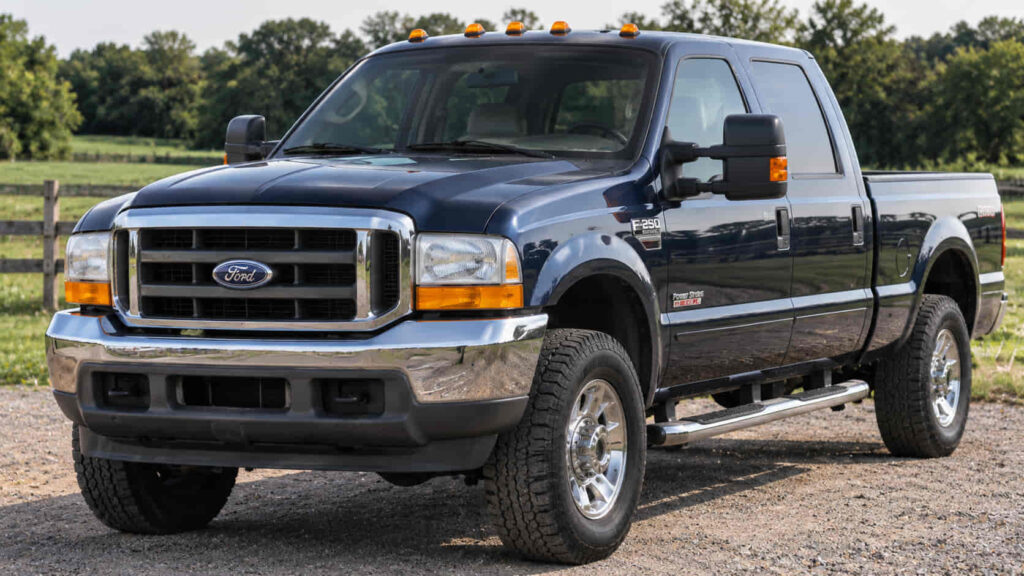
The best years for the 7.3 Powerstroke are generally 2000, late 1999, 2002, 2003, 2001, 1997, and 1996, depending on whether you prioritize long-term durability, towing performance, mechanical simplicity, or engine modification potential. The 2000 model year is particularly attractive because it combines the improved Super Duty platform with the forged-steel connecting rods found in most engines from that period.
However, no published manufacturer data establishes one model year as having the lowest engine failure rate.
The Ford 7.3L Power Stroke was manufactured by International Navistar and offered in Ford vehicles from the middle of the 1994 model year through 2003. It is widely recognized for its cast-iron engine block, cast-iron cylinder heads, direct diesel injection, and hydraulically actuated electronic unit injector system.
Early versions produced approximately 210 horsepower and 425 lb-ft of torque. Later Super Duty applications offered up to 275 horsepower and approximately 525 lb-ft of torque, depending on transmission and calibration.
One important difference involves the connecting rods. Most early engines used forged-steel rods, while Ford and International transitioned to powdered-metal connecting rods during later production. Both designs can operate reliably at factory power levels, but forged rods are generally preferred for high-output performance builds.
The 1999 Super Duty generation also introduced important improvements involving intercooling, fuel delivery, and turbocharging. Further revisions appeared during the 1999 production period.
For drivers who want a newer truck with stronger factory performance, the 2002 and 2003 model years are especially attractive.
For enthusiasts who appreciate traditional Ford truck styling, the 1996 and 1997 OBS trucks remain desirable.
The best 7.3 Powerstroke is ultimately the engine with the strongest maintenance history, verified mechanical condition, and configuration suited to its intended workload.
This guide ranks seven recommended model years, explains their differences, identifies the years requiring additional inspection, and covers common problems, engine life expectancy, maintenance, towing, and used-truck buying considerations.
What Are the Best Years for the 7.3 Powerstroke?
The 2000 Ford 7.3 Powerstroke is one of the strongest overall choices because it combines the Super Duty generation’s improved equipment with the forged connecting rods present in most engines produced during that period.
Late-1999 trucks offer a similar combination.
The 2002 and 2003 versions are attractive because they represent mature factory configurations with stronger available horsepower ratings.
The 2001 model year offers a useful balance of performance and features, but its connecting rod transition requires additional verification.
For older trucks, the 1997 and 1996 versions offer the classic OBS platform and a comparatively straightforward original engine configuration.
These recommendations reflect mechanical characteristics and typical ownership priorities rather than measured year-by-year failure rates.
A high-mileage 2000 truck with poor maintenance may be a worse purchase than a well-maintained 2002 truck.
Likewise, a 1997 truck with significant corrosion may require more money to restore than a mechanically sound 2003 Super Duty.
The correct choice depends on whether the owner wants a work truck, towing vehicle, restoration project, or modified diesel.
1. 2000 Ford 7.3 Powerstroke — Best Overall Year
The 2000 Ford 7.3 Powerstroke is a leading overall choice because it offers the established Super Duty platform, factory intercooling, and forged-steel connecting rods in most original engine configurations.
By the 2000 model year, Ford had moved beyond the first production revisions of the redesigned Super Duty platform.
The engine produced approximately 235 horsepower and 500 lb-ft of torque in common pickup configurations.
This represented a substantial improvement over the original mid-1990s Power Stroke.
The 2000 version also benefited from the air-to-air intercooling system introduced with the newer truck generation.
Intercooling reduces the temperature of compressed intake air.
This helps support combustion efficiency and manage thermal demands during towing.
The electric fuel supply system also differs from the mechanical lift pump used in earlier OBS configurations.
Another advantage is the turbocharger arrangement.
The later Super Duty configuration uses the Garrett GTP38 turbocharger and associated intake improvements.
However, the engine’s most important feature for performance enthusiasts is its connecting rod design.
Most 2000 engines contain forged-steel rods.
These are generally preferred over the powdered-metal rods used in many later engines when substantial additional power is planned.
However, the transition to powdered-metal rods began during a later production period, and engine build dates can differ from model years.
Therefore, a buyer planning major performance modifications should confirm the actual connecting rods.
For ordinary towing and transportation, the stock engine’s condition matters much more than maximum aftermarket horsepower capability.
2. Late 1999 Ford 7.3 Powerstroke — Best for Performance Upgrades
A late-production 1999 Ford 7.3 Powerstroke is especially desirable for buyers seeking an early Super Duty truck with improved turbocharging hardware and forged connecting rods.
The 1999 model year introduced the redesigned Ford Super Duty platform.
This was a major transition from the older OBS pickup design.
The newer trucks offered improved chassis configurations, towing equipment, and drivetrain options.
The 7.3L engine also received significant updates.
These included changes involving the fuel delivery system, injection equipment, high-pressure oil system, and intake arrangement.
An air-to-air intercooler became part of the Super Duty engine package.
However, not every 1999 engine uses identical turbocharger and fuel system components.
Early-production trucks can differ from those built later.
The late-1999 revision is commonly called the 1999.5 Powerstroke.
This is an informal enthusiast designation rather than a separate official Ford model year.
Later engines generally received the updated GTP38 turbocharger arrangement and revised high-pressure oil pump configuration.
These changes made the late-production engine attractive to owners planning moderate performance improvements.
The original connecting rods are another advantage.
The 1999 engines use forged-steel rods, making them desirable for certain higher-output builds.
However, the buyer must still evaluate the transmission, fuel system, turbocharger, and cooling equipment.
A forged-rod engine with worn injectors or inadequate fuel pressure is not ready for additional power.
3. 2002 Ford 7.3 Powerstroke — Best for Daily Driving and Towing
The 2002 Ford 7.3 Powerstroke is one of the best choices for owners who want a relatively late-production Super Duty truck with strong factory torque and an established engine configuration.
By 2002, the Super Duty platform had been in production for several years.
The truck offered a familiar combination of the 7.3L V8, available four-wheel drive, and heavy-duty transmission options.
Factory horsepower depended on the transmission.
Common automatic-transmission versions were rated at approximately 250 horsepower.
Manual-transmission versions were available with approximately 275 horsepower.
Torque ratings varied by application and calibration, generally falling around 505–525 lb-ft.
These ratings provided stronger performance than earlier 1999–2000 engines.
However, the higher factory output was not achieved through a completely different engine architecture.
The basic cast-iron block, direct injection system, and turbocharged V8 design remained familiar.
Most 2002 engines use powdered-metal connecting rods.
These components are generally suitable for the engine’s original factory ratings.
However, owners seeking substantially greater power should consider the connecting rod limitations.
For a stock or mildly modified towing truck, a well-maintained 2002 Powerstroke can be an excellent choice.
The transmission, cooling system, suspension, and frame condition are equally important.
A truck used for heavy towing throughout its life should receive a thorough mechanical inspection before purchase.
4. 2003 Ford 7.3 Powerstroke — Best Final-Production Year
The 2003 Ford 7.3 Powerstroke is desirable because it represents the final model year of the legendary engine family in Ford’s heavy-duty diesel lineup.
The 7.3L Power Stroke was discontinued as Ford transitioned to the 6.0L Power Stroke.
Both engines were offered during the 2003 model year.
Therefore, the model year alone does not confirm which diesel engine is installed.
A prospective buyer must verify the engine identification.
For the relevant 2003 Super Duty VIN configurations, the eighth VIN character identifies the engine.
The letter F indicates the 7.3L diesel, while P identifies the 6.0L diesel.
The engine itself should also be inspected because a truck may have undergone an engine replacement.
The 2003 7.3L offers the mature Super Duty design and factory horsepower ratings of approximately 250–275 horsepower, depending on the transmission and application.
However, most engines from this final production period use powdered-metal connecting rods.
These are not necessarily a problem at factory output.
The main reason to prefer a 2003 truck is the combination of later production, established components, and desirable vehicle features.
However, the truck’s age is still a serious consideration in 2026.
Even the newest 7.3L-equipped Super Duty is now more than two decades old.
Engine condition, frame corrosion, transmission performance, and maintenance records should determine its actual value.
5. 2001 Ford 7.3 Powerstroke — Best for Buyers Who Verify Engine Details
The 2001 Ford 7.3 Powerstroke can be an attractive purchase because it introduced stronger available factory performance, but its connecting rod production transition makes engine identification especially important.
The 2001 model year is frequently discussed among Power Stroke enthusiasts.
One reason is the change from forged-steel connecting rods to powdered-metal connecting rods.
However, this change did not occur in a perfectly uniform manner across every engine carrying a 2001 model-year designation.
Some engines retained forged rods.
Other engines received the powdered-metal design.
The engine serial number is therefore more useful than registration year for identifying the internal hardware.
The change matters primarily for owners planning substantial performance modifications.
Both connecting rod types are capable of operating within their intended factory conditions.
The 2001 engines also received revised performance calibrations.
Automatic-transmission versions commonly produced approximately 250 horsepower and 505 lb-ft of torque.
Certain manual-transmission configurations received higher ratings, particularly later in the model year.
However, not every early-2001 manual truck originally carried the same calibration as later examples.
This makes the 2001 engine a good example of why model-year specifications should not be treated as universal.
For a stock work truck, a healthy 2001 Powerstroke may be just as attractive as a later version.
For a performance project, the actual engine configuration should be verified before making expensive modifications.
6. 1997 Ford 7.3 Powerstroke — Best OBS Model Year
The 1997 Ford 7.3 Powerstroke is one of the most desirable choices for drivers who want the classic Old Body Style Ford truck combined with the durability of the early Power Stroke engine.
The 1997 model year marked the end of the traditional OBS F-Series generation before the move to the redesigned Super Duty pickup platform.
The engine retained its 7.3-liter V8 configuration.
It used electronic direct injection with hydraulically actuated unit injectors.
However, its fuel supply and turbocharger arrangements differed from those of the later Super Duty versions.
The engine also lacked the factory air-to-air intercooling arrangement used in the newer Super Duty platform.
This makes the early truck less powerful in factory form.
However, the comparatively straightforward original configuration appeals to owners who prefer working on older diesel vehicles.
The 1997 version uses forged-steel connecting rods.
It is also associated with the familiar OBS body design.
However, ownership requires an understanding of the vehicle’s age.
Fuel system leaks, glow plug issues, electrical connectors, cooling components, and transmission wear can all create expenses.
The truck’s body and frame may also have accumulated substantial corrosion.
A mechanically healthy 1997 Powerstroke can be a rewarding purchase for a restoration or classic diesel truck project.
However, condition should matter more than appearance or nostalgia alone.
7. 1996 Ford 7.3 Powerstroke — Best Classic Diesel Value
The 1996 Ford 7.3 Powerstroke is worth considering because it combines the early engine’s forged connecting rods with the established OBS truck platform.
The 1996 engine belongs to the earlier Power Stroke generation.
It uses a cast-iron engine block and cylinder heads.
The engine also has a fixed-geometry turbocharger and hydraulically actuated electronic unit injection.
Factory output was lower than that of the later Super Duty engines.
Published ratings vary according to emissions configuration and application.
Common figures are approximately 210–215 horsepower and 425 lb-ft of torque.
However, these numbers should not be confused with the output of the International T444E used in certain medium-duty applications.
The 1996 truck can appeal to buyers who value a traditional diesel pickup.
It may also be attractive when a well-maintained example is available at a reasonable price.
However, the vehicle’s age presents challenges.
Fuel system seals can deteriorate.
Electrical connectors and glow plug components may require repair.
The cooling system must also be inspected.
An older automatic transmission may need substantial service.
For buyers interested in a classic work truck, a properly maintained 1996 Powerstroke can offer useful durability.
However, the lower original horsepower and older chassis design should be considered when comparing it with a later Super Duty truck.
What Years Was the Ford 7.3 Powerstroke Made?
Ford offered the 7.3L Power Stroke diesel from the middle of the 1994 model year through 2003, although vehicle availability differed by platform.
The engine was developed by International Navistar.
It replaced the earlier 7.3L indirect-injection diesel in relevant Ford applications.
The change introduced an electronically controlled direct-injection system.
The 7.3L Power Stroke also used turbocharging.
Its basic design remained recognizable throughout production.
However, there were significant equipment changes.
The OBS F-Series configuration was available through the 1997 model year.
The redesigned Super Duty pickup generation began with the 1999 model year.
This creates some confusion about 1998.
There was no equivalent full-year 1998 F-250 or F-350 pickup lineup that fits the same simple chronological comparison, although 7.3L applications existed in other Ford vehicle platforms and early Super Duty production timing overlaps calendar years.
The engine also appeared in Ford E-Series vans, the Excursion, and selected larger truck applications.
Therefore, a 7.3L from an E-Series van should not automatically be assumed to share every component or horsepower rating with a Super Duty pickup from the same year.
The engine application and serial number are essential.
Read more: Is the Honda 1.5 Turbo Reliable
Which 7.3 Powerstroke Years Have Forged Connecting Rods?
Most original 7.3 Powerstroke engines produced before the transition around the 2000–2001 period use forged-steel connecting rods, while many later engines use powdered-metal connecting rods.
However, the transition was not perfectly aligned with model years.
Specialist engine references identify several serial-number ranges.
Engines from the beginning of production through serial number 1425746 are associated with forged rods.
Serial numbers 1425747 through 1440712 are associated with powdered-metal rods.
A later range, 1440713 through 1498318, returned to forged rods.
Engines beginning with serial number 1498319 are generally associated with powdered-metal rods.
These ranges are useful references for original factory assemblies.
However, an engine rebuilt with replacement components may no longer match its original internal configuration.
This is especially important for high-performance projects.
An engine that has already been rebuilt may contain upgraded rods.
Conversely, a truck with an early model-year registration may have received a replacement engine.
When the connecting rod design matters, the buyer should verify the actual engine serial number and mechanical components.
The year alone is insufficient.
Are Forged Rods Better Than Powdered-Metal Rods?
Forged-steel connecting rods are generally preferred for high-output 7.3 Powerstroke builds because they offer greater tolerance for substantial increases in combustion load.
The connecting rods transfer force from the pistons to the crankshaft.
They experience significant compression and tension during engine operation.
Forged rods are produced through a metal-forming process that creates a particular material structure.
Powdered-metal rods use a different manufacturing process.
Both designs can be suitable for their intended operating conditions.
However, the aftermarket has found that the forged 7.3L rods are generally more tolerant of aggressive performance modifications.
Powdered-metal rods become a particular concern when engine output is increased substantially.
However, horsepower alone does not determine rod stress.
Peak cylinder pressure, injection timing, torque delivery, and engine speed also matter.
An aggressive calibration can damage connecting rods even when the engine’s advertised horsepower is not exceptionally high.
Therefore, published aftermarket horsepower thresholds should be treated as approximate tuning guidance rather than guaranteed mechanical limits.
For a stock engine, connecting rod design is usually less important than oil pressure, injector condition, and maintenance history.
For a major power build, forged rods or suitable upgraded aftermarket rods can be a significant advantage.
Is the 2000 or 2002 7.3 Powerstroke Better?
The 2000 Powerstroke is usually the more attractive choice for a performance-oriented build, while the 2002 version can be preferable for buyers seeking a later-production stock towing truck.
The 2000 engine commonly uses forged-steel connecting rods.
Its factory output is approximately 235 horsepower and 500 lb-ft of torque.
The 2002 engine generally offers higher factory power.
Depending on configuration, it may produce approximately 250–275 horsepower.
It also benefits from being a later version of the Super Duty platform.
However, most 2002 engines use powdered-metal connecting rods.
For a driver who plans to keep the engine near factory output, this difference may not be decisive.
A well-maintained 2002 engine can be a strong towing choice.
A performance enthusiast may prefer a verified forged-rod 2000 engine.
However, the condition of the complete truck remains essential.
A worn 2000 transmission can erase the financial advantage of choosing an earlier forged-rod engine.
Likewise, a 2002 truck with documented maintenance may provide better long-term value than a heavily modified 2000 truck.
The best choice depends on the owner’s actual goals.
Is the 1999 or 2000 7.3 Powerstroke Better?
The 2000 Ford 7.3 Powerstroke is often the easier choice because it avoids some of the early-versus-late 1999 hardware identification issues.
The 1999 model year included substantial revisions during production.
Early engines can have different turbocharger and high-pressure oil system components from later versions.
These differences can affect parts selection and performance modifications.
A late-1999 truck can be an excellent choice.
However, the owner should confirm the engine build configuration.
The 2000 model year generally provides a more consistent example of the later Super Duty arrangement.
However, the connecting rod transition began around this period.
Therefore, a buyer planning significant tuning should still verify the actual engine internals.
The two model years have similar factory power output in common applications.
Both offer approximately 235 horsepower and 500 lb-ft of torque.
The better truck is therefore likely to be determined by mechanical condition.
Oil leaks, injector wear, transmission operation, and body corrosion matter more than the small difference between their model-year labels.
Is the 2003 Ford 7.3 Powerstroke Better Than the 6.0?
The 2003 7.3 Powerstroke is often preferred by buyers seeking a well-established engine design with fewer of the later 6.0L engine’s characteristic service concerns.
The 2003 model year is important because Ford offered both engines.
The 7.3L was approaching the end of its production life.
The 6.0L represented a newer generation designed to provide higher output and address changing requirements.
The 6.0L offered stronger factory performance.
However, its ownership record includes concerns involving the exhaust gas recirculation system, oil cooler, fuel injection control module, and cylinder head sealing under certain conditions.
The 7.3L has a comparatively simpler original exhaust and engine management arrangement.
However, this does not mean that every 7.3L is more dependable than every 6.0L.
A carefully maintained 6.0L can be a reasonable vehicle.
A neglected 7.3L can also require expensive repairs.
The two engines should be evaluated independently.
For buyers who specifically want a 7.3 Powerstroke, the 2003 VIN and engine identification should be verified before purchase.
What Are the Worst Years for the 7.3 Powerstroke?
There is no reliable manufacturer-supported ranking identifying a single worst 7.3 Powerstroke model year, but certain configurations require additional attention.
Early 1999 trucks deserve careful parts identification because of production-period changes.
A buyer should verify the turbocharger and other relevant engine hardware before purchasing replacement components or planning upgrades.
The 2001 model year requires particular attention to connecting rod identification.
The transition from forged rods to powdered-metal rods affects the suitability of some engines for high-output builds.
However, powdered-metal rods are not automatically defective at factory output.
The 2003 model year requires careful engine identification because Ford also offered the 6.0L Power Stroke.
Earlier OBS trucks present different concerns.
Their mechanical simplicity is attractive, but corrosion and aging vehicle systems may create substantial restoration expenses.
Therefore, it would be misleading to describe all early engines as worse than later engines.
The highest-risk purchase may be a truck with undocumented tuning, neglected fluids, unresolved hard starting, or serious frame corrosion regardless of model year.
How Reliable Is the 7.3 Powerstroke?
The 7.3L Powerstroke is widely regarded as one of Ford’s most durable older diesel engines, although its longevity depends on maintenance and the condition of its fuel injection and lubrication systems.
Ford itself describes the 1994–2003 engine as renowned for reliability and durability.
The engine uses a cast-iron block and cast-iron cylinder heads.
Its fuel injection system is electronically controlled but hydraulically actuated through high-pressure engine oil.
This system is commonly called HEUI.
The design is capable of dependable service when supplied with clean oil and fuel.
However, the engine also contains components that wear.
Injectors can develop problems.
The high-pressure oil pump and related control components may require repair.
Electrical harnesses and sensors can deteriorate with age.
Turbocharger oil leaks may also develop.
Nevertheless, many of these problems can be repaired without replacing the complete engine.
This contributes to the 7.3L’s reputation for long-term ownership.
However, reliability should not be confused with the absence of maintenance expenses.
Every surviving 7.3 Powerstroke is now an older vehicle, and supporting-system condition is increasingly important.
How Long Does a 7.3 Powerstroke Last?
A well-maintained 7.3 Powerstroke can reach 300,000–400,000 miles, with some engines continuing beyond that range, but no mileage figure guarantees trouble-free operation.
Long service life is one of the engine’s defining attractions.
The heavy-duty block and crankshaft architecture are designed for substantial loads.
However, actual durability varies.
An engine used for daily highway transportation may experience different operating demands from one used for heavy towing or frequent idling.
Fuel quality also matters.
The injectors depend on clean diesel.
Lubrication is particularly important because the HEUI system uses pressurized engine oil to actuate injection.
Therefore, oil condition affects more than ordinary bearing lubrication.
A truck may require injector, sensor, turbocharger, or transmission repairs before the engine reaches its ultimate mechanical lifespan.
This does not automatically mean the engine has failed.
A high-mileage 7.3L with stable oil pressure, acceptable blow-by, and a healthy fuel system may remain serviceable.
However, a lower-mileage engine with poor maintenance or severe overheating may need major work.
The best prediction comes from inspection, not simply the odometer.
What Are the Most Common 7.3 Powerstroke Problems?
Common 7.3 Powerstroke problems include camshaft position sensor failure, injector wiring faults, high-pressure oil leaks, fuel filter housing leaks, turbocharger oil leaks, and aging cooling components.
The camshaft position sensor is particularly important.
Ford issued Safety Recall 07S57, corresponding to NHTSA campaign 07V-553, for certain 1997–2003 vehicles equipped with the 7.3L engine.
The affected sensor could operate intermittently and cause an unexpected engine stall.
Ford provided an improved replacement sensor under the recall.
A buyer should check the vehicle’s current recall status using its VIN.
Under-valve-cover wiring is another common diagnostic area.
The injector and glow plug wiring connections can deteriorate with age.
A connection problem may cause a misfire or starting difficulty.
The high-pressure oil system also deserves attention.
Oil leaks or pressure-control problems can affect injector operation.
The fuel system must maintain suitable supply pressure.
However, these symptoms can have multiple causes.
A hard-starting engine does not automatically need new injectors.
A professional diagnosis should evaluate electrical, fuel, and oil systems before major components are replaced.
Why Is the 7.3 Powerstroke Cam Sensor Recall Important?
Ford’s 7.3 Powerstroke camshaft position sensor recall is important because an intermittent sensor fault can cause the engine to stall unexpectedly.
The safety concern was documented in December 2007.
Ford recall number 07S57 corresponds to NHTSA campaign 07V-553.
The campaign covered certain heavy-duty Ford vehicles equipped with the 7.3L engine.
The manufacturer’s notification explained that the sensor could function intermittently.
A sudden engine stall creates a safety risk.
Ford instructed dealers to inspect the affected sensor and replace it with an improved unit when necessary.
However, recall eligibility depends on the vehicle’s identification and campaign status.
A truck may already have received the repair.
Another truck may have had a sensor replaced during ordinary maintenance.
The owner should therefore verify the current status rather than relying on a seller’s statement.
The recall is also a useful reminder that the 7.3L’s reliability reputation does not eliminate electrical or safety-related failures.
A pre-purchase inspection should evaluate the engine’s starting behavior and relevant service history.
Does the 7.3 Powerstroke Have a High-Pressure Oil Pump?
Yes. The 7.3 Powerstroke uses a high-pressure oil pump to supply the hydraulic pressure required for its HEUI fuel injection system.
The injectors use pressurized engine oil to drive the internal injection mechanism.
The engine control system regulates the injection process electronically.
This arrangement differs from a conventional mechanical diesel injection pump.
It also differs from the high-pressure common-rail fuel systems used in many newer diesel engines.
The high-pressure oil pump is therefore essential for starting and running.
A problem with the pump or oil pressure control components can cause extended cranking, rough operation, or failure to start.
However, these symptoms can also involve other components.
The injection pressure regulator and injection control pressure sensor are important parts of the system.
Electrical faults can affect the system’s behavior.
Oil leaks may also prevent the engine from developing the required hydraulic pressure.
Therefore, replacing the high-pressure oil pump without testing the system can be expensive and unnecessary.
A qualified technician should diagnose the complete system using the appropriate service information.
What Is the Difference Between the OBS and Super Duty 7.3 Powerstroke?
The main differences between OBS and Super Duty 7.3 Powerstroke trucks involve the vehicle platform, fuel delivery components, turbocharging arrangement, intercooling, transmissions, and factory performance ratings.
The OBS F-Series trucks use the older body and chassis design.
These models are especially popular among enthusiasts who appreciate traditional Ford styling.
Their 7.3L engines commonly use the earlier mechanical fuel supply arrangement.
They also lack the factory intercooling equipment found in the later Super Duty trucks.
The Super Duty generation introduced a redesigned truck.
It also incorporated changes to the engine’s turbocharging and electronic control systems.
Factory horsepower and torque increased.
However, the new platform also introduced different supporting components.
A fuel system part from an OBS truck may not be directly compatible with a later Super Duty.
Turbocharger components can also differ.
The transmission options changed.
OBS trucks commonly used the E4OD automatic or ZF five-speed manual transmissions.
Later Super Duty pickups offered the 4R100 automatic and ZF six-speed manual configurations.
The correct vehicle should be selected according to its intended purpose.
An OBS truck can be attractive for restoration.
A Super Duty may be more suitable for a buyer wanting a later chassis and higher factory output.
Is a 7.3 Powerstroke Good for Towing?
The 7.3 Powerstroke remains a capable towing engine when installed in a properly rated and maintained truck, although it produces less factory horsepower than modern heavy-duty diesels.
The engine delivers substantial low-speed torque.
This is useful for pulling trailers and maintaining speed on grades.
Later Super Duty engines offer approximately 500 lb-ft or more of torque in common configurations.
However, towing capacity is not determined by engine torque alone.
The transmission, axle ratio, brakes, suspension, tires, and gross combined weight rating all matter.
A truck’s rated towing capacity can differ significantly according to cab, drivetrain, axle, and transmission configuration.
Therefore, a 2002 7.3L F-250 should not automatically be assigned the same tow rating as a differently equipped F-350.
The vehicle’s actual ratings must be checked.
Engine condition is also important.
A worn turbocharger or inadequate fuel pressure can reduce performance.
Cooling problems may become more noticeable during heavy towing.
Transmission condition matters just as much.
A reliable engine does not prevent an overloaded or poorly maintained transmission from failing.
Is the 7.3 Powerstroke Better With a Manual or Automatic Transmission?
A manual-transmission 7.3 Powerstroke may appeal to buyers seeking direct control and certain higher factory engine ratings, while an automatic can be more convenient for everyday driving and towing.
The later Super Duty platform offered the ZF six-speed manual transmission.
It also offered the 4R100 four-speed automatic.
The available horsepower ratings were not always identical.
Certain later manual-transmission applications were rated at approximately 275 horsepower.
Automatic versions were commonly rated at approximately 250 horsepower.
However, the exact output depends on engine calibration and model year.
The manual transmission may be attractive to enthusiasts who prefer direct gear selection.
However, clutch wear and related components require inspection.
The automatic transmission can offer convenience.
Nevertheless, its condition is particularly important on high-mileage trucks.
A slipping transmission, delayed engagement, or abnormal shifting can create expensive repairs.
Previous towing and modifications may influence durability.
The correct choice depends on driver preference and the condition of the individual transmission.
A healthy automatic can be a better purchase than a neglected manual, and the reverse can also be true.
Which 7.3 Powerstroke Is Best for Performance Modifications?
A verified forged-rod 1999–2000 Powerstroke is one of the best starting points for a performance build because it combines the later Super Duty engine platform with a stronger original connecting rod design.
However, engine modifications should begin with a mechanical inspection.
Oil pressure must be healthy.
The injectors and high-pressure oil system must operate correctly.
Fuel supply pressure should also be verified.
The turbocharger and exhaust system must support the intended output.
Aggressive engine tuning can increase cylinder pressure.
This places additional stress on the connecting rods and other components.
The forged rods offer a useful advantage.
However, they are not indestructible.
Poorly calibrated tuning can damage even a forged-rod engine.
Transmission capability also matters.
Increasing engine output without addressing the drivetrain can lead to transmission failure.
For 2001–2003 engines using powdered-metal rods, the owner should be particularly cautious about substantial power increases.
The appropriate modification strategy depends on the actual engine hardware and intended use.
A truck designed for towing may benefit more from controlled temperatures and reliable fuel delivery than from maximum horsepower.
What Oil Does the 7.3 Powerstroke Use?
The 7.3 Powerstroke requires heavy-duty diesel engine oil meeting the applicable Ford specifications, with SAE 15W-40 commonly used in suitable operating temperatures.
The correct viscosity depends on climate and service requirements.
A colder operating environment may require a different approved grade.
However, the engine’s lubrication needs deserve special attention because of the HEUI fuel injection system.
The engine oil lubricates the bearings and other internal parts.
It also supplies hydraulic pressure to actuate the injectors.
Therefore, severely degraded or incorrect oil can affect engine operation.
The oil filter should be replaced at the appropriate interval.
A suitable filter must also be used.
However, the exact oil specification should come from the applicable Ford owner’s manual and current lubricant compatibility guidance.
An older historical oil classification should not automatically be treated as the only acceptable formulation today.
Synthetic oil may be suitable when it meets the relevant requirements.
However, using synthetic oil does not automatically justify extending maintenance intervals.
The oil should be changed according to the engine’s service schedule and operating conditions.
How Much Oil Does a 7.3 Powerstroke Take?
Most later Ford 7.3 Powerstroke applications use approximately 15 US quarts of engine oil during an oil and filter change.
This equals approximately 14.2 liters.
However, the engine’s historical lubrication specifications changed during early production.
Some original documentation identified different refill and dipstick calibration information.
Therefore, the exact engine and service procedure should be checked.
An aftermarket oil pan or other modification may also affect capacity.
During servicing, the engine should be filled with the appropriate quantity of approved oil.
The oil level must then be verified using the dipstick.
It is important not to overfill the crankcase.
The oil level should also be monitored between changes.
A high-mileage engine may develop external leakage or increased oil consumption.
The correct response is to investigate the cause rather than simply adding oil indefinitely.
For a 7.3L with hard starting or rough operation, oil condition and level are useful diagnostic considerations.
However, they should be evaluated alongside high-pressure oil system data and fuel delivery performance.
Does the 7.3 Powerstroke Need Special Coolant?
The 7.3 Powerstroke requires coolant compatible with its engine and cooling system, and certain older conventional-coolant applications require appropriate supplemental coolant additive maintenance.
Cooling system maintenance is important for diesel durability.
The coolant protects the engine against overheating and corrosion.
It must also provide the appropriate protection for the cooling system’s materials.
Some older heavy-duty diesel coolant formulations require supplemental coolant additives.
However, Ford used different factory coolant formulations during the later production period.
Certain 2002 trucks, for example, were delivered with gold-colored extended-life coolant.
These systems have different maintenance requirements from conventional green-coolant arrangements.
Therefore, adding supplemental coolant additives indiscriminately is not appropriate.
The actual coolant type should be identified first.
Mixing incompatible formulations may create maintenance problems.
The engine’s service history should also be reviewed.
A neglected cooling system can contribute to corrosion, leakage, and overheating.
For used-truck buyers, the coolant reservoir, radiator, hoses, water pump, and oil cooler should be inspected.
The correct maintenance procedure should match the installed coolant and engine configuration.
What Should You Check Before Buying a Used 7.3 Powerstroke?
A used 7.3 Powerstroke should be inspected for cold-start behavior, oil and fuel leaks, injector performance, high-pressure oil system operation, transmission condition, frame corrosion, and outstanding recalls.
A true cold start is particularly useful.
The engine should not be warmed before the inspection without the buyer’s knowledge.
Extended cranking can indicate glow plug, electrical, fuel, or high-pressure oil problems.
However, the exact cause requires testing.
The engine should idle smoothly.
Excessive smoke or irregular running may require investigation.
The valley beneath the turbocharger should be inspected for leakage.
Fuel filter housing leaks and turbocharger pedestal oil leaks are familiar concerns.
The valve cover harnesses and injector operation should also be evaluated.
Cooling system condition is important.
Fuel or oil contamination in the coolant may indicate a problem requiring additional diagnosis.
The transmission should be checked during a road test.
A high-mileage automatic transmission with slipping or delayed engagement may require expensive repair.
Frame and body corrosion can be equally serious.
Finally, the VIN should be checked for relevant recalls, including the camshaft position sensor campaign.
A professional diesel pre-purchase inspection is strongly recommended.
Are High-Mileage 7.3 Powerstroke Trucks Worth Buying?
A high-mileage 7.3 Powerstroke can be worth purchasing when the complete truck is mechanically sound and the price reflects its age, maintenance history, and likely future repair costs.
The engine’s durability reputation makes these trucks appealing.
However, an engine with 300,000 miles should not automatically be considered healthier than one with 180,000 miles.
Maintenance matters.
A well-maintained high-mileage truck may have received new injectors, repaired oil leaks, updated sensors, and transmission service.
A lower-mileage truck may have spent years idling, towing at heavy loads, or sitting unused.
These conditions can affect mechanical health.
The buyer should therefore evaluate operating history.
Oil pressure, starting behavior, compression-related symptoms, and injector performance provide important clues.
The complete vehicle also matters.
Transmission repairs, suspension replacement, rust repair, and electrical troubleshooting can exceed the cost of many ordinary engine repairs.
A used 7.3L should be purchased according to its actual condition rather than the assumption that the engine can never fail.
Why Are 7.3 Powerstroke Trucks Still Popular?
The 7.3 Powerstroke remains popular because of its reputation for long service life, relatively straightforward heavy-duty construction, strong parts support, and recognizable Ford truck styling.
Its production ended in 2003.
However, demand remains strong among diesel enthusiasts and truck owners.
One reason is the engine’s durable basic architecture.
The cast-iron block and cylinder heads provide a substantial mechanical foundation.
The original engine also predates many of the emissions aftertreatment systems used on newer diesel trucks.
However, this does not mean the engine lacks electronic controls.
The HEUI injection system requires a functioning engine computer and related electronics.
Its sensors and wiring can develop problems.
Nevertheless, many repairs are familiar to diesel specialists.
Replacement components and remanufactured engines are also available.
Ford continues to list the 7.3L Power Stroke among its supported remanufactured engine offerings.
The OBS trucks have additional appeal because of their classic body design.
Later Super Duty trucks are attractive for their towing capabilities and improved factory performance.
These characteristics help explain why the 7.3L remains a desirable older diesel engine.
Is the 7.3 Powerstroke Worth Buying in 2026?
A 7.3 Powerstroke is still worth considering in 2026 when the buyer understands the limitations and maintenance costs of an older diesel truck.
The engine is now more than two decades removed from production.
Even the newest trucks have aging fuel systems, seals, electrical connectors, and cooling components.
However, the engine’s mechanical foundation can remain serviceable.
A properly maintained truck may still be useful for towing, rural work, or occasional hauling.
Nevertheless, it should not automatically be compared with a new Super Duty.
Modern diesels provide much greater factory horsepower and torque.
They also offer newer safety systems, improved transmissions, and additional convenience features.
The older 7.3L has its own advantages, particularly for buyers who value its original engine architecture.
However, fuel economy, emissions requirements, parts availability, and local regulations should be considered.
The price must also reflect the truck’s condition.
An expensive collector-quality OBS truck serves a different purpose from a work-worn Super Duty with high mileage.
The best purchase is the one that matches the intended use and leaves an appropriate repair budget.
Final Verdict: Which Year 7.3 Powerstroke Is Best?
The 2000 Ford 7.3 Powerstroke is one of the best overall choices because most engines combine forged-steel connecting rods with the improved Super Duty platform. However, the correct answer depends on how the truck will be used.
A late-production 1999 truck is particularly attractive for performance enthusiasts seeking the updated engine configuration and forged rods.
The 2002 Powerstroke offers stronger factory performance and is a good candidate for daily transportation or towing when maintained correctly.
The 2003 version is desirable because it represents the final production year of the 7.3L Power Stroke.
However, buyers must verify that a 2003 truck actually contains the 7.3L rather than the 6.0L engine introduced during the same model year.
The 2001 engine can also be an excellent choice, but the connecting rod transition makes individual engine identification important.
For traditional Ford truck enthusiasts, the 1997 and 1996 OBS versions offer classic styling and comparatively straightforward original engine configurations.
However, none of these years is automatically reliable.
The 7.3L engine can suffer from camshaft position sensor faults, injector wiring problems, high-pressure oil system leaks, fuel supply problems, and normal age-related wear.
Transmission condition and frame corrosion are also critical.
Therefore, buyers should not select a used truck based solely on a favorable model-year ranking.
For stock towing and long-term ownership, choose the cleanest, best-maintained 7.3 Powerstroke you can find. For substantial engine modifications, prioritize a mechanically healthy truck with verified forged-steel connecting rods.
With proper maintenance, accurate diagnosis, and attention to the complete vehicle, the Ford 7.3L Power Stroke remains one of the most compelling older diesel truck engines available.