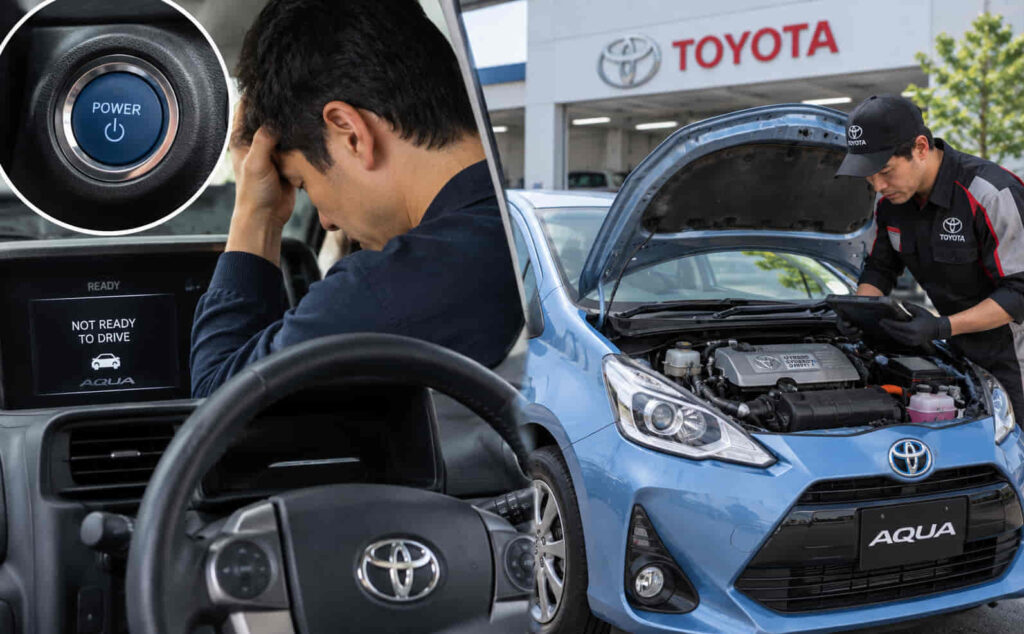
A Toyota Aqua not starting does not automatically mean the hybrid battery has failed. In many cases, the problem is related to the 12V auxiliary battery, electronic key recognition, an incorrect start condition, an electrical fault, or another system that prevents the hybrid system from entering READY mode. Because the Aqua is a hybrid, diagnosing a no-start condition is different from diagnosing a conventional gasoline vehicle.
The most important first check is whether the READY indicator appears after the brake pedal is pressed and the power switch is operated correctly. Dashboard lights can come on even when the hybrid system has not fully started, so electrical power alone does not confirm that the vehicle is ready to drive. A weak 12V battery, key communication problem, blown fuse, immobilizer issue, low fuel level, or hybrid control fault can interrupt this startup sequence.
This guide explains the main reasons a Toyota Aqua will not start, how to distinguish a flat 12V battery from a hybrid-system problem, what to check when the lights work but READY does not appear, how key-related starting problems are handled, and when a jump start or professional hybrid diagnosis is the correct next step.
What Does It Mean When a Toyota Aqua Is Not Starting?
A Toyota Aqua not starting means the hybrid system has failed to reach READY mode, even though some electrical functions may still operate. Because the Aqua uses a hybrid drivetrain, the absence of conventional engine cranking does not always indicate a starter-related failure. The most useful confirmation is the READY indicator, because the vehicle is not fully prepared to drive until the hybrid control system completes its startup checks and allows READY mode.
A Toyota Aqua can show several different no-start conditions that point toward different diagnostic paths. A completely dead vehicle with no dashboard display suggests a problem with the 12V electrical supply before the high-voltage hybrid system should be suspected. A vehicle with dashboard lights but no READY indicator has already passed part of the electrical startup process, which shifts attention toward battery voltage stability, key recognition, brake-pedal input, shift position, system authorization, or a hybrid control fault.
The power switch can also enter accessory or ignition-related modes without completing a normal hybrid startup. This distinction is important because a driver may see the instrument panel illuminate and assume the vehicle has started. Electrical accessories being available only confirm that part of the low-voltage electrical system has power. They do not confirm that the hybrid control system has completed the checks required to make the vehicle ready for propulsion.
The READY indicator therefore provides a clearer diagnostic reference than engine sound. A Toyota Aqua may enter READY while the gasoline engine remains off because the hybrid system can keep the engine stopped when engine operation is not immediately required. The absence of engine noise is consequently not proof of a no-start condition. The vehicle should be considered successfully started when READY is displayed and the system allows normal operation.
Temperature can affect how quickly this state is reached. Toyota notes that the READY indicator may take longer to illuminate under low-temperature conditions, so a short delay should not automatically be diagnosed as a failure. The key distinction is whether READY eventually appears normally or whether the vehicle continues refusing to enter READY after the correct starting procedure has been performed.
This makes symptom classification the first step in diagnosing a Toyota Aqua that will not start. A vehicle with no electrical response, a vehicle with lights but no READY indicator, a vehicle that does not recognize its key, and a vehicle that displays a hybrid warning are not experiencing the same failure. Identifying which condition is present narrows the number of systems that need to be checked and reduces the risk of replacing the 12V battery, hybrid battery, or another component without evidence.
What Are the Most Common Reasons a Toyota Aqua Will Not Start?
There are 7 main groups of problems that can prevent a Toyota Aqua from starting: insufficient 12V auxiliary-battery power, electronic-key recognition problems, incorrect starting conditions, electrical or fuse faults, insufficient fuel, immobilizer or shift-control problems, and hybrid-system faults. These causes affect different stages of the startup sequence, so the fastest diagnosis begins by matching the vehicle’s symptoms to the system that controls that stage.
A weak or discharged 12V auxiliary battery is one of the first systems to evaluate because the Toyota Aqua depends on low-voltage power to activate its computers, relays, electronic key functions, displays, and hybrid control systems. The high-voltage traction battery does not eliminate the need for a functional 12V electrical supply. If auxiliary-battery voltage falls too low, the vehicle may appear completely dead, produce abnormal dashboard behavior, fail to recognize commands consistently, or refuse to enter READY.
Electronic-key problems create a different type of no-start condition. The Smart Entry & Start System must recognize an authorized key before normal startup can proceed. A depleted key-fob battery, communication problem, or interference affecting the signal between the key and vehicle can prevent this recognition. In this situation, the vehicle may still have adequate 12V power, which is why replacing or jump-starting the auxiliary battery without checking key behavior can lead diagnosis in the wrong direction.
Incorrect starting conditions can also prevent READY mode without any component being defective. The hybrid system expects specific inputs during startup, including the correct shift condition, brake-pedal input, electronic-key authorization, and power-switch operation. If one of these inputs is missing or not detected, the Toyota Aqua can power some electrical systems while still refusing to complete the startup sequence.
Electrical faults form a broader fourth group. A blown fuse, poor electrical connection, interrupted power circuit, or another low-voltage problem can prevent specific control systems from operating even when the auxiliary battery itself has sufficient charge. This explains why the presence of headlights or dashboard illumination cannot prove that every circuit required for READY mode is functioning correctly.
Insufficient fuel is another possible cause because the Toyota Aqua is a hybrid vehicle rather than a battery-electric vehicle. The high-voltage traction battery assists propulsion and stores regenerative energy, but the gasoline engine remains part of the powertrain. A hybrid battery with charge does not mean the vehicle can ignore conditions that require engine operation, so an empty or extremely low fuel supply remains relevant when investigating a no-start complaint.
Immobilizer and shift-control faults can prevent startup because the hybrid control system must receive valid authorization and operating-state information before permitting the vehicle to enter READY. Toyota identifies immobilizer and shift-control malfunctions among the conditions that can stop the hybrid system from starting. These faults are fundamentally different from a discharged battery because additional electrical power will not correct a system that is intentionally withholding startup authorization.
Hybrid-system faults make up the final major group and should be diagnosed from evidence rather than assumed from the vehicle simply refusing to start. Problems involving hybrid control electronics, traction-battery management, inverter-related systems, sensors, or associated control circuits can prevent READY mode and may trigger warning messages or diagnostic trouble codes. These failures require a different level of diagnosis from basic checks such as verifying the 12V battery or key.
The order of diagnosis should therefore follow the symptom rather than the cost or perceived severity of each component. A completely dead Toyota Aqua directs attention toward the 12V power supply first, while a vehicle with a normal dashboard but no READY indicator requires additional checks of key recognition, startup conditions, control inputs, and warning information. This symptom-based approach prevents the common mistake of treating every Toyota Aqua no-start condition as a failed hybrid battery.
Read more: Toyota Camry Air Conditioning Recharge
Can a Weak 12V Battery Stop a Toyota Aqua From Starting?
A weak or discharged 12V auxiliary battery can stop a Toyota Aqua from starting even when the high-voltage hybrid battery still has charge. The 12V battery supplies the low-voltage electrical power needed to wake the vehicle’s control modules, operate relays, recognize startup inputs, and initialize the hybrid system. If that electrical supply is too weak or unstable, the startup sequence may stop before the vehicle reaches READY mode.
This happens because the Toyota Aqua uses two battery systems for different purposes. The high-voltage traction battery stores energy for the hybrid drivetrain and electric motor, while the 12V auxiliary battery supports the vehicle’s computers, electronic controls, locks, lighting, and startup electronics. The traction battery therefore does not replace the function of the 12V battery. A Toyota Aqua can have a serviceable hybrid battery and still refuse to start because its auxiliary battery cannot provide adequate low-voltage power.
Toyota specifically identifies a discharged auxiliary battery as a possible cause when the Aqua hybrid system will not start. Toyota also associates auxiliary-battery problems with symptoms such as dim interior or headlights, a weak horn, lights that do not illuminate, or a horn that does not operate. Loose or disconnected auxiliary-battery terminals can create similar no-start symptoms because electrical power cannot reach the required systems reliably.
A completely flat 12V battery can make the Toyota Aqua appear almost entirely dead. The instrument panel may remain dark, the power switch may produce little or no response, the central locking system may behave abnormally, and READY will not appear. In this situation, the lack of electrical activity points toward the low-voltage supply before it points toward the high-voltage hybrid battery.
A partially discharged battery can create a less obvious condition. Dashboard lights may illuminate because those loads require relatively little power, yet the hybrid system may still fail to complete its startup sequence. The displays may flicker, warning indicators may appear unexpectedly, electronic systems may reset, or the vehicle may respond inconsistently when the power switch is pressed. The presence of dashboard lights therefore does not prove that the 12V battery has enough usable power for a normal startup.
A successful jump start provides useful diagnostic evidence. Toyota states that an Aqua with a discharged auxiliary battery can have its hybrid system restarted using booster cables and a 12V battery from another vehicle or suitable source. If a Toyota Aqua that previously would not enter READY starts normally after receiving 12V assistance, the auxiliary-battery circuit becomes a strong diagnostic priority. The result does not prove by itself that the battery must be replaced, because poor terminal connections, battery discharge from an electrical load, or another power-supply problem can produce similar behavior.
Repeated discharge requires diagnosis rather than repeated jump starting. A battery may lose usable capacity as it ages, but the same symptom can occur when the vehicle has been parked for an extended period, a terminal connection is poor, or an electrical load continues drawing power while the vehicle is off. If the Aqua starts after a jump but becomes unable to start again after sitting, the condition of the auxiliary battery and the reason it became discharged should both be investigated.
The 12V battery should also be distinguished from faults that will not be corrected by additional battery power. Toyota lists electronic-key problems, insufficient fuel, immobilizer faults, shift-control faults, blown fuses, and other electrical abnormalities among the possible reasons the hybrid system may fail to start. A jump start that produces no meaningful change therefore shifts attention toward other stages of the startup sequence rather than proving that a larger or newer battery is required.
The practical diagnostic rule is that a weak 12V battery can prevent a Toyota Aqua from entering READY even when the traction battery is not the problem. When the vehicle is completely dead, electrical functions are weak, or the hybrid system starts after 12V assistance, the auxiliary-battery system deserves early attention. When normal 12V power is confirmed but READY still does not appear, diagnosis should move to key recognition, startup conditions, fuses, control systems, and hybrid-related faults.
How Can You Tell If the Toyota Aqua 12V Battery Is Flat?
A Toyota Aqua 12V battery is likely discharged when the vehicle has weak or absent low-voltage electrical functions and cannot enter READY mode, especially if normal operation returns after a correctly performed 12V jump start. The most useful diagnosis combines the vehicle’s electrical symptoms with battery testing rather than judging the battery from a single warning light or from the age of the vehicle alone.
A completely dead Toyota Aqua provides the clearest symptom pattern. If the interior lights and headlights do not illuminate, the horn does not operate, and the instrument panel does not respond normally to the power switch, Toyota identifies a discharged auxiliary battery or disconnected battery terminal as possible causes. These symptoms indicate that low-voltage electrical power should be checked before attempting to diagnose the traction battery or other expensive hybrid components.
A weak battery can produce a different pattern because it may still supply enough power for lights and displays. Toyota notes that dim interior or headlights and a weak or non-operating horn can accompany an auxiliary-battery problem. In real-world diagnosis, unstable dashboard behavior, electronic resets, or inconsistent response from the power switch can also justify testing the 12V supply. These signs matter because modern vehicle electronics require stable voltage even when the electrical load is much smaller than the cranking load associated with a conventional starter motor.
The READY indicator remains the most useful functional reference. A Toyota Aqua with a discharged 12V battery cannot complete the control sequence needed to initialize the hybrid system, so the vehicle may power some accessories without reaching READY. If adequate external 12V power is supplied and the vehicle then enters READY normally, the result establishes a stronger connection between the no-start condition and the auxiliary electrical supply.
Battery terminals must be checked as part of the same diagnosis because a serviceable battery cannot supply the vehicle correctly through a loose or disconnected connection. Toyota specifically lists loose or disconnected auxiliary-battery terminals among the possible causes associated with a hybrid system that cannot start. A connection problem can therefore imitate a flat battery and may also cause intermittent symptoms that disappear temporarily after the terminal is disturbed during a jump-start attempt.
A battery test provides better evidence than visual inspection alone. The diagnostic objective is not merely to establish that some voltage exists at the battery terminals, but to determine whether the battery can maintain an adequate electrical supply under the conditions required by the vehicle. A battery that powers cabin lights can still perform poorly when the Aqua initializes multiple control modules and relays. This is why a battery-condition or load-related test is more informative than assuming the battery is healthy because the dashboard illuminates.
The result after jump starting should also be interpreted carefully. Toyota provides a specific 12V booster procedure for an Aqua with a discharged auxiliary battery, confirming that external low-voltage power can restore the hybrid startup process in this condition. If the car starts with assistance but repeatedly becomes unable to start again, the problem has not been permanently solved. The battery may no longer retain sufficient charge, or another condition may be causing it to discharge while the vehicle is parked.
A Toyota Aqua that does not respond differently after adequate 12V assistance requires a broader diagnostic path. The electronic key may not be recognized, a fuse or electrical circuit may have failed, the immobilizer or shift-control system may be preventing startup, or another hybrid-system fault may be present. Toyota directs owners toward these alternative causes when the normal hybrid-system startup procedure does not work.
The strongest indication of a flat Toyota Aqua 12V battery is therefore a combination of low-voltage electrical symptoms, failure to reach READY, battery or connection test results, and restoration of normal startup after proper 12V assistance. Using several pieces of evidence prevents a discharged auxiliary battery from being confused with a failed hybrid battery and prevents an unrelated no-start fault from being incorrectly treated with repeated jump starts.
How Do You Jump Start a Toyota Aqua With a Flat 12V Battery?
A Toyota Aqua with a discharged 12V auxiliary battery can be jump-started with a compatible 12V source, but the purpose of the procedure is to supply low-voltage power so the hybrid system can enter READY mode. It does not directly charge or jump-start the high-voltage hybrid traction battery. Toyota provides a specific booster procedure for an Aqua with a discharged auxiliary battery, confirming that loss of 12V power alone can prevent the hybrid system from starting.
The exact connection points should be confirmed in the owner’s manual for the Aqua’s model year before connecting booster cables. On Aqua models covered by Toyota’s September 2025 manual, the procedure uses a dedicated rescue terminal inside the engine-compartment fuse box rather than treating the hybrid traction battery as the jump-start point. Toyota instructs the driver to open the fuse box and expose this dedicated terminal before connecting the booster cables.
For that configuration, Toyota specifies connecting the positive booster cable to the Aqua’s rescue terminal and the other positive end to the positive terminal of the assisting 12V battery. The negative cable connects to the negative terminal of the assisting battery, while its remaining end connects to the designated metal grounding point on the Aqua. The cable ends must remain separated and should only be attached to the locations specified for the vehicle because an incorrect connection can create sparks, electrical damage, or battery-related hazards.
After the cables are connected correctly, Toyota instructs the assisting vehicle’s engine to be operated for approximately five minutes so that some charge can be supplied to the Aqua’s auxiliary battery. The Aqua’s hybrid system can then be started while the external 12V supply remains connected. The objective is not to hear the gasoline engine crank or run continuously; the important confirmation is that the READY indicator illuminates, showing that the hybrid system has completed its startup sequence.
Once READY appears, the booster cables should be removed in the reverse order of connection and the rescue-terminal and fuse-box covers returned to their normal positions. Toyota recommends having the vehicle inspected after a discharged auxiliary battery event even when the jump start succeeds. A successful jump establishes that additional 12V power allowed the system to start, but it does not explain why the auxiliary battery became discharged in the first place.
If READY does not appear after the correct booster procedure, repeatedly attempting to jump-start the Toyota Aqua is unlikely to identify the fault. Toyota specifically advises contacting a dealer when READY fails to illuminate after the prescribed procedure. At that point, the diagnostic path needs to expand beyond a simple flat battery to include battery connections, fuses, electronic-key authorization, starting inputs, shift-control conditions, and hybrid control faults.
A Toyota Aqua cannot be treated like a conventional manual-transmission vehicle that might be push-started. Toyota states that the Aqua cannot be started by pushing the vehicle when the auxiliary battery is discharged. The hybrid control electronics need an adequate electrical supply before READY can be established, so physically moving the car does not replace the 12V power required for system initialization.
A jump start should also be treated as a diagnostic event rather than a permanent repair. Toyota explains that the auxiliary battery can gradually discharge while the vehicle is not being used because electrical equipment continues to consume a small amount of power and the battery also self-discharges. The auxiliary battery is automatically charged while the hybrid system is operating, which is why a Toyota Aqua left unused for a prolonged period can eventually reach a state where it cannot initialize the hybrid system.
If the Toyota Aqua starts after a jump but becomes unable to start again soon afterward, the 12V battery and its electrical circuit need further testing. The battery may have lost usable capacity, may not have received sufficient charge, or may be discharging because of another electrical condition. Repeatedly applying an external 12V source restores startup temporarily but does not correct a battery that no longer holds adequate charge or an electrical problem that continually drains it.
The most useful result from a Toyota Aqua jump start is therefore diagnostic as well as practical. If adequate 12V assistance immediately restores READY mode, the auxiliary power system becomes a strong priority for further testing. If adequate assistance produces no READY indicator, diagnosis should move beyond the assumption of a flat 12V battery and investigate the other systems that authorize and control hybrid startup.
Why Does My Toyota Aqua Have Lights but No READY Indicator?
A Toyota Aqua can have dashboard lights but no READY indicator because powering the instrument panel and starting the hybrid system are two different electrical states. Dashboard illumination confirms that at least part of the 12V system has power, but READY only appears after the vehicle has recognized the required startup conditions and successfully initialized the hybrid system. Lights on without READY therefore means the diagnosis should not stop at the question of whether the vehicle has electrical power.
Toyota’s startup procedure shows this distinction clearly. On current Aqua models covered by Toyota’s manual, the vehicle must recognize the electronic key, the shift position must be suitable for startup, the brake pedal must be pressed firmly, and the power switch must be operated correctly. Toyota states that when the shift position is N, the hybrid system cannot be started and the vehicle should be in P for startup. The brake pedal must remain depressed until READY illuminates.
This means an Aqua can enter an accessory or powered electrical state without becoming ready to drive. The displays, audio system, lights, and other electronic features may operate while the hybrid system remains inactive. Toyota identifies illumination of the READY indicator as the confirmation that the hybrid system has started normally. A driver should therefore use READY, rather than dashboard illumination or gasoline-engine noise, to determine whether startup has actually completed.
The absence of gasoline-engine noise also should not be confused with a no-start condition. When READY is illuminated, a Toyota Aqua can be ready to drive even while the gasoline engine is stopped because the hybrid system starts and stops the engine according to operating requirements. Toyota explicitly states that the vehicle can be driven when READY is illuminated even if the gasoline engine is not currently running.
A weak 12V battery remains possible even when the dashboard lights appear normal. Lighting the instrument cluster requires less from the electrical system than successfully initializing all of the control modules and relays involved in hybrid startup. A marginal battery may therefore provide enough voltage for visible electrical functions while becoming unstable during the startup sequence. If the Aqua enters READY normally after receiving proper 12V assistance, that response increases the diagnostic significance of the auxiliary battery or its connections.
The brake-pedal input is another important distinction when the lights work but READY does not appear. Toyota states that the brake pedal must be pressed firmly during the hybrid startup process and that the required indication and message should appear on the multi-information display. If that expected response is absent, the hybrid system will not start normally. This creates a diagnostic path that includes not only driver input but also whether the vehicle is correctly detecting that input.
Shift position can create a similar symptom. Toyota specifies P for normal hybrid-system startup and states that the system cannot be started when N is displayed. A vehicle with adequate electrical power may therefore show a fully illuminated instrument cluster but remain without READY because the startup conditions have not been satisfied. This is fundamentally different from a completely dead Aqua, where the first diagnostic priority is the low-voltage power supply.
Electronic-key recognition also belongs in this diagnostic branch. The vehicle must authorize the key as part of the normal start sequence. If the key battery is depleted, communication is interrupted, or the vehicle cannot authenticate the electronic key correctly, the dashboard may have power without the hybrid system being permitted to enter READY. This is why a Toyota Aqua with lights but no READY should be evaluated differently from one with no electrical response at all.
Warning messages on the multi-information display provide additional evidence. A message requesting a particular starting action should be followed before parts are replaced, because the vehicle may be identifying a missing start condition rather than reporting a failed hybrid component. Conversely, a persistent hybrid-system, shift-control, or other fault message after the normal startup procedure has been confirmed can justify diagnostic scanning rather than repeated power-switch attempts.
The diagnostic sequence therefore becomes narrower when a Toyota Aqua has lights but no READY. The presence of dashboard power reduces the likelihood of a completely disconnected electrical supply, but it does not rule out a weak 12V battery. The next questions are whether the battery supply remains stable, the vehicle is in the correct start condition, the brake input is recognized, the electronic key is authorized, and a warning or control fault is preventing hybrid initialization.
A Toyota Aqua with lights but no READY should not automatically receive a new hybrid battery. The READY indicator sits at the end of a startup sequence involving low-voltage power, start inputs, key authorization, shift conditions, and hybrid control checks. Identifying which part of that sequence has stopped provides a more accurate diagnostic path than assuming the most expensive hybrid component has failed.
Can the Key Stop a Toyota Aqua From Starting?
Yes, an electronic-key problem can stop a Toyota Aqua from starting because the hybrid system must recognize an authorized key before it can complete the startup sequence and enter READY mode. Toyota specifically identifies an electronic key that is not functioning correctly as one of the possible causes when the hybrid system does not start even after the normal starting procedure has been followed.
The electronic key performs more than a door-locking function. It communicates with the Smart Entry & Start System so the vehicle can determine whether an authorized key is present before permitting hybrid-system startup. If communication between the key and vehicle is interrupted, the Aqua may still have adequate 12V power and an illuminated dashboard but remain unable to reach READY. This creates a no-start condition that can resemble an electrical or hybrid-system fault even though the underlying problem is key recognition.
A depleted electronic-key battery is one direct cause of this problem. Toyota states that when the key battery is exhausted or communication between the electronic key and vehicle is disrupted, the Smart Entry & Start System and wireless remote functions may become unavailable. The vehicle provides an alternative starting procedure for this condition, which means failure of normal wireless key operation does not automatically mean the car itself has a major hybrid fault.
Radio interference can also prevent reliable key communication even when the key battery still contains power. Toyota identifies sources such as mobile phones, cordless phones, other vehicle keys, computers, portable digital devices, game devices, chargers, and environments with interfering radio signals as conditions that can affect Smart Entry & Start operation. Moving the electronic key away from these devices can therefore help distinguish communication interference from a failed vehicle component.
The physical location of the key inside the vehicle also matters. Toyota notes that an electronic key may not be detected reliably when it is placed in certain locations, including on the instrument panel, on the floor, around door pockets, inside the glove box, or in areas where the vehicle’s detection antennas cannot communicate with it normally. A Toyota Aqua that displays a key-related message should therefore be tested with the key positioned normally near the driver before the key or Smart Entry system is diagnosed as defective.
The immobilizer adds another authorization layer. Toyota Aqua keys contain a transmitter, and Toyota states that the hybrid system cannot be started using a key that has not been registered to the vehicle. The immobilizer can also operate abnormally when a registered key is in contact with metal or positioned very close to another transponder-equipped vehicle key. These conditions explain why a vehicle with normal battery power can still refuse READY when the security system cannot validate the expected key signal correctly.
Key symptoms should therefore be interpreted together rather than individually. A remote that suddenly stops locking or unlocking the doors, a dashboard message indicating that the key is not detected, and a vehicle that starts when the key is physically presented to the power switch all point more strongly toward key communication or key-battery problems than toward a failed traction battery. Conversely, a key that operates normally does not rule out a 12V battery, fuse, shift-control, immobilizer, or hybrid-control problem elsewhere in the startup sequence.
Using a spare registered electronic key can provide additional diagnostic information when one is available. If one key consistently allows the Toyota Aqua to enter READY while another does not, the difference directs attention toward the individual key or its battery. If neither registered key works and the vehicle also shows abnormal low-voltage behavior, the diagnostic priority should broaden to the 12V supply and vehicle-side Smart Entry or electrical systems rather than assuming that both keys failed simultaneously.
Replacing the electronic-key battery is appropriate when evidence indicates that the battery is depleted, but it should not become an automatic response to every Toyota Aqua no-start condition. Toyota also identifies insufficient fuel, immobilizer problems, shift-control faults, blown fuses, disconnected auxiliary-battery terminals, and other electrical faults as possible reasons for failure to start. A key-related diagnosis becomes stronger when the vehicle specifically fails to recognize the key or responds differently when Toyota’s emergency key-start procedure is used.
The key can therefore prevent a Toyota Aqua from starting without any failure of the high-voltage hybrid battery. When dashboard power is available but READY does not appear, checking electronic-key recognition is a logical early step. If the normal Smart Entry function fails, Toyota’s alternative key-recognition procedure can help determine whether the vehicle can still authorize the key and start the hybrid system.
How Do You Start a Toyota Aqua When the Smart Key Is Not Working?
A Toyota Aqua can be started when normal Smart Key communication is not working by using the electronic key directly at the power switch, provided the vehicle has adequate 12V power and no separate fault is preventing startup. Toyota provides this procedure specifically for situations in which communication between the vehicle and electronic key is disrupted or the electronic-key battery is depleted.
The procedure begins with the Toyota Aqua in P and the brake pedal depressed. Instead of relying on normal wireless detection, the electronic key is brought directly to the power switch with the side containing the key’s switches facing outward. Toyota states that when the vehicle recognizes the electronic key, a buzzer sounds and the power state changes to ON under the normal configuration.
The brake pedal must then remain firmly depressed. Toyota instructs the driver to confirm the appropriate startup indication on the multi-information display before pressing the power switch briefly and firmly. The relevant success condition remains the READY indicator: once READY illuminates, the hybrid system has completed startup and the Aqua is ready for normal operation.
This emergency procedure works because it changes how the vehicle identifies the electronic key. Normal Smart Entry operation relies on wireless communication across the vehicle’s detection area, while presenting the key directly to the power switch allows the system to identify the key under conditions where normal communication is unavailable. The procedure therefore addresses key-recognition failure; it does not bypass the immobilizer, repair a discharged 12V battery, or override a genuine hybrid-system fault.
A mechanical key and the electronic-key startup procedure also serve different purposes. When normal wireless operation is unavailable, Toyota allows the mechanical key to be used for door access, while starting the hybrid system still requires the registered electronic key to be recognized at the power switch. Mechanically unlocking the door does not itself authorize the hybrid drivetrain to enter READY.
If the Aqua starts through direct electronic-key recognition but repeatedly fails with normal Smart Entry operation, the key battery and wireless communication conditions become the next diagnostic priorities. A depleted key battery may need replacement, while interference from devices such as mobile phones, other electronic keys, computers, chargers, or strong external radio sources may explain intermittent recognition. Testing the key away from potential interference can help separate an environmental communication problem from a persistent component fault.
The emergency procedure should not be interpreted as a universal bypass for every Toyota Aqua that will not start. The vehicle still requires adequate auxiliary power, valid security authorization, suitable shift conditions, correct brake input, and a hybrid control system capable of completing startup. If the instrument panel is completely dead or the 12V supply is severely discharged, presenting the electronic key to the power switch cannot replace the electrical energy required by the control systems.
Failure of the direct-key procedure therefore changes the diagnostic direction. Toyota advises contacting a Toyota dealer if the hybrid system still does not operate after the prescribed procedure has been performed. At that point, possible causes extend beyond a simple key-battery problem and include the 12V electrical supply, immobilizer, fuses, shift-control system, wiring, vehicle-side key recognition, and hybrid-control faults.
Toyota also provides an emergency hybrid-system starting procedure for situations where the normal starting process fails, but it explicitly describes that method as an emergency measure rather than a normal starting technique. Current Aqua guidance states that even if the hybrid system starts using that procedure, a system fault may still be present and the vehicle should be inspected. This reinforces an important diagnostic principle: getting the Toyota Aqua into READY does not necessarily prove that the underlying no-start problem has been resolved.
The correct response to a Smart Key failure is therefore to distinguish key communication from broader vehicle failure. If direct electronic-key recognition at the power switch allows the Toyota Aqua to enter READY, investigate the electronic-key battery and communication conditions. If the vehicle still does not reach READY, diagnosis should move beyond the key toward the 12V electrical system, startup inputs, immobilizer, shift-control system, and hybrid controls.
Can an Incorrect Start Procedure Prevent a Toyota Aqua From Starting?
Yes, an incorrect starting procedure can prevent a Toyota Aqua from entering READY mode even when the 12V battery, electronic key, and hybrid system are functioning normally. The Aqua requires several startup conditions to be recognized in the correct sequence, including an authorized electronic key, the correct shift position, firm brake-pedal input, and proper operation of the power switch. Missing one of these conditions can leave the dashboard powered while the hybrid drivetrain remains inactive.
The READY indicator is the clearest confirmation that the starting sequence has completed successfully. Toyota instructs the driver to carry the electronic key, confirm the appropriate parking condition, press the brake pedal firmly, operate the power switch briefly, and continue holding the brake until READY illuminates. On current Aqua guidance, Toyota also states that the hybrid system cannot be started when the shift position is N and that P should be selected for normal startup.
Brake-pedal input is particularly important because pressing the power switch without the required brake input can change the vehicle’s electrical mode without starting the hybrid system. The instrument panel, multimedia system, and other accessories may become active, which can create the impression that the car has partially started. In reality, the vehicle may only be in ACC or ON mode. READY remains absent because the hybrid control system has not received the conditions required to authorize propulsion.
Toyota specifically states that a corresponding indication and message should appear on the multi-information display when the brake pedal is pressed correctly during startup. If that indication does not appear, the hybrid system will not start normally. This means a Toyota Aqua with dashboard lights but no READY should be evaluated not only for whether the driver is pressing the brake pedal, but also for whether the vehicle is actually detecting that input.
Shift position creates another important distinction. A Toyota Aqua that remains in N cannot complete the normal startup sequence described by Toyota. Selecting P establishes the expected starting state before the power switch is operated. If the vehicle cannot enter or correctly recognize P, the problem moves beyond driver procedure and toward the shift-control system, which Toyota separately identifies as a possible cause of hybrid-system starting failure.
The power switch also needs to be operated in the intended manner. During normal starting, Toyota specifies a short, firm press rather than holding the switch continuously. Holding the switch for an extended period belongs to a separate emergency-start procedure Toyota provides for specific no-start situations. That distinction matters because the emergency method is not intended to replace the standard procedure during everyday use.
A Toyota Aqua can therefore appear electrically normal while still failing to start because the startup sequence has not been completed correctly. This scenario should be separated from a flat 12V battery, where lights may be dim or electrical functions unstable, and from a key-recognition problem, where the vehicle cannot authorize the electronic key. When electrical power appears normal, checking whether the vehicle recognizes P, brake input, the key, and the correct power-switch operation provides a logical diagnostic path before component replacement begins.
An incorrect procedure becomes less likely when the same starting sequence has been performed correctly several times and READY still does not appear. Toyota states that when the normal hybrid starting procedure has been followed but the system still will not start, possible causes include electronic-key failure, insufficient fuel, an immobilizer malfunction, a shift-control malfunction, electrical faults such as a blown fuse, or a disconnected auxiliary-battery terminal.
Toyota also provides an emergency starting procedure for cases where the normal method does not work. Depending on the Aqua configuration, the procedure involves confirming the parking brake, placing the power switch in the required electrical mode, depressing the brake firmly, and holding the power switch for approximately 15 seconds or longer. Toyota explicitly warns that this is an emergency measure rather than a normal starting method and states that a vehicle that starts this way may still have a system fault that requires inspection.
The diagnostic value of the starting procedure is therefore greater than simply teaching the driver how to turn the vehicle on. If the Toyota Aqua reaches READY after the correct normal sequence is restored, no hardware failure may be present. If the correct sequence is confirmed and the vehicle still refuses READY, diagnosis should move to the 12V electrical supply, key authorization, fuses, shift-control system, immobilizer, and hybrid controls.
Can a Fuse or Electrical Problem Stop a Toyota Aqua From Starting?
Yes, a blown fuse or another electrical fault can stop a Toyota Aqua from starting because the hybrid system depends on multiple low-voltage circuits to initialize its control modules and authorize READY mode. Toyota specifically identifies a depleted electronic-key battery, blown fuse, and other electrical abnormalities among the possible causes when the Aqua does not start after the normal procedure has been followed.
A fuse protects an electrical circuit by opening when current exceeds the circuit’s designed limit. If a fuse supplying a system involved in startup fails, the 12V auxiliary battery can remain charged while the affected control circuit loses power. This creates a different diagnostic pattern from a completely flat battery. Headlights, interior lights, or parts of the instrument panel may operate normally while the hybrid system still cannot complete the sequence required to illuminate READY.
This is why visible electrical power does not prove that every startup circuit is functioning. A Toyota Aqua relies on separate electrical paths for systems such as vehicle control, key recognition, brake input, shift control, and hybrid-system management. Failure in one circuit can interrupt the starting sequence without shutting down every electrical feature in the vehicle. The diagnostic question is therefore not simply whether the car has electricity, but whether the specific systems required for READY mode are receiving stable power and communicating correctly.
Auxiliary-battery terminal condition belongs to the same electrical diagnostic branch. Toyota identifies loose terminals as a possible cause when interior lights or headlights are dim and the horn sounds weak, and it identifies disconnected terminals when those electrical functions do not operate at all. A battery can be fully charged yet remain unable to supply the vehicle correctly if the electrical connection between the battery and vehicle is compromised.
Intermittent electrical behavior can provide useful evidence. Dashboard displays that repeatedly reset, power-switch responses that change between attempts, or electrical functions that disappear and return can indicate an unstable low-voltage supply or connection. These symptoms should be investigated before concluding that the traction battery has failed because the high-voltage battery does not replace the electrical circuits that initialize and control the vehicle.
A repeatedly blown fuse requires more attention than simply installing another fuse. A fuse normally opens because the circuit has experienced an abnormal electrical condition. Replacing it may restore the circuit temporarily, but repeated failure indicates that the cause remains present. Installing a higher-rated fuse or bypassing the fuse removes designed circuit protection and can expose wiring or components to damage. The appropriate repair is to identify why the circuit is drawing abnormal current rather than changing its protection threshold.
Electrical diagnosis also needs to distinguish a fuse problem from a control-system fault. A circuit may have intact power and protection while a sensor, module, connector, ground connection, or communication path prevents the expected startup signal from reaching the hybrid control system. In such a case, visual fuse inspection alone cannot establish the cause. Diagnostic trouble codes and electrical testing become more useful because they identify which system has failed to communicate or operate within its expected range.
Toyota’s own no-start guidance demonstrates why this broader approach is necessary. Alongside blown fuses and auxiliary-battery problems, Toyota lists electronic-key faults, immobilizer malfunctions, shift-control faults, and insufficient fuel as separate possible causes. The symptom “Toyota Aqua not starting” therefore cannot be reduced to one electrical component even when the dashboard appears abnormal.
The amount of electrical response helps determine where diagnosis should begin. A Toyota Aqua with no interior lights, no headlights, no horn, and no instrument response points strongly toward the auxiliary power supply or its connections. A vehicle with normal lighting but no READY requires a narrower investigation into startup circuits, key authorization, shift and brake inputs, fuses, control modules, and hybrid-system faults. Toyota’s troubleshooting guidance makes the same distinction between weak electrical functions, completely absent electrical functions, and a hybrid system that will not start despite following the correct procedure.
A fuse or electrical fault should therefore be diagnosed from the affected circuit and symptom pattern rather than from the no-start condition alone. If 12V battery power is stable and the normal starting procedure is correct but READY remains absent, checking relevant electrical circuits and diagnostic trouble codes is more useful than repeatedly jump-starting the vehicle or assuming the high-voltage hybrid battery has failed.
Can an Immobilizer Problem Prevent a Toyota Aqua From Starting?
Yes, an immobilizer problem can prevent a Toyota Aqua from starting because the vehicle must recognize an authorized electronic key before the hybrid system is allowed to enter READY mode. Toyota specifically lists an immobilizer-system malfunction among the possible causes when the Aqua hybrid system does not start after the normal starting procedure has been followed. The presence of dashboard power therefore does not guarantee that startup authorization has been completed successfully.
The immobilizer is part of the vehicle’s anti-theft system and works with the registered electronic key. Toyota explains that each registered key contains a transponder chip and that the hybrid system cannot be started with a key that has not been registered to the vehicle. When key identification succeeds, the security system permits the normal startup sequence to continue. When authentication fails, the vehicle can retain electrical power while preventing the hybrid drivetrain from becoming ready to operate.
This distinction explains why an immobilizer-related no-start can resemble a Smart Key problem. Both involve key authorization, but they are not identical faults. A depleted key battery or temporary communication interference can disrupt normal Smart Entry operation, while an immobilizer issue involves the vehicle’s ability to validate the key for startup. The diagnostic path becomes clearer when the driver considers whether the remote functions work, whether the vehicle displays a key-related message, and whether the registered key is recognized when held directly against the power switch.
Toyota also notes that immobilizer operation can be affected when a registered key is placed in contact with metal or positioned extremely close to another transponder-equipped vehicle key. These conditions can interfere with the normal recognition process. Moving other keys or metal objects away and retrying the normal procedure can therefore help distinguish temporary identification interference from a persistent immobilizer or vehicle-side fault.
A spare registered key can provide useful diagnostic evidence when one is available. If the Toyota Aqua consistently enters READY with one registered key but refuses to start with another, the individual key becomes the stronger diagnostic suspect. If neither registered key works while the 12V electrical supply remains stable, the problem is more likely to involve vehicle-side key recognition, immobilizer control, wiring, or another part of the startup authorization system.
An immobilizer problem should not be treated by repeatedly jump-starting the vehicle unless evidence also points to a weak 12V battery. External 12V power can restore a discharged auxiliary electrical supply, but it does not resolve a security system that is refusing startup authorization. Similarly, replacing the high-voltage hybrid battery would not correct a key-authentication fault because the immobilizer acts before the vehicle completes the READY sequence.
The warning information shown on the instrument panel can help separate authorization faults from power-supply problems. A Toyota Aqua that has normal dashboard illumination but displays a key or security-related warning presents a different diagnostic pattern from a car that is completely dead. The exact message should be noted before battery disconnection or repeated reset attempts because it may identify the system preventing startup.
Immobilizer-related faults also require a different repair approach from normal owner-level troubleshooting. The correct response is to confirm the registered key, stable 12V power, normal start procedure, and electronic-key communication before moving to professional diagnosis. Vehicle-side immobilizer faults may require diagnostic scanning, key registration checks, electrical testing, or Toyota-specific service procedures.
A Toyota Aqua with an immobilizer problem can therefore have normal lights, a functioning dashboard, and even a healthy hybrid battery while still refusing to enter READY. The critical issue is authorization rather than propulsion energy. Once normal 12V power and the correct start procedure have been confirmed, persistent key or security-related symptoms should be investigated before expensive hybrid components are considered.
Can Low Fuel Cause a Toyota Aqua Not to Start?
Yes, insufficient fuel can prevent a Toyota Aqua hybrid system from starting normally, and Toyota specifically lists an insufficient fuel level among the conditions to check when the hybrid system will not start. The Aqua is a hybrid-electric vehicle, not a battery-electric vehicle, so the presence of energy in the high-voltage traction battery does not eliminate the vehicle’s dependence on gasoline.
The gasoline engine and electric drive system operate as parts of one coordinated hybrid powertrain. The hybrid battery can provide electrical energy to the motor, recover energy during regenerative braking, and allow periods of electric operation, but it is not designed to make the Aqua function indefinitely without fuel. The vehicle’s hybrid control system determines when the engine must operate based on battery state, temperature, power demand, emissions requirements, and other operating conditions.
This means an Aqua with an empty fuel tank should not be diagnosed from the assumption that the traction battery can simply propel the vehicle on its own. Even when some battery charge remains, the hybrid control system must preserve the battery within its intended operating range. The system cannot rely on the traction battery as a substitute for the gasoline supply when engine operation is required.
A low-fuel condition can also be confused with other no-start problems when the dashboard and electrical equipment operate normally. Unlike a flat 12V battery, insufficient fuel does not necessarily cause dim lights, electrical resets, or loss of Smart Key operation. The vehicle may appear electrically healthy but still fail to complete normal hybrid operation because the fuel required by the powertrain is unavailable.
Fuel level should therefore be verified before diagnosing high-cost hybrid components, particularly when the gauge indicates empty or the vehicle stopped after an extended period of low-fuel driving. Adding the appropriate fuel is a simpler diagnostic action than assuming the traction battery, inverter, or hybrid control unit has failed. The objective is to eliminate a known operating requirement before proceeding to more complex diagnosis.
A Toyota Aqua that still refuses READY after an adequate fuel supply has been restored requires further investigation. Fuel availability is only one possible no-start cause. The 12V auxiliary battery, electronic key, immobilizer, shift-control system, fuses, electrical circuits, and hybrid control system remain separate diagnostic branches. Restoring fuel should therefore be treated as confirmation of one operating condition rather than as a universal repair.
Running extremely low on fuel can also produce a different symptom from a simple startup failure. The vehicle may initially operate using available hybrid-battery energy after the gasoline supply becomes insufficient, but that electrical reserve is limited. Once the hybrid system can no longer maintain the traction battery within its required operating range, the vehicle cannot continue functioning as though it were a pure electric car.
This distinction is important because repeated attempts to start an Aqua with no usable fuel do not solve the underlying condition. Likewise, attempting to compensate by repeatedly cycling the power switch can further consume available 12V electrical power and complicate the original diagnosis. Confirming fuel supply early keeps the troubleshooting sequence focused on actual evidence.
Low fuel should therefore remain one of the basic conditions checked when a Toyota Aqua will not start, but it should not be blamed automatically whenever READY is absent. A vehicle with an empty tank presents a different diagnostic pattern from one with weak low-voltage power, an unrecognized key, a security fault, or a hybrid-system warning. Matching the no-start symptom to the corresponding system remains the most accurate way to determine the next step.
Can the Hybrid Battery Cause a Toyota Aqua Not to Start?
Yes, a high-voltage hybrid traction battery problem can prevent a Toyota Aqua from starting, but a no-start condition should not automatically be diagnosed as hybrid battery failure. The Aqua also depends on its 12V auxiliary battery, electronic key, immobilizer, shift-control system, fuel supply, and hybrid control electronics before READY mode can be established. In many no-start situations, these systems should be evaluated before concluding that the traction battery itself has failed.
The 12V auxiliary battery and high-voltage traction battery perform different functions. The auxiliary battery provides low-voltage power to control modules, electronic key systems, relays, displays, and other electronics required during startup. The traction battery stores high-voltage energy for the hybrid drivetrain and electric motor. A failure in either battery system can prevent normal operation, but the symptoms and diagnostic path are different.
A weak 12V battery is the stronger suspect when the Toyota Aqua is completely dead, dashboard functions are unstable, lights are dim, or the vehicle starts normally after receiving external 12V assistance. A high-voltage traction battery problem becomes more relevant when adequate 12V power is confirmed but the hybrid system still cannot enter READY and the vehicle produces hybrid-system warnings, battery-related messages, or diagnostic trouble codes. This distinction prevents the presence of the word “hybrid” from turning every no-start problem into a hybrid battery diagnosis.
Toyota confirms that the traction battery gradually discharges when the vehicle is left unused for a long period. In the current Aqua owner guidance, Toyota recommends operating the vehicle at least once every 2 to 3 months for approximately 30 minutes or driving about 16 km to maintain traction-battery charge. Toyota also states that if the traction battery becomes completely discharged and the hybrid system can no longer be started, the owner should contact a Toyota dealer.
This provides an important boundary between 12V and high-voltage battery troubleshooting. A discharged auxiliary battery can normally be addressed with the specified 12V booster procedure because Toyota provides a dedicated rescue method for restoring enough low-voltage power to start the hybrid system. A completely discharged traction battery is different. Toyota does not instruct the owner to connect ordinary booster cables to the high-voltage battery, and the 12V jump-start procedure should not be interpreted as a method for charging the traction battery.
Hybrid battery condition also should not be judged solely from vehicle age or mileage. Battery deterioration can occur over time, but age by itself does not establish that the traction battery is the cause of a specific no-start event. A Toyota Aqua with a mature traction battery can still refuse READY because the 12V battery has discharged overnight, while a younger vehicle can develop an unrelated control or electrical fault. Diagnostic evidence is more useful than assuming the most expensive component is responsible.
Warning messages provide stronger evidence. A Toyota Aqua that displays a hybrid-system or traction-battery-related warning should be evaluated according to the exact message and any stored diagnostic trouble codes. Toyota’s current warning guidance includes messages associated with the hybrid system and traction-battery cooling components, demonstrating that the vehicle monitors these systems and can provide more specific information than the broad symptom “not starting.”
The absence of READY with stable 12V power also shifts diagnosis toward higher-level control systems, but it still does not prove the traction battery has failed. Toyota lists electronic-key malfunction, insufficient fuel, immobilizer malfunction, shift-control malfunction, electrical faults, and disconnected auxiliary-battery terminals among the causes that can prevent the hybrid system from starting. Each of those conditions can produce a no-start without requiring replacement of the hybrid battery.
A traction-battery problem should therefore be diagnosed with vehicle-specific data rather than through trial-and-error parts replacement. When 12V power is stable, the electronic key is recognized, fuel is available, the correct startup procedure has been followed, and READY remains absent with hybrid-system warnings present, professional scan-based diagnosis becomes appropriate. Hybrid control modules can store fault information that identifies whether the problem involves the traction battery, inverter, battery-control system, sensors, or another component.
The high-voltage hybrid battery can cause a Toyota Aqua not to start, but it is only one branch of the diagnostic tree. The most accurate approach is to eliminate the simpler startup requirements first and use warning information and diagnostic trouble codes before attributing the failure to the traction battery.
Why Is My Toyota Aqua Not Starting After It Has Been Parked for a Long Time?
A Toyota Aqua that will not start after being parked for a long time should first be checked for a discharged 12V auxiliary battery, although extended storage can also reduce the charge of the high-voltage traction battery. Toyota states that electrical equipment continues consuming a small amount of auxiliary-battery power while the vehicle is unused and that the battery also loses charge naturally over time. If the vehicle remains parked long enough, the auxiliary battery can discharge to the point where the hybrid system can no longer be started.
The 12V battery is often the first diagnostic priority because the hybrid control system cannot initialize normally without adequate low-voltage power. After a long period of inactivity, the driver may find that the doors do not respond normally, the dashboard is dark, the horn is weak or does not work, or the power switch fails to produce READY. These symptoms direct attention toward the auxiliary electrical supply rather than proving that the traction battery has failed.
Toyota explains that the auxiliary battery is automatically charged while the hybrid system is operating. When the Aqua remains parked and the hybrid system is never placed in READY, that normal charging opportunity disappears while background electrical consumption and natural battery self-discharge continue. This mechanism explains why an otherwise functional 12V battery can become too weak to initialize the vehicle after extended storage.
A correct 12V jump start can help distinguish this condition from a more complex failure. Toyota provides a booster procedure using an external 12V source when the auxiliary battery is discharged. If the Aqua enters READY normally after the external supply is connected, the result strongly suggests that insufficient low-voltage power was involved. The underlying reason for the discharge still needs attention, especially when the same battery becomes flat again after another short period of parking.
Extended storage also affects the traction battery, but on a different timescale and through a different mechanism. Toyota states that the high-voltage traction battery gradually discharges when the vehicle is left unused and, in current Aqua guidance, recommends running or driving the vehicle periodically to maintain battery charge. Toyota warns that if the traction battery becomes completely discharged, the hybrid system may no longer be able to start and dealer assistance is required.
This means a Toyota Aqua parked for months should not be diagnosed from only one battery assumption. If the vehicle is electrically dead and responds to 12V assistance, the auxiliary battery remains the stronger starting point. If low-voltage power is confirmed as adequate but READY still does not appear after very prolonged storage, traction-battery condition and hybrid-system diagnostic data become more relevant.
Battery terminals and connections also need consideration after storage. Toyota lists loose or disconnected auxiliary-battery terminals among the causes associated with no-start symptoms. A poor connection can mimic a discharged battery because stored electrical energy cannot be delivered reliably to the control systems. The battery should therefore be evaluated together with its electrical connections rather than replaced solely because the car has been parked for an extended period.
A Toyota Aqua that starts after a jump but becomes dead again should not simply receive repeated booster starts. The 12V battery may no longer retain sufficient charge, or another electrical condition may be consuming power while the vehicle is parked. Battery condition and parasitic electrical demand should be investigated so that the reason for the repeated discharge is identified rather than temporarily overcome.
The length of storage also matters. Toyota’s current Aqua guidance advises operating the vehicle at least every 2 to 3 months for approximately 30 minutes or about 16 km to reduce the risk of traction-battery depletion. This recommendation should be treated as model-specific Toyota guidance rather than a universal maintenance interval for every Aqua generation, so the owner’s manual for the exact model year remains the final reference.
A Toyota Aqua that does not start after long-term parking should therefore be diagnosed in sequence. The first question is whether the 12V electrical system has enough stable power to initialize the vehicle. If restoring low-voltage power allows READY mode, the auxiliary battery or the cause of its discharge becomes the priority. If adequate 12V power is confirmed and the vehicle still refuses READY, especially after very prolonged storage, the diagnostic path should expand to the traction battery, key authorization, electrical controls, and hybrid-system fault data.
What Should You Check When a Toyota Aqua Is Completely Dead?
A completely dead Toyota Aqua should first be checked for loss of 12V auxiliary power or a disconnected battery connection rather than a failed hybrid traction battery. When the interior lights and headlights do not illuminate, the horn does not operate, the instrument panel remains dark, and the power switch produces no normal response, Toyota identifies a discharged auxiliary battery or a disconnected auxiliary-battery terminal as primary causes to investigate.
This symptom pattern is important because the 12V battery must power the vehicle’s low-voltage control systems before the high-voltage hybrid system can enter READY. The traction battery may still contain energy, but that energy does not replace the electrical supply required to wake control modules, authorize the electronic key, operate relays, display vehicle information, and initialize the hybrid control system. A Toyota Aqua can therefore appear completely lifeless even when the high-voltage battery is not the component causing the no-start condition.
The condition of the exterior and interior electrical functions provides a useful first distinction. Toyota separates a vehicle with dim lights and a weak horn from one with no lights and no horn at all. Dim or weak electrical functions can indicate that the auxiliary battery has some remaining energy but cannot provide a stable supply. Complete loss of these functions points more strongly toward a deeply discharged auxiliary battery or an interrupted battery connection.
Battery connections matter because stored electrical energy cannot reach the vehicle through a disconnected terminal. A Toyota Aqua with a healthy battery but an interrupted main connection can therefore produce symptoms similar to those of a completely flat battery. The battery condition and its connections should be considered together before attention moves toward more complex hybrid components.
A proper 12V jump-start procedure can provide additional diagnostic evidence when auxiliary-battery discharge is suspected. Toyota states that a discharged Aqua auxiliary battery can be assisted using booster cables and a 12V source through the specified rescue terminal. If the instrument panel returns to normal and the vehicle subsequently enters READY, insufficient auxiliary power was directly involved in the original no-start condition.
A successful jump start does not establish why the battery became discharged. The battery may have lost usable capacity, the vehicle may have remained unused long enough for the battery to discharge, a connection may be unreliable, or an electrical load may be consuming power while the vehicle is parked. A Toyota Aqua that repeatedly becomes completely dead therefore needs battery and electrical-system diagnosis rather than an indefinite series of booster starts.
A failed jump start changes the diagnostic direction. If a correctly connected, adequate 12V source restores normal electrical power but READY still does not illuminate, the problem can no longer be explained solely by the absence of auxiliary power. The electronic key, brake input, shift condition, immobilizer, fuses, electrical circuits, and hybrid control system become relevant diagnostic branches.
Toyota specifically states that if the correct starting procedure has been followed and the hybrid system still does not start, possible causes extend beyond the battery to electronic-key problems, fuel supply, immobilizer faults, shift-control faults, fuses, and other electrical abnormalities. Toyota recommends dealer assistance when the prescribed checks or corrective actions do not restore hybrid-system startup.
The distinction between a dead dashboard and a powered dashboard therefore has real diagnostic value. A completely dead Toyota Aqua directs attention toward 12V supply and electrical continuity first. A Toyota Aqua with normal dashboard illumination but no READY requires a different investigation because enough low-voltage power exists to activate at least part of the vehicle.
A completely dead Toyota Aqua should not be diagnosed by replacing the hybrid battery first. Confirming auxiliary power, battery connections, and the vehicle’s response to proper 12V assistance provides more relevant evidence. Only after stable low-voltage power has been restored should unresolved failure to enter READY be treated as a broader starting or hybrid-system problem.
What Should You Check When a Toyota Aqua Shows a Warning Message and Will Not Start?
A Toyota Aqua that displays a warning message but will not enter READY should be diagnosed from the exact message before parts are replaced or the electrical system is repeatedly reset. Toyota states that hybrid-system abnormalities and other conditions requiring driver attention are displayed automatically on the multi-information display and instructs the driver to follow the directions shown on that screen.
A warning message confirms that at least part of the vehicle’s control and display system is operating, which makes this condition different from a completely dead Aqua. The diagnostic priority shifts from determining whether any 12V power exists to determining which startup condition or control system is preventing READY mode. The message can identify whether the driver needs to correct an operating condition or whether the vehicle has detected an actual system abnormality.
Start-related messages should first be interpreted in the context of the normal startup procedure. Toyota requires the brake pedal to be pressed firmly and the vehicle to be in the appropriate shift condition before normal hybrid startup can occur. Toyota also states that the hybrid system cannot be started while N is displayed and identifies READY illumination as confirmation that startup has completed successfully.
This means a message instructing the driver to press the brake pedal, change a vehicle condition, or perform another startup action does not automatically indicate a failed component. The vehicle may simply be reporting that one of the required inputs has not been recognized. Correcting the stated condition and repeating the normal starting procedure is more appropriate than immediately replacing the 12V battery or hybrid battery.
A persistent warning after the correct starting conditions have been confirmed has greater diagnostic significance. Hybrid control systems monitor multiple electrical and drivetrain functions, and a fault that prevents normal initialization can keep READY from illuminating. Toyota states that if a warning light or warning message is present and another startup attempt still does not produce READY, Toyota dealer assistance is required.
The exact wording of the warning should therefore be recorded before disconnecting the 12V battery or attempting repeated resets. Removing low-voltage power can change what is displayed and may remove useful information from the driver’s immediate view. A photograph of the complete message and any accompanying warning indicators can provide useful context when the vehicle is later diagnosed.
Diagnostic trouble codes become particularly valuable when the message indicates an actual system fault rather than a missing driver input. A compatible diagnostic scan can identify which control module detected the abnormality and narrow the investigation toward the relevant electrical, shift-control, key-authorization, battery-management, or hybrid subsystem. The purpose of scanning is to use vehicle-generated evidence rather than infer the failed component from the broad symptom that the Aqua will not start.
A warning associated with the hybrid system should also not be translated automatically into “the hybrid battery has failed.” The Toyota Aqua hybrid system includes the traction battery, power electronics, control modules, sensors, cooling functions, and related electrical circuits. A fault within this network can generate a hybrid-related warning without establishing that the traction battery itself requires replacement.
The same principle applies to the 12V battery. Low or unstable auxiliary voltage can disrupt electronic systems and contribute to abnormal startup behavior, but a warning message with a powered dashboard does not prove that the 12V battery is the only cause. Battery condition, warning information, startup inputs, and stored diagnostic data should be interpreted together.
Toyota also provides an emergency-starting method for cases in which the normal hybrid-system starting procedure does not work. For the 2025 Aqua guidance, the procedure involves placing the vehicle in the specified state, pressing the brake firmly, and holding the power switch for approximately 15 seconds or longer. Toyota explicitly states that this is an emergency measure and that even if the hybrid system starts, a system fault may still exist and the vehicle should be inspected.
A Toyota Aqua that displays a warning and refuses READY should therefore be diagnosed from the information the vehicle is already providing. Follow a clear start-related instruction when one is displayed, confirm normal 12V power and starting conditions, and move to scan-based diagnosis when the warning persists or indicates a system abnormality. This approach preserves useful diagnostic evidence and prevents an unrelated battery, key, or hybrid component from being replaced simply because the vehicle will not start.
Can Cold Weather Stop a Toyota Aqua From Starting?
Yes, very low temperature can prevent a Toyota Aqua from starting, but ordinary cold weather should not automatically be treated as the cause of every no-start condition. Toyota states that when outside temperature is low, the READY indicator may flash for longer than usual during hybrid-system startup. The vehicle can still be driven once READY illuminates, so a short delay in cold conditions is different from a true starting failure.
The more serious cold-weather condition occurs when the high-voltage traction battery becomes extremely cold. Toyota states that if traction-battery temperature falls to approximately −30°C or below, the hybrid system may be unable to start. In that situation, Toyota advises waiting until ambient conditions improve enough for traction-battery temperature to rise before attempting startup again.
This mechanism is different from a weak 12V auxiliary battery, although low temperature can make both problems more noticeable. The traction battery is part of the high-voltage hybrid drivetrain, while the auxiliary battery powers the low-voltage electronics required to initialize the vehicle. A Toyota Aqua that is completely dead, has dim lights, or responds normally after a 12V jump start should still be investigated for auxiliary-battery discharge even when the weather is cold.
The symptom pattern therefore matters more than temperature alone. A READY indicator that flashes longer than usual and then becomes steadily illuminated can be normal in low-temperature conditions. A vehicle that has no electrical response points toward the 12V supply first. A vehicle with stable electrical power that continues refusing READY in extreme cold creates a stronger reason to consider traction-battery temperature or another hybrid-system condition.
Toyota lists an extremely cold traction battery alongside other independent no-start causes such as electronic-key faults, immobilizer problems, shift-control faults, fuse or electrical abnormalities, and auxiliary-battery problems. This means cold weather should be treated as one diagnostic branch rather than as a universal explanation whenever an Aqua will not start during winter.
The temperature threshold also needs context. Toyota describes approximately −30°C or below as the type of extreme condition in which traction-battery temperature can prevent hybrid startup. This is substantially colder than the conditions experienced in many markets. A Toyota Aqua that refuses READY at temperatures well above that range should therefore still be diagnosed for the more common startup conditions rather than assuming that normal winter weather has disabled the hybrid battery.
Repeated power-switch attempts are unlikely to correct a traction battery that is genuinely too cold. The limiting factor is battery temperature rather than driver input. If Toyota’s normal starting procedure has been followed and READY remains unavailable because the traction battery is at an extremely low temperature, allowing the battery to warm is more relevant than repeatedly attempting to force the startup sequence.
Cold weather can also reveal an already weak 12V battery. A marginal auxiliary battery may still operate acceptably under mild conditions but provide less usable performance when temperatures fall. If dashboard functions become weak or the Aqua starts after receiving 12V assistance, the auxiliary battery should be tested rather than attributing the problem solely to the outside temperature.
A Toyota Aqua no-start in cold weather should therefore be diagnosed from both the temperature and the vehicle’s electrical behavior. A delayed READY indication can be normal, an extremely cold traction battery can prevent startup around the conditions Toyota specifies, and a weak 12V battery can produce a separate cold-weather no-start. Distinguishing these three states prevents an environmental condition from being confused with a battery or control-system failure.
When Should You Stop Troubleshooting and Call a Toyota Hybrid Technician?
You should stop basic troubleshooting and seek professional Toyota hybrid diagnosis when the Aqua still will not enter READY after stable 12V power, correct key recognition, adequate fuel, and the proper starting procedure have been confirmed. At that point, continuing to replace batteries, fuses, or other components without diagnostic evidence becomes less useful than reading fault data from the systems that are actually preventing startup.
Persistent warning messages are one strong reason to move to professional diagnosis. A warning related to the hybrid system, shift-control system, security system, or another startup-critical function can indicate a fault that cannot be confirmed from dashboard symptoms alone. Toyota’s no-start guidance directs owners toward dealer assistance when the prescribed basic procedures do not restore hybrid-system startup.
A Toyota Aqua that has normal 12V electrical power but repeatedly refuses READY also requires deeper investigation. Adequate low-voltage power removes one major branch of the diagnostic tree, leaving key authorization, shift and brake inputs, electrical circuits, control modules, traction-battery management, inverter-related systems, and other hybrid controls as possible causes. These systems are better evaluated using diagnostic trouble codes and vehicle-specific electrical data than by observing lights alone.
Repeated fuse failure is another point where owner-level troubleshooting should stop. A fuse that opens again after replacement indicates that an abnormal electrical condition remains in the circuit. Installing a higher-rated fuse or bypassing the protection does not repair the fault and can expose wiring or components to greater damage. The correct next step is electrical diagnosis of the affected circuit.
A Smart Key problem also warrants professional diagnosis when the registered key is presented correctly at the power switch and the Aqua still cannot authorize startup. If adequate 12V power has already been confirmed, the remaining possibilities can include vehicle-side key recognition, immobilizer control, wiring, or another authorization fault. These conditions are fundamentally different from a simple depleted key-fob battery.
The same principle applies when an Aqua starts only through an emergency procedure. Toyota explains that some hybrid-system faults may allow temporary startup through an emergency measure, but successful emergency starting does not prove that the underlying problem has disappeared. A vehicle that requires an abnormal startup method should be inspected rather than treated as repaired simply because READY eventually appeared.
A suspected high-voltage traction-battery fault should also move the vehicle beyond basic DIY diagnosis. The traction battery, inverter, power-control components, and orange high-voltage wiring operate at voltages that require hybrid-specific service procedures. The objective at this stage is to read the vehicle’s fault information and identify the affected subsystem, not to open or test high-voltage components through improvised methods.
Diagnostic trouble codes become especially important once the basic no-start conditions have been eliminated. A scan capable of communicating with Toyota hybrid-control modules can show which system detected the fault and provide a more precise direction than the generic symptom “Toyota Aqua not starting.” For example, a code related to shift control, battery management, key authorization, or another control module creates a different repair path from a simple discharged auxiliary battery.
Professional diagnosis is also appropriate when the no-start repeatedly returns after a temporary fix. An Aqua that starts after a jump but becomes dead again, starts after a reset but later refuses READY, or intermittently loses key authorization has a recurring condition that should be identified at its source. Temporary recovery confirms that the symptom can be changed; it does not establish that the fault has been removed.
The practical stopping point is reached when the simple operating requirements have been verified but the hybrid system still refuses READY. Once 12V supply, key recognition, fuel, start procedure, and obvious connection issues have been checked, further diagnosis should become evidence-based. A Toyota hybrid technician with the correct scan and electrical equipment can then determine whether the no-start is caused by a control input, electrical circuit, immobilizer, shift-control system, traction battery, inverter, or another part of the hybrid system.
How Can You Reduce the Risk of a Toyota Aqua Not Starting Again?
You can reduce the risk of a Toyota Aqua not starting again by maintaining the 12V auxiliary battery, preventing unnecessary electrical discharge, monitoring electronic-key condition, operating the vehicle regularly during long periods of storage, and investigating repeated no-start symptoms instead of relying on temporary fixes. Preventive action should focus on the system that caused the previous failure rather than treating every Toyota Aqua no-start as a hybrid battery problem.
The 12V auxiliary battery deserves particular attention because it provides the electrical power required to initialize the vehicle’s control systems and establish READY mode. Toyota states that the auxiliary battery gradually loses charge while the vehicle is unused because some electrical equipment continues consuming power and the battery also self-discharges naturally. The battery is automatically charged while the hybrid system is operating, so leaving the Aqua unused for extended periods increases the possibility that the available 12V power will eventually become insufficient for startup.
Unnecessary electrical loads should therefore be minimized when the hybrid system is not operating. Toyota advises switching off lights, audio equipment, and other unnecessary electrical devices when the hybrid system is stopped. This matters because an Aqua in OFF mode is not replenishing the auxiliary battery in the same way it does when the hybrid system is operating. A battery that is already weakened by age or previous deep discharge has less reserve capacity and can reach a no-start condition sooner when additional electrical loads remain active.
A Toyota Aqua that has already required a jump start should not automatically be considered repaired once READY returns. A successful jump confirms that external 12V power helped restore startup, but it does not establish why the battery became discharged. If the same vehicle needs another jump after a short period, the auxiliary battery may have lost usable capacity or another electrical condition may be drawing power while the car is parked. Repeated discharge should therefore lead to battery-condition and electrical-system testing rather than repeated booster starts.
Long-term parking also requires attention to the high-voltage traction battery. Toyota states that the traction battery gradually discharges while the Aqua is left unused and, in current Aqua guidance, recommends operating the vehicle at least once every 2 to 3 months for approximately 30 minutes or driving about 16 km. Toyota also states that dealer assistance is required if the traction battery becomes completely discharged and the hybrid system can no longer start. This recommendation should be checked against the owner’s manual for the exact model year because vehicle specifications and guidance can change between generations.
The electronic key is another preventive maintenance point because depleted key-battery power can interfere with normal Smart Entry & Start operation. Toyota states that the typical electronic-key battery life is approximately 1 to 2 years and that a low-battery warning may appear on the multi-information display when battery capacity decreases. Reduced operating range, failure of the Smart Entry or wireless remote functions, and failure of the key’s LED to illuminate can also indicate that replacement is approaching. Replacing a weakening key battery before complete failure reduces the chance of mistaking a key-recognition problem for a larger starting fault.
Warning messages should also be treated as diagnostic information rather than cleared and ignored. A Toyota Aqua that intermittently refuses READY, reports a key problem, displays a hybrid-system warning, or shows another start-related message is providing information about the stage of the startup sequence that needs attention. Recording the exact message and having recurring faults diagnosed can prevent a temporary reset from hiding a developing electrical, authorization, shift-control, or hybrid-system problem.
Battery connections should remain part of preventive diagnosis after a previous no-start event. A charged 12V battery cannot supply the vehicle reliably through a loose or interrupted connection. If a Toyota Aqua previously showed intermittent electrical behavior, complete loss of power, or a sudden return of electrical functions after battery-related work, the battery terminals and associated low-voltage connections should be examined rather than assuming that replacing the battery alone has resolved the issue.
The way the vehicle is shut down also matters when preventing unnecessary auxiliary-battery discharge. The driver should confirm that the power switch has reached OFF rather than leaving the Aqua in ACC or another powered state. Electrical accessories that remain energized can continue consuming low-voltage power. This is especially relevant when the vehicle will remain parked for an extended period, because even a modest continuous load can become significant when the battery receives no replenishment.
Preventing another Toyota Aqua no-start ultimately depends on correcting the original cause. A flat 12V battery requires more than a successful jump if the discharge repeats. A Smart Key problem requires attention to key power or communication rather than battery replacement elsewhere in the vehicle. A warning-related failure needs diagnostic evidence, while a traction-battery or hybrid-control problem requires hybrid-specific service. Maintaining this cause-and-effect relationship keeps preventive maintenance connected to the actual starting system instead of replacing components simply because the vehicle previously failed to enter READY.
What Should You Do First When a Toyota Aqua Will Not Start?
When a Toyota Aqua will not start, the first step is to identify whether the vehicle has stable 12V electrical power and whether the READY indicator appears after the normal starting procedure. This distinction immediately separates a completely dead vehicle from one that has electrical power but cannot complete hybrid-system startup, which prevents diagnosis from jumping prematurely to the hybrid traction battery.
A Toyota Aqua with no dashboard response, no interior lights, and little or no electrical activity should first be evaluated for a discharged 12V auxiliary battery or an interrupted battery connection. If proper 12V assistance restores electrical operation and allows the vehicle to enter READY, the auxiliary battery and the reason for its discharge become the primary diagnostic targets. A successful jump start should be treated as evidence, not as proof that the underlying problem has been permanently repaired.
When the dashboard operates normally but READY does not appear, the diagnostic path changes. The vehicle should be in the correct shift condition, the brake pedal must be recognized, and the registered electronic key must be authorized before the hybrid system can complete startup. A key-related message, brake-related instruction, or other information on the multi-information display can therefore identify a missing startup condition before mechanical or electrical parts are replaced.
If those starting conditions are correct, fuel supply, fuses, electrical circuits, immobilizer authorization, and shift-control operation become the next areas to consider. A Toyota Aqua can have a charged 12V battery and functioning dashboard while still being prevented from entering READY by one of these systems. Repeatedly pressing the power switch or replacing the auxiliary battery does not correct a startup authorization or control-system fault.
The high-voltage hybrid battery becomes a stronger diagnostic consideration only after simpler startup requirements have been evaluated and evidence points toward the hybrid system. Stable 12V power combined with persistent failure to reach READY, hybrid-system warnings, or relevant diagnostic trouble codes provides a stronger basis for hybrid-specific testing than the no-start symptom alone. A Toyota Aqua should not receive a hybrid battery diagnosis simply because it is a hybrid vehicle that will not start.
The warning information displayed by the vehicle should guide the next step whenever it is available. Recording the complete warning message and reading diagnostic trouble codes can identify whether the problem involves key authorization, shift control, electrical power, traction-battery management, or another hybrid control function. This evidence-based approach is more accurate than replacing components until the vehicle eventually starts.
The practical diagnostic sequence is therefore straightforward: establish whether the Toyota Aqua has stable 12V power, determine whether READY appears, confirm the correct starting conditions and electronic-key recognition, consider fuel and electrical faults, and move to scan-based hybrid diagnosis when the basic checks do not identify the cause. Following this sequence helps separate a simple auxiliary-battery problem from a control or hybrid-system failure while reducing unnecessary parts replacement.