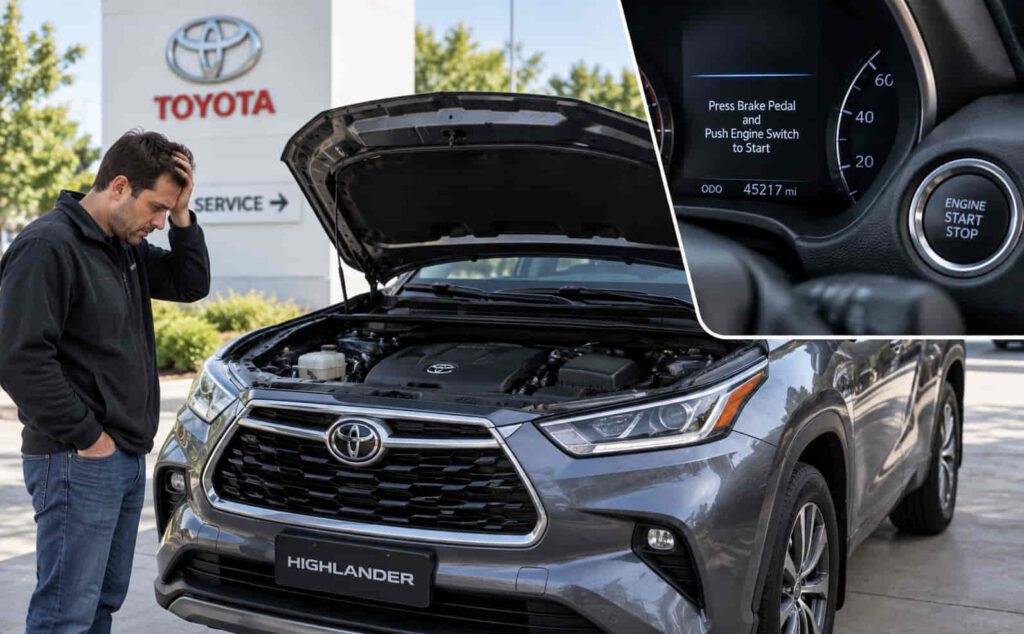
A Toyota Highlander that is not starting should be diagnosed according to what happens when you try to start the vehicle. A Highlander that makes a clicking sound, cranks normally but does not start, powers the dashboard without cranking, or produces no response at all is showing a different failure pattern. Identifying that pattern first helps narrow the problem before replacing the battery, starter, fuel-system components, or other parts.
The most common starting problems involve the 12-volt electrical supply, starter circuit, fuel delivery, ignition or engine-management system, Smart Key authorization, and the conditions required by the push-button start system. Toyota Highlander Hybrid models require an additional distinction because a hybrid vehicle can be ready to drive without the gasoline engine immediately running; the READY indicator is more important than engine sound when confirming whether the hybrid system has started.
This guide explains why a Toyota Highlander may not start, what different no-start symptoms mean, how to distinguish a weak battery from a starter or engine-related problem, why a Highlander can have working lights but still fail to start, and what to check when a Hybrid, Smart Key, or recently replaced battery is involved.
Why Is My Toyota Highlander Not Starting?
A Toyota Highlander may not start because the 12-volt electrical system cannot supply enough power, the starter circuit cannot crank the engine, the engine is not receiving the fuel or ignition conditions required for combustion, or the vehicle is preventing the start command because a Smart Key, immobilizer, brake-switch, transmission-position, or hybrid-system condition has not been satisfied. The fastest way to narrow the cause is to identify exactly what the Highlander does when the key is turned or the Start button is pressed.
A Highlander that does not crank has a different problem from one that cranks normally but does not start. “Crank” means the starter motor is physically turning the engine. If the engine does not turn at all, diagnosis should initially focus on the 12-volt battery, battery terminals, starter circuit, start authorization, and related electrical inputs. Fuel delivery and spark are not the first systems to investigate when the engine itself is not being rotated by the starter.
A clicking sound without engine rotation narrows the diagnosis further. Repeated clicking commonly occurs when the electrical system attempts to operate the starter but voltage drops too far under the starting load. A weak 12-volt battery, poor battery-terminal connection, excessive resistance in a cable, or another high-current electrical problem can create this condition. A single click with no crank can also involve the starter solenoid, starter motor, electrical connections, or control circuit, so the sound alone should not be used to condemn one component.
A Highlander that has working headlights, dashboard lights, or infotainment but does not crank can still have a battery-related problem. Lighting and electronic accessories require substantially less current than the starter motor. A weakened battery can therefore power the dashboard while failing when the vehicle requests the much larger current needed to crank the engine. Working lights confirm that some electrical power is present; they do not confirm that the 12-volt battery is capable of starting the vehicle.
The diagnostic direction changes when the engine cranks at a normal speed but does not start. In this condition, the battery and starter have already provided enough power to rotate the engine, so the next question is whether the engine has the conditions needed to run. Fuel delivery, ignition, engine-position information, electronic engine control, and other combustion-related inputs become more relevant than the starter itself. Replacing a starter will not correct a fuel or ignition problem when the existing starter is already cranking the engine normally.
A completely silent response creates another diagnostic pattern. If pressing the Start button produces no crank and no starter click, the vehicle may not be issuing or completing the start command. The cause can involve insufficient 12-volt power, Smart Key recognition, immobilizer authorization, brake-pedal input, the transmission not being recognized in the required position, a fuse or relay, or another part of the starter-control circuit. The dashboard messages and security indicators displayed during the start attempt can provide useful context in this situation.
Toyota Highlander Hybrid models require a different interpretation of “starting.” The gasoline engine does not have to begin running immediately for the vehicle to be successfully started. The important indication is whether the hybrid system enters its READY state. A Highlander Hybrid that displays READY can be capable of driving even when the gasoline engine is temporarily stopped. A Hybrid that does not enter READY should therefore be diagnosed as a hybrid-system start problem rather than judged only by whether engine noise is present.
The no-start symptom should always be identified before parts are replaced. The difference between no crank, clicking, normal cranking without ignition, electrical power without cranking, and failure to enter READY determines which system should be tested first. This symptom-based approach reduces unnecessary replacement of batteries, starters, fuel-system components, sensors, and ignition parts that may be operating normally.
What Should You Check First When a Toyota Highlander Won’t Start?
The first check when a Toyota Highlander will not start is the vehicle’s response to the start command: determine whether the engine cranks, whether the dashboard retains normal power, whether clicking or other sounds occur, and whether any Smart Key, security, transmission, or hybrid-system message appears. These observations establish the diagnostic path before electrical or mechanical components are tested.
Start by paying attention to how the dashboard behaves when the vehicle is switched on and when a start is attempted. Dashboard lights that become very dim, rapidly flicker, or disappear when the starter is requested can indicate that system voltage is collapsing under load. This pattern is more useful than simply confirming that the lights turn on before the start attempt because a battery can maintain accessory voltage but fail once starter current is demanded.
The sound produced during the start attempt provides another important distinction. Rapid clicking with no engine rotation points toward an electrical supply or connection problem before it points toward fuel or ignition. A single click suggests that part of the starter circuit is responding but the engine is still not being cranked. Complete silence indicates that the start command may not be reaching the starter or that the vehicle has not satisfied one of the conditions required to authorize starting.
If the engine turns over at a normal and consistent speed, the starting battery and starter motor have already performed their primary cranking function. Diagnosis should then move toward the systems that allow the engine to begin running. Fuel must reach the engine in the required amount, ignition must occur at the correct time on gasoline engines, and the engine-control system must receive the information it needs to coordinate starting. A crank-but-no-start condition should therefore not be diagnosed in the same way as a no-crank condition.
The 12-volt battery deserves attention even when the Highlander appears to have electrical power. Battery condition is determined by its ability to maintain adequate voltage and current under load, not by whether a radio or dome light works. Battery terminals should also provide a clean and secure electrical connection because resistance at a loose or corroded connection can restrict starter current even when the battery itself still contains charge.
The vehicle should also be in the correct transmission position for starting. A Highlander normally requires the transmission to be recognized in an approved start position such as Park, with model-specific conditions applying to the starting system. If the vehicle does not correctly recognize that condition, the starter command can be inhibited even though other electrical functions continue to operate.
On Highlanders with push-button start, brake-pedal input and Smart Key recognition are also part of the starting sequence. If the vehicle does not detect the brake-pedal input or cannot authenticate the registered key, pressing the Start button may switch electrical modes without completing the normal start sequence. A weak key-fob battery can affect communication, although the correct response depends on the Highlander’s model year and Smart Key system.
Warning messages should be treated as diagnostic information rather than ignored while repeatedly attempting to start the vehicle. A key-detection message, security indicator, charging-system warning, hybrid-system warning, or other start-related notification can identify which system is preventing normal operation. The message does not always identify the failed component directly, but it can eliminate unrelated causes and determine which system requires testing.
For a Highlander Hybrid, the READY indicator is the key starting reference. The absence of immediate gasoline-engine noise does not indicate a failure if READY is illuminated. If READY does not appear, diagnosis should focus on whether the 12-volt electrical system can initialize the vehicle, whether the Smart Key and start conditions are satisfied, and whether the hybrid control system is reporting a malfunction. High-voltage hybrid components should not be treated as ordinary starter-system components or tested using conventional battery procedures.
The first diagnostic goal is therefore not to identify a replacement part. It is to classify the starting failure correctly. Once the Highlander is identified as no-crank, clicking, crank-but-no-start, start-authorization failure, or Hybrid no-READY, the number of relevant systems becomes much smaller and the next test becomes more precise.
Read more: Toyota VIN Code Decoder
Why Does My Toyota Highlander Click but Not Start?
A Toyota Highlander that clicks but does not start usually has a problem delivering enough electrical power to crank the engine or completing the high-current starter circuit. The most relevant areas are the 12-volt battery, battery terminals and cables, starter solenoid, starter motor, and the electrical connections between them. The type of clicking sound provides useful diagnostic context, but it does not identify a failed component by itself.
Rapid repeated clicking commonly occurs when the starter circuit is energized but system voltage drops before the starter can rotate the engine. The solenoid engages, voltage falls under load, the solenoid releases, and the cycle repeats. This produces the familiar series of fast clicks. A discharged or deteriorated 12-volt battery is a common reason for this pattern because the battery can retain enough energy to operate low-current electronics while failing to deliver the substantially higher current required by the starter motor.
Battery condition is not the only factor that determines how much current reaches the starter. Loose battery terminals, corrosion around the connections, damaged cables, or excessive electrical resistance can reduce current even when the battery retains an adequate charge. The result can resemble a weak battery because the starter experiences the same practical problem: insufficient electrical power under load. This is why replacing the battery without checking its connections can leave the original no-start condition unchanged.
A single strong click followed by silence creates a different diagnostic direction. The sound can indicate that the starter solenoid or another part of the starting circuit is responding to the start command, but the starter motor is not successfully turning the engine. A worn starter motor, poor high-current connection, solenoid problem, or insufficient battery output can all produce this pattern. The click confirms that part of the circuit is reacting; it does not prove that the starter itself is the failed component.
The dashboard can provide additional evidence during the same start attempt. Headlights or instrument-panel illumination that become dramatically dimmer when the click occurs indicate that a significant electrical load is being applied. If electrical power remains apparently normal while the vehicle produces one click and never cranks, testing of the starter circuit becomes increasingly important. These observations narrow the diagnosis, but battery voltage and circuit performance under load provide stronger evidence than brightness alone.
A jump-start can also help distinguish an insufficient-power condition from another starting fault when it is performed according to the procedure specified for the vehicle. If the Highlander cranks normally after receiving an appropriate external 12-volt supply, the battery state, battery connections, and charging system deserve further testing. The successful jump does not automatically prove that the battery alone is defective because a poor charging condition may have discharged an otherwise functional battery.
If an adequate external 12-volt supply does not change the symptom and the Highlander continues to produce a single click without cranking, repeatedly attempting to start the engine provides little diagnostic value. The starter circuit, cable voltage drop, starter motor, solenoid, and related electrical controls need to be tested. A component should be replaced only after the failure pattern shows that electrical power reaches the relevant point but the circuit cannot perform its required function.
Clicking should also be distinguished from normal engine cranking. A starter that is audibly rotating the engine is already performing a different function from a starter circuit that only clicks. If the engine turns over repeatedly but never begins running, the problem has moved beyond a simple click/no-crank diagnosis and fuel delivery, ignition, engine-management inputs, or another combustion requirement becomes more relevant.
The correct interpretation is therefore based on the complete symptom. Rapid clicking strongly supports an electrical supply or connection problem, while one click without engine rotation shifts more attention toward the high-current starter circuit. Testing the 12-volt supply and its connections before replacing the starter provides a more reliable diagnosis than choosing a component from the clicking sound alone.
Why Won’t My Toyota Highlander Start Even Though the Lights Work?
A Toyota Highlander can have working headlights, dashboard lights, radio, and other accessories while still lacking enough 12-volt power or the required start authorization to crank the engine. Electrical accessories working normally does not prove that the battery, starter circuit, Smart Key system, or start-control inputs are functioning correctly.
The battery explanation comes from the difference in electrical demand. Interior lights, dashboard electronics, and infotainment systems require far less current than the starter motor needs to rotate the engine. A weakened battery can maintain sufficient voltage under a small electrical load and then experience a major voltage drop when starter current is requested. The driver therefore sees a powered dashboard and assumes the battery is healthy even though the battery cannot perform its most demanding starting function.
The behavior of those lights during the start attempt provides more information than whether they work before it. If the lights become substantially dimmer when the Start button is pressed or the key is turned, the electrical system may be experiencing a large voltage drop. A weak battery, poor terminal connection, cable resistance, or starter circuit drawing abnormal current can contribute to this response. If the lights remain bright and the starter remains completely silent, the diagnostic focus expands toward start authorization and starter-control inputs.
On Highlanders equipped with Smart Key and push-button start, powering the dashboard is not the same action as starting the engine. The vehicle must recognize the Smart Key and receive the inputs required for the start sequence. The brake pedal must be depressed and the transmission must be in the required starting position, normally Park. If those conditions are not recognized, pressing the button can power vehicle electronics without commanding a normal engine start.
This distinction explains a common symptom in which the Start button appears functional because the dashboard turns on, but the engine never cranks. The button itself has more than one operating function. Without the required brake input, a push can place the vehicle into an accessory or ignition-on state rather than initiate the complete starting sequence. The visible electrical response therefore does not establish that the starter was commanded.
Brake-pedal recognition can matter because the starting system relies on an electrical input rather than simply the physical fact that the driver is pressing the pedal. If the relevant brake-switch signal is not recognized, the vehicle may not satisfy the conditions required to start. The exact behavior varies by model year and system configuration, so dashboard start prompts and brake-related indications should be interpreted according to the Highlander’s specific operating information.
Smart Key recognition creates another separation between accessory power and successful starting. A vehicle can have a fully illuminated dashboard while the key is not being authenticated correctly. A weak key-fob battery, communication problem, unrecognized key, or immobilizer-related condition can interfere with start authorization without removing all electrical power from the vehicle. Key-related messages or security indicators are therefore more informative than simply observing that the cabin electronics operate.
The transmission-position input can produce a similar no-crank symptom. The starting system must recognize an acceptable selector position before enabling normal cranking. If the vehicle does not correctly recognize Park, electrical accessories can continue to function while the starter remains inhibited. This creates a fundamentally different problem from a discharged battery even though both conditions can result in an engine that does not crank.
A starter-control problem remains possible when the battery supply, key recognition, brake input, and transmission conditions are correct. A fuse, relay, wiring connection, starter solenoid, starter motor, or another control-circuit component can prevent the starter from operating while the rest of the vehicle retains electrical power. Testing is required to determine where the start command or electrical current stops rather than assuming that one component is responsible.
Working lights should therefore be treated as evidence that the Highlander has some 12-volt electrical power, not evidence that its starting system is healthy. The next diagnostic question is whether voltage remains adequate under starter load and whether the vehicle is actually authorizing a start. That distinction separates battery and high-current circuit problems from Smart Key, brake-input, transmission-position, and starter-control faults.
Why Does My Toyota Highlander Crank but Not Start?
A Toyota Highlander that cranks normally but does not start has already passed the basic starter test, so diagnosis should shift from the starter motor toward fuel delivery, ignition, engine-management inputs, and the conditions required for combustion. The starter is doing its primary job when it rotates the engine at a normal speed. Replacing it will not correct a no-start condition caused by missing fuel, missing spark, or incorrect engine-control information.
Fuel delivery is one of the first systems that becomes relevant after normal cranking is confirmed. The engine needs the correct amount of fuel at the required pressure before combustion can begin. A fuel-pump problem, an electrical fault in the pump circuit, restricted delivery, or another fuel-system failure can allow the starter to rotate the engine repeatedly while the engine never begins running. The symptom is therefore different from a weak-battery condition because engine rotation is already occurring.
Ignition is another requirement on gasoline Highlander models. Fuel in the cylinders must be ignited at the correct time for the engine to start and continue running. Problems involving ignition coils, spark-plug operation, electrical power to the ignition system, or engine-control commands can create a crank-but-no-start condition. The presence of normal cranking alone does not confirm that the ignition system is producing the spark required for combustion.
Engine-position information is also important because the engine control system needs to know how the crankshaft and camshafts are moving before it can coordinate fuel injection and ignition timing correctly. A fault involving a crankshaft-position or camshaft-position signal can interfere with the information required during starting. The starter can continue turning the engine because the cranking circuit is independent of whether the engine-control module is receiving every signal needed to begin normal operation.
The immobilizer and engine-control system can also affect the transition from cranking to running. Toyota uses registered-key and immobilizer functions to prevent unauthorized engine operation. Depending on model year and system design, an authorization or control problem can prevent a normal start sequence even when other parts of the vehicle remain powered. A security indicator, key-related message, or stored diagnostic fault can therefore provide more useful evidence than repeatedly attempting to start the vehicle.
Cranking speed should also be considered before moving completely away from the 12-volt electrical system. An engine that technically rotates but does so unusually slowly is not showing the same condition as an engine that cranks strongly at normal speed. Low battery output, poor cable connections, or excessive starter resistance can reduce cranking speed enough to make engine starting more difficult. The distinction should therefore be between normal cranking without ignition and abnormally slow cranking, not simply whether any rotation occurs.
The duration of the symptom can provide additional context. A Highlander that suddenly cranks but does not start after operating normally can point toward a failure that interrupted fuel, ignition, sensor input, or authorization. A vehicle that becomes progressively harder to start can indicate a different diagnostic path. Timing alone does not identify the failed component, but it helps determine which changes occurred immediately before the no-start condition appeared.
Diagnostic trouble codes and live engine data become more useful in a crank-but-no-start condition because the engine-control system is active while the engine is being rotated. A scan tool can reveal whether the control module has stored faults related to engine-position sensors, ignition, fuel control, immobilizer functions, or other systems. Codes should be treated as diagnostic evidence rather than instructions to replace whichever component is named, because a wiring, power-supply, connection, or related-system problem can create the same fault information.
A crank-but-no-start Toyota Highlander therefore requires a different diagnostic strategy from a vehicle that only clicks or remains silent. Once strong, normal cranking is confirmed, the central question becomes why the engine cannot transition from being mechanically rotated by the starter to running under its own combustion. Fuel delivery, ignition, engine-position information, and engine-control authorization become the primary systems to evaluate.
Why Does My Toyota Highlander Make No Sound When I Try to Start It?
A Toyota Highlander that produces no starter sound and no engine cranking should first be checked for a 12-volt power problem, an unsatisfied start condition, Smart Key or immobilizer authorization, or a fault in the starter-control circuit. A silent no-start condition is different from a crank-but-no-start problem because the starter has not yet begun rotating the engine.
The dashboard response helps divide this condition into two diagnostic directions. If the Highlander is completely unresponsive and the instrument panel does not power normally, the 12-volt battery and its main connections become the first concerns. A deeply discharged battery, disconnected terminal, poor ground connection, or major power-supply fault can prevent both vehicle electronics and the starter-control system from operating normally.
If the dashboard powers normally but the starter remains silent, the vehicle may have electrical power without satisfying the conditions required to issue a start command. Highlanders equipped with Smart Key and push-button start require the correct start sequence. Toyota’s Highlander guidance specifies that the Smart Key must be carried, the transmission must be in Park, and the brake pedal must be depressed for the start function. Pressing the start switch without the brake pedal can instead place the vehicle into accessory or ignition-on modes while leaving the engine off.
This operating distinction explains why a driver can see a fully illuminated dashboard without hearing any starter activity. The electrical system has entered a power mode, but the vehicle has not necessarily authorized engine cranking. A weak electronic-key battery, failed key recognition, immobilizer issue, missing brake-pedal input, or incorrect transmission-position signal can interfere with this authorization while leaving many electrical functions available.
The brake-pedal signal is important because push-button starting depends on an electrical input from the braking system, not simply on the driver’s intention to start the vehicle. If the vehicle does not detect the required brake input, the Start button can behave as a power-mode switch instead of commanding the starter. Model-year-specific dashboard messages or indicators can help distinguish this situation from a starter-motor failure.
Transmission-position recognition performs a similar safety function. The starting system must confirm an acceptable selector position before normal engine cranking is permitted. A Highlander that is physically in Park but whose control system does not correctly recognize the position can remain silent when the driver attempts to start it. This is why a no-sound condition should not immediately be attributed to a dead starter motor.
The Smart Key and engine immobilizer provide another layer of authorization. If the registered key is not recognized, the vehicle can inhibit normal starting even though other electrical systems are available. The presence of a key-related warning or security indication therefore changes the diagnostic direction from high-current starter hardware toward key recognition and authorization.
If the battery supply and required start conditions are confirmed, the starter-control circuit becomes more important. The Start button or ignition input has to be communicated through the appropriate control system before power reaches the starter solenoid and motor. A fault involving a fuse, relay, wiring connection, control signal, starter solenoid, or starter motor can interrupt this process and produce complete silence at the starter.
Toyota’s operating guidance also reinforces why power mode and start mode should not be confused. On Highlander models with Smart Key, pressing the engine switch without depressing the brake cycles through electrical operating modes rather than starting the engine. This behavior is normal and can resemble a starting failure when the driver expects dashboard activation to mean that a complete start command has occurred.
A silent Toyota Highlander should therefore be diagnosed in sequence according to what the vehicle is actually doing. Complete loss of electrical response points first toward 12-volt power and main connections. Normal dashboard power with no starter response shifts attention toward start authorization and control inputs. Once those conditions are verified, testing can move deeper into the starter-control circuit instead of replacing parts based only on the absence of sound.
Can a Weak or Dead 12-Volt Battery Stop a Toyota Highlander From Starting?
Yes. A weak or discharged 12-volt battery can prevent a Toyota Highlander from starting because the starting system requires sufficient electrical power to operate the vehicle electronics and, on gasoline models, turn the engine with the starter motor. A battery does not need to be completely dead to cause a no-start condition. It can retain enough charge to illuminate the dashboard or operate accessories while failing when the much larger starting load is applied.
A weak battery commonly changes how the Highlander behaves during the start attempt. The starter may turn more slowly than normal, the instrument lights may become noticeably dim, or the vehicle may produce repeated clicking instead of cranking. Toyota’s own troubleshooting information associates slow starter operation combined with dim lights or a weak horn with a discharged battery or loose or corroded battery-terminal connections.
The difference between available voltage and usable starting power explains why battery problems are frequently misdiagnosed. A voltmeter can show that electrical potential is present while the battery still performs poorly under load. Starting a gasoline engine requires a high current for the starter motor, and resistance at the battery terminals or cables can reduce the amount of current that actually reaches the starting circuit. Battery condition and connection condition therefore need to be evaluated together.
Loose or corroded battery terminals can produce nearly the same symptoms as a discharged battery. The battery may contain adequate stored energy, but excessive resistance at the connection prevents that energy from reaching the starter efficiently. Toyota includes loose or corroded terminal connections among the causes to consider when the starter turns slowly and the vehicle’s lights are dim. This is why installing a new battery does not necessarily solve a Highlander starting problem when the original fault is in the connections.
A deeply discharged 12-volt battery can produce a more complete loss of vehicle response. If the starter does not turn, the headlights and interior lights do not illuminate, and the horn does not operate, Toyota identifies a discharged battery or disconnected battery terminal among the possible causes. This failure pattern differs from a Highlander that has strong electrical power but remains silent when the Start button is pressed.
Temperature and battery age can influence when the problem becomes noticeable. A battery that has lost capacity may continue to start the Highlander under favorable conditions and then fail when electrical demand increases or available battery performance decreases. The important diagnostic question is therefore not simply whether the battery still produces electricity, but whether it maintains sufficient output during the actual start attempt.
A successful jump-start provides useful evidence when the Highlander initially shows a weak-battery pattern. If external 12-volt power allows the vehicle to crank and start normally, battery state and the charging system become important areas for further testing. The jump-start itself does not establish why the battery was discharged. The battery may have deteriorated, the vehicle may have been left unused long enough to discharge it, an electrical load may have remained active, or the charging system may not have restored the battery sufficiently during previous operation.
The battery and alternator should therefore not be treated as the same diagnosis. The 12-volt battery stores the electrical energy used during starting, while the charging system replenishes and supports the electrical supply after the engine is operating on a conventional gasoline Highlander. A discharged battery can be the immediate reason the vehicle will not start even when the underlying reason for that discharge lies elsewhere. Replacing the battery without determining why it lost charge can allow the same symptom to return.
Highlander Hybrid models also rely on a 12-volt battery even though their propulsion system includes a much larger high-voltage traction battery. The 12-volt system supplies the low-voltage electronics required to initialize the vehicle and bring the hybrid system into READY mode. Toyota documentation for Highlander Hybrid specifically addresses preventing discharge of the 12-volt battery and distinguishes it from the hybrid traction battery. A Hybrid can therefore fail to start because of a low 12-volt battery even though the high-voltage battery is a separate component.
The distinction is especially important because a Highlander Hybrid does not use engine cranking sound as the primary confirmation that it has started. The vehicle needs enough 12-volt power to initialize the control systems and enter READY. The gasoline engine can remain off after READY appears because the hybrid system can determine when the engine needs to run. A no-READY condition can therefore be caused by a low 12-volt supply without producing the traditional slow-cranking symptom associated with a gasoline-only vehicle.
A 12-volt battery should ultimately be diagnosed by its condition under load, the integrity of its terminals and cables, and the reason it became discharged. Dashboard lights alone are not enough to clear the battery from suspicion, and a successful jump-start is not enough to prove that every other part of the charging system is healthy. Testing the electrical supply before replacing starter or engine-control components provides a stronger diagnostic path for a Toyota Highlander that will not start.
Can a Toyota Highlander Smart Key or Push Button Prevent the Car From Starting?
Yes. A Toyota Highlander equipped with Smart Key and push-button start can fail to start when the vehicle does not recognize the key or when one of the conditions required to authorize starting is not satisfied. The Start button does more than switch the starter motor on and off; its behavior depends on key recognition, brake input, transmission position, and the vehicle’s electronic start-control logic.
Toyota’s Highlander guidance states that the Smart Key must be carried for the start function and that the vehicle is started with the transmission in Park, the brake pedal depressed, and the engine Start/Stop switch pressed. The same guidance explains that pressing the switch without depressing the brake pedal changes the vehicle through electrical power modes rather than starting the engine. This distinction directly explains why a Highlander can display dashboard lights while remaining completely silent at the starter.
A key-recognition problem can interrupt the sequence before engine cranking begins. The vehicle must authenticate an appropriate electronic key before normal starting is allowed. If communication between the key and vehicle is unsuccessful, the driver may see a key-related warning or find that pressing the Start button changes electrical modes without producing a normal start. The resulting symptom can resemble a starter fault even though the starter has never been authorized to operate.
A depleted Smart Key battery is one condition that can interfere with normal wireless operation, but it does not automatically mean the vehicle itself has an electrical failure. Toyota documentation for Smart Key systems includes alternative recognition procedures for situations in which the electronic-key battery is depleted, with the exact method dependent on the vehicle and model year. The correct procedure should therefore come from the owner’s manual for the specific Highlander rather than from a generic key-fob reset method.
The brake-pedal input is equally important because the vehicle must electronically recognize that the brake is being applied during the normal push-button start sequence. Physically pressing the pedal does not guarantee that the required electrical signal is reaching the start-control system. If the relevant brake-switch input is missing, the Highlander can behave as though the driver is requesting an accessory or ignition mode instead of a full start.
This failure pattern can be identified by comparing the Start button response with normal operation. If the dashboard powers up but the expected start indication never appears, the problem may be with one of the start conditions rather than with the starter motor itself. The vehicle’s display messages are especially useful because they can indicate a missing brake input, an undetected key, or another condition that prevents the start command from progressing.
Transmission-position recognition creates another electronic condition that must be satisfied. Highlander Smart Key instructions specify Park as part of the normal start procedure. If the vehicle does not recognize the required selector position, the starting system can remain inhibited while the lights, radio, climate-control panel, and other electronics continue operating.
The engine immobilizer adds a security layer to this process. Toyota’s troubleshooting material identifies an immobilizer malfunction as one possible reason an engine can fail to start even when the starter operates normally. This means authorization faults do not always present as complete silence; their behavior can vary according to model year and system configuration. Security indicators and diagnostic data therefore matter when the mechanical and electrical starting components appear functional.
A push-button start problem should not automatically lead to replacement of the Start button. The button is only one input within a larger system that includes the Smart Key, brake-pedal signal, transmission-position information, immobilizer, 12-volt power supply, control modules, wiring, relays, and starter circuit. A fault anywhere along that authorization path can create the same visible symptom of pressing the button without a successful start.
The diagnostic distinction is straightforward: if the Highlander has adequate 12-volt power but no crank occurs, determine whether the vehicle is actually authorizing the start before concluding that the starter motor has failed. Key-related messages, the brake-pedal response, selector position, dashboard behavior, and starter activity provide the evidence needed to separate an authorization problem from a high-current starter problem.
For Highlander Hybrid models, Smart Key authorization remains important, but the final confirmation changes from engine noise to READY status. Toyota’s Highlander Hybrid guidance states that the Smart Key must be present, the selector must be in Park, and the brake pedal must be depressed before the power button is used to start the vehicle. Once READY appears, the hybrid system is operating even if the gasoline engine does not immediately run.
Smart Key and push-button failures should therefore be diagnosed as part of the complete starting sequence rather than as isolated button problems. When a Toyota Highlander has normal electrical power but does not start, confirming key recognition and the required brake and transmission inputs can prevent unnecessary replacement of the battery, starter, or other components that may already be functioning correctly.
Why Won’t My Toyota Highlander Start After Replacing the Battery?
If a Toyota Highlander will not start immediately after the 12-volt battery has been replaced, the new battery’s state of charge, terminal connections, electrical installation, and normal start conditions should be checked before assuming that an unrelated component failed at the same time. The timing of the failure matters because a no-start condition that begins directly after battery replacement increases the relevance of anything disturbed during that procedure.
A replacement battery is not automatically fully charged simply because it is new. The battery must still provide sufficient voltage and current under the starting load. If its state of charge is low, a gasoline Highlander may crank slowly, click without cranking, or fail to crank at all. A Hybrid may instead fail to initialize its control systems and enter READY. The battery should therefore be evaluated by its actual electrical performance rather than by its age alone.
Battery-terminal installation is equally important. Both terminals must make secure electrical contact because the starter and vehicle control systems depend on a low-resistance connection to the 12-volt supply. A terminal that is positioned incorrectly, insufficiently tightened, contaminated, or poorly connected can allow lights and electronics to operate while restricting the current required during starting. This produces the misleading situation in which the battery has just been replaced and the Highlander has electrical power but still will not start.
The ground side of the circuit also matters. Electrical current must complete a path from the battery through the vehicle’s circuits and back through the ground connections. A disturbed, loose, or high-resistance ground connection can create starting symptoms similar to those caused by a weak positive connection. The diagnostic question after battery replacement is therefore whether the new battery is properly connected to the complete electrical circuit, not simply whether the positive terminal appears attached.
The starting symptom should then be classified in the same way as any other Highlander no-start condition. Repeated clicking or severe dimming under load keeps attention on the 12-volt supply and high-current connections. Normal dashboard power with complete starter silence shifts attention toward start authorization, transmission position, brake input, Smart Key recognition, and the starter-control circuit. Normal cranking without engine operation means the replacement battery is already supplying enough power to perform the basic cranking function, so the diagnosis must extend beyond the battery.
A battery replacement can also temporarily interrupt power to vehicle systems. This interruption should not be interpreted as evidence that every unusual behavior after reconnection represents a failed control module. Toyota specifically notes for Highlander Hybrid that after the 12-volt battery has discharged or its terminal has been removed and reinstalled, operating behavior can temporarily differ; Toyota also states that a hybrid system may not start after the 12-volt battery has been disconnected and instructs the driver to attempt starting it again. If READY still does not illuminate, Toyota directs the owner to contact a dealer.
This manufacturer guidance is important because it provides a defined response without relying on unsupported “reset” procedures. Disconnecting and reconnecting the battery repeatedly, performing arbitrary button sequences, or attempting internet-sourced relearn methods can introduce additional variables without establishing why the vehicle is not starting. The correct procedure should match the Highlander’s model year and powertrain because gasoline and hybrid starting systems do not behave identically.
A Hybrid also requires the 12-volt battery and the high-voltage traction battery to be treated as separate systems. Replacing the 12-volt battery does not mean the traction battery has been replaced or reset. The 12-volt system supports vehicle electronics and system initialization, while the traction battery serves the high-voltage hybrid powertrain. A problem occurring after 12-volt battery replacement should therefore be diagnosed first in the context of the work that was actually performed rather than attributed automatically to the hybrid battery.
If the vehicle starts after an external 12-volt supply is provided, the replacement battery’s charge condition and its connections require further attention. If the vehicle has adequate 12-volt power and still does not start, diagnosis should move to the symptom that remains, such as no crank, failure of start authorization, normal cranking without ignition, or Hybrid failure to enter READY. This prevents the recently replaced battery from becoming the assumed explanation for every subsequent starting problem.
A Toyota Highlander that stops starting immediately after battery replacement should therefore be checked in chronological order. Confirm that the replacement battery can supply the required electrical power, confirm that the terminals and ground path provide secure connections, and then determine whether the vehicle is completing its normal start sequence. If those conditions are correct, the no-start problem requires diagnosis beyond the battery rather than another battery replacement.
Why Won’t My Toyota Highlander Hybrid Start or Show the READY Light?
A Toyota Highlander Hybrid should be considered successfully started when the READY indicator illuminates; the gasoline engine does not need to start running immediately. Toyota states that a hybrid vehicle can be capable of moving while the gasoline engine is stopped when READY is illuminated. Judging a Highlander Hybrid only by engine sound can therefore make normal hybrid operation appear to be a starting failure.
The READY indicator has a different diagnostic meaning from the engine-running sound used on a conventional gasoline vehicle. After the hybrid system is initialized, the control system determines when the gasoline engine needs to operate and when propulsion or vehicle operation can occur with the engine stopped. The engine may start or stop automatically according to factors such as operating conditions, battery state, temperature, or vehicle demand. Silence from the gasoline engine is therefore normal when READY confirms that the hybrid system is active.
A Highlander Hybrid that does not display READY has a genuine start-system problem and should first be evaluated according to the vehicle’s startup conditions and 12-volt electrical state. The 12-volt auxiliary battery is required to power the low-voltage vehicle electronics and initialize the hybrid control system. It performs a different function from the high-voltage traction battery. If the 12-volt supply is discharged, the vehicle may not be able to complete the electronic sequence required to enter READY.
This distinction explains why a Hybrid can have a no-start condition without producing the slow starter-motor sound associated with a conventional gasoline vehicle. The hybrid starting process does not rely on the driver hearing a traditional starter crank as the primary indication of success. The driver should instead observe whether the vehicle powers correctly, recognizes the Smart Key and required start inputs, and ultimately illuminates READY.
The Smart Key and normal start conditions still matter on a Highlander Hybrid. The vehicle must recognize the appropriate key and receive the required brake and transmission-position inputs before the hybrid system can be placed into its operating state. A key-recognition problem, insufficient 12-volt power, or another condition that prevents the start sequence from being completed can leave the dashboard active without producing READY.
A warning message provides another important distinction. Toyota states that hybrid-system warning messages are displayed when a malfunction occurs or an improper operation is attempted and instructs the driver to follow the message shown on the multi-information display. When READY does not appear and a hybrid warning is present, the message should be treated as diagnostic information rather than bypassed through repeated start attempts.
Toyota also specifically addresses the relationship between the 12-volt battery and a no-READY condition. The Highlander Hybrid owner’s manual states that if a warning appears or the 12-volt battery has been disconnected, the hybrid system may not start. Toyota instructs the driver to try starting the system again and to contact a Toyota dealer if the READY indicator still does not illuminate. This provides a clearer diagnostic boundary than assuming that battery disconnection permanently damaged or “locked” the hybrid system.
Fuel level can matter as well because the hybrid powertrain still contains a gasoline engine. Toyota states that if the vehicle runs out of fuel, the hybrid system may be unable to start until enough gasoline has been added. This demonstrates why a Hybrid no-start condition cannot always be attributed to the electrical side of the powertrain simply because the vehicle contains a traction battery.
The high-voltage traction battery must also be distinguished from the 12-volt auxiliary battery when discussing jump-starting. The two batteries operate at different voltage levels and serve different functions. Toyota’s hybrid safety documentation distinguishes the 12-volt auxiliary electrical system from the high-voltage battery system, and high-voltage hybrid components should not be treated as ordinary 12-volt starter components.
This distinction has a direct safety implication. A driver diagnosing a no-READY condition can evaluate ordinary observations such as dashboard behavior, Smart Key recognition, warning messages, and the condition of the 12-volt supply, but should not attempt to access, bypass, or service high-voltage hybrid components as part of routine no-start troubleshooting. A hybrid-system warning or persistent failure to achieve READY after the normal start conditions and 12-volt supply have been confirmed requires appropriate diagnostic equipment and procedures.
A Highlander Hybrid no-start problem should therefore be defined by READY status before anything else. READY illuminated with no gasoline-engine sound can be normal. READY absent with weak or abnormal electrical behavior makes the 12-volt system relevant. READY absent with adequate 12-volt power, correct key recognition, proper start inputs, or a hybrid warning requires diagnosis of the corresponding control system. This distinction prevents the gasoline engine’s normal start-stop behavior from being mistaken for a failed hybrid system.
Can You Jump-Start a Toyota Highlander That Won’t Start?
A Toyota Highlander can be jump-started when insufficient 12-volt battery power is the reason it will not start, but a jump-start will not correct a failed starter, Smart Key authorization problem, fuel or ignition fault, or hybrid-system malfunction. The value of jump-starting is therefore both practical and diagnostic: it supplies temporary 12-volt power while showing whether insufficient battery output is responsible for the no-start condition.
A Highlander that produces rapid clicking, cranks unusually slowly, or shows substantial electrical dimming during a start attempt is more consistent with a low-voltage condition than a vehicle that cranks strongly but never begins running. Providing an appropriate external 12-volt source can restore enough electrical capacity for the starting system to operate. If the Highlander then cranks and starts normally, the original battery state and the reason it became discharged should be investigated rather than assuming the problem has been permanently solved.
A successful jump-start does not prove that the battery itself is the only failed component. A battery can become discharged because it has deteriorated internally, the vehicle was unused for an extended period, an electrical load remained active, a poor connection prevented proper charging, or the charging system did not replenish the battery during previous operation. The jump-start establishes that additional 12-volt power changed the starting condition; it does not identify why the original battery lacked that power.
The opposite result is equally useful. If the Highlander receives an adequate external 12-volt supply but still produces one click without cranking, the starter motor, solenoid, high-current cables, ground path, or starter-control circuit becomes more relevant. If the vehicle remains completely silent despite adequate electrical power, Smart Key recognition, brake input, transmission-position recognition, immobilizer authorization, and starter-control signals should be examined. If the engine cranks strongly but does not run, the diagnostic path moves toward fuel delivery, ignition, engine-management signals, or another combustion requirement.
The procedure must match the Highlander’s model year and powertrain because the location of the battery or designated jump terminal can differ. Toyota instructs owners to use the specified terminals and connection points rather than choosing an arbitrary point in the electrical system. Incorrect jumper-cable placement can damage electrical equipment and creates a risk of short circuits or other hazards. For that reason, the owner’s manual for the specific Highlander should determine the connection procedure rather than a generic jump-start diagram.
A Highlander Hybrid can also use external 12-volt power when its auxiliary battery is discharged. Toyota’s hybrid documentation explains that a discharged 12-volt battery can prevent the hybrid system from starting and provides a designated jump-start procedure using an external 12-volt source. After power is supplied, the relevant confirmation is that the READY indicator comes on. If READY does not appear after the specified procedure, Toyota directs the owner toward further inspection rather than continued repeated starting attempts.
The 12-volt auxiliary battery must not be confused with the high-voltage traction battery on a Highlander Hybrid. Jump-starting addresses the low-voltage system needed to initialize the vehicle; it is not a procedure for directly charging or bypassing the high-voltage hybrid battery. High-voltage components require specialized safety procedures and should not be accessed as part of normal roadside starting diagnosis.
A jump-start is therefore most useful when the symptoms already support inadequate 12-volt power. If external power restores normal starting, the battery and charging system require follow-up testing. If the symptom does not change, continuing to boost the battery provides little additional information, and diagnosis should shift to the specific system associated with the remaining no-start pattern.
When Should a Toyota Highlander That Won’t Start Be Professionally Diagnosed?
A Toyota Highlander should be professionally diagnosed when adequate 12-volt power and the normal starting conditions have been confirmed but the vehicle still will not crank, will not continue running, or will not enter READY on a Hybrid model. Professional diagnosis becomes more valuable once the problem can no longer be isolated through basic observations of battery power, starter behavior, Smart Key recognition, transmission position, and dashboard warnings.
A repeated no-crank condition with a known-good battery is one example. Once battery output and terminal connections are confirmed, the technician can measure voltage through the starter circuit and determine whether the starter motor receives the electrical supply and control signal it requires. Voltage-drop testing can identify excessive resistance in cables or ground connections that may look normal during a visual inspection. This separates a starter failure from a wiring or connection problem before an expensive component is replaced.
A Highlander that cranks normally but never starts also requires deeper testing when obvious conditions such as fuel level and key authorization have been eliminated. A technician can use scan-tool information and direct system tests to determine whether the engine control module is receiving crankshaft and camshaft position information, whether fuel delivery is available, whether ignition is being commanded correctly, and whether diagnostic trouble codes point toward a specific circuit or control problem. A trouble code should guide testing rather than automatically determine which part is replaced.
Persistent Smart Key or immobilizer symptoms also justify professional diagnosis when a known registered key and the correct start procedure do not restore operation. Electronic authorization involves communication among the key, security functions, vehicle control modules, and starting system. Replacing a starter or battery cannot solve a no-start condition when the vehicle is intentionally withholding start authorization because one of those electronic conditions has not been satisfied.
Warning lights and messages provide a stronger reason to stop basic troubleshooting when they indicate a system malfunction. Toyota explains that warning lights identify faults in specific vehicle systems and recommends inspection when malfunction-related indicators do not behave normally. A charging-system warning, transmission/Park-related warning, persistent malfunction indicator, or another start-related message should therefore be interpreted according to the Highlander’s model-year-specific manual rather than cleared or ignored without diagnosis.
A Highlander Hybrid requires an even clearer boundary between owner-level checks and professional service. If adequate 12-volt power is available, the correct Smart Key and startup conditions are present, and READY still does not illuminate, the hybrid system needs appropriate diagnostic procedures. Toyota states that when the hybrid system does not start after a 12-volt battery interruption, the start should be attempted again; if READY still does not come on, the vehicle should be inspected.
High-voltage hybrid faults should not be approached as conventional starter problems. The traction battery, inverter, high-voltage cables, and associated control components operate under conditions that require specialized procedures and equipment. A hybrid-system warning combined with a persistent no-READY condition is therefore a diagnostic boundary where further DIY electrical testing should not extend into high-voltage components.
Professional diagnosis is also appropriate when the vehicle repeatedly discharges its 12-volt battery after being successfully jump-started or recharged. In that situation, restoring battery power treats the immediate symptom but does not explain why charge is repeatedly lost. Battery condition, charging performance, cable integrity, and abnormal electrical drain may need to be measured to identify the root cause.
The point at which professional diagnosis becomes necessary is therefore based on evidence rather than the number of unsuccessful start attempts. Once basic 12-volt power, physical connections, Smart Key recognition, required starting inputs, and the observable start pattern have been established, additional repeated attempts provide less information. Circuit testing, scan data, fuel or ignition testing, or hybrid-system diagnostics can then identify the failed system without replacing unrelated components.
How Can You Prevent Toyota Highlander Starting Problems?
You can reduce Toyota Highlander starting problems by maintaining the 12-volt electrical system, correcting weak battery or connection problems before they cause a no-start condition, keeping the Smart Key functional, and responding to warning signs instead of waiting until the vehicle stops starting completely. Preventive maintenance cannot eliminate every starter, sensor, fuel-system, or electronic failure, but it can reduce several common conditions that lead directly to a Highlander that will not start.
The 12-volt battery deserves the most consistent attention because both gasoline and Hybrid Highlanders depend on low-voltage electrical power during the starting process. A battery can gradually lose capacity before it becomes completely discharged, which means slower cranking, repeated clicking, unusual electrical dimming, or intermittent starting should be treated as early diagnostic signals rather than normal aging. Toyota describes the 12-volt battery as the electrical source required for vehicle starting and recommends maintaining the vehicle according to its applicable service information.
Battery terminals and main electrical connections should remain secure and free from conditions that create excessive resistance. A battery with sufficient stored energy can still produce a starting failure when the electrical path cannot deliver that energy efficiently to the starter or vehicle control systems. Intermittent starting after a battery has been moved, replaced, or serviced deserves particular attention because a marginal terminal or ground connection can allow accessories to operate while failing under the substantially larger electrical demand of starting.
Repeated battery discharge should be diagnosed rather than corrected only by jump-starting the vehicle. A jump-start restores temporary starting power but does not explain why the 12-volt battery lost charge. A battery that repeatedly becomes discharged can indicate declining battery capacity, inadequate charging, an electrical load remaining active while the vehicle is parked, or another problem in the low-voltage electrical system. Identifying the cause prevents the same Toyota Highlander not-starting symptom from returning after the battery has been recharged.
Periods of little or no vehicle use can also affect the 12-volt electrical system. Toyota’s Highlander Hybrid manual describes a battery-saving function intended to reduce depletion of the electronic-key battery and 12-volt battery when the vehicle remains unused for extended periods. The same manual explains that Smart Key operation can change after several days of inactivity as battery-saving functions activate. Understanding this behavior helps distinguish a battery-saving feature from a new Smart Key malfunction after the vehicle has been parked for an extended period.
The electronic key should also be maintained because Smart Key recognition is part of the normal start authorization process on equipped Highlanders. A weakening key-fob battery can eventually affect wireless operation and create symptoms that resemble a vehicle starting fault. Toyota’s Highlander documentation identifies electronic-key battery depletion as a condition that can affect Smart Key operation and provides model-specific procedures for situations in which normal electronic-key operation is unavailable. Replacing a weak key battery before key recognition becomes unreliable removes one avoidable source of starting difficulty.
Drivers should also pay attention to changes in the normal starting pattern. A Highlander that occasionally cranks more slowly, requires repeated attempts, produces a new clicking sound, intermittently fails to recognize the key, or displays start-related warning messages is already providing diagnostic information. These symptoms are more useful when investigated before the vehicle reaches a complete no-start state because an intermittent electrical or authorization problem can be tested while the vehicle is still operating.
Warning indicators should not be treated as unrelated dashboard clutter when they occur together with starting changes. Toyota explains that warning-light meaning and required action depend on the specific system and directs owners to the model-specific owner’s manual for details. A charging, security, engine, or hybrid-system indication that repeatedly appears around the time of a starting problem can help identify the system that requires attention before another no-start event occurs.
Highlander Hybrid owners should pay particular attention to READY status and the condition of the 12-volt system rather than trying to judge vehicle health solely by whether the gasoline engine is running. The Hybrid still depends on its low-voltage electrical system to initialize the vehicle, while the high-voltage traction battery serves a separate propulsion function. Preventing 12-volt discharge and recognizing abnormal READY behavior early therefore reduces the risk of confusing an auxiliary-battery problem with a high-voltage hybrid-system failure.
The most effective prevention strategy is to respond to deterioration before it becomes a complete failure. Stable 12-volt power, secure electrical connections, reliable Smart Key operation, correct interpretation of warning messages, and model-specific scheduled maintenance protect the systems that participate directly in the Highlander’s start sequence. When the starting behavior changes repeatedly, testing the affected system provides more value than waiting until the Toyota Highlander no longer starts at all.