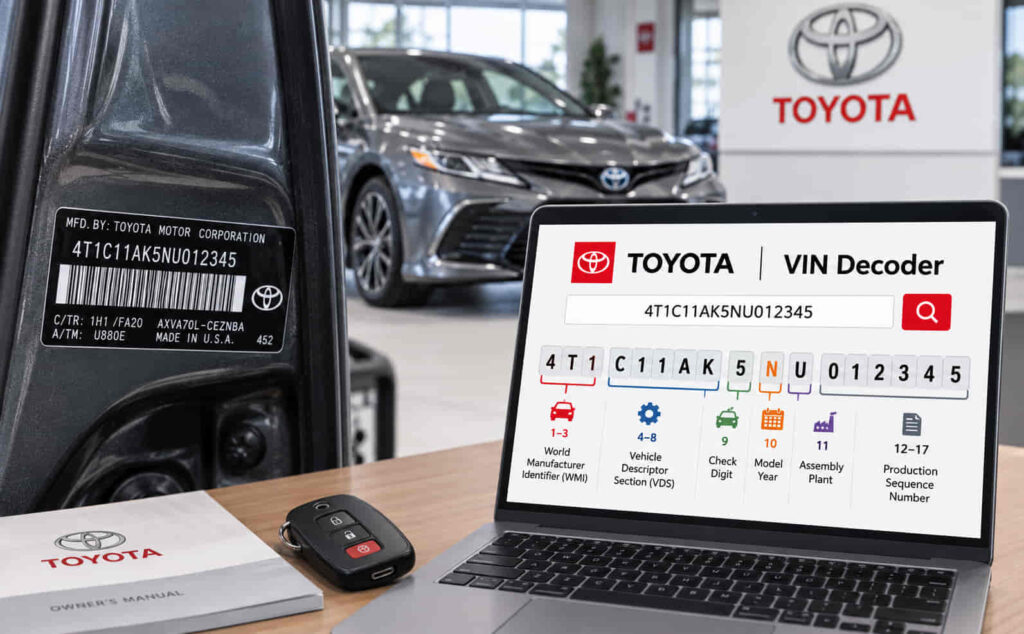
A Toyota VIN code decoder reads the 17-character Vehicle Identification Number assigned to a Toyota vehicle and converts its coded characters into identifiable vehicle information. A Toyota VIN can reveal the manufacturer, vehicle characteristics, model year, assembly plant, and production sequence when the VIN follows the standardized 17-character format used on modern vehicles.
Each position in a Toyota VIN has a specific identification function. The first characters identify the manufacturer and manufacturing region, the middle section describes vehicle-related attributes, and the final section identifies information such as the model year, assembly plant, and individual production sequence. This structure allows a VIN to distinguish one Toyota vehicle from another even when two vehicles share the same model name, trim level, or production year.
A Toyota VIN decoder is therefore useful when checking vehicle specifications, verifying a used Toyota, identifying the model year, confirming manufacturing information, or comparing the VIN shown on the vehicle with official records. This guide explains how to decode a Toyota VIN, what each section means, where to find the VIN, what information it can reveal, and why some Toyota VINs may not decode correctly.
What Is a Toyota VIN Number?
A Toyota VIN is a unique Vehicle Identification Number used to identify a specific Toyota vehicle and distinguish it from other vehicles produced by the manufacturer. Modern Toyota vehicles that use the standardized VIN system generally have a 17-character identifier composed of letters and numbers. Those characters represent several categories of vehicle information rather than forming a random serial number.
The VIN functions as the vehicle’s primary identification reference. A model name such as Toyota Camry, Corolla, RAV4, Tacoma, or Land Cruiser can identify a product line, but it cannot identify one individual vehicle. Thousands of vehicles can share the same model, model year, engine configuration, and exterior color. The VIN separates those vehicles by combining manufacturer information, vehicle-description data, production information, and an individual production sequence within one identifier.
A Toyota VIN is also different from a license plate or registration number. Registration identifiers are issued by government or regional authorities and can change when a vehicle is registered in another jurisdiction or under different circumstances. The VIN is assigned as part of the vehicle identification process and remains associated with the vehicle. This is why Toyota VIN numbers are used when matching vehicle specifications, registration records, service information, recalls, insurance records, and vehicle-history databases.
A standardized VIN is divided into three functional sections known as the World Manufacturer Identifier, Vehicle Descriptor Section, and Vehicle Identifier Section. The World Manufacturer Identifier occupies the beginning of the VIN and identifies the manufacturer-related origin of the vehicle. The Vehicle Descriptor Section contains coded vehicle characteristics. The Vehicle Identifier Section distinguishes the individual vehicle and can include information such as the model year, assembly plant, and production sequence, depending on the applicable VIN standard and market.
The exact meaning of a Toyota VIN character should therefore be interpreted according to the vehicle’s market, model year, manufacturing operation, and coding system. A code used for one Toyota model or production market should not automatically be applied to every Toyota VIN. This distinction is particularly important for engine, body, restraint-system, and plant codes because Toyota produces vehicles through multiple manufacturing operations for different global markets.
How Do You Decode a Toyota VIN Number?
To decode a Toyota VIN, read the 17-character identifier from left to right and interpret each position according to its function within the manufacturer, vehicle-description, verification, model-year, plant, and production-identification sections. The most reliable decoding process treats the VIN as a structured identifier instead of assuming that every character represents an independent vehicle specification.
The first three characters form the World Manufacturer Identifier, commonly abbreviated as WMI. This section establishes the manufacturer-related identity of the vehicle and provides information associated with its geographic or manufacturing origin. The first character is connected with the geographic region or country code used within the VIN system, while the following characters further identify the manufacturer or manufacturing entity. Toyota operates manufacturing facilities in several countries, so two genuine Toyota vehicles do not necessarily begin with the same three characters. A Toyota assembled in Japan can therefore have a different WMI from a Toyota produced for or assembled in another market.
Characters four through eight form the main vehicle-description area in the standardized VIN structure. These positions are used to encode vehicle attributes determined by the manufacturer. Depending on the Toyota model, production period, and market, this section can correspond with attributes such as the vehicle line, body configuration, restraint system, engine-related classification, or other technical characteristics. These codes should be decoded as a connected manufacturer-defined sequence because the meaning of an individual character can depend on the characters around it.
The ninth position serves a verification role on VINs that follow systems requiring a check digit, including vehicles produced for the North American market. The check digit helps determine whether the VIN has a mathematically valid character sequence. It is calculated from the other VIN characters using assigned numerical values and weighting factors. A failed check-digit calculation can indicate that the VIN was entered incorrectly, although the check digit alone does not prove whether a vehicle is genuine, legally registered, or free from title problems.
The tenth character is commonly used to identify the model year in VIN systems that follow the North American model-year convention. Letters and numbers represent specific model years, and the sequence is reused after a defined cycle. This means a single year code cannot always identify the calendar period by itself. The vehicle generation, surrounding VIN characters, known production dates, and manufacturer data can be required to distinguish between vehicles whose year codes belong to different cycles. The model year should also not automatically be treated as the exact calendar year in which the vehicle physically left the assembly line because model-year designation and production date are separate concepts.
The eleventh character commonly identifies the assembly plant within Toyota VIN structures used in relevant markets. The plant code indicates the manufacturing or assembly facility associated with the vehicle rather than simply repeating the country information at the beginning of the VIN. This distinction explains why the first character and the plant character answer different identification questions. The beginning of the VIN contributes manufacturer and geographic identification, while the plant position narrows the production information to a specific facility or manufacturer-defined plant code.
Characters twelve through seventeen generally provide the sequential production portion of the Vehicle Identifier Section. These characters help distinguish one vehicle from other Toyota vehicles that share similar manufacturer and specification codes. The production sequence is therefore one of the elements that makes the complete VIN vehicle-specific. Two Toyota vehicles can share the same model year, body type, engine family, and assembly plant while still having different final VIN characters because they are separate units in the production sequence.
A Toyota VIN decoder combines these sections and translates the coded sequence into readable vehicle information. For example, a decoder may identify the Toyota manufacturing entity from the WMI, interpret the vehicle-description section using a manufacturer-specific database, read the applicable year and plant codes, and display the production sequence. A decoder with access to additional databases may also show specifications that are associated with that VIN but are not literally encoded character by character inside the VIN itself.
This difference between VIN decoding and database lookup is important. VIN decoding interprets information contained in or structurally associated with the identifier. A database lookup uses the VIN as a key to retrieve additional records linked to that vehicle. Accident reports, title information, odometer records, ownership-related data, service history, and previous sale records are not encoded directly into the 17 VIN characters. A service can display those records only when it has access to external data sources that associate the records with that VIN.
For accurate Toyota VIN decoding, the complete identifier should be entered exactly as it appears on the vehicle or official documentation. A single incorrect character can change the manufacturer code, vehicle-description sequence, year interpretation, plant code, or production number. Characters should also be checked carefully when copied from a dashboard plate, door label, registration document, or digital record because an incorrect VIN can produce either a decoding error or information belonging to a different vehicle.
A Toyota VIN should ultimately be interpreted as one complete identification structure. The first characters establish manufacturer-related identity, the middle characters describe the vehicle according to Toyota’s coding system, and the final portion helps identify production information and the individual vehicle. Reading those sections together produces a more reliable result than trying to assign a universal meaning to every character without considering the Toyota model, market, and model year.
What Does Each Position in a Toyota VIN Tell You?
Each position in a Toyota VIN performs a defined identification function, but the 17 characters should be interpreted as connected sections rather than as 17 completely independent codes. The VIN begins with manufacturer-related identification, continues with vehicle-description information, and ends with identifiers connected with the model year, assembly plant, and individual production sequence. This structure allows the same VIN to describe both the general characteristics of a Toyota and the identity of one specific vehicle.
The first position provides geographic information within the VIN identification system. It is commonly associated with the region or country connected with the manufacturer or production source. This is why Toyota VINs do not all start with the same character. Toyota vehicles are manufactured through production operations in Japan, North America, Europe, and other markets, so the first character can differ according to the manufacturing context of the vehicle.
The second and third positions complete the World Manufacturer Identifier. These characters work with the first position to identify the manufacturer or manufacturing entity responsible for the vehicle. The complete three-character WMI is more useful than interpreting the second or third character in isolation because manufacturer identification is based on the combined sequence. A Toyota VIN decoder therefore reads the first three characters together before interpreting the remainder of the VIN.
Positions four through eight contain the Vehicle Descriptor Section used to describe manufacturer-defined characteristics of the Toyota. These positions can represent attributes associated with the model line, body configuration, restraint system, engine classification, drivetrain, or other vehicle specifications depending on the coding system used for that model and market. Their meanings are not universally identical across every Toyota vehicle. A character that corresponds with one attribute in a particular Toyota model year should not automatically be assigned the same meaning in another model or market without the corresponding Toyota coding reference.
The ninth character has a verification function in VIN systems that use a check digit. Instead of describing an engine, body style, or model, this character helps verify whether the surrounding VIN sequence is mathematically consistent. The check digit is calculated from the other characters in the VIN according to an established weighting formula. It is therefore useful for detecting data-entry errors, but it should not be treated as proof that the vehicle has a clean title, authentic ownership history, or accident-free record.
The tenth position identifies the model year under VIN systems that use the standardized model-year code. This is one of the most frequently checked positions because it allows a decoder to associate the vehicle with a designated model year. The code is represented by a letter or number according to a repeating sequence. For this reason, the tenth character must be interpreted together with the vehicle’s generation, production context, and other VIN information when the same code could refer to different year cycles.
The eleventh position commonly identifies the assembly plant. This character provides a different type of information from the country-related code at the beginning of the VIN. The beginning of the VIN helps establish the manufacturer and geographic context, while the plant code identifies the facility associated with assembly under the applicable Toyota coding system. A decoder needs the correct Toyota plant-code reference to translate this character accurately because the plant designation is manufacturer-specific.
Positions twelve through seventeen form the sequential identification portion used to distinguish an individual vehicle within the production system. These final characters are commonly referred to as the production sequence or serial portion of the VIN. Their primary purpose is vehicle-level identification rather than describing another broad category such as body style or model year. Two Toyota vehicles can therefore share the same manufacturer identifier, vehicle-description codes, model year, and plant code while having different final six characters.
The complete VIN gains its value from the relationship between these positions. The WMI identifies the manufacturing entity, the vehicle-description section defines manufacturer-coded vehicle characteristics, and the final portion narrows the identifier to a specific production context and vehicle. A Toyota VIN code decoder performs this interpretation simultaneously, which is more reliable than attempting to identify a Toyota from one isolated VIN character.
How Can You Find the Model Year From a Toyota VIN?
The model year of a Toyota can generally be identified from the 10th character of a standardized 17-character VIN when the vehicle follows the model-year coding system used for that market. The character represents a designated model year rather than the exact date on which the vehicle was manufactured. This distinction matters because a vehicle assigned to one model year may have been physically produced during the preceding calendar year.
The model-year sequence uses both letters and numbers. Certain characters are excluded from the standardized VIN alphabet to reduce confusion when VINs are read or entered manually. The sequence eventually repeats, which means the tenth character alone does not always establish the vehicle’s year without additional context. For example, the same model-year character can appear again decades later after the coding cycle restarts. A decoder therefore needs to consider the age of the Toyota, its generation, other VIN positions, and manufacturer data before assigning the final model year.
This repeating system is one reason a Toyota VIN decoder provides more dependable results than a standalone year-code chart when the vehicle’s production period is unknown. A year-code chart can translate the tenth character into one or more possible model years, but the remaining VIN information determines which year is compatible with that Toyota. Model availability also provides context. A model generation that did not exist during one possible year can eliminate that interpretation and point to the correct cycle.
The Toyota model year should not be confused with the manufacturing date. Model year is a manufacturer-designated classification used to identify a vehicle within a product cycle, while the production date records when the vehicle was actually manufactured. A Toyota identified as one model year may have a production label showing a manufacturing month and year from the previous calendar year. This does not automatically indicate an incorrect VIN because manufacturers routinely begin production for a new model year before the corresponding calendar year begins.
The tenth character also should not be interpreted independently when checking an imported Toyota. VIN standards and identification practices vary between markets, particularly for vehicles produced outside systems that use the North American 17-character model-year convention in the same way. A valid Toyota identification number can therefore require market-specific decoding rather than a generic chart designed only for U.S.-market vehicles.
A reliable Toyota VIN year check combines the tenth character with the WMI, vehicle-description section, assembly information, model generation, and available manufacturer records. When these elements agree, the decoder can distinguish between repeated year-code cycles and identify the appropriate model year without treating one character as sufficient evidence on its own.
Read more: Is Toyota Care Plus Worth It
How Can You Identify Where a Toyota Was Built From the VIN?
You can identify where a Toyota was built by reading the geographic and manufacturer information at the beginning of the VIN together with the assembly plant code used later in the identifier. These two parts of the VIN describe different levels of manufacturing information, so they should be interpreted together rather than treated as interchangeable codes.
The first three characters form the World Manufacturer Identifier and establish the manufacturer-related origin of the vehicle. The first character is associated with a geographic region or country within the VIN system, while the remaining characters complete the manufacturer identification. This means the beginning of a Toyota VIN can indicate whether the vehicle is connected with a Toyota manufacturing operation in Japan, North America, Europe, or another production market. It does not, however, identify every assembly detail by itself.
The assembly plant is normally identified through a separate character within the Vehicle Identifier Section. In Toyota VIN structures that follow the commonly used 17-character format, the eleventh position is generally used as the plant identifier. This character connects the vehicle with a specific assembly facility or manufacturer-defined plant code. A Toyota VIN decoder must compare that character with the correct Toyota plant-code reference because a plant identifier is not a universal geographic code shared by every manufacturer.
The distinction between country information and assembly plant information is important. A Toyota can belong to a Japanese manufacturer while being assembled outside Japan, and a Toyota sold in the United States does not automatically mean the vehicle was built in the United States. The VIN must be decoded according to its actual WMI and plant designation rather than the vehicle’s sales market, owner location, or model reputation.
This is especially relevant for globally produced models. Toyota can manufacture the same vehicle line through different plants and supply different markets from different production locations. Two vehicles carrying the same Toyota model name and model year can therefore have different WMI sequences or plant codes because they were produced through different manufacturing operations. The vehicle name alone is not sufficient to determine production origin.
The first VIN character should also not be treated as a complete factory locator. It gives geographic context within the identification system, while the WMI refines manufacturer identity and the plant code narrows the production source further. Accurate decoding depends on reading these components as a hierarchy: geographic origin first, manufacturer identification second, and assembly facility after that.
A Toyota VIN decoder can therefore provide a more precise answer to where a vehicle was built when it combines the manufacturer identifier with the plant code. When those elements are interpreted against the correct Toyota coding data, the VIN can distinguish between the broader manufacturing region and the specific facility associated with the vehicle.
Can a Toyota VIN Tell You the Engine Type?
A Toyota VIN can contain information related to the vehicle’s engine or powertrain configuration, but the exact engine type cannot always be determined from one universal VIN position across every Toyota model and market. Engine-related information is usually encoded within the Vehicle Descriptor Section, where Toyota assigns characters according to the vehicle specification system used for a particular model, production period, and destination market.
Characters four through eight are the main area used to describe vehicle attributes. Depending on the Toyota VIN format, these positions can correspond with characteristics such as the model line, body type, restraint system, engine classification, drivetrain, or other technical specifications. The engine-related code therefore has to be interpreted within the complete descriptor sequence rather than isolated without context.
This manufacturer-specific structure explains why the same VIN character should not be assumed to represent the same engine across all Toyota vehicles. A character used within the VIN of one Corolla generation may not carry the same engine meaning in a Tacoma, RAV4, Camry, Land Cruiser, or another Toyota platform. Model year and regional specification can also change the mapping because manufacturers revise product configurations and coding systems over time.
A Toyota VIN decoder that identifies an engine correctly is typically doing more than reading a single generic character. It first identifies the manufacturer and vehicle family, then applies the correct model-specific decoding rules to the Vehicle Descriptor Section. A database can subsequently match that decoded configuration with an engine family, displacement, fuel type, cylinder arrangement, hybrid system, or other specification when those attributes are available for that VIN.
This creates an important distinction between an engine code that is structurally encoded in the VIN and engine information retrieved through an external vehicle database. A decoder may display detailed specifications such as displacement, horsepower, fuel system, or transmission pairing even when those exact values are not individually represented by separate VIN characters. The VIN acts as the identifier that allows the service to retrieve the corresponding technical record.
Differences between VIN decoder results can occur when databases use different levels of Toyota-specific coverage. One decoder may recognize the WMI and model year but provide limited engine information, while another may connect the same VIN with a more complete manufacturer or specification database. Incomplete output therefore does not automatically mean the VIN is invalid. It can indicate that the decoder does not contain the correct market, model-year, or configuration mapping.
The production market also affects interpretation. Toyota vehicles manufactured for different regions can use different coding conventions or specification combinations, even when the model name is similar. An engine designation associated with a U.S.-market Toyota should not automatically be applied to a vehicle built for Japan, Europe, Australia, the Middle East, or another market without confirming the relevant VIN structure and vehicle data.
For this reason, the most reliable engine identification combines the VIN with supporting manufacturer information. The decoded Vehicle Descriptor Section can narrow the vehicle configuration, while Toyota build data, specification records, emissions labels, service documentation, or other vehicle identifiers can confirm the exact engine fitted to the vehicle. This approach is more accurate than assuming that one position in every Toyota VIN independently identifies the complete engine specification.
Where Can You Find the VIN Number on a Toyota?
You can usually find a Toyota VIN on the dashboard near the windshield, on the driver-side door area, and on official vehicle documents. The exact physical location can vary by model, model year, and market, so the VIN should be checked in more than one place when vehicle identity needs to be verified.
One of the most accessible locations is the lower section of the dashboard near the windshield. On many Toyota vehicles, the VIN plate can be viewed from outside the vehicle by looking through the windshield on the driver side. This placement allows the identifier to be checked without opening the vehicle and provides a convenient reference when comparing the physical VIN with registration, insurance, service, or ownership records.
A second common location is the driver-side door jamb or door pillar. Toyota can place a certification or information label in this area containing the VIN together with other vehicle data. The label can also include manufacturing information, weight ratings, tire specifications, or compliance details depending on the vehicle and market. The VIN shown on this label should match the VIN displayed on the dashboard.
The same identifier also appears on official vehicle records. Registration documents, title or ownership documents, insurance records, service records, and manufacturer-related documentation can use the VIN as the primary reference for the vehicle. These records are useful when the physical VIN plate is difficult to read, but a document should not automatically replace inspection of the vehicle itself when identity verification is important.
Comparing the VIN across several locations provides a stronger verification method than relying on one source. The dashboard VIN, door-area VIN, and official documents should normally refer to the same vehicle identifier. A mismatch can result from a transcription mistake, document error, replacement component, damaged label, or a more serious vehicle-identification issue that requires further investigation.
The complete 17-character sequence should be copied exactly when using a Toyota VIN code decoder. One incorrect character can prevent a decoder from recognizing the VIN or can change the interpreted manufacturer, vehicle description, model year, plant, or production sequence. Reading the VIN directly from a clear physical label and comparing it with official records reduces the risk of decoding the wrong identifier.
VIN location therefore has a direct role in accurate Toyota VIN decoding. Finding the identifier is not only the first step before entering it into a decoder; it also provides an opportunity to confirm that the same VIN is consistently associated with the physical vehicle and its documentation.
Is a Toyota VIN the Same as a Chassis Number?
A Toyota VIN and a chassis number can refer to the same vehicle-identification concept in some contexts, but the terms are not universally interchangeable across every Toyota model, market, or production period. The correct interpretation depends on the identification system used for the vehicle and the terminology common in the country where it was produced or registered.
A modern standardized VIN is a structured vehicle identifier that generally contains 17 characters and follows an established format for manufacturer identification, vehicle description, and individual vehicle identification. When a Toyota uses this system, the VIN provides more than a simple serial sequence because different sections of the number carry defined identification functions.
The term chassis number is broader and has historically been used in several markets to describe the number assigned to a vehicle’s chassis or frame. In everyday automotive use, owners, workshops, registration authorities, and vehicle sellers may use “chassis number” as another name for the VIN when referring to a modern vehicle. This usage does not mean that every identifier officially called a chassis number follows the standardized 17-character VIN structure.
The distinction becomes more important with older Toyota vehicles and market-specific identification systems. A vehicle manufactured before widespread adoption of the modern 17-character VIN format can have a shorter manufacturer-assigned chassis or serial number. Some Toyota vehicles produced for particular markets can also use model codes, frame numbers, or other identification formats alongside or instead of the VIN conventions familiar to North American users.
This difference explains why a generic 17-character Toyota VIN decoder may not recognize every Toyota chassis number. The decoder may be designed specifically for standardized VINs, while an older frame or chassis identifier follows a different Toyota coding system. A failed decoding result therefore does not automatically indicate that the identifier is incorrect; the number may require a chassis-number or frame-number reference appropriate to that model and market.
The physical vehicle can also display several codes that should not be confused with the VIN. Toyota identification plates and labels may contain a model code, engine code, color code, trim code, transmission code, axle code, frame information, or production-related references. These codes provide useful specification data, but they do not automatically serve the same identification function as the complete VIN.
For a Toyota equipped with a standardized 17-character VIN, that VIN should be the primary identifier used with a Toyota VIN code decoder. When the vehicle instead has an older or market-specific chassis or frame number, the identification method must match that format. Recognizing this distinction prevents a valid Toyota identifier from being rejected simply because it does not conform to the structure expected by a modern VIN decoder.
What Information Can a Toyota VIN Decoder Show?
A Toyota VIN decoder can identify manufacturer information, vehicle characteristics, model year, assembly plant, production sequence, and additional specifications linked to the VIN. The exact amount of information shown depends on both the data encoded in the VIN and the database used by the decoding service.
The first level of information comes directly from the VIN structure. The World Manufacturer Identifier at the beginning of the VIN establishes the manufacturer-related identity and geographic context. The vehicle-description section provides coded information associated with the configuration of the Toyota, while the later positions identify the model year, assembly plant, and production sequence where those functions apply under the relevant VIN standard.
A decoder can also translate manufacturer-specific codes into readable vehicle attributes. Instead of displaying only an internal code, the service may identify the Toyota model family, body style, engine-related classification, restraint system, drivetrain, or other configuration details. The accuracy of these results depends on whether the decoder contains the correct Toyota mapping for the vehicle’s model year, market, and production system.
More detailed specifications may come from external vehicle databases rather than from individual VIN characters. A decoder can use the complete VIN as a lookup key and connect it with records containing engine displacement, fuel type, transmission configuration, drive type, body classification, seating information, or other technical specifications. These details may be highly relevant to the vehicle even when they are not independently encoded as separate readable positions within the 17-character VIN.
This difference matters because the phrase “decoded from the VIN” is sometimes used too broadly. A VIN can directly encode or structurally identify certain attributes, while a database can enrich the result with additional specifications linked to that VIN. The user may see both types of information on the same results page, but they do not come from the same source mechanism.
A Toyota VIN decoder can therefore function at several levels. A basic decoder may identify only the manufacturer, VIN structure, model year, plant, and serial portion. A more complete Toyota-specific decoder may interpret the vehicle descriptor and show model or engine-related details. A database-connected service can extend the result further by retrieving technical specifications and records associated with the vehicle identifier.
The most useful decoding result is one that distinguishes verified VIN-derived information from supplementary database information. This makes it easier to understand which details come from the standardized identifier itself and which details are being retrieved from additional data sources. It also reduces the risk of treating a missing specification as evidence that the VIN is invalid.
Can a Toyota VIN Decoder Show Accident or Ownership History?
A Toyota VIN does not directly encode accident history, ownership history, mileage history, service records, or title events inside its 17 characters. A service can display that information only by using the VIN to search external records associated with the vehicle.
This distinction separates VIN decoding from a vehicle history lookup. VIN decoding interprets the identification structure of the vehicle. It can reveal manufacturer-related information, model-year data, plant information, coded vehicle characteristics, and the production sequence. A history service uses the same VIN as a unique reference to search databases that contain events recorded during the vehicle’s life.
Accident information is therefore not created by decoding a specific VIN position. It must come from records that were previously associated with the vehicle, such as insurance claims, repair records, auction disclosures, police reports, damage records, or other available data sources. If an accident was never reported to a database accessible to the history provider, the absence of a record does not prove that the vehicle has never been damaged.
Ownership information follows the same principle. The VIN identifies the vehicle, but the sequence itself does not contain the names, addresses, or number of previous owners. Ownership-related data must be obtained from registration, title, or other authorized record systems. The level of detail available also depends on privacy rules, jurisdiction, provider access, and the type of report being generated.
Mileage history is another example of external data. The VIN does not contain a continuously updated odometer reading. A history provider may instead compile mileage values recorded during inspections, service visits, registrations, sales, auctions, or other documented events. Comparing those readings can help identify inconsistencies, but the information comes from records attached to the VIN rather than from the encoded VIN structure itself.
Service and maintenance records can also be connected to a Toyota VIN when repair facilities, dealerships, manufacturers, or data providers have recorded work against that vehicle identifier. A user may therefore see maintenance information on a VIN-based report, but this should not be confused with the decoding of the VIN characters. The VIN acts as the key that connects the vehicle to the record.
This is why a Toyota VIN decoder and a vehicle history report serve different search intents. The decoder answers questions about what the vehicle is, while the history report answers questions about what has happened to the vehicle. One focuses on identity and configuration; the other focuses on recorded events linked to that identity.
A complete vehicle check can use both functions together. The Toyota VIN should first be decoded to confirm that the manufacturer, model-year information, plant data, and vehicle characteristics are consistent with the physical vehicle. The same VIN can then be used in an appropriate history database to search for title events, accident records, mileage entries, service information, or other available records. Keeping these two processes separate produces a more accurate interpretation of what a Toyota VIN can and cannot reveal.
Why Might a Toyota VIN Decoder Not Recognize a VIN?
A Toyota VIN decoder may fail to recognize a VIN because the identifier was entered incorrectly, the vehicle uses an older or market-specific identification format, or the decoder does not contain the data required for that Toyota. A failed result should therefore be treated as a decoding problem first rather than immediate proof that the VIN itself is invalid.
Typing errors are one of the most direct causes of VIN decoding failure. A standardized Toyota VIN contains a fixed sequence of letters and numbers, and one incorrect character can change the manufacturer identifier, vehicle-description data, model-year interpretation, plant information, or production sequence. A VIN copied from a dashboard plate can also be misread when the characters are worn, dirty, partially obscured, or viewed through reflective glass. Comparing the number with another physical VIN location or an official vehicle document helps determine whether the entered sequence is accurate.
Older Toyota vehicles can create a different problem because not every historical Toyota identifier follows the modern 17-character VIN structure. Vehicles produced before standardized VIN formats became widely adopted can use shorter chassis, frame, or serial numbers. A decoder designed only for modern 17-character VINs may reject those identifiers even when they are valid for the vehicle. In that situation, the correct solution is to use a Toyota chassis-number or frame-number reference appropriate to the model and production market rather than repeatedly entering the identifier into a standard VIN decoder.
Market differences can also affect decoding. Toyota manufactures and sells vehicles across multiple regions, and identification practices are not identical in every market or production period. A decoder built primarily around U.S. or North American vehicle data may recognize the manufacturer and basic VIN structure but fail to translate model-specific codes from Japan, Europe, Australia, the Middle East, Asia, or another regional market. The VIN can be structurally valid while the decoder lacks the manufacturer-specific mapping needed to interpret the entire sequence.
Database coverage is another important limitation. A decoder can only return attributes that its data source knows how to associate with the VIN. One service may identify the Toyota manufacturer, model year, and plant but provide no engine or trim information, while another service may return a more complete specification profile for the same VIN. This difference reflects database depth rather than a change in the VIN itself.
Production changes can also create incomplete results. Toyota can revise models, platforms, powertrains, production facilities, and regional specifications over time. A database that has not mapped a particular model year, production variant, or assembly configuration may return partial information even though the VIN is correct. This is especially relevant when a vehicle belongs to a less common market specification or a production configuration with limited database coverage.
A damaged or inconsistent vehicle identifier requires more careful verification. The VIN shown on the dashboard, certification label, vehicle documents, and other manufacturer-approved identification points should refer to the same vehicle. If the identifiers do not match, the difference should not be resolved by simply choosing whichever VIN produces a decoder result. The inconsistency needs to be checked against official vehicle records because transcription errors, replaced body components, damaged labels, document mistakes, or other identification issues can produce conflicting numbers.
A Toyota VIN decoder error is therefore diagnostic rather than conclusive. The correct approach is to confirm the characters, determine whether the vehicle uses a standardized VIN or another Toyota identification format, consider the production market, and evaluate the decoder’s database coverage. These checks separate an invalid VIN from a valid Toyota identifier that a particular decoding service cannot interpret.
How Can You Check Whether a Toyota VIN Is Valid?
You can check whether a Toyota VIN is valid by confirming its format, comparing the identifier across the vehicle and its documents, verifying applicable VIN characters, and checking whether the decoded information matches the actual Toyota. VIN validation should confirm both structural consistency and vehicle-level consistency rather than relying on a single decoder result.
For a modern Toyota that uses the standardized VIN system, the identifier should generally contain 17 characters. The complete sequence should be read exactly as displayed on the vehicle because a missing, added, or substituted character can invalidate the format or produce an incorrect decoding result. A format check is useful as an initial filter, but it cannot establish the complete legal or historical status of the vehicle.
The next verification step is consistency across identification sources. The VIN visible through the windshield should correspond with the VIN shown on the manufacturer or certification label where applicable, and the same identifier should appear on the vehicle’s registration, ownership, insurance, or other official records. Matching identifiers strengthen the connection between the physical vehicle and its documentation. A discrepancy requires investigation because a valid-looking VIN in one location does not explain why another identification point shows a different sequence.
A check digit can provide an additional structural test for VINs produced under systems that use one. The verification character is derived from the other VIN characters according to an established calculation. If the sequence fails the required check-digit calculation, the VIN may contain a transcription error or another inconsistency. Passing the calculation indicates that the character sequence is mathematically consistent, but it does not prove that the Toyota has a clean title, accurate mileage, genuine ownership documents, or no accident history.
Decoded vehicle information should also correspond with the vehicle being inspected. If the VIN identifies a Toyota of a certain model-year range, vehicle configuration, manufacturing source, or other available attribute, those results should be compatible with the physical vehicle and its records. A major mismatch between decoded data and the vehicle can indicate that the VIN was entered incorrectly, the decoder used the wrong market mapping, the database contains incomplete information, or the vehicle identification requires further verification.
The model year deserves particular attention because a valid year code should still be interpreted in context. VIN year codes repeat over long cycles, so a decoder must use other vehicle information to select the correct period. A code that technically corresponds with more than one possible year becomes meaningful only when the Toyota model generation, manufacturing context, and surrounding VIN data support the same interpretation.
VIN validity and vehicle history should remain separate concepts during this process. A Toyota can have a structurally valid VIN and still have accident records, title issues, odometer discrepancies, outstanding recalls, or other historical events. Conversely, a decoder’s inability to retrieve complete specifications does not by itself establish that the VIN is fraudulent. Validation asks whether the identifier is structurally and contextually consistent with the vehicle, while a history lookup examines records associated with that identifier.
The strongest Toyota VIN check therefore combines several forms of evidence. The identifier should have the expected structure for the vehicle, remain consistent across physical and documentary sources, satisfy any applicable verification rule, and produce decoded information that corresponds with the Toyota being examined. When these elements agree, the VIN provides a reliable foundation for identifying the vehicle and for conducting any additional specification or history lookup.