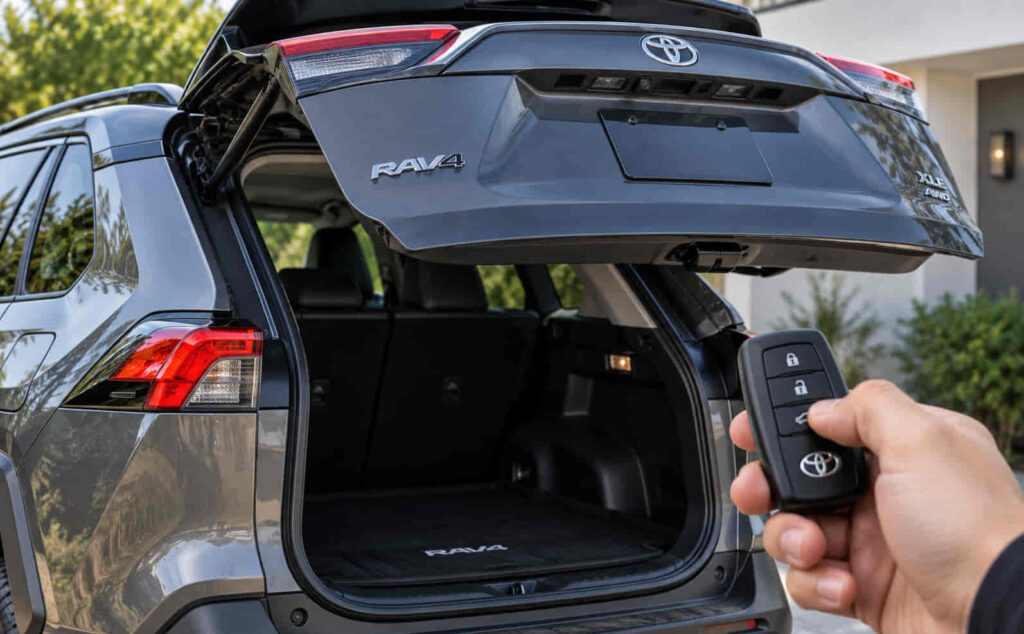
A Toyota RAV4 power back door can stop working because the system is disabled, the required operating conditions are not met, the 12-volt battery has been disconnected or weakened, the door detects an obstruction, or an electrical or mechanical component has failed. A non-working liftgate does not automatically mean the power back door actuator needs replacement. In many cases, the fault can be narrowed down by checking system settings, battery condition, initialization status, control inputs, and whether the door is being prevented from moving normally.
The correct diagnosis starts with the simplest reversible causes before moving to component-level repair. If the door still opens manually, the power system may be disabled or unable to complete its initialization. If the liftgate works from one switch but not another, the fault may be limited to a control input rather than the complete mechanism. If the door beeps, moves only partway, reverses direction, or stops under load, obstruction detection, low voltage, latch operation, or the power actuator may need closer inspection.
This guide explains how to diagnose a Toyota RAV4 power back door that is not working, including settings, operating conditions, battery reset, sensors, switches, fuses, latch operation, and actuator faults.
Why Is My Toyota RAV4 Power Back Door Not Working?
A Toyota RAV4 power back door may stop working because the system is disabled, its operating conditions are not satisfied, 12-volt battery voltage is interrupted or drops too low, the door detects an obstruction, or an electrical or mechanical part of the system cannot complete the commanded movement. The symptom alone does not identify the failed component. A door that does nothing, a door that beeps without moving, and a door that starts moving before stopping halfway represent different diagnostic conditions and should not immediately lead to actuator replacement.
The first distinction is whether the power back door is actually permitted to operate. Toyota states that automatic operation requires the power back door system to be enabled in the vehicle settings. When the system is disabled, the back door can still be opened and closed manually even though its powered function does not operate. This means a RAV4 with a manually movable liftgate but no automatic response may have a control or operating-condition issue rather than a mechanically seized door.
Vehicle state can also prevent normal operation. On the 2021 RAV4, Toyota specifies that when the engine switch is ON, automatic opening requires additional conditions such as the parking brake being engaged, the brake pedal being depressed, or the shift lever being in Park. Toyota also warns that if the required operating conditions stop being satisfied while the door is moving, a buzzer may sound and automatic movement may stop. Exact conditions can vary by model year and equipment, so the applicable owner’s manual should be used when diagnosing a different RAV4 generation.
Electrical power creates another failure path. Toyota states that automatic operation can stop if battery voltage suddenly drops, including when the engine is started while the power back door is moving. The system also requires reinitialization after the 12-volt battery has been disconnected and reconnected; Toyota instructs the owner to close the back door manually so the powered function can operate properly again. A liftgate problem that begins immediately after battery replacement, jump-starting, or battery disconnection should therefore be investigated as a power or initialization issue before replacing mechanical components.
The system also monitors resistance to door movement. Toyota equips the power back door with jam-protection sensors, and an obstruction encountered while the door is closing can make the door reverse direction or stop. Excessive force during opening can likewise stop operation, while ice between the door and body, excessive load on the liftgate, or damage to the edge sensors can interfere with normal powered movement. These protections are designed to prevent injury and component damage, so a door that stops or reverses is not necessarily demonstrating motor failure.
The way the door responds to different controls can further narrow the cause. The RAV4 power back door can receive commands from the wireless remote, instrument-panel switch, exterior back-door opener, and switch on the liftgate itself, depending on configuration. If one control operates the door while another does not, the actuator and main power mechanism have demonstrated that they can still move the door, shifting the diagnostic focus toward the failed input or the conditions required for that input. If none of the controls produces powered movement, system settings, battery power, electrical supply, control circuitry, latch status, and actuator operation become more relevant.
The correct first response to a Toyota RAV4 power back door that is not working is therefore to determine whether the system is being prevented from operating before assuming that a component has failed. Confirming the system setting, vehicle operating conditions, recent battery events, visible obstructions, and response from multiple switches can eliminate several causes before electrical or mechanical diagnosis becomes necessary.
Is the Toyota RAV4 Power Back Door System Turned Off?
A disabled power back door setting can make a Toyota RAV4 liftgate appear faulty even when the powered mechanism itself is functional. Toyota states that the power back door operates automatically only when the system is enabled. If the setting is turned off, the door does not perform its normal powered opening or closing operation but can still be moved manually.
On the 2021 RAV4, Toyota places the setting under the Vehicle Settings and PBD menu in the multi-information display. The setting remains in its selected state when the engine is switched off, so turning the vehicle off and restarting it does not automatically restore a power back door function that has been disabled. Toyota notes that the setting must be changed again through the display to restore the previous configuration.
This creates a useful diagnostic distinction. If the liftgate moves normally by hand but refuses to power open or close from several controls, checking whether PBD operation is enabled should come before testing or replacing an actuator. The same principle applies if the problem begins after another driver has changed vehicle settings or after configuration work has been performed. An intentionally disabled system can produce a complete lack of powered movement while leaving the mechanical door itself fully usable.
The setting should not be confused with the programmable opening-height function. Toyota allows the maximum opening position of the power back door to be adjusted separately. A reduced programmed height can make the door stop earlier than expected while still functioning normally, whereas disabling the PBD system prevents automatic operation. These are different control functions and require different corrections.
Model year matters because Toyota has changed displays, menus, and available equipment across RAV4 generations. The 2021 menu path should therefore not be presented as a universal sequence for every RAV4. The correct procedure is to verify the power back door or PBD setting using the owner’s manual for the vehicle’s exact model year and equipment configuration.
If the system is enabled and the power back door still does not operate, the next diagnostic step is to verify that the RAV4 meets the required operating conditions and that the 12-volt electrical system has not interrupted or disabled normal operation.
Read more: Are Toyota 4Runners Reliable
What Operating Conditions Must Be Met for the RAV4 Power Back Door to Work?
The Toyota RAV4 power back door will operate automatically only when the system is enabled and the vehicle meets the operating conditions programmed into the power back door control system. On the 2021 RAV4, Toyota states that when the engine switch is ON, an opening command can operate the power back door when the parking brake is engaged, the brake pedal is depressed, or the shift lever is in Park. Toyota’s 2024 service information similarly specifies that the vehicle must be traveling at no more than 3 km/h, or about 2 mph, when the ignition is ON, and that Park, brake-pedal, or parking-brake conditions must be satisfied for powered opening.
These operating rules explain why a liftgate can work correctly in one situation and appear completely unresponsive in another. For example, a driver may successfully open the power back door while the vehicle is parked and turned off but receive no normal opening response when the ignition is ON and the vehicle state does not satisfy Toyota’s programmed conditions. In that situation, the actuator has not necessarily failed. The control system may simply be preventing powered movement because the required vehicle-state input has not been confirmed.
The power back door setting remains another prerequisite. Toyota specifies that the system must be enabled before automatic opening and closing can occur. When the power back door setting is disabled, the liftgate can still be operated by hand, which can make the failure appear mechanical even though the powered function has intentionally been cancelled. This is why system status and operating conditions should be confirmed together before testing individual components.
Door-lock status can also affect operation depending on how the command is given and how the vehicle has been configured. Toyota’s 2024 operation-check information specifies that the back door normally needs to be unlocked for certain opening operations, with exceptions for functions designed to combine authentication and opening. If the liftgate responds to the wireless remote but not to another switch, the difference may therefore result from authorization or operating logic rather than a failed power unit.
A change in operating conditions can stop a door that has already begun moving. Toyota warns that when the required conditions are no longer met during automatic operation, a buzzer may sound and the door may stop opening or closing. The liftgate may then need to be moved manually. This behavior is important diagnostically because a door that stops unexpectedly is not automatically showing actuator failure; the control system may have intentionally cancelled movement after detecting a change in vehicle state.
The exact operating logic should still be checked against the owner’s manual for the specific RAV4 model year. Toyota has changed equipment, electronics, Smart Key functions, and power-back-door configurations across generations. An older RAV4 may use a different combination of ignition position and Park requirements from a newer fifth-generation model. Applying one model year’s conditions to every RAV4 can therefore create a false diagnosis.
If the power back door works after the vehicle is placed in Park, the correct brake or parking-brake condition is established, and the system is enabled, the original symptom was likely caused by operating logic rather than a failed liftgate component. If those conditions are satisfied and the door remains unresponsive from multiple controls, the next diagnostic area is the 12-volt electrical supply and system initialization.
Can a Weak or Disconnected 12V Battery Stop the RAV4 Power Back Door?
Yes, a weak, disconnected, or suddenly dropping 12-volt battery supply can prevent the Toyota RAV4 power back door from operating normally. Toyota specifically warns that automatic back-door operation may stop when battery voltage suddenly drops, such as when the engine is started while the liftgate is moving. The system depends on stable electrical power for the control electronics, switches, sensors, latch functions, and powered door mechanism, so a voltage problem can create a power-back-door symptom even when the mechanical components remain intact.
The mechanism is broader than simply providing electricity to a motor. The power back door controller must monitor door position, operating conditions, obstruction detection, user commands, and latch status while controlling powered movement. A substantial voltage drop can interrupt that sequence and cause the controller to stop automatic operation as a protective response. Toyota’s manual explicitly identifies sudden battery-voltage reduction as a condition in which the system may detect an abnormality and stop the door.
Battery disconnection creates a separate but related condition because the system may need to re-establish the door’s closed position after electrical power is restored. Toyota instructs owners to close the back door manually after reconnecting the battery so the power back door can operate properly again. This instruction is especially relevant when the liftgate stopped working immediately after battery replacement, battery service, electrical repair, or any event in which the 12-volt supply was disconnected.
This initialization requirement should be distinguished from resetting the programmable opening height. Toyota treats the two procedures separately. Closing the door manually after reconnecting the battery restores proper power-back-door operation, while the opening-position procedure changes or cancels the stored maximum opening height. Resetting the opening height is therefore not the correct first response when the entire power function disappeared after battery disconnection.
A recently replaced battery also does not automatically eliminate the electrical supply as a diagnostic possibility. Loose terminal connections, an incompletely secured battery connection, low state of charge, or another charging-system issue can still produce unstable voltage. The owner’s manual evidence establishes that voltage loss can interrupt power-back-door operation, but it does not establish that every non-working liftgate is caused by a weak battery. Battery condition should be considered most strongly when other low-voltage symptoms are present or when the problem began immediately after battery-related work.
The timing of the failure provides useful context. If the power back door function disappeared directly after the battery was disconnected, the Toyota-specified manual-closing procedure should be completed before actuator or latch replacement is considered. If the liftgate intermittently stops at the same time other electrical systems show low-voltage behavior, the battery and charging system deserve further evaluation. If battery power is stable, initialization has been completed, and the liftgate still fails from all controls, the diagnostic path should move toward switches, fuses, wiring, latch status, sensors, or the powered door unit.
A 12-volt battery issue can therefore make a functional RAV4 power back door appear defective without any actuator failure. Stable voltage must be available, and after battery reconnection Toyota requires the back door to be closed manually so normal powered operation can be restored. Checking these conditions before replacing components prevents a power-supply or initialization problem from being misdiagnosed as a mechanical liftgate failure.
How Do You Reset a Toyota RAV4 Power Back Door?
To restore normal Toyota RAV4 power back door operation after the 12-volt battery has been disconnected and reconnected, Toyota instructs the owner to close the back door manually. This procedure allows the system to re-establish the door’s closed position so powered opening and closing can operate correctly again. Toyota does not describe a universal sequence of ignition cycling, fuse removal, or repeated button presses as the standard battery-reconnection reset procedure, so those methods should not be treated as the first step for every RAV4.
This initialization is most relevant when the power back door stopped operating immediately after battery replacement, battery disconnection, jump-start-related electrical work, or another event that interrupted the 12-volt supply. In that situation, the system may still have functional switches, sensors, and powered door hardware but lack the reference state required for normal operation. Closing the liftgate fully by hand gives the system the closed-door state Toyota requires before automatic operation resumes.
The battery-reconnection procedure should not be confused with resetting the programmed opening height. Toyota allows the maximum opening position to be customized so the liftgate stops below its normal full-open position. On applicable RAV4 models, the stored opening position can be canceled by pressing and holding the power back door switch on the liftgate until the buzzer sounds four times, pauses, and then sounds two more times. The next powered opening returns to the initial full-open setting. This procedure changes the maximum opening position; it does not repair a liftgate that has completely lost powered operation.
The distinction matters because a door that stops consistently at the same height may be functioning exactly as programmed. Toyota’s current RAV4 settings continue to include an opening adjustment for the power back door, confirming that opening height remains a configurable function on newer models. Resetting that setting is appropriate when the symptom is an unexpectedly low stopping position, whereas manually closing the door after battery reconnection addresses initialization following electrical power loss.
A reset also cannot correct every mechanical or electrical failure. If the door has been manually closed after reconnecting the battery and still does not respond from the wireless remote, dashboard switch, or liftgate switch, the diagnostic process should continue rather than repeating initialization procedures. The remaining causes can include disabled system settings, unmet operating conditions, unstable 12-volt power, obstruction detection, switch faults, electrical supply problems, latch-state faults, or problems within the powered liftgate mechanism.
The response after initialization provides useful diagnostic evidence. If the door begins operating normally after being manually closed, the original symptom was consistent with loss of system initialization following battery disconnection. If powered movement returns but the door stops at a lower position every time, the programmed opening height may need adjustment. If no powered function returns at all, initialization alone has not resolved the underlying problem.
The correct RAV4 power back door reset therefore depends on what is being reset. After a disconnected 12-volt battery, close the back door manually as Toyota specifies. Reset the stored opening position only when the problem involves the programmed maximum height. If neither procedure restores the relevant function, continue diagnosis instead of assuming the system needs another generic reset.
Why Does the RAV4 Power Back Door Beep but Not Open or Close?
A Toyota RAV4 power back door that beeps but does not open or close may be acknowledging a command while the control system is preventing or stopping powered movement because an operating condition is not satisfied, an abnormality is detected, battery voltage drops, or resistance to movement triggers a protective function. A buzzer by itself does not prove that the actuator has failed. Toyota uses audible signals both during normal power back door operation and when automatic movement is interrupted under certain conditions.
During normal operation, Toyota states that a buzzer sounds and the emergency flashers operate to indicate that the power back door is opening or closing. The Hands Free Power Back Door also produces a buzzer when the kick sensor successfully detects the required movement before the liftgate begins operating. Hearing a beep therefore confirms that part of the vehicle’s control logic may have recognized an input, but it does not establish that the complete opening or closing sequence can proceed.
Operating conditions are one reason the sequence can stop. Toyota warns that if the required power back door conditions are no longer met, a buzzer may sound and the door may stop opening or closing. Depending on model year and vehicle state, conditions can include system enablement, ignition status, Park selection, brake input, parking-brake status, or other control requirements. A door that beeps but does not complete the requested movement should therefore be tested under the correct conditions before mechanical parts are condemned.
Battery voltage can produce a similar symptom. Toyota specifically identifies a sudden reduction in battery voltage, such as when the ignition is switched on or the engine is started during automatic liftgate operation, as a condition that can cause the power back door to detect an abnormality and stop. In this case, the control system has not necessarily lost the command; it has interrupted the movement after detecting an electrical condition inconsistent with normal powered operation.
Resistance or an obstruction can also stop movement after the system responds. Toyota’s jam-protection function monitors the power back door while it opens or closes. If an object obstructs the door, the liftgate can reverse direction or stop. Toyota also states that applying excessive force while the door is opening can activate fall-down protection and stop automatic opening. A beep followed by little or no movement should therefore prompt inspection for cargo contacting the liftgate, ice around the door opening, external accessories, or abnormal mechanical resistance before the powered mechanism is assumed to be defective.
The pattern across different switches can further narrow the fault. If the liftgate fails from the dashboard switch but opens normally from the wireless remote or exterior switch, the main powered mechanism has demonstrated that it can move the door. The diagnosis should then focus more closely on that input, the conditions required for its operation, or associated control logic. If every control produces a beep or acknowledgement but none can generate powered movement, the diagnostic scope shifts toward system conditions, power supply, latch state, sensors, or the powered door mechanism itself.
A beep followed by a door that moves only a short distance provides different evidence from a completely stationary door. Partial movement shows that the system can energize the powered mechanism, but something is interrupting continued operation. Abnormal resistance, obstruction detection, low voltage, or a mechanical problem in the liftgate drive becomes more relevant in that situation. A door that remains completely stationary despite correct settings, stable battery power, proper initialization, and valid operating conditions requires deeper electrical and mechanical diagnosis.
The beep should therefore be treated as a diagnostic clue rather than a diagnosis. It indicates that the RAV4 power back door system is producing an audible response, but the reason movement does not follow must still be isolated through operating conditions, battery voltage, obstruction detection, control inputs, and mechanical operation. Replacing the actuator solely because the liftgate beeps but does not move skips several causes Toyota’s own documentation shows can interrupt automatic operation.
Why Does the RAV4 Power Back Door Stop Halfway or Reverse?
A Toyota RAV4 power back door that stops halfway or reverses direction is often responding to obstruction detection, abnormal resistance, a programmed stop command, or another condition that causes the control system to interrupt automatic movement. This symptom is different from a completely dead liftgate because the door has already demonstrated that its powered mechanism can begin moving. The diagnostic focus should therefore shift toward what is causing movement to be interrupted rather than immediately assuming that electrical power has been lost.
Toyota equips the RAV4 power back door with a jam protection function. If an object obstructs the liftgate while it is opening or closing, Toyota states that the door will automatically move in the opposite direction or stop. The mechanism is designed to reduce the risk of trapping an object or person and to limit excessive force on the power back door system. A liftgate that repeatedly reverses at approximately the same point should therefore be checked for physical interference before an actuator is replaced.
Physical interference does not need to be a large object. Cargo extending into the door path, accumulated ice, dirt around the door opening, accessories attached to the liftgate, or resistance around the seals can increase the load required to move the door. Toyota specifically warns that ice between the back door and frame can prevent movement and that operating the system with excessive load on the back door can cause a malfunction. Toyota also advises against applying excessive force to the door while it is operating.
The edge sensors are another relevant part of the protection system. Toyota documents sensors along the right and left edges of the power back door and warns that damage or disconnection can prevent normal automatic operation. The system relies on these inputs to identify conditions that require movement to stop or reverse, so a damaged sensor or related wiring can create symptoms that resemble excessive mechanical resistance. A visibly damaged edge sensor therefore changes the diagnostic direction from simple obstruction removal toward electrical or sensor inspection.
Toyota also uses a fall-down protection function while the power back door is opening. The manufacturer states that applying excessive force to the liftgate during automatic opening can cause the system to stop movement to prevent the door from suddenly shutting. This means manually pushing, pulling, or loading the liftgate while the powered mechanism is operating can itself create a stop condition. The system should be allowed to complete normal powered movement without additional force unless the owner intentionally wants to stop it.
A user command can also explain a door that stops without any fault. Toyota states that pressing the wireless remote or power back door switch while the liftgate is moving stops operation. Pressing the applicable control again during the halted state can command the door to move in the opposite direction. An unintentionally pressed remote button, interior switch, or liftgate switch can therefore produce a stop-and-reverse pattern that resembles a protection event.
Programmed opening height creates a different but easily confused symptom. Toyota allows the user to store a maximum opening position. When this function is configured, the back door can stop at the same lower height every time while otherwise operating normally. This is not a jam-protection event or actuator failure. Toyota allows the stored position to be canceled so the liftgate returns to its initial full-open position. A door that consistently stops smoothly at exactly the same height should therefore have its opening-height setting checked before mechanical diagnosis begins.
The movement pattern helps separate these causes. A smooth, repeatable stop at the same height is more consistent with a programmed opening position. A sudden reversal when the liftgate encounters resistance is more consistent with jam protection. A door that struggles, slows, produces abnormal noise, or stops at changing positions despite a clear travel path requires closer investigation of the powered mechanism, door alignment, sensors, or electrical supply.
A RAV4 power back door that stops halfway is therefore not automatically evidence of a failed actuator. Remove physical obstructions, verify that ice or accessories are not increasing door load, inspect the visible edge-sensor areas, check whether a reduced opening height has been programmed, and confirm that no control is unintentionally stopping the door. Mechanical or electrical diagnosis becomes more appropriate when the door repeatedly stops or reverses after these conditions have been eliminated.
Why Does the Power Back Door Work From One Switch but Not Another?
If the Toyota RAV4 power back door works from one control but not another, the main powered liftgate mechanism is capable of operating and the fault is more likely associated with the non-working input, its operating conditions, authorization logic, or related control circuit. This is one of the most useful diagnostic distinctions because it separates a system-wide failure from a problem affecting only one method of commanding the door.
Toyota provides several ways to operate the power back door on equipped RAV4 models. The 2021 owner’s manual documents operation from the wireless remote, the power back door switch on the instrument panel, the exterior back door opener switch, and the power back door switch mounted on the liftgate. Vehicles equipped with the Hands Free Power Back Door add the kick sensor as another input. These controls ultimately request operation of the same liftgate, but they do not all use identical operating conditions.
The instrument-panel switch illustrates why those differences matter. Toyota instructs the driver to unlock the back door before using this control on the documented 2021 system. The exterior opener operates differently: when the back door is already unlocked, pressing the opener can command the door, while a locked door can be opened by pressing and holding the switch when the user is carrying the electronic key. A switch that appears defective may therefore be functioning normally while a lock, Smart Key, or vehicle-state condition required for that specific input has not been met.
The wireless remote provides another comparison point. Toyota specifies that the remote button must be pressed and held to command automatic operation on the documented system. A brief press that produces no powered movement is therefore not equivalent to a failed remote or liftgate. The correct input method must be verified before the switch itself is diagnosed.
Comparing controls can substantially narrow the fault. If the wireless remote opens and closes the door normally but the dashboard switch never responds under the correct conditions, battery power, the main liftgate drive, and much of the central control system have already demonstrated an ability to operate the door. The investigation can then focus more closely on the dashboard switch, its wiring, required door-lock condition, or the input received by the control system.
The same reasoning applies when the exterior opener fails but the remote and interior switch continue to operate normally. Because the actuator still moves the door through other commands, replacing the power back door drive assembly would not logically address the first diagnostic evidence. The exterior switch, Smart Key recognition where required, wiring, connector condition, and input signal become more relevant.
If the liftgate-mounted closing switch is the only non-working control, the system should again be evaluated locally before diagnosing the entire power back door. Toyota documents that pressing this switch commands automatic closing and that pressing it while the door is moving stops operation. A failure limited to that control therefore presents a different diagnostic pattern from a vehicle on which every switch is unresponsive.
Hands-free operation must also be treated as a separate input. A RAV4 can have a fully functional power liftgate while the kick sensor does not trigger it. Toyota requires Hands Free Power Back Door operation to be enabled, the engine switch to be OFF on the documented system, an electronic key to be within the specified Smart Key operating range, and the foot movement to occur near the lower center of the rear bumper. Failure of this method alone does not establish failure of the liftgate actuator.
The diagnostic meaning changes when none of the available controls can produce powered movement. If the remote, interior switch, exterior opener, and liftgate switch all fail under valid operating conditions, a single switch becomes less likely to explain the problem. System enablement, 12-volt power, initialization, fuse or electrical supply, latch-state information, control-unit operation, and the powered liftgate mechanism then deserve greater attention.
The response from multiple switches should therefore be used as a diagnostic comparison rather than treating every “button not working” complaint as a complete liftgate failure. One working control proves that significant parts of the power back door system remain operational. The more controls that fail simultaneously, the more reasonable it becomes to move the investigation from an individual input toward the common electrical, control, latch, or actuator systems shared by those inputs.
How Do You Reset the Toyota Highlander Power Liftgate?
Resetting a Toyota Highlander power liftgate generally involves restoring the power back door system to a valid operating state and reinitializing it when electrical power has been interrupted. A reset is most relevant when the liftgate stopped operating after the 12-volt battery was disconnected, replaced, discharged, or when certain electrical work was performed. It is less likely to solve a hatch that has a physically damaged latch, failed drive component, broken wiring, or significant mechanical resistance.
The first check is whether the power back door system is enabled. On newer Highlander systems, Toyota provides a PBD or Power Back Door setting through the vehicle settings where the system can be enabled or disabled. The same settings area can also control functions such as the opening height and, on equipped vehicles, the hands-free kick sensor. A disabled PBD setting can therefore create a condition where the rear hatch remains mechanically usable but powered opening and closing do not function normally.
Reinitialization becomes particularly important after an interruption to the vehicle’s 12-volt electrical supply. Toyota documentation for multiple Highlander generations states that the power back door may need to be initialized after the battery has been disconnected. Some Toyota documentation specifies that when the 12-volt battery is reconnected while the back door is open, proper operation can be restored by completely closing the back door manually. This allows the system to establish a known closed position before powered operation resumes.
The required procedure is not identical across every Highlander model year, so a model-specific owner’s manual should be used before performing a reset. Earlier generations can use physical power-door controls and different initialization logic, while newer Highlanders integrate more power back door functions into vehicle settings. Applying a reset sequence from a different generation can therefore create confusion even when no component has actually failed.
Opening-height memory should also be distinguished from a complete power liftgate failure. On equipped Highlanders, the maximum opening position can be stored and adjusted. Toyota documentation describes a procedure for returning the programmed opening height to its default position by using the power back door switch, while newer systems can also offer opening adjustment through vehicle settings. A hatch that consistently stops at the same reduced height may therefore be following a stored opening position rather than suffering from a weak motor.
A successful reset provides diagnostic information as well as restoring operation. If the rear hatch begins working normally after reinitialization, the failure was more likely related to system state or loss of position information than permanent hardware damage. If the power liftgate remains completely inoperative after the PBD function has been enabled, the hatch has been properly initialized according to the correct model-year procedure, and the door moves freely by hand, troubleshooting should continue toward the electrical supply, latch, wiring, and powered drive system.
Can a Weak Battery Cause the Toyota Highlander Power Liftgate to Stop Working?
A weak Toyota Highlander 12-volt battery can contribute to power liftgate failure because the latch actuator, control electronics, and powered hatch mechanism depend on stable vehicle electrical power. Battery condition becomes especially relevant when the rear hatch problem appears after the battery has discharged, been disconnected, or been replaced, or when other electrical systems are also behaving abnormally.
The distinction between low voltage and lost initialization is important. A battery problem can prevent an electrically powered system from operating correctly while voltage is inadequate, but disconnecting the battery can also affect the operating state of the power back door even after electrical power has been restored. Toyota specifically notes on multiple Highlander generations that the power back door may require reinitialization following battery disconnection. This means a liftgate that stops working immediately after battery service does not automatically have a failed motor or actuator.
Other electrical symptoms make a weak battery diagnosis more convincing. If the Highlander also has slow starting, electronics that reset unexpectedly, dim or unstable accessories, or other systems behaving inconsistently, the common 12-volt supply deserves attention before individual liftgate components are replaced. By contrast, a vehicle that starts strongly and has no other electrical symptoms but consistently produces a latch click or partial liftgate movement may have a more localized rear hatch problem.
Battery voltage is only one part of the electrical diagnosis. The power liftgate also depends on circuit protection, wiring, connections, switches, control electronics, and the powered drive components. A healthy battery therefore does not prove that electrical power is reaching every part of the liftgate system. If all power liftgate controls stop working while the rest of the vehicle operates normally, the investigation should move toward the circuit and components dedicated to the power back door rather than repeatedly replacing or charging the battery.
A battery-related diagnosis should also consider the timing of the fault. A liftgate that worked normally before the battery was disconnected and stopped operating immediately afterward has a stronger connection to the electrical event than a hatch that gradually became weak over several months. In the first situation, initialization or system state should be checked early. In the second, repeated weak or partial movement may justify closer inspection of the powered drive mechanism after electrical supply has been confirmed.
Can a Blown Fuse Cause the Toyota Highlander Rear Hatch to Stop Working?
A blown fuse or another loss of electrical supply can prevent the Toyota Highlander power liftgate from operating, particularly when every powered rear hatch control becomes unresponsive at the same time. A fuse is more relevant to a complete loss of powered operation than to a hatch that still moves automatically but stops at one specific point, reverses because of resistance, or fails only from a single switch.
The purpose of a fuse is to protect an electrical circuit when excessive current occurs. If circuit protection for a component involved in power back door operation opens, electrical power to that part of the system can be interrupted. The resulting symptom depends on which circuit is affected, so a fuse-related problem should not automatically be assumed to produce the same behavior on every Highlander.
Fuse identification must be based on the specific vehicle rather than a generic fuse number copied from another Toyota Highlander. Fuse layouts and circuit design can change with model year, powertrain, equipment level, and generation. The correct owner’s manual or fuse-box diagram should therefore be used to identify the relevant circuit before inspection. Replacing unrelated fuses based solely on the phrase “rear hatch not working” does not establish whether the actual fault is electrical.
A fuse that has blown should also be treated as evidence rather than simply as a part that needs replacement. Fuses normally open because current exceeded the circuit’s designed limit. If a replacement fuse fails again, installing additional fuses does not correct the underlying electrical problem. A repeated failure requires diagnosis of the circuit for conditions such as damaged wiring, a short, or a component drawing abnormal current.
Electrical service can also affect power back door initialization. Toyota documentation for certain Highlander systems states that if a fuse is changed while the back door is open, the system may need to be initialized by completely closing the back door manually. The same document states that initialization is not required under that specific procedure when the fuse is changed while the back door is already closed. This demonstrates why a rear hatch can remain inoperative after electrical work even when electrical power itself has been restored.
Fuse diagnosis is therefore most useful when combined with the hatch’s behavior. If every powered control is dead but the rear hatch still moves freely manually, checking power supply and circuit protection is reasonable. If one switch fails while another successfully opens the liftgate, a common power fuse is less likely because the system is demonstrably receiving enough electrical power to operate. If the fuse is intact and no powered control works, troubleshooting should continue toward wiring, power back door control, latch state, and the liftgate drive components.
Can a Fuse Cause the Toyota RAV4 Power Back Door to Stop Working?
Yes, a blown fuse or another loss of electrical supply can stop the Toyota RAV4 power back door from operating, especially when none of the available switches produces powered movement. Toyota’s service procedure for a 2024–2025 RAV4 power back door closer that does not operate specifically instructs technicians to inspect the fuses for circuits related to the system before continuing with deeper diagnosis. This makes power-supply verification a logical step before replacing the latch, actuator, or control ECU.
The diagnostic value of a fuse check depends on the failure pattern. If the liftgate operates from the wireless remote but not from the dashboard switch, the system clearly still has enough electrical power to move the door, making a main power-supply failure less likely. If the remote, instrument-panel switch, exterior opener, and liftgate switch are all unresponsive despite correct settings and operating conditions, the shared power path becomes more relevant. A complete loss of powered operation should therefore lead to electrical-supply checks before an individual input switch is blamed.
A fuse protects an electrical circuit by opening when current exceeds its designed limit. Replacing a blown fuse can restore power, but the blown fuse may be a symptom rather than the root cause. Wiring damage, a short circuit, water intrusion, or a malfunctioning electrical component can create excessive current and cause a replacement fuse to open again. Repeated fuse failure therefore requires diagnosis of the protected circuit rather than repeated fuse replacement.
The exact fuse identification should be verified for the specific RAV4 model year and equipment configuration. Toyota has used different electrical layouts across generations and between gasoline, hybrid, and option configurations, so a fuse designation found for one RAV4 should not automatically be applied to another. The applicable owner’s manual, fuse-box labeling, or Toyota service information provides a safer reference than assuming one fuse number covers every power-back-door-equipped RAV4.
Electrical diagnosis also extends beyond the fuse itself. Toyota’s service documentation for the power back door closer includes the back door lock assembly, wiring and connectors, and multiplex network door ECU within the diagnostic path. The service procedure also directs technicians to confirm communication-system operation before deeper component testing, illustrating that a powered liftgate depends on both electrical supply and electronic communication rather than on a single motor circuit alone.
This is particularly important when a fuse appears normal but the system remains completely dead. A visually intact fuse does not prove that voltage reaches the power back door components. Connector problems, damaged wiring, ground faults, or control-system faults can interrupt operation farther downstream. Toyota’s diagnostic procedures use scan-tool data and electrical measurements to distinguish these conditions rather than replacing parts based solely on symptoms.
A replacement fuse should always match the specified rating for that circuit. Installing a higher-rated fuse to prevent it from blowing defeats the circuit protection Toyota designed into the vehicle and can allow wiring to overheat before the fuse opens. If the specified fuse fails repeatedly, the correct repair is to identify the electrical fault responsible for the excessive current.
A fuse is therefore a valid cause to check when a RAV4 power back door has lost all powered operation, but it should be treated as part of the electrical diagnostic path rather than assumed to be the fault in every non-working liftgate. When the correct fuse and 12-volt supply are intact but every control remains ineffective, wiring, control-unit communication, latch signals, and the powered door mechanism become the next diagnostic areas.
Can the Back Door Latch Cause a Toyota RAV4 Power Liftgate Problem?
Yes, a faulty back door latch or the switches integrated with the latch assembly can prevent normal RAV4 power back door operation because the control system uses latch-position signals to determine whether the door is open, partially latched, or fully closed. Toyota’s service information shows that the power back door ECU does not simply command a motor and assume the door position. It monitors several signals from the back door lock assembly before and during closer operation.
Toyota calls the related function the back door closer. When the liftgate is left slightly open, the closer automatically pulls it into the fully closed position. Toyota notes that this function operates regardless of engine-switch state and can still operate even when the main power back door function is canceled. This separation is diagnostically useful because a door may have a problem completing the final latching stage even when the larger powered opening mechanism can still move it.
The latch assembly also provides door-status information to the vehicle. Toyota’s 2024 service documentation states that the multiplex network door ECU determines latch position using signals from the latch switch, back door courtesy switch, sector or home-position switch, and pawl switch. If these signals do not agree with the expected latch position, the control system can store a diagnostic trouble code and suspend back door closer or power back door operation.
This explains why a latch-related problem can create symptoms that appear larger than the latch itself. If the controller cannot confirm that the door has reached the correct half-latch or full-latch position, it cannot safely assume that the next automatic operation should continue. A mechanical latch that binds, an internal switch that reports the wrong state, damaged wiring, or an ECU input problem can therefore prevent the system from completing normal operation even when the power spindle is physically capable of moving the liftgate.
Toyota’s diagnostic data makes this relationship explicit. The vehicle monitors a Back Door Courtesy Switch Status indicating whether the door is open or closed and a Back Door Lock Position Status indicating whether it is locked or unlocked. Technicians can view these signals through Toyota diagnostic equipment to determine whether the control modules are receiving the correct door-state information.
A useful owner-level clue is a back door that reaches the body but does not pull itself fully closed. Toyota states that the closer should automatically finish closing a door that is slightly open. Failure at this final stage makes the latch/closer mechanism more relevant than it would be on a door that never moves at all. Abnormal repeated attempts to latch, failure to recognize that the door is closed, or a door-open indication that remains active after physical closure can also justify closer investigation of the latch-state system.
The opposite conclusion is equally important. A liftgate that never begins to move should not automatically receive a new latch. System settings, operating conditions, battery initialization, electrical supply, switch inputs, and power-back-door drive operation still need to be considered. Toyota’s service procedure checks several of these systems and signals before identifying the back door lock assembly as the component requiring replacement.
The back door latch becomes a stronger suspect when the RAV4 cannot complete the final closing stage or when the vehicle receives incorrect open, closed, or latch-position signals. Because the latch assembly contains multiple position-related switches and interacts with the multiplex network door ECU, confirming the fault with diagnostic data is more reliable than replacing the latch solely because the power liftgate is not working.
Can a Power Back Door Actuator or Spindle Cause the RAV4 Liftgate to Fail?
Yes, a faulty power back door unit or spindle can prevent a Toyota RAV4 liftgate from opening or closing correctly because these components provide and control the mechanical force that moves the back door. Toyota identifies dedicated left- and right-side power back door unit assemblies on equipped vehicles, and its parts documentation describes these assemblies as components responsible for supporting controlled powered opening and closing. A failure within this mechanism can therefore produce complete loss of powered movement, interrupted travel, uneven movement, or other abnormal liftgate behavior.
The spindle should not, however, be treated as the first component to replace whenever the RAV4 power back door stops working. Toyota’s troubleshooting architecture includes system settings, operating conditions, battery initialization, fuses, control signals, sensors, latch information, wiring, and ECU data before component replacement is justified. Toyota’s service information specifically recommends reading switch, sensor, and actuator data early in diagnosis because doing so can identify abnormal or intermittent signals without first removing parts.
Mechanical symptoms make the powered door units more relevant after those simpler causes have been excluded. A liftgate that receives a valid command and begins moving but then struggles, moves unevenly, repeatedly stops despite a clear travel path, or develops abnormal mechanical noise presents a different diagnostic pattern from a completely dead system. The first pattern shows that the controller can initiate movement, which shifts attention toward excessive mechanical resistance, the power back door units, door alignment, sensor input, or the ability of the drive mechanism to move the door through its full range.
Toyota’s own precautions demonstrate that the spindle is sensitive to abnormal physical loading. The RAV4 owner’s manual states that the back door uses spindles to hold and move the door and warns owners not to attach foreign material to the spindle rod, touch it with fabric, install heavy accessories on the back door without appropriate guidance, place a hand on the spindle, or apply lateral force to it. Toyota explicitly states that violating these precautions can damage the spindle and result in malfunction.
Additional weight can affect the system because the powered mechanism is calibrated to move a liftgate within a defined load range. Heavy accessories mounted to the rear door increase the force required during opening and closing. Toyota separately warns that operating the power back door when excessive load is present can cause malfunction. This means an aftermarket accessory, unusually heavy equipment attached to the liftgate, or another source of added resistance should be considered before concluding that the spindle itself has internally failed.
Spindle replacement can also affect system initialization. Toyota’s 2024–2025 service information states that back-door initial-position learning is required when a left or right power back door unit assembly is removed and installed or replaced under specified conditions. The same initialization requirement applies when certain ECU connectors, power-source fuses, or the auxiliary battery connection are disturbed while the back door is open. Toyota states that the power back door will not operate unless the multiplex network door ECU is correctly initialized in those circumstances.
This requirement creates an important diagnostic distinction after repair work. If a power back door stops operating immediately after a spindle, door unit, battery connection, fuse, or relevant control component has been serviced, incomplete initialization may explain the symptom without indicating failure of the newly installed part. Toyota’s prescribed initialization begins by fully closing the back door by hand so the controller can establish the required reference position.
Electrical verification is equally important because an actuator cannot operate correctly without proper control-unit power and ground. Toyota’s service specifications for applicable 2024–2025 RAV4 models identify 11–14 volts at the relevant auxiliary-battery and ignition power terminals of the multiplex network door ECU, along with a low-resistance body ground. These measurements belong to technician-level diagnosis, but they illustrate why a door unit should not be condemned until the electrical conditions required to drive it have been confirmed.
A power back door actuator or spindle becomes a strong suspect only after system settings, operating conditions, battery initialization, obstructions, power supply, switches, latch information, and related control signals have been checked. Physical damage to a spindle, pronounced uneven movement, abnormal mechanical noise, or repeated stopping despite a clear door path makes the powered mechanism more relevant. Replacing a spindle solely because the liftgate does not move can miss an upstream electrical or control problem and may introduce an additional initialization requirement.
Why Is the RAV4 Hands Free Power Back Door Not Working?
A RAV4 Hands Free Power Back Door can fail to respond even when the normal powered liftgate works because hands-free operation has additional requirements involving its setting, ignition state, electronic key, kick sensor, rear-bumper condition, and foot movement. Failure of the kick function alone therefore does not mean the complete power back door system has failed. If the liftgate still opens normally from the wireless remote or another power back door switch, the diagnostic scope should focus primarily on the hands-free input and the conditions required for it to operate.
On the 2021 RAV4 system documented by Toyota, Hands Free Power Back Door operation must be enabled in the vehicle settings, the engine switch must be OFF, and an electronic key must be within the Smart Key detection range. Toyota specifies an approximate standing distance of 30–50 cm from the rear bumper. The user then moves a foot to within approximately 10 cm of the lower center portion of the bumper and pulls it back, completing the entire kick motion within about one second. The liftgate does not begin operating while the foot remains under the bumper; the kick sensor responds when the foot is withdrawn.
This operating sequence explains why an incorrect kick technique can resemble sensor failure. Holding a foot under the bumper, sweeping it slowly from side to side, standing too close to the vehicle, or kicking outside the detection area may prevent the expected response. Toyota specifically states that leaving a foot under the bumper or remaining too close can interfere with proper operation. The first diagnostic step should therefore reproduce the manufacturer-defined movement rather than repeatedly moving a foot around different portions of the bumper.
The rear bumper environment also directly affects the kick sensor. Toyota states that mud, snow, or ice on the lower center of the rear bumper can prevent normal operation and advises keeping this area clean. Large amounts of water from heavy rain or vehicle washing can affect detection as well. If the bumper is contaminated, Toyota advises cleaning it, moving the vehicle from its current location, and checking operation again. Persistent failure after these steps can justify dealer inspection.
Electrical interference can produce a similar symptom without any physical sensor damage. Toyota warns that external radio waves or electrical noise can interfere with communication between the electronic key and the vehicle. Locations near facilities such as power plants, radio transmitters, large displays, airports, electrically heated roads, or other strong sources of electrical noise can affect hands-free operation. Moving the vehicle and testing the system in another location can therefore help distinguish an environmental detection problem from a persistent hardware fault.
Accessories around the bumper provide another failure mechanism. Toyota states that accessories installed on or around the rear bumper can affect the Hands Free Power Back Door and advises disabling the function when certain equipment is installed. Objects positioned near the lower bumper can also create unwanted detections or interfere with the sensor’s ability to recognize the intended movement. A kick sensor that stopped working after a bumper accessory, repair, coating, or modification was installed should therefore be evaluated in that context.
Physical damage changes the diagnostic threshold. Toyota warns owners not to subject the kick sensor or surrounding bumper area to strong impact, disassemble the rear bumper, attach stickers to it, or paint the area in ways that can interfere with the system. Toyota recommends inspection when the sensor area has sustained a strong impact or when the lower center portion of the bumper is scratched or damaged and hands-free operation no longer works.
The response from conventional controls provides the clearest way to separate a kick-sensor problem from a complete power back door failure. If the wireless remote, dashboard control, or liftgate-mounted switch opens and closes the door normally while the foot sensor does nothing, the door units and much of the main power system have already demonstrated normal operation. The relevant entities become the hands-free setting, Smart Key detection, kick technique, bumper condition, environmental interference, sensor, and associated wiring instead of the primary liftgate actuator.
If both the kick sensor and every conventional power back door control fail, the problem is no longer isolated to the hands-free system. Diagnosis should return to the broader power back door path, including system enablement, operating conditions, 12-volt supply, initialization, fuses, latch-state signals, control-unit communication, and power back door units.
A non-working RAV4 kick sensor should therefore be diagnosed separately from a non-working power liftgate. Confirm that hands-free operation is enabled, the electronic key and ignition meet the applicable requirements, the foot movement is performed correctly, and the lower center of the rear bumper is clean and undamaged. If conventional power controls still operate but the hands-free function consistently fails after those conditions are corrected, the sensor or its related circuit becomes a more credible cause.
What Should You Do If the Toyota RAV4 Back Door Will Not Open at All?
If the Toyota RAV4 back door will not open electrically or from the exterior opener, Toyota provides a manual release procedure that allows the door to be unlocked from inside the cargo area. This procedure is intended for an inoperative back door opener and should be treated as an emergency access method rather than a repair for the underlying power back door fault. Toyota’s 2021 RAV4 owner’s manual instructs the user to access the internal release behind a trim cover, loosen the retaining screw, move the cover, and operate the internal lever to unlock the back door.
The exact internal trim arrangement can differ between RAV4 model years, so the release procedure should be taken from the owner’s manual for the specific vehicle rather than copied from another generation. Toyota manuals for multiple RAV4 versions document an internal release when the normal opener is inoperative, confirming that manual access is an intended fallback function.
An emergency release only addresses the immediate need to open the door. It does not identify why the powered system failed. Once access is restored, the diagnostic process should return to the symptom that existed before the manual release was used. If every powered control remains dead, the relevant areas include system enablement, 12-volt supply, initialization, fuse and wiring condition, latch-state signals, control-unit operation, and the power back door units. If the exterior opener alone fails while other controls still move the liftgate normally, the diagnosis should remain focused on that input rather than the entire powered system.
The door should also be handled carefully once it has been released manually. Toyota warns that power-back-door-equipped liftgates can move unexpectedly on an incline and that users should confirm the area around the door is clear before opening or closing it. The manufacturer also warns against applying excessive force to the powered door mechanism because doing so can damage components or create malfunction.
A completely closed door may also have a latch-related fault rather than a failed spindle. The power back door system depends on the latch and associated position signals to determine whether the door is locked, partially latched, or fully closed. If the exterior opener cannot release the latch but the vehicle otherwise has normal electrical power, the latch, opener input, wiring, or control circuit may require diagnosis after the emergency release has restored access.
Use the internal release only to regain access when the RAV4 back door cannot be opened normally, then diagnose the original electrical or mechanical fault separately. If the trim-release procedure for the specific model year is unclear, using the applicable Toyota owner’s manual is preferable to forcing the liftgate or attempting to pry the latch open.
When Should You Have the RAV4 Power Back Door Professionally Diagnosed?
The RAV4 power back door should be professionally diagnosed when basic checks confirm that the system is enabled, operating conditions are correct, battery power and initialization are normal, and no visible obstruction explains the failure, yet the door still will not operate correctly. At this stage, the remaining faults increasingly involve wiring, control-unit inputs, latch-position signals, sensors, or the powered liftgate units, which require electrical measurements or diagnostic data rather than repeated resets.
Repeated stopping or reversal without a physical obstruction is one reason to move beyond basic owner-level troubleshooting. Toyota’s jam-protection system is designed to stop or reverse the door when abnormal resistance is detected. If the travel path is clear but the system repeatedly behaves as though an obstruction exists, a damaged edge sensor, sensor circuit, mechanical resistance, door alignment problem, or power-unit fault may be creating an abnormal signal or load. Toyota specifically warns that damaged or disconnected edge sensors can prevent normal automatic closing.
Abnormal mechanical behavior also justifies professional inspection. A power back door that moves unevenly, produces grinding or clicking noises, visibly twists while opening, or repeatedly stalls after beginning movement can have excessive resistance or a problem within one of the powered door units. Toyota warns against lateral force on the spindles and against excessive load on the liftgate because these conditions can damage the mechanism and lead to malfunction.
A persistent latch problem should also be diagnosed rather than bypassed. If the door reaches the body but does not complete the final closing stage, repeatedly attempts to latch, or continues to indicate that the door is open after physical closure, the latch and door-state system become relevant. These faults may require verification of switch signals and control-unit data rather than visual inspection alone.
Electrical symptoms create another threshold for professional diagnosis. A correctly rated fuse that blows repeatedly indicates an excessive-current condition somewhere in the circuit. Replacing the fuse repeatedly does not correct the root cause and can obscure a wiring, connector, or component fault. Likewise, a system that receives stable 12-volt power yet remains dead from every control requires diagnosis of the common electrical and control path before a motor or latch assembly is replaced.
Hands-free problems deserve professional inspection when the normal liftgate works but the kick function consistently fails after the documented operating conditions have been corrected. Toyota specifically recommends dealer inspection when the kick sensor still does not operate after the rear bumper has been cleaned and the vehicle moved away from possible environmental interference, or when the sensor area has suffered a strong impact or visible damage.
Recent repair work is another important context. If the power back door stops functioning after body repair, rear-bumper work, battery service, latch replacement, or power-unit replacement, the problem may involve damaged wiring, disconnected sensors, installation errors, or incomplete initialization. Replacing more components without first checking the work already performed can increase cost without resolving the original condition.
Professional diagnosis becomes appropriate when the fault can no longer be isolated through settings, operating conditions, battery initialization, obvious obstructions, or comparison between different switches. At that point, scan data, wiring tests, voltage and ground measurements, latch-state verification, and mechanical inspection provide more reliable evidence than guessing which expensive component has failed.
How Do You Fix a Toyota RAV4 Power Back Door That Is Not Working?
Fix a Toyota RAV4 power back door by identifying whether the problem comes from system settings, operating conditions, 12-volt power, initialization, obstruction detection, an individual control input, electrical supply, latch operation, or the powered door mechanism before replacing any parts. The correct repair depends on where normal operation stops in that chain.
The diagnosis should begin with whether the vehicle is allowing powered operation at all. Toyota states that the power back door must be enabled, and specific vehicle-state requirements apply when the ignition is ON. A liftgate that begins working after the PBD setting is restored or after the vehicle is placed in the correct operating state does not need an actuator repair.
Battery history comes next because power interruption can create a fault that resembles component failure. Toyota states that automatic operation may stop after a sudden voltage drop and instructs owners to close the back door manually after reconnecting the 12-volt battery so the system can operate properly again. A problem that begins immediately after battery disconnection should therefore be initialized correctly before deeper mechanical diagnosis begins.
The movement pattern then determines the next diagnostic direction. A door that moves but reverses or stops should be checked for physical obstruction, ice, excessive load, damaged edge sensors, unwanted control input, or a programmed opening height. Toyota confirms that jam protection can reverse or stop the liftgate when an obstruction is detected and that excessive load or sensor damage can interfere with automatic operation.
A door that works from one control but not another should be diagnosed at the input level. If the wireless remote opens the liftgate normally but the dashboard switch does not, the power units have already demonstrated that they can move the door. Lock status, operating requirements, the switch, wiring, or its control input then become more relevant than the spindle assembly. The same logic applies when only the exterior opener or hands-free sensor fails.
A system that does not respond from any powered control requires a broader electrical check. Stable battery voltage, applicable fuses, wiring, power and ground, control-unit communication, latch-state inputs, and power back door units all become relevant. A blown fuse can explain total power loss, but a repeatedly blown fuse requires diagnosis of the circuit rather than installation of a higher-rated replacement.
Latch symptoms should be addressed when the door cannot complete the final closing stage or the vehicle does not recognize its open or closed state correctly. Powered-unit or spindle diagnosis becomes more credible when simpler causes have been eliminated and the liftgate shows abnormal mechanical noise, uneven movement, repeated stalling, or visible damage to the drive mechanism.
Hands-free operation should remain a separate branch of the diagnosis when conventional switches still work. Toyota requires the hands-free function to be enabled, an electronic key to be within range, the vehicle to meet the applicable operating conditions, and the kick motion to occur in the correct area. Mud, snow, water, electrical interference, bumper accessories, or damage around the sensor can prevent operation even when the main liftgate system remains functional.
The most efficient repair strategy is therefore to move from reversible control conditions to component-level faults: verify that the system is permitted to operate, restore stable 12-volt power and initialization, remove conditions that trigger protection, compare the available switches, confirm the electrical supply and latch state, and only then diagnose the actuator or spindle. This sequence reduces unnecessary parts replacement and matches the way the Toyota power back door system actually depends on multiple electrical, electronic, and mechanical conditions before it can open or close automatically.