An Audi coolant leak occurs when engine coolant escapes from the cooling system through a failed component, damaged connection, or internal engine fault. Common leak sources include the water pump, thermostat housing, coolant reservoir, hoses and pipes, radiator, and their seals or connections. Coolant loss should be investigated promptly because the cooling system depends on a sufficient volume of coolant to transfer heat away from the engine.
An Audi with a coolant leak may show several warning signs before severe overheating occurs. These include a low coolant warning, a repeatedly falling coolant level, visible fluid or dried coolant residue, a sweet smell around the vehicle, steam, or an abnormal rise in engine temperature. The location and severity of the leak determine how quickly these symptoms develop. A small leak may only become apparent when the cooling system is hot and pressurized, while a larger leak can cause rapid coolant loss.
Diagnosing an Audi coolant leak requires identifying where the coolant is escaping rather than repeatedly topping up the reservoir. This guide explains the main symptoms and causes of Audi coolant leaks, common leak locations, hidden coolant loss, driving risks, diagnostic methods, repair options, and factors that affect repair cost.
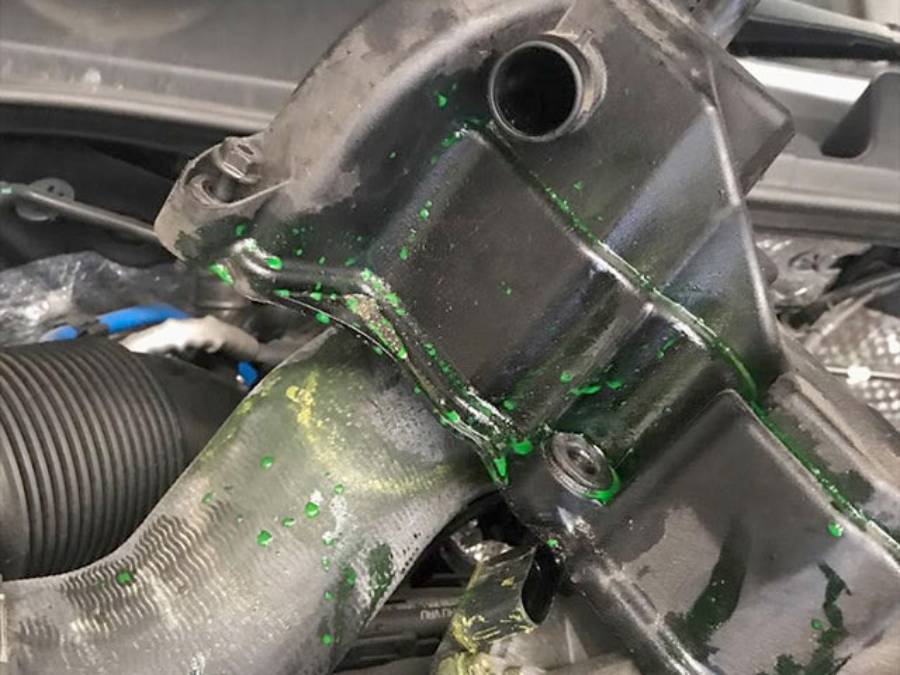
An Audi coolant leak occurs when engine coolant escapes from the cooling system through a failed component, damaged connection, or internal engine fault. Common leak sources include the water pump, thermostat housing, coolant reservoir, hoses and pipes, radiator, and their seals or connections. Coolant loss should be investigated promptly because the cooling system depends on a sufficient volume of coolant to transfer heat away from the engine.
An Audi with a coolant leak may show several warning signs before severe overheating occurs. These include a low coolant warning, a repeatedly falling coolant level, visible fluid or dried coolant residue, a sweet smell around the vehicle, steam, or an abnormal rise in engine temperature. The location and severity of the leak determine how quickly these symptoms develop. A small leak may only become apparent when the cooling system is hot and pressurized, while a larger leak can cause rapid coolant loss.
Diagnosing an Audi coolant leak requires identifying where the coolant is escaping rather than repeatedly topping up the reservoir. This guide explains the main symptoms and causes of Audi coolant leaks, common leak locations, hidden coolant loss, driving risks, diagnostic methods, repair options, and factors that affect repair cost.
Where Does Coolant Commonly Leak From on an Audi?
Coolant commonly leaks from an Audi around the water pump, thermostat housing, coolant reservoir, hose and pipe connections, radiator, and heater circuit. Finding the physical location of coolant is an important diagnostic step, but the place where coolant becomes visible is not always the point where the leak started. Coolant can run across engine surfaces or underbody panels before dripping onto the ground.
Coolant found around the engine can originate from the water pump, thermostat housing, coolant pipes, or their seals and connections. These areas contain pressurized coolant when the engine reaches operating temperature. A small sealing failure may therefore leave dried residue around the affected component before it produces enough liquid to form a puddle. Inspecting the area for both fresh coolant and dried deposits can help trace the leak toward its source.
Coolant around the expansion reservoir should lead to an inspection of the reservoir, cap area, attached hoses, and connections. A crack in the reservoir or a leaking connection can allow coolant to escape as system temperature and pressure increase. Coolant found near the reservoir should not automatically be attributed to a cracked tank because fluid released elsewhere can reach nearby components, and an abnormal cooling-system condition can also affect coolant behavior around the reservoir.
A leak near the front of the Audi can originate from the radiator, radiator connections, or associated hoses. The radiator carries coolant through a large heat-exchange surface, creating multiple areas where physical damage or a sealing problem can result in coolant loss. Inspecting the radiator itself and the points where hoses connect to it helps distinguish radiator leakage from coolant that has traveled forward or downward from another component.
Coolant found underneath the vehicle requires tracing the fluid upward rather than diagnosing the leak from the puddle position alone. Engine covers and underbody panels can collect coolant and release it at a different location. For example, coolant escaping higher in the engine bay may travel along a component or panel before dripping several inches away from the actual failure point. Removing obstructing panels during a professional inspection can make the original leak path easier to identify.
Coolant-related symptoms near the firewall or inside the cabin can indicate that the heater circuit also requires inspection. Unlike a radiator or reservoir leak that may be visible from outside the vehicle, a heater-core-related leak can be less obvious during a basic engine-bay inspection. The location of the symptoms therefore helps determine which section of the cooling system should be tested next.
Why Is My Audi Losing Coolant but There Is No Visible Leak?
An Audi can lose coolant without leaving a visible puddle when the leak is small, occurs mainly under pressure, reaches a hot surface and evaporates, remains hidden behind other components, enters the heater system, or occurs internally in the engine. The absence of coolant underneath the vehicle does not confirm that the cooling system is leak-free.
A small external leak may become active primarily after the engine warms up. Coolant temperature rises during operation, and the cooling system operates under pressure. A marginal seal or connection can therefore leak under operating conditions while appearing dry when the engine is cold. If only a small volume escapes, the coolant may dry on the component or evaporate after reaching a hot surface instead of accumulating beneath the vehicle. Dried residue around the leak area can remain as evidence after the liquid coolant has disappeared.
The physical layout of the engine bay can also hide coolant loss. A leak behind a housing, beneath an intake component, around a difficult-to-see connection, or above an underbody panel may not be visible during a quick inspection. Coolant can remain trapped on a panel or travel away from the failed component before it becomes visible. A cooling-system pressure test is useful in this situation because it can help reproduce leakage while the vehicle is stationary and available for closer inspection.
Coolant loss through the heater circuit can also produce fewer obvious signs underneath the engine. The heater core uses engine coolant to transfer heat for cabin heating, so a leak within this part of the system occurs in a different location from common engine-bay leaks. Evidence associated with the cabin or firewall area should therefore be considered when coolant continues to disappear but the radiator, reservoir, hoses, water pump, and thermostat area appear dry.
Can an Audi Have an Internal Coolant Leak?
Yes, an Audi can have an internal coolant leak when coolant escapes from its intended cooling passages into another part of the engine rather than leaking onto the ground. Internal coolant loss is important to investigate when the coolant level repeatedly decreases and pressure testing or inspection does not reveal a convincing external source.
An internal leak requires a different diagnostic approach because the coolant may enter a combustion-related or lubrication-related area instead of producing an external puddle. Depending on the actual failure, additional symptoms can accompany the coolant loss. However, coolant disappearing without a visible leak is not enough evidence to diagnose a failed head gasket. Small external leaks, hidden leaks, heater-system faults, and leaks that occur only under operating pressure can produce the same initial complaint.
Diagnosis should therefore establish evidence before an internal engine repair is recommended. The cooling system should first be inspected for external leakage and tested where appropriate. Further engine-specific testing becomes justified when coolant loss continues and the available evidence points away from accessible external components. This sequence prevents an expensive internal-engine diagnosis from being based solely on a falling coolant level.
Can You Drive an Audi With a Coolant Leak?
You should not continue driving an Audi with a coolant leak if the coolant level is dropping rapidly, the engine temperature is rising, steam is visible, or an overheating warning appears. A coolant leak reduces the amount of fluid available to transfer heat away from the engine. The risk therefore depends on the leak rate, remaining coolant level, and whether the cooling system can still maintain a safe engine temperature.
A small suspected leak does not always cause immediate overheating, but it still requires prompt diagnosis. A slow leak can gradually lower the coolant level until the cooling system no longer has enough coolant to regulate engine temperature correctly. Repeatedly adding coolant without finding the leak does not repair the failed component and can allow a minor cooling-system fault to develop into a more serious overheating problem.
Stop driving when the engine temperature rises beyond its normal operating range, an overheating warning appears, steam comes from the engine compartment, or substantial coolant loss is evident. Continuing to operate an overheating engine increases thermal stress on the engine and cooling-system components. Severe overheating can turn a repair involving a hose, seal, reservoir, thermostat housing, or water pump into a more expensive engine-related repair.
Check the coolant level only after the engine has cooled sufficiently and follow the vehicle-specific procedure. Do not open a hot, pressurized coolant reservoir or cooling system. Heated coolant expands and remains under pressure, so releasing the cap while the system is hot can discharge hot coolant or steam and cause serious burns. If the vehicle has overheated or cannot retain coolant, arranging professional inspection or recovery is safer than continuing to drive it.
How Do You Diagnose an Audi Coolant Leak?
Diagnosing an Audi coolant leak involves 6 main steps: verify coolant loss, inspect visible cooling-system components, look for coolant residue, trace the leak toward its highest visible point, pressure-test the system when necessary, and investigate hidden or internal coolant loss if no external source is found. Diagnosis should identify the failed component before parts are replaced because coolant can travel away from the original leak location.
Start by confirming that the coolant level is actually decreasing. Check the reservoir under the conditions specified for the vehicle, preferably comparing the level over time rather than relying on a single observation. A recurring low-coolant warning or a level that continues to fall after being correctly refilled provides stronger evidence of coolant loss than one isolated reading.
Inspect accessible cooling-system components after the engine has cooled. The inspection should include the coolant reservoir and its connections, visible hoses and pipe joints, radiator area, thermostat housing area, and accessible sections around the water pump. Look for fresh wetness as well as dried coolant residue because a small leak can evaporate before the vehicle is inspected. The presence of residue can help identify a leak that occurs primarily when the system is hot.
Trace visible coolant toward its source instead of assuming the lowest wet component has failed. Gravity, airflow, engine surfaces, and underbody panels can move coolant away from the original leak point. If several components are wet, identifying the highest point where fresh coolant or residue appears can narrow the search. Cleaning an affected area and inspecting it again after testing can also make a new leak path easier to distinguish from old residue.
A pressure test becomes useful when visual inspection does not reveal the source. Additional diagnostic methods, including leak-detection dye where appropriate, can help identify small or difficult-to-see leaks. If the cooling system continues losing coolant but external testing does not locate the source, diagnosis should expand to the heater circuit and potential internal coolant loss rather than assuming that the system is not leaking.
How Does a Pressure Test Find an Audi Coolant Leak?
A cooling-system pressure test helps find an Audi coolant leak by applying controlled pressure to the cooling system and checking whether the system loses pressure or coolant escapes from a failed component. The test makes some leaks easier to observe while the vehicle is stationary, particularly leaks that are difficult to reproduce during a cold visual inspection.
The diagnostic principle is straightforward: the cooling system must contain coolant under pressure during normal operation, and a leak creates a path through which that pressure or coolant can escape. Applying the specified test pressure can expose wetness around a damaged hose, connection, housing, radiator, reservoir, water-pump area, or another external leak point. The technician can then trace the escaping coolant to the failed component instead of replacing parts based only on where a puddle appeared.
A pressure test should still be interpreted with the rest of the diagnosis. Pressure loss indicates that the system requires further investigation, but the test result alone does not identify every possible failure. If pressure changes without an obvious external leak, additional testing may be required to determine whether the loss is hidden, associated with the heater circuit, or related to an internal engine problem. The objective is to establish the actual leak source before deciding on the repair.
How Is an Audi Coolant Leak Repaired?
An Audi coolant leak is repaired by identifying the failed cooling-system component and replacing or resealing that component before refilling and bleeding the cooling system. The correct repair depends on whether coolant is escaping from the water pump, thermostat housing, reservoir, hose, pipe, radiator, heater circuit, or an internal engine component. Repeatedly topping up the reservoir replaces lost coolant but does not correct the failure that caused the coolant loss.
A leaking water pump requires repair or replacement of the failed pump or associated sealing components. The water pump circulates coolant through the engine and cooling system, so a leak around the pump must be distinguished from coolant that has traveled into the same area from another component. Access to the pump also differs between Audi engines. Correct diagnosis is therefore necessary before committing to a repair that may involve substantial disassembly and labor.
A thermostat-housing leak is repaired by replacing the failed housing, seal, or related component as required by the specific cooling-system design. The sealing surfaces and nearby connections should also be inspected because coolant visible around the thermostat area does not prove that the thermostat itself has failed. A thermostat that does not regulate coolant flow correctly and a housing that physically leaks coolant are separate faults, even though both involve the same section of the cooling system.
Leaks from the coolant reservoir, hoses, pipes, connections, and seals require replacement of the damaged component or sealing element. For example, a cracked reservoir requires attention to the reservoir, while a leaking hose connection may require a hose, O-ring, clamp, fitting, or another connection-specific repair. The surrounding components should be inspected at the same time because aged cooling-system parts can show deterioration at more than one connection.
A leaking radiator generally requires repair or replacement based on the location and extent of the damage. The radiator and its connections should first be confirmed as the source because coolant from another part of the vehicle can travel toward the front or collect on underbody panels. Heater-core and internal engine leaks require different procedures because the failed components are not repaired through the same external cooling-system access points.
The cooling system must be returned to its correct operating condition after the failed component has been repaired. This process includes refilling with coolant that meets the specification required for the particular Audi, bleeding or filling the system according to the applicable procedure, checking the coolant level, bringing the system to operating conditions, and verifying that the original leak is no longer present. Air trapped in the cooling system can interfere with normal coolant circulation, so the refill procedure is part of the repair rather than an optional final step.
Can You Fix an Audi Coolant Leak Yourself?
You can fix some Audi coolant leaks yourself when the failed component is accessible, the leak has been correctly identified, and you have the tools and technical knowledge required for the specific repair. More complex leaks involving difficult-to-access water pumps, heater components, internal engine faults, or an unidentified source are better suited to professional diagnosis and repair.
The difficulty of a DIY repair depends more on the failed component than on the visible amount of coolant. An accessible hose or reservoir-related repair can be relatively straightforward on some vehicles, while replacing a water pump or another component located behind surrounding engine parts can require considerably more disassembly. Audi models and engines use different cooling-system layouts, so a repair procedure for one engine should not automatically be applied to another.
Accurate diagnosis is the first requirement for a successful DIY repair. Replacing the component nearest a coolant puddle can fail to solve the problem because coolant may have traveled from a higher leak point. Before buying parts, confirm the source through visible evidence, residue patterns, pressure testing, or another appropriate diagnostic method. A persistent leak with no identifiable external source requires further testing rather than repeated component replacement.
Cooling-system temperature and pressure create an additional safety requirement. Never open the coolant reservoir or another pressurized part of the cooling system while the engine is hot. Hot coolant can be released rapidly when system pressure is removed. Repairs should begin only after the engine and cooling system have cooled sufficiently and the vehicle is positioned safely for the required work.
Professional diagnosis is appropriate when the Audi overheats, loses coolant rapidly, repeatedly loses coolant without a visible external leak, or requires a repair beyond the available tools and experience. It is also appropriate when an internal coolant leak is suspected. In these cases, diagnostic testing can establish the failed component before extensive disassembly begins and reduce the risk of replacing unrelated parts.
Read more: How Long Can a Dealership Hold Your Car for Repair?
How Much Does It Cost to Fix an Audi Coolant Leak?
The cost to fix an Audi coolant leak depends on 6 main factors: the failed component, Audi model, engine configuration, replacement parts, labor time, and whether overheating has caused additional damage. A coolant leak does not have one standard repair price because replacing an accessible hose or reservoir involves a different amount of parts and labor than repairing a water pump, radiator, heater core, or internal engine fault.
The failed component is the primary cost driver. A leaking seal, connection, hose, or reservoir can involve relatively limited parts and labor when the component is easy to access. A water pump or thermostat-housing repair can require more labor when surrounding components must be removed to reach the failure point. Radiator and heater-core repairs have different access requirements, while an internal coolant leak can require additional diagnostic testing and engine work.
Audi model and engine configuration also affect labor time. Two vehicles can show the same symptom of a falling coolant level while requiring substantially different repair procedures because their cooling-system layouts and component locations differ. For this reason, an accurate estimate should be based on the vehicle’s model, model year, engine, confirmed leak source, and local labor rate rather than a generic “Audi coolant leak” price.
Additional engine damage can increase the final repair cost substantially. A leak repaired before the engine overheats may require attention only to the failed cooling-system component. Continued driving with insufficient coolant can result in overheating and create additional problems that require separate diagnosis. Repairing a coolant leak early therefore reduces the risk that a relatively localized cooling-system fault develops into a larger engine repair.
| Failed component | Typical repair complexity | Main cost drivers |
|---|---|---|
| Hose, seal, or connection | Low to moderate | Part location, accessibility, replacement hardware |
| Coolant reservoir | Low to moderate | Reservoir, cap or connection, labor |
| Thermostat housing | Moderate | Housing or seal, engine layout, labor |
| Water pump | Moderate to high | Pump location, engine configuration, labor |
| Radiator | Moderate to high | Radiator, connections, removal and installation |
| Heater core | High on many layouts | Component access, interior disassembly, labor |
| Internal engine component | High | Diagnosis, affected component, engine labor |
These categories describe repair complexity rather than fixed prices. A diagnosis should establish the failed component before a cost estimate is treated as meaningful.
How Can You Prevent Coolant Leaks in an Audi?
You can reduce the risk of an Audi coolant leak by using the correct coolant specification, monitoring the coolant level, inspecting cooling-system components, investigating recurring warnings, and following model-specific maintenance requirements. Preventive checks are most useful when they identify deterioration or coolant loss before the engine begins to overheat.
Check the coolant level periodically under the conditions specified for the vehicle. A stable level provides a useful baseline, while a level that repeatedly decreases indicates that the system requires investigation. Adding coolant every time the warning appears without determining why the level is falling can hide a developing leak rather than prevent a breakdown.
Inspect accessible reservoirs, hoses, connections, and surrounding cooling-system areas for deterioration, wetness, or dried coolant residue. Small leaks can leave deposits before they create a substantial puddle. Finding these signs early provides an opportunity to diagnose the affected component before coolant loss becomes severe enough to compromise engine-temperature control.
Investigate recurring low-coolant warnings promptly. A warning that disappears after topping up the reservoir does not establish that the underlying problem has been resolved. The important diagnostic question is why the coolant level decreased. Establishing whether the cause is an external leak, hidden leak, or another cooling-system fault prevents repeated coolant replacement from becoming a substitute for repair.
Follow the maintenance and coolant requirements applicable to the specific Audi model and engine. Cooling-system designs differ across models and powertrains, so inspection procedures, replacement requirements, and coolant specifications should be matched to the vehicle rather than applied universally across the Audi range.
What Coolant Should You Use After Repairing an Audi Coolant Leak?
Use coolant that meets the specification required for your Audi’s model, model year, and engine after repairing a coolant leak. Audi vehicles produced in different periods and with different powertrains do not necessarily share one universal coolant requirement, so the required specification should be confirmed from the applicable vehicle information before the cooling system is refilled.
Coolant specification matters because the fluid must operate correctly with the cooling-system materials and requirements for which it was designed. Selecting coolant only because its color resembles the fluid already in the reservoir is not a reliable method of confirming compatibility. Coolant color can help with visual identification in some situations, but the required manufacturer specification is the more important criterion.
Avoid mixing coolants unless their specifications and compatibility with the vehicle have been confirmed. When the existing coolant is unknown or contamination is suspected, the appropriate service procedure should be determined before refilling the system. The objective after a leak repair is not simply to restore the fluid level but to return the entire cooling system to the correct operating condition.
The system should also be filled and bled according to the procedure applicable to the vehicle. Air remaining in the cooling circuit can interfere with coolant circulation and produce abnormal cooling-system behavior. After filling, verify the coolant level and confirm that the repaired area remains dry under appropriate operating conditions. A stable coolant level after the repair provides additional evidence that the original source of coolant loss has been resolved.