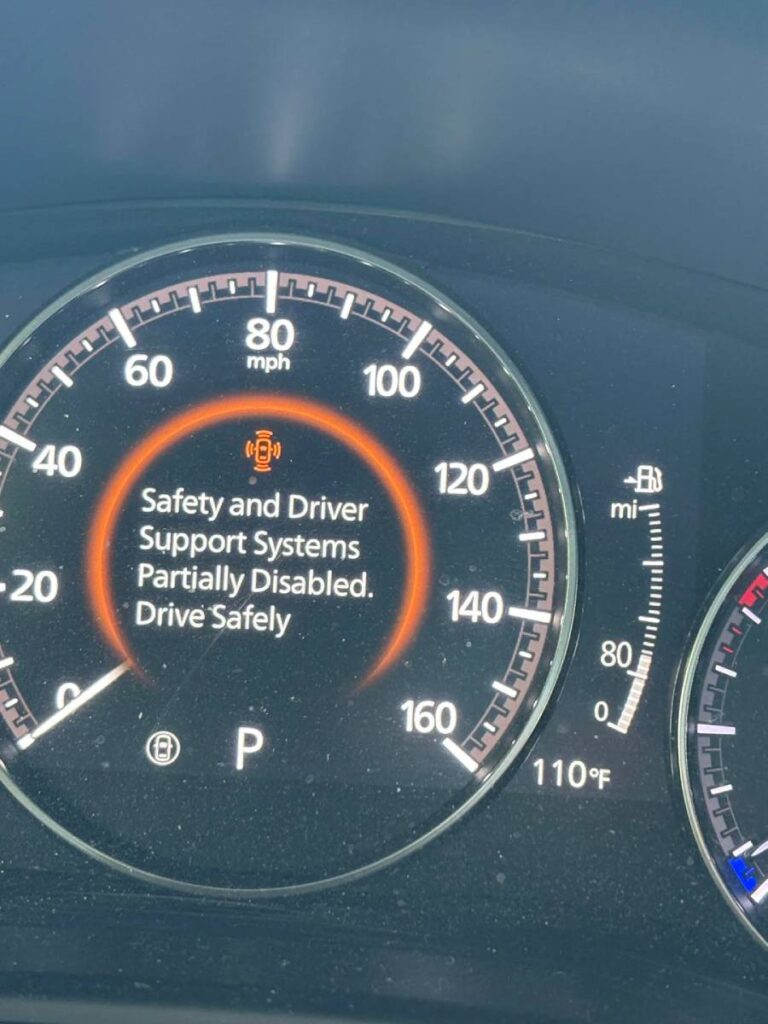
An i-ACTIVSENSE system malfunction means your Mazda has detected a problem that may limit or disable one or more driver-assistance features. The warning does not necessarily mean the entire i-ACTIVSENSE system has failed or that the vehicle cannot be driven. It indicates that a camera, radar sensor, electrical component, or operating condition is preventing the system from functioning as expected.
There are 6 main causes of an i-ACTIVSENSE system malfunction: a dirty or blocked camera or radar sensor, poor weather or visibility, low battery voltage, windshield replacement or damage, sensor misalignment, and a sensor, wiring, or electrical fault. Some warnings are temporary and disappear after the obstruction or environmental condition is removed. Persistent or recurring warnings require diagnosis because affected safety features may remain unavailable.
The correct fix depends on the underlying cause. It may involve cleaning the camera or radar area, correcting a battery or electrical problem, scanning the vehicle for diagnostic trouble codes, or calibrating or repairing an ADAS component. This guide explains what the i-ACTIVSENSE system malfunction warning means, what causes it, how to diagnose and fix it, and when the warning can affect driving safety.
What Does an i-ACTIVSENSE System Malfunction Mean?
An i-ACTIVSENSE system malfunction means the vehicle has detected a condition or fault that prevents one or more i-ACTIVSENSE driver-assistance functions from operating as intended. i-ACTIVSENSE uses cameras, radar sensors, control modules, and other vehicle inputs to monitor the road and support the driver. A problem with these inputs can cause the vehicle to limit or disable the affected function and display a warning.
The warning does not automatically mean every i-ACTIVSENSE feature has stopped working. The affected functions depend on the Mazda model, model year, equipment, and source of the malfunction. A problem involving a forward-facing camera, for example, can affect functions that depend on visual information from the road ahead, while a radar-related problem can affect functions that require distance and relative-speed measurements.
An i-ACTIVSENSE malfunction can also be temporary rather than a permanent component failure. Dirt covering a sensor, poor visibility, or another operating condition can temporarily prevent the system from obtaining reliable information. A warning that remains after normal operating conditions return, disappears and repeatedly comes back, or appears with other vehicle warnings requires further diagnosis.
What Safety Features Can Stop Working When i-ACTIVSENSE Malfunctions?
An i-ACTIVSENSE malfunction can disable or restrict the driver-assistance features that depend on the affected camera, radar sensor, or related component. Depending on the Mazda model and equipment, these can include Mazda Radar Cruise Control, Smart Brake Support, Lane Departure Warning, Lane-keep Assist, and other monitoring or collision-avoidance functions.
The exact combination matters because i-ACTIVSENSE is a collection of driver-assistance technologies rather than a single safety feature. A fault affecting one sensor does not prove that every system is unavailable. Drivers should check the specific warning messages displayed by the vehicle and consult the owner’s manual for the functions installed on their model.
These systems supplement the driver rather than replace normal vehicle control. When an i-ACTIVSENSE malfunction is displayed, the driver should not assume that functions such as automatic braking, lane assistance, or adaptive cruise control will intervene normally until the cause of the warning has been identified.
What Causes an i-ACTIVSENSE System Malfunction?
There are 6 main categories of conditions that can cause an i-ACTIVSENSE system malfunction: sensor obstruction, poor environmental conditions, low system voltage, windshield-related problems, sensor misalignment, and component or electrical faults. Identifying which category applies is important because the correct repair can range from removing an obstruction to calibrating or replacing an ADAS component.
1. A dirty or blocked camera or radar sensor can prevent i-ACTIVSENSE from receiving reliable information. Dirt, mud, snow, ice, or other material covering a sensing area can interfere with the system’s view of the road or surrounding traffic. In this situation, the component itself may still be functional; the system cannot use its data reliably because its sensing area is obstructed. Cleaning the affected area can resolve the warning when obstruction is the only cause.
2. Poor weather or visibility can temporarily limit i-ACTIVSENSE operation. Heavy rain, fog, snow, and other conditions that reduce sensor visibility can prevent some driver-assistance functions from operating normally. This type of limitation can disappear when environmental conditions improve. A warning that continues under clear, normal driving conditions points to a cause that requires additional inspection rather than weather alone.
3. Low battery voltage or an electrical supply problem can trigger warnings in electronic vehicle systems. i-ACTIVSENSE depends on electronic modules and sensors receiving the electrical conditions required for normal operation. A weak battery, charging-system issue, or unstable voltage therefore belongs in the diagnostic process, particularly when the i-ACTIVSENSE message appears with other electronic warnings. The battery should be tested before replacement rather than treated as the cause based only on the warning.
4. Windshield damage or replacement can affect camera-based i-ACTIVSENSE functions. A forward sensing camera mounted in relation to the windshield requires the correct position and view of the road. Windshield work can therefore create a calibration concern when it changes the camera’s position or its relationship to the glass. In such cases, cleaning the windshield or restarting the vehicle does not correct an alignment problem; the camera may require inspection and calibration.
5. A misaligned camera or radar sensor can cause the system to receive inaccurate information about the road and surrounding vehicles. Alignment problems can occur after collision damage, body repairs, windshield work, or physical impact near a sensor. ADAS sensors operate according to defined viewing or detection areas, so even a functioning sensor may require calibration when its physical alignment changes.
6. A faulty sensor, damaged wiring, connector problem, or electronic component can cause a persistent i-ACTIVSENSE malfunction. Unlike a temporary obstruction, a hardware or electrical fault generally requires diagnostic testing to identify the affected circuit or component. Diagnostic trouble codes can help narrow the investigation, but a code should be interpreted with inspection and testing rather than used as automatic proof that the named component needs replacement.
The pattern of the warning provides useful diagnostic context. A warning that appears only during snow or after the sensor becomes dirty points toward an operating limitation, while a warning that persists in clear conditions or returns immediately after startup requires a broader diagnosis. Checking simple external causes first prevents unnecessary replacement of expensive cameras, radar sensors, or control components.
How Do You Diagnose an i-ACTIVSENSE System Malfunction?
Diagnose an i-ACTIVSENSE system malfunction by checking the warning message, inspecting the camera and radar areas, checking the windshield, evaluating battery voltage, reviewing related warnings, and scanning for diagnostic trouble codes. Start with visible and temporary causes before assuming that an expensive ADAS component has failed.
First, read every warning displayed on the instrument cluster or infotainment display. An i-ACTIVSENSE warning appearing by itself provides different diagnostic context from the same warning appearing with battery, charging, braking, ABS, or other electronic-system warnings. Record the messages before turning the vehicle off because temporary warnings may disappear after a restart.
Next, inspect the areas used by the i-ACTIVSENSE sensors. Look for dirt, mud, snow, ice, condensation, or another obstruction around the forward sensing area and radar locations specified for the vehicle. Also check whether the warning appeared during heavy rain, fog, snow, or another condition that reduced visibility. A warning that disappears after the sensing area becomes clear points toward a temporary operating limitation rather than immediately proving sensor failure.
Inspect the windshield when the vehicle uses a forward-facing camera. Cracks, damage, recent windshield replacement, or work near the camera can provide important diagnostic information. A camera that has changed position or requires calibration cannot necessarily be corrected by cleaning its viewing area.
Battery condition and system voltage should be evaluated when no obvious obstruction exists, especially when several electronic warnings appear together. A battery test and charging-system check can determine whether low or unstable voltage is contributing to the malfunction. Replacing the battery without testing it is not a reliable diagnostic method because the same warning can originate from unrelated camera, radar, wiring, or calibration problems.
A diagnostic scan is the next step when the warning persists or repeatedly returns. Diagnostic trouble codes identify the system or circuit that detected an abnormal condition, but a trouble code does not automatically prove that a specific sensor needs replacement. The code should be combined with visual inspection, electrical testing, calibration information, and the vehicle’s repair procedure to determine the root cause.
The diagnostic sequence should therefore move from warning information → external obstruction → environmental conditions → windshield and physical condition → battery and electrical supply → DTC scan → sensor, wiring, and calibration testing. This order eliminates simple causes first while reducing the risk of replacing a functioning ADAS component.
How Do You Fix an i-ACTIVSENSE System Malfunction?
Fix an i-ACTIVSENSE system malfunction by correcting the condition that caused the warning rather than simply clearing the message. The repair can involve cleaning an obstructed sensing area, resolving an electrical problem, restoring correct camera or radar calibration, repairing wiring, or replacing a failed component.
Start with conditions that can be corrected without disassembling the system. Remove visible dirt, snow, ice, or other material from the relevant sensing areas and make sure the windshield area used by a camera is clear. Allow severe weather or poor visibility to pass when the warning occurs only under those conditions. The warning may clear after the system can obtain reliable information again.
An electrical cause requires a different repair path. Test the battery and charging system when voltage is suspected, then repair the confirmed battery, charging, connection, or electrical problem. After stable electrical operation has been restored, recheck the i-ACTIVSENSE system to determine whether the warning remains. This prevents an unrelated ADAS component from being replaced because of a voltage-related fault.
Persistent warnings associated with wiring, connectors, cameras, radar units, or control electronics require component-level diagnosis. Damaged wiring or poor connections should be repaired according to the affected circuit. A camera or radar unit should be replaced only when diagnostic testing supports component failure because replacement may also introduce calibration requirements.
Can Cleaning the Camera or Radar Clear the Warning?
Cleaning an obstructed camera or radar sensing area can clear an i-ACTIVSENSE warning when dirt, snow, ice, or another external obstruction is the cause. Cleaning will not repair an internal sensor fault, damaged wiring, incorrect alignment, or a calibration problem.
Use the sensor and camera locations specified for the particular Mazda model rather than assuming every i-ACTIVSENSE-equipped vehicle uses identical hardware locations. Clean accessible exterior sensing areas carefully without moving, pressing, removing, or adjusting ADAS components. The objective is to restore an unobstructed sensing area, not to alter sensor alignment.
After the obstruction has been removed, operate the vehicle under normal conditions and monitor the warning. A message that disappears and does not return supports an obstruction-related explanation. A warning that remains or repeatedly returns indicates that cleaning alone has not resolved the underlying condition.
Can Restarting the Vehicle Clear an i-ACTIVSENSE Warning?
Restarting the vehicle can clear a temporary i-ACTIVSENSE warning, but restarting does not repair a persistent hardware, electrical, or calibration fault. A restart can appear to solve the problem when the original limitation was temporary and the system completes its next check under normal conditions.
For example, a warning caused by a temporary sensing limitation may no longer appear after the vehicle is restarted once the sensing area is clear. This outcome differs from repeatedly restarting the vehicle solely to suppress a recurring warning. If the message returns after startup or during normal driving, the underlying cause still requires diagnosis.
Drivers should therefore treat restarting as a way to determine whether a warning was temporary, not as a universal reset procedure. Clearing a message without determining why it returns can leave one or more driver-assistance functions unavailable.
When Does i-ACTIVSENSE Need Camera or Radar Calibration?
i-ACTIVSENSE may require camera or radar calibration when work or damage changes the position, orientation, or reference conditions of an ADAS sensor. Relevant situations can include windshield replacement, collision repair, body work, sensor removal or replacement, and physical impact near a sensing component.
Calibration matters because an ADAS sensor must not only operate electrically; it must also detect the road and surrounding objects from the intended position. A camera or radar unit can communicate with the vehicle while still providing inaccurate spatial information if its alignment is incorrect. Cleaning or clearing fault codes cannot correct physical misalignment.
The required calibration procedure depends on the Mazda model, model year, installed equipment, affected component, and repair performed. When calibration is required, the procedure should follow the applicable Mazda service information and use the necessary ADAS calibration equipment.
Professional diagnosis is appropriate when the warning remains after basic checks, repeatedly returns in normal conditions, follows windshield or collision repair, appears with multiple vehicle-system warnings, or is associated with physical sensor damage. These conditions require more than repeatedly clearing the warning because the repair must restore the affected i-ACTIVSENSE function, not merely remove the message from the display.
Can You Drive With an i-ACTIVSENSE System Malfunction?
You may still be able to drive a Mazda with an i-ACTIVSENSE system malfunction, but you should not rely on any driver-assistance feature affected by the warning. An i-ACTIVSENSE malfunction and a mechanical failure that makes the vehicle undrivable are not the same condition. The warning indicates that one or more assistance or safety functions may be limited or unavailable, so the driver must maintain full control without expecting those systems to intervene.
The practical risk depends on which function has been affected. For example, a malfunction involving a forward camera or radar sensor can interfere with features that use information about lane markings, vehicles ahead, obstacles, or relative distance. The exact affected features vary by Mazda model, model year, trim, market, and installed i-ACTIVSENSE equipment. The warning messages displayed by the vehicle should therefore be checked before continuing to drive.
Driving conditions also affect the decision. A temporary warning caused by snow, dirt, heavy rain, or another sensor obstruction has a different diagnostic meaning from a persistent malfunction under clear conditions. Remove a safe-to-access obstruction and check whether normal operation returns. Do not assume the system is functioning normally simply because the vehicle continues to accelerate, steer, and brake through conventional driver inputs.
Stop driving when the i-ACTIVSENSE warning appears with another warning or vehicle behavior that indicates the car may not be safe to operate. Examples include braking problems, steering abnormalities, severe electrical problems, or other critical warnings that require immediate attention. An i-ACTIVSENSE message alone does not establish the condition of these systems, so additional warnings must be evaluated separately rather than attributed automatically to i-ACTIVSENSE.
A persistent i-ACTIVSENSE malfunction should be diagnosed even when the vehicle remains drivable. Continuing to ignore the warning can leave the driver without assistance that would normally support collision avoidance, lane monitoring, distance control, or other functions installed on the vehicle. The correct approach is to drive according to the vehicle’s actual condition, follow the applicable owner’s manual warning instructions, and repair the malfunction rather than treating normal vehicle movement as proof that the ADAS system is working.
How Much Does It Cost to Fix an i-ACTIVSENSE System Malfunction?
The cost to fix an i-ACTIVSENSE system malfunction depends on the root cause, because the same warning can result from an external obstruction, battery or electrical problem, calibration issue, damaged wiring, or failed ADAS component. There is no single repair price that accurately represents every i-ACTIVSENSE malfunction.
The least complex cases involve conditions that do not require component replacement. Dirt, snow, ice, or another removable obstruction may require only cleaning of the appropriate sensing area. A temporary environmental limitation may require no repair once normal sensing conditions return. These cases differ substantially from a persistent fault, which may require diagnostic labor and specialized testing.
Battery and electrical problems create a second cost category. A technician may need to test the battery, charging system, electrical connections, and related circuits before determining the repair. The cost is therefore based on the confirmed electrical problem rather than the i-ACTIVSENSE warning itself. Replacing a battery without verifying its condition can add unnecessary expense while leaving the actual malfunction unresolved.
Calibration creates another repair category. Windshield replacement, collision repairs, sensor replacement, or changes to camera or radar alignment can require an ADAS calibration procedure when specified for the vehicle. Calibration cost depends on the affected system, required procedure, labor rate, and equipment involved. A calibration requirement should therefore be identified from the specific vehicle and repair condition instead of assumed from the warning message alone.
Sensor, camera, radar, wiring, or control-component faults can produce the highest repair costs because diagnosis may be followed by component repair or replacement and then calibration. A radar unit that has suffered physical damage, for example, presents a different repair scope from a loose electrical connection even though both conditions can contribute to an i-ACTIVSENSE malfunction warning.
For this reason, the most reliable repair estimate comes after diagnosis identifies the failed condition or component. Owners comparing repair quotes should determine whether the estimate includes diagnostic labor, replacement parts, ADAS calibration, and any required post-repair verification. Comparing only the final price without comparing the repair scope can make two substantially different procedures appear equivalent.
A specific dollar range should only be provided when current pricing is available for the relevant Mazda model, model year, location, component, and repair procedure. Without those variables, a broad universal estimate would create false precision rather than help the owner understand the actual cost of repairing the malfunction.
Read more: Symptoms of a Bad Engine Oil Pump: 7 Warning Signs
How Can You Prevent i-ACTIVSENSE System Malfunctions?
You can reduce preventable i-ACTIVSENSE system malfunctions by keeping sensing areas clear, maintaining a healthy electrical system, addressing windshield or collision damage correctly, and completing required ADAS calibration after relevant repairs. These measures cannot prevent an electronic component from eventually failing, but they reduce problems caused by obstruction, low voltage, physical changes, and incorrect sensor alignment.
Keep the windshield and exterior areas used by cameras or radar sensors free from dirt, mud, snow, ice, and other material that can interfere with detection. This is particularly important before driving in conditions where road debris or winter precipitation can quickly cover exterior surfaces. Use the sensor locations specified for the particular Mazda model because the number, type, and position of sensing components can differ between vehicles.
Battery and charging-system condition also matters because i-ACTIVSENSE depends on electronic sensors and control systems. Investigate slow starting, recurring low-voltage conditions, charging problems, or multiple electronic warnings instead of waiting for additional systems to become affected. A healthy electrical supply does not guarantee that an ADAS malfunction will never occur, but it removes one potential source of electronic-system warnings.
Windshield and body repairs require additional attention when they involve an area associated with an ADAS camera or radar sensor. A windshield replacement can change conditions around a forward-facing camera, while collision or body repair can affect the position of a radar unit or its mounting structure. Complete the calibration procedure specified for the affected vehicle and repair when sensor position or reference conditions have changed.
Avoid adjusting, moving, or removing an i-ACTIVSENSE camera or radar unit as a troubleshooting shortcut. ADAS components rely on defined positions and sensing directions, so changing their physical alignment can create a new problem even when the original issue was only an obstruction. Cleaning an accessible sensing surface and physically adjusting a sensor are different procedures.
Recurring warnings should also be treated as diagnostic information. A warning that repeatedly disappears and returns indicates that the underlying condition has not necessarily been resolved. Record when the warning occurs, the weather and driving conditions, recent repairs, other dashboard messages, and whether the warning disappears after a restart. This information can help distinguish environmental limitations from electrical, calibration, or component faults.
Preventive maintenance therefore focuses on preserving the conditions i-ACTIVSENSE needs to operate correctly rather than repeatedly resetting warnings. Clear sensing areas, stable electrical power, correct component positioning, and appropriate post-repair calibration reduce avoidable malfunctions while making persistent faults easier to identify.
Does i-ACTIVSENSE Work the Same on Every Mazda Model?
No, i-ACTIVSENSE does not have an identical combination of features, sensors, and operating conditions on every Mazda vehicle. The installed driver-assistance equipment can differ by model, model year, trim level, market, and vehicle specification. A troubleshooting procedure should therefore be matched to the specific vehicle rather than applied universally to every Mazda displaying an i-ACTIVSENSE warning.
These differences matter because individual i-ACTIVSENSE functions rely on different types of vehicle information. One vehicle may use a particular combination of forward camera and radar inputs for its installed assistance features, while another model or model year can have a different equipment configuration. As a result, the same general malfunction message does not prove that the same component has failed on two different Mazda vehicles.
The affected safety functions can differ for the same reason. Mazda Radar Cruise Control, Smart Brake Support, lane-related assistance, and other i-ACTIVSENSE technologies should only be attributed to a vehicle after confirming that the feature is installed on that model and specification. This prevents a general troubleshooting guide from incorrectly telling every Mazda owner that a particular feature has stopped working.
Diagnostic and calibration procedures can also vary. Sensor location, access, alignment requirements, diagnostic trouble codes, and calibration procedures should be checked against the applicable service information for the vehicle being repaired. A procedure appropriate for one Mazda model or model year should not automatically be transferred to another simply because both vehicles use the i-ACTIVSENSE name.
For owners, the practical starting point is the warning displayed by the specific vehicle and the i-ACTIVSENSE information in its owner’s manual. For technicians, diagnosis should then follow the applicable service information and fault data. This model-specific approach connects the general causes of an i-ACTIVSENSE system malfunction to the actual sensors, features, and repair procedures installed on the vehicle.