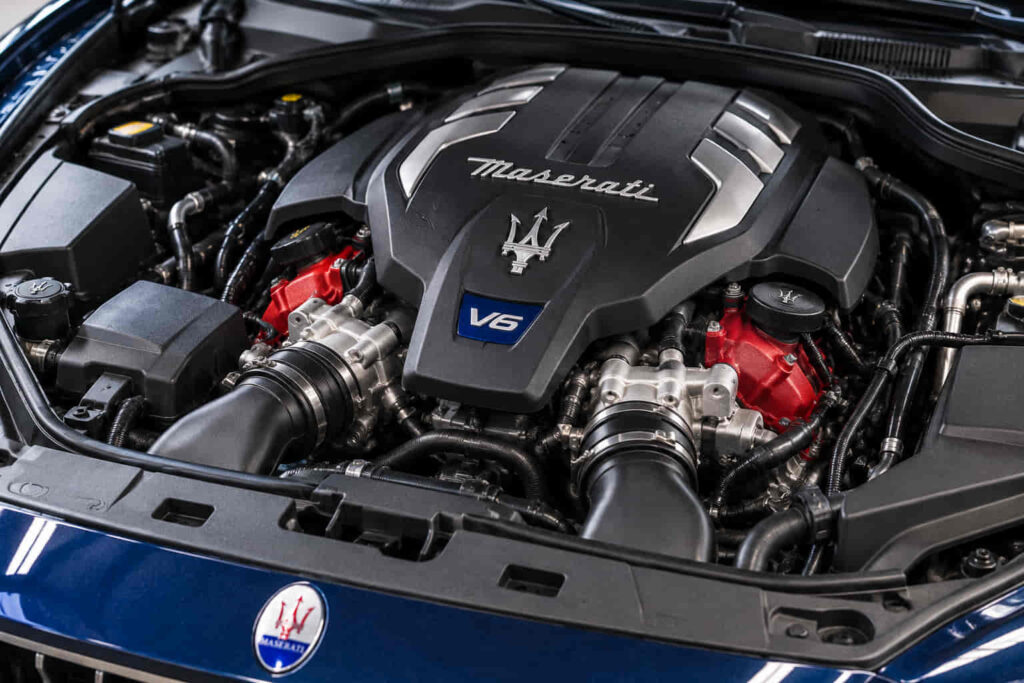
Who makes Maserati engines? Maserati currently develops and manufactures its high-performance Nettuno V6 engines in Modena, Italy, while several older Maserati models were powered by engines manufactured by Ferrari. Ferrari supplied V6 and V8 engines to Maserati from 2003 until December 2023, when their engine production agreement officially ended.
Today, Maserati’s 3.0-liter twin-turbocharged Nettuno V6 powers vehicles such as the MCPURA, GranTurismo, GranCabrio, and performance versions of the Grecale SUV. However, not every Maserati engine has the same manufacturer. Earlier gasoline V6 and V8 engines came from Ferrari, certain diesel engines were produced by VM Motori, and some four-cylinder hybrid powertrains use engines derived from Fiat Chrysler Automobiles technology.
The manufacturer therefore depends on the Maserati model, production year, and engine configuration. Understanding these distinctions explains the relationship between Ferrari and Maserati, where the engines are built, and how the brand’s powertrain technology has evolved.
Who Manufactures Maserati Engines Today?
Maserati manufactures its own Nettuno V6 engine at its historic factory in Modena, Italy, rather than relying on Ferrari to supply engines for its current high-performance sports cars. This represents a major change from the brand’s previous dependence on Ferrari-manufactured powertrains.
The transition began with the development of the Nettuno engine, introduced in 2020 alongside the Maserati MC20 supercar.
Unlike the V6 and V8 engines supplied by Ferrari, Nettuno was engineered by Maserati’s own development teams.
The engine was designed and developed through the Maserati Innovation Lab and Maserati Engine Lab, with production located at the company’s facility on Viale Ciro Menotti in Modena.
The engine uses a 3.0-liter, 90-degree V6 configuration with two turbochargers and an advanced combustion system incorporating pre-chamber ignition technology.
This design allows Maserati to achieve high specific power output without relying on a traditional large-displacement V8.
The original MC20 version produces approximately 621 horsepower in its U.S. specification, while other Nettuno applications use different engine calibrations to match their performance requirements.
The relationship between Maserati and its engine suppliers has therefore changed substantially.
Ferrari previously manufactured some of the most recognizable Maserati engines, including naturally aspirated V8 engines for older GranTurismo models and twin-turbocharged powerplants for the Ghibli, Quattroporte, and Levante.
However, Ferrari’s production agreement with Maserati expired in December 2023.
Maserati now places greater emphasis on its own engine engineering, particularly the Nettuno family, while continuing to use different powertrain technologies in selected vehicles.
This distinction matters because describing every Maserati as Ferrari-powered is no longer accurate.
Did Ferrari Make Maserati Engines?
Yes, Ferrari manufactured engines for Maserati from 2003 until December 2023, supplying both V8 and V6 powerplants for several luxury sedans, grand touring cars, and SUVs.
The partnership developed during a period when the two Italian automotive manufacturers had close corporate and technical relationships.
Ferrari’s engine manufacturing expertise provided Maserati with access to advanced powertrain engineering, precision manufacturing processes, and performance-oriented engine technologies.
One of the most recognizable examples was the Ferrari-manufactured F136 V8 engine family.
Variants of this naturally aspirated V8 powered Maserati vehicles such as the GranTurismo, GranCabrio, and certain generations of the Quattroporte.
These engines became closely associated with Maserati’s distinctive exhaust sound and high-revving performance characteristics.
Ferrari also produced later twin-turbocharged V8 engines used in high-performance Maserati sedans and SUVs.
The relationship extended beyond eight-cylinder engines.
According to Ferrari’s corporate filings, the company began manufacturing a V6 engine family specifically for Maserati in 2011.
These powerplants included the F160 3.0-liter twin-turbocharged V6 used in the Ghibli and Quattroporte, followed by related engines for the Levante.
Importantly, a Ferrari-manufactured Maserati engine was not necessarily identical to an engine installed in a Ferrari sports car.
Some engines shared engineering characteristics with Ferrari powerplants, while others were developed specifically for Maserati applications.
Different crankshaft designs, engine calibrations, intake systems, exhaust arrangements, and performance objectives could create substantial differences.
Ferrari’s own annual report confirms that the company produced engines for Maserati until December 2023.
During 2023, Ferrari sold approximately 5,600 engines to Maserati before the supply agreement expired.
Consequently, Ferrari-powered Maserati vehicles remain available in the used-car market, but that historical arrangement should not be confused with the manufacturer of the brand’s newer Nettuno engines.
Which Maserati Models Have Ferrari-Made Engines?
Ferrari-manufactured engines were installed in several Maserati models, including the GranTurismo, GranCabrio, Quattroporte, Ghibli, and Levante, depending on the model year and engine specification.
The older Maserati GranTurismo is one of the most recognizable examples.
Early versions of the first-generation GranTurismo used a 4.2-liter naturally aspirated V8, while later variants adopted a larger 4.7-liter V8.
These engines belonged to the Ferrari-associated F136 family and were known for their strong acceleration, high-revving character, and distinctive exhaust note.
The original GranCabrio also used the 4.7-liter V8 in various configurations.
The Quattroporte has an especially important place in Maserati’s Ferrari-engine history.
Fifth-generation Quattroporte models used naturally aspirated Ferrari-manufactured V8 engines, while later sixth-generation models offered both twin-turbocharged V6 and V8 powertrains.
The sixth-generation Quattroporte’s 3.0-liter V6 belonged to the Ferrari-produced F160 family.
Higher-performance versions used a 3.8-liter twin-turbocharged V8.
The Maserati Ghibli introduced in 2013 also used Ferrari-manufactured gasoline engines.
Its 3.0-liter twin-turbocharged V6 provided different horsepower outputs depending on the model and trim.
The later Ghibli Trofeo introduced a 3.8-liter twin-turbocharged V8, producing approximately 580 horsepower in the European specification.
The Levante SUV followed a similar approach.
Certain Levante models used the Ferrari-manufactured twin-turbocharged V6, while higher-performance Levante GTS and Trofeo versions employed a twin-turbocharged V8.
However, not every engine offered in these vehicles came from Ferrari.
Diesel-powered Ghibli, Quattroporte, and Levante models used engines associated with VM Motori.
The Ghibli Hybrid also introduced a four-cylinder powertrain based on FCA engine technology.
This means that the model name alone cannot establish whether the engine was manufactured by Ferrari.
Engine displacement, fuel type, trim level, model year, and engine code are necessary to identify the correct manufacturer.
Who Makes the Maserati Nettuno Engine?
Maserati designs, develops, tests, and manufactures the Nettuno 3.0-liter twin-turbocharged V6 engine at its own facilities in Modena, Italy. Nettuno is a Maserati-developed engine rather than a Ferrari-supplied powerplant.
The Nettuno project marked Maserati’s return to developing and producing a major road-car engine at its historic Modena headquarters after roughly two decades.
Engineering work took place through the Maserati Innovation Lab and specialized engine development facilities.
The company’s Engine Lab was established within the Viale Ciro Menotti factory, providing the infrastructure required for development, testing, assembly, and quality validation.
Maserati officially introduced the engine in July 2020 before the world premiere of the MC20 supercar.
The engine has a displacement of approximately 3.0 liters and uses six cylinders arranged in a 90-degree V configuration.
Two turbochargers increase the amount of air entering the combustion chambers, allowing the relatively compact engine to produce substantial power.
One of Nettuno’s defining characteristics is its patented pre-chamber combustion system.
This technology uses a small combustion chamber positioned above the main combustion chamber.
The system incorporates a central spark plug associated with the pre-chamber and a separate side spark plug to support combustion under operating conditions where the pre-chamber system is not required.
The engine also uses both direct and port fuel injection.
Together, these technologies provide Maserati with additional control over combustion behavior, engine responsiveness, and efficiency.
The original MC20 version delivers approximately 621 horsepower and 538 lb-ft of torque in U.S. specifications.
This output demonstrates that Maserati can produce supercar-level performance using its own six-cylinder engine architecture.
The Nettuno engine has since become a central part of the brand’s modern performance identity.
How Is the Nettuno V6 Different From Ferrari Engines?
The Maserati Nettuno V6 differs from earlier Ferrari-manufactured Maserati engines through its independent development, patented pre-chamber combustion system, and specific engineering architecture.
Although Maserati and Ferrari share a history of technical cooperation, the Nettuno engine was developed under Maserati’s own engineering program.
Its principal innovation is the combustion system.
Conventional spark-ignition gasoline engines use a spark plug to ignite the air-fuel mixture directly within the main combustion chamber.
Nettuno adds a separate pre-chamber located above the main chamber.
During suitable operating conditions, the mixture inside the pre-chamber ignites first.
The resulting combustion jets pass through specially shaped openings into the main combustion chamber, promoting rapid ignition of the remaining mixture.
This approach draws on principles used in advanced motorsport combustion systems.
However, the Nettuno engine is not simply a Formula 1 engine installed in a road car.
Its hardware and control systems were engineered for production vehicle operating conditions, including everyday drivability, emissions requirements, and durability.
The engine also includes dual fuel injection and electronically controlled combustion strategies.
Earlier Ferrari-manufactured Maserati engines used different engineering solutions.
For example, the naturally aspirated 4.2-liter and 4.7-liter V8 engines relied on high-revving eight-cylinder configurations to generate power.
The later 3.8-liter V8 used twin turbochargers to produce greater torque and horsepower.
Nettuno achieves substantial output from a smaller six-cylinder displacement through its combustion technology and forced induction system.
Another important difference is the location and responsibility for production.
Ferrari manufactured its Maserati engines through its own engine manufacturing operations, including facilities in Maranello.
Nettuno is developed and produced by Maserati in Modena.
The distinction is therefore both technical and organizational.
Which Maserati Cars Use the Nettuno V6 Engine?
The Maserati Nettuno engine powers the MC20 and its successor, the MCPURA, along with the modern GranTurismo, GranCabrio, GT2 Stradale, and certain Grecale SUV variants.
The MC20 was the first production Maserati to use Nettuno.
Introduced in 2020, it established the engine’s high-performance credentials through a mid-engine supercar configuration.
The later MCPURA continued this approach, retaining the twin-turbocharged 3.0-liter V6 with approximately 621 horsepower in its U.S. specification.
The MCPURA Cielo offers the same fundamental engine concept in an open-top supercar.
The GT2 Stradale also uses a high-output version of the Nettuno V6 developed for a more track-focused road vehicle.
The modern GranTurismo represents a different application.
Rather than prioritizing only supercar performance, the GranTurismo combines the engine with a front-engine grand touring layout.
The Nettuno V6 provides substantial torque and acceleration while supporting long-distance driving comfort.
The GranCabrio uses a related powertrain in a convertible grand touring configuration.
These models are available with different horsepower ratings depending on trim, model year, and market.
The Grecale SUV further demonstrates the engine’s versatility.
The Grecale Trofeo introduced a 3.0-liter Nettuno-derived V6 with approximately 530 metric horsepower.
Later model updates also expanded the use of Nettuno-derived V6 powertrains in selected Grecale versions.
For example, the U.S.-market 2026 Grecale Modena V6 is advertised with 385 horsepower.
European versions introduced in 2026 include a related 390-metric-horsepower Nettuno application.
The power difference between these vehicles does not necessarily indicate completely different engines.
Turbocharger calibration, combustion management, vehicle requirements, and performance objectives all influence the final output.
The Nettuno family demonstrates Maserati’s ability to use its own engine technology across luxury SUVs, grand touring cars, and high-performance supercars.
Who Makes the Maserati Grecale Engine?
The Maserati Grecale uses different engine technologies depending on the model year, trim, and market, including four-cylinder mild-hybrid powertrains, Maserati’s Nettuno-derived V6, and fully electric propulsion.
When the Grecale debuted in 2022, Maserati introduced several powertrain configurations.
The Grecale GT used a 2.0-liter turbocharged four-cylinder engine combined with a 48-volt mild-hybrid system.
The Grecale Modena initially offered a more powerful version of the same general four-cylinder hybrid concept.
The Grecale Trofeo used a high-performance 3.0-liter V6 derived from the Nettuno engine developed for the MC20.
This created a clear distinction between the mainstream mild-hybrid versions and the performance-oriented V6 model.
The four-cylinder hybrid engines reflect the wider technology resources available through the Stellantis group and its predecessor companies.
Maserati engineered the powertrain integration and vehicle-specific calibration to meet its performance objectives.
The Nettuno V6, by contrast, belongs to Maserati’s own high-performance engine family and is manufactured at its Modena facilities.
More recent Grecale versions have introduced additional V6 configurations.
For the 2026 U.S. market, the Grecale Modena V6 uses a 3.0-liter six-cylinder engine rated at approximately 385 horsepower.
Other markets continue to offer different powertrain configurations, including four-cylinder mild-hybrid versions.
Consequently, the answer to who makes the Maserati Grecale engine depends on the exact vehicle being discussed.
A Grecale GT with a four-cylinder hybrid system does not have the same engine manufacturing background as a Grecale Trofeo equipped with Nettuno technology.
The fully electric Grecale Folgore is different again because it uses electric motors rather than a gasoline combustion engine.
Read more: Jasper Engine Warranty
Who Makes Maserati Hybrid Engines?
Maserati’s four-cylinder hybrid powertrains use engine technology derived from Fiat Chrysler Automobiles, with substantial development and calibration work carried out by Maserati’s engineering teams.
The Ghibli Hybrid provides a clear example.
Introduced in 2020, it became Maserati’s first electrified production vehicle.
The model combined a turbocharged 2.0-liter four-cylinder gasoline engine with a 48-volt mild-hybrid system.
Its powertrain included a belt starter generator, a battery, an electrically driven compressor known as an e-Booster, and associated power electronics.
The system was designed to improve responsiveness and reduce fuel consumption compared with certain conventional gasoline configurations.
The gasoline engine originated from an FCA-based four-cylinder architecture.
However, Maserati did not simply install an unchanged engine from another vehicle.
According to the company’s technical information, Maserati engineers extensively revised the engine’s internal mechanical components and electronic management to achieve the desired performance.
The Ghibli Hybrid engine was manufactured at Termoli, Italy.
This provides an important example of the distinction between engine platform origin and final vehicle engineering.
A powerplant may share architecture with engines used by other brands while featuring specialized internal components, controls, and calibration for Maserati.
The Grecale mild-hybrid powertrain follows a related philosophy.
Its turbocharged four-cylinder engine is supported by a 48-volt electrical system that assists combustion-engine performance.
These powertrains are part of Maserati’s broader approach to combining combustion-engine technology with electrification.
However, the hybrid systems should not be confused with the Nettuno V6, which is a separate engine family developed and manufactured by Maserati.
Who Makes Maserati Diesel Engines?
VM Motori manufactured the 3.0-liter V6 turbo-diesel engines used in certain Maserati Ghibli, Quattroporte, and Levante models. These engines were developed for diesel applications rather than being Ferrari-produced gasoline engines.
VM Motori is an Italian engine manufacturer historically associated with diesel engine engineering and production.
The company was established in Cento, near Ferrara, Italy, and developed diesel powerplants for automotive, industrial, and other applications.
Maserati introduced the Ghibli diesel in 2013, offering customers a powertrain with strong low-speed torque and relatively low fuel consumption for a large luxury sports sedan.
The 3.0-liter V6 turbo-diesel produced approximately 275 metric horsepower and 600 Nm of torque in common European specifications.
Its design incorporated common-rail direct fuel injection and a variable-geometry turbocharger.
These technologies allowed the engine to deliver substantial torque at relatively low engine speeds.
The diesel powertrain was particularly suited to European markets where long-distance driving and fuel efficiency were important purchasing considerations.
The Quattroporte diesel used a related engine configuration.
The Levante was also offered with a 3.0-liter V6 diesel in selected markets.
The diesel engine family was associated with VM Motori’s A630 and B630 developments, adapted for Maserati’s performance requirements.
These engines were not universally available in every country.
For example, some Maserati diesel configurations were primarily offered in European and other international markets rather than the United States.
Diesel-powered Maserati models have since been discontinued as the company has shifted toward newer gasoline, hybrid, and electric powertrains.
For used-car buyers, the distinction remains important because a Maserati Ghibli diesel and a gasoline Ghibli V6 may require completely different engine parts, maintenance procedures, and diagnostic equipment.
Who Makes Maserati Electric Motors?
Maserati develops and integrates the electric powertrains used in its Folgore models through its engineering programs, working within the broader Stellantis technology and supplier ecosystem.
The Folgore name identifies Maserati’s fully electric vehicle range.
Unlike a gasoline or diesel engine, an electric powertrain generates propulsion through electric motors powered by a high-voltage battery.
This eliminates the need for pistons, spark plugs, fuel injection, and conventional combustion processes.
The GranTurismo Folgore was one of the company’s most significant steps into high-performance electric propulsion.
Its original technical configuration used an 800-volt electrical architecture and three electric motors.
This arrangement allowed the vehicle to provide all-wheel-drive performance with rapid torque response.
The GranCabrio Folgore applies similar electric technology to an open-top grand touring vehicle.
The Grecale Folgore uses a different electric vehicle configuration suited to a luxury SUV, including a 400-volt architecture in current applications.
These differences demonstrate that electric vehicle powertrains are designed around specific vehicle requirements rather than using a single combustion-engine replacement.
Maserati’s engineering teams are involved in vehicle dynamics, powertrain control, thermal management, and performance calibration.
However, the company does not publicly establish that every electric motor component, battery cell, or power electronic device is manufactured entirely in-house.
Modern electric vehicles rely on complex supplier networks, and component manufacturing should be distinguished from overall powertrain engineering.
For this reason, describing Folgore as a Maserati-developed electric vehicle platform is more accurate than assuming every electrical component is produced at the Modena engine factory.
Does Ferrari Own Maserati?
No, Ferrari does not currently own Maserati. Maserati is part of Stellantis, while Ferrari operates as a separate publicly traded automotive company.
The relationship between Ferrari and Maserati has changed several times throughout their histories.
Both brands were associated with the Fiat automotive group during an important period of their development.
Ferrari obtained control of Maserati in the late 1990s and played an important role in the brand’s technical and manufacturing transformation.
This relationship helped establish the engine supply arrangements that later powered several Maserati models.
In 2005, Maserati was transferred out of Ferrari’s control within the Fiat group.
However, the companies continued collaborating through engine manufacturing agreements.
Ferrari ultimately became an independent publicly traded company following its separation from Fiat Chrysler Automobiles.
Maserati subsequently became part of Stellantis when Fiat Chrysler Automobiles and PSA Group combined in 2021.
These corporate changes explain why the two brands continued sharing certain technical relationships even though they were no longer operating under the same ownership structure.
Ferrari’s engine supply agreement with Maserati ended in December 2023.
Consequently, the relationship between the companies today is different from the one that existed during the production of Ferrari-manufactured Maserati V6 and V8 engines.
Owning a Maserati with a Ferrari-built engine does not mean that Ferrari currently owns the Maserati brand.
It means that the vehicle was manufactured during a period when Ferrari supplied engines under a commercial agreement.
Are Maserati Engines the Same as Ferrari Engines?
Some older Maserati engines share engineering families and manufacturing origins with Ferrari engines, but they are not necessarily mechanically identical or interchangeable.
The distinction is important because the Ferrari name is frequently associated with Maserati’s historical performance reputation.
The naturally aspirated F136 V8 provides a useful example.
Variants of this engine family were used by both Ferrari and Maserati.
However, different applications employed different specifications.
Maserati versions commonly used a cross-plane crankshaft configuration, contributing to the deeper exhaust character associated with the brand’s V8 grand touring cars.
Certain Ferrari versions used a flat-plane crankshaft arrangement designed around different performance and engine-speed objectives.
Crankshaft design influences the firing sequence, vibration behavior, exhaust pulse distribution, and sound characteristics of the engine.
Other components may also differ.
Camshafts, intake manifolds, engine management systems, exhaust components, and accessory arrangements can be specific to the vehicle.
The later Ferrari-manufactured F160 V6 engines were produced specifically for Maserati applications.
Although Ferrari assembled these engines, they should not be described as identical to a Ferrari production-car engine.
The modern Nettuno engine represents an even clearer separation.
It is a Maserati-developed V6 with patented pre-chamber combustion technology and a production process based in Modena.
Its performance characteristics may be comparable with certain Ferrari sports car engines, but that does not establish a shared manufacturing origin.
For repairs or engine swaps, compatibility must be determined through exact engine codes, component specifications, and service documentation.
An engine manufactured by Ferrari is not automatically compatible with Ferrari vehicle parts.
Where Are Maserati Engines Built?
Maserati’s modern Nettuno V6 is manufactured in Modena, Italy, while earlier Ferrari-supplied engines were manufactured at Ferrari facilities in Maranello. Other Maserati powertrains have been produced at additional Italian manufacturing sites.
Modena is central to Maserati’s identity.
The company moved its operations to the city in the late 1930s, and its historic plant on Viale Ciro Menotti opened in 1940.
The site became an important production and engineering center for Maserati vehicles and racing technology.
The development of the Nettuno engine brought a major engine production program back to the facility.
Maserati established specialized engine development and manufacturing capabilities at the Modena plant, supporting the introduction of the MC20 and later Nettuno-powered vehicles.
Ferrari’s historical production operations were based in Maranello, another major automotive manufacturing center in Italy.
Ferrari used its own manufacturing infrastructure to produce engines supplied to Maserati.
The F160 V6 production program included dedicated assembly capacity developed to support Maserati’s engine requirements.
Other powertrains have different manufacturing origins.
The diesel engines associated with VM Motori were produced in Cento, Italy.
The FCA-derived four-cylinder engine used in the Ghibli Hybrid was produced at Termoli.
It is also important to distinguish engine manufacturing from complete vehicle assembly.
A Maserati engine can be built in one Italian city and installed in a vehicle assembled at another manufacturing facility.
For example, the original modern GranTurismo production program was associated with the Mirafiori plant in Turin, while more recent plans returned GranTurismo and GranCabrio production to Modena.
The Grecale is associated with Maserati’s production operations in Cassino.
Therefore, identifying the factory where a Maserati car was assembled does not always identify the factory where its engine was manufactured.
Why Did Maserati Stop Using Ferrari Engines?
Maserati moved away from Ferrari-manufactured engines as its long-term engine supply agreement expired and the company developed its own high-performance powertrain technology.
Ferrari had supplied engines to Maserati for approximately two decades.
During this period, the arrangement allowed Maserati to offer powerful V6 and V8 engines without independently manufacturing every engine family.
The partnership supported several successful performance vehicles, including the GranTurismo, Quattroporte, Ghibli, and Levante.
However, Ferrari’s long-term supply agreement was scheduled to conclude in 2023.
Ferrari’s 2023 annual report confirms that engine production for Maserati ended in December of that year.
Meanwhile, Maserati had already begun investing in its own engine development infrastructure.
The Nettuno project was a central part of this strategy.
By developing and producing its own high-performance engine, Maserati gained greater control over combustion technology, powertrain characteristics, and future product engineering.
Independent development also allowed the company to create a distinctive technical identity rather than continuing to depend on engines manufactured by another sports car brand.
The introduction of Nettuno alongside the MC20 demonstrated that Maserati could design a production engine capable of delivering supercar-level performance.
The same engine family was subsequently adapted for grand touring vehicles and SUVs.
Maserati’s move toward electrification also influenced the broader transformation of its powertrain lineup.
Hybrid systems and Folgore electric vehicles introduced additional technologies beyond traditional Ferrari-supplied V6 and V8 engines.
The end of the Ferrari relationship was therefore part of a wider change in Maserati’s engineering and product strategy.
It should not be interpreted as evidence that Ferrari-manufactured Maserati engines were inherently defective or unsuitable.
Are Maserati Engines Reliable?
Maserati engine reliability depends on the engine family, maintenance history, operating conditions, and quality of servicing rather than whether Ferrari or Maserati manufactured the engine.
Ferrari-manufactured Maserati engines have strong performance credentials, but they are complex luxury performance powerplants.
Naturally aspirated V8 engines use advanced valvetrain and lubrication systems, while turbocharged V6 and V8 configurations introduce additional thermal and mechanical demands.
Turbochargers require reliable lubrication and cooling to protect their bearings and related components.
Fuel injection, ignition timing, and engine management must also operate correctly to maintain combustion performance.
As these vehicles age, problems involving cooling components, gaskets, sensors, and supporting systems can increase maintenance expenses.
However, an external component failure does not necessarily mean that the internal engine architecture is unreliable.
The Nettuno V6 introduces a different set of engineering considerations.
Its high specific output is achieved through twin turbocharging, advanced injection strategies, and pre-chamber combustion technology.
These systems require precise manufacturing and electronic control.
They also make correct maintenance procedures and suitable diagnostic equipment particularly important.
Because Nettuno is a newer engine family than the historical Ferrari-manufactured V8 engines, there is less long-term high-mileage ownership history available for direct comparison.
It would therefore be misleading to claim that Nettuno is universally more reliable or less reliable than every earlier Ferrari-manufactured Maserati engine.
The same principle applies to diesel and hybrid powertrains.
A VM Motori diesel has different lubrication, fuel injection, and emissions control requirements from a naturally aspirated gasoline V8.
A four-cylinder mild-hybrid engine introduces electrical and powertrain control components not found in older Maserati models.
For used-car buyers, a documented service history and professional inspection are more useful than assuming a specific engine manufacturer guarantees reliability.
Are Ferrari-Built Maserati Engines Expensive to Maintain?
Ferrari-built Maserati engines can be expensive to maintain because their specialized components, performance-oriented design, and limited production volumes may increase parts and labor costs.
Engine maintenance expenses depend on more than the original manufacturer.
A Maserati V8 may require specialized replacement parts and repair procedures even when the underlying engine family shares engineering history with a Ferrari product.
Certain components may be available only through Maserati-specific suppliers or qualified aftermarket manufacturers.
This can affect availability and repair costs as the vehicle ages.
Engine packaging also influences labor requirements.
Accessing some components in a tightly packaged luxury sedan or grand touring car may require removing surrounding intake, exhaust, or cooling system parts.
Turbocharged engines introduce additional systems that can require attention.
Turbocharger oil lines, cooling connections, charge-air plumbing, and boost control components all contribute to the overall maintenance requirements.
However, high repair costs should not automatically be confused with high failure rates.
An engine may operate reliably for many years while still being expensive to repair when a specialized component eventually fails.
Modern Nettuno engines also require model-specific parts and qualified servicing.
Their advanced combustion systems should be maintained according to Maserati’s technical requirements rather than using procedures intended for older Ferrari-manufactured engines.
A buyer comparing different Maserati models should evaluate the engine’s service history, current mechanical condition, known maintenance requirements, and availability of qualified repair facilities.
Choosing a vehicle solely because it has a Ferrari-manufactured engine does not guarantee lower operating costs or greater long-term reliability.
How Can You Tell Who Made Your Maserati Engine?
The most reliable way to identify who manufactured a Maserati engine is to confirm the vehicle’s model year, engine type, engine code, and factory specifications.
The Maserati model name alone is not sufficient.
A Ghibli, for example, was offered with different powertrains across its production history.
Certain gasoline versions used Ferrari-manufactured twin-turbocharged V6 engines.
The Ghibli Trofeo used a Ferrari-manufactured V8, while diesel versions used a VM Motori powerplant.
The Ghibli Hybrid featured a four-cylinder engine derived from FCA technology and extensively modified by Maserati.
All of these vehicles carried the Ghibli name, but their engine origins were different.
The GranTurismo provides another example.
The original first-generation GranTurismo used Ferrari-manufactured naturally aspirated V8 engines.
The modern GranTurismo uses Maserati’s Nettuno twin-turbocharged V6 or a fully electric Folgore powertrain, depending on the version.
The Levante also used multiple engine families, including Ferrari-manufactured gasoline V6 and V8 engines and VM Motori diesel configurations in certain markets.
The Grecale uses hybrid, Nettuno-derived V6, and electric powertrains depending on model year and trim.
The vehicle identification number can help determine the original factory configuration.
However, an engine code or official service record is more useful when confirming exact powertrain details.
An engine replacement performed during previous ownership can also make the original vehicle specifications incomplete.
For parts selection and maintenance, the engine code should be verified using manufacturer documentation or a qualified Maserati service provider.
This is especially important because engines manufactured by Ferrari for Maserati are not necessarily interchangeable with Ferrari-branded vehicle engines.
Does Maserati Still Use V8 Engines?
Maserati has moved away from the Ferrari-manufactured V8 engines used in earlier high-performance models and now relies primarily on the Nettuno V6 for its modern combustion-engine sports cars.
The V8 played an important role in Maserati’s performance identity.
The naturally aspirated 4.2-liter and 4.7-liter V8 engines were closely associated with the GranTurismo, GranCabrio, and Quattroporte.
Their exhaust sound and high-revving character became defining features of the brand.
Later Maserati vehicles used a 3.8-liter twin-turbocharged V8.
This engine powered high-performance versions of the Ghibli, Quattroporte, and Levante.
The Trofeo models demonstrated the performance potential of the turbocharged V8 configuration.
However, the historical Ferrari engine supply arrangement ended in December 2023.
The company’s modern combustion-engine development has increasingly centered on the 3.0-liter Nettuno V6 family.
By using twin turbochargers and pre-chamber combustion technology, Nettuno can produce horsepower levels comparable with or greater than some earlier Maserati V8 applications despite its smaller displacement.
This allows the brand to retain high-performance characteristics while using a different engine architecture.
It also creates opportunities to adapt the engine across several vehicle categories.
For enthusiasts seeking the sound and character of a naturally aspirated Maserati V8, earlier GranTurismo and Quattroporte models remain important choices in the used market.
Drivers seeking Maserati’s newer engine engineering will encounter the Nettuno V6 in the brand’s latest performance vehicles.
Final Verdict: Who Makes Maserati Engines?
Maserati currently develops and manufactures its own high-performance Nettuno V6 engines in Modena, Italy, while Ferrari manufactured many earlier Maserati V6 and V8 engines between 2003 and December 2023.
Ferrari-supplied engines powered well-known Maserati models, including the original GranTurismo, GranCabrio, certain Quattroporte versions, and gasoline-powered variants of the Ghibli and Levante.
However, those engines were not necessarily identical to engines installed in Ferrari sports cars.
Maserati also used other manufacturers for specific powertrain applications.
VM Motori produced diesel V6 engines for selected Ghibli, Quattroporte, and Levante models.
Certain four-cylinder hybrid engines use technology originating from Fiat Chrysler Automobiles, with extensive Maserati engineering and calibration.
The modern Nettuno engine represents a significant shift in the company’s history.
Developed and manufactured by Maserati, the 3.0-liter twin-turbocharged V6 powers vehicles such as the MCPURA, GranTurismo, GranCabrio, GT2 Stradale, and performance versions of the Grecale.
Fully electric Folgore models represent a separate development because they use electric propulsion instead of conventional combustion engines.
The answer to who makes Maserati engines ultimately depends on the vehicle’s generation and powertrain: Ferrari manufactured many historical performance engines, VM Motori supplied certain diesels, FCA-derived technology underpins some hybrids, and Maserati itself produces the modern Nettuno V6.
Understanding these differences provides a more accurate view of Maserati’s engineering history and helps buyers identify the technology, maintenance requirements, and manufacturer behind a specific Maserati engine.