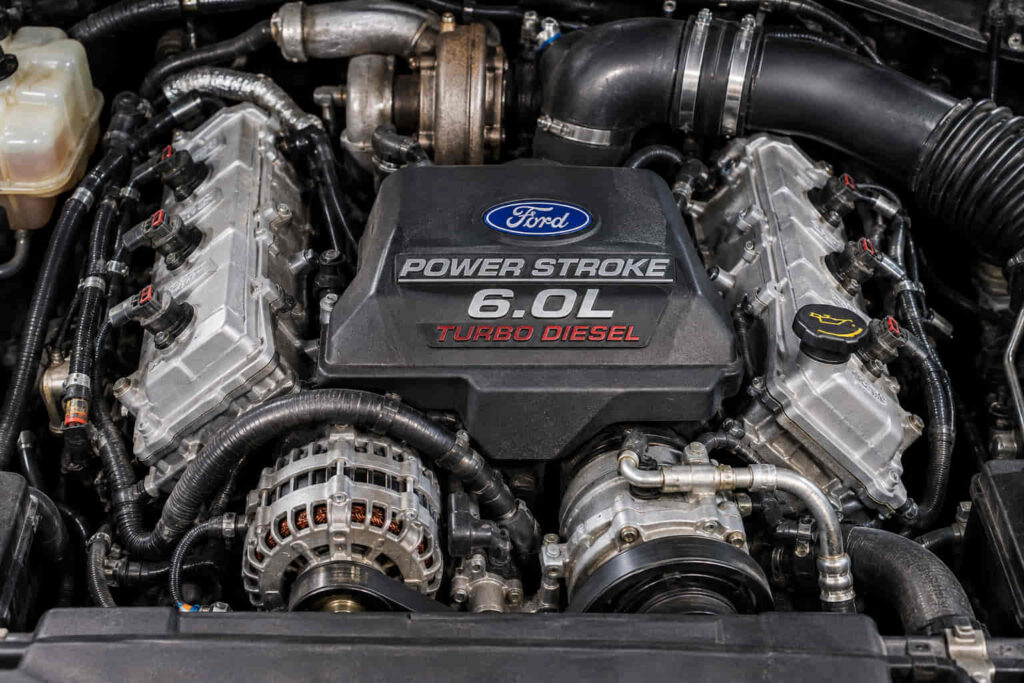
The 6.0 Powerstroke firing order is 1-2-7-3-4-5-6-8, which determines the sequence in which the eight cylinders produce combustion power strokes. On the Ford 6.0L Power Stroke diesel engine, cylinders 1, 3, 5, and 7 are located on the passenger-side bank, while cylinders 2, 4, 6, and 8 are positioned on the driver’s-side bank. Both cylinder banks are numbered from the front of the engine toward the rear.
This firing sequence applies to the factory-configured 6.0-liter Power Stroke V8 used in Ford Super Duty trucks, Excursion SUVs, and certain E-Series commercial vehicles. Unlike gasoline V8 engines, the 6.0 Powerstroke does not use spark plugs, ignition coils, or a distributor to control combustion. Instead, it relies on compression ignition and an electronically controlled hydraulic fuel injection system.
Understanding the correct firing order is essential when diagnosing cylinder misfires, replacing fuel injectors, inspecting injector wiring, or performing internal engine repairs. It also helps identify cylinder-specific diagnostic trouble codes and distinguish fuel injection faults from mechanical engine problems.
What Is the 6.0 Powerstroke Firing Order?
The correct firing order for the Ford 6.0 Powerstroke diesel engine is 1-2-7-3-4-5-6-8. This sequence applies to the standard 6.0L Power Stroke V8 developed by International and used in Ford diesel vehicles.
The firing order describes the sequence in which individual cylinders begin their combustion power strokes.
The 6.0 Powerstroke is a four-stroke diesel engine, meaning each cylinder completes intake, compression, power, and exhaust strokes during two crankshaft revolutions.
One complete combustion cycle requires 720 degrees of crankshaft rotation.
Because the engine contains eight cylinders, it produces eight combustion power strokes during this cycle.
In an evenly firing V8 configuration, combustion events begin at intervals of 90 degrees of crankshaft rotation.
Cylinder number 1 begins the firing sequence, followed by cylinder 2, then cylinders 7, 3, 4, 5, 6, and 8.
After cylinder 8 completes its designated combustion event, the sequence returns to cylinder 1 and repeats as long as the engine operates.
The firing order is determined by the relationship between crankshaft position, camshaft timing, and electronic fuel injection control.
It is not simply a sequence selected by the engine control module independently of the engine’s mechanical design.
The crankshaft and camshaft must maintain the correct relationship so that each cylinder receives fuel when its piston approaches the appropriate point in the compression stroke.
On the 6.0 Powerstroke, the powertrain control module and fuel injection control module coordinate these events using information from engine position sensors.
This allows the engine to maintain the intended firing sequence under different speeds and operating loads.
How Are the Cylinders Numbered on a 6.0 Powerstroke?
The 6.0 Powerstroke cylinder numbering arrangement places cylinders 1-3-5-7 on the passenger side and cylinders 2-4-6-8 on the driver side, with numbering progressing from the front of the engine toward the transmission.
Cylinder numbering identifies the physical position of each cylinder rather than the order in which it produces power.
On a conventional left-hand-drive Ford Super Duty truck, the passenger-side cylinder bank is the right bank when viewed in the manufacturer’s engine orientation.
Cylinder number 1 is positioned at the front of this bank, closest to the front engine accessories.
Cylinder number 3 is immediately behind cylinder 1, followed by cylinders 5 and 7.
Cylinder number 7 is the rearmost cylinder on the passenger side.
The driver’s-side bank follows the same front-to-rear arrangement but uses even-numbered cylinders.
Cylinder number 2 is at the front, followed by cylinders 4 and 6, while cylinder number 8 is located nearest the rear of the engine.
These positions remain important when identifying an injector or diagnosing a cylinder-specific fault.
For example, a diagnostic trouble code associated with cylinder 3 directs attention toward the second cylinder from the front on the passenger-side bank.
A fault involving cylinder 6 points toward the third cylinder from the front on the driver’s side.
The cylinder numbering arrangement does not change simply because the engine is installed in a different Ford vehicle.
However, service access and the orientation of surrounding components may differ between Super Duty trucks, Excursion models, and E-Series vans.
When identifying cylinder locations, the front of the engine refers to the crankshaft pulley and accessory-drive end.
It should not be confused with the transmission or flywheel end of the engine.
How Do You Read a 6.0 Powerstroke Firing Order Diagram?
A 6.0 Powerstroke firing order diagram shows the physical cylinder locations and the sequence 1-2-7-3-4-5-6-8, allowing technicians to identify which cylinder produces the next combustion event.
A typical diagram illustrates the engine from above, with the front of the engine clearly identified.
The passenger-side bank contains the odd-numbered cylinders in the order 1, 3, 5, and 7.
The driver’s-side bank contains the even-numbered cylinders in the order 2, 4, 6, and 8.
The firing sequence does not proceed consecutively along either bank.
Instead, it moves between cylinders according to the crankshaft and camshaft configuration.
The sequence begins at cylinder 1 on the front passenger side.
The next combustion event occurs in cylinder 2 at the front of the driver’s-side bank.
Cylinder 7 then fires at the rear of the passenger-side bank, followed by cylinder 3 on the same side.
The sequence continues with cylinder 4 on the driver’s side, cylinder 5 on the passenger side, cylinder 6 on the driver’s side, and finally cylinder 8 at the rear of the driver’s-side bank.
After cylinder 8, the combustion sequence returns to cylinder 1.
This explanation is useful when interpreting a firing order diagram because the numbers represent two different relationships.
The cylinder numbering arrangement identifies where each cylinder is physically located, while the firing sequence identifies the order of power production.
Confusing the two can lead to mistakes during fuel injector service and diagnostic work.
The correct diagram should also be specific to the 6.0L Power Stroke diesel rather than a generic Ford gasoline V8 engine.
Although both engine types may have eight cylinders, their cylinder numbering, combustion systems, and firing sequences can differ.
How Does the 6.0 Powerstroke Firing Order Work?
The 6.0 Powerstroke firing order works by coordinating fuel injection with the compression stroke of each cylinder, allowing combustion to occur sequentially throughout the engine’s 720-degree operating cycle.
The 6.0-liter Power Stroke is a compression-ignition diesel engine.
Unlike a gasoline engine, it does not rely on a spark plug to ignite a premixed air-fuel charge.
During the intake stroke, the piston moves downward and draws air into the cylinder.
The intake valve then closes, allowing the piston to compress the trapped air as it moves upward.
This compression raises the air temperature sufficiently to support diesel fuel ignition.
Near the appropriate point in the compression stroke, the fuel injector introduces precisely controlled fuel into the combustion chamber.
The fuel atomizes, mixes with hot compressed air, and ignites after a short ignition delay.
Expanding combustion gases force the piston downward, transmitting mechanical energy to the crankshaft through the connecting rod.
The exhaust stroke removes the burned gases and prepares the cylinder for its next operating cycle.
Each cylinder completes these processes independently, but the timing of the combustion events must remain coordinated with the other seven cylinders.
The 1-2-7-3-4-5-6-8 sequence distributes power strokes throughout the crankshaft’s rotation.
Correct synchronization helps maintain stable torque production, consistent engine operation, and the intended distribution of combustion forces.
A firing order does not independently determine maximum horsepower or fuel efficiency.
Those characteristics also depend on cylinder filling, injection timing, fuel quantity, compression, turbocharger operation, and overall combustion efficiency.
However, the correct firing sequence is fundamental to the engine’s mechanical operation.
Read more: Who Makes Maserati Engines
Which Ford Vehicles Use the 6.0 Powerstroke Firing Order?
The 1-2-7-3-4-5-6-8 firing order applies to factory-configured Ford vehicles equipped with the 6.0L Power Stroke diesel engine, including Super Duty trucks, Excursion SUVs, and selected commercial vans.
The 6.0 Powerstroke was introduced during the 2003 model year as the successor to Ford’s 7.3-liter Power Stroke diesel.
It was developed by International, which used a related engine architecture under the VT365 designation.
Ford offered the 6.0-liter engine in F-250, F-350, F-450, and F-550 Super Duty applications from the 2003 through 2007 model years.
The Ford Excursion was also available with the 6.0 Powerstroke during the 2003–2005 period.
Commercial E-Series vehicles used the engine in selected configurations, with certain applications continuing beyond the end of 6.0-liter production for Super Duty pickups.
Some F-650 and F-750 medium-duty trucks also used related International diesel powertrains.
Although vehicle calibration, horsepower ratings, supporting systems, and emissions equipment varied, the standard 6.0L Power Stroke maintained the same firing order.
This means a factory 2004 F-250 and a factory 2006 F-350 with the 6.0-liter diesel use the same fundamental combustion sequence.
However, different model years can have meaningful differences in fuel injection components, high-pressure oil connections, wiring harnesses, sensors, and service procedures.
A firing order that remains consistent does not mean every engine component is interchangeable.
When ordering replacement injectors or electrical components, the vehicle’s model year, engine serial number, and applicable service specifications should be verified.
Does the 6.0 Powerstroke Use Spark Plugs or a Distributor?
The 6.0 Powerstroke does not use spark plugs, ignition coils, or a distributor because it is a diesel engine that relies on compression ignition.
This distinction is essential when comparing the 6.0 Powerstroke with gasoline-powered V8 engines.
In a conventional gasoline engine, the ignition system produces an electrical spark that initiates combustion inside each cylinder.
The firing order determines the sequence in which the cylinders receive their intended spark events and produce power.
Some older gasoline engines use a mechanical distributor to direct ignition voltage to the spark plugs.
Modern gasoline engines often use individual electronically controlled ignition coils.
The 6.0 Powerstroke operates differently.
Air is compressed until it reaches a temperature suitable for diesel combustion.
Fuel injection then initiates the combustion process without requiring an ignition spark.
The engine uses electronically controlled fuel injectors instead of a conventional spark ignition system.
However, the 6.0 Powerstroke does contain glow plugs.
Glow plugs assist cold starting by raising the local temperature within the combustion chamber.
They do not operate like gasoline spark plugs and do not generate a timed spark for every combustion event.
Consequently, there is no distributor cap to rotate and no spark plug wire arrangement to configure according to the firing order.
Technicians should instead focus on the fuel injection control system, injector wiring, crankshaft and camshaft position information, and mechanical engine timing.
Using a gasoline-engine firing order procedure on a 6.0 Powerstroke can lead to incorrect diagnosis because the underlying combustion systems are fundamentally different.
How Does the HEUI Fuel Injection System Control the Firing Order?
The 6.0 Powerstroke uses a hydraulically actuated, electronically controlled unit injection system, commonly called HEUI, to deliver diesel fuel according to the engine’s firing sequence.
HEUI technology combines electronic control with high-pressure engine oil.
The engine’s fuel injectors contain internal hydraulic components that use pressurized oil to produce the force required for fuel injection.
This system differs from common-rail diesel injection, which uses a shared high-pressure fuel rail to supply injection pressure.
The high-pressure oil pump supplies oil to the injector oil rails.
The injection pressure regulator controls the hydraulic pressure available to the system, while the injector control pressure sensor provides feedback about the actual pressure.
The engine management system uses this information to determine whether sufficient hydraulic pressure is available for injector operation.
The fuel injection control module, commonly known as the FICM, receives control information from the powertrain control module.
The FICM then delivers electrical signals to the injector solenoids.
These signals operate the injector’s internal spool valve, allowing high-pressure oil to actuate the injection mechanism.
The process determines when fuel enters each combustion chamber.
The sequence follows the engine’s established 1-2-7-3-4-5-6-8 firing order during normal operation.
However, the system can modify individual injection events, including injection timing and fuel delivery characteristics, according to operating conditions.
This does not change the fundamental order in which cylinders produce their combustion power strokes.
The relationship between hydraulic pressure and electrical control makes the 6.0 Powerstroke especially sensitive to certain oil system and electrical faults.
An injector may fail to operate correctly even when its mechanical location and engine firing order are correct.
How Do the FICM and Engine Sensors Control Injection Timing?
The 6.0 Powerstroke fuel injection control module works with the powertrain control module, crankshaft position sensor, and camshaft position sensor to coordinate fuel delivery with the engine’s mechanical firing order.
The crankshaft position sensor provides information about crankshaft rotation and position.
The camshaft position sensor helps the engine control system identify which part of the four-stroke operating cycle is taking place.
This distinction is necessary because a piston reaches top dead center twice during one complete four-stroke cycle.
One top dead center event occurs at the end of compression, while the other occurs between the exhaust and intake strokes.
Crankshaft position information alone may not identify which event is occurring.
The camshaft position signal allows the control system to establish the correct engine phase and injection synchronization.
Once synchronization is established, the powertrain control module calculates appropriate fuel injection commands.
The FICM provides the electrical energy required to operate the injectors.
The 6.0 Powerstroke FICM uses a nominal 48-volt injector drive system, substantially higher than the vehicle’s ordinary 12-volt electrical system.
Internal FICM problems, low supply voltage, damaged wiring, or poor electrical connections can interfere with injector operation.
A weak or failing FICM may cause difficult starting, rough running, misfires, or reduced performance.
However, similar symptoms can also result from low high-pressure oil supply, fuel pressure problems, or damaged injectors.
Camshaft and crankshaft sensor faults can create additional synchronization problems.
A lost or unreliable position signal may prevent the engine control system from establishing the timing information necessary for fuel injection.
This is why diagnosing a suspected firing-order-related problem requires more than memorizing the correct cylinder sequence.
The technician must establish whether mechanical timing, electronic synchronization, injector control, and hydraulic injection pressure are operating correctly.
Is the Injector Firing Sequence the Same as the Injector Buzz Test Order?
No. The 6.0 Powerstroke’s combustion firing order is 1-2-7-3-4-5-6-8, while the factory key-on, engine-off injector electrical self-test activates injectors individually in numerical order from 1 through 8.
This distinction can prevent significant confusion during diagnostic work.
A fuel injector buzz test, also called an injector electrical self-test or click test, is performed using a suitable diagnostic scan tool.
The test commands the injector solenoids to operate so the technician can evaluate their electrical response.
According to Ford’s diagnostic procedure, the injectors are first activated together.
They are then activated individually in numerical cylinder order.
Therefore, the test follows cylinders 1, 2, 3, 4, 5, 6, 7, and 8 rather than the normal combustion firing sequence.
The difference exists because the self-test is an electrical diagnostic procedure performed without normal engine combustion.
Its purpose is to help identify injector solenoid faults, circuit problems, and possible FICM-related concerns.
It does not reproduce the engine’s power stroke sequence.
A normal audible click indicates that the injector’s electrical actuation mechanism is responding to the test command.
However, this does not guarantee that the injector delivers the correct fuel quantity during actual engine operation.
Mechanical injector wear, fuel delivery problems, or high-pressure oil system faults can remain present even when the electrical self-test appears normal.
Likewise, an injector that fails the buzz test may require circuit inspection before the injector itself is condemned.
The technician should evaluate injector wiring, connectors, FICM operation, and available diagnostic trouble codes.
Understanding the difference between firing order and injector self-test order helps avoid incorrectly identifying a normal diagnostic sequence as an injection timing problem.
Can an Incorrect Injector Connection Affect the 6.0 Powerstroke Firing Order?
Incorrect injector wiring or control connections can interfere with fuel delivery to the intended cylinder, but they do not physically change the 6.0 Powerstroke’s mechanical firing order.
The mechanical firing sequence is determined by the engine’s crankshaft and camshaft configuration.
The injection control system must operate in synchronization with that sequence.
If injector wiring is damaged, connected incorrectly after a repair, or affected by a circuit fault, a cylinder may fail to receive the correct electrical command.
This can produce a misfire, rough idling, reduced power, or starting problems.
Unlike a distributor-equipped gasoline engine, the 6.0 Powerstroke does not have a set of spark plug wires that can simply be rearranged around a distributor cap.
Its injectors connect through dedicated wiring harnesses to the FICM.
These electrical connections must match the correct factory wiring diagram.
A technician replacing an injector or repairing an engine harness should identify the cylinder using the correct physical numbering arrangement.
The appropriate injector connection should then be verified using the engine-specific wiring information.
Connector identification should not be inferred solely from the order in which wires appear along a harness.
In addition, certain wiring and control components vary across production years.
A replacement harness or injector component must be compatible with the installed engine configuration.
If a misfire develops immediately after injector replacement, the repair should be inspected for damaged electrical connectors, incorrectly seated wiring, injector sealing problems, and related installation errors.
The objective is to restore the intended injection control rather than attempt to change the mechanical firing order.
What Causes a 6.0 Powerstroke Cylinder Misfire?
A 6.0 Powerstroke cylinder misfire can result from a faulty fuel injector, FICM malfunction, inadequate high-pressure oil supply, low fuel pressure, poor cylinder compression, or an electrical synchronization problem.
A misfire occurs when a cylinder does not produce its expected combustion power contribution.
In a diesel engine, this can happen even though no spark ignition system is involved.
The HEUI fuel injectors depend on both electrical activation and sufficient hydraulic oil pressure.
If an injector’s internal spool valve becomes restricted or its electrical solenoid fails, fuel delivery may become inconsistent.
This can cause rough running, hesitation, and cylinder contribution faults.
The condition may be particularly noticeable during cold starts or when the engine reaches a specific operating temperature.
A failing FICM can affect injector operation because it supplies the electrical energy needed to actuate the injector solenoids.
Low FICM output voltage, internal module defects, or wiring problems can disrupt injection events.
High-pressure oil problems can produce similar symptoms.
Leaks within the high-pressure oil system, a malfunctioning injection pressure regulator, or a worn high-pressure oil pump may prevent the system from achieving the pressure needed for reliable injection.
The fuel supply system must also maintain adequate pressure and flow.
Restricted fuel filters, an inadequate fuel pump supply, or fuel contamination can affect combustion.
Mechanical compression is another factor.
Worn piston rings, damaged valves, or other cylinder sealing problems can prevent the air from reaching the temperature required for consistent diesel ignition.
Because these faults can create overlapping symptoms, diagnosing a misfire requires evaluating the injector, fuel system, oil system, and cylinder condition together.
The firing order helps identify the affected cylinder, but it does not independently determine the cause of the misfire.
How Can You Diagnose a 6.0 Powerstroke Misfire Using Cylinder Numbers?
The most effective way to diagnose a cylinder-specific 6.0 Powerstroke misfire is to identify the affected cylinder through diagnostic testing and then inspect its injector, electrical circuit, fuel supply, and mechanical condition.
A suitable scan tool can retrieve diagnostic trouble codes from the powertrain control system.
Certain fault codes identify a specific cylinder contribution or injector circuit problem.
For example, P0263 is associated with a cylinder 1 contribution or balance fault on applicable 6.0 Powerstroke systems.
Since cylinder 1 is located at the front of the passenger-side bank, the technician can identify the physical location requiring further investigation.
P0266 corresponds to cylinder 2 contribution or balance, while P0269 corresponds to cylinder 3.
These codes help narrow the diagnostic process.
However, a contribution code does not automatically mean that the injector itself is defective.
The affected cylinder may suffer from insufficient fuel delivery, an electrical control problem, inadequate compression, or another issue that prevents it from producing the expected torque.
A cylinder contribution test evaluates the relative power produced by individual cylinders.
This can help identify an underperforming cylinder when the engine is running.
The injector buzz test provides different information by checking electrical actuation.
If the injector passes the electrical test but the cylinder continues misfiring, further examination may be necessary.
Fuel pressure and high-pressure oil system data can help determine whether the injector receives the required operating conditions.
Compression testing may be appropriate when mechanical wear is suspected.
Injector wiring can also be inspected for damage, poor connections, or evidence of overheating.
The correct firing order ensures that cylinder identification and injection events are interpreted accurately throughout the diagnostic process.
However, replacing an injector based solely on a cylinder-specific trouble code may not correct the underlying failure.
What Are the Signs of a FICM or Fuel Injection Timing Problem?
Common symptoms of FICM and fuel injection control problems on the 6.0 Powerstroke include hard starting, rough idling, hesitation, reduced power, misfires, and inconsistent engine operation.
The FICM is responsible for providing controlled electrical signals to the HEUI injector solenoids.
When the module cannot maintain proper operation, injector activation may become unreliable.
Some FICM problems are more noticeable during cold starts, when battery voltage and other operating conditions place additional demands on the system.
However, low battery voltage, poor cable connections, and charging system problems can produce symptoms that resemble an internal FICM fault.
Therefore, the vehicle’s electrical supply should be evaluated before replacing the module.
The FICM’s operating voltage can be checked using suitable diagnostic equipment and manufacturer-approved procedures.
An abnormal reading may support further investigation, but the complete electrical system must be considered.
The crankshaft and camshaft position sensors are another important part of injection synchronization.
If the control module cannot reliably determine crankshaft position or engine phase, it may be unable to coordinate fuel injection correctly.
This can result in extended cranking, intermittent stalling, or failure to start.
A separate problem may involve the high-pressure oil system.
If adequate hydraulic pressure is unavailable, the injector may not deliver fuel correctly even when the FICM provides the appropriate electrical command.
This distinction is particularly important for hot-start problems.
Certain high-pressure oil leaks become more noticeable as oil temperature increases and viscosity decreases.
The engine may start normally when cold but struggle after reaching operating temperature.
These symptoms should be investigated through fuel pressure, injector control pressure, electrical synchronization, and FICM testing.
The firing order remains unchanged throughout these conditions.
The fault lies in the engine’s ability to execute the required injection events correctly.
Is the 6.0 Powerstroke Firing Order the Same as the 7.3 Powerstroke?
Yes, the factory 6.0 Powerstroke and 7.3 Powerstroke diesel engines share the same firing order: 1-2-7-3-4-5-6-8. They also use the same basic passenger-side odd-numbered and driver-side even-numbered cylinder arrangement.
Despite these similarities, the two engines have different mechanical and fuel injection designs.
The 7.3 Powerstroke was introduced in the mid-1990s and became widely used in Ford trucks before being replaced by the 6.0-liter engine.
It uses a 7.3-liter V8 configuration and an earlier generation of HEUI fuel injection technology.
The 6.0 Powerstroke introduced substantial changes, including a smaller displacement, four valves per cylinder, updated high-pressure oil injection components, and a variable-geometry turbocharger.
The fuel injector control systems also differ.
The 7.3 Powerstroke uses an injector driver module, commonly called the IDM.
The 6.0 Powerstroke uses a FICM to control its injector electrical operation.
Although both systems coordinate electronically controlled injection, their components and diagnostic procedures are not interchangeable.
The same firing sequence also does not mean the engines use identical crankshafts, camshafts, timing systems, or cylinder heads.
Their mechanical architecture and supporting systems differ considerably.
The shared firing order is useful when identifying cylinder combustion events, but repair procedures must still correspond to the correct engine family.
A 7.3 Powerstroke service manual should not be used as the primary reference for repairing a 6.0 Powerstroke fuel injection system.
Is the 6.0 Powerstroke Firing Order the Same as the 6.4 and 6.7 Powerstroke?
The 6.0 and 6.4 Powerstroke engines share the 1-2-7-3-4-5-6-8 firing order, while the 6.7 Powerstroke uses a different sequence: 1-3-7-2-6-5-4-8.
The 6.4-liter Power Stroke replaced the 6.0-liter engine in Ford Super Duty trucks for the 2008 model year.
Although it retained the same basic firing sequence, its fuel injection system was substantially different.
The 6.4 Powerstroke uses high-pressure common-rail fuel injection rather than the HEUI system found in the 6.0.
Its injectors receive pressurized diesel fuel from a common-rail injection system instead of using high-pressure engine oil as the primary actuation energy source.
As a result, the diagnostic procedures for injector problems and fuel pressure faults differ.
The 6.7 Powerstroke introduced another major change.
Developed by Ford and launched for the 2011 model year, the 6.7-liter engine uses a different engine architecture and firing sequence.
Its standard firing order is 1-3-7-2-6-5-4-8.
The 6.7 engine also uses a different cylinder numbering arrangement, with cylinders 1 through 4 on the passenger-side bank and cylinders 5 through 8 on the driver’s-side bank.
This differs from the alternating odd-and-even bank numbering used by the 6.0 Powerstroke.
Therefore, a cylinder location diagram for the 6.7 Powerstroke should never be applied to a 6.0-liter engine.
The differences are particularly important when interpreting diagnostic trouble codes.
A code identifying cylinder 3 may point to a different physical location depending on the engine generation.
Before performing repairs, the technician must verify whether the vehicle contains a 6.0, 6.4, or 6.7-liter Power Stroke.
Using the correct engine-specific firing order and cylinder diagram prevents misidentification of injectors and related components.
Does the 6.0 Powerstroke Firing Order Change by Model Year?
No, the factory 6.0 Powerstroke firing order remains 1-2-7-3-4-5-6-8 across the engine’s production years and Ford vehicle applications.
The engine underwent several production revisions during its service life.
Certain components associated with the high-pressure oil injection system, fuel injection electronics, cooling system, and engine management were revised.
These changes were intended to address operational requirements, manufacturing improvements, or known service concerns.
However, the basic crankshaft and camshaft firing arrangement remained consistent.
A factory 2003 Power Stroke and a factory 2007 Power Stroke follow the same combustion sequence.
Likewise, an engine installed in an Excursion does not use a different firing order simply because the vehicle is an SUV rather than a pickup truck.
Nevertheless, model year remains important for replacement part selection.
The engine’s high-pressure oil system changed during production, and some injector wiring and related service components differ.
Service procedures should therefore be matched to the specific engine and build date.
The engine serial number can help identify the appropriate configuration.
If an engine has undergone major internal modifications, its installed camshaft and control calibration should be verified.
For an unmodified factory engine, however, there is no need to search for a different firing order based on the vehicle’s production year.
Can You Change the 6.0 Powerstroke Firing Order?
Changing the 6.0 Powerstroke firing order is not a normal performance modification and cannot be accomplished simply by reprogramming the FICM or rearranging injector connectors.
The engine’s mechanical firing sequence is established by its crankshaft configuration and camshaft valve timing.
Each cylinder must receive fuel when its piston reaches the correct point in the compression stroke.
The camshaft determines valve operation, while the crankshaft establishes piston movement.
Fuel injection must remain synchronized with these mechanical events.
Changing the sequence would therefore require coordinated changes to the engine’s mechanical and electronic systems.
A different firing sequence may require specialized camshaft design and compatible control strategies.
This type of engineering is far more involved than modifying injector pulse width or adjusting turbocharger calibration.
Most common 6.0 Powerstroke performance upgrades do not alter the firing order.
Upgraded fuel injectors, turbochargers, intake components, and engine management calibrations are designed to increase airflow or fuel delivery while preserving the original combustion sequence.
Even high-horsepower diesel builds typically retain the factory firing arrangement unless the complete engine has been specially engineered for a different configuration.
The 1-2-7-3-4-5-6-8 order should therefore be treated as a fundamental engine specification.
Attempting to change injector wiring without a corresponding mechanical design change can cause incorrect injection timing, misfires, or failure to start.
For normal repairs and performance modifications, maintaining the original firing order is the appropriate approach.
How Do You Verify the 6.0 Powerstroke Firing Order After Engine Repairs?
After servicing a 6.0 Powerstroke, the correct firing sequence should be verified through engine identification, cylinder location, mechanical timing, and proper fuel injector wiring rather than through spark plug wire routing.
The first consideration is the engine’s actual configuration.
A factory 6.0 Powerstroke uses the firing order 1-2-7-3-4-5-6-8.
Cylinder number 1 is at the front of the passenger-side bank, while cylinder number 2 is at the front of the driver’s-side bank.
These locations provide a reference when inspecting injectors and related components.
After injector replacement, the electrical harness connections should be checked against the applicable service wiring diagram.
Damaged connectors, incorrectly seated terminals, or wiring problems can prevent injector operation.
The injector installation itself must also follow the correct procedure.
Fuel injector seals, copper sealing washers, and mounting components must be installed according to the manufacturer’s specifications.
If a major engine repair involved removing the camshaft or timing gear components, mechanical synchronization must be verified.
The camshaft and crankshaft must maintain their intended relationship.
Incorrect mechanical timing can affect valve operation and combustion even when the electronic system is functioning correctly.
The high-pressure oil system should also be checked after major injector or oil system service.
Air remaining in the system or hydraulic oil pressure problems may contribute to difficult starting.
Before cranking the engine after injector removal, any excess fuel or oil that could have entered the cylinders must be addressed using the approved procedure.
Liquid accumulation inside a combustion chamber can cause hydrolock and serious engine damage.
Once assembly is complete, a suitable diagnostic scanner can help evaluate engine synchronization, injector operation, and diagnostic trouble codes.
A cylinder contribution test may be useful if the engine runs but exhibits an uneven idle.
The objective is to verify that the mechanical timing, electronic control, and hydraulic injection systems work together correctly.
What Happens If the 6.0 Powerstroke Firing Sequence Is Disrupted?
A disruption in the 6.0 Powerstroke’s fuel injection synchronization can cause misfires, rough running, hard starting, reduced power, excessive smoke, or failure to start. However, these symptoms do not necessarily mean that the engine’s mechanical firing order has changed.
The firing sequence is fixed by the engine design.
Problems occur when the systems responsible for delivering fuel cannot follow the required combustion timing.
For example, a faulty camshaft position sensor may prevent the engine management system from correctly identifying the operating phase of the cylinders.
A crankshaft position sensor problem can disrupt engine speed and position information.
If the engine control module cannot establish reliable synchronization, injection commands may be interrupted or prevented.
A FICM fault can also interfere with injector operation.
An individual injector may fail because of an electrical, hydraulic, or mechanical defect.
Low high-pressure oil supply may prevent multiple injectors from operating correctly, particularly during starting.
When a cylinder fails to produce the intended combustion event, the engine experiences a reduction in smooth torque delivery.
This may create noticeable vibration and poor acceleration.
Depending on the condition, the engine may also produce white, gray, or black exhaust smoke.
However, smoke color alone does not identify the failing component.
Mechanical timing failures can create more serious risks.
Incorrect camshaft timing may interfere with valve operation and, in severe situations, lead to internal engine damage.
Continuing to drive with substantial misfiring, low oil pressure, severe engine knocking, or overheating can increase repair costs.
A diagnostic procedure should identify the actual source of the synchronization or combustion problem before components are replaced.
Why Is the Correct 6.0 Powerstroke Firing Order Important?
The correct 6.0 Powerstroke firing order ensures that combustion events occur in the intended sequence, allowing the engine to produce smooth torque and maintain coordinated operation across all eight cylinders.
Each power stroke applies force to the crankshaft through a piston and connecting rod.
The timing and distribution of these events influence engine vibration, rotational smoothness, and mechanical loading.
In the 6.0 Powerstroke, eight combustion events occur during every complete 720-degree engine cycle.
The firing sequence establishes which cylinder contributes power at each event.
Properly timed combustion also supports efficient fuel use.
Fuel must enter the combustion chamber when the compressed air conditions are suitable for ignition.
Fuel delivered at the wrong point may fail to burn efficiently or may not produce the intended power output.
The firing order is also important for diagnostic accuracy.
A technician using a scan tool must know which physical cylinder corresponds to a reported injector fault.
Incorrect cylinder identification can lead to unnecessary replacement of functioning injectors or other components.
Engine rebuilding requires the same precision.
Camshaft timing, crankshaft position, and fuel injection synchronization must correspond to the engine’s established design.
The firing order also provides a useful reference when comparing Ford diesel engine generations.
Although the 6.0 and 7.3 Powerstroke share the same sequence, the 6.7 uses a different firing order and cylinder numbering arrangement.
Recognizing these differences helps prevent errors when consulting technical diagrams or repair manuals.
For a standard 6.0 Powerstroke, there is no performance benefit to changing its factory firing order through ordinary maintenance or tuning.
Reliable operation depends on preserving that sequence while ensuring the supporting fuel, oil, electrical, and mechanical systems function properly.
Final Verdict: What Is the Correct 6.0 Powerstroke Firing Order?
The correct Ford 6.0 Powerstroke firing order is 1-2-7-3-4-5-6-8, with cylinders 1, 3, 5, and 7 located on the passenger side and cylinders 2, 4, 6, and 8 located on the driver’s side.
The firing sequence applies to factory-configured 6.0-liter Power Stroke diesel engines used in Ford Super Duty trucks, Excursion SUVs, and selected E-Series commercial vehicles.
Unlike gasoline engines, the 6.0 Powerstroke does not use spark plugs or a mechanical ignition distributor.
Its combustion process relies on compression ignition and the HEUI fuel injection system.
The FICM, powertrain control module, crankshaft position sensor, and camshaft position sensor work together to coordinate fuel injection with the engine’s mechanical cycle.
The engine shares its firing order with the older 7.3 Powerstroke and later 6.4 Powerstroke, while the 6.7 Powerstroke uses a different sequence.
For diagnosing cylinder misfires, injector faults, and rough engine operation, identifying the correct physical cylinder is just as important as knowing the firing order.
A cylinder-specific diagnostic code should lead to inspection of the affected injector, electrical circuit, hydraulic oil supply, and mechanical condition rather than immediate replacement of parts.
The most important point is that the 6.0 Powerstroke firing order remains 1-2-7-3-4-5-6-8 across factory applications, and maintaining proper synchronization between the engine’s mechanical components and electronic fuel injection system is essential for reliable diesel performance.