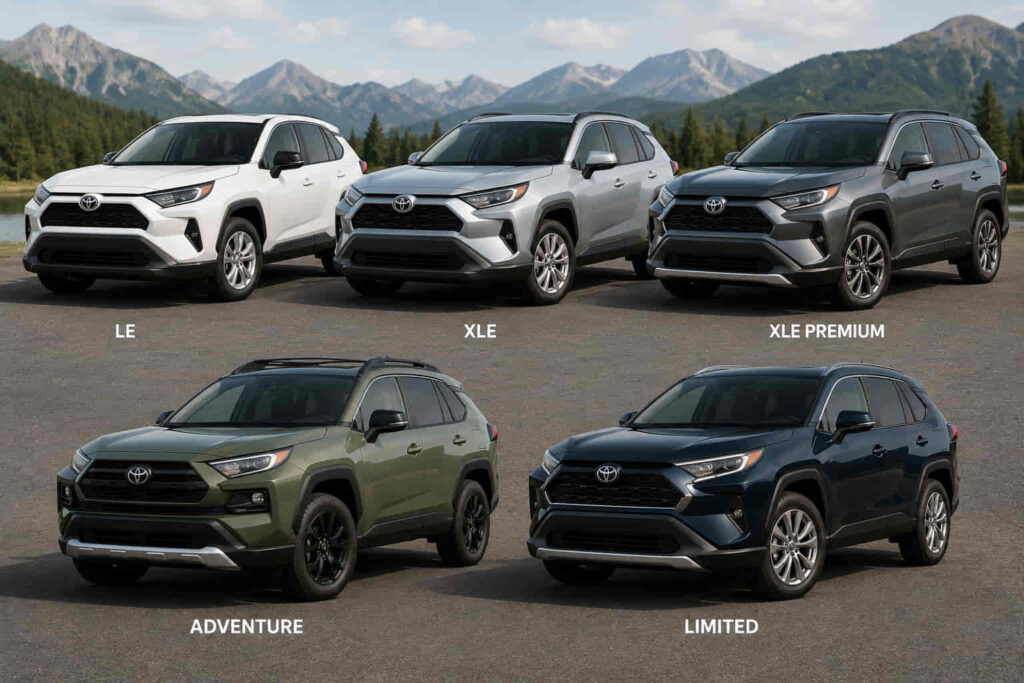
Toyota RAV4 trim packages give buyers different combinations of performance, comfort, technology, exterior equipment, and convenience features without changing the vehicle’s core compact SUV identity. Rather than choosing a RAV4 based only on price, buyers should compare what each trim adds over the configuration below it and determine whether those upgrades match how they plan to use the vehicle.
The RAV4 lineup progresses from entry-level configurations focused on essential equipment and affordability to higher trims with upgraded cabin materials, larger wheels, additional convenience features, and more advanced technology. The price difference between two trims therefore represents more than a different badge. It reflects changes in standard equipment, available packages, drivetrain choices, and features that would otherwise require an upgrade or may not be available on lower trims.
This guide compares 7 Toyota RAV4 trim packages by examining their prices, standard features, major differences, and intended buyer profiles. It also explains how the trims progress through the lineup, which upgrades provide meaningful value, and what buyers should consider before paying more for a higher RAV4 trim. Because Toyota changes trim availability, equipment, and pricing between model years, all trim-specific specifications should be evaluated within the same model year.
What Are the 7 Toyota RAV4 Trim Packages?
The Toyota RAV4 trim lineup varies by model year, so the exact seven trims must be identified within the same production year before their prices and equipment can be compared accurately. Toyota uses trim levels to create distinct RAV4 configurations, with each version combining a specific set of exterior, interior, technology, comfort, and drivetrain features. Moving higher through the lineup generally increases the amount of standard equipment, although a higher position does not automatically make a trim the better choice for every buyer.
A RAV4 trim level is also different from an optional package. The trim establishes the vehicle’s primary equipment configuration, while an optional package adds a defined group of features to an eligible trim. This distinction matters when comparing Toyota RAV4 trim packages because a feature that appears standard on a higher trim may be available only through an optional package on a lower trim. Comparing trim names without checking whether equipment is standard or optional can therefore produce an inaccurate price and value comparison.
The most useful way to evaluate the seven Toyota RAV4 trims is to treat the entry-level model as the equipment baseline and examine what changes at every subsequent step. A higher trim should justify its additional cost through measurable differences such as upgraded seating materials, additional convenience equipment, exterior changes, infotainment technology, or drivetrain availability. This incremental comparison shows what buyers actually receive for the price increase instead of treating every trim as an isolated vehicle.
What Does the Toyota RAV4 LE Trim Include?
The Toyota RAV4 LE serves as the entry point to the RAV4 trim hierarchy in model years where Toyota offers the LE. Its primary role is to provide the essential RAV4 driving, safety, connectivity, and utility functions without requiring buyers to pay for the comfort and appearance upgrades associated with higher trims. This makes the LE the baseline against which the equipment and value of subsequent RAV4 trims should be measured.
Choosing the RAV4 LE does not mean choosing a fundamentally different vehicle from the rest of the lineup. The LE retains the core characteristics that define the RAV4, including its compact SUV body configuration, passenger and cargo utility, core powertrain architecture applicable to that model year, and Toyota’s standard safety equipment. The important differences appear in secondary attributes such as cabin materials, convenience equipment, wheel design, seating functions, exterior details, and available options.
The LE is therefore most relevant to buyers who place greater value on the RAV4’s core functionality than on premium equipment. Paying for a higher trim becomes more rational when a buyer needs features that are unavailable on the LE or when adding available options substantially reduces the price advantage of remaining with the base trim. The LE’s value should consequently be evaluated using both its starting price and the equipment a specific buyer would need to add.
What Does the Toyota RAV4 XLE Trim Include?
The Toyota RAV4 XLE moves above the LE by adding comfort and convenience equipment rather than changing the fundamental purpose of the vehicle. The XLE is positioned for buyers who want the core practicality of the RAV4 but prefer additional everyday features that reduce the compromises associated with an entry-level configuration. Its value is therefore determined primarily by the usefulness of its incremental equipment compared with the additional price over the LE.
The most important comparison is not the complete XLE specification sheet but the equipment the XLE adds over the LE. Depending on the model year, these differences can involve exterior equipment, seating functions, climate and convenience features, driver-assistance equipment, and access to options or packages unavailable on the base model. Every feature must be classified as standard, available, or package-dependent for the relevant model year because availability alone does not mean the equipment is included in the XLE’s starting price.
The RAV4 XLE makes the strongest purchasing case when its additional standard equipment includes several features a buyer already intends to obtain. In that situation, moving from LE to XLE consolidates those requirements into a factory trim rather than forcing the buyer to accept the limitations of the base configuration. Conversely, buyers who do not need the XLE-specific upgrades may receive little practical benefit from paying the higher trim price. The decision between LE and XLE should therefore be based on the incremental cost of the features that will actually be used, not simply on the XLE’s higher position in the Toyota RAV4 lineup.
Read more: Mazda vs Toyota Reliability
What Does the 2026 Toyota RAV4 XLE Premium Trim Include?
The 2026 Toyota RAV4 XLE Premium starts at a base MSRP of $36,100 and combines the RAV4’s hybrid powertrain with a more comfort-focused equipment package. Toyota positions the XLE Premium within the Core design family alongside the LE and Limited, making it the logical step for buyers who want more cabin comfort and convenience without moving into the rugged Woodland or sport-oriented SE and XSE configurations.
The XLE Premium’s most meaningful upgrades are concentrated inside the cabin and around everyday vehicle access. SofTex-trimmed seating replaces the more basic seating treatment found lower in the lineup, while heated front seats add a practical comfort upgrade. A height-adjustable power liftgate makes the cargo area easier to access, particularly when loading groceries, luggage, or other equipment. Front and Rear Parking Assist with Automatic Braking also adds another layer of assistance during low-speed parking maneuvers.
The 2026 RAV4 XLE Premium is available with either front-wheel drive or all-wheel drive, which gives buyers more flexibility than grades restricted to AWD. The broader drivetrain choice also matters when comparing price because a buyer who does not require AWD can select the XLE Premium without paying for an all-wheel-drive configuration simply to obtain its comfort equipment.
The XLE Premium makes the most sense for buyers who prioritize interior comfort and convenience over sporty styling or trail-oriented equipment. Its $1,400 base MSRP increase over the $34,700 SE is relatively small, but the two trims serve different purposes rather than representing a simple linear upgrade. The SE emphasizes sport styling, while the XLE Premium directs more of its equipment toward comfort and daily usability.
What Does the 2026 Toyota RAV4 Woodland Trim Include?
The 2026 Toyota RAV4 Woodland starts at $39,900 in its hybrid configuration and is the rugged-focused grade in the RAV4 family. Unlike the Core-oriented XLE Premium, the Woodland changes the vehicle’s equipment around outdoor use and traction. Toyota equips the hybrid Woodland with all-wheel drive as standard, so buyers do not need to select AWD as a separate drivetrain upgrade.
The Woodland’s exterior equipment distinguishes it immediately from the road-focused trims. It uses 18-inch six-spoke matte metallic gray alloy wheels fitted with all-terrain tires, Woodland-branded raised black roof rails with cross bars, and integrated Rigid Industries LED fog lights. These changes have functional relevance as well as visual value: the all-terrain tires address mixed-surface driving, the roof hardware expands external cargo-carrying possibilities, and the auxiliary lighting supports the trim’s outdoor-oriented configuration.
The Woodland also demonstrates why Toyota RAV4 trims should be compared by purpose rather than price alone. At $3,800 more than the XLE Premium based on their hybrid starting MSRPs, the Woodland is not simply a more luxurious XLE Premium. The additional cost shifts the configuration toward standard AWD, all-terrain equipment, cargo flexibility, and rugged exterior hardware. A buyer primarily interested in cabin luxury may therefore receive more relevant equipment from another trim even when the Woodland sits higher on the price ladder.
For 2026, Woodland is particularly important because Toyota also offers the grade with a plug-in hybrid powertrain. The Woodland PHEV starts at $45,300 and uses AWD, creating a second configuration for buyers who want the rugged design with plug-in capability. The HEV and PHEV Woodland should consequently be treated as separate powertrain configurations when comparing prices rather than assuming that every Woodland has the same starting MSRP.
What Does the 2026 Toyota RAV4 XSE Trim Include?
The 2026 Toyota RAV4 XSE starts at $41,300 with the hybrid powertrain and combines sport-oriented exterior styling with a higher level of cabin technology and comfort. Toyota places the XSE in the Sport design family, separating its purpose from the rugged Woodland and the Core-oriented Limited. The result is a trim intended for buyers who want stronger visual differentiation without giving up premium interior equipment.
The XSE uses 20-inch multi-spoke black sport alloy wheels, giving it a noticeably different stance from the 18-inch wheels on the Woodland. Inside, Toyota equips the XSE with SofTex and synthetic suede-trimmed seats as well as heated and ventilated front seats. The combination is important because the XSE does not rely solely on cosmetic sport details; it also introduces comfort equipment relevant to daily driving in both cold and warm weather.
Technology provides another major reason to move to the XSE. A 12.9-inch Toyota Audio Multimedia system is standard on the grade and supports wireless Apple CarPlay and Android Auto. This screen is larger than the 10.5-inch multimedia system used as standard equipment on the LE, creating a measurable technology distinction between the lower and higher portions of the RAV4 lineup.
The hybrid XSE uses all-wheel drive and has an EPA-estimated fuel economy rating of 43 mpg city and 37 mpg highway. Toyota also offers the XSE with the 2026 RAV4 plug-in hybrid powertrain, where its starting MSRP rises to $47,200. Buyers comparing XSE pricing should therefore distinguish the HEV from the PHEV rather than treating the XSE name as a single mechanical configuration. The hybrid XSE suits buyers who prioritize sport styling, larger wheels, upgraded multimedia technology, and enhanced seat comfort, while the PHEV version adds plug-in capability at a higher entry price.
What Does the 2026 Toyota RAV4 Limited Trim Include?
The 2026 Toyota RAV4 Limited starts at $43,300 and serves as the highest-priced trim in the standard RAV4 Hybrid lineup. Unlike the XSE, which combines upgraded equipment with sport-oriented styling, the Limited concentrates its value on premium comfort, convenience, and technology. It is available with the hybrid powertrain and all-wheel drive, making it the most equipment-focused choice for buyers who want a RAV4 without moving into the plug-in hybrid lineup.
Three features help distinguish the Limited from lower 2026 RAV4 trims: a panoramic glass roof with a power tilt-and-slide moonroof, a nine-speaker JBL Premium Audio system, and dual Qi-compatible wireless charging. These additions target cabin experience rather than rugged capability or sport appearance. The panoramic roof changes the openness of the passenger compartment, the JBL system upgrades audio performance, and dual wireless charging provides simultaneous charging capability for compatible devices.
The Limited also demonstrates why the highest Toyota RAV4 trim is not automatically the right choice for every buyer. Its $43,300 base MSRP is $2,000 higher than the $41,300 XSE, but the two grades emphasize different attributes. The XSE combines 20-inch black sport alloy wheels with SofTex and synthetic suede-trimmed seating and sport-oriented styling, while the Limited directs more of its equipment toward premium cabin features. Buyers should therefore evaluate whether luxury and convenience equipment provides more practical value than the XSE’s sport-focused configuration.
The 2026 RAV4 Limited is best suited to buyers who prioritize premium interior equipment and daily comfort while still wanting a conventional hybrid rather than a plug-in hybrid. Its position at the top of the HEV lineup also makes it the reference point for determining how far Toyota can upgrade the RAV4’s cabin and technology without requiring buyers to switch to a PHEV powertrain.
What Does the 2026 Toyota RAV4 GR SPORT Trim Include?
The 2026 Toyota RAV4 GR SPORT starts at $48,500 and is exclusively a plug-in hybrid grade with all-wheel drive. This distinction is essential when comparing Toyota RAV4 trim packages because GR SPORT is not simply the trim above Limited in a single mechanical hierarchy. Limited belongs to the hybrid lineup, while GR SPORT sits within the plug-in hybrid range and combines a different powertrain configuration with equipment developed around a stronger performance identity.
The GR SPORT uses the 2026 RAV4 Plug-in Hybrid system, which produces 324 net combined horsepower. Toyota states that the PHEV can accelerate from 0 to 60 mph in as little as 5.4 seconds, although performance figures depend on configuration. These figures place the plug-in hybrid powertrain in a substantially different performance context from the standard hybrid system, so the $48,500 GR SPORT price should not be interpreted as a simple equipment premium over the $43,300 Limited.
Toyota differentiates the GR SPORT visually with 20-inch black alloy wheels featuring a black pearl machined finish and increased offset, GR-designed front and rear bumpers, and a functional GR-designed rear spoiler. These components establish a separate design identity rather than applying only badges to another RAV4 trim. The GR SPORT was developed in collaboration with Toyota Gazoo Racing, connecting its exterior and chassis-oriented positioning to Toyota’s performance sub-brand.
The GR SPORT is therefore most relevant to buyers who want the performance-focused expression of the 2026 RAV4 and specifically want a plug-in hybrid. Buyers interested primarily in luxury equipment should compare the Limited instead, while those prioritizing plug-in capability without requiring the GR treatment can consider the PHEV SE, Woodland, or XSE. This distinction prevents the trim hierarchy from implying that every buyer should progress from Limited to GR SPORT as their budget increases.
What Are the Main Differences Between 2026 Toyota RAV4 Trim Levels?
The main differences between 2026 Toyota RAV4 trims are price, powertrain availability, drivetrain, design orientation, interior equipment, wheel and tire configuration, multimedia technology, and comfort features. Toyota divides the RAV4 into Core, Rugged, and Sport design families, which means the lineup is not a simple progression in which every more expensive trim contains everything offered by the trim below it.
The Core family includes LE, XLE Premium, and Limited. These trims progress from essential equipment toward greater comfort and premium cabin features. The LE starts at $31,900 and establishes the equipment baseline with a 12.3-inch digital gauge cluster, 10.5-inch Toyota Audio Multimedia system, and Toyota Safety Sense 4.0. The XLE Premium raises the starting MSRP to $36,100 and adds comfort-oriented equipment such as SofTex-trimmed seats, heated front seats, and a height-adjustable power liftgate. The $43,300 Limited moves further toward premium equipment with its panoramic glass roof, JBL Premium Audio system, and dual wireless charging.
The Sport family follows a different progression. The hybrid SE starts at $34,700 and introduces sport-specific visual treatments, 18-inch black sport alloy wheels, and blue interior stitching. The hybrid XSE starts at $41,300 and adds 20-inch black sport alloy wheels, heated and ventilated front seats, and a 12.9-inch Toyota Audio Multimedia system. GR SPORT extends the Sport concept into the plug-in hybrid range at $48,500, combining the 324-horsepower PHEV system with GR-specific exterior and performance-oriented equipment.
Woodland forms the rugged branch of the lineup rather than fitting directly between two Core or Sport trims. The hybrid Woodland starts at $39,900 and uses standard all-wheel drive, 18-inch wheels with all-terrain tires, raised roof rails with cross bars, and integrated Rigid Industries LED fog lights. A PHEV Woodland is also available at $45,300. Its value is therefore tied to outdoor-oriented equipment and drivetrain capability rather than additional luxury features.
Powertrain availability creates another major distinction. The 2026 RAV4 LE and XLE Premium are hybrid grades available with front-wheel drive or all-wheel drive, while the hybrid Woodland, XSE, and Limited use all-wheel drive. Toyota also offers plug-in hybrid versions of the SE, Woodland, and XSE, while GR SPORT is PHEV-only. As a result, the same grade name can represent different powertrain and price configurations when it appears in both the HEV and PHEV ranges.
The 2026 RAV4 trim structure should consequently be evaluated as intersecting configuration families rather than one uninterrupted ladder from cheapest to most expensive. Core trims prioritize mainstream comfort, Sport trims emphasize appearance and a more performance-oriented character, and Woodland prioritizes rugged equipment. Powertrain choice then creates another layer across those design families. This structure explains why the best RAV4 trim depends on the buyer’s intended use rather than simply which model has the highest MSRP.
How Much Does Each 2026 Toyota RAV4 Trim Cost?
The 2026 Toyota RAV4 starts at $31,900 for the LE and reaches $43,300 for the Limited within the hybrid lineup. Between those two grades, the SE starts at $34,700, the XLE Premium at $36,100, the Woodland at $39,900, and the XSE at $41,300. These figures are base MSRPs, so they provide a consistent way to compare trim positioning but do not represent the final amount every buyer will pay.
The price progression becomes more useful when the difference between adjacent trims is measured. Moving from the $31,900 LE to the $34,700 SE adds $2,800, while moving from the SE to the $36,100 XLE Premium adds $1,400. The Woodland costs $3,800 more than the XLE Premium, the XSE costs $1,400 more than the Woodland, and the Limited adds another $2,000 over the XSE. The complete hybrid range therefore spans $11,400 between the base LE and top Limited before options and other applicable charges.
Price alone does not establish a direct equipment hierarchy because Toyota organizes the 2026 RAV4 around different design and use cases. The $36,100 XLE Premium emphasizes comfort with SofTex-trimmed seats, heated front seats, and a power liftgate, while the $39,900 Woodland directs more of its additional cost toward rugged equipment such as all-terrain tires, raised roof rails with cross bars, and integrated LED fog lights. The $41,300 XSE shifts the emphasis again toward sport styling, 20-inch wheels, upgraded seating, and a larger multimedia display. A higher MSRP therefore identifies a more expensive configuration, not necessarily a universally better configuration.
Plug-in hybrid pricing creates a second comparison layer. The 2026 RAV4 PHEV SE starts at $41,500, followed by the Woodland at $45,300 and XSE at $47,200. The PHEV-only GR SPORT starts at $48,500. A buyer comparing a $41,300 hybrid XSE with a $47,200 PHEV XSE is consequently evaluating more than $5,900 in price difference; the comparison also involves two powertrain configurations and the benefits associated with plug-in operation.
The final purchase price can exceed base MSRP when a vehicle includes optional packages, accessories, upgraded configurations, destination-related charges, taxes, registration costs, or dealer-specific additions. For this reason, trim MSRP should first be used to establish the relative cost of each RAV4 configuration. Buyers can then compare actual vehicles with equivalent equipment rather than assuming that every RAV4 carrying the same trim badge will have an identical final price.
Which 2026 Toyota RAV4 Trim Offers the Best Value?
The 2026 Toyota RAV4 XLE Premium offers one of the strongest value propositions for buyers who prioritize everyday comfort because its $36,100 starting MSRP adds several meaningful convenience features without approaching the price of the upper hybrid trims. Its SofTex-trimmed seats, heated front seats, height-adjustable power liftgate, and Front and Rear Parking Assist with Automatic Braking create functional differences that occupants can use regularly rather than upgrades that are primarily cosmetic.
The $1,400 price difference between the $34,700 SE and $36,100 XLE Premium makes the comparison particularly relevant. The SE is the stronger choice for buyers who value sport-oriented styling, including its black 18-inch alloy wheels and distinctive exterior treatment. The XLE Premium directs its higher price toward comfort and convenience instead. Neither trim is universally better, but the XLE Premium provides a stronger value case when heated seating, SofTex upholstery, parking assistance, and easier cargo access are priorities.
The LE remains the value choice for buyers whose main objective is obtaining the core 2026 RAV4 experience at the lowest starting price. At $31,900, it still includes a 12.3-inch digital gauge cluster, a 10.5-inch Toyota Audio Multimedia system with wireless Apple CarPlay and Android Auto compatibility, and Toyota Safety Sense 4.0. A buyer who does not need the comfort, rugged, or sport-oriented equipment of higher grades can therefore avoid an $11,400 climb to the Limited while retaining the RAV4’s fundamental technology and safety package.
The Woodland offers a different type of value because its equipment addresses a specific use case. Its $39,900 starting price includes all-terrain tires, raised roof rails with cross bars, and integrated Rigid Industries LED fog lights. Those features provide greater relevance to buyers who regularly carry outdoor equipment or prefer the Woodland’s rugged configuration. Buyers who spend almost all of their time on paved roads and prioritize cabin comfort may receive less practical value from the same expenditure.
The XSE becomes the stronger value candidate when technology, seat comfort, and sport styling are all priorities. Its $41,300 MSRP includes 20-inch black sport alloy wheels, SofTex and synthetic suede-trimmed seats, heated and ventilated front seats, and a 12.9-inch Toyota Audio Multimedia system. The XSE costs $5,200 more than the XLE Premium, so that premium is justified primarily for buyers who will use its additional comfort and technology while also valuing its Sport design identity.
The Limited is the better fit when premium cabin equipment takes priority over minimizing purchase price. At $43,300, it costs $2,000 more than the XSE and adds features such as a panoramic glass roof, JBL Premium Audio, and dual Qi-compatible wireless charging. These features increase cabin convenience and perceived luxury, but they do not make the Limited the automatic value winner because the benefits depend heavily on how much a buyer values premium interior equipment.
There is therefore no single 2026 Toyota RAV4 trim that provides the best value for every buyer. The LE delivers the lowest-cost entry into the hybrid lineup, the XLE Premium creates a strong balance between price and daily comfort, the Woodland concentrates value around rugged equipment, the XSE combines technology with sport-oriented design, and the Limited prioritizes premium cabin features. The most cost-effective trim is the one that includes the buyer’s required equipment as standard without forcing payment for higher-grade features that will rarely be used.
Which 2026 Toyota RAV4 Trims Are Available With All-Wheel Drive?
All-wheel drive is available across the 2026 Toyota RAV4 lineup, but Toyota does not configure AWD the same way on every trim. The LE, SE, and XLE Premium Hybrid can be configured with either front-wheel drive or Electronic On-Demand All-Wheel Drive, while the Woodland, XSE, and Limited Hybrid use AWD as standard. Every 2026 RAV4 Plug-in Hybrid also comes with AWD, including the SE, Woodland, XSE, and GR SPORT.
The drivetrain difference affects both performance and the way buyers should compare trim prices. Front-wheel-drive RAV4 Hybrid models produce 226 net combined horsepower, while AWD Hybrid configurations produce 236 net combined horsepower. The AWD system adds a dedicated rear electric motor that can send driving force to the rear wheels when additional traction is required. The system responds to conditions such as front-wheel slip and adjusts front-to-rear torque distribution electronically according to vehicle speed, accelerator input, and driving conditions.
Choosing AWD is therefore different from choosing a higher RAV4 trim. A buyer interested in an LE, SE, or XLE Premium can obtain AWD without moving automatically into the Woodland, XSE, or Limited. This distinction prevents equipment level and drivetrain from being treated as the same purchasing decision. Trim selection determines the broader combination of comfort, technology, styling, and convenience features, while drivetrain selection determines whether an eligible Hybrid configuration sends power only to the front wheels or can also use a rear electric motor.
The Woodland is the more relevant choice when AWD needs to be combined with rugged equipment. Its Hybrid and Plug-in Hybrid configurations both use AWD, and the grade adds all-terrain tires and other outdoor-oriented equipment. The XSE and Limited also include AWD in their Hybrid configurations but target different users: the XSE emphasizes sport styling and technology, while the Limited prioritizes premium comfort. AWD availability alone therefore does not determine which RAV4 trim is best.
What Is the Difference Between a Toyota RAV4 Trim and an Optional Package?
A Toyota RAV4 trim is a predefined vehicle configuration, while an optional package adds a group of eligible features to a specific configuration. The distinction matters because LE, SE, XLE Premium, Woodland, XSE, Limited, and GR SPORT identify grades within the 2026 RAV4 family rather than optional packages that can simply be added to any RAV4.
A trim determines a larger portion of the vehicle’s identity. For example, Toyota classifies LE, XLE Premium, and Limited within the Core design family, Woodland within the Rugged design family, and SE, XSE, and GR SPORT within the Sport design family. Those grades can change wheel designs, seating materials, exterior treatments, comfort equipment, drivetrain availability, and other standard features. Moving from one trim to another therefore changes the vehicle’s predefined equipment configuration.
An optional package works within that trim structure rather than replacing it. Package availability depends on the selected grade and can bundle additional technology, convenience, or comfort equipment that is not included in the trim’s base specification. This means two RAV4 vehicles carrying the same trim badge can have different equipment and final prices when one has additional factory options or packages.
Buyers should consequently compare standard equipment before evaluating optional packages. A lower trim with several added options can approach the price of a higher trim where comparable features are already standard. Conversely, moving to a higher trim solely to obtain one desired feature can result in paying for several additional features that the buyer does not need. The more accurate comparison is the price of the complete configuration required by the buyer, not the base MSRP or trim name in isolation.
Which 2026 Toyota RAV4 Trim Should You Choose?
Choose the 2026 Toyota RAV4 LE when the priority is obtaining the essential RAV4 Hybrid experience at the lowest base MSRP. The LE starts at $31,900 and includes key technology such as a 12.3-inch digital gauge cluster, a 10.5-inch Toyota Audio Multimedia system, and Toyota Safety Sense 4.0. It is also available with FWD or AWD, allowing buyers to select additional traction without being forced into a more expensive equipment grade.
Choose the SE when sport-oriented design matters more than the comfort upgrades associated with the Core grades. Starting at $34,700 in Hybrid form, the SE uses 18-inch black sport alloy wheels, distinctive exterior treatments, and blue interior stitching. It also offers FWD or AWD in Hybrid form and is available as a Plug-in Hybrid, making the SE one of the more flexible grades for buyers who want Sport-family styling.
Choose the XLE Premium when everyday comfort and convenience provide more value than sport styling. Its $36,100 starting MSRP includes SofTex-trimmed seats, heated front seats, a height-adjustable power liftgate, and Front and Rear Parking Assist with Automatic Braking. Because the XLE Premium Hybrid is available with FWD or AWD, buyers can also separate their comfort-equipment decision from their drivetrain decision.
Choose the Woodland when rugged equipment is a primary requirement. The $39,900 Hybrid Woodland combines standard AWD with all-terrain tires, raised roof rails with cross bars, and integrated Rigid Industries LED fog lights. Toyota also offers Woodland as a Plug-in Hybrid, allowing buyers to retain the rugged-focused configuration while moving to the PHEV powertrain.
Choose the XSE when the desired configuration combines sport styling with a higher level of cabin technology and comfort. The Hybrid XSE starts at $41,300 and includes 20-inch black sport alloy wheels, SofTex and synthetic suede-trimmed seats, heated and ventilated front seats, and a 12.9-inch multimedia system. The availability of an XSE Plug-in Hybrid also gives buyers a route to PHEV capability without moving into the more specialized GR SPORT.
Choose the Limited when premium cabin features matter more than rugged or sport-oriented equipment. Starting at $43,300, the Limited includes a panoramic glass roof, JBL Premium Audio, and dual Qi-compatible wireless charging. AWD is standard on the Limited Hybrid, making it the most equipment-focused Core grade for buyers who want an upscale RAV4 while remaining with the conventional hybrid powertrain.
Choose the GR SPORT when performance positioning and plug-in hybrid capability are both priorities. GR SPORT is not simply the next equipment level above Limited because it belongs to the Sport family and uses the PHEV powertrain with standard AWD. Its GR-specific suspension and steering tuning, functional aerodynamic components, and performance-oriented design give it a different purpose from the luxury-focused Limited.
The best 2026 Toyota RAV4 trim is therefore determined by the attributes a buyer values most. LE prioritizes price, SE prioritizes accessible sport styling, XLE Premium emphasizes everyday comfort, Woodland targets rugged use, XSE combines sport design with upgraded technology, Limited focuses on premium amenities, and GR SPORT provides the most performance-oriented PHEV configuration. Selecting the RAV4 trim around those requirements is more useful than assuming the most expensive grade automatically provides the best value.