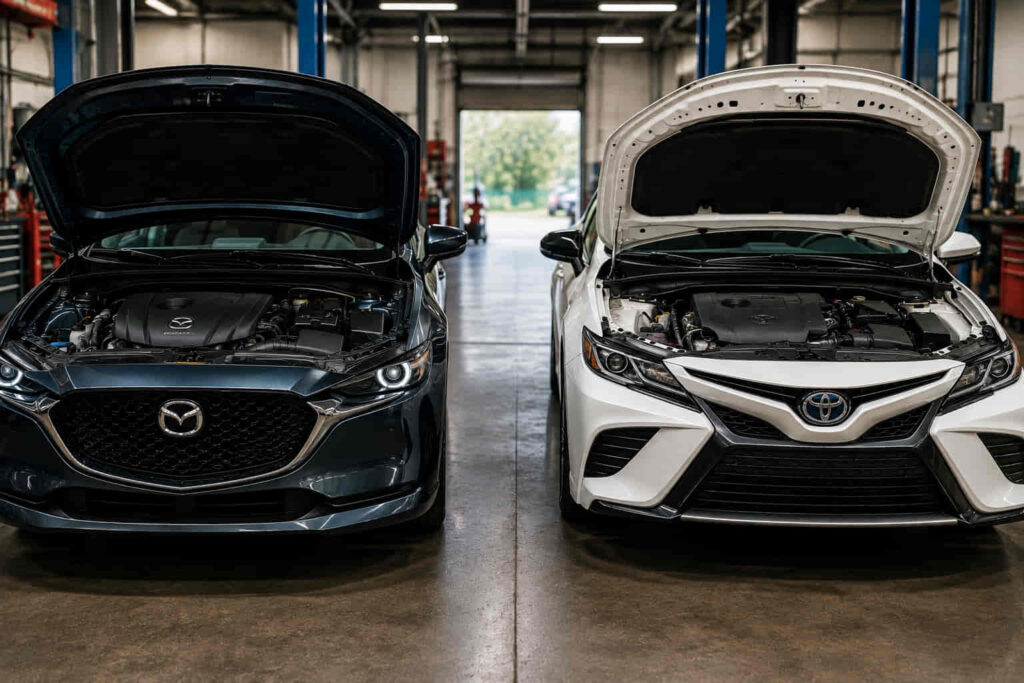
Toyota has the stronger overall record for long-term reliability, but Mazda is a close competitor when the comparison focuses on modern models with proven engines and transmissions. Toyota has built its reputation around durable powertrains, high-mileage vehicles, and established models such as the Corolla, Camry, and RAV4. Mazda has strengthened its reliability position through its Skyactiv powertrains and continued use of conventional automatic transmissions across much of its lineup. The result is a smaller reliability gap than brand reputation alone may suggest.
A useful Mazda vs Toyota reliability comparison must therefore examine more than an overall reliability rating. Vehicle lifespan, engine durability, transmission reliability, repair frequency, repair severity, maintenance costs, and model-specific performance determine how dependable each vehicle remains during long-term ownership. Model year and maintenance history become even more important when comparing used vehicles because two cars from the same manufacturer can have substantially different mechanical conditions.
This comparison examines 7 key reliability differences between Mazda and Toyota to determine where each manufacturer has an advantage and which one is better suited to long-term ownership. The comparison also separates brand-level reputation from model-level reliability, helping buyers evaluate the specific Mazda or Toyota they are considering rather than making a purchase based on the badge alone.
Is Toyota More Reliable Than Mazda Overall?
Toyota has the stronger overall reliability record, but the difference between Toyota and Mazda is smaller when modern vehicles with comparable powertrains are evaluated. Toyota’s advantage comes from decades of high-volume vehicles using established engines and transmissions, while Mazda has developed a strong reliability position through relatively consistent powertrain designs across models such as the Mazda3, CX-30, and CX-5. Brand reputation therefore favors Toyota, but it does not establish that every Toyota is more dependable than every Mazda.
Overall vehicle reliability depends on more than the number of reported problems. Repair frequency indicates how often an owner encounters an unscheduled problem, while repair severity reflects whether those problems involve inexpensive components or major systems such as the engine and transmission. Long-term reliability adds another dimension because a vehicle can perform well during its first years of ownership but develop expensive problems as mileage accumulates. A meaningful Mazda vs Toyota reliability comparison must account for all three factors rather than treating a single reliability score as a complete measurement.
Toyota’s greatest advantage is consistency across several established nameplates. The Corolla, Camry, RAV4, Highlander, Prius, and other long-running Toyota models provide extensive ownership histories across multiple generations. This gives buyers more evidence for identifying durable powertrains as well as specific model years that require additional caution. Toyota also tends to retain successful mechanical designs long enough for problems to become understood and corrected, which reduces uncertainty for buyers choosing a proven configuration.
Mazda follows a similar strategy on a smaller scale. Its Skyactiv engine and transmission families have been shared across several mainstream vehicles, reducing the number of completely different powertrain architectures buyers need to evaluate. Models such as the Mazda3 and CX-5 have helped move Mazda beyond its older reputation as primarily a performance-oriented alternative to larger Japanese manufacturers. Modern Mazda reliability should consequently be assessed through its current and recent powertrains rather than assumptions based on much older vehicles.
Model year remains a critical qualifier for both manufacturers. Engines, transmissions, electrical systems, infotainment hardware, manufacturing processes, and individual components can change during a vehicle’s production cycle. A reliable Toyota nameplate can have weaker model years, just as a Mazda with a strong overall record can have individual years with higher problem rates. For a used-car purchase, the exact model, model year, powertrain, mileage, maintenance records, and current condition provide a more precise assessment than the manufacturer’s average reputation.
Toyota is therefore the safer default when reliability is the buyer’s dominant criterion, but Mazda should not be treated as a substantially less reliable alternative without model-specific evidence. The practical reliability gap depends on which two vehicles are being compared and how long the buyer intends to keep them.
Do Toyota Vehicles Last Longer Than Mazda Vehicles?
Toyota has the stronger established record for extreme vehicle longevity, while well-maintained Mazda vehicles can also remain dependable beyond 150,000 miles and potentially reach 200,000 miles or more. The important distinction is that reaching a high odometer reading does not prove that a vehicle reached it inexpensively. Longevity measures how long the vehicle remains operational, whereas reliability measures how consistently it operates without unexpected failures.
Toyota’s advantage becomes clearer when considering the breadth of its high-mileage vehicle portfolio. Long-running models such as the Corolla, Camry, RAV4, Tacoma, 4Runner, and Highlander have created decades of ownership experience across passenger cars, SUVs, and trucks. This does not establish a guaranteed lifespan for an individual Toyota. Instead, it provides a larger historical record from which buyers can identify powertrains and generations that have demonstrated durability under extended use.
Mazda has fewer comparable high-volume nameplates with the same length of ownership history, but its modern gasoline vehicles have several characteristics that support long-term use. Skyactiv engines are deployed across multiple models, and Mazda has continued using conventional automatic transmissions in many applications instead of moving its mainstream gasoline lineup entirely to conventional CVTs. This consistency makes long-term reliability easier to evaluate because the same basic powertrain families appear across multiple vehicles and production years.
Maintenance becomes increasingly important once either brand passes 100,000 miles. Oil changes, cooling-system condition, transmission servicing where specified, spark plugs, belts, suspension components, wheel bearings, engine seals, batteries, and other age-related items influence whether a vehicle can continue operating economically. Neglecting one critical system can shorten the practical lifespan even when the underlying engine and transmission are capable of substantially greater mileage.
Driving environment also changes longevity. Repeated short trips, severe temperatures, road salt, heavy stop-and-go traffic, poor road surfaces, towing, and deferred maintenance can accelerate component wear. A 120,000-mile vehicle that accumulated most of its mileage under steady highway driving can therefore have a different mechanical condition from another 120,000-mile vehicle subjected to years of short urban trips. Mileage is useful only when interpreted alongside age, operating history, and maintenance.
Toyota has the advantage when a buyer’s goal is maximizing the probability of very high mileage, but maintenance history can outweigh that brand-level advantage when comparing two used vehicles. A Mazda with complete service records and a healthy powertrain can represent a lower ownership risk than a Toyota with neglected fluids, unresolved warning lights, overheating history, or previous mechanical damage. For this reason, Toyota’s longevity record should narrow a buyer’s search rather than replace an inspection of the individual vehicle.
Are Toyota Engines More Reliable Than Mazda Engines?
Toyota has a broader long-term record for engine reliability, but modern Mazda engines can provide comparable durability when the correct engine, model year, and maintenance history are considered. Toyota’s advantage comes primarily from the number of proven engine families used across high-volume vehicles for long periods. Mazda has a smaller product portfolio, but its Skyactiv engine strategy has created substantial mechanical consistency across models such as the Mazda3, CX-30, CX-5, and CX-50.
Mazda’s naturally aspirated Skyactiv-G engines are particularly relevant to this comparison. Mazda developed these engines around high compression ratios, direct fuel injection, combustion efficiency, and reduced internal energy losses rather than relying exclusively on smaller turbocharged engines to achieve efficiency. The same basic engineering approach has appeared across multiple Mazda models, giving buyers a relatively mature powertrain architecture instead of an entirely different engine design for every vehicle. Mechanical consistency is useful for long-term reliability because recurring problems become easier to identify across model years and service histories.
Toyota uses a wider range of engine configurations because its vehicle lineup is substantially broader. Naturally aspirated gasoline engines, turbocharged engines, and gasoline-electric hybrid powertrains all appear within the Toyota range, so the statement that “Toyota engines are more reliable” requires qualification. A naturally aspirated Corolla engine, a hybrid RAV4 powertrain, and a turbocharged engine in a larger Toyota vehicle do not share identical components, operating conditions, or long-term failure risks. The correct comparison must match equivalent engines and vehicles rather than applying Toyota’s overall reputation to every powertrain.
Engine complexity also affects the type of reliability risk a buyer should evaluate. Mazda’s turbocharged Skyactiv applications add components and operating pressures that naturally aspirated versions do not have. Toyota’s newer turbocharged applications require the same model-specific scrutiny. Turbocharging does not establish that an engine is unreliable, but additional components such as the turbocharger and associated oil, cooling, and intake systems create additional systems whose condition matters as mileage increases.
Direct injection introduces another relevant consideration. Fuel is delivered directly into the combustion chamber rather than passing over the intake valves in a conventional port-injection arrangement. This changes combustion efficiency and fuel control, but it also changes how deposits can develop within the intake system. Toyota has used different injection strategies depending on the engine, including systems that combine direct and port injection in certain applications. Mazda and Toyota engines should therefore be compared by their actual fuel-delivery architecture instead of treating all gasoline engines from either manufacturer as mechanically identical.
Maintenance history ultimately has greater diagnostic value than brand reputation when evaluating an individual used engine. Consistent oil changes protect internal components, while proper cooling-system operation limits the risk of overheating and heat-related damage. Abnormal oil consumption, coolant loss, persistent warning lights, rough operation, unusual exhaust smoke, fluid leaks, or evidence of previous overheating can indicate greater risk regardless of whether the engine carries a Mazda or Toyota badge.
Toyota remains the safer brand-level choice for buyers prioritizing a long-established engine reliability record, while Mazda’s naturally aspirated Skyactiv engines make the reliability gap narrower at the model level. Buyers should therefore identify the exact engine before comparing reliability, particularly when choosing between naturally aspirated, turbocharged, and hybrid configurations.
Are Mazda Transmissions More Reliable Than Toyota Transmissions?
Mazda’s conventional automatic transmissions are a reliability strength, but they do not make Mazda universally more reliable than Toyota because Toyota uses several fundamentally different transmission architectures. Mazda has continued using conventional geared automatic transmissions across much of its mainstream lineup, while Toyota vehicles can use conventional automatics, conventional CVTs, or hybrid eCVTs depending on the model and powertrain.
This difference matters because the term “transmission reliability” can otherwise produce a misleading brand comparison. Mazda’s Skyactiv-Drive automatic uses fixed gear ratios within a conventional automatic architecture. Toyota’s conventional automatics operate on broadly comparable principles, but a Toyota CVT uses a different mechanism to provide continuously variable ratios. Toyota hybrid eCVTs require another distinction because they should not be treated as mechanically equivalent to conventional belt- or chain-type CVTs simply because both carry the CVT label.
Mazda’s relatively consistent use of conventional automatics provides an advantage for buyers who prefer a familiar transmission architecture with established service characteristics. The transmission works with Mazda’s Skyactiv engines as part of an integrated powertrain strategy, and using related designs across several models creates a larger history from which long-term behavior can be evaluated. As with any automatic transmission, durability still depends on the exact application, operating conditions, fluid condition, maintenance requirements, and whether previous symptoms were addressed promptly.
Toyota’s CVTs need to be evaluated separately from its conventional automatics. A conventional CVT changes ratios continuously instead of shifting through a fixed sequence of gears, which changes both driving characteristics and internal mechanical operation. That distinction does not establish that a CVT is inherently unreliable. Reliability must be determined from the specific transmission family, vehicle application, maintenance history, and documented failure pattern.
Toyota hybrid eCVTs create an even more important semantic distinction. The eCVT used in Toyota hybrid applications operates as part of the hybrid power-split system and should not be evaluated according to the same mechanical assumptions applied to a conventional CVT. This architecture integrates the gasoline engine with electric motor-generators to control power delivery. As a result, a comparison between a Mazda conventional automatic and a Toyota hybrid eCVT is also a comparison between two different powertrain systems rather than simply two competing automatic transmissions.
Transmission maintenance remains important for both manufacturers as vehicles accumulate mileage. Fluid deterioration, heat, towing, heavy traffic, repeated short trips, and other severe operating conditions can influence drivetrain wear. Buyers should follow the service information specified for the exact model and powertrain instead of applying a universal fluid-change interval to every Mazda or Toyota. On a used vehicle, delayed engagement, abnormal vibration, shuddering, warning lights, fluid leaks, harsh operation, or unusual noises warrant further inspection before purchase.
Mazda has a strong transmission-reliability position because of its continued use of conventional automatic transmissions, while Toyota’s reliability depends more heavily on which transmission or hybrid architecture is being evaluated. Toyota still retains the stronger overall brand reliability record, but transmission type is one area where the Mazda-versus-Toyota gap cannot be determined accurately from brand reputation alone. A Mazda CX-5 and Toyota RAV4, for example, should be compared using the transmissions installed in the specific model years and powertrains under consideration.
Read more: Subaru vs Toyota Reliability
Does Mazda Need Repairs More Often Than Toyota?
Toyota generally has the advantage in long-term repair risk, but Mazda does not consistently require more repairs simply because it has a weaker overall reliability reputation than Toyota. Repair frequency depends on the specific model, model year, powertrain, mileage, and maintenance history. The more useful comparison is whether Mazda or Toyota develops unscheduled problems more frequently and whether those problems involve minor components or expensive mechanical systems.
Repair frequency and repair severity measure different aspects of reliability. A vehicle that requires several inexpensive repairs can visit a repair shop more frequently while still costing less to own than a vehicle that develops one major engine or transmission failure. Repair frequency therefore measures how often problems occur, while repair severity measures their mechanical and financial consequences. Both factors need to be considered before concluding that one manufacturer creates a lower long-term ownership risk.
Mazda benefits from using related Skyactiv powertrains across several mainstream models. The Mazda3, CX-30, CX-5, and other Mazda vehicles have shared engine and transmission technologies, which reduces the number of completely different mechanical architectures within the lineup. This consistency does not eliminate failures, but it makes reliability patterns easier to evaluate at the engine, transmission, and model-year level. A naturally aspirated Mazda with a conventional automatic transmission also has a different repair profile from a turbocharged Mazda or a newer model with additional powertrain technology.
Toyota’s broader lineup produces a more varied repair profile. A Corolla with a conventional gasoline powertrain, a RAV4 Hybrid, and a larger Toyota with a turbocharged engine contain different mechanical and electrical systems. Toyota’s brand-level reliability advantage therefore cannot predict exactly which components will require repairs on every model. Conventional gasoline vehicles may develop age-related engine, cooling, suspension, or transmission problems, while hybrids add components such as traction batteries, electric motors, and power electronics that require a different reliability assessment.
Vehicle age and mileage increase the importance of repair severity. Minor items such as switches, sensors, batteries, or worn suspension components usually have a different ownership impact from an internal engine failure or major transmission repair. Once a Mazda or Toyota passes 100,000 miles, the condition of major components becomes increasingly important because one expensive repair can outweigh years of relatively low routine maintenance costs. This is why a high-mileage vehicle with documented preventive maintenance can represent a lower financial risk than a lower-mileage vehicle with an incomplete service history.
Previous ownership also changes repair probability. Delayed oil changes can accelerate engine wear, neglected cooling-system problems can lead to overheating, and unresolved transmission symptoms can progress into more expensive failures. Accident repairs, corrosion, poor-quality replacement parts, and ignored warning lights create additional risks that are not represented by a manufacturer’s average reliability rating. For a used Mazda or Toyota, service records and a pre-purchase inspection provide more vehicle-specific evidence than the badge alone.
Toyota remains the safer default when the goal is minimizing long-term repair uncertainty, but Mazda can deliver a similarly dependable ownership experience when the comparison involves a proven model year and well-maintained powertrain. The practical difference becomes more meaningful when repair frequency is combined with the amount owners must spend to maintain and repair each vehicle over time.
Is Mazda More Expensive to Maintain Than Toyota?
Mazda is not inherently more expensive to maintain than Toyota, and the actual cost difference depends more on vehicle configuration, mileage, scheduled service requirements, and unexpected repairs than on the manufacturer alone. Both brands require the same basic categories of routine maintenance, including engine oil and filter changes, tires, brakes, batteries, fluids, spark plugs, and other wear-related components. Long-term costs begin to separate when powertrain design and major repair requirements are included.
Scheduled maintenance should be distinguished from unexpected repair costs. Scheduled maintenance consists of services performed at predetermined mileage or time intervals to keep the vehicle operating correctly. Repairs occur when a component wears out, malfunctions, or fails. Combining these expenses into one number can hide an important reliability difference because two vehicles with similar annual ownership costs may reach that total through completely different patterns of routine service and unexpected failures.
Mazda’s widespread use of conventional automatic transmissions provides a relatively consistent maintenance profile across many of its gasoline vehicles. Naturally aspirated Skyactiv engines also avoid the additional turbocharger hardware found in Mazda’s turbocharged configurations. This does not prove that a naturally aspirated Mazda will cost less to maintain than a Toyota, but it reduces the number of powertrain-specific systems that need to be considered in that particular configuration. Turbocharged Mazda models require a separate analysis because engine operating conditions and component complexity differ.
Toyota maintenance costs vary more substantially according to powertrain. A conventional gasoline Corolla, a gasoline RAV4, and a RAV4 Hybrid should not be treated as having identical maintenance requirements. Hybrid vehicles add a traction battery, electric motors, and power electronics, but they can also reduce dependence on certain conventional components. Regenerative braking, for example, uses the electric drive system to recover energy during deceleration, which changes how the friction brakes are used. The resulting ownership profile cannot be evaluated accurately by counting additional hybrid components alone.
Major repairs have the greatest potential to change long-term cost. An owner can budget for oil changes, tires, brakes, and other scheduled services, while an unexpected engine or transmission repair creates a much larger financial event. Reliability therefore influences maintenance economics indirectly: a vehicle that avoids expensive failures can remain inexpensive to own even when individual routine services are not the cheapest in its class.
The comparison also changes after 100,000 miles because age-related components begin to overlap with scheduled maintenance. Suspension wear, engine mounts, wheel bearings, cooling components, seals, hoses, sensors, air-conditioning components, and other parts can require attention independently of routine servicing. The exact pattern depends on model and operating environment, which makes a fixed brand-wide maintenance-cost conclusion less useful for a high-mileage used vehicle.
Toyota provides the stronger overall position when low maintenance risk is considered together with long-term reliability, but Mazda can remain cost-competitive, particularly with a proven naturally aspirated engine and conventional automatic transmission. Buyers should compare equivalent models over the same ownership period rather than relying on a single annual maintenance figure. For a used vehicle, the most relevant calculation includes the purchase price, immediate deferred maintenance, expected scheduled service, and the risk of major repairs during the planned ownership period.
Which Mazda and Toyota Models Are the Most Reliable?
Toyota has a larger selection of models with established long-term reliability records, while Mazda has several strong choices built around a relatively consistent family of Skyactiv powertrains. The difference is important because brand-level reliability only describes an average. A buyer ultimately owns a specific model, model year, engine, and transmission, so model-level evidence provides a more useful prediction of long-term ownership than the manufacturer’s reputation alone.
The Mazda3 and Toyota Corolla provide one of the clearest comparisons between the two brands. Both target buyers looking for compact, relatively efficient vehicles that can remain in service for many years. The Corolla benefits from a longer history and a large population of vehicles from which long-term reliability patterns can be observed. The Mazda3 has a shorter history with its current Skyactiv-based architecture, but naturally aspirated versions combine Mazda’s Skyactiv-G engines with conventional automatic transmissions, creating a comparatively straightforward powertrain configuration. Choosing between them therefore requires examining the exact generation and model year rather than assuming the Corolla automatically wins because Toyota has the stronger brand reputation.
The Mazda CX-30 and Toyota Corolla Cross provide another relevant comparison among smaller crossovers, although powertrain and drivetrain configurations must be matched carefully. The CX-30 shares major technologies with other modern Mazda vehicles, while the Corolla Cross draws from Toyota’s broader platform and powertrain portfolio. Gasoline and hybrid configurations should be evaluated separately because their mechanical architectures differ. A reliability conclusion about a gasoline Corolla Cross should not automatically be transferred to the hybrid version, just as conclusions about a naturally aspirated CX-30 should not automatically apply to a turbocharged configuration.
The Mazda CX-5 and Toyota RAV4 represent a particularly important comparison because compact SUVs are frequently purchased as long-term family vehicles. The CX-5 has used Mazda’s Skyactiv powertrain strategy for years, while the RAV4 has been produced across numerous generations with gasoline and hybrid options. Toyota has the broader high-mileage reputation, but the comparison becomes narrower when a proven CX-5 model year is evaluated against a specific RAV4 model year. Engine choice, transmission design, drivetrain, previous maintenance, recalls, and current mechanical condition can change which individual vehicle represents the lower ownership risk.
The Mazda CX-50 requires additional qualification because it does not have the same length of long-term ownership history as older Mazda nameplates such as the Mazda3 and CX-5. A newer model can perform well in early reliability assessments without yet providing the same amount of high-mileage evidence available for vehicles that have been on the road for considerably longer. Early reliability and proven long-term durability are related but separate measurements. This distinction prevents recent vehicles from being declared exceptionally durable before enough examples have accumulated substantial mileage.
Model year can matter as much as model name. Manufacturers change engines, transmissions, electronics, suppliers, software, manufacturing processes, and individual components throughout a model’s life cycle. A problem affecting one production period does not establish that every Mazda3, CX-5, Corolla, or RAV4 has the same weakness. Conversely, a nameplate with a strong historical reputation does not guarantee that every new generation will reproduce the reliability of its predecessors.
For used vehicles, maintenance history further narrows the value of brand averages. A Mazda with consistent oil changes, appropriate fluid servicing, no overheating history, a smooth transmission, and documented repairs can present less mechanical risk than a neglected Toyota of similar age. The reverse is equally true. Toyota provides the stronger model portfolio when reliability is considered across the entire brand, but the best individual purchase is the Mazda or Toyota with a proven model year, suitable powertrain, documented maintenance, and strong current mechanical condition.
Does Toyota or Mazda Have Better Resale Value?
Toyota generally has the stronger resale-value position because its long-term reliability reputation creates sustained demand for many of its used vehicles, although Mazda can retain value well in competitive passenger-car and crossover segments. Resale value should not be treated as direct evidence of reliability. It is an economic outcome influenced by reliability reputation alongside depreciation, supply, mileage, vehicle condition, market demand, configuration, and regional preferences.
Toyota’s reliability reputation supports resale value because used-car buyers frequently associate the brand with long service life and manageable ownership risk. This perception is reinforced by established models such as the Corolla, Camry, RAV4, Tacoma, and 4Runner, which have accumulated long ownership histories. When buyers expect a vehicle to remain usable at higher mileage, demand does not necessarily disappear when the original warranty expires or the odometer passes a major mileage threshold.
Mazda’s resale position operates in a different context. Models such as the Mazda3, CX-30, CX-5, and CX-50 compete partly through design, driving characteristics, equipment, and powertrain configuration in addition to reliability. A strong reliability record can support their used-market value, but the size of the effect depends on the specific model. Mazda’s smaller overall sales volume also means its used-vehicle market does not mirror Toyota’s across every vehicle category.
Powertrain configuration can affect resale value within the same model. A naturally aspirated engine, turbocharged engine, front-wheel-drive configuration, AWD system, or hybrid powertrain can attract different buyers and carry different expectations about fuel economy, performance, maintenance, and future repairs. Comparing average resale values without accounting for these configurations can therefore create the impression of a brand-level difference that partly results from the types of vehicles being compared.
Condition becomes increasingly important as vehicles age. A high-mileage Toyota does not retain value simply because it is a Toyota if it has accident damage, poor maintenance records, fluid leaks, warning lights, worn suspension components, or significant cosmetic deterioration. A well-maintained Mazda with comprehensive service records can command stronger buyer confidence than a poorly maintained Toyota even when Toyota has the better average resale reputation.
Toyota has the overall advantage when resale value and reliability reputation are considered together, but resale value should remain a supporting factor rather than a reliability metric. Buyers comparing Mazda and Toyota should first determine whether the specific vehicle has a durable powertrain and good maintenance history, then consider resale value as part of the broader ownership-cost calculation.
Should You Buy a Mazda or Toyota for Long-Term Reliability?
Choose Toyota if long-term reliability and minimizing ownership risk are your highest priorities; choose Mazda if you want strong reliability with a conventional powertrain approach and prefer a specific Mazda model over its Toyota alternative. Toyota wins the overall Mazda vs Toyota reliability comparison because it combines a broader history of high-mileage vehicles with proven powertrains and consistent reliability across multiple vehicle classes. Mazda remains a strong alternative, particularly when the comparison involves a naturally aspirated Skyactiv engine paired with a conventional automatic transmission.
Toyota is the safer default for buyers who intend to keep a vehicle well beyond the warranty period or accumulate substantial mileage. Models such as the Corolla, Camry, and RAV4 have long ownership histories, which gives buyers more evidence for evaluating durability across different generations. Toyota also offers gasoline, hybrid, front-wheel-drive, and AWD configurations, allowing buyers to select a powertrain according to their intended use. This breadth matters because reliability should be evaluated within the configuration a buyer actually needs rather than across an entire manufacturer’s lineup.
Mazda becomes particularly competitive when the buyer wants a relatively straightforward gasoline powertrain. Mazda has used its Skyactiv engine and transmission strategy across several models, and naturally aspirated configurations avoid the additional hardware associated with turbocharging. Conventional automatic transmissions also distinguish many Mazda vehicles from competitors that rely more extensively on conventional CVTs. These characteristics do not prove that Mazda is more reliable than Toyota, but they give buyers several established mechanical configurations that can be evaluated through model- and year-specific reliability records.
The decision becomes more nuanced when comparing individual models. A Mazda3 should be evaluated against the relevant Toyota Corolla rather than Toyota’s entire lineup, while a Mazda CX-5 should be compared with a corresponding Toyota RAV4 of similar age, mileage, drivetrain, and condition. The Mazda CX-30 and Toyota Corolla Cross require the same approach. Toyota’s brand-level advantage can become smaller, disappear, or become more significant once the comparison moves to specific model years and powertrains.
Used-car buyers should place even greater weight on vehicle-specific evidence. A Toyota with incomplete service records, signs of overheating, transmission problems, accident damage, fluid leaks, or neglected maintenance is not automatically a reliable purchase. A Mazda with documented servicing, a healthy engine and transmission, no unresolved warning lights, and a strong pre-purchase inspection can represent the lower-risk vehicle. Model year, powertrain, maintenance history, mileage, accident history, and current mechanical condition should therefore be evaluated before brand reputation determines the final choice.
Ownership duration also affects the decision. Buyers planning relatively short ownership periods may experience little practical difference between two reliable modern vehicles. The comparison becomes more important for owners planning to exceed 100,000 miles because powertrain durability, repair severity, maintenance history, and age-related component failures have more time to influence total ownership cost. Toyota’s extensive high-mileage history gives it an advantage in this context, while Mazda remains competitive when the selected vehicle uses a proven powertrain and has been maintained correctly.
Toyota is the overall winner for long-term reliability, but Mazda is close enough that reliability alone should not eliminate a well-maintained Mazda from consideration. Toyota provides the stronger default choice for buyers seeking the most established record of durability and lower long-term uncertainty. Mazda provides a compelling alternative when the specific model has a proven reliability record, the powertrain suits the buyer’s priorities, and its maintenance history confirms that the vehicle has been properly cared for. For a new vehicle, Toyota has the broader reliability advantage; for a used vehicle, the condition and history of the individual Mazda or Toyota can matter more than the difference between the two brands.