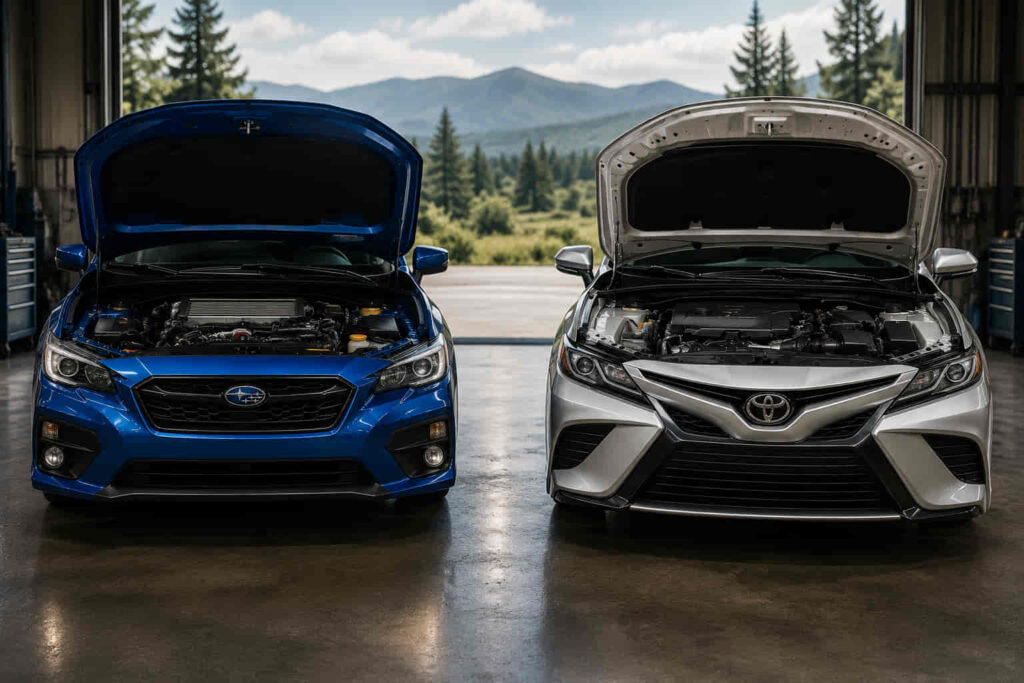
Toyota has an overall advantage over Subaru for long-term reliability, but the difference depends on the model, model year, powertrain, and maintenance history. Toyota has built its reliability reputation around durable engines, proven transmissions, and vehicles capable of accumulating high mileage with routine maintenance. Subaru also produces dependable vehicles, particularly the Forester, Crosstrek, and Outback, but its standard all-wheel-drive layout and widespread use of continuously variable transmissions create a different long-term maintenance profile.
A useful Subaru vs Toyota reliability comparison therefore requires more than comparing two brand-level reliability scores. Vehicle lifespan, engine durability, transmission performance, repair frequency, repair severity, maintenance costs, and model-specific reliability all affect how dependable a vehicle remains after years of ownership. A Toyota with poor maintenance history, for example, is not automatically a safer purchase than a well-maintained Subaru from a reliable model year.
This comparison examines 7 key reliability differences between Subaru and Toyota to determine where each manufacturer performs better and which brand makes more sense for long-term ownership. It also separates brand reputation from model-level reliability so buyers can evaluate the vehicle they are actually considering rather than relying on the badge alone.
Is Toyota More Reliable Than Subaru Overall?
Toyota has the stronger overall reliability record, while Subaru remains a reliable brand with greater variation between models and powertrains. The difference matters most for buyers who plan to keep a vehicle well beyond the warranty period. Toyota has developed a reputation for using mature powertrain designs across high-volume models, while Subaru combines boxer engines, continuously variable transmissions, and standard all-wheel drive on most of its lineup. Those engineering choices do not make Subaru unreliable, but they introduce different components and maintenance requirements that influence long-term dependability.
Overall reliability should be measured through several signals rather than a single brand score. Repair frequency shows how often a vehicle develops a problem, repair severity indicates how serious those problems become, and long-term durability shows whether major components continue functioning as mileage increases. Model year also matters because manufacturers redesign engines, transmissions, electrical systems, and vehicle platforms over time. A reliability rating for one generation of the Subaru Forester, for example, should not automatically be applied to every Forester ever produced.
Toyota’s advantage is therefore most useful as a starting point rather than a rule for every purchase. Models such as the Toyota Corolla, Camry, and RAV4 have established long-term ownership records, but individual generations can still develop mechanical or electrical problems. The same principle applies to the Subaru Forester, Crosstrek, and Outback. A reliable Subaru from a proven model year with documented maintenance can be a better long-term purchase than a neglected Toyota with unresolved problems.
For buyers comparing individual vehicles, model, model year, mileage, powertrain, service history, and current mechanical condition provide a more precise reliability assessment than the manufacturer’s name alone. Brand-level data answers whether Toyota or Subaru performs better on average; model-level evidence determines whether a specific vehicle is worth buying.
Do Toyota Vehicles Last Longer Than Subaru Vehicles?
Toyota generally has the advantage in vehicle longevity, although both Toyota and Subaru vehicles can exceed 200,000 miles when the model has a durable powertrain and receives proper maintenance. Longevity measures how far and how long a vehicle remains usable, which makes it related to reliability but not identical to it. A vehicle that reaches 200,000 miles after several expensive repairs has demonstrated longevity without necessarily providing a low-maintenance ownership experience.
Toyota’s high-mileage reputation is supported by the number of long-running nameplates built around relatively conservative mechanical designs. Vehicles such as the Corolla, Camry, RAV4, Highlander, Tacoma, and 4Runner have been sold across multiple generations, giving buyers a large pool of long-term ownership data. This history makes it easier to identify which engines, transmissions, and model years have demonstrated durability and which versions require greater caution. Toyota’s advantage is consequently not that every vehicle reaches a specific mileage, but that several of its major models have established records of remaining operational at high mileage.
Subaru can also provide substantial vehicle lifespan. The Outback, Forester, and Crosstrek can remain serviceable beyond 150,000 miles and reach 200,000 miles when maintenance is consistent and major mechanical issues are addressed correctly. However, high-mileage Subaru ownership places greater importance on the condition of the boxer engine, cooling system, CVT, wheel bearings, suspension components, and all-wheel-drive system. Previous maintenance becomes increasingly important because deferred repairs can turn an otherwise durable vehicle into an expensive high-mileage purchase.
Mileage alone should therefore never determine whether a used Subaru or Toyota is reliable. A 150,000-mile vehicle with complete service records can represent a lower mechanical risk than a 90,000-mile vehicle with neglected maintenance. Oil-change history, transmission servicing, cooling-system maintenance, accident history, warning lights, fluid leaks, unusual drivetrain noises, and evidence of previous repairs provide additional context for the mileage displayed on the odometer.
The first two differences establish Toyota’s advantage at the broad brand level, but they do not explain the mechanical reasons behind it. Engine and transmission reliability provide the next layer of evidence because failures in these components have a much greater effect on long-term ownership than routine maintenance items.
Are Toyota Engines More Reliable Than Subaru Engines?
Toyota engines generally have the advantage over Subaru engines for long-term reliability, but engine family and model year are more important than the brand name alone. Toyota has used naturally aspirated four-cylinder and V6 engines across many high-volume vehicles for long production periods, allowing mechanical weaknesses to become well documented and later designs to be refined. Subaru relies heavily on horizontally opposed boxer engines, which provide packaging and drivetrain advantages but have their own maintenance characteristics and historical failure points.
Subaru’s reputation for engine problems is influenced heavily by older generations rather than every vehicle the company currently produces. Earlier Subaru boxer engines became associated with head-gasket failures, particularly specific naturally aspirated EJ-series applications. A failed head gasket can allow coolant or oil to leak and, when left unresolved, contribute to overheating and internal engine damage. This history remains relevant when shopping for an older used Subaru, but it should not be treated as evidence that every modern Subaru engine has the same problem. Later FB-series engines use different designs and need to be evaluated according to their specific model years and maintenance histories.
Oil consumption is another factor that requires model-specific analysis. Excessive oil consumption matters because an engine that operates repeatedly with insufficient oil can experience accelerated wear of internal components. Subaru has faced oil-consumption concerns involving certain vehicles and engine generations, while Toyota has also produced specific engines and model years associated with excessive oil consumption. The correct reliability comparison is therefore not “Subaru engines consume oil and Toyota engines do not,” but whether the specific engine installed in the vehicle has a documented problem history and whether previous owners maintained the correct oil level and service intervals.
Toyota’s broader reliability advantage becomes more relevant at high mileage because several of its established powertrains have demonstrated long service lives without requiring major internal engine work. However, Toyota engines are not immune to coolant leaks, oil consumption, water-pump failures, timing-system problems, or other age-related repairs. For a used vehicle, an engine with documented oil changes, stable coolant levels, no abnormal exhaust smoke, no persistent warning lights, and no evidence of overheating is more valuable than brand reputation by itself. A pre-purchase inspection becomes particularly important once either vehicle has accumulated substantial mileage.
The practical verdict is that Toyota offers the safer engine-reliability choice at the brand level, while Subaru requires closer attention to the exact engine and model year. Buyers considering an older Subaru should determine which engine family the vehicle uses and investigate problems associated with that specific application. Buyers considering a Toyota should apply the same process rather than assuming the Toyota badge eliminates mechanical risk.
Is Subaru’s CVT More Reliable Than Toyota Transmissions?
Toyota has the overall advantage in transmission reliability because its lineup includes several transmission designs with established durability records, while Subaru depends more heavily on its Lineartronic CVT across the passenger-vehicle range. This comparison requires an important distinction: Toyota uses conventional automatic transmissions, continuously variable transmissions, and hybrid electronic continuously variable transmissions, so there is no single “Toyota transmission” that can accurately be compared with every Subaru CVT.
Subaru’s Lineartronic CVT is designed to keep the engine operating within an efficient speed range while delivering continuously variable ratios rather than relying on a fixed set of conventional gears. The design works particularly well with Subaru’s boxer engine and all-wheel-drive architecture, but long-term reliability depends on fluid condition, operating temperature, driving conditions, and the specific CVT generation. Problems involving hesitation, shuddering, unusual noises, valve-body components, or other transmission-related symptoms deserve attention on a used Subaru because a significant CVT repair can change the economics of owning an otherwise affordable high-mileage vehicle.
Toyota’s transmission portfolio is more diverse. Its conventional automatics have been used across numerous cars, SUVs, pickups, and crossovers, while Toyota also uses CVTs in selected gasoline vehicles. Hybrid models add another important distinction. Toyota’s hybrid eCVT should not be treated as mechanically equivalent to a conventional belt- or chain-driven CVT simply because both use the term “CVT.” The hybrid system uses a different power-split architecture to manage the gasoline engine and electric motors, creating a different set of components and potential failure modes.
Maintenance history remains critical for both manufacturers. Transmission fluid degrades through heat, contamination, and repeated operating cycles, while severe driving conditions can place additional stress on drivetrain components. Service requirements also vary by transmission and model year. Owners should follow the maintenance information specified for the exact vehicle rather than applying a universal transmission-fluid interval to every Subaru or Toyota. For used-car buyers, service records, fluid condition where inspection is appropriate, warning lights, delayed engagement, vibration, shuddering, and abnormal noises provide more actionable information than mileage alone.
Toyota therefore provides the broader transmission-reliability advantage, but the size of that advantage changes according to the vehicles being compared. A Subaru Lineartronic CVT should be evaluated against the specific Toyota transmission in the competing model, not against Toyota’s entire historical transmission record. This distinction becomes especially important when comparing a Subaru Forester with a Toyota RAV4 or a Subaru Crosstrek with a Toyota Corolla Cross, because powertrain configuration can vary by year and trim.
Read more: Toyota P0442
Is Subaru AWD More Reliable Than Toyota AWD and Hybrid Systems?
Subaru’s standard all-wheel-drive system is a proven drivetrain design, but it does not automatically make Subaru more reliable than Toyota. Subaru and Toyota use different drivetrain strategies, so reliability depends on the specific system being compared. Subaru equips most of its mainstream vehicles with symmetrical all-wheel drive, while Toyota offers front-wheel drive, conventional all-wheel drive, and hybrid AWD configurations depending on the model. These differences affect the number of drivetrain components, maintenance requirements, and potential repair points during long-term ownership.
Subaru’s symmetrical AWD continuously connects the drivetrain to all four wheels rather than treating AWD as an occasional secondary function. This configuration provides predictable power distribution and is one reason buyers choose vehicles such as the Forester, Outback, and Crosstrek. Reliability, however, depends on keeping the drivetrain operating under consistent mechanical conditions. Tires are especially important because significant differences in tire circumference can create additional stress within an AWD drivetrain. Correct tire size, similar tread depth, proper inflation, wheel alignment, and timely replacement therefore contribute directly to long-term drivetrain health.
Toyota approaches AWD differently across its lineup. A gasoline Toyota RAV4, for example, does not necessarily use the same AWD architecture as a RAV4 Hybrid. Toyota hybrid AWD systems can use an electric motor to provide rear-wheel propulsion instead of connecting the front and rear axles through the same type of mechanical arrangement found in a conventional AWD drivetrain. Fewer shared mechanical connections between the axles change both the operating mechanism and the components that require reliability consideration. For this reason, comparing “Subaru AWD” with “Toyota AWD” without identifying the exact Toyota powertrain produces an incomplete reliability comparison.
Toyota’s hybrid systems also add components that conventional gasoline vehicles do not have, including a traction battery, power electronics, and electric motors. Additional components do not by themselves establish lower reliability. The relevant question is how frequently those components fail, how long they are designed to operate, and what they cost to repair when a failure occurs. Hybrid battery condition becomes particularly important when evaluating an older used Toyota because battery age, operating history, temperature exposure, and vehicle condition can affect the remaining service life.
For buyers who need AWD, Subaru provides a mature system that is integrated into the basic design of most of its vehicles. Toyota provides a wider choice of drivetrain configurations, allowing buyers who do not require permanent AWD to avoid some drivetrain complexity altogether. Neither AWD architecture should be declared universally more reliable without considering the specific model, model year, powertrain, maintenance history, and intended use. Toyota retains the broader brand-level reliability advantage, while Subaru’s AWD remains a legitimate strength when traction and all-weather capability are major purchasing requirements.
Does Subaru Need Repairs More Often Than Toyota?
Toyota generally presents the lower long-term repair risk, while Subaru ownership can become more dependent on powertrain condition and drivetrain maintenance as mileage increases. Repair reliability should be evaluated through both frequency and severity. Frequency measures how often an unscheduled repair occurs, whereas severity measures the likelihood and financial impact of a major repair. A vehicle that needs several inexpensive repairs creates a different ownership risk from one that rarely fails but eventually requires an expensive engine or transmission repair.
Subaru’s repair profile is closely connected to its mechanical configuration. Boxer engines, CVTs, and standard AWD mean that several major systems need to remain healthy together for the vehicle to deliver dependable long-term service. A worn wheel bearing or suspension component, for example, is fundamentally different from an internal engine or CVT failure even though both count as repairs. This distinction matters because simply counting workshop visits does not reveal how disruptive or expensive those repairs are.
Toyota’s advantage comes from the long-term performance of multiple high-volume models and powertrains rather than an absence of repairs. Toyota vehicles still require replacement of wear components and can develop engine, transmission, cooling, electrical, suspension, or hybrid-system faults as they age. The reliability benefit is strongest when major components remain serviceable while routine maintenance and predictable wear items account for most ownership expenses. Once a vehicle requires major powertrain work, its historical brand reliability becomes much less relevant to the owner’s actual cost.
Vehicle age also changes the comparison. During the early years of ownership, both a properly maintained Subaru and Toyota can provide dependable transportation without frequent major repairs. Differences become more consequential after substantial mileage accumulates because maintenance history, heat cycles, corrosion, fluid condition, previous repairs, and component wear begin to influence reliability simultaneously. Two vehicles of the same model year can therefore have substantially different mechanical conditions after years of different ownership and driving environments.
A used-car buyer should evaluate expected repair risk at the model-and-year level rather than assuming every Toyota will require fewer repairs than every Subaru. Service records and a pre-purchase inspection can reveal fluid leaks, drivetrain noises, suspension wear, cooling-system problems, warning codes, previous collision damage, and deferred maintenance that a brand-level reliability score cannot detect. This is particularly important for high-mileage vehicles because one major neglected problem can outweigh years of otherwise inexpensive maintenance.
Toyota remains the safer choice when the objective is minimizing overall long-term mechanical risk, but Subaru can still provide dependable ownership when the buyer selects a strong model year and maintains the engine, transmission, tires, and AWD system correctly. The next reliability difference is therefore financial rather than purely mechanical: how these maintenance and repair requirements translate into long-term ownership costs.
Is Subaru More Expensive to Maintain Than Toyota?
Subaru generally has the potential for higher long-term maintenance and repair costs than Toyota, especially as mileage increases, but the actual difference depends on the model, powertrain, service schedule, and previous maintenance. Routine services such as oil changes, brake replacement, filters, batteries, and tire replacement apply to both brands. The cost difference becomes more important when drivetrain-specific maintenance or major repairs enter the ownership cycle.
Subaru’s standard AWD configuration affects maintenance because all four tires function as part of the same drivetrain system. Maintaining compatible tire diameter and similar tread depth is important for proper AWD operation. If one tire is damaged when the remaining tires are significantly worn, replacing only the damaged tire may not always provide the appropriate tire circumference across the vehicle. Depending on tire condition and manufacturer specifications, the owner may need a matched replacement solution or more than one new tire. This creates a potential ownership expense that a two-wheel-drive vehicle does not face in the same way.
Powertrain condition creates a larger financial difference than routine service. Engine, CVT, and AWD repairs can cost substantially more than predictable wear items, so avoiding a major failure has a greater effect on long-term ownership cost than saving a small amount on individual maintenance services. This is why maintenance cost and reliability need to be analyzed together. A vehicle with inexpensive scheduled servicing is not necessarily economical to own if it develops a major drivetrain problem later in its service life.
Toyota gives buyers more drivetrain choices that can change this calculation. A conventional front-wheel-drive Toyota has fewer AWD-specific components to consider, while Toyota AWD and hybrid vehicles introduce their own maintenance and repair requirements. Hybrid models also require buyers to consider the condition of the traction battery and associated electrical components as the vehicle ages. The presence of a hybrid battery does not establish that a Toyota hybrid will be expensive to maintain; its actual financial effect depends on component longevity and whether replacement becomes necessary during the ownership period.
Mileage further increases the importance of maintenance history. At 100,000 miles and beyond, the purchase price alone provides an incomplete picture of value. Fluids, brakes, tires, wheel bearings, suspension parts, cooling components, engine seals, transmission condition, and other wear-related systems can influence the next several years of expenses. A cheaper high-mileage Subaru with deferred maintenance can consequently cost more to own than a more expensive Toyota with comprehensive service records, while a neglected Toyota can reverse the same comparison.
Toyota is generally the stronger choice for buyers whose primary objective is reducing long-term maintenance and repair risk, while Subaru ownership places greater emphasis on consistent drivetrain maintenance. The most useful cost comparison is therefore between equivalent models of similar age, mileage, condition, and maintenance history rather than between brand averages alone. This prevents a relatively simple Toyota configuration from being compared unfairly with a more complex Subaru configuration without accounting for what each vehicle actually contains.
Which Subaru and Toyota Models Are the Most Reliable?
The most reliable Subaru or Toyota cannot be identified accurately from the brand name alone because reliability changes by model, generation, model year, and powertrain. Toyota holds the broader brand-level advantage, but buyers ultimately purchase a specific vehicle rather than a manufacturer’s average reliability record. Model-level comparison is therefore the seventh and most actionable Subaru vs Toyota reliability difference.
The Subaru Forester and Toyota RAV4 provide one of the most relevant examples because both compete for buyers seeking compact SUVs with practical interiors and available or standard all-wheel-drive capability. Toyota’s overall reliability reputation gives the RAV4 an initial advantage, but that advantage should be tested against the exact model years being considered. Engine design, transmission type, recalls, known problems, maintenance records, and mileage can all change the risk profile. A well-maintained Forester from a strong model year can consequently be a better purchase than a poorly maintained RAV4 from a problematic year.
The Subaru Crosstrek and Toyota Corolla Cross create a similar comparison among smaller crossovers. Subaru’s standard AWD is an important part of the Crosstrek’s mechanical package, while Corolla Cross configurations vary by drivetrain and powertrain. Buyers should therefore compare equivalent vehicles rather than treating the two nameplates as mechanically identical alternatives. The reliability question is not simply which model has the higher rating; it is which configuration introduces the fewest unacceptable risks for the buyer’s expected mileage, driving conditions, and ownership period.
The Subaru Outback requires even more careful matching because there is no single Toyota model that duplicates its combination of wagon-like packaging, ground clearance, AWD, and available powertrains. Selecting an inappropriate Toyota comparison can produce misleading reliability conclusions because vehicle size, drivetrain complexity, engine output, and intended use affect component stress and maintenance requirements. The correct comparison should start with the buyer’s use case and then examine vehicles that satisfy similar requirements.
Model year becomes particularly important when buying used. Manufacturers revise components during a generation, issue technical updates, change suppliers, modify engines and transmissions, and address problems identified after vehicles enter service. A strong reliability record for one model year does not prove that every year of the same nameplate has the same reliability. Buyers should identify the exact year, engine, transmission, drivetrain, recall history, and documented problem pattern before treating a Forester, Outback, Crosstrek, RAV4, Corolla Cross, Camry, or Corolla as a reliable choice.
This model-level approach changes the practical meaning of Subaru vs Toyota reliability. Toyota is the stronger default when comparing the two manufacturers broadly, but the best individual purchase is the model and model year with a proven powertrain, documented maintenance, acceptable repair history, and good current mechanical condition. Brand reputation narrows the search; vehicle-specific evidence should make the final decision.
Does Toyota or Subaru Have Better Resale Value?
Toyota generally has the stronger resale-value position, although Subaru vehicles can also retain value well when demand for AWD vehicles is high. Resale value is not a direct measure of mechanical reliability, but the two are connected. Used-car buyers are willing to pay more for vehicles they expect to remain dependable, require manageable repairs, and provide useful service life after the original owner sells them. A strong reliability reputation can therefore support used-vehicle demand and slow depreciation.
Toyota benefits from a long-standing reputation for durable, high-mileage vehicles. Models such as the Corolla, Camry, RAV4, Tacoma, and 4Runner have established large used-car markets, which helps maintain buyer demand as the vehicles age. Reliability is only one part of this effect. Vehicle availability, fuel economy, market demand, configuration, condition, mileage, and regional preferences also influence resale prices. A Toyota model should therefore not be expected to retain a specific percentage of its original value simply because it carries the Toyota badge.
Subaru has a different resale-value advantage. Vehicles such as the Forester, Crosstrek, and Outback combine practical body styles with standard AWD, creating strong utility for buyers who regularly drive in snow, rain, mountainous terrain, or other conditions where additional traction is desirable. That capability can support used-market demand, particularly in regions where AWD is a purchasing priority. However, an older Subaru with questionable CVT condition, incomplete maintenance records, mismatched tires, engine problems, or other deferred repairs can lose that advantage because the next owner must account for potential repair costs.
Vehicle condition becomes increasingly important as mileage rises. Two identical models with the same age and similar odometer readings can have different resale values when one has complete maintenance records, matching tires, a clean inspection, and no unresolved warning lights while the other has deferred maintenance or evidence of drivetrain problems. Reliability reputation attracts buyers to a model, but the condition of the individual vehicle determines how much of that reputation translates into actual resale value.
Toyota has the broader advantage when reliability and resale value are considered together, but Subaru remains competitive when a well-maintained vehicle combines dependable mechanical condition with strong demand for AWD. Buyers should treat resale value as an outcome influenced partly by reliability rather than evidence that one vehicle is mechanically superior to another.
Should You Buy a Subaru or Toyota for Long-Term Reliability?
Choose Toyota if long-term reliability and minimizing mechanical risk are your highest priorities; choose Subaru if you want dependable ownership combined with standard AWD and are prepared to follow its drivetrain maintenance requirements. Across the seven reliability differences examined in this comparison, Toyota holds the stronger overall position in brand-level reliability, longevity, engine durability, transmission history, repair risk, maintenance burden, and consistency across several established models. Subaru remains a credible long-term choice, but selecting the right model and model year carries greater importance.
Toyota is particularly suitable for buyers who intend to accumulate high mileage and keep a vehicle beyond its original warranty period. The brand offers conventional gasoline, hybrid, front-wheel-drive, and AWD configurations across different vehicle classes, allowing buyers to select a powertrain that matches their needs without automatically adding drivetrain complexity they do not require. Models with established reliability records also give used-car shoppers more historical information for evaluating high-mileage ownership.
Subaru makes more sense when AWD is a core requirement rather than an optional feature. The Forester, Crosstrek, and Outback integrate AWD into their basic vehicle configurations and combine it with ground clearance and practical packaging. These characteristics can justify choosing Subaru even when Toyota has the stronger overall reliability record. The trade-off is that tire condition, CVT behavior, engine maintenance, and AWD-related components deserve close attention, particularly as mileage increases.
The decision changes further in the used-car market. A well-maintained Subaru is a better purchase than a poorly maintained Toyota. Service history, model year, mileage, engine condition, transmission operation, fluid leaks, cooling-system condition, tire consistency, recalls, accident history, warning codes, and evidence of previous repairs reveal more about an individual used vehicle than its badge. A pre-purchase inspection is especially valuable because it can identify mechanical problems that neither a reliability score nor a vehicle-history report fully captures.
For buyers comparing new vehicles, Toyota provides the safer default when reliability outweighs every other consideration. Subaru becomes more compelling when standard AWD, all-weather usability, and the characteristics of a specific Subaru model carry substantial weight in the purchase decision. For used vehicles, the hierarchy changes to model year, maintenance history, current condition, powertrain, and then brand reputation.
The Subaru vs Toyota reliability comparison therefore does not produce a rule that every Toyota is more reliable than every Subaru. Toyota wins the overall reliability comparison, while Subaru can still be a reliable long-term vehicle when the right model year is selected and maintained correctly. The most dependable purchase is the vehicle that combines a proven model and powertrain with documented maintenance and strong current mechanical condition.