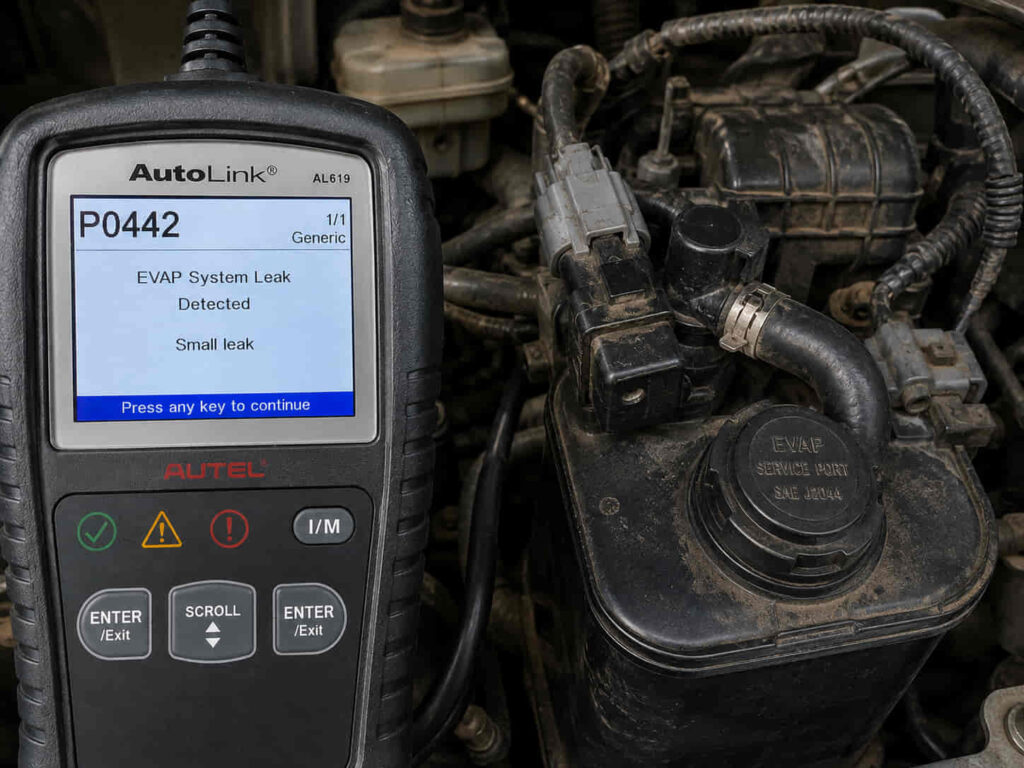
The Toyota P0442 code means the Engine Control Module (ECM) has detected a small leak in the evaporative emission control (EVAP) system. The EVAP system is designed to contain fuel vapors from the fuel tank and route them through a controlled path instead of allowing hydrocarbons to escape into the atmosphere. When the system cannot maintain the pressure, vacuum, or sealing condition expected during the applicable EVAP monitor, the ECM can store P0442 and illuminate the Check Engine Light.
P0442 identifies a leak condition rather than a specific failed component. A loose, damaged, or improperly sealing fuel cap can create an EVAP leak, but the same code can result from a leaking vapor hose or connection, a sealing problem around the fuel tank or filler area, a charcoal canister fault, or an EVAP valve that does not seal when required. Replacing the gas cap solely because P0442 is stored can therefore leave the actual leak unresolved.
Correct diagnosis requires determining where the EVAP system is losing its seal and why the monitor detects that loss. Related DTCs, fuel-cap inspection, EVAP hoses and connections, scan-tool data, component testing, and smoke or leak testing can narrow the fault to its actual source. This article explains what Toyota P0442 means, the symptoms and conditions associated with it, how the small EVAP leak is diagnosed, and which repair should be performed once the root cause has been confirmed.
The Toyota P0442 code means the Engine Control Module (ECM) has detected a small leak in the evaporative emission control (EVAP) system. The EVAP system is designed to contain fuel vapors from the fuel tank and route them through a controlled path instead of allowing hydrocarbons to escape into the atmosphere. When the system cannot maintain the pressure, vacuum, or sealing condition expected during the applicable EVAP monitor, the ECM can store P0442 and illuminate the Check Engine Light.
P0442 identifies a leak condition rather than a specific failed component. A loose, damaged, or improperly sealing fuel cap can create an EVAP leak, but the same code can result from a leaking vapor hose or connection, a sealing problem around the fuel tank or filler area, a charcoal canister fault, or an EVAP valve that does not seal when required. Replacing the gas cap solely because P0442 is stored can therefore leave the actual leak unresolved.
Correct diagnosis requires determining where the EVAP system is losing its seal and why the monitor detects that loss. Related DTCs, fuel-cap inspection, EVAP hoses and connections, scan-tool data, component testing, and smoke or leak testing can narrow the fault to its actual source. This article explains what Toyota P0442 means, the symptoms and conditions associated with it, how the small EVAP leak is diagnosed, and which repair should be performed once the root cause has been confirmed.
What Causes the P0442 Code on a Toyota?
Toyota P0442 is caused when the EVAP system cannot maintain the sealed condition required during the ECM’s small-leak monitor. The underlying problem can be an opening in the vapor containment path or a component that fails to seal when the EVAP system is being tested. A loose or damaged fuel cap is one possible cause, but vapor hoses, connections, sealing surfaces, the charcoal canister, and EVAP control valves can produce the same small-leak condition.
The fuel cap can cause P0442 because it forms part of the sealed boundary between the fuel tank and the outside atmosphere. The cap must seal correctly against the filler neck when the EVAP system is closed for leak monitoring. A loose cap, damaged seal, incorrect cap, or sealing surface that prevents proper contact can allow air to enter the system. The ECM does not identify the cap itself as defective; it detects that the EVAP system does not behave as a sufficiently sealed system during the monitor.
This distinction explains why replacing the fuel cap is not a complete diagnostic strategy. A new cap will not correct P0442 when the leak exists farther downstream. The filler neck and its sealing surface also affect the cap’s ability to close the system. A cap that appears serviceable can fail to produce an adequate seal when the mating surface is damaged, contaminated, or otherwise unable to maintain the required vapor-tight connection.
EVAP vapor hoses and their connections can create another leak path. These lines carry fuel vapor between the fuel tank, charcoal canister, engine, and other EVAP components. Age, heat exposure, physical damage, loose connections, or deterioration can create an opening that is small enough to be difficult to identify visually but large enough to affect the leak monitor. The diagnostic relationship remains the same: the opening allows the sealed system to lose the expected pressure or vacuum condition, and the ECM interprets the resulting system behavior as leakage.
The charcoal canister and its associated connections can also be involved when the assembly no longer maintains the required seal. The canister’s primary function is to store fuel vapors until they can be routed into the engine and burned. Damage to the canister housing, ports, connected lines, or sealing interfaces can introduce a leak into the vapor-control path. A canister should therefore be considered a repair target only when inspection or leak testing demonstrates that it is the source of the EVAP sealing failure.
EVAP control valves can cause P0442 through a different mechanism. A valve does not need to have an obvious external crack to create a leak condition. During EVAP monitoring, specific parts of the system must open or close according to the control strategy. A valve that fails to seal completely can create an internal airflow path between sections that should be isolated during the test. The ECM then observes system behavior consistent with leakage even though no external hole is visible.
This mechanism is particularly important when evaluating purge- and vent-related components. Their normal purpose requires controlled vapor or airflow, so their position changes according to operating conditions. A component that flows correctly when commanded open but leaks when it should be closed can interfere with EVAP leak detection. The component must therefore be tested for both commanded operation and sealing ability before it is identified as the cause of P0442.
Electrical faults should be distinguished from physical leaks because they affect the EVAP system differently. A wiring or control problem can prevent a purge or vent component from reaching the state required for an EVAP test, potentially changing system behavior and producing related DTCs. When electrical or control codes appear together with P0442, those codes provide additional diagnostic context and should be evaluated rather than assuming that the vehicle simply has a hole in a vapor hose.
The size of the leak also affects how difficult the cause is to locate. A large disconnected vapor line can be obvious during inspection, while the small leak associated with P0442 may only become apparent under controlled testing. A sealing surface can look normal, a hose can leak only at a connection, or a valve can pass a small amount of air while appearing functional during a basic visual check. This is why a vehicle can repeatedly store P0442 even after no obvious EVAP damage is found.
Related DTCs can narrow the possible cause before components are tested. A code describing purge performance, vent control, an electrical circuit, or a larger EVAP leak provides context that P0442 alone does not contain. The codes must be interpreted according to their detection conditions and their relationship to the same EVAP system rather than treated as independent reasons to replace several components.
The root cause of Toyota P0442 is therefore the specific opening or sealing failure that prevents the EVAP system from passing its small-leak monitor, not the P0442 code itself. The fuel cap may be responsible, but it should be confirmed through inspection and testing just like the vapor lines, canister, valves, connections, and other sealing points. Locating that failure is the purpose of the diagnostic process and determines which repair will actually prevent P0442 from returning.
How Do You Diagnose Toyota Code P0442?
Diagnosing Toyota P0442 requires locating the leak or sealing fault that prevents the EVAP system from passing its small-leak monitor. The correct process starts by confirming all stored DTCs and preserving diagnostic information, then moves from accessible sealing points such as the fuel cap and vapor connections to system-specific leak testing and EVAP component verification. Replacing the gas cap, purge valve, vent valve, or charcoal canister before the leak has been identified can clear neither the physical fault nor the reason the ECM stored P0442.
A complete diagnostic scan should be performed before any codes are cleared. P0442 provides evidence that the ECM detected a small EVAP leak, but another stored code can provide more specific information about purge operation, vent control, electrical circuits, or a different EVAP leak condition. Codes such as P0441, P0446, or P0455 can therefore change the diagnostic direction when they appear with P0442. The purpose of reading the complete DTC set is to establish how the individual detection conditions relate to the same EVAP system rather than diagnosing each code as an independent component failure.
The fuel cap and filler-neck sealing area provide a logical early inspection point because they form part of the EVAP system’s sealed boundary and can be checked without disassembling the system. The cap should be examined for an incorrect installation, damaged or deteriorated seal, physical damage, and conditions that prevent it from seating correctly. The filler-neck sealing surface also matters because a functional cap cannot create an adequate seal against a damaged or contaminated mating surface. A cap that appears normal should not automatically be replaced when there is no evidence that it is responsible for the leak.
The visible EVAP vapor path should then be inspected for conditions capable of allowing fuel vapor or outside air to pass through a section that should remain sealed. Vapor hoses, connections, ports, and accessible areas around the charcoal canister and fuel tank can develop cracks, loose connections, physical damage, or deteriorated sealing surfaces. A disconnected hose can be apparent during visual inspection, but a P0442-sized leak can be too small to locate reliably by sight alone. Finding no visible damage therefore does not establish that the EVAP system is leak-free.
A smoke or controlled leak test becomes particularly useful when visual inspection does not reveal the source. During a properly performed EVAP smoke test, the system is placed in the required test configuration and low-pressure test vapor is introduced so that an opening can be identified where the system should remain sealed. Smoke escaping from a hose connection, sealing surface, canister housing, or another EVAP component can provide physical evidence of the leak location. The test is more diagnostically useful than replacing likely components because it attempts to locate the opening responsible for the failed monitor.
Smoke testing must still account for the normal airflow paths built into the EVAP system. Purge and vent components are designed to control vapor or airflow, so the system must be configured correctly before escaping smoke can be interpreted as a defect. A valve that is supposed to be open during a particular operating state cannot be diagnosed as leaking simply because air passes through it. The technician must know which components should be open or closed during the test and compare their actual behavior with the applicable Toyota diagnostic procedure.
Purge-related components require additional attention when scan results or testing indicate that the system is not sealing correctly through the purge path. A purge valve controls the movement of stored fuel vapor toward the engine. If the valve does not seal when the EVAP leak monitor requires that path to be closed, it can create an internal leak even though no smoke appears from an external hose or housing. Testing must therefore establish whether the valve responds to commands and whether it seals in the operating state in which sealing is required.
The vent side of the system should be evaluated through the same functional relationship. Vent-control components allow or restrict airflow according to the EVAP operating strategy. A vent valve that cannot reach or maintain its commanded sealing state can prevent the system from achieving the condition required for leak detection. Electrical operation and mechanical sealing are separate diagnostic questions: a valve can receive the correct command but fail to seal mechanically, while a functional valve can remain in the wrong position because its electrical circuit does not operate correctly.
The charcoal canister should only become a replacement target when testing connects it to the leak. Physical damage to the canister housing, leaking ports, damaged connections, or an internal condition affecting the applicable EVAP operation can justify further inspection or replacement. P0442 by itself does not establish a defective canister because the ECM detects the system’s inability to maintain the expected condition rather than directly identifying which sealed component allowed the leakage.
Vehicle-specific service information becomes increasingly important as diagnosis moves beyond basic inspection. Toyota has used different EVAP architectures, components, monitoring strategies, and diagnostic procedures across models, engines, model years, and emissions configurations. The correct wiring information, scan-tool procedures, component tests, and monitor conditions should therefore be selected for the exact vehicle. A procedure that correctly diagnoses P0442 on one Toyota application should not automatically be assumed to apply unchanged to another.
Intermittent P0442 faults require evidence from the circumstances in which the code returns. Temperature changes, component movement, sealing behavior, and operating conditions can make a small leak detectable during one EVAP monitor while the system appears normal during a later workshop inspection. Repeating the applicable test and examining the system under relevant conditions can expose a fault that a single visual inspection misses.
Diagnosis is complete when testing establishes a connection between a specific fault and the EVAP system’s inability to maintain its required sealed condition. A verified leak at a hose connection, a fuel-cap sealing failure, or a valve proven not to seal provides a root cause; P0442 alone does not. After that condition has been repaired, the DTC can be cleared and the applicable EVAP monitor can be completed again. If the system passes its monitor and P0442 does not return, the result provides stronger evidence that the actual small-leak condition has been corrected.
Read more: Toyota C0278
How Do You Fix Toyota Code P0442?
Fixing Toyota P0442 requires sealing the verified EVAP leak or correcting the component that prevents the evaporative emission system from maintaining the condition required by its small-leak monitor. The correct repair depends on what diagnosis identifies. A fuel-cap sealing problem, leaking vapor connection, damaged EVAP hose, canister leak, or valve that does not seal correctly can produce the same P0442 code, so the repair should target the confirmed fault rather than the component that is easiest to replace.
When testing confirms that the fuel cap is responsible for the leak, the repair must restore a reliable seal between the cap and filler neck. A damaged or deteriorated cap seal can require fuel-cap replacement, while an incorrectly installed cap may only need to be installed correctly before the system is retested. The filler-neck sealing surface should also be evaluated because installing a new cap does not correct a damaged mating surface. The repair is successful when the cap and filler area create the sealed boundary required by the EVAP system rather than simply when a new cap has been installed.
A leaking EVAP hose or connection requires restoration of the vapor-tight path between system components. A cracked hose should be repaired or replaced according to the applicable vehicle procedure, while loose, damaged, or poorly sealing connections must be corrected at the point where leakage has been verified. This distinction matters with P0442 because the opening can be small enough to escape visual inspection. Smoke or leak-test evidence provides a stronger basis for repair than replacing hoses because they appear old.
The charcoal canister should be repaired or replaced only when testing establishes that the canister assembly or one of its sealing interfaces is leaking or otherwise responsible for the failed EVAP test. A damaged housing, leaking port, or defective sealing point can allow the system to lose the condition required by the monitor. P0442 alone does not establish a failed charcoal canister because the ECM detects system leakage rather than directly monitoring the physical integrity of every canister surface.
A purge or vent-related component requires a different repair decision because the failure can involve internal sealing rather than an obvious external leak. A valve that does not close completely when the EVAP monitor requires a sealed path can allow airflow through the system and produce behavior consistent with leakage. If testing confirms that the valve receives the correct command but cannot seal mechanically, replacement of that verified component can correct the fault. If the valve does not operate because of a wiring, connector, power, or control-circuit problem, repairing the electrical condition is the appropriate fix instead of replacing a functional valve.
Electrical faults should therefore be repaired according to the circuit evidence found during diagnosis. Damaged wiring, poor terminal contact, connector problems, or another electrical condition can prevent an EVAP control component from reaching its required operating state. Restoring the circuit allows the ECM to control the component correctly and permits the EVAP system to complete its monitor under the intended conditions.
After the verified fault is repaired, P0442 can be cleared with an appropriate scan tool and the EVAP system should be allowed to complete its applicable monitor again. The Check Engine Light turning off immediately after codes are cleared does not verify the repair because clearing DTCs also resets diagnostic information. The meaningful confirmation occurs when the EVAP monitor runs again under the required operating conditions and P0442 does not return.
Replacing the gas cap, purge valve, vent valve, or charcoal canister without proving that it caused the leak is not a reliable P0442 repair strategy. The repair process is complete when testing identifies the leak or sealing failure, that condition is corrected, and subsequent EVAP monitoring confirms that the system can maintain the required sealed condition.
Is Toyota P0442 Serious?
Toyota P0442 is primarily an emissions-related fault and does not normally indicate immediate engine failure, but an active EVAP leak should still be diagnosed and repaired. A small EVAP leak allows the evaporative emission system to operate outside its intended sealing condition and can keep the Check Engine Light illuminated even when the engine starts, idles, and drives normally.
The severity of P0442 follows from the function of the EVAP system. Its purpose is to contain gasoline vapors and control their movement rather than allow hydrocarbons to escape directly into the atmosphere. A small leak compromises that containment process. This explains why P0442 can represent a genuine emissions-system malfunction without producing the loss of power, severe misfire, overheating, or stalling associated with more immediate engine-operating faults.
An illuminated Check Engine Light also has a practical diagnostic consequence. When the light remains on because of P0442, the driver has a persistent warning indication even if the vehicle feels normal. Additional faults can subsequently be stored, which makes periodically ignoring the warning light a poor diagnostic strategy. Repairing the EVAP fault restores the system’s intended operation and allows new warning conditions to be evaluated without an unresolved P0442 remaining in the background.
Fuel odor changes the level of attention required but should not automatically be attributed to P0442. A small vapor leak can allow fuel vapor to escape, yet odor can originate from other fuel or EVAP conditions. The source should be inspected rather than assuming that the smell is simply a normal symptom of the stored code.
Visible liquid fuel is a separate and more urgent condition. P0442 indicates an EVAP small-leak condition; it does not establish that liquid gasoline is leaking from the vehicle. If liquid fuel is visible, the problem should be treated as a fuel-system safety issue and inspected directly instead of using the generally lower severity of an isolated P0442 code to judge whether continued operation is appropriate.
The presence of additional DTCs also changes the assessment. P0442 stored by itself describes a different diagnostic situation from P0442 accompanied by purge, vent, electrical, fuel-system, or engine-performance codes. Those additional faults can identify problems outside the narrow small-leak condition and should be evaluated according to their own detection logic.
An isolated Toyota P0442 with normal drivability is therefore not equivalent to an immediate mechanical breakdown, but it should not be dismissed as harmless. The ECM has determined that the EVAP system cannot pass its small-leak monitor. Locating and repairing that sealing fault restores evaporative-emission control and prevents an unresolved EVAP problem from remaining active.
Can You Drive a Toyota With Code P0442?
You can generally drive a Toyota with P0442 when the vehicle operates normally and there is no visible fuel leak, strong unexplained fuel odor, or additional symptom indicating a more serious fuel-system problem. P0442 identifies a small leak detected by the evaporative emission control system, so an isolated code does not normally indicate that the engine is about to fail or that the vehicle has lost its basic ability to operate. The EVAP fault should still be diagnosed because the system is no longer maintaining the sealing condition expected by the ECM.
A Toyota with an isolated P0442 can continue to start, idle, accelerate, and cruise normally because the EVAP system primarily controls evaporative fuel emissions rather than supplying the engine with the fuel required for combustion. A small opening in a vapor hose or a poorly sealing fuel cap can therefore cause the EVAP monitor to fail without producing an obvious drivability problem. Normal engine operation does not prove that the code is false; it only shows that the detected EVAP condition is not currently producing a noticeable engine-performance symptom.
The illuminated Check Engine Light is another reason not to leave P0442 unresolved indefinitely. Once the warning light remains on for an existing EVAP fault, the driver has less immediate visual distinction between that known condition and a later fault that also requests illumination of the same warning indicator. Scanning and repairing P0442 restores the EVAP system to its intended condition and removes an existing diagnostic problem from future troubleshooting.
Fuel odor requires more attention because it provides information beyond the DTC itself. P0442 can be associated with an EVAP vapor leak, but the code does not identify where vapor is escaping and does not prove that every fuel smell originates from the EVAP small leak. A persistent or strong gasoline odor should therefore be investigated directly rather than dismissed because the vehicle continues to drive normally.
Visible liquid fuel changes the decision completely. A liquid-fuel leak should not be treated as an ordinary P0442 drivability question because P0442 represents an EVAP leak detection result, not confirmation that leaking liquid gasoline is safe. If fuel is visibly leaking, the vehicle should not continue to be driven until the source has been identified and the safety issue corrected.
Additional DTCs can also change whether continued driving is appropriate. P0442 accompanied only by another EVAP-related code presents a different diagnostic situation from P0442 stored with misfire, fuel-delivery, electrical, or other engine-performance faults. The complete scan result and current vehicle behavior should therefore be considered rather than using P0442 alone to judge the condition of the entire vehicle.
An isolated Toyota P0442 with normal drivability is consequently a repair-soon emissions fault rather than an automatic stop-driving condition. The appropriate response is to diagnose the EVAP leak before it remains unresolved for an extended period. If the vehicle develops a visible fuel leak, strong unexplained fuel odor, abnormal engine operation, or additional serious warning conditions, those symptoms take priority over the general drivability assessment for P0442.
How Much Does It Cost to Fix Toyota P0442?
The cost to fix Toyota P0442 depends on where the EVAP system is leaking and which component or sealing point has been confirmed as the root cause. P0442 does not correspond to one replacement part, so a single advertised “P0442 repair cost” can be misleading. The total expense consists of the diagnostic work required to locate a small leak and the parts and labor required to repair that specific fault.
A fuel-cap-related repair is different from a leak located deeper in the EVAP system. When inspection and testing confirm that the cap or its seal cannot maintain the required EVAP sealing condition, the repair can be limited to correcting the cap installation or replacing the verified defective component. If the cap seals correctly, spending money on another cap does not move the diagnosis closer to the actual leak.
A leaking vapor hose or connection changes the cost according to its location and accessibility. A damaged connection in an accessible area can require relatively little labor, while a small leak near the fuel tank, charcoal canister, or a difficult-to-access vapor line can require more diagnostic and repair time. The physical size of the leak does not determine repair cost by itself; a very small opening can consume substantial diagnostic time when it is intermittent or difficult to expose during testing.
Smoke or EVAP leak testing can therefore represent an important portion of the diagnostic expense. The purpose of this testing is to avoid spending money on unverified parts. Introducing test vapor into the correctly configured EVAP system can expose leakage at a hose, connection, sealing surface, canister, or other component that may look normal during visual inspection. Paying for accurate leak diagnosis can be less expensive than replacing several EVAP components sequentially until the Check Engine Light happens to remain off.
A purge or vent component produces a different repair cost when testing proves that it cannot operate or seal correctly. The final expense depends on the component’s location, vehicle configuration, required labor, and whether the fault originates inside the valve or in its electrical circuit. A valve that cannot seal mechanically can require replacement, while a valve that remains functional but is not being controlled because of damaged wiring requires circuit repair instead.
A confirmed charcoal-canister problem can create a higher repair expense than a simple sealing or hose fault because the canister is a larger EVAP component and its accessibility differs among Toyota models. The canister should not become the repair target merely because P0442 remains after a gas cap has been replaced. Leak testing must establish that the canister, one of its ports, or an associated sealing interface is actually responsible for the failed EVAP monitor.
Toyota model, model year, engine, emissions configuration, parts selection, local labor rate, and diagnostic time all affect the final invoice. These variables make a universal dollar range less useful than a root-cause-based estimate. Once testing has identified the actual leak, the technician can calculate an estimate from the required part, access time, diagnostic labor, and any applicable post-repair verification.
Replacing inexpensive EVAP components by trial and error can also make a seemingly simple P0442 substantially more expensive. Installing a fuel cap, purge valve, vent valve, and charcoal canister in sequence without verifying the leak can cost more than diagnosing the system correctly at the beginning, while the original problem may remain.
The most accurate Toyota P0442 repair estimate should therefore be calculated after the leak or sealing failure has been located. The cost belongs to the verified fuel-cap, hose, connection, valve, canister, circuit, or other EVAP repair—not to P0442 itself. After the repair, completing the applicable EVAP monitor and confirming that the code does not return provides the evidence needed to determine that the repair expense actually resolved the fault.
What Toyota EVAP Codes Are Related to P0442?
Toyota P0442 is related to other EVAP diagnostic trouble codes that describe different leak conditions, purge-flow problems, vent-control faults, or broader evaporative emission system malfunctions. Codes such as P0440, P0441, P0446, and P0455 can provide additional diagnostic context when they appear with P0442, but they should not be interpreted as different names for the same fault. Each DTC represents a specific condition detected by the ECM and can change which part of the EVAP system should be investigated first.
Toyota P0440 provides broader EVAP-system malfunction context on applicable vehicles. While P0442 specifically directs attention toward a small-leak condition, P0440 can indicate that the ECM has detected an abnormality within the evaporative emission control system without narrowing the diagnosis to the same small-leak classification. When P0440 and P0442 appear together, the technician should evaluate the complete EVAP monitoring results rather than assuming that both codes independently prove a leaking fuel cap.
P0441 shifts the diagnostic context toward purge-flow performance. The purge system controls the movement of stored fuel vapor from the charcoal canister toward the engine under conditions determined by the ECM. If purge flow does not correspond with the expected operating state, the resulting DTC can provide evidence about system behavior that P0442 alone does not contain. This relationship becomes relevant during small-leak diagnosis because the purge path may need to seal correctly during portions of EVAP monitoring. A purge-related problem can therefore affect the system’s ability to complete a valid leak test without representing the same detection condition as P0442.
Toyota P0446 directs attention toward the EVAP vent-control side on applicable systems. Vent components regulate airflow between the EVAP system and the atmosphere according to the vehicle’s operating and diagnostic strategy. If the vent system cannot reach the state commanded by the ECM, the EVAP system may be unable to establish the conditions required for leak monitoring. When P0446 appears with P0442, testing vent operation and its associated circuit can provide more diagnostic value than immediately searching for a physical hole in a vapor hose.
P0455 is closely related to P0442 because both concern EVAP leakage, but they represent different leak-detection conditions. P0442 identifies a small leak, whereas P0455 is associated with a larger or gross leak condition in applicable OBD-II strategies. A disconnected vapor line or substantially unsealed fuel cap can produce system behavior different from the smaller opening associated with P0442. The distinction helps explain why two EVAP leak codes should not automatically lead to the same inspection sequence or replacement decision.
The relationship among these codes is more useful than the number of codes stored. P0441 can provide purge context, P0446 can provide vent-control context, and P0455 can indicate a different degree of leakage, while P0442 remains focused on the detected small-leak condition. The technician should determine whether the DTCs share a causal relationship before treating each code as evidence of a separate failed component.
Related Toyota EVAP codes should therefore be used to narrow the diagnostic path for P0442 rather than create a replacement list. A complete scan can show whether the ECM is detecting only a small sealing loss or whether purge, vent, electrical, or additional leak conditions are also present. That context helps determine which EVAP path should be tested and which component should only become a repair target after its failure has been verified.
Can You Diagnose Toyota P0442 Yourself?
You can perform the initial diagnosis of Toyota P0442 yourself with an OBD-II scan tool and a careful inspection of accessible EVAP sealing points, but locating a small leak can require smoke-testing equipment, bidirectional scan-tool functions, and vehicle-specific diagnostic information. DIY diagnosis is most effective when it preserves evidence and tests plausible leak paths rather than replacing inexpensive EVAP components until the Check Engine Light stays off.
The first step is to record P0442 and every other stored, pending, or permanent DTC before clearing anything. Related EVAP codes can show whether the ECM has also detected abnormal purge flow, vent operation, an electrical problem, or another leak condition. Clearing the codes immediately removes part of that diagnostic context and resets monitors, making it harder to understand why P0442 was stored in the first place.
The fuel cap is an appropriate DIY inspection point because it is accessible and forms part of the sealed EVAP boundary. The cap should seat correctly and its sealing surface should not show damage that prevents a reliable seal against the filler neck. The filler-neck mating surface also deserves inspection. A new cap cannot correct a leak if the surface against which it seals is damaged or contaminated, so replacing the cap without evaluating the complete sealing interface does not establish a diagnosis.
Accessible vapor hoses and connections can also be inspected for cracks, disconnections, physical damage, or poor sealing. The limitation is that P0442 represents a small leak condition, and the opening can be too small to identify visually. A hose that looks intact can leak at a connection, and a component can fail to seal internally without showing external damage. A normal visual inspection therefore reduces the number of obvious possibilities but does not prove that the EVAP system is sealed.
This is where professional or advanced DIY leak testing becomes more valuable. A properly performed smoke test can expose an opening that cannot be seen during ordinary inspection by introducing test vapor into the EVAP system under controlled conditions. The system must be placed in the correct configuration because purge and vent components normally create intentional airflow paths. Smoke appearing through a path that is supposed to be open is not evidence of a leak; the diagnostic value comes from determining whether vapor escapes from a location or component that should be sealed during the test.
Bidirectional scan-tool control can further distinguish a physical leak from a control problem on supported Toyota systems. Commanding applicable EVAP valves allows the technician to compare requested operation with actual system behavior. A valve can respond electrically yet still fail to seal mechanically, while a mechanically functional valve can remain in the wrong position because its wiring or control circuit is faulty. Testing both operation and sealing prevents an electrical problem from being mistaken for a defective valve.
The diagnostic boundary becomes important when basic inspection does not locate the leak. EVAP architecture, valve configuration, leak-detection strategy, test conditions, and component locations vary across Toyota models and model years. Continuing with generic component replacement after the accessible checks have passed is less reliable than using the diagnostic procedure for the exact vehicle.
Do not diagnose Toyota P0442 by replacing the gas cap, purge valve, vent valve, and charcoal canister one after another. P0442 establishes that the ECM detected a small EVAP leak condition; it does not identify which of those components failed. A component becomes a valid repair target when inspection, functional testing, smoke testing, or another applicable diagnostic procedure establishes that it creates the leak or prevents the system from sealing.
Diagnosis is complete only when the identified fault explains why the EVAP system failed its small-leak monitor. After that condition is repaired, P0442 can be cleared and the applicable EVAP monitor should be allowed to run again. A completed monitor without P0442 returning provides stronger evidence of a successful repair than simply clearing the Check Engine Light immediately after replacing a component.