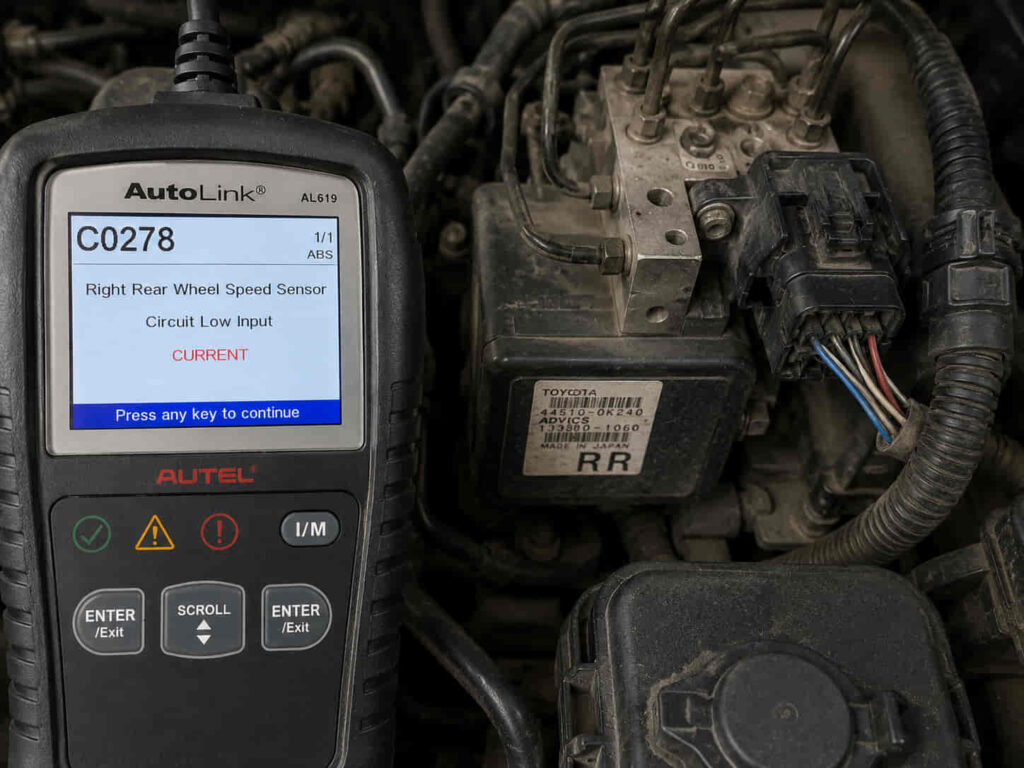
The Toyota C0278 code indicates a fault detected within the ABS/VSC brake control system on applicable Toyota vehicles. The code is associated with an electrical control condition monitored by the skid control ECU, so C0278 should be treated as a diagnostic starting point rather than proof that the ABS actuator, skid control ECU, relay, or another specific component has failed.
When C0278 is stored, the underlying problem can involve the power supply, wiring, connectors, relay-related circuitry, or another part of the circuit monitored by the brake control system. The exact detection condition and diagnostic procedure can vary by Toyota model, model year, and brake control configuration. For this reason, identifying the vehicle-specific definition of C0278 and checking related diagnostic trouble codes are necessary before testing or replacing components.
Correct diagnosis follows the relationship between the stored DTC and the electrical condition that produced it. A technician should confirm C0278, examine related ABS or VSC codes, and test the applicable power supply, circuit, wiring, connectors, and control components against Toyota specifications. This article explains what Toyota C0278 means, the symptoms and conditions associated with the code, how to diagnose its underlying cause, and how to determine the correct repair without unnecessary parts replacement.
What Does the C0278 Code Mean on a Toyota?
The Toyota C0278 code means the skid control ECU has detected an open condition in the ABS solenoid relay circuit on applicable Toyota vehicles. Toyota service information identifies C0278/11 as “Open in ABS Solenoid Relay Circuit.” The solenoid relay supplies electrical power to the ABS solenoids and, on applicable systems, the TRAC solenoids. This makes C0278 an electrical brake-control DTC rather than a code that directly identifies a wheel speed sensor or another individual braking component as defective.
The ABS solenoid relay operates as part of the system’s self-diagnostic and control process. On several Toyota applications, the skid control ECU activates the relay after the ignition is switched on and the system completes its initial check. Toyota documentation for vehicles such as the RAV4 states that C0278 detection begins once vehicle speed exceeds approximately 6 km/h (4 mph). If the relay is commanded on but its contact remains open for the specified detection period, the ECU can store C0278.
The electrical relationship is important because the relay supplies power needed by the ABS solenoids to perform brake-control functions. On Toyota applications where the relay is integrated into the actuator assembly, the skid control ECU monitors whether the relay responds correctly to its command. A failure in the power path can prevent the expected relay operation, causing the ECU to recognize the open-circuit condition and store C0278. Toyota service information for the RAV4 and Corolla confirms that the solenoid relay can be housed within the skid control ECU or actuator assembly.
C0278 does not automatically mean that the brake actuator assembly has failed. Toyota diagnostic information identifies the fuse, power-supply circuit or wire harness, and actuator-related circuitry among the areas that may need inspection. Low voltage can also matter. On applicable Toyota systems, insufficient battery or alternator output can reduce the voltage supplied to the solenoid relay below the DTC detection threshold and contribute to C0278 being stored.
The exact diagnostic specification must still be matched to the vehicle. Toyota used C0278 across different models and brake-control configurations, and the electrical specifications are not identical in every application. For example, passenger-vehicle service information can specify a different IG1 voltage range from Toyota commercial-vehicle documentation. The correct model, model year, powertrain, and brake system therefore determine which wiring diagram and diagnostic thresholds should be used.
What Are the Symptoms of Toyota Code C0278?
The main symptoms of Toyota C0278 are warning indications and loss or restriction of the electronic brake-control functions affected by the ABS solenoid relay circuit fault. The precise warning lights and fail-safe behavior depend on the Toyota model and brake-control system, so C0278 should not be interpreted as proof that the vehicle has completely lost conventional braking.
The symptoms originate from the function of the circuit itself. The solenoid relay supplies power to the solenoids used by the ABS and, on applicable vehicles, traction or stability-control functions. When the skid control ECU detects the electrical fault, it can prevent the affected electronic control from operating normally rather than continuing to command a circuit that has failed its self-diagnostic check. This explains why a driver can encounter brake-control warning indications even when the underlying problem is electrical rather than a mechanical failure of the brake pads, rotors, or calipers.
C0278 can also appear with additional brake-control DTCs, and these codes can materially change the diagnostic direction. Toyota service information for several applications specifically instructs technicians to address certain power-supply codes first when they occur together with C0278. For example, documentation for some RAV4 and Corolla configurations directs diagnosis toward C1241 or C1417 before continuing with C0278/C0279. This relationship matters because an abnormal supply voltage can affect the solenoid relay circuit without the relay itself being the original cause.
A vehicle can therefore present C0278 without producing a symptom that identifies the failed part. A warning indicator tells the driver that the brake-control system has detected a malfunction; it does not establish whether the root cause is a fuse, low supply voltage, wiring, a connector, the solenoid relay circuit, or the actuator assembly. The symptom establishes that the system requires diagnosis, while circuit testing establishes what actually needs repair.
What Causes the C0278 Code on a Toyota?
Toyota C0278 is caused when the skid control ECU detects an abnormal open condition in the ABS solenoid relay circuit on applicable Toyota vehicles. The root cause can be outside the relay itself because the ECU evaluates an electrical circuit that includes the relay power supply, fuse, wiring, connectors, grounds, and components integrated into the brake actuator assembly. The correct diagnosis must therefore identify where the expected electrical path is interrupted before a component is replaced.
An open or failed fuse in the ABS/VSC power-supply circuit is one possible cause of C0278. The ABS solenoid relay requires a stable electrical supply to energize and provide power to the ABS solenoids and, on applicable systems, the TRAC solenoids. If the relevant fuse or fusible link cannot carry current correctly, the relay circuit cannot behave as expected when commanded on. Toyota diagnostic procedures for several applications consequently begin by inspecting the applicable ABS or VSC fuse before moving deeper into the circuit. The exact fuse designation varies by vehicle; Toyota documentation shows examples including ABS2, ABS SOL, ABS No. 2, and VSC No. 2 depending on the model and brake-control configuration.
Insufficient voltage at the solenoid relay power supply can also produce C0278 even when the relay itself is not the original failure. Toyota service information for applications such as the RAV4 and Sequoia specifically notes that the DTC can be stored when the voltage supplied to the solenoid relay falls below the detection threshold because battery or alternator output is insufficient. The mechanism is electrical: the skid control ECU commands the relay on, but inadequate supply voltage prevents the monitored circuit from reaching the expected operating condition. This is also why a low-power-supply DTC such as C1241 can materially change the diagnostic direction when it appears with C0278.
Damaged wiring or poor connector contact can create the same monitored failure without a defective battery, fuse, or internal relay. The +BS power path and associated ground circuits must maintain the voltage and continuity required by the brake-control system. An open wire, excessive resistance, loose terminal, corrosion, damaged connector, or unreliable ground can interrupt that path. Toyota procedures for multiple applications direct technicians to measure power and ground conditions at the skid control ECU and repair the harness or connector when the measured values fall outside specification. This establishes an important diagnostic distinction: C0278 identifies abnormal relay-circuit behavior, while electrical testing identifies where that behavior originates.
The ABS solenoid relay or the assembly containing it becomes a potential cause after the external power and circuit conditions have been verified. On many Toyota applications, the relay is housed within the skid control ECU or brake actuator assembly rather than installed as a separate conventional relay that can simply be removed and substituted. Toyota documentation for the Highlander, RAV4, Sienna, and Corolla describes the relay as being incorporated into the actuator/skid control ECU assembly. This architecture changes the repair strategy because an internally failed relay can ultimately require replacement of the corresponding actuator assembly rather than replacement of a standalone relay.
Toyota models do not all use an identical physical brake-control configuration. On applications such as certain 4Runner and Land Cruiser systems, service information describes the ABS solenoid relay as being built into the master cylinder solenoid. The diagnostic logic remains similar: verify the external fuse, power supply, ground, harness, and connectors before condemning the assembly that contains the relay. On the 2010 Land Cruiser procedure, for example, Toyota directs inspection from the ABS2 fuse through the +BS terminal and ground circuit before DTC reconfirmation can lead to master cylinder solenoid replacement.
Related DTCs can reveal that the apparent C0278 fault originates from a broader electrical condition. Several Toyota procedures state that when C1241 and, on applicable systems, C1417 are stored together with C0278/C0279, the power-supply-related trouble areas represented by those codes should be inspected first. This diagnostic order prevents a low or abnormal voltage condition from being mistaken for an internal brake actuator failure.
The most accurate way to interpret the causes of Toyota C0278 is therefore as an electrical chain rather than a list of interchangeable failed parts. Power must pass through the applicable fuse and wiring, reach the brake-control system at the required voltage, maintain a reliable ground path, and allow the ABS solenoid relay to respond correctly when commanded by the skid control ECU. A failure anywhere in that verified path can produce the circuit condition associated with C0278. Only after the external circuit passes the applicable Toyota tests and C0278 returns does an internal relay or actuator-related failure become a supported repair direction.
Read more: Toyota P1603
How Do You Diagnose Toyota Code C0278?
Diagnosing Toyota C0278 requires confirming the DTC and testing the ABS solenoid relay power circuit before replacing the brake actuator, skid control ECU, or another brake-control component. On applicable Toyota vehicles, C0278 indicates that the skid control ECU has detected an open condition in the ABS solenoid relay circuit. The diagnostic objective is therefore to determine whether the abnormal circuit condition originates from the electrical supply, fuse, wiring, connectors, ground path, or the assembly containing the solenoid relay.
Diagnosis should begin with a complete scan of the brake-control system rather than reading C0278 in isolation. Other current, pending, or stored DTCs can identify a power-supply problem that affects the solenoid relay circuit. Toyota service information for several applications specifically directs technicians to diagnose codes such as C1241 and, where applicable, C1417 before continuing with C0278 or C0279. This sequence matters because insufficient system voltage can prevent the relay circuit from operating correctly even when the internal relay and brake actuator are functional.
Battery and charging-system condition should be evaluated when the scan results or vehicle symptoms indicate a voltage problem. Toyota service information notes on applicable models that C0278 can be stored when battery or alternator output causes the voltage supplied to the solenoid relay to fall below the detection threshold. Voltage should therefore be measured and compared with the specification for the exact Toyota model rather than judged only by whether the engine starts. A battery can provide enough power to start or run the vehicle while an abnormal supply condition still affects a monitored brake-control circuit.
The applicable ABS or VSC fuse is the next important part of the power path. Toyota uses different fuse designations according to model and system configuration, including ABS2, ABS SOL, ABS No. 2, and VSC No. 2 on documented applications. The correct wiring diagram must be used to identify the fuse associated with the solenoid relay circuit. A blown fuse should not simply be replaced and considered repaired because an overcurrent condition or downstream electrical fault can cause the replacement fuse to fail again. The circuit responsible for the fuse condition must be identified when the failure repeats.
Power at the brake-control assembly should then be verified. Toyota diagnostic procedures for several models specify checking voltage between the +BS terminal of the skid control ECU or actuator connector and body ground. This test determines whether electrical power has successfully passed through the upstream supply path and reached the circuit monitored by the ECU. If the specified voltage is absent or outside the applicable range, the diagnostic direction remains with the power supply, fuse, wiring, or connectors rather than the internal ABS solenoid relay.
Ground integrity must also be confirmed because a valid power measurement does not establish that the complete electrical circuit is functional. The relevant ground terminals and harness should provide the low-resistance path required by the brake-control system. A loose terminal, damaged wire, corrosion, poor connector contact, or abnormal ground resistance can interfere with circuit operation and produce a fault that appears to originate inside the actuator. Voltage and continuity or resistance measurements should be performed according to the wiring diagram and specifications for the exact vehicle because connector layouts and terminal designations vary among Toyota models.
Wiring and connectors between the fuse, power source, and brake-control assembly require inspection when electrical measurements identify an abnormal path. Visible damage can include loose terminals, backed-out pins, corrosion, damaged insulation, or wiring that has been repaired incorrectly. Intermittent connections require particular attention because the circuit can test normally after the warning light appears. When the fault is intermittent, connector condition and circuit behavior under the circumstances that produced the DTC provide stronger evidence than a single static measurement made after the problem disappears.
The actuator or assembly containing the ABS solenoid relay becomes the primary diagnostic direction only after the external circuit satisfies the applicable Toyota specifications. On many Toyota applications, the ABS solenoid relay is integrated into the brake actuator or skid control ECU assembly rather than installed as an independently replaceable external relay. Other configurations place the relay within a master cylinder solenoid assembly. This design is why identifying the exact vehicle configuration is essential before deciding which component contains the monitored relay and which repair procedure applies.
DTC reconfirmation provides the final distinction between an external circuit problem and a supported internal component fault. After a wiring, connector, fuse, power-supply, or ground problem has been corrected, the DTC should be cleared and the brake-control system operated under the conditions required for its self-check. The vehicle should then be rescanned. If C0278 does not return, the corrected external condition provides evidence of the root cause. If the external circuit passes Toyota’s specified tests and C0278 returns under the applicable detection conditions, the diagnostic procedure can support further testing or replacement of the assembly identified by the model-specific service information.
A scan tool displaying C0278 is therefore not sufficient evidence to replace an ABS actuator. A valid diagnosis establishes the complete relationship between the DTC and the electrical fault: the ECU detects an abnormal solenoid relay circuit, circuit measurements locate or eliminate an external power or ground problem, and DTC reconfirmation determines whether the fault remains after those conditions are corrected. Following this sequence reduces unnecessary actuator replacement and ensures that the repair addresses the condition that caused Toyota C0278 rather than only clearing the stored code.
How Do You Fix Toyota Code C0278?
Fixing Toyota C0278 requires repairing the electrical condition responsible for the open ABS solenoid relay circuit and then confirming that the brake control ECU no longer detects the fault. The correct repair depends on the result of circuit diagnosis. A fuse, power-supply problem, damaged harness, poor connector, ground fault, or internal solenoid relay problem can produce the electrical condition associated with C0278, so replacing the brake actuator before identifying the failed part of the circuit can result in an unnecessary and expensive repair.
When diagnosis identifies a power-supply problem, the repair must restore the correct voltage to the ABS solenoid relay circuit. Low battery voltage or inadequate charging-system output can prevent the relay from receiving the electrical supply required for normal operation on applicable Toyota systems. The battery and charging system should be repaired when testing confirms that their output is responsible for the abnormal voltage. Restoring voltage is more diagnostically meaningful than replacing the actuator because it corrects the electrical condition detected by the skid control ECU.
A failed ABS or VSC fuse requires more than installing a replacement fuse when the failure has an underlying electrical cause. The applicable fuse protects the power path supplying the brake control system, and a fuse that opens repeatedly indicates that the circuit requires further diagnosis. The correct repair is to identify and correct the condition responsible for the fuse failure before installing the specified replacement. Fuse designations differ among Toyota models, so the replacement and circuit diagnosis must follow the wiring information for the exact vehicle.
Wiring and connector faults should be repaired when voltage, continuity, resistance, or physical inspection establishes an abnormal connection in the solenoid relay circuit. Damaged wiring can interrupt the +BS power path, while loose terminals, corrosion, poor pin contact, or damaged connectors can create an intermittent open circuit. Ground connections also require repair when excessive resistance or poor terminal contact prevents the brake control system from maintaining a reliable electrical path. The repair is complete only when circuit measurements return to the applicable Toyota specification.
The brake actuator, skid control ECU, or master cylinder solenoid assembly becomes a repair target when the external power supply, fuse, wiring, connectors, and ground circuits have passed the applicable tests but the solenoid relay fault remains. On many Toyota applications, the ABS solenoid relay is integrated into an assembly instead of being installed as a separately serviceable external relay. An internally failed relay can therefore require replacement of the assembly that contains it. The exact replacement component must be determined from the model-specific system configuration rather than from C0278 alone.
Replacing an actuator assembly should not be used as a shortcut around electrical diagnosis. C0278 identifies abnormal behavior in the ABS solenoid relay circuit; it does not independently prove that the actuator is defective. This distinction is especially important because an actuator-related repair can involve substantially more labor and parts cost than correcting an external fuse, connector, wiring, power-supply, or ground problem.
After the verified fault has been repaired, C0278 should be cleared with an appropriate diagnostic scan tool and the system should be tested again. The vehicle must complete the relevant brake control self-check or operating conditions specified for the applicable Toyota system before the result is evaluated. A rescan should then confirm whether C0278 or related brake-control codes have returned. Clearing the code without repairing the circuit is not a fix because the skid control ECU can store C0278 again when it detects the same electrical condition.
A successful repair therefore follows a complete causal sequence: the abnormal circuit condition is identified, the responsible electrical or control component is repaired, circuit operation is verified, and the DTC does not return during reconfirmation. This approach fixes the root cause of Toyota C0278 instead of treating the diagnostic code itself as the failed component.
Is Toyota C0278 Serious?
Toyota C0278 is a potentially serious fault because it involves the ABS solenoid relay circuit that supplies power required for electronic brake-control functions on applicable Toyota vehicles. Its presence does not by itself mean that the vehicle has lost all braking capability, but it does indicate that the skid control ECU has detected a malfunction capable of affecting ABS and other brake-control functions supported by the same system.
The severity comes from the function of the solenoid relay. The ABS system controls hydraulic pressure during conditions in which wheel lock needs to be prevented. On applicable vehicles, the brake-control architecture can also use related solenoid operation for traction and stability-control functions. An electrical fault that prevents the relay from supplying the expected power can cause the ECU to restrict affected electronic brake-control operation rather than operate the system with an unresolved circuit fault.
C0278 should not be described as equivalent to complete brake failure. The DTC concerns a monitored electronic brake-control circuit, while the vehicle’s total braking system contains additional hydraulic and mechanical functions. The exact fail-safe behavior differs according to Toyota model and brake-control configuration. For this reason, the warning indicators, additional DTCs, brake behavior, and vehicle-specific service information determine the actual severity of an individual C0278 case.
The presence of additional brake or power-supply DTCs increases the amount of diagnostic information that must be considered. A related low-voltage code can indicate that C0278 is part of a broader electrical supply problem, while other brake-control DTCs can show that more than one monitored function has been affected. Diagnosing these codes together provides a more accurate assessment than assigning severity from C0278 alone.
Abnormal braking behavior requires more urgent attention than an isolated stored code discovered during a scan. A change in pedal behavior, braking response, or additional brake warning indications should not be dismissed as a simple ABS relay code. The vehicle needs inspection to determine whether the symptoms originate from the C0278-related electrical condition or another brake-system fault.
Even when braking appears normal, an active C0278 should not be ignored because the electronic brake-control system has detected a circuit that is not operating as expected. The appropriate response is to diagnose the solenoid relay circuit and restore the affected brake-control function rather than assuming that normal everyday braking proves the fault is harmless. Once the circuit has been repaired and the DTC does not return during reconfirmation, the system has stronger evidence of normal operation.
Can You Drive a Toyota With Code C0278?
Driving a Toyota with an active C0278 code is not recommended until the brake-control fault has been evaluated, especially when ABS, VSC, or brake warning indicators are illuminated or braking behavior has changed. C0278 involves the ABS solenoid relay circuit on applicable Toyota vehicles, so the fault can affect electronic brake-control functions even when the vehicle still appears to have conventional braking ability.
The decision to continue driving should be based on the current brake-system condition rather than the DTC number alone. C0278 does not independently establish that all braking capability has been lost. The code indicates that the skid control ECU has detected an electrical condition affecting the solenoid relay circuit, and the resulting fail-safe behavior depends on the Toyota model and brake-control configuration. A vehicle that stops normally but displays an ABS or VSC warning therefore presents a different condition from a vehicle with abnormal pedal feel, reduced braking response, multiple brake warnings, or other braking symptoms.
ABS operation is particularly relevant because the system is designed to regulate hydraulic brake pressure when wheel lock is detected. If the solenoid relay circuit cannot provide the electrical conditions required for normal electronic control, the affected ABS function may not be available as intended. This difference can become more important during emergency braking or on surfaces with reduced traction, where electronic brake-pressure control has a larger role than during routine braking on a dry road.
Traction and stability-control functions can also be relevant on Toyota models where the same brake-control architecture uses the affected solenoids for these systems. A C0278-related electrical fault can therefore have consequences beyond the ABS warning indicator itself. The exact functions disabled or restricted must be determined from the warning indicators, related DTCs, scan data, and service information for the specific vehicle rather than assumed from C0278 alone.
A stored C0278 discovered during a scan also requires a different interpretation from a DTC that immediately returns after being cleared and reconfirmed. A historical or intermittent electrical condition may no longer be present during inspection, while a current fault indicates that the skid control ECU continues to detect abnormal circuit behavior. The code should still be investigated in either case because an intermittent power, connector, wiring, or ground fault can return after the vehicle has temporarily resumed normal operation.
Driving should be avoided when C0278 appears together with abnormal braking behavior or warning indications suggesting a broader brake-system problem. A change in brake pedal response, braking effectiveness, or other safety-critical behavior requires inspection rather than an assumption that only ABS has been disabled. C0278 should also be evaluated together with additional brake and power-supply DTCs because they can identify a condition that affects more than the solenoid relay circuit.
A Toyota that appears to brake normally with C0278 still requires diagnosis because normal conventional braking does not prove that ABS, VSC, or related electronic brake-control functions are operating correctly. Confirming the condition of the solenoid relay circuit is the appropriate way to determine whether the vehicle has an active electrical fault and which brake-control functions may be affected.
How Much Does It Cost to Fix Toyota C0278?
The cost to fix Toyota C0278 depends on the component or circuit confirmed to be causing the ABS solenoid relay fault, so there is no single repair price for the code itself. A power-supply or wiring problem and an internally failed brake actuator can both result in C0278 while requiring very different parts, labor, and diagnostic time.
Diagnostic labor is the first part of the repair cost because the technician must establish where the electrical path fails. A complete diagnosis can require scanning the brake-control ECU, checking related DTCs, verifying battery and charging voltage, inspecting the applicable ABS or VSC fuse, measuring voltage at the brake actuator or skid control ECU, checking grounds, and testing wiring or connectors. An intermittent fault can require additional diagnostic time because the circuit may operate normally while the vehicle is being inspected.
A fuse-related repair can remain relatively limited when testing confirms that the fuse itself or a corrected external condition is responsible for the fault. However, repeatedly replacing an open fuse is not a valid repair when an unresolved circuit problem continues to cause it to fail. In that situation, the final cost depends on locating and repairing the electrical condition responsible for the repeated fuse failure.
Harness and connector repairs vary according to the location and extent of the damage. Repairing an accessible poor connection can require substantially less work than tracing an intermittent open circuit through a wiring harness. Corrosion, damaged terminals, previous wiring repairs, or faults that only occur with vibration or movement can increase diagnostic labor even when the replacement parts themselves are inexpensive.
The repair becomes more substantial when diagnosis confirms an internal problem with the assembly containing the ABS solenoid relay. On many Toyota applications, the relay is incorporated into the brake actuator or skid control ECU assembly rather than installed as a separately serviceable external relay. Other configurations integrate the relevant relay function into a master cylinder solenoid assembly. When Toyota’s model-specific diagnostic procedure confirms an internal failure, the cost can therefore include replacement of the larger assembly, associated labor, and any required post-replacement procedures.
Vehicle configuration also prevents a universal C0278 price from being accurate. Toyota model, model year, brake-control system, replacement-part availability, OEM versus appropriate replacement parts, regional labor rates, and required calibration or initialization procedures can change the final invoice. A repair estimate should therefore be produced only after the exact vehicle has been identified and the failed circuit or component has been confirmed.
Replacing the brake actuator before completing these tests can turn C0278 into a much more expensive repair without resolving the fault. If low supply voltage, an open power circuit, a damaged connector, or a poor ground is responsible, installing another actuator does not correct the electrical condition that caused the skid control ECU to store the code.
The most accurate C0278 repair estimate is therefore based on the verified root cause, not on the diagnostic code alone. Diagnosis should establish whether the required repair involves the power supply, fuse circuit, wiring, connector, ground, or the assembly containing the solenoid relay before parts and labor costs are calculated.
What Toyota Codes Are Related to C0278?
Toyota C0278 can appear with other ABS/VSC diagnostic trouble codes that provide additional evidence about the power supply, relay circuit, or brake-control condition responsible for the fault. Related DTCs should not be treated as separate problems automatically. Their diagnostic value comes from showing whether C0278 is part of a broader electrical condition or whether the fault remains concentrated in the ABS solenoid relay circuit.
C0279 is particularly relevant because Toyota service information commonly addresses C0278 and C0279 within the same solenoid relay diagnostic context. C0278 identifies an open condition in the ABS solenoid relay circuit on applicable vehicles, while C0279 concerns a different abnormal electrical state within the related relay circuit. The distinction is important because two codes associated with the same circuit can represent different detection conditions and therefore should not be interpreted as identical faults.
Toyota C1241 is another important related DTC when it appears with C0278. C1241 is associated with abnormal power-supply voltage in applicable Toyota brake-control systems. Toyota diagnostic information for several models directs technicians to diagnose the power-supply condition represented by C1241 before continuing with C0278/C0279. This order follows the electrical relationship between the two conditions: inadequate supply voltage can prevent the ABS solenoid relay circuit from operating as expected and cause the skid control ECU to detect a secondary relay-related fault.
C1417 can also affect the diagnostic sequence on Toyota applications where the code is associated with brake-control power-supply voltage. When C1417 and C0278 are stored together, the power-supply fault should be evaluated according to the applicable Toyota procedure before an internal actuator failure is assumed. A voltage problem upstream of the relay can change the relay circuit behavior even when the relay itself remains functional.
Other ABS or VSC codes can be relevant when they appear during the same scan, but their presence does not prove that they share one root cause with C0278. Each DTC describes a detection condition established by the control system. The correct diagnostic approach is to determine whether the codes share a power source, ground, circuit, operating condition, or causal sequence before treating them as one failure.
The order in which related DTCs are diagnosed therefore matters. A power-supply DTC can explain why the solenoid relay circuit failed its self-check, while C0278 describes the resulting abnormal condition detected in that circuit. Reading the codes as connected diagnostic evidence creates a stronger troubleshooting path than replacing the brake actuator because several ABS/VSC codes happen to be stored at the same time.
Can You Diagnose Toyota C0278 Yourself?
You can perform the initial diagnosis of Toyota C0278 yourself if you have a scan tool capable of communicating with the Toyota ABS/VSC system and the skills to perform basic electrical checks safely, but complete diagnosis can require model-specific wiring information and circuit measurements. A generic code reader that only accesses engine DTCs may not provide the brake-control information required to diagnose C0278 correctly.
The first useful DIY action is to preserve the diagnostic information before clearing the code. C0278 should be recorded together with every other ABS, VSC, power-supply, or chassis DTC retrieved from the vehicle. Current and historical status should also be retained when the scan tool provides that information. Clearing all codes immediately removes part of the diagnostic context and can make an intermittent electrical problem more difficult to trace.
The exact Toyota model, model year, and brake-control configuration should then be identified before circuit testing begins. This step is necessary because Toyota applications do not all use the same fuse designation, connector arrangement, actuator configuration, terminal locations, or electrical specifications. A procedure for one RAV4, Corolla, Highlander, Land Cruiser, or another Toyota application should not automatically be applied to a different vehicle merely because both store C0278.
A basic visual inspection can identify external conditions that support the diagnostic direction. The applicable fuse, brake-control connectors, visible wiring, battery connections, and accessible grounds can be examined for obvious damage or poor connections. Evidence such as corrosion, loose terminals, damaged wiring, or a repeatedly open fuse provides a more specific diagnostic direction than C0278 alone. Visual inspection should still follow the correct wiring diagram because inspecting unrelated ABS components does not establish the cause of the solenoid relay circuit fault.
Electrical measurements require greater care. Testing the +BS power path, ground circuit, continuity, resistance, or other specified terminals requires the correct connector identification and Toyota specification for the vehicle. An incorrect probe location or inappropriate test method can produce a misleading result and can risk damage to terminals or electronic components. The measurement only becomes diagnostically useful when it is compared with the specification and circuit condition defined for that exact system.
DIY diagnosis becomes less appropriate when the external power and ground circuits test correctly but C0278 continues to return. On many Toyota applications, the ABS solenoid relay is integrated into the brake actuator or skid control ECU assembly, while other configurations can incorporate the relay into another brake-control assembly. Determining whether an internal failure has actually occurred requires following the model-specific diagnostic procedure through its required circuit checks and DTC reconfirmation.
Brake-control work also requires a stricter diagnostic boundary than routine code reading. A vehicle with abnormal braking behavior, multiple brake warning indicators, unresolved electrical faults, or a C0278 that repeatedly returns after external circuit checks should receive professional diagnosis. The purpose is not simply to erase the warning light but to establish whether the brake-control system can perform its intended electronic functions.
Do not replace the ABS actuator, skid control ECU, master cylinder solenoid assembly, or another expensive brake component solely because a scan tool displays Toyota C0278. Confirm the applicable fuse and power supply, verify the circuit and ground path, evaluate related DTCs, and follow the vehicle-specific Toyota diagnostic procedure first. An internal component becomes a supported repair target only after the external circuit has been tested and the evidence points to the assembly containing the ABS solenoid relay.
A successful DIY or professional diagnosis ends with verification rather than parts replacement. After the confirmed fault is repaired, C0278 should be cleared, the brake-control system should complete the applicable self-check, and the vehicle should be scanned again. If the circuit meets specification and C0278 does not return under the relevant detection conditions, the repair has stronger evidence of resolving the root cause.