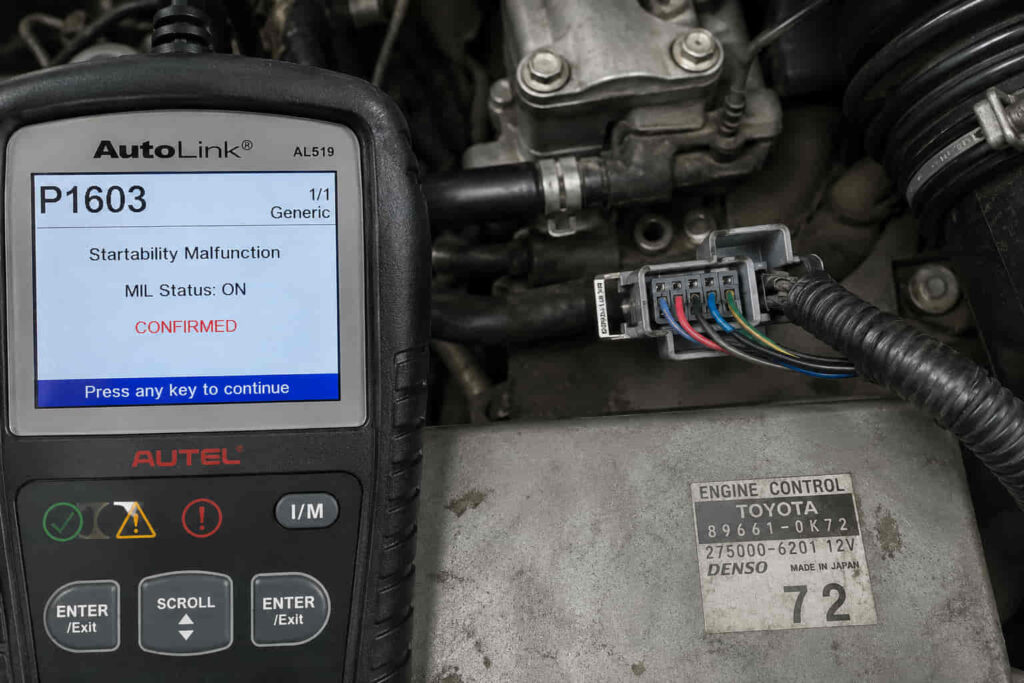
The Toyota P1603 code indicates that the Engine Control Module (ECM) has recorded an Engine Stall History condition on applicable Toyota vehicles. In practical terms, the ECM detected that the engine stopped running under conditions in which an engine stall was recognized. P1603 therefore identifies a recorded operating condition rather than confirming that one specific component has failed.
The underlying cause of Toyota P1603 can originate from systems required to keep the engine running. Fuel delivery problems can interrupt combustion, ignition faults can prevent the air-fuel mixture from burning correctly, and abnormal intake or electrical conditions can cause engine speed to fall until the engine stalls. Because several systems can produce the same final result, replacing a fuel pump, ignition coil, sensor, or ECM solely because P1603 is stored can lead to an incorrect repair.
Diagnosing P1603 requires checking other stored diagnostic trouble codes, reviewing freeze frame and operating data, and then testing the system associated with the conditions present when the engine stalled. This article explains what Toyota P1603 means, the conditions that can cause it, the symptoms associated with the code, how to diagnose the underlying fault, and which repairs can resolve the problem.
What Does the P1603 Code Mean on a Toyota?
The Toyota P1603 code means the ECM has detected and stored an Engine Stall History condition. The code indicates that the engine stopped running when the ECM recognized the event as an unintended stall. P1603 records the result of a problem—the engine stopping—rather than identifying one failed component as the direct cause.
The Engine Control Module continuously monitors engine operation through parameters such as engine speed and data from systems involved in combustion. When engine speed drops and the engine stops under the detection conditions programmed by Toyota, the ECM can store P1603 as a record of the stall event. This distinction matters because the same engine stall can result from different faults. Insufficient fuel delivery can stop combustion, an ignition problem can prevent the mixture from burning, and an abnormal air intake condition can destabilize combustion until engine speed falls to zero.
P1603 should therefore be treated as the starting point of a diagnosis rather than a command to replace a specific part. A stored P1603 does not, by itself, prove that the fuel pump, MAF sensor, ignition coil, throttle body, battery, or ECM is defective. The correct component can only be identified after the conditions surrounding the stall are examined and the affected system is tested.
Freeze frame and related operating data are particularly important when diagnosing Toyota P1603 because the engine may operate normally by the time the vehicle is inspected. The recorded information can help establish what the vehicle was doing around the fault event and provides a more useful diagnostic direction than replacing parts based solely on the DTC. Other stored codes must also be considered because they can provide more specific evidence about the system responsible for the engine stall.
What Are the Symptoms of Toyota Code P1603?
The primary symptom associated with Toyota P1603 is an engine that has stalled unexpectedly, but the symptoms present during diagnosis depend on the fault that caused the stall. A vehicle can have P1603 stored even when the engine appears to run normally during a later inspection because the code can preserve evidence of an earlier engine-stall event.
An active underlying problem can produce repeated stalling, unstable idle, rough engine operation, difficulty restarting, or abnormal engine performance. For example, a fuel-delivery problem severe enough to interrupt combustion can cause engine speed to decrease until the engine stops. An intermittent ignition or electrical problem can produce a similar stall but may disappear temporarily after the engine restarts. The symptom alone therefore cannot identify which component caused P1603.
The Check Engine Light may accompany P1603, particularly when the ECM has stored additional diagnostic trouble codes associated with the underlying malfunction. Those additional DTCs are diagnostically important because P1603 describes the stall history while another code may identify a more specific system or operating abnormality. P1604 and P1605 are especially relevant within Toyota’s related diagnostic context because they concern startability and rough-idling conditions, respectively.
The absence of current symptoms does not establish that the vehicle has no fault. An intermittent condition can cause one stall, disappear, and leave P1603 stored as diagnostic evidence. For this reason, the next step is to determine what caused the engine to stall, rather than diagnosing P1603 from the presence or absence of a single symptom.
What Causes the P1603 Code on a Toyota?
Toyota P1603 is caused when an operating problem results in an engine stall that the ECM records as Engine Stall History. The underlying fault can involve fuel delivery, ignition, air intake, engine control, or an electrical condition that prevents the engine from maintaining combustion. P1603 does not identify which of these systems failed, so the cause must be determined from other DTCs, operating data, the conditions surrounding the stall, and component testing.
Fuel delivery problems can cause P1603 when the engine receives insufficient fuel to maintain the required air-fuel mixture. The engine needs a continuous supply of fuel at the appropriate pressure and volume for stable combustion. A loss of fuel delivery reduces or interrupts combustion, causing engine RPM to fall until the engine stalls. Fuel-system diagnosis can therefore include the fuel pump, fuel pressure, fuel supply, and related control components when the available diagnostic evidence points toward insufficient fuel delivery. A fuel pump should not be replaced solely because P1603 is present because the code itself does not identify fuel pressure as the cause.
Ignition faults can produce the same final result through a different mechanism. The ignition system must generate a correctly timed spark to ignite the compressed air-fuel mixture. A fault affecting spark generation can cause incomplete combustion, misfires, rough running, or an engine stall when the fault becomes severe enough. Spark plugs, ignition coils, their electrical circuits, and related engine-control signals become relevant when additional DTCs or operating symptoms indicate an ignition problem. The presence of P1603 alone is not sufficient evidence that an ignition coil or spark plug has failed.
Air intake and air-fuel control problems can also destabilize the engine enough to produce a stall. The ECM calculates and adjusts engine operation using information about incoming air and other operating conditions. Incorrect airflow information, an abnormal intake condition, or a throttle-related problem can interfere with the engine’s ability to maintain a stable air-fuel mixture and idle speed. MAF sensor data, throttle operation, intake conditions, and related parameters should therefore be evaluated when the stall occurs alongside symptoms or diagnostic data pointing to air-management problems. The diagnostic objective is to establish the connection between the abnormal condition and the engine stall rather than treating every intake component as a possible replacement part.
Electrical faults require similar evidence-based diagnosis because engine operation depends on stable electrical power and reliable connections between sensors, actuators, control circuits, and the ECM. An intermittent loss of power, poor electrical connection, damaged wiring, or another circuit problem can interrupt a signal or function required to keep the engine running. Intermittent electrical faults are particularly relevant when the vehicle stalls unexpectedly and then restarts normally because the fault may no longer be present when the vehicle reaches a workshop.
The ECM itself should not be assumed to be defective simply because it stores P1603. The ECM is the module reporting the engine-stall event, not automatically the component responsible for causing it. ECM replacement should only enter the repair process after the applicable diagnostic procedure and supporting tests have excluded more direct causes and provided evidence of an ECM-related fault.
The most useful way to identify the actual cause is to connect the circumstances of the stall with the available diagnostic evidence. A Toyota that stalls while idling, a vehicle that loses power before stalling, and an engine that stops because of an intermittent electrical condition can all store P1603 while requiring different repairs. Other DTCs, freeze frame or operating data, the driver’s description of the stall, and system-specific tests narrow these possibilities. This cause-to-effect approach prevents P1603 from becoming a parts-replacement exercise and establishes the evidence needed for the next stage of diagnosis.
Read more: Toyota Highlander Tow Package
How Do You Diagnose Toyota Code P1603?
Diagnosing Toyota P1603 requires identifying the condition that caused the engine to stall rather than testing or replacing a component based on P1603 alone. The diagnostic process should begin with a complete scan for stored and pending DTCs, followed by a review of freeze frame and relevant operating data. The results determine whether the next checks should focus on fuel delivery, ignition, air intake, electrical control, or another system capable of interrupting engine operation.
Other diagnostic trouble codes should be evaluated before P1603 is treated as an isolated fault. This matters because P1603 records an Engine Stall History condition, while another DTC can provide more specific information about the malfunction that preceded the stall. Toyota P1604 and P1605 are relevant examples within this diagnostic context because they concern startability and rough-idling conditions. A fuel, ignition, sensor, or circuit-related DTC can provide an even more specific diagnostic direction. When another code is present, its detection conditions and relationship to the stall should be investigated instead of assuming that every stored code represents a separate problem.
Freeze frame and operating data should then be used to reconstruct the conditions surrounding the engine stall. Engine speed, engine load, coolant temperature, throttle-related information, airflow-related data, fuel-control information, battery voltage, and other available parameters can help determine how the engine was operating when the abnormal condition occurred. The exact parameters available depend on the Toyota model, powertrain, scan tool, and information recorded by the control system. The objective is not simply to find an unusual number; it is to identify a group of values that supports a specific failure mechanism.
The circumstances reported by the driver should be compared with the electronic data. An engine that stalls primarily at idle creates a different diagnostic direction from an engine that loses power under load before stopping. A vehicle that stalls and immediately restarts also presents a different pattern from one that cranks for an extended period afterward. When P1603 is historical and the engine currently operates normally, information about engine temperature, vehicle operation, warning lights, loss of power, rough running, restart behavior, and frequency of the stall becomes particularly valuable because an intermittent fault may not be active during inspection.
The fuel system should be tested when the evidence indicates that combustion stopped because adequate fuel delivery could not be maintained. Fuel pressure and delivery should be evaluated according to the applicable Toyota diagnostic procedure rather than inferred from P1603. If fuel pressure falls outside specification while the engine exhibits the relevant symptom, the diagnosis can move toward the components and circuits responsible for fuel delivery. If fuel delivery meets specification under the conditions in which the fault occurs, replacing the fuel pump merely because the engine stalled is not supported by the diagnostic evidence.
The ignition system should be evaluated when misfire symptoms, related DTCs, scan data, or testing indicates that the engine is losing the spark required for combustion. Spark plugs, ignition coils, wiring, connectors, and control circuits should be inspected or tested according to the fault pattern. A single ignition component should only be identified as the cause when the test results connect its malfunction to abnormal combustion or the stall. This distinction prevents an intermittent electrical problem, fuel problem, or air-management fault from being misdiagnosed as a failed ignition coil.
Air intake and engine-control data should be examined when the engine has unstable idle, abnormal airflow information, throttle-related symptoms, or other evidence pointing toward air-fuel control. MAF sensor readings, intake conditions, throttle operation, and relevant fuel-control data can help establish whether the engine is receiving or calculating the airflow required for stable combustion. Visual inspection also matters because damaged connections, disconnected components, or abnormal intake conditions can produce symptoms that electronic data alone does not fully explain.
Electrical diagnosis becomes particularly important when the stall is abrupt, intermittent, or difficult to reproduce. Battery voltage, power supply, grounds, connectors, wiring, and relevant control circuits should be inspected according to the symptoms and other DTCs present. A momentary interruption can stop the engine and disappear before testing begins, so a normal reading taken after the event does not automatically eliminate an intermittent electrical fault. The diagnosis needs to reproduce the condition where possible or find supporting evidence in stored data, circuit tests, connector condition, or the pattern of repeated failures.
The ECM should be considered only when the diagnostic evidence supports an ECM or control-module fault. P1603 does not prove that the Toyota ECM is defective because the ECM is responsible for detecting and recording the stall condition. Replacing the module before checking the systems that maintain combustion and electrical operation reverses the correct diagnostic sequence and can result in an expensive repair that does not resolve the original stall.
A successful P1603 diagnosis ends when the technician can connect a verified abnormal condition to the engine stall. For example, proving that fuel pressure falls outside the applicable specification when the engine loses power provides a diagnostic relationship between fuel delivery and the stall; merely finding P1603 does not. After the suspected fault is repaired, the DTC can be cleared and the vehicle should be operated under appropriate conditions and rescanned. If the engine operates normally and the relevant DTC does not return, the repair has stronger evidence of addressing the root cause rather than simply removing the stored code.
How Do You Fix Toyota Code P1603?
Fixing Toyota P1603 requires repairing the condition that caused the engine to stall, not replacing a specific component simply because P1603 is stored. The correct repair depends on the fault confirmed during diagnosis. Once the underlying fuel, ignition, air intake, electrical, or engine-control problem is corrected, the DTC can be cleared and the vehicle retested to confirm that the engine remains running normally.
A fuel-related P1603 requires correction of the verified fuel-delivery problem. If testing confirms that fuel pressure or delivery falls outside the applicable specification when the engine loses power or stalls, the component or circuit responsible for that loss must be repaired. The repair could involve the fuel pump or another part of the fuel-delivery system, but P1603 alone does not justify replacing the pump. Fuel-system repair is complete only when the system operates within the applicable specification and the original stalling condition no longer occurs.
An ignition-related repair follows the same evidence-based principle. A defective spark plug, ignition coil, connector, wiring circuit, or related component should be repaired or replaced when testing establishes that it is preventing reliable combustion. For example, an ignition coil supported by a related misfire DTC and diagnostic testing provides a stronger repair direction than an ignition coil selected only because the engine previously stalled. The objective is to correct the ignition fault that caused unstable or interrupted combustion rather than to remove P1603 temporarily.
Air intake and engine-control problems require repair of the condition that prevents the ECM from maintaining stable engine operation. A contaminated or defective MAF sensor, abnormal intake condition, throttle-related fault, damaged connection, or another air-management problem should only be corrected when inspection and testing establish its relationship to the symptoms. Cleaning or replacing the MAF sensor or throttle body without diagnostic evidence can add cost without addressing the actual reason the engine stalled.
Electrical repairs should target the circuit or connection that has been proven unreliable. Damaged wiring, poor connectors, abnormal power supply, or ground problems can interrupt the operation of sensors, actuators, or control systems required to keep the engine running. Intermittent electrical faults require particular attention because the vehicle may restart and operate normally after the original stall. Correcting the connection or circuit and then reproducing the previous operating conditions provides stronger confirmation than clearing the code immediately after the repair.
ECM replacement should remain a diagnosis-supported repair rather than a first response to P1603. The ECM storing P1603 is evidence that it detected an engine-stall condition, not evidence by itself that the ECM caused the stall. The module should only become the repair target when the applicable diagnostic process supports an ECM-related failure after relevant power supplies, grounds, circuits, inputs, outputs, and other plausible causes have been evaluated.
Clearing P1603 is the final verification stage, not the repair itself. After the confirmed fault has been corrected, stored DTCs can be cleared with an appropriate scan tool. The vehicle should then be operated under conditions relevant to the original complaint and scanned again. A successful repair is supported when the original stalling symptom is no longer present, relevant operating data remains normal, and P1603 or related fault codes do not return. Simply erasing P1603 without correcting the cause removes diagnostic information but does not prevent another engine stall.
Is Toyota P1603 Serious?
Toyota P1603 can be serious when the condition that caused the recorded engine stall is still active, particularly if the engine can stop unexpectedly while the vehicle is being driven. The severity of P1603 therefore depends more on the underlying fault and current symptoms than on the presence of the stored code itself.
A historical P1603 on a Toyota that currently starts, idles, accelerates, and operates normally does not establish that an immediate mechanical failure is occurring. The code can remain as evidence of an earlier stall, including an intermittent event that is no longer present during inspection. However, the absence of current symptoms should not be used as proof that the underlying problem has disappeared permanently. Stored DTCs, operating data, the circumstances of the original stall, and any related codes still need to be evaluated.
Repeated engine stalling creates a more urgent situation. An engine that stops while the vehicle is moving can reduce the driver’s ability to maintain normal vehicle operation and can leave the vehicle unable to continue safely in traffic. Difficulty restarting, repeated stalls, severe rough running, loss of engine power, or additional warning indicators provide further evidence that P1603 is associated with an active problem rather than only a historical event.
The seriousness of the code also changes according to its root cause. A temporary operating condition and a persistent fuel-delivery or electrical fault do not have the same likelihood of causing another stall. This is why severity should be assessed from the complete diagnostic picture rather than assigning P1603 a universal “minor” or “major” rating.
P1603 should therefore not be ignored solely because the Toyota currently runs normally. A stored P1603 calls for investigation, while repeated or current engine stalling calls for prompt diagnosis before normal driving continues. Identifying whether the event was isolated or whether an active fuel, ignition, intake, electrical, or control-system fault remains is what determines the appropriate response.
Can You Drive a Toyota With Code P1603?
You can drive a Toyota with a stored P1603 only when the engine is currently operating normally and there is no evidence of an active stalling problem, but the cause of the recorded stall should still be diagnosed. P1603 indicates that the ECM has recorded an Engine Stall History condition, so the decision to continue driving depends on whether the event was isolated or the fault responsible for it remains active.
A Toyota that starts normally, maintains a stable idle, accelerates without hesitation, and has not stalled again presents a different level of risk from a vehicle that repeatedly loses engine speed or shuts off. When P1603 is historical and no current drivability symptoms are present, the stored code provides evidence that a stall occurred but does not by itself prove that another stall is imminent. Checking other DTCs and available operating data is still necessary because an intermittent fault can disappear temporarily and return under the same operating conditions.
Continued driving is not appropriate when the engine repeatedly stalls, struggles to restart, loses power, runs severely rough, or shows other symptoms indicating that the underlying problem remains active. An unexpected engine shutdown while moving can create a hazardous situation because normal vehicle operation can be affected at the moment the driver needs to respond to traffic. In this situation, determining why the engine stops is more important than clearing P1603 and observing whether the code returns.
The safest decision therefore depends on current vehicle behavior rather than the DTC number alone. A historical P1603 with no current symptoms requires diagnosis, while P1603 accompanied by repeated engine stalling requires the underlying fault to be addressed before normal driving continues. This distinction prevents both extremes: treating every stored P1603 as an immediate catastrophic failure or dismissing an active stalling condition because the engine restarted successfully.
How Much Does It Cost to Fix Toyota P1603?
There is no single repair cost for Toyota P1603 because the code records an engine-stall condition rather than identifying one component that must be replaced. The final cost consists of the diagnostic work required to identify the root cause and the repair required to correct that specific fault. Two Toyota vehicles with the same P1603 code can therefore require substantially different repairs.
Diagnostic cost depends on how quickly the underlying condition can be reproduced and isolated. A technician may be able to identify the problem from related DTCs, freeze frame data, operating data, and a basic inspection. An intermittent stall can require substantially more diagnostic time because the vehicle may operate normally during testing. Fuel-pressure testing, electrical circuit testing, scan-tool data analysis, and attempts to reproduce the original operating conditions can add labor before any component is replaced.
Repair cost then depends on the system confirmed to have caused the stall. A relatively simple wiring, connector, spark plug, or maintenance-related problem can require less labor and fewer parts than a fuel-delivery failure or a complex intermittent electrical fault. Repairs involving expensive components or extensive circuit diagnosis can cost considerably more. Vehicle model, engine configuration, model year, parts selection, labor rate, and local market also change the final price, which makes a universal “P1603 repair price” misleading.
The most expensive approach can be replacing components without first proving that they caused the stall. Replacing a fuel pump, MAF sensor, ignition coils, throttle-related component, or ECM based only on P1603 can increase the repair bill while leaving the original problem unresolved. A diagnosis that establishes a causal relationship between the failed system and the engine stall reduces unnecessary parts replacement and produces a more defensible repair estimate.
A precise estimate should therefore be calculated after the root cause has been identified. For example, if testing demonstrates that fuel pressure falls outside the applicable specification at the same time the engine loses power, the estimate can be based on the verified fuel-system repair. If testing instead identifies an intermittent electrical connection, the estimate should reflect circuit diagnosis and repair rather than fuel-system replacement. This distinction is essential because the cost belongs to the underlying fault, not to P1603 itself.
What Is the Difference Between Toyota P1603, P1604, and P1605?
Toyota P1603, P1604, and P1605 describe different engine operating conditions, although the codes can be diagnostically related when a Toyota has problems with stalling, starting, or maintaining a stable idle. P1603 is associated with Engine Stall History, P1604 concerns startability, and P1605 concerns rough idling. The distinction matters because each code describes a different part of the engine’s operating behavior and should not automatically be treated as evidence of the same failed component.
Toyota P1603 focuses on an engine-stall event recorded by the ECM. Its diagnostic context begins with determining why the engine stopped running and then using other available evidence to identify the system responsible. P1604 shifts the diagnostic focus toward starting performance. When P1604 is present, the relevant question is why the engine did not start or achieve normal starting behavior under the applicable detection conditions. P1605 shifts the focus again toward idle quality because it is associated with rough or unstable idling.
These operating conditions can form part of the same failure sequence. For example, an underlying engine-control problem can produce unstable combustion at idle, progress to an engine stall, and then cause difficulty when the driver attempts to restart the engine. Such a vehicle can present diagnostic information related to rough idling, stalling, and startability without requiring three independent component failures. The codes must therefore be interpreted together with the order of symptoms, operating data, and any additional DTCs rather than diagnosed as unrelated faults solely because their numbers differ.
The relationship also works in the opposite direction: the presence of P1603, P1604, and P1605 does not prove that all three conditions originated from one component. The diagnostic process still has to establish the causal relationship. Fuel delivery, ignition, air management, electrical control, or another engine-operating problem can affect more than one stage of engine operation, but testing must identify which abnormal condition actually exists on the vehicle.
For P1603 diagnosis, P1604 or P1605 can therefore provide additional context rather than an automatic answer. P1603 directs attention to the recorded engine stall, P1604 to starting behavior, and P1605 to idle behavior. Reading the codes as related descriptions of engine operation helps narrow the diagnostic path while avoiding unnecessary component replacement.
Can You Diagnose Toyota P1603 Yourself?
You can perform the initial diagnosis of Toyota P1603 yourself if you have a suitable scan tool and can safely carry out basic vehicle inspections, but identifying the root cause may require professional diagnostic equipment and testing. Reading P1603 is only the beginning of the process because the code records an engine-stall condition rather than identifying the component responsible for it.
A useful DIY diagnosis starts by preserving diagnostic information before clearing any codes. The complete DTC scan, available freeze frame information, and relevant operating data can contain evidence that is lost or made more difficult to interpret after codes are erased. Recording whether the engine stalled at idle, during acceleration, after reaching operating temperature, under electrical load, or during another repeatable condition can also help connect the driver’s experience with the data stored by the vehicle.
Basic visual inspection can identify faults that do not require advanced equipment to notice. Loose or damaged electrical connections, obvious wiring damage, disconnected intake components, and other visible abnormalities should be evaluated when they correspond with the symptoms and diagnostic evidence. The purpose of this inspection is not to inspect every component under the hood. It is to find physical evidence that supports or eliminates a plausible cause of the recorded stall.
A capable scan tool becomes more valuable when P1603 appears with other DTCs. Related codes can direct the diagnosis toward a specific system, while live data can reveal abnormal engine behavior that is not apparent from P1603 alone. However, scan data still requires interpretation. A sensor value that appears unusual does not prove that the sensor itself has failed because wiring faults, mechanical conditions, or another system can cause the ECM to receive an abnormal value.
Professional diagnosis becomes appropriate when the engine repeatedly stalls, the fault cannot be reproduced reliably, or testing requires procedures beyond basic inspection and scan-tool analysis. Fuel-pressure testing and detailed electrical diagnosis, for example, require the correct equipment, specifications, and procedures to produce useful conclusions. Intermittent faults can also require testing under the same conditions that produced the original stall rather than checking the vehicle only while it is operating normally.
DIY diagnosis should stop before unverified parts replacement begins. A scan tool showing Toyota P1603 does not provide enough evidence to replace the fuel pump, MAF sensor, ignition coils, throttle-related components, or ECM. A component should become the repair target only when additional testing establishes that its malfunction explains the engine stall.
The diagnosis is complete when the identified fault can explain the original symptom and the repair can be verified afterward. Once the confirmed problem has been corrected, the stored DTC can be cleared, the vehicle can be operated under appropriate conditions, and the system can be scanned again. Normal engine operation without another stall or returning related DTC provides stronger evidence that the root cause has been resolved than simply seeing P1603 disappear after the code is erased.