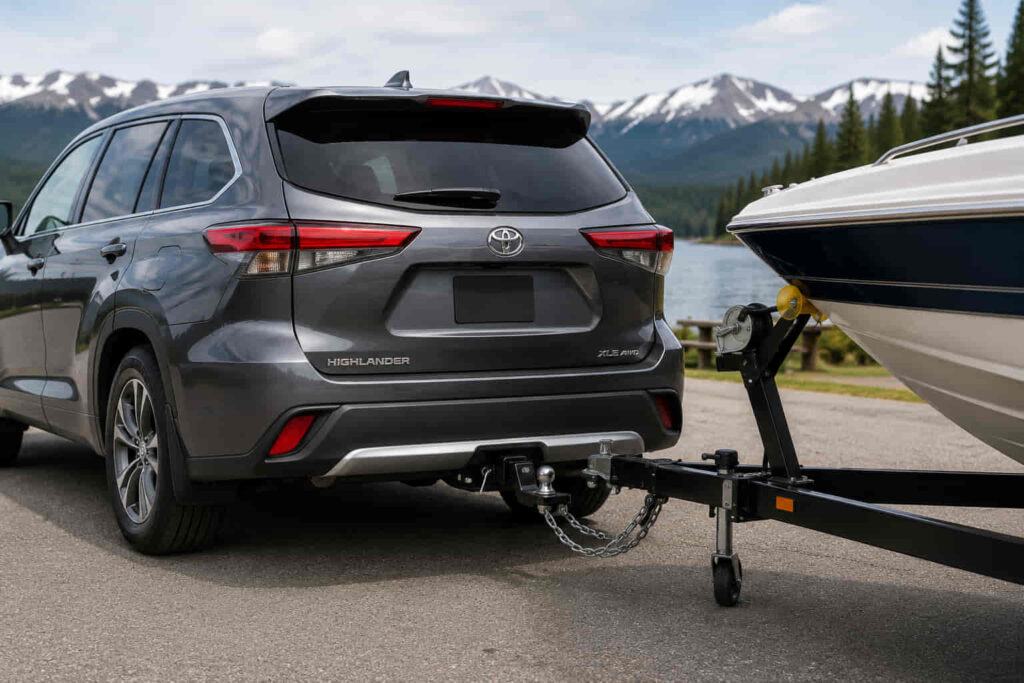
A Toyota Highlander tow package provides the towing-related equipment needed to connect the SUV to a compatible trailer, but installing towing equipment does not increase the Highlander’s manufacturer-rated towing capacity. A trailer hitch is only one part of the towing setup. Depending on the model year and vehicle configuration, towing can also require compatible electrical wiring, a trailer connection, appropriate hitch hardware, and trailer-specific equipment.
The distinction between towing equipment and towing capacity is important because not every Toyota Highlander has the same capability. Maximum trailer weight can depend on the model year, powertrain, drivetrain, and exact vehicle configuration. A hitch with a higher weight rating does not override the towing limit Toyota establishes for the vehicle. The Highlander, hitch, trailer, and related equipment must therefore be evaluated as one towing system rather than as independent components.
The term “Toyota Highlander tow package” can also refer to different equipment depending on the vehicle and how the towing setup is purchased or installed. Factory equipment, Toyota accessories, dealer-installed components, and aftermarket towing products should not automatically be treated as the same package. This guide explains what a Highlander tow package includes, how it relates to towing capacity, what hitch and wiring equipment may be required, and what to consider when adding towing equipment after purchasing the vehicle.
What Is the Toyota Highlander Tow Package?
A Toyota Highlander tow package is the collection of vehicle-compatible equipment used to connect the Highlander to a trailer and support towing within the vehicle’s rated limits. The term should not be treated as another name for a trailer hitch. The hitch creates the mechanical connection point, while a complete towing setup can also involve electrical wiring, a trailer connector, hitch-mounted hardware, and equipment required by the trailer or applicable towing conditions.
The distinction matters because towing equipment and vehicle capability perform different functions. Towing equipment allows the Highlander and trailer to be connected mechanically and electrically. Towing capacity defines how much trailer weight the specific vehicle is permitted to tow under the manufacturer’s applicable specifications. Installing additional towing hardware changes the equipment available on the vehicle, but it does not automatically change the Highlander’s underlying towing rating.
The term “tow package” also needs qualification when shopping for Highlander equipment. A factory vehicle configuration, Toyota accessory hitch, dealer-installed towing setup, and aftermarket hitch-and-wiring combination are not automatically identical products. The equipment available can change by model year and vehicle application, so a buyer should identify the exact Highlander before assuming that a package described for another year or configuration will fit or provide the same functionality.
This distinction becomes particularly important with used Highlanders. A vehicle may already have a hitch receiver installed without having every electrical or trailer-specific component required for the intended towing application. Conversely, the absence of an installed hitch does not by itself establish the vehicle’s underlying towing rating. The tow package describes towing equipment; the vehicle specification determines towing capability. Both must be verified before a trailer is connected.
What Does the Toyota Highlander Tow Package Include?
A Toyota Highlander towing setup generally centers on a vehicle-compatible tow hitch and the electrical equipment required to connect the trailer, but the exact components depend on model year, vehicle configuration, trailer requirements, and whether the equipment is Toyota or aftermarket hardware. For that reason, there is no single list of components that should be presented as a universal factory “Highlander tow package” across every model year.
The trailer hitch provides the structural connection between the Highlander and towing hardware. It is mounted to specified attachment points on the vehicle and provides the receiver used with compatible hitch equipment. The hitch itself must be designed for the exact Highlander application and installed according to the applicable specifications. A hitch being physically attachable to an SUV does not establish that it is appropriate for that vehicle or that the SUV can tow up to the hitch’s maximum rating.
Electrical equipment performs a separate function. A trailer needs an electrical connection to operate required functions such as lighting and signals, so towing preparation can involve a vehicle-specific wiring harness and compatible trailer connector. The required electrical setup depends on the trailer and vehicle application. This is why installing only a hitch receiver should not automatically be described as completing every part of a towing setup.
Additional hitch hardware connects the receiver to the trailer coupling system. The correct hardware depends on the receiver, trailer coupler, load, and application. Each component introduces its own rating and compatibility requirements, but the presence of higher-rated hardware cannot increase the manufacturer’s limit for the Highlander. The towing system remains constrained by the applicable limits of the vehicle and its components.
Trailer-specific requirements can extend the setup beyond equipment mounted directly to the Highlander. A heavier or differently configured trailer can require additional braking or electrical considerations that are unnecessary for a lighter trailer. These requirements should be determined from the exact trailer, vehicle guidance, equipment specifications, and applicable regulations rather than inferred from the phrase “tow package.”
A complete Toyota Highlander towing setup should therefore be defined by function rather than by the package name alone. The vehicle needs a compatible mechanical connection, the appropriate electrical connection, correctly rated towing hardware, and any trailer-specific equipment required for the intended load. The exact components should be verified for the Highlander’s model year and configuration before installation.
How Much Can a Toyota Highlander Tow With a Tow Package?
A tow package does not create a new towing capacity for a Toyota Highlander; the maximum trailer weight remains limited by Toyota’s rating for the specific model year, powertrain, and vehicle configuration. This means a Highlander should never be assigned a towing limit simply because a particular hitch or towing accessory has been installed.
The relationship can be understood by separating the vehicle limit from the equipment limit. If a hitch is rated to handle more weight than the Highlander itself is permitted to tow, the higher hitch rating does not become the new vehicle rating. The Highlander’s specified limit remains the constraint. The same principle applies throughout the towing system because trailer weight must remain within the applicable limits of the vehicle and towing components rather than within whichever component happens to display the largest number.
Model year is particularly important for the Highlander because the nameplate has been sold with different powertrains and configurations over time. A towing figure associated with one Highlander generation should not be copied to another generation without verification. Hybrid and non-hybrid configurations can also have different specifications, which makes the exact vehicle more useful than the model name alone when determining towing capability.
Actual towing also involves more than comparing trailer weight with one maximum number. Occupants, cargo, accessories, and trailer tongue weight affect the loads placed on the vehicle. A trailer that appears to fall below a headline maximum can therefore still require a closer evaluation of the vehicle and trailer specifications. Manufacturer limits should be applied to the actual configuration and loading condition rather than treated as an approximate target.
For this reason, the correct sequence is to identify the exact Highlander first, determine its applicable towing specifications, and then select towing equipment that is compatible with those limits. Installing a Toyota Highlander tow package enables the vehicle to connect to an appropriate trailer; it does not upgrade the Highlander’s manufacturer-rated towing capability. This distinction prevents a higher-rated hitch or aftermarket component from being incorrectly interpreted as permission to tow a heavier trailer.
Does a Toyota Highlander Need a Tow Package to Tow a Trailer?
A Toyota Highlander needs the correct towing equipment to connect and operate a trailer safely, but that does not mean every Highlander must have a single factory option specifically called a “tow package.” The required setup depends on the Highlander’s model year and configuration, the trailer being used, and the equipment needed to establish both the mechanical and electrical connections. The important distinction is whether the vehicle is properly equipped for the intended trailer, not whether a particular package name appears on its equipment list.
The Highlander’s towing rating and its installed towing equipment answer two different questions. The vehicle rating determines how much the specific Highlander is designed to tow under the applicable manufacturer specifications. The towing equipment determines whether an appropriate trailer can be connected to the vehicle. A Highlander can therefore have an underlying towing rating without having a hitch installed, while a Highlander with an aftermarket hitch still remains subject to its original vehicle towing limits.
A trailer requires a secure mechanical connection to the vehicle, which is normally established through a compatible hitch and related coupling hardware. It also requires the appropriate electrical connection for functions such as trailer lighting and signals. Depending on trailer weight, configuration, and applicable requirements, additional equipment can also be necessary. These functions explain why attaching a receiver hitch alone should not automatically be considered complete towing preparation.
The trailer itself must also remain compatible with the Highlander’s limits after it is loaded. Trailer weight can change when cargo, water, equipment, or recreational gear is added, and tongue weight places additional load on the tow vehicle. Evaluating an empty trailer specification without considering its loaded condition can therefore understate the actual demand placed on the Highlander.
The practical requirement is not a package name but a correctly matched towing system. The exact Highlander must have sufficient manufacturer-rated capability for the loaded trailer, while the hitch, electrical connection, coupling hardware, and any required trailer equipment must be compatible with the intended towing application.
What Trailer Hitch Does a Toyota Highlander Need?
A Toyota Highlander needs a trailer hitch specifically designed for its model year and vehicle application, with ratings appropriate for the intended trailer and within the Highlander’s own towing limits. Hitch selection should begin with vehicle compatibility rather than choosing the hitch with the highest advertised weight rating. Mounting design, receiver configuration, installation requirements, and component ratings must correspond to the vehicle being equipped.
The hitch rating and Highlander towing capacity should not be interpreted as interchangeable numbers. A hitch can be engineered for a load greater than the amount the vehicle itself is permitted to tow. In that situation, the vehicle limit remains controlling. Installing stronger towing hardware does not modify the engine, transmission, cooling system, chassis, brakes, or other vehicle characteristics used to establish the manufacturer’s towing specification.
The receiver is also only one part of the mechanical connection. Compatible hitch-mounted hardware must connect the receiver to the trailer’s coupling system while maintaining the correct operating relationship between the vehicle and trailer. Component selection therefore depends on the actual towing application rather than the Highlander nameplate alone. Equipment ratings must be considered together because a towing system should not be operated beyond the applicable limit of the vehicle or its components.
Fit is equally important when choosing between Toyota and aftermarket hitch equipment. A hitch intended for the correct Highlander application is designed around specific vehicle mounting locations and installation requirements. Equipment intended for a different generation or model year should not be assumed compatible because the vehicles share the Highlander name. This becomes particularly important when purchasing used towing equipment or selecting parts online using incomplete vehicle information.
The correct Toyota Highlander trailer hitch is therefore a vehicle-specific hitch that fits the exact application, supports the intended towing use, and does not encourage operation beyond Toyota’s vehicle rating. A higher hitch rating can provide adequate component capacity, but it never converts a Highlander into a higher-capacity tow vehicle.
Does a Toyota Highlander Need a Wiring Harness for Towing?
A Toyota Highlander needs an appropriate trailer electrical connection when the trailer requires powered lighting, signals, or other electrical functions, which makes compatible wiring a fundamental part of most road-going towing setups. The hitch establishes the mechanical connection, while the wiring system allows required electrical signals to pass between the Highlander and trailer. One cannot substitute for the other.
The wiring harness connects vehicle electrical functions with a compatible trailer connector. When the driver activates a turn signal or applies the brakes, the trailer needs to reproduce the applicable lighting signal so other road users can interpret the combined vehicle’s movement. This relationship explains why a Highlander with a correctly installed hitch can still be incompletely equipped for towing if no suitable trailer electrical connection is available.
Connector requirements should be determined from the trailer and the exact towing setup rather than assumed from the Highlander alone. A relatively simple trailer lighting system does not necessarily require the same electrical functions as a trailer equipped with additional braking or auxiliary electrical systems. The correct connection therefore depends on what information or power must pass between the vehicle and trailer.
Vehicle-specific wiring also matters because trailer electrical equipment interfaces with the Highlander’s electrical system. A compatible harness is intended to create that interface without relying on an improvised connection. Installation should follow the requirements of the selected equipment and vehicle application, particularly when the towing setup requires functionality beyond basic trailer lighting.
Electrical preparation does not change towing capacity. Adding a wiring harness allows the Highlander to communicate electrically with a compatible trailer, just as installing a hitch creates the mechanical connection. Neither component increases the manufacturer’s vehicle rating; together they help equip a properly rated Highlander to operate an appropriate trailer. This separation between connection equipment and vehicle capability remains the central rule when building a Highlander towing setup.
Can You Add a Tow Package to a Toyota Highlander After Purchase?
You can add compatible towing equipment to a Toyota Highlander after purchase, but retrofitting a hitch, wiring, and related components does not increase the vehicle’s original manufacturer-rated towing capacity. The first step is to identify the exact model year, powertrain, and vehicle configuration so the equipment can be matched to the Highlander rather than selecting parts from the model name alone.
A retrofit commonly addresses the physical and electrical connections that were not installed when the vehicle was purchased. A vehicle-specific trailer hitch can provide the mechanical connection point, while compatible wiring can provide the electrical connection required by the trailer. Additional hardware depends on the trailer and intended use. The purpose of the retrofit is therefore to equip an already capable Highlander for a compatible towing application, not to create additional towing capability beyond the vehicle’s established limits.
This distinction becomes important when a Highlander did not leave the dealership with towing accessories installed. The absence of a hitch does not by itself define the vehicle’s towing capacity, and adding one later does not automatically reproduce every characteristic of another factory configuration. Towing capability should be verified from information applicable to the exact vehicle before parts are selected. The retrofit equipment can then be chosen around that existing capability.
Installation quality also affects whether retrofitting is practical. The hitch must attach at the appropriate vehicle mounting locations, while wiring must interface correctly with the vehicle’s electrical system. Improvised mounting or electrical connections introduce problems that cannot be solved by selecting equipment with a higher advertised rating. Correct fit and installation are therefore as important as the nominal capacity printed on the component.
A Highlander owner considering a retrofit should consequently separate two decisions. The first is whether the vehicle has sufficient rated capability for the intended loaded trailer. The second is which equipment is required to connect and operate that trailer correctly. If the intended trailer exceeds the Highlander’s applicable towing limit, adding a larger hitch or more extensive tow package is not the solution; a vehicle with sufficient towing capacity is required instead.
Should You Choose an OEM or Aftermarket Tow Package for a Toyota Highlander?
OEM and compatible aftermarket towing equipment can both be appropriate for a Toyota Highlander, but the better choice depends on vehicle fit, component ratings, electrical compatibility, installation requirements, warranty considerations, and total installed cost. The comparison should therefore be made between equipment designed for the same Highlander application rather than assuming OEM is always superior or aftermarket equipment is automatically the better value.
Toyota towing accessories have the advantage of being identified for specific Toyota applications. This can simplify parts selection when the correct accessory is available for the exact Highlander. Vehicle-specific fit is particularly relevant for a hitch because mounting locations and surrounding vehicle components determine how the equipment must be installed. The same application-specific principle applies to electrical equipment intended to integrate the trailer connection with the vehicle.
Aftermarket equipment expands the number of available choices. A compatible aftermarket hitch can provide the mechanical connection required for towing, while aftermarket wiring products can address the electrical side of the setup. The important word is compatible. A product advertised with a high towing rating or broad SUV application is not automatically appropriate for every Highlander generation, and its component rating does not override Toyota’s limit for the vehicle.
Cost differences should also be evaluated at the installed-system level. A lower-priced hitch can cease to be the less expensive option if installation requires additional components or labor that were not included in the initial price. Conversely, paying more for OEM equipment does not automatically produce greater towing capability. The useful comparison includes the parts necessary for the intended trailer, installation requirements, and any additional electrical or trailer-related equipment required to complete the setup.
Warranty considerations should be evaluated according to the actual vehicle, part, installer, and applicable warranty terms rather than through a general claim that aftermarket towing equipment automatically voids vehicle coverage. Installation quality and whether a modification causes or contributes to a problem can be relevant. Owners concerned about warranty implications should verify the applicable terms before installation rather than relying on a universal rule.
Choose the towing equipment that provides verified compatibility with the exact Highlander and intended trailer, regardless of whether the component is OEM or aftermarket. OEM equipment can simplify application matching, while aftermarket products can provide additional choices in price and configuration. Neither option changes the fundamental constraint that the Highlander must remain within its manufacturer-rated towing limits.
How Much Does It Cost to Add a Tow Package to a Toyota Highlander?
The cost to add towing equipment to a Toyota Highlander depends on the hitch, wiring and electrical components, required towing hardware, installation labor, and the requirements of the trailer being used. A single universal “tow package price” would be misleading because a Highlander that only needs compatible hitch and electrical equipment represents a different installation from a setup requiring additional trailer-specific components.
The hitch is one part of the total installed cost. Its price varies according to manufacturer, Highlander application, receiver design, and the equipment included with the product. Labor then depends on how the hitch attaches to the specific vehicle and what work is required to complete the installation correctly. Comparing hitch prices without including installation can therefore make one option appear cheaper even when its completed cost is not.
Electrical equipment creates a separate cost component. A vehicle-specific wiring solution, trailer connector, and installation labor can add to the price beyond the mechanical hitch. The required electrical functionality should be established from the intended trailer before the installation is quoted. Purchasing a hitch first and identifying the electrical requirements afterward can result in an incomplete estimate of the actual towing setup.
Trailer requirements can add further cost because not every trailer places the same demands on the tow vehicle. The appropriate coupling hardware, electrical functionality, and braking-related equipment depend on the application. These costs belong in the towing decision even when a seller does not include them under the label “Toyota Highlander tow package.”
For that reason, the most useful estimate is the total installed cost for a towing setup matched to the exact Highlander and intended trailer, not the advertised price of one hitch or accessory. An accurate quote should identify the vehicle application and required functions before pricing the components and labor. This approach prevents a low initial parts price from being mistaken for the complete cost of preparing the Highlander to tow.
Does the Toyota Highlander Need Trailer Brakes?
A Toyota Highlander may require a trailer braking system when the trailer, towing conditions, manufacturer guidance, or applicable law requires independent braking assistance. Trailer brakes should not be treated as an optional extension of the hitch alone because they perform a different function. The hitch creates the mechanical connection between the Highlander and trailer, while trailer brakes help control and decelerate the trailer’s own mass during braking.
Trailer weight is central to this decision because a heavier trailer adds more momentum to the combined vehicle-and-trailer system. The Highlander’s brakes must slow the SUV while the trailer continues to exert force through the hitch connection. A properly configured trailer braking system allows braking force to be distributed more appropriately instead of relying entirely on the tow vehicle to manage the combined load. The exact requirements must be determined from the Highlander’s applicable towing guidance, the trailer specifications, and regulations where the combination will be operated.
Electrical requirements can also change when trailer brakes are involved. Basic trailer lighting and an electrically controlled braking system do not perform the same function, so the presence of a trailer-light connector does not automatically establish that every braking requirement has been addressed. The trailer’s braking design determines what electrical functionality is necessary between the vehicle and trailer.
Trailer brakes also do not increase the Highlander’s towing capacity. Adding more capable braking equipment can improve how a properly matched trailer is controlled, but it does not alter Toyota’s maximum trailer-weight specification for the vehicle. The same constraint applies to upgraded hitches, wiring, and other towing components: additional equipment cannot be used to override the vehicle manufacturer’s limit.
Trailer brake requirements should therefore be determined for the specific Highlander, loaded trailer, towing setup, and jurisdiction rather than from the phrase “tow package” alone. When braking equipment is required, it becomes another component of the complete towing system and should be addressed before the trailer is put into service.
How Do You Know if Your Toyota Highlander Is Ready to Tow?
A Toyota Highlander is ready to tow when the exact vehicle has sufficient manufacturer-rated capacity for the intended loaded trailer and the mechanical, electrical, load, and braking requirements of the complete towing system have been verified. Having a hitch installed is not sufficient evidence by itself because towing readiness depends on the relationship between the vehicle, equipment, trailer, and actual load.
The verification process starts with the Highlander rather than the trailer hitch. The model year, powertrain, drivetrain, and relevant vehicle configuration should be identified so the applicable towing specifications can be determined. This prevents a towing figure from another Highlander generation or configuration from being applied to a vehicle for which it was not specified.
The loaded trailer must then fit within those limits. The relevant weight is not necessarily the trailer’s empty or advertised base weight because cargo and installed equipment increase the load being pulled. A camper carrying water, batteries, equipment, and personal cargo, for example, can weigh substantially more in use than its unloaded specification suggests. The towing decision should therefore reflect the trailer in its actual operating condition.
Tongue weight must also be considered because part of the trailer load is transferred to the Highlander through the hitch. That load interacts with passengers, cargo, accessories, and the vehicle’s other applicable weight limits. Staying below a headline maximum towing figure does not automatically prove that every other load-related requirement has been satisfied.
The mechanical connection should then be evaluated for compatibility and condition. The hitch and related hardware must fit the vehicle and trailer application, remain within their applicable ratings, and be installed correctly. A component with a rating above the Highlander’s towing capacity provides component headroom but does not increase the amount the SUV is permitted to tow.
The electrical connection must support the functions required by the trailer. Trailer lighting and signals need the appropriate vehicle-to-trailer connection, while trailers with additional braking or electrical systems can require further functionality. The equipment should be selected from the actual trailer requirements rather than assuming that every trailer uses the same electrical setup.
Towing readiness is therefore established by matching the Highlander’s rated capability with the loaded trailer and then verifying the hitch, load distribution, electrical connection, and any required braking equipment. If one part of that relationship falls outside its applicable limit or is incompatible, installing additional accessories elsewhere in the system does not correct the mismatch.
Should You Add a Tow Package to Your Toyota Highlander?
Adding towing equipment to a Toyota Highlander makes sense when the SUV has sufficient manufacturer-rated capability for the trailer you intend to use and the correct hitch, wiring, and trailer-specific equipment can be installed for that application. A tow package is valuable because it prepares an appropriately rated Highlander to connect to and operate a compatible trailer; it should not be viewed as an upgrade that creates additional vehicle towing capacity.
The strongest use case is an owner whose Highlander already meets the capability requirements but lacks the equipment needed to connect the trailer. Adding a vehicle-specific hitch and compatible electrical connection can address that gap. Depending on the trailer, the completed setup may also require additional coupling, electrical, or braking equipment. In this situation, retrofitting towing equipment allows the owner to use capability the vehicle already has.
Adding a tow package is less appropriate when the intended trailer exceeds the applicable Highlander limits. Selecting a hitch with a higher rating cannot solve that problem because hitch capacity and vehicle towing capacity describe different constraints. If the loaded trailer requires greater capability than the specific Highlander provides, the appropriate solution is a tow vehicle rated for that application rather than stronger accessories installed on the Highlander.
The same reasoning applies when choosing between OEM and aftermarket equipment. Toyota accessories can provide a vehicle-specific option when available for the application, while compatible aftermarket equipment can expand the selection of hitch and wiring solutions. The useful comparison is whether the complete setup fits the exact vehicle, satisfies the trailer requirements, and remains within all applicable ratings. The brand name on an individual component does not change those requirements.
Installation cost should likewise be judged against the complete towing requirement. The cheapest hitch is not necessarily the cheapest finished setup if wiring, additional hardware, or further installation work must be purchased separately. An installed-price comparison should account for the equipment necessary to move from an unequipped Highlander to a towing setup that is actually usable with the intended trailer.
A Toyota Highlander tow package is therefore worth adding when it completes a properly matched towing system within the Highlander’s existing limits. Identify the exact vehicle and its towing specifications first, determine the loaded trailer requirements second, and select compatible towing equipment around those constraints. If the vehicle’s capacity is insufficient, no hitch, wiring harness, or aftermarket tow package can legitimately increase Toyota’s specified towing limit.