The main difference between an H6 and H7 battery is their physical size and electrical capacity. An H6 battery, also known as Group 48 or L3, measures approximately 278 × 175 × 190 mm, while an H7 battery, also called Group 94R or L4, measures approximately 315 × 175 × 190 mm. The H7 battery is 37 mm longer and generally provides higher cold cranking amps (CCA), amp-hour capacity (Ah), and reserve capacity (RC) than a comparable H6 model.
Both H6 and H7 batteries operate at 12 volts and are available in different lead-acid technologies, including absorbed glass mat (AGM) and conventional flooded designs. However, H6 and H7 batteries are not automatically interchangeable. Their compatibility depends on the vehicle’s battery tray dimensions, terminal configuration, hold-down system, and manufacturer-specified electrical requirements. Installing an H7 battery in a vehicle designed for an H6 requires sufficient mounting space and a compatible electrical system.
Choosing between an H6 and H7 battery requires more than comparing starting power or capacity. This guide examines their dimensions, CCA ratings, amp-hour capacity, interchangeability, and vehicle compatibility to help you identify the correct replacement battery.
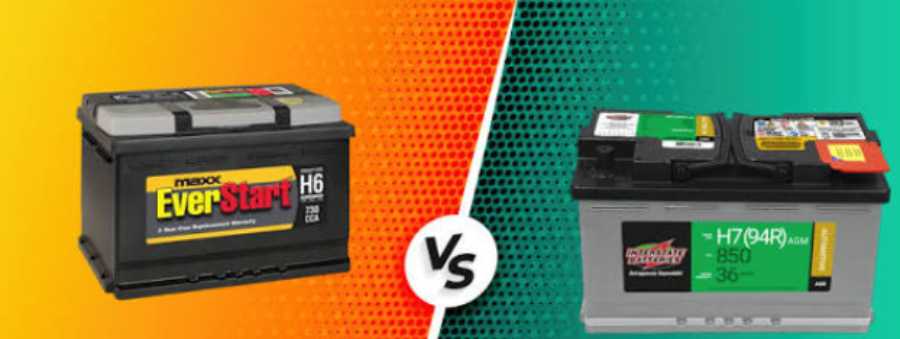
What Is the Difference Between an H6 and H7 Battery?
The main differences between H6 and H7 batteries are case dimensions, amp-hour capacity, cold cranking amps (CCA), and reserve capacity (RC). An H6 battery belongs to BCI Group 48 and corresponds to the European L3 size, while an H7 battery belongs to BCI Group 94R and corresponds to the European L4 size. Both are 12-volt automotive starting batteries, but the larger H7 case generally accommodates greater electrical capacity.
The following table compares standard dimensions and representative electrical specifications for H6 and H7 batteries.
| Specification | H6 Battery (Group 48) | H7 Battery (Group 94R) |
|---|---|---|
| BCI group size | 48 | 94R |
| European size | L3 | L4 |
| Voltage | 12V | 12V |
| Length | 278 mm (10.94 in) | 315 mm (12.40 in) |
| Width | 175 mm (6.89 in) | 175 mm (6.89 in) |
| Height | 190 mm (7.48 in) | 190 mm (7.48 in) |
| Typical capacity | 60–75 Ah | 70–85 Ah |
| Typical CCA | 600–760 A | 730–850 A |
| Reserve capacity | Varies by model | Generally higher in comparable models |
| Battery technology | Flooded, EFB, AGM | Flooded, EFB, AGM |
These electrical ranges are representative rather than fixed group-size requirements. For example, VARTA’s comparable AGM batteries are rated at 70 Ah and 760 CCA for H6 and 80 Ah and 850 CCA for H7. The H7 model provides approximately 14% more rated amp-hour capacity and 12% more cold cranking amps in this comparison. Actual differences depend on battery construction, manufacturer, and product specifications.
The H7 battery’s greater capacity makes it suitable for vehicles designed to accommodate its larger case and electrical requirements. However, a higher CCA or Ah rating does not automatically make H7 a better choice. A correctly specified H6 battery can provide reliable starting performance in a vehicle designed for Group 48 batteries. Battery selection must account for physical fitment, terminal placement, and the vehicle manufacturer’s requirements.
What Are the Dimensions of H6 and H7 Batteries?
Standard H6 batteries measure approximately 278 × 175 × 190 mm (10.94 × 6.89 × 7.48 inches), while H7 batteries measure approximately 315 × 175 × 190 mm (12.40 × 6.89 × 7.48 inches). These measurements represent length, width, and height. The two group sizes share the same nominal width and height, but the H7 battery is 37 mm (1.46 inches) longer.
The 37 mm length difference directly affects battery tray compatibility. For example, a vehicle with a battery tray designed to accommodate a maximum case length of 280 mm cannot safely accept a standard 315 mm H7 battery without an approved alternative mounting arrangement. Even when the engine compartment has sufficient open space, the battery must fit securely within the tray and engage the designated hold-down system.
Battery dimensions also influence terminal positioning and cable routing. H6 and H7 batteries are commonly available with similar terminal layouts, but the longer H7 case changes the physical location of the terminals relative to the mounting area. Battery cables designed for an H6 installation may not reach the H7 terminals without excessive tension, depending on the vehicle’s layout.
The battery’s base mounting profile is another important consideration. Many European-style H6 and H7 batteries use compatible bottom hold-down designs, but a matching hold-down profile does not guarantee a secure installation. The battery tray, retaining bracket, terminal clearance, and surrounding components must all accommodate the replacement battery. Checking the exact manufacturer’s dimensions and vehicle-specific fitment information is necessary before changing battery group sizes.
How Do H6 and H7 Batteries Compare in CCA and Amp-Hours?
H7 batteries generally provide higher cold cranking amps (CCA), amp-hour capacity (Ah), and reserve capacity (RC) than comparable H6 batteries. The larger H7 case accommodates more internal battery material, allowing manufacturers to design batteries with greater starting power and energy storage. However, these performance differences depend on battery technology, internal construction, and manufacturer specifications rather than group size alone.
Cold cranking amps measure a battery’s ability to deliver current when starting an engine in low temperatures. Under the SAE testing standard, CCA represents the current a fully charged 12V battery can supply for 30 seconds at 0°F (-18°C) while maintaining at least 7.2 volts. Higher CCA ratings indicate greater cold-starting capability, particularly for engines that require substantial electrical current during ignition.
For example, VARTA’s comparable AGM models provide 760 CCA for the H6 (L3) battery and 850 CCA for the H7 (L4) battery. The H7 delivers 90 additional cold cranking amps, representing approximately 12% more rated starting current. This difference provides additional starting capability in demanding conditions, such as freezing temperatures, provided the battery meets the vehicle’s electrical and installation requirements.
Amp-hour capacity measures how much electrical charge a battery can deliver over a specified discharge period. A 70 Ah battery, for example, has a nominal capacity equivalent to delivering 3.5 amps for 20 hours under the applicable rating conditions. In the same VARTA AGM comparison, the H6 provides 70 Ah, while the H7 provides 80 Ah. The H7 therefore offers approximately 14% greater rated capacity, allowing it to support electrical loads for longer under comparable discharge conditions.
Reserve capacity provides another measure of stored energy. It indicates how many minutes a fully charged battery can deliver 25 amps at 80°F (26.7°C) before its voltage drops to 10.5 volts. A battery with higher reserve capacity can sustain essential electrical systems for longer when the alternator is not supplying sufficient power. Comparable H7 models generally have higher reserve capacity than H6 models, although exact ratings must be checked on individual product specifications.
The distinction between CCA, Ah, and RC is important when selecting a replacement battery. CCA determines rated cold-starting capability, Ah describes charge capacity, and RC measures operating time under a standardized electrical load. For example, a vehicle frequently driven in freezing conditions benefits from meeting its manufacturer’s specified CCA requirement, while a vehicle with substantial electrical accessory demands must also meet its required capacity rating.
Despite the H7 battery’s typical performance advantage, higher electrical ratings do not guarantee better vehicle compatibility or longer battery life. A properly specified H6 battery can meet the starting and electrical demands of a vehicle designed for Group 48 batteries. The correct replacement must satisfy the manufacturer’s minimum electrical requirements while matching the required battery technology, physical dimensions, and mounting configuration.
Can You Replace an H6 Battery With an H7 Battery?
You can replace an H6 battery with an H7 battery if your vehicle has sufficient battery tray space, compatible terminals, a secure mounting system, and electrical specifications that support the replacement. Both batteries operate at 12 volts, but the H7 is approximately 37 mm (1.46 inches) longer than the H6. This physical difference makes interchangeability dependent on the vehicle’s battery compartment design rather than voltage compatibility alone.
The first requirement is sufficient space in the battery tray. An H6 battery measures approximately 278 × 175 × 190 mm, while an H7 measures 315 × 175 × 190 mm. A vehicle designed exclusively for the shorter H6 case may not accommodate the H7 without interfering with surrounding components. However, some vehicles use battery trays designed to accept multiple group sizes, allowing an H7 installation when the appropriate factory-approved mounting hardware is available.
Terminal configuration is equally important. The replacement battery must have the correct positive and negative terminal positions, compatible terminal posts, and sufficient cable reach. Although H6 and H7 batteries commonly share similar terminal arrangements, the longer H7 case changes the position of its terminals relative to the mounting points. Incorrect terminal placement can place excessive tension on battery cables or create a risk of accidental electrical contact.
The battery hold-down system must also secure the H7 without movement. A battery that fits inside the compartment but cannot be properly restrained is not a suitable replacement. Vehicle vibration and sudden braking can cause an unsecured battery to shift, potentially damaging electrical connections or surrounding components. The replacement must engage the designated hold-down bracket without modifying safety-critical mounting components.
Electrical compatibility requires more than matching the nominal 12V rating. The H7 battery must meet the vehicle manufacturer’s requirements for cold cranking amps, amp-hour capacity, and battery technology. Vehicles equipped with intelligent battery management systems may also require battery registration or coding when the installed battery’s capacity or technology changes. For example, replacing a 70 Ah H6 AGM battery with an 80 Ah H7 AGM battery may require updating the configured battery capacity in vehicles that support this procedure.
An H7 battery is therefore a suitable H6 replacement only when both physical and electrical compatibility have been verified. Higher CCA and Ah ratings alone do not justify an upgrade, particularly when the larger battery cannot be mounted correctly or does not meet the vehicle’s specified configuration.
Can You Replace an H7 Battery With an H6 Battery?
You can replace an H7 battery with an H6 battery only if the smaller H6 meets the vehicle’s minimum electrical requirements and can be securely installed using compatible mounting hardware. Although both batteries operate at 12 volts, the H6 generally has lower amp-hour capacity and cold cranking performance than a comparable H7 model. This makes downsizing unsuitable for vehicles that require the H7’s higher electrical ratings.
For example, replacing an 80 Ah, 850 CCA H7 AGM battery with a 70 Ah, 760 CCA H6 AGM battery reduces rated capacity by 12.5% and cold cranking performance by approximately 10.6%. These reductions may be acceptable only when the replacement still satisfies the vehicle manufacturer’s specifications. Vehicles with high electrical loads, demanding cold-start requirements, or start-stop systems may require the original H7 capacity and battery technology.
Physical installation also presents challenges. Because an H6 battery is 37 mm shorter than an H7, the original hold-down bracket may not secure the smaller case correctly. A compatible battery spacer, retaining bracket, or manufacturer-approved mounting arrangement may be necessary. Installing an undersized battery without proper restraint can allow movement and damage the battery terminals or electrical connections.
The safest replacement choice is the battery group size specified by the vehicle manufacturer. Switching from H7 to H6 should only be considered when the vehicle’s approved fitment information confirms compatibility, including minimum CCA, required capacity, battery technology, terminal layout, and mounting requirements.
Which Battery Is Better for Your Car, H6 or H7?
The better battery for your car is the one that matches the manufacturer’s required group size, cold cranking amps (CCA), amp-hour capacity (Ah), and battery technology. An H7 battery generally offers greater starting power and electrical capacity than a comparable H6 battery, but these advantages do not make it the correct choice for every vehicle. Physical fitment and original equipment manufacturer (OEM) specifications determine whether either battery can be installed safely.
An H6 battery is the appropriate choice for vehicles designed around Group 48 dimensions when its electrical ratings satisfy the manufacturer’s requirements. Its shorter 278 mm case fits battery compartments that cannot accommodate the 315 mm H7. For example, a vehicle requiring a 70 Ah AGM battery with at least 760 CCA can use an H6 model meeting those specifications without needing the additional capacity of an H7.
An H7 battery is better suited to vehicles requiring Group 94R dimensions or higher electrical capacity. Its larger case accommodates batteries with greater Ah and CCA ratings, making it suitable for vehicles whose manufacturers specify those characteristics. For example, an H7 AGM battery rated at 80 Ah and 850 CCA provides more starting-current capability and stored charge than a comparable 70 Ah, 760 CCA H6 AGM model. However, these advantages matter only when the vehicle supports the larger battery and its electrical configuration.
To determine whether your vehicle requires an H6 or H7 battery, check five specifications:
- Battery group size: Consult the owner’s manual, OEM parts catalog, or vehicle-specific battery fitment guide to identify the approved H6, H7, or alternative group size.
- Physical dimensions: Measure the battery tray and verify the replacement’s length, width, height, terminal clearance, and hold-down compatibility.
- Cold cranking amps: Choose a battery that meets or exceeds the manufacturer’s specified minimum CCA rating.
- Amp-hour capacity: Match the required capacity or select an approved alternative that is compatible with the vehicle’s charging and battery management systems.
- Battery technology: Verify whether the vehicle requires AGM, EFB, or conventional flooded lead-acid construction, particularly when it has an automatic start-stop system.
The existing battery label can help identify the installed group size and electrical ratings, but it should not be treated as definitive evidence of the correct specification. A previous owner may have installed an incompatible replacement. Vehicle-specific manufacturer information provides a more reliable reference.
Choosing an H7 solely for higher CCA is unnecessary when an H6 already meets the engine’s starting requirements. Likewise, selecting an H6 to reduce replacement costs is inappropriate when the vehicle requires the H7’s capacity or physical configuration. For most drivers, matching the OEM-approved battery specifications is more important than choosing the battery with the highest electrical ratings. This approach ensures reliable starting performance, secure installation, and compatibility with the vehicle’s electrical system.
Are H6 and H7 Batteries Available in AGM and Flooded Types?
Both H6 and H7 batteries are available in absorbed glass mat (AGM), enhanced flooded battery (EFB), and conventional flooded lead-acid configurations, although availability varies by manufacturer and product line. H6 and H7 identify battery case sizes rather than internal battery technologies. Two batteries with the same group size can therefore differ in charging characteristics, cycle durability, maintenance requirements, and suitability for start-stop vehicles.
AGM batteries use fiberglass separators to absorb and retain the electrolyte between lead plates. This construction provides low internal resistance, strong starting performance, and better resistance to repeated discharge cycles than conventional flooded starting batteries. AGM technology is commonly used in vehicles with advanced start-stop systems, regenerative charging strategies, and substantial electrical demands. For example, an H6 AGM battery rated at 70 Ah and 760 CCA differs in construction and cycling capability from a conventional flooded H6 battery with similar external dimensions.
Conventional flooded batteries contain liquid electrolyte surrounding their internal lead plates. They provide reliable engine-starting performance and are generally less expensive than comparable AGM batteries. However, conventional starting batteries are less suited to frequent deep discharge and repeated start-stop operation. EFB batteries use improved flooded-battery construction to provide greater cycling durability than standard flooded designs, making them suitable for certain vehicles equipped with basic start-stop systems.
The following table summarizes the differences between these battery technologies.
| Feature | AGM | EFB | Flooded |
|---|---|---|---|
| Electrolyte design | Absorbed in glass mat | Liquid electrolyte | Liquid electrolyte |
| Cycle durability | High | Moderate to high | Lower |
| Start-stop compatibility | Advanced systems | Basic systems | Generally not suitable |
| Maintenance | Sealed, maintenance-free design | Usually maintenance-free | Depends on model |
| Relative cost | Higher | Mid-range | Lower |
Battery technology should match the vehicle manufacturer’s requirements, regardless of whether the battery is H6 or H7. Replacing an OEM-specified AGM battery with a conventional flooded battery can reduce cycling durability and create incompatibility with the vehicle’s charging strategy. Similarly, changing from flooded or EFB to AGM may require confirmation of charging-system compatibility and battery management settings.
For vehicles equipped with battery management systems, changing battery technology or rated capacity may also require coding or registration. A compatible replacement must therefore match more than the battery’s physical dimensions and nominal voltage.
Do H6 and H7 Batteries Have Different Lifespans?
H6 and H7 batteries do not have inherently different lifespans because battery group size alone does not determine service life. Both typically last approximately three to five years under normal automotive operating conditions, although actual longevity varies with battery technology, ambient temperature, charging performance, discharge depth, and driving habits. An H7 battery does not automatically last longer simply because it has a larger case and greater electrical capacity.
Battery technology has a greater influence on cycle durability than the difference between H6 and H7 dimensions. AGM batteries generally tolerate repeated charge and discharge cycles better than conventional flooded starting batteries. This advantage is particularly relevant in vehicles with start-stop systems, where the battery supports electrical accessories while the engine is stopped and must repeatedly supply starting current. However, AGM construction does not guarantee a longer calendar lifespan under every operating condition.
Temperature also affects battery longevity. High under-hood temperatures accelerate internal chemical reactions, water loss in susceptible designs, and corrosion of battery components. Cold temperatures temporarily reduce available starting performance and charging acceptance. For example, a battery operating in a consistently hot climate may deteriorate faster than an equivalent battery used in moderate temperatures, even when both have identical CCA and Ah ratings.
Driving patterns and charging conditions create additional differences in service life. Frequent short trips may prevent the alternator from fully replenishing energy consumed during engine starting, especially when the vehicle operates multiple electrical accessories. Repeated partial charging and prolonged low states of charge can promote sulfation in lead-acid batteries, reducing their usable capacity and starting performance. A malfunctioning alternator or excessive parasitic electrical draw can accelerate deterioration in either group size.
A larger H7 battery may provide additional reserve capacity when compared with an equivalent H6 battery, but this does not establish a predictable lifespan advantage. For example, an 80 Ah H7 AGM battery has approximately 14% more rated capacity than a 70 Ah H6 AGM battery, yet both can experience similar degradation when exposed to the same high temperatures, charging problems, or prolonged periods of inactivity.
The most effective way to maximize H6 or H7 battery lifespan is to use the correct battery technology, maintain a healthy charging system, and prevent prolonged undercharging. Battery testing should include state of charge, starting performance, and overall condition rather than relying on age or group size alone. Replacing a deteriorating battery with an OEM-compatible model is more reliable than choosing a larger battery solely in the expectation of longer service life.
Read more: Ford F150 Cabin Air Filter Replacement Guide
Is an H7 Battery More Expensive Than an H6 Battery?
H7 batteries are generally more expensive than comparable H6 batteries because their larger cases typically contain more active material and provide higher electrical capacity. However, the actual price difference depends on battery technology, brand, cold cranking amps (CCA), amp-hour capacity (Ah), warranty coverage, and retailer pricing. An H7 battery is not necessarily more expensive than every H6 model, particularly when comparing different manufacturers or battery technologies.
Battery construction is one of the primary factors affecting replacement cost. Conventional flooded batteries are generally the least expensive option, while enhanced flooded batteries (EFB) occupy a higher price category. Absorbed glass mat (AGM) batteries typically cost more because their construction supports greater cycling durability and demanding electrical applications. For example, a premium H6 AGM battery can cost more than a basic H7 flooded battery despite having a smaller case and lower nominal capacity.
Comparing H6 and H7 batteries within the same product family provides a more meaningful assessment of their price difference. A 70 Ah, 760 CCA H6 AGM battery and an 80 Ah, 850 CCA H7 AGM battery illustrate how the larger group size can offer additional capacity and starting power. The H7 model generally requires more materials, contributing to its higher manufacturing cost. Nevertheless, the final retail price also reflects brand positioning, distribution costs, warranty terms, and regional availability.
Replacement expenses may extend beyond the battery’s purchase price. Some vehicles require battery registration after installation, while others need updated battery capacity settings when switching between H6 and H7. Installation costs can also increase when manufacturer-approved mounting hardware is required. These additional expenses should be considered when evaluating a battery upgrade rather than comparing purchase prices alone.
The best-value battery is the least expensive reliable option that fully meets the vehicle manufacturer’s specifications, not necessarily the battery with the lowest price or highest capacity. Choosing an incompatible H6 to save money or purchasing an unnecessary H7 upgrade can create additional costs without improving vehicle performance. Comparing equivalent battery technologies, verified specifications, warranty coverage, and total installation costs provides a more accurate purchasing decision.
Do You Need to Register an H6 or H7 Battery After Replacement?
H6 and H7 batteries require registration after replacement only in vehicles whose battery management systems specify that procedure. Battery registration is determined by the vehicle’s electrical architecture rather than battery group size. Some modern vehicles monitor battery age, state of charge, temperature, and charging history to manage alternator output and electrical loads. Registering a replacement battery allows the vehicle’s control system to recognize that a new battery has been installed.
Battery registration and battery coding perform different functions. Registration records the installation of a new battery and may reset battery-aging information used by the charging system. Coding configures parameters such as battery capacity and technology when supported or required by the vehicle. For example, replacing a 70 Ah H6 AGM battery with an approved 80 Ah H7 AGM battery may require both registration and a capacity setting change, depending on the vehicle manufacturer’s procedures.
Vehicles equipped with intelligent battery sensors, advanced charging systems, or automatic start-stop technology are more likely to have specific battery replacement procedures. Certain BMW, Audi, and Volkswagen models, for example, use battery management functions that require registration, adaptation, or coding during replacement. However, these requirements vary by model, production year, and electrical system. The presence of an AGM battery or start-stop function alone does not establish that registration is mandatory.
Failure to complete a required registration procedure can cause the charging system to continue using settings associated with the previous battery. This may affect charging behavior, battery state-of-charge estimates, or start-stop availability. Installing a battery with a different Ah rating or technology without completing required coding can also prevent the charging strategy from matching the replacement battery’s specifications.
Battery registration is generally performed using a compatible diagnostic scan tool or manufacturer-specific service equipment. The technician selects the appropriate battery replacement function, confirms the installed battery specifications, and completes the required registration or adaptation procedure. Vehicles without battery registration requirements generally need only correct installation and any manufacturer-specified electrical system checks.
Before replacing an H6 or H7 battery, verify whether the vehicle requires registration, coding, or both. Consult the manufacturer’s service information and confirm the procedure for the exact vehicle model. Correct battery selection, secure installation, and completion of required battery management procedures help maintain reliable starting performance and appropriate charging operation.