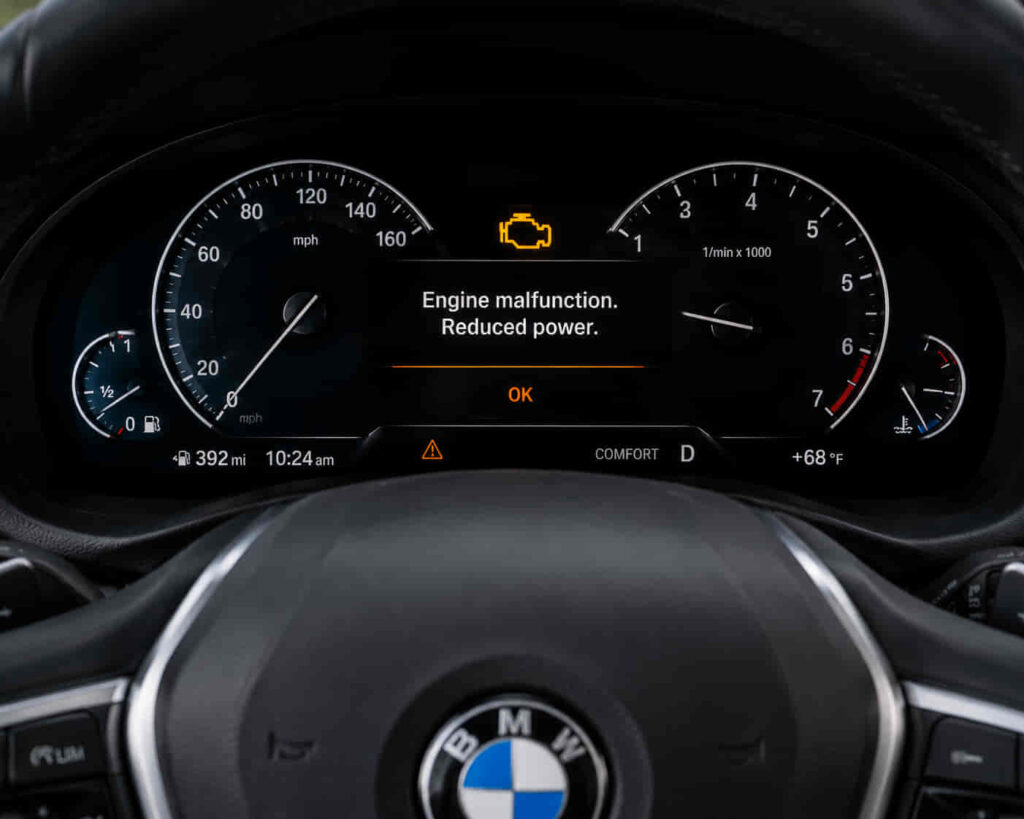
BMW Engine Malfunction Reduced Power means the vehicle has detected an abnormal engine operating condition and has limited engine output to protect important components. This warning appears when the engine control system identifies a condition that could affect normal performance, reliability, or emissions operation.
The reduced power mode is a protection strategy controlled by the BMW engine management system. When the Digital Motor Electronics (DME) detects incorrect operating values, unstable signals, or conditions outside the expected range, it can reduce available power to prevent further stress on the engine and related systems.
A common misunderstanding is that the BMW Engine Malfunction Reduced Power warning automatically means the engine is severely damaged. The warning does not identify one failed component. Instead, it indicates that the vehicle has detected a condition affecting engine operation and has adjusted performance as a protective response.
Several different systems can create the same warning message. Ignition faults, fuel delivery problems, turbocharger issues, throttle control problems, sensor failures, low voltage conditions, and electronic communication problems can all affect how the engine produces power.
The correct diagnostic approach starts by understanding the difference between the warning message and the actual cause. The warning shows that the engine management system has entered a protective state, while stored fault codes and system testing reveal which component or condition triggered the response.
This guide explains the 7 common causes of BMW Engine Malfunction Reduced Power, why the vehicle limits performance, how to diagnose the problem correctly, and why resetting the warning alone does not repair the underlying issue.
Can Ignition Problems Cause BMW Engine Malfunction Reduced Power?
Ignition system faults can cause a BMW Engine Malfunction Reduced Power warning because they prevent the engine from producing consistent combustion and expected power output. The BMW engine management system continuously monitors combustion quality, and when ignition performance becomes unstable, the DME can reduce engine power to protect the drivetrain and maintain controlled operation.
The ignition system is responsible for creating the spark required to ignite the air-fuel mixture inside each cylinder. Components such as ignition coils and spark plugs directly influence combustion efficiency. When a spark plug becomes worn or an ignition coil begins to fail, the engine may experience incomplete combustion, misfires, rough operation, or inconsistent torque production.
The connection between ignition faults and reduced power comes from the way BMW manages engine protection. The DME calculates expected engine performance based on sensor inputs and operating conditions. If combustion becomes unreliable, the system may detect that the engine cannot safely deliver normal output and activate a reduced power strategy.
This is why a BMW reduced power warning does not automatically mean that the turbocharger, transmission, or major engine components have failed. A relatively small ignition-related issue can create a significant performance limitation because the engine cannot maintain stable power delivery.
Diagnosing ignition-related reduced power requires identifying the source of the combustion problem rather than replacing parts based only on symptoms. Fault codes, misfire information, ignition system testing, and engine operating data help determine whether the issue comes from spark generation, fuel delivery, air supply, or another related system.
Can Fuel System Problems Cause BMW Engine Malfunction Reduced Power?
Fuel system problems can trigger a BMW Engine Malfunction Reduced Power warning when the engine cannot receive the correct fuel supply needed for stable combustion and power production. The BMW engine control system depends on precise fuel management, and any significant deviation can cause the DME to limit engine output.
The fuel system must maintain the correct relationship between fuel delivery and incoming air. Components such as fuel pumps, fuel injectors, and fuel pressure control systems work together to ensure that the engine receives the required amount of fuel under different driving conditions. When fuel pressure or delivery becomes inconsistent, engine performance can decrease and the vehicle may activate reduced power mode.
A fuel-related reduced power warning does not automatically identify one failed component. For example, poor engine performance can result from insufficient fuel pressure, injector problems, incorrect fuel mixture calculations, or another condition affecting combustion efficiency.
The reason BMW reduces power in these situations is to protect engine operation. Running under incorrect fuel conditions can create unstable combustion, increased emissions, or additional stress on engine components. The DME responds by limiting output until the abnormal condition is corrected.
A proper diagnosis of fuel-related BMW reduced power requires analyzing fault codes, fuel system data, and engine behavior together. Replacing fuel components without confirming the cause can result in unnecessary repairs while leaving the actual problem unresolved.
Read more: BMW X3 Drivetrain Malfunction
Can Turbocharger or Boost Problems Cause BMW Engine Malfunction Reduced Power?
Turbocharger and boost-control problems can cause a BMW Engine Malfunction Reduced Power warning when the engine cannot achieve the expected airflow or boost pressure required for normal power production. Turbocharged BMW engines rely on precise air management, and the engine control system continuously compares requested performance with actual operating conditions.
The turbocharger increases engine output by forcing additional air into the combustion process. The DME monitors boost pressure, airflow measurements, and related sensor signals to ensure that the turbo system operates within the expected range. When the measured values do not match the calculated requirements, the system can reduce engine power to prevent inefficient or potentially harmful operation.
A boost-related reduced power warning does not automatically mean the turbocharger itself has failed. The issue may involve several parts of the air-management system, including boost leaks, pressure sensors, control valves, intake-related problems, or electronic regulation issues. The warning identifies that engine output is not meeting expectations, but it does not identify one specific failed component.
This distinction is important because replacing a turbocharger based only on a reduced power message can result in unnecessary repairs. A complete diagnosis should confirm whether the problem comes from the turbocharger assembly, a supporting component, incorrect sensor information, or another engine-management condition.
Diagnosing turbocharger-related BMW reduced power requires analyzing fault codes, boost pressure data, airflow measurements, and the physical condition of the related components. The correct repair depends on identifying why the engine is not achieving the expected air and power output.
Can Throttle Body or Accelerator Pedal Problems Cause BMW Engine Malfunction Reduced Power?
Throttle body and accelerator pedal control problems can trigger BMW Engine Malfunction Reduced Power because modern BMW engines rely on electronic throttle management to control engine output. Unlike older mechanical throttle systems, BMW uses electronic signals to determine driver input and adjust airflow into the engine.
The throttle system works through communication between the accelerator pedal sensor, engine control module, and electronic throttle body. When the driver presses the accelerator, the system evaluates the request, calculates the required engine response, and adjusts throttle opening accordingly.
If the DME detects an incorrect signal, inconsistent throttle operation, or a communication problem within this system, it may limit engine power as a protective measure. Reducing power allows the vehicle to maintain controlled operation when the engine management system cannot accurately determine or control throttle behavior.
A throttle-related reduced power warning does not always mean the throttle body itself has failed. Problems with electrical connections, sensors, wiring, software communication, or related control signals can create similar symptoms. The system must be tested before replacing expensive components.
Proper diagnosis requires evaluating accelerator input signals, throttle operation, stored fault codes, and related engine data. Understanding the complete electronic throttle system prevents replacing parts based only on the warning message.
Can Sensor Problems Cause BMW Engine Malfunction Reduced Power?
Sensor problems can cause a BMW Engine Malfunction Reduced Power warning when the engine control system receives inaccurate or inconsistent information about engine operation. Modern BMW engines depend on multiple sensors to calculate fuel delivery, airflow, ignition timing, boost control, and overall engine performance.
The DME uses sensor data to determine how the engine should operate under different driving conditions. Sensors related to airflow, pressure, temperature, oxygen levels, and engine position provide continuous feedback that allows the control system to make precise adjustments. When one of these signals becomes unreliable, the DME may not be able to control engine operation accurately.
A sensor-related reduced power warning does not automatically mean the sensor itself has failed. The same diagnostic condition can be caused by wiring problems, damaged connectors, electrical interference, incorrect voltage supply, or another component affecting the measured system. This is why replacing a sensor immediately after seeing a fault code can lead to unnecessary repairs.
The reason BMW reduces power in response to incorrect sensor information is protection. If the engine control system cannot accurately determine important operating conditions, limiting output helps prevent inefficient combustion or excessive stress on related components.
Diagnosing sensor-related BMW reduced power requires comparing fault codes with live operating data and testing the affected system. The goal is to identify whether the sensor is the actual cause or simply reporting a problem created by another component.
Can a Weak BMW Battery Cause Engine Malfunction Reduced Power?
Low battery voltage or unstable electrical supply can contribute to BMW Engine Malfunction Reduced Power warnings because modern BMW engine systems depend on reliable electrical communication between multiple control modules. The engine management system requires stable voltage to process sensor signals, control components, and maintain communication between electronic systems.
BMW vehicles use complex electronic networks that connect the DME with other modules responsible for engine operation and vehicle control. When voltage drops below expected levels, modules may produce incorrect readings, communication errors, or temporary faults that affect engine management.
A weak battery does not always mean the battery is the direct cause of the reduced power warning. Charging system problems, poor electrical connections, voltage fluctuations, or other power-related issues can create similar symptoms. This is why replacing the battery without confirming the electrical condition may not solve the problem.
The relationship between battery condition and reduced power comes from system reliability. The engine control system needs consistent electrical power to correctly interpret information and operate components such as sensors, throttle systems, and ignition controls.
A BMW Engine Malfunction Reduced Power warning related to voltage issues requires checking battery condition, charging performance, stored fault information, and electrical communication. Proper electrical diagnosis prevents unnecessary replacement of engine components when the real issue is unstable power supply.
Can Software or ECU Problems Cause BMW Engine Malfunction Reduced Power?
Software, ECU, or communication problems can cause a BMW Engine Malfunction Reduced Power warning when the engine control system cannot correctly process information or coordinate related vehicle systems. Modern BMW engines rely on continuous communication between electronic control modules, and any interruption in this communication can affect how the vehicle manages engine performance.
The Digital Motor Electronics (DME) acts as the central control system for engine operation. It receives information from sensors, processes operating conditions, and controls components responsible for fuel delivery, airflow, ignition, and power output. If the DME detects inconsistent data, communication errors, or a system condition outside expected parameters, it may activate reduced power mode.
A software-related reduced power warning does not automatically mean that the ECU itself has failed. The issue may involve outdated software, communication interruptions between modules, incorrect sensor information, or another system creating inconsistent operating data. Proper diagnosis is required before considering replacement of expensive electronic components.
The purpose of reduced power mode is protection. When the control system cannot confidently manage engine operation, limiting performance allows the vehicle to continue operating under controlled conditions while preventing additional stress on affected systems.
Diagnosing software or ECU-related BMW reduced power problems requires retrieving fault codes, identifying the affected control module, and verifying communication between related systems. The warning message provides the direction for diagnosis, while detailed fault information determines the actual repair path.
Can You Drive a BMW With Engine Malfunction Reduced Power?
You may be able to drive a BMW with Engine Malfunction Reduced Power for a limited distance, but the decision depends on the severity of the warning, vehicle behavior, and the underlying cause. The reduced power mode is designed to allow controlled operation while protecting the engine and related components, but it does not mean the vehicle can be driven normally without diagnosis.
Some BMW reduced power situations occur with limited acceleration but otherwise normal engine operation. Other cases involve serious symptoms such as rough running, severe shaking, unusual noises, overheating, smoke, or rapidly decreasing performance. These symptoms indicate that the vehicle requires more immediate attention.
The important distinction is that the warning message describes a protection state, not the exact level of mechanical damage. A sensor-related issue and a serious engine problem can both create a reduced power message, but the risks and repair requirements are different.
Continuing to drive without understanding the cause can allow a smaller issue to become a larger repair. For example, an unresolved misfire can create additional stress on emissions components, while a boost-control problem can affect engine performance and efficiency.
A BMW Engine Malfunction Reduced Power warning should be treated as a signal to diagnose the vehicle rather than simply continue driving until the problem becomes worse. The stored fault information and vehicle symptoms determine how urgently the issue needs attention.
How Do You Diagnose BMW Engine Malfunction Reduced Power?
BMW Engine Malfunction Reduced Power diagnosis begins by retrieving stored Diagnostic Trouble Codes (DTCs) and identifying which engine system caused the reduced power strategy to activate. The warning message alone does not identify the failed component, so proper diagnosis requires connecting the message with detailed vehicle data.
The diagnostic process starts with scanning the vehicle and reviewing stored fault information from the relevant control modules. The technician then evaluates whether the fault relates to ignition, fuel delivery, airflow, throttle control, sensors, voltage supply, or electronic communication.
A common diagnostic mistake is replacing components based only on symptoms. For example, a reduced power warning may appear similar whether the cause is a failing ignition coil, incorrect sensor data, boost-control problem, or electrical instability. The correct repair depends on identifying the system that created the abnormal condition.
BMW-specific diagnostic tools can provide deeper access to control modules and operating data compared with basic generic scanners. This information helps determine whether the issue is mechanical, electrical, software-related, or caused by communication between systems.
The correct diagnostic sequence is: retrieve fault codes → identify affected system → test possible causes → repair the root problem → verify normal operation. This approach prevents unnecessary parts replacement and ensures the reduced power warning is properly resolved.
Does Resetting BMW Engine Malfunction Reduced Power Fix the Problem?
Resetting the BMW Engine Malfunction Reduced Power warning does not repair the condition that caused the vehicle to limit power. Clearing the warning only changes the stored diagnostic status, while the underlying mechanical, electrical, or software issue may still exist.
When the DME detects an abnormal condition, it activates reduced power mode as a protective response. If the original cause remains after the reset, the vehicle can detect the same condition again and reactivate the warning.
For example, resetting a reduced power warning caused by a misfire will not correct a failing ignition coil or fuel problem. Similarly, clearing a warning caused by incorrect boost pressure will not repair a turbocharger control issue or air leak.
Resetting can be useful after the repair process has been completed because it allows the vehicle to verify that the original fault no longer exists. However, using reset as the first step only removes the symptom temporarily.
BMW Engine Malfunction Reduced Power should be diagnosed and repaired before resetting the warning. The goal is not only to remove the message but to confirm that the engine management system is operating correctly.
Why Does BMW Reduced Power Warning Keep Coming Back?
A BMW Reduced Power warning that repeatedly returns usually means the original fault condition has not been completely resolved or another related problem remains active. The returning warning provides additional diagnostic information because it confirms that the engine management system is still detecting abnormal operation.
A recurring warning can happen when a repair addresses only the symptom instead of the root cause. For example, clearing a fault code without correcting the ignition, fuel, airflow, or sensor problem allows the DME to detect the same condition again during normal operation.
Repeated warnings can also occur when multiple related faults exist. A sensor problem may affect another system, or an electrical issue may create several unrelated-looking fault codes at the same time. This is why reading only one code without understanding the complete system relationship can lead to incorrect repairs.
The correct response to a returning warning is additional diagnosis rather than repeated resets. The fault history, current symptoms, and previous repair attempts should be evaluated together.
A BMW Reduced Power warning that returns is evidence that the vehicle still detects a condition requiring attention. Finding the root cause is the only way to restore full engine performance.
Is BMW Engine Malfunction Reduced Power Expensive to Repair?
The repair cost for BMW Engine Malfunction Reduced Power depends on the system causing the warning and the component that requires repair. The warning itself does not determine repair complexity because it can result from simple electrical issues, sensor problems, or more involved engine-management conditions.
A fault caused by an ignition component may require a different repair approach from a turbocharger control problem, fuel system issue, or electronic module communication fault. This is why diagnosis must come before estimating repair requirements.
Replacing expensive components without confirming the cause can create unnecessary costs. The reduced power message indicates that the vehicle has entered a protection mode, but it does not identify which part needs replacement.
The most efficient repair process focuses on identifying the failed system first. Once the cause is confirmed, the correct repair can be performed without replacing unrelated components.
BMW Engine Malfunction Reduced Power repair costs are determined by diagnosis, not by the warning message alone. Accurate fault identification is the key factor in avoiding unnecessary repairs.
When Should BMW Engine Malfunction Reduced Power Be Diagnosed Professionally?
Professional diagnosis is recommended when a BMW Engine Malfunction Reduced Power warning appears with severe symptoms, returns after clearing, or cannot be explained through basic checks. Because the warning can involve multiple engine systems, accurate diagnosis requires more than simply reading the message.
Professional evaluation is especially important when the vehicle experiences significant power loss, rough operation, multiple stored fault codes, unusual noises, or repeated reduced power activation. These situations indicate that the engine management system continues detecting a condition that requires deeper analysis.
A complete diagnostic approach connects the warning message with stored DTCs, vehicle symptoms, system testing, and repair verification.
The correct process is:
warning appears → retrieve fault codes → identify affected system → confirm root cause → repair → verify operation
BMW Engine Malfunction Reduced Power is a protective system response, not a final diagnosis. Understanding the relationship between ECU protection, engine systems, and fault diagnosis allows the correct repair path to be identified.