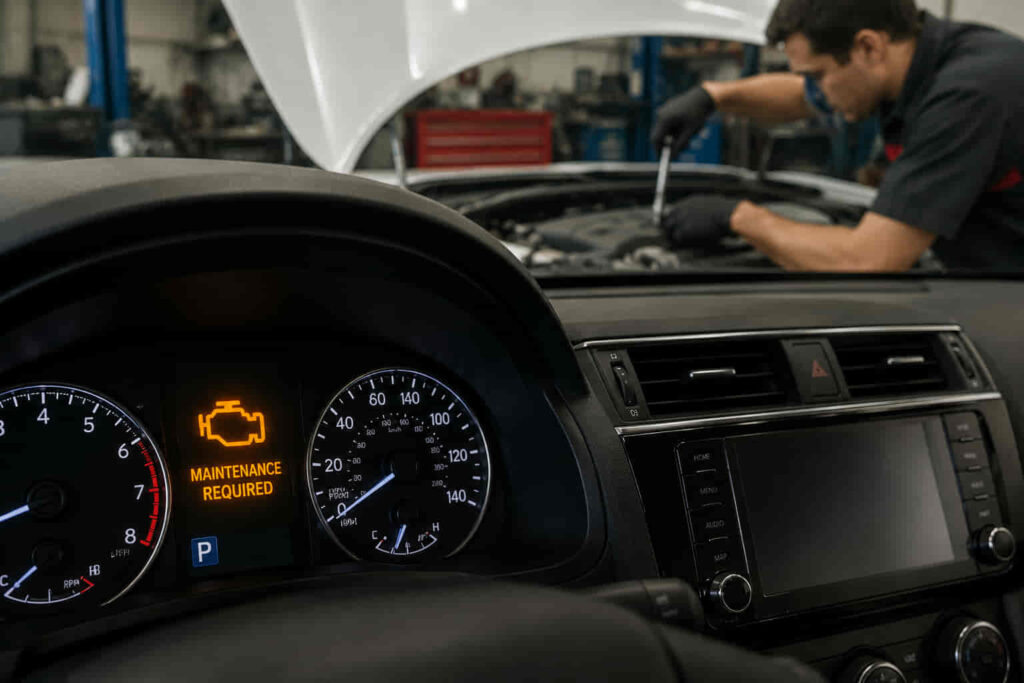
The Toyota Engine Maintenance Required warning indicates that the vehicle has detected an engine-related condition that requires inspection or service. It should not automatically be treated as the standard Maintenance Required reminder, which is associated with scheduled maintenance. The exact reason for the message depends on the Toyota model, model year, diagnostic trouble codes, and the condition of the components monitored by the vehicle’s control systems.
There are 7 potential cause categories worth investigating when an Engine Maintenance Required message appears, including faults involving engine thermal management components, coolant control, electrical wiring, connectors, sensors, control circuits, and unresolved engine-related conditions. A coolant bypass valve problem is particularly relevant on certain Toyota applications, but the dashboard message alone does not prove that the valve has failed. The underlying cause should be confirmed through vehicle-specific diagnosis before parts are replaced.
This guide explains 7 causes of the Toyota Engine Maintenance Required warning, how the warning differs from other Toyota maintenance messages, whether the vehicle can still be driven, and how the problem should be diagnosed and repaired. It also explains repair costs and warning clearance so that resetting the message is not confused with correcting the fault that caused it.
What Does Engine Maintenance Required Mean on a Toyota?
The Toyota Engine Maintenance Required message means the vehicle has identified an engine-related condition that requires inspection or service. It is different from treating every maintenance notification as a routine mileage reminder. The message identifies the need for further attention, but its wording alone does not identify the failed component or establish which repair is required.
The underlying problem must therefore be determined from the vehicle’s model, model year, symptoms, diagnostic trouble codes, and component testing. A dashboard message is the visible result of a monitoring process: a control system detects an operating condition outside its expected range, records diagnostic information when applicable, and alerts the driver that attention is required. Diagnosis connects that warning back to the system or component responsible for the abnormal condition.
This distinction is important because replacing a commonly associated component without diagnosis can result in an unnecessary repair. A coolant-related component may be responsible on an applicable Toyota, while another vehicle can require inspection of a circuit, connector, wiring, or another monitored condition. The Engine Maintenance Required message should therefore be treated as the beginning of the diagnostic process rather than as a diagnosis by itself.
What Are the 7 Causes of Toyota Engine Maintenance Required Warning?
There are 7 potential cause categories to investigate when a Toyota displays an Engine Maintenance Required warning: coolant bypass valve faults, coolant flow-control problems, damaged wiring, connector faults, broader engine cooling-system problems, sensor or control-circuit faults, and an underlying engine-related condition that remains unresolved. These categories describe diagnostic paths rather than seven components that should automatically be replaced whenever the message appears.
The exact cause is vehicle-specific because Toyota uses different engine, cooling, electrical, and control configurations across models and model years. Two Toyota vehicles displaying similar dashboard wording can therefore require different diagnostic procedures. The warning must be interpreted together with stored diagnostic information and the physical condition of the relevant system.
The relationship between these causes is also important. A control module may detect an abnormal electrical value associated with a coolant-control component, but that does not automatically prove that the component itself has mechanically failed. The same abnormal condition can originate in the component, its connector, the wiring between components, or another part of the circuit. Identifying the root cause requires separating the detected symptom from the part responsible for producing it.
Can a Faulty Engine Coolant Bypass Valve Trigger Engine Maintenance Required?
A faulty engine coolant bypass valve can trigger an Engine Maintenance Required message on applicable Toyota models when the vehicle detects that the valve or its control circuit is not operating as expected. The valve forms part of the engine’s thermal-management system, so its operation affects how coolant is directed through relevant portions of the cooling system under different operating conditions.
A failure can become detectable when the commanded valve operation and the monitored response no longer agree. Depending on the vehicle and type of failure, diagnosis may involve stored trouble codes and electrical or functional testing of the valve circuit. This is why the coolant bypass valve has become strongly associated with the Engine Maintenance Required message on certain Toyota applications.
The association does not mean every Toyota displaying the message needs a new coolant bypass valve. A technician must determine whether the valve has failed mechanically or electrically and whether its wiring and connector are functioning correctly. Replacing the valve based only on dashboard wording skips the diagnostic step required to distinguish a defective valve from a fault elsewhere in the circuit.
Can a Coolant Flow Control Problem Cause Engine Maintenance Required?
A coolant flow-control problem can contribute to an Engine Maintenance Required warning when an applicable Toyota detects abnormal operation within its engine thermal-management system. Controlled coolant movement helps the engine and related systems operate within intended temperature ranges, so a fault that prevents the system from controlling coolant as designed can create a condition that requires diagnosis.
The important distinction is between coolant flow as a system function and the specific component responsible for a failure. An abnormal flow-control condition does not prove that the vehicle has low coolant, an overheating engine, or a defective bypass valve. The cause can depend on the system architecture and the diagnostic information stored by the vehicle. Treating all coolant-related conditions as the same failure would combine separate mechanical and electrical relationships into one diagnosis.
Diagnosis should therefore establish what the control system commanded, what response it detected, and which component or circuit prevented the expected result. This approach connects the dashboard warning to a verified root cause rather than replacing parts according to the most common explanation found for another Toyota model or model year.
Read more: Toyota RAV4 Trim Packages
Can Damaged Wiring Trigger Toyota Engine Maintenance Required?
Damaged wiring can contribute to a Toyota Engine Maintenance Required warning when an electrical fault prevents an engine-related component or control circuit from operating within its expected range. The vehicle’s control system relies on electrical paths to supply power, provide ground connections, transmit commands, and return sensor information. A damaged circuit can therefore create an abnormal reading even when the component connected to that circuit has not mechanically failed.
Wiring faults can develop when a wire becomes damaged, chafed, pinched, exposed, or electrically discontinuous. Increased resistance or an open or short circuit can change the voltage or signal received by a control module. If the affected circuit controls or monitors a component associated with engine thermal management, the resulting electrical abnormality can be interpreted as a system malfunction and contribute to an engine-related maintenance message on applicable Toyota vehicles.
This relationship explains why a diagnostic trouble code associated with a component does not always prove that the component itself needs replacement. A coolant-control valve, for example, may receive an incorrect electrical supply or fail to communicate its expected state because the wiring between the valve and control circuit is compromised. Replacing the valve without testing the circuit can leave the original fault unchanged and allow the warning to return.
Diagnosis should establish electrical continuity and circuit condition before a wiring-related cause is confirmed. The appropriate tests depend on the Toyota model, model year, circuit design, and diagnostic information stored by the vehicle. The objective is to determine whether the abnormal condition originates inside the component or along the electrical path that allows the component and control system to function together.
Can a Loose or Corroded Electrical Connector Cause the Warning?
A loose, damaged, or corroded electrical connector can contribute to an Engine Maintenance Required warning when poor electrical contact disrupts a monitored engine-related circuit. Connectors form the physical interface between wiring and components, so a connection problem can interrupt power, ground, command signals, or feedback information without requiring either the wiring harness or connected component to fail completely.
Connector problems can produce intermittent faults because electrical contact may change with vibration, temperature, moisture, or movement of the wiring harness. A terminal that does not maintain adequate contact can increase electrical resistance or interrupt the circuit temporarily. The control system can then receive a value that differs from the expected operating state and record diagnostic information associated with the affected circuit.
Corrosion creates a similar problem by degrading the conductive surfaces within a connection. Moisture intrusion and terminal deterioration can increase resistance and interfere with current or signal transmission. In an engine-related control circuit, this means a correctly functioning component can appear faulty because the control module cannot reliably communicate with it or verify its operation.
Connector inspection is therefore relevant when diagnostic information points toward an electrical component or circuit. The connector condition, terminal fit, signs of moisture or corrosion, and associated wiring should be evaluated before concluding that the connected component has failed. This distinction prevents a circuit-level problem from being incorrectly diagnosed as a component-level failure.
Can an Engine Cooling System Fault Cause Engine Maintenance Required?
An engine cooling-system fault can contribute to an Engine Maintenance Required warning when an applicable Toyota detects abnormal operation in a monitored thermal-management function. The cooling system regulates engine temperature by circulating coolant through defined paths, and newer thermal-management systems can use electronically controlled components to alter that circulation according to operating conditions. A malfunction within this system can therefore produce an engine-related maintenance condition.
The cooling system should be treated as a network of related components rather than a single part. Coolant passages, control valves, electrical actuators, sensors, hoses, the radiator, thermostat-related functions, and other model-specific components can participate in maintaining the intended operating temperature. A fault in one part of this network can change coolant circulation or the information the control system receives about thermal conditions.
An Engine Maintenance Required message does not, however, establish that the engine is overheating. An electronically detected coolant-control fault and an actual high-temperature condition are different diagnostic states. Engine temperature, coolant condition, accompanying dashboard warnings, diagnostic trouble codes, and vehicle symptoms must be evaluated together before the severity and root cause can be established.
This distinction also affects whether the vehicle should continue to be driven. A maintenance message without abnormal temperature indications requires a different risk assessment from a vehicle displaying an overheating warning, rising coolant temperature, steam, coolant loss, or other evidence of a serious cooling-system problem. The dashboard message should therefore lead to diagnosis, while evidence of overheating requires more immediate attention to prevent engine damage.
Can a Sensor or Control Circuit Fault Trigger Toyota Engine Maintenance Required?
A sensor or control circuit fault can contribute to a Toyota Engine Maintenance Required warning when the vehicle receives information that falls outside the expected operating range for an engine-related system. Toyota control systems depend on sensor inputs and electrical feedback to determine whether monitored components are functioning correctly, so an inaccurate signal can indicate a fault even when the underlying mechanical system is still capable of operating.
The distinction between a sensor fault and a mechanical failure is important during diagnosis. A control module makes decisions from the electrical information available to it rather than by physically inspecting a component. If a sensor reports an implausible value, a circuit has excessive resistance, or a signal is interrupted, the module can detect a disagreement between the commanded operating state and the measured response. Diagnostic information can then point toward the affected system without proving which individual part caused the abnormal signal.
Control-circuit faults can also overlap with the wiring and connector problems discussed earlier. The circuit represents the complete electrical relationship between the control module, wiring, connectors, sensors, actuators, power supply, and grounds. A diagnostic result associated with a circuit therefore requires testing that relationship instead of automatically replacing the component named in a trouble-code description.
Sensor and control-circuit diagnosis must remain specific to the Toyota model, model year, engine configuration, and stored diagnostic information. The Engine Maintenance Required message alone does not identify a particular sensor as defective. Confirming the fault requires determining which monitored value is abnormal and then testing the relevant circuit and component against the applicable vehicle specifications.
Can an Unresolved Engine-Related Fault Keep the Warning On?
An unresolved engine-related fault can keep the Toyota Engine Maintenance Required warning active or cause it to return after the message has been cleared. Clearing a dashboard message removes the visible indication or stored diagnostic information under applicable conditions, but it does not repair the mechanical or electrical condition that caused the vehicle to detect the problem.
This distinction explains why resetting the warning should not be the first repair step. If a coolant-control component cannot reach its commanded position, a connector continues to make poor contact, or damaged wiring still produces an abnormal electrical value, the vehicle can detect the same condition again during subsequent operation. The control system responds to the underlying condition rather than whether the driver previously cleared the message.
An incomplete repair can produce the same result. Replacing a component will not permanently correct a warning if the actual root cause is a damaged connector or wiring circuit. Likewise, repairing an electrical connection will not resolve the condition when the connected component itself has failed. Effective repair requires identifying the failure point, correcting it, and verifying that the monitored system operates normally afterward.
A warning that returns after repair therefore requires further diagnosis rather than repeated clearing. The repair should be verified against the original diagnostic findings, and related circuits or components should be examined when the initial correction did not eliminate the detected condition. This cause-and-effect sequence separates temporary warning clearance from an actual repair.
Is Toyota Engine Maintenance Required the Same as Maintenance Required?
Toyota Engine Maintenance Required should not automatically be treated as the same message as the standard Maintenance Required reminder. The two phrases describe different maintenance contexts: an Engine Maintenance Required message directs attention toward an engine-related condition requiring evaluation, while a routine Maintenance Required reminder is associated with scheduled vehicle maintenance.
The difference changes the appropriate response. A scheduled maintenance reminder is generally tied to a maintenance interval and indicates that routine service is due. An engine-related warning requires the underlying condition to be identified before the correct repair can be determined. Resetting a scheduled maintenance reminder after completing the required service is therefore conceptually different from clearing an engine-related message without correcting its cause.
The wording displayed by the vehicle should be checked carefully before diagnosis begins. Searching for a procedure to reset “Maintenance Required” when the dashboard actually displays “Engine Maintenance Required” can lead the owner toward a routine reminder reset procedure that does not address the engine-related condition. Model and model-year differences also matter because Toyota does not use identical instrument displays and warning strategies across every vehicle.
This semantic distinction is particularly important during online troubleshooting. “Maintenance Required,” “Engine Maintenance Required,” and “Check Engine” are closely related search terms, but they should not be used interchangeably. Identifying the exact dashboard wording keeps the diagnostic process connected to the correct vehicle system and prevents a routine service reminder from being confused with a fault that requires inspection.
Is Engine Maintenance Required the Same as the Check Engine Light?
The Engine Maintenance Required message should not be treated as another name for the Check Engine Light. A Check Engine Light, also called the Malfunction Indicator Lamp, is a specific dashboard indicator associated with the vehicle’s onboard diagnostic system, while Engine Maintenance Required is a displayed maintenance or warning message. Their presence can provide different information even when both direct attention toward an engine-related condition.
The distinction matters because the driver should record every indicator and message that appears rather than reducing them to a single warning. If an Engine Maintenance Required message appears together with a Check Engine Light, diagnostic scanning can provide information associated with the illuminated Malfunction Indicator Lamp and help identify the system requiring testing. If only a maintenance message is displayed, the diagnostic approach should still begin with the exact vehicle, warning wording, symptoms, and available diagnostic information.
Neither warning should be used by itself to identify a failed component. The Check Engine Light can correspond to numerous diagnostic conditions, while an Engine Maintenance Required message does not establish one universal Toyota failure. The useful diagnostic relationship is warning or indicator, stored information, affected system, testing, and confirmed root cause.
Correctly separating these dashboard signals also prevents an inaccurate repair sequence. Resetting a maintenance reminder, clearing diagnostic information, and repairing a detected engine fault are three different actions. The appropriate action depends on what the Toyota is actually displaying and why the vehicle generated that warning or indicator.
Can You Drive With Toyota Engine Maintenance Required Showing?
You may be able to drive a Toyota displaying Engine Maintenance Required for a limited distance when the vehicle operates normally and no signs of overheating or another serious malfunction are present, but the warning should still be diagnosed promptly. The message alone does not establish the severity of the underlying problem, so the decision to continue driving must account for engine temperature, additional warning lights, drivability changes, coolant loss, unusual noises, and other symptoms.
A vehicle that displays the message while maintaining normal engine temperature and normal driving behavior presents a different situation from one showing evidence of an active cooling-system failure. A coolant-control or electrical fault can require repair without immediately making the vehicle undrivable. However, continued operation becomes more concerning when the fault interferes with engine temperature regulation because excessive heat can damage engine components if the cooling system can no longer maintain the intended operating range.
Stop driving when the warning is accompanied by clear evidence of overheating or another condition that makes continued operation unsafe. An abnormal temperature indication, steam from the engine compartment, significant coolant loss, severe loss of engine performance, or another critical warning changes the situation from routine diagnosis to immediate fault assessment. Continuing to drive an overheating engine can turn a repair involving a cooling-system component into substantially more extensive engine damage.
The safest response is therefore based on the vehicle’s actual condition rather than the Engine Maintenance Required wording alone. A Toyota that continues to operate normally should still be inspected because an unresolved fault can remain active or become more severe. A vehicle showing abnormal temperature or serious drivability symptoms should not be treated as safe simply because the dashboard uses the word “maintenance.”
How Do You Diagnose Toyota Engine Maintenance Required?
Diagnosing Toyota Engine Maintenance Required begins by confirming the exact dashboard message, Toyota model, model year, engine configuration, accompanying warning lights, and current vehicle symptoms. These details establish the diagnostic context before any component is tested or replaced. The same dashboard wording should not be assumed to identify the same failed part across every Toyota vehicle.
Diagnostic information should then be retrieved from the vehicle when applicable. Stored diagnostic trouble codes can identify the system or circuit in which the control module detected an abnormal condition. A code associated with a coolant-control component, for example, provides a direction for testing, but it does not by itself prove that the named component has failed. The fault can exist in the component, connector, wiring, power or ground path, or another related portion of the circuit.
Physical and electrical inspection narrows that diagnostic path. When the stored information points toward an electronically controlled coolant component, diagnosis can include examining the connector and wiring for damage, checking the integrity of the electrical circuit, and testing whether the component responds as expected. Cooling-system condition and relevant engine-temperature information should also be evaluated when the detected fault involves thermal management.
The final diagnostic step is to connect the detected condition to a confirmed root cause. Replacing a component should follow evidence that the component is responsible rather than precede testing. This distinction is particularly important for Engine Maintenance Required because owners can encounter online advice that associates the message with one frequently reported component and assumes the same repair applies to every vehicle.
Diagnosis should also continue when previous repairs have failed to prevent the warning from returning. A recurring message can indicate that the original cause was not corrected, that another part of the circuit remains faulty, or that repair verification was incomplete. Rechecking the original diagnostic information and testing the complete affected system is more useful than repeatedly clearing the message.
How Do You Fix Toyota Engine Maintenance Required?
Fix Toyota Engine Maintenance Required by repairing the confirmed mechanical or electrical fault that caused the vehicle to generate the message, then verifying normal system operation before clearing the warning. There is no single repair that applies to every Toyota displaying this message because the correct fix depends on the model, model year, diagnostic findings, and failed system.
A confirmed coolant bypass valve failure requires correction of the valve-related fault rather than simply resetting the dashboard message. If testing instead identifies damaged wiring, the repair must restore the affected electrical path. A loose, damaged, or corroded connector requires correction of the connection problem, while a verified sensor or control-circuit fault requires repair of the specific component or circuit responsible for the abnormal signal. The repair must correspond to the diagnosed cause.
This cause-specific approach prevents unnecessary parts replacement. A diagnostic trouble code that identifies abnormal operation in a valve circuit does not establish that installing a new valve will solve the problem. The new component can produce the same warning when damaged wiring, poor terminal contact, an inadequate power or ground connection, or another circuit problem remains unresolved.
Repair verification is the final part of the fix. After the underlying condition has been corrected, the affected system should operate within its expected parameters and the original diagnostic condition should no longer return. Diagnostic information can then be cleared according to the applicable repair procedure, followed by confirmation that the warning remains off during subsequent vehicle operation.
Resetting the Engine Maintenance Required message without repairing its cause is therefore not a complete fix. Clearing the warning changes what appears on the dashboard; repairing the fault changes the condition that caused the warning to appear. Maintaining this distinction is essential when troubleshooting an engine-related message instead of a routine scheduled-maintenance reminder.
How Much Does It Cost to Fix Toyota Engine Maintenance Required?
The cost to fix Toyota Engine Maintenance Required depends on the fault that triggered the warning rather than the warning message itself. There is no single repair price for this condition because diagnosis can identify a failed coolant-control component, damaged wiring, a poor electrical connection, a sensor or control-circuit problem, or another engine-related fault. The Toyota model, model year, labor rate, replacement part, and extent of the repair all affect the final cost.
Diagnostic cost should be separated from repair cost when evaluating the total expense. Diagnosis identifies which system generated the fault and determines whether the problem originates in a component or elsewhere in its circuit. This step can prevent a more expensive incorrect repair. Replacing a coolant-control valve, for example, adds parts and labor costs without solving the warning if testing would have shown that the actual problem was a damaged wire or poor terminal connection.
Labor requirements also change according to the failed component and its location. An accessible electrical connector can require substantially less work than a component whose replacement requires coolant draining, removal of surrounding parts, system refilling, and verification after installation. The same fault category can therefore produce different repair totals across Toyota models because component placement and service procedures are not identical.
A reliable repair estimate should consequently be based on the vehicle identification details and confirmed diagnosis. The estimate should identify the failed component or circuit, required parts, expected labor, and any additional procedures needed to restore normal operation. A generic price attached only to the words “Engine Maintenance Required” does not provide enough diagnostic context to predict the actual repair cost accurately.
How Do You Reset Toyota Engine Maintenance Required?
Reset Toyota Engine Maintenance Required only after the underlying engine-related condition has been diagnosed and corrected. Clearing the displayed warning without repairing the fault does not change the mechanical or electrical condition that caused the vehicle to detect a problem, and the message can return when the control system detects the same abnormal condition again.
The correct clearing procedure depends on the Toyota model, model year, warning type, and diagnostic condition involved. An engine-related fault associated with stored diagnostic information may require the relevant repair to be completed and diagnostic information to be cleared with appropriate service equipment. The system should then be checked to confirm that the original fault does not return during subsequent operation.
This procedure should not be confused with resetting Toyota’s routine Maintenance Required reminder. A scheduled maintenance reminder can generally be reset after the required maintenance has been completed because the reminder tracks a service interval. Engine Maintenance Required has a different diagnostic context, so following a routine maintenance-light reset procedure does not establish that an engine-related problem has been repaired.
A warning that returns after being cleared provides useful diagnostic information. Its recurrence indicates that the triggering condition may still exist, the initial repair may not have addressed the root cause, or another related circuit or component requires testing. Repeatedly clearing the message removes the symptom from the dashboard temporarily but does not provide evidence that the affected system is operating correctly.
Which Toyota Models Can Show Engine Maintenance Required?
Engine Maintenance Required can appear on applicable Toyota vehicles whose monitoring and display systems support the message, but the warning should be interpreted according to the specific model and model year rather than treated as a universal Toyota fault. Vehicle generations can use different engines, thermal-management components, electrical circuits, instrument displays, and diagnostic strategies even when owners report similar dashboard wording.
This model-specific context is especially important when researching coolant bypass valve problems. A repair that applies to a particular Toyota RAV4 configuration should not automatically be transferred to a Camry, Highlander, Corolla, or another Toyota solely because the dashboard message sounds similar. The same principle applies across different generations of one model because Toyota can revise components and control systems between model years.
The vehicle’s exact configuration should therefore be established before model-specific repair information is used. Model year, engine or powertrain configuration, diagnostic trouble codes, accompanying warning indicators, and symptoms provide stronger diagnostic context than the Toyota badge alone. These attributes determine whether a commonly discussed failure is actually relevant to the vehicle being inspected.
Model-specific information also creates a more accurate path for further troubleshooting. An owner of a RAV4 displaying Engine Maintenance Required needs diagnostic information applicable to that RAV4 generation and powertrain, while an owner of another Toyota requires the corresponding vehicle-specific procedure. Separating these contexts reduces the risk of replacing a component based on a repair reported for a different Toyota application.
How Can You Prevent Toyota Engine Maintenance Required From Returning?
Prevent Toyota Engine Maintenance Required from returning by correcting the confirmed root cause and verifying that the affected system operates normally after repair. Warning recurrence is most effectively prevented by resolving the mechanical or electrical condition that generated the message rather than repeatedly clearing diagnostic information.
Repair verification is particularly important for electrical faults. A replaced component will not provide a permanent solution when its connector has poor terminal contact or its wiring remains damaged. The same principle works in the opposite direction: repairing a connector will not solve the problem when testing confirms that the connected actuator, sensor, or coolant-control component has failed internally. The complete circuit must function as intended after the repair.
Cooling-system condition should also be evaluated when diagnosis identifies a thermal-management fault. Correct coolant level, absence of relevant leaks, proper operation of the repaired component, and normal engine-temperature behavior provide evidence that the system is functioning correctly. The exact checks depend on the Toyota model and repair procedure, so generic preventive maintenance should not replace vehicle-specific verification.
Future warnings should be investigated rather than automatically assumed to be a recurrence of the previous failure. A Toyota can develop a new fault after an earlier problem has been repaired successfully. Reading the current diagnostic information and comparing it with the original fault establishes whether the same condition has returned or a separate engine-related problem has developed.
The most effective prevention strategy is therefore diagnostic accuracy followed by complete repair verification. Scheduled maintenance remains important for overall vehicle condition, but routine service cannot guarantee that an electrical component, connector, sensor, or control circuit will never fail. Keeping the distinction between preventive maintenance and fault-specific repair prevents the Engine Maintenance Required warning from being reduced to a generic maintenance issue.