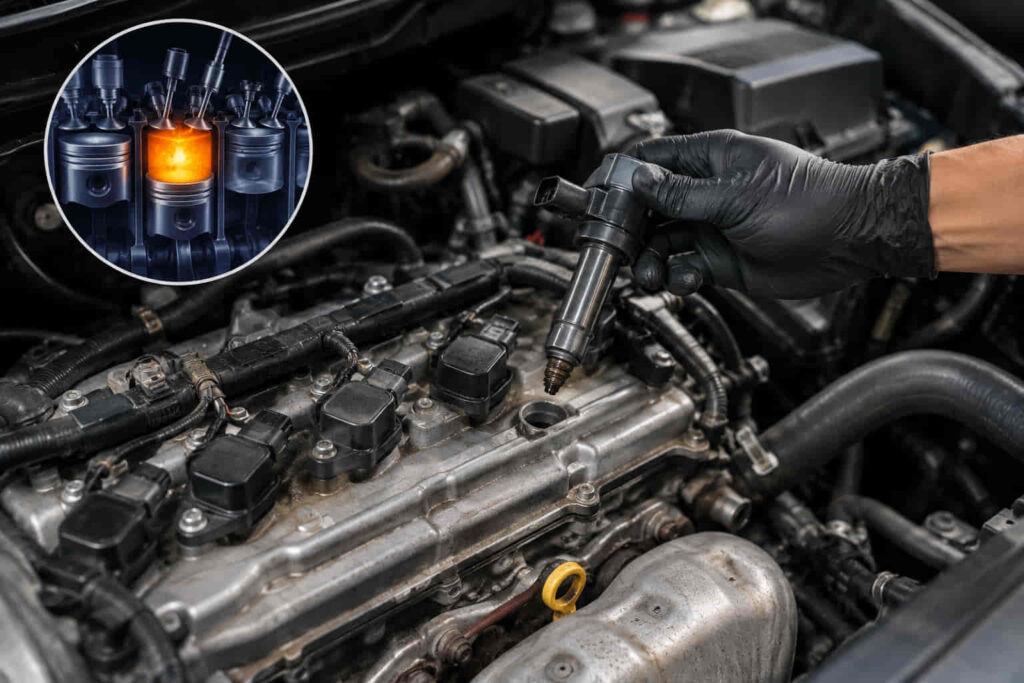
The Toyota P0304 code means Cylinder 4 Misfire Detected, indicating that the engine control system has identified abnormal combustion in the fourth cylinder. A properly operating cylinder requires the correct combination of air, fuel, ignition, and compression to produce consistent combustion. When cylinder 4 fails to contribute as expected, the engine control system can detect the resulting variation in engine operation and store the P0304 diagnostic trouble code.
There are 7 main cause categories to investigate when P0304 appears on a Toyota, including problems involving the spark plug, ignition coil, fuel injector, intake air, cylinder compression, internal engine components, and the electrical circuits controlling ignition or fuel delivery. However, P0304 identifies the cylinder experiencing the misfire, not the component that has failed. Replacing the cylinder 4 spark plug or ignition coil without testing can therefore leave the code unresolved when the actual cause is fuel delivery, an air leak, low compression, or an electrical fault.
This guide explains the 7 causes of Toyota P0304, the symptoms associated with a cylinder 4 misfire, how serious the code is, whether the vehicle can still be driven, and how to diagnose and fix the underlying problem. It also covers repair costs, related misfire codes, and the steps needed to prevent P0304 from returning after repair.
The Toyota P0304 code means Cylinder 4 Misfire Detected, indicating that the engine control system has identified abnormal combustion in the fourth cylinder. A properly operating cylinder requires the correct combination of air, fuel, ignition, and compression to produce consistent combustion. When cylinder 4 fails to contribute as expected, the engine control system can detect the resulting variation in engine operation and store the P0304 diagnostic trouble code.
There are 7 main cause categories to investigate when P0304 appears on a Toyota, including problems involving the spark plug, ignition coil, fuel injector, intake air, cylinder compression, internal engine components, and the electrical circuits controlling ignition or fuel delivery. However, P0304 identifies the cylinder experiencing the misfire, not the component that has failed. Replacing the cylinder 4 spark plug or ignition coil without testing can therefore leave the code unresolved when the actual cause is fuel delivery, an air leak, low compression, or an electrical fault.
This guide explains the 7 causes of Toyota P0304, the symptoms associated with a cylinder 4 misfire, how serious the code is, whether the vehicle can still be driven, and how to diagnose and fix the underlying problem. It also covers repair costs, related misfire codes, and the steps needed to prevent P0304 from returning after repair.
Read more: Toyota Engine Maintenance Required
What Does the P0304 Code Mean on a Toyota?
The P0304 code on a Toyota means Cylinder 4 Misfire Detected, which indicates that the engine control system has detected abnormal combustion in the fourth cylinder. P0304 is a cylinder-specific diagnostic trouble code: “P” identifies a powertrain-related code, while the final digit “4” identifies cylinder 4 as the location where the misfire was detected.
A gasoline engine requires the correct amount of air and fuel, sufficient compression, and a properly timed ignition event to produce stable combustion. Cylinder 4 can misfire when one of these requirements is missing or falls outside the range needed for consistent combustion. The resulting cylinder contributes less rotational force than expected, creating an operating variation that the engine management system can identify as a misfire.
P0304 identifies where the abnormal combustion is occurring, but it does not identify why it is occurring. A worn spark plug and failed ignition coil can both reduce or eliminate ignition in cylinder 4, while a restricted fuel injector can interfere with fuel delivery. An intake leak can alter the air-fuel mixture, and a mechanical problem can reduce compression. Electrical faults affecting the ignition coil or injector can produce the same cylinder-specific result without either component being mechanically defective.
The diagnostic distinction is therefore P0304 → cylinder 4 misfire → root-cause investigation. Treating P0304 as a direct instruction to replace a spark plug, ignition coil, or fuel injector skips the diagnostic relationship between the stored code and the component that actually caused the combustion failure.
What Are the Symptoms of Toyota P0304?
The symptoms of Toyota P0304 can include an illuminated or flashing Check Engine Light, rough idle, engine vibration, hesitation, reduced acceleration, uneven engine operation, increased fuel consumption, and difficulty maintaining smooth combustion under load. The exact symptoms depend on how frequently cylinder 4 misfires and how severely its combustion is disrupted.
Rough idle and vibration occur because the cylinders are no longer contributing evenly to engine rotation. In a four-cylinder engine, for example, losing consistent combustion from one cylinder represents a substantial reduction in the number of effective combustion events. The imbalance becomes especially noticeable at idle because engine speed is low and each individual cylinder contribution has a greater effect on smoothness.
Hesitation and reduced acceleration can appear when the misfire becomes more pronounced under load. Acceleration requires the engine to increase torque output, which increases the importance of reliable combustion in every cylinder. A weak ignition component that still operates during light-load conditions can fail to produce consistent combustion when cylinder pressure and engine load increase.
Fuel consumption can also increase because a misfiring cylinder does not convert the supplied air-fuel charge into useful mechanical work efficiently. The precise effect depends on the root cause and engine-management response, so poor fuel economy should be treated as a supporting symptom rather than proof of P0304.
A flashing Check Engine Light requires greater attention than a stored code with no severe drivability symptoms. Active misfiring can allow unburned fuel to enter the exhaust, increasing thermal stress on the catalytic converter. The severity of the warning behavior therefore provides diagnostic context in addition to the P0304 code itself.
What Are the 7 Causes of Toyota P0304?
The 7 main cause categories of Toyota P0304 are a defective spark plug, a failing ignition coil, a faulty fuel injector, a localized vacuum or intake leak, low cylinder compression, an internal valve or engine problem, and an electrical wiring or connector fault affecting cylinder 4. Each cause interferes with one or more requirements for stable combustion, but the correct cause must be confirmed through diagnosis rather than inferred from the P0304 code alone.
Ignition faults prevent the air-fuel mixture from being ignited reliably. This category primarily directs diagnosis toward the cylinder 4 spark plug, ignition coil, and their electrical circuits. Fuel-related faults create a different failure mechanism because the cylinder can have adequate spark and compression but still misfire when its injector does not deliver the required fuel.
Air and mechanical faults create additional diagnostic paths. A localized intake leak can produce a mixture that is too lean for stable combustion, while low compression prevents the cylinder from developing the pressure needed to convert combustion into normal engine output. Internal problems involving valve sealing or other cylinder components can produce that compression loss.
The seven causes should therefore be evaluated according to their relationship with cylinder 4 rather than treated as seven replacement recommendations. A part should be replaced only when testing connects its failure to the detected misfire.
Can a Bad Spark Plug Cause Toyota P0304?
A worn, fouled, damaged, or improperly functioning spark plug in cylinder 4 can cause Toyota P0304 by preventing reliable ignition of the compressed air-fuel mixture. The spark plug must produce an electrical discharge across its electrode gap at the correct point in the combustion cycle. When that spark becomes weak, inconsistent, or absent, cylinder 4 can fail to combust normally and the engine control system can detect the resulting misfire.
Spark plug condition affects ignition in several ways. Electrode wear can increase the voltage required to create a spark, while deposits can interfere with reliable discharge. Oil or excessive fuel contamination can foul the firing end, and physical damage can prevent the plug from operating correctly. The exact appearance of the plug can also provide diagnostic information about the conditions occurring inside cylinder 4.
Inspection should compare the cylinder 4 spark plug with the plugs from other cylinders when the engine configuration permits a meaningful comparison. A visibly abnormal plug can support the diagnosis, but replacement should still account for plug condition, service history, correct specification, ignition-coil operation, and whether another engine problem caused the plug to become contaminated.
A new spark plug will not permanently fix P0304 when the plug is only a symptom of another fault. For example, oil contamination caused by an underlying engine condition can foul a replacement plug again. Effective diagnosis therefore determines both whether the spark plug is failing and why its condition differs from normal when evidence points to another underlying problem.
Can a Bad Ignition Coil Cause Toyota P0304?
A failing ignition coil can cause Toyota P0304 when the coil serving cylinder 4 cannot provide the voltage required for the spark plug to ignite the air-fuel mixture consistently. On Toyota engines using individual coil-on-plug ignition, a fault isolated to one coil can create a cylinder-specific misfire while the remaining cylinders continue operating normally.
An ignition coil can fail completely or become weak enough to misfire only under particular operating conditions. A marginal coil may produce adequate ignition at idle or light load but become unreliable as engine load and cylinder pressure increase. This explains why some P0304 cases are accompanied by hesitation or misfiring during acceleration even when the engine appears relatively smooth under less demanding conditions.
A coil swap test can provide useful diagnostic evidence on compatible Toyota engines. Moving the suspected cylinder 4 ignition coil to another cylinder and then monitoring which misfire code returns can help determine whether the fault follows the coil. If the misfire moves from cylinder 4 to the cylinder receiving the suspected coil, the result provides stronger evidence that the coil itself is responsible. If P0304 remains at cylinder 4, diagnosis should continue rather than automatically replacing the coil.
The test must be interpreted together with spark plug condition, electrical connections, wiring, and other diagnostic information. A defective connector or circuit can prevent a correctly functioning coil from operating, producing a misfire that appears similar to an internal coil failure. The purpose of testing is therefore to isolate the failing part of the ignition path before selecting the repair.
Can a Faulty Fuel Injector Cause Toyota P0304?
A faulty fuel injector can cause Toyota P0304 when the injector serving cylinder 4 does not deliver the amount of fuel required for stable combustion. The cylinder needs an appropriate air-fuel mixture in addition to spark and compression, so an injector that is restricted, electrically inoperative, or operating incorrectly can cause cylinder 4 to misfire even when its spark plug and ignition coil function normally.
A restricted injector can reduce fuel delivery enough to create a lean combustion condition in cylinder 4. The cylinder may still fire during some combustion cycles but fail during others as engine speed, load, and fuel demand change. An injector with an electrical fault can create a more direct interruption because the injector may not receive or respond to the control signal required to open correctly.
A cylinder-specific injector problem should also be distinguished from a fuel-supply problem affecting the entire engine. Low fuel pressure or inadequate fuel delivery upstream of the injectors can affect multiple cylinders, while an injector problem isolated to cylinder 4 has a stronger causal relationship with a standalone P0304 code. Related trouble codes and misfire data can help determine whether diagnosis should remain focused on one cylinder or expand to the broader fuel system.
Injector diagnosis should confirm both electrical operation and fuel-delivery performance before replacement. A technician can evaluate the injector circuit, connector, operating response, and other available diagnostic information to determine whether the injector itself is responsible. Replacing the cylinder 4 injector without checking its circuit can leave P0304 unresolved when damaged wiring or poor electrical contact is actually preventing injector operation.
Can a Vacuum or Intake Leak Cause Toyota P0304?
A vacuum or intake leak can cause Toyota P0304 when unmetered air changes the air-fuel mixture reaching cylinder 4 enough to produce unstable combustion. This relationship is strongest when the leak is localized near the intake path supplying cylinder 4 because the additional air can affect that cylinder more severely than the others.
Stable gasoline combustion requires the engine management system to control the relationship between incoming air and delivered fuel. Air entering through an unintended path can create a mixture that contains more air relative to fuel than the control system intended. When the mixture in cylinder 4 becomes too lean to burn consistently, combustion energy decreases or the combustion event fails, allowing the engine control system to identify a cylinder-specific misfire.
Leak location provides important diagnostic context. A large vacuum leak affecting a shared section of the intake system can influence several cylinders and may produce additional lean-condition or multiple-cylinder misfire codes. A leak concentrated around an intake runner, manifold sealing area, or another path associated with cylinder 4 has a more direct relationship with an isolated P0304 condition.
Diagnosis should therefore determine whether an intake leak exists and whether its location can reasonably explain the cylinder 4 misfire. Fuel-trim information, related diagnostic trouble codes, inspection of the intake system, and an appropriate leak test can help establish that relationship. An intake leak should not be diagnosed from P0304 alone because ignition, injector, compression, and electrical faults can produce the same cylinder-specific code through different mechanisms.
Can Low Compression Cause Toyota P0304?
Low compression in cylinder 4 can cause Toyota P0304 because the cylinder requires sufficient pressure to produce stable and effective combustion. Spark and fuel can both be present, but cylinder 4 can continue to misfire when its mechanical condition prevents the air-fuel charge from being compressed adequately before ignition.
Compression depends on the cylinder sealing correctly during the compression and combustion portions of the engine cycle. The piston, piston rings, cylinder walls, intake and exhaust valves, cylinder head, and head gasket contribute to maintaining pressure within the combustion chamber. A sealing problem involving one of these areas can reduce cylinder pressure and decrease the amount of useful force produced when combustion occurs.
Low compression becomes particularly relevant when ignition and fuel tests do not explain a persistent P0304. Repeatedly replacing the spark plug, ignition coil, or injector will not correct a mechanical sealing problem. Comparing cylinder 4 compression with the other cylinders can establish whether its mechanical performance differs significantly enough to justify deeper engine testing.
A compression test can identify that cylinder 4 produces inadequate pressure, but it does not always identify the exact location of the pressure loss. A leak-down test can provide additional diagnostic information by introducing compressed air into the cylinder and determining where it escapes. Air leakage associated with the intake path can indicate an intake-valve sealing problem, while leakage through the exhaust path can point toward an exhaust-valve problem. Leakage into the crankcase can direct diagnosis toward piston, ring, or cylinder-wall sealing.
Mechanical diagnosis should therefore progress from confirming low compression to identifying why compression is low. This sequence prevents P0304 from being treated exclusively as an ignition problem and establishes whether the misfire originates from the physical condition of cylinder 4 rather than the components supplying spark or fuel.
Can a Valve or Internal Engine Problem Cause Toyota P0304?
A valve or internal engine problem can cause Toyota P0304 when mechanical damage prevents cylinder 4 from developing or retaining the pressure required for stable combustion. These faults become particularly relevant when cylinder 4 continues to misfire after the ignition system, fuel delivery, and intake path have been tested and no external cause explains the condition.
Intake and exhaust valves must seal the combustion chamber during the compression and combustion events. A valve that is burned, damaged, incorrectly seated, or otherwise unable to seal can allow cylinder pressure to escape. The spark plug may still fire and the injector may still deliver fuel, but the cylinder cannot convert that air-fuel charge into the expected combustion force when compression is inadequate.
Piston, piston-ring, and cylinder-wall problems can create a similar result through a different mechanical path. The piston rings help seal the space between the piston and cylinder wall so that compression remains inside the combustion chamber. Excessive leakage past that sealing surface reduces cylinder pressure and can produce a persistent misfire. These conditions should not be assumed from P0304 alone because they require mechanical testing to distinguish them from valve-related compression loss.
A cylinder head gasket problem can also affect combustion when the failure compromises sealing around cylinder 4. However, a head gasket should not be diagnosed solely because P0304 and low compression are present. Coolant loss, combustion-gas leakage, neighboring-cylinder behavior, engine temperature, oil or coolant condition, and additional mechanical tests can provide the evidence required to identify the actual failure path.
Compression and leak-down testing provide the connection between P0304 and an internal mechanical diagnosis. A compression test establishes whether cylinder 4 produces significantly different pressure from the other cylinders, while a leak-down test helps identify where that pressure is escaping. The repair should address the confirmed mechanical defect rather than treating low compression itself as the final diagnosis.
Can Wiring or an Electrical Connector Cause Toyota P0304?
Damaged wiring or a poor electrical connection can cause Toyota P0304 when the fault interrupts operation of the cylinder 4 ignition coil or fuel injector. Both components depend on electrical power, control signals, ground paths, and reliable connections, so a circuit problem can eliminate spark or fuel delivery even when the coil or injector itself remains functional.
A damaged wire can create an open circuit, short circuit, excessive resistance, or intermittent connection. Each condition changes how electrical energy or control information reaches the affected component. If the cylinder 4 ignition coil loses the electrical conditions required to generate spark, combustion can fail. If the injector circuit is interrupted instead, cylinder 4 can misfire because the required fuel is not delivered.
Electrical connectors can produce intermittent symptoms when terminals become loose, damaged, contaminated, or corroded. Engine vibration and temperature changes can alter an already poor connection, which means P0304 may appear consistently under some conditions and disappear under others. An intermittent electrical fault can therefore be more difficult to isolate than a component that has failed completely.
Circuit inspection becomes especially important when replacing or swapping a suspected component does not move or eliminate the misfire. If a known-good ignition coil continues to misfire only when installed at cylinder 4, the evidence directs diagnosis back toward the spark plug, coil circuit, injector, compression, or another condition specific to that cylinder. The same diagnostic principle applies when injector operation is abnormal despite the injector itself testing correctly.
The seventh cause category therefore reinforces the distinction between a failed component and a failed path controlling that component. P0304 identifies abnormal combustion in cylinder 4; electrical testing determines whether the ignition and fuel-delivery components responsible for that cylinder are actually receiving the conditions they require to operate.
Is Toyota P0304 a Serious Code?
Toyota P0304 is a code that should be diagnosed promptly because an active cylinder 4 misfire can reduce engine performance, increase fuel consumption, and place additional thermal stress on the catalytic converter. The severity depends on the frequency of the misfire, the underlying cause, the vehicle’s drivability, and whether the Check Engine Light is continuously illuminated or flashing.
A persistent misfire affects more than engine smoothness. Cylinder 4 is expected to convert its air-fuel charge into mechanical force during each combustion cycle. When combustion fails, the engine loses part of that expected contribution, producing vibration, reduced torque, hesitation, or rough operation. A severe misfire can become increasingly noticeable as engine load rises.
Catalytic converter damage is an important risk associated with continued active misfiring. Fuel entering a cylinder does not always burn completely when ignition or combustion fails. Unburned hydrocarbons can then enter the exhaust system and react inside the catalytic converter, generating additional heat. Sustained exposure to excessive temperature can damage the catalyst and turn a cylinder-specific misfire repair into a more expensive emissions-system problem.
A flashing Check Engine Light indicates a more urgent misfire condition than a stored P0304 accompanied by otherwise normal engine operation. The warning behavior should therefore be considered together with rough running, power loss, unusual exhaust behavior, engine temperature, and other diagnostic information. Severity should not be determined from the code number alone.
P0304 also varies in seriousness according to its root cause. A worn spark plug and a mechanically damaged valve can produce the same cylinder 4 misfire code while requiring substantially different repairs. Prompt diagnosis establishes whether the problem is an external ignition or fuel fault or evidence of a deeper mechanical condition.
Can You Drive a Toyota With Code P0304?
A Toyota with P0304 may remain drivable when the cylinder 4 misfire is mild or intermittent, but continued driving should be minimized until the cause is diagnosed. Driving becomes substantially more concerning when the engine runs severely rough, loses significant power, stalls, produces other abnormal symptoms, or displays a flashing Check Engine Light.
The distinction depends on whether the misfire is currently active and severe. A stored P0304 discovered during a diagnostic scan can represent a different immediate risk from a vehicle that is visibly shaking and continuously misfiring. The first situation still requires diagnosis, but the second indicates that combustion is being disrupted enough to affect current engine operation.
A flashing Check Engine Light is a strong reason to avoid unnecessary driving because active misfiring can expose the catalytic converter to unburned fuel and excessive heat. Continuing to operate the vehicle under load can increase this risk. Reducing driving does not repair the misfire, but it limits continued exposure while the root cause is being identified.
Driving decisions should also account for symptoms beyond the Check Engine Light. Severe hesitation, major power loss, stalling, abnormal engine noises, overheating, or other critical warnings indicate that the vehicle requires more immediate assessment. P0304 does not identify whether the cause is a relatively straightforward ignition fault or a serious internal mechanical problem, so the code alone cannot establish that continued driving is safe.
The appropriate response is to diagnose P0304 before a manageable cylinder 4 misfire develops into a secondary problem. A Toyota that still operates normally may allow limited movement for diagnosis or repair, while a severe active misfire warrants a more cautious response and can justify avoiding further driving until the vehicle has been inspected.
How Do You Diagnose Toyota P0304?
Diagnosing Toyota P0304 starts by confirming that cylinder 4 is actually misfiring and then determining whether the failure comes from ignition, fuel delivery, intake air, compression, or the electrical circuit controlling cylinder-specific components. P0304 identifies the affected cylinder, but diagnosis must connect that detected misfire to a verified root cause before any part is replaced.
The first diagnostic context comes from the vehicle itself. The Toyota model, model year, engine configuration, current symptoms, Check Engine Light behavior, freeze-frame information when available, and any additional diagnostic trouble codes can narrow the investigation. A standalone P0304 points toward a cylinder 4-specific problem more directly than a scan showing P0304 together with random or multiple-cylinder misfire codes, lean-condition codes, or other system faults.
Ignition is a logical early area to evaluate because the spark plug and ignition coil can produce a cylinder-specific misfire and can often be inspected without internal engine disassembly. The cylinder 4 spark plug should be evaluated for wear, fouling, contamination, damage, and correct specification. On Toyota engines with individual coil-on-plug ignition, comparing or swapping the cylinder 4 coil with another cylinder can provide additional evidence when the engine configuration and service procedure allow it.
A useful coil swap test follows the misfire rather than the part name. If P0304 changes to a cylinder-specific code corresponding to the cylinder that received the suspected coil, the result supports an ignition-coil fault. If the misfire remains on cylinder 4 after a known-good coil is installed, replacing another coil is unlikely to address the root cause. Diagnosis should then continue toward the spark plug, injector, air supply, electrical circuit, or mechanical condition of cylinder 4.
Fuel delivery becomes another diagnostic path when ignition testing does not explain the misfire. The cylinder 4 injector must receive the required electrical command and deliver fuel correctly. Injector operation, connector condition, circuit integrity, and relevant fuel-system information can help distinguish an injector fault from a broader fuel-supply problem. A general fuel-pressure problem is more likely to influence multiple cylinders than an isolated injector failure, although the complete code set and operating symptoms should guide that distinction.
The intake system should be evaluated when evidence suggests a lean combustion condition. A localized leak near the intake path serving cylinder 4 can introduce unmetered air and destabilize combustion in that cylinder. By contrast, a larger shared intake leak can affect several cylinders. Leak location therefore matters when determining whether an intake fault adequately explains a standalone P0304.
Compression testing becomes increasingly important when spark, ignition-coil operation, fuel delivery, and intake integrity do not explain a persistent cylinder 4 misfire. Comparing cylinder 4 with the remaining cylinders can reveal whether its mechanical sealing differs significantly. If compression is low, further testing can determine whether pressure is escaping through an intake valve, exhaust valve, piston and ring area, head-gasket sealing surface, or another internal path.
Electrical inspection should remain part of the diagnostic process rather than an afterthought. A correctly functioning coil or injector cannot operate normally if damaged wiring, excessive resistance, poor terminal contact, an open circuit, or another electrical fault interrupts its operation. The final diagnosis should therefore explain both why cylinder 4 is misfiring and which physical or electrical failure created that condition.
How Do You Fix Toyota P0304?
Fix Toyota P0304 by repairing the confirmed condition causing cylinder 4 to misfire, verifying that normal combustion has returned, and then clearing the diagnostic code according to the applicable repair procedure. There is no universal P0304 repair because spark, fuel, air, compression, mechanical, and electrical faults can all produce the same cylinder-specific code.
When diagnosis confirms a defective spark plug, the repair must restore reliable ignition using the correct plug specification for that Toyota engine. If the ignition coil is responsible, repairing the ignition path requires correcting the failed coil or related electrical condition. Replacing ignition parts without confirming the fault can waste parts and labor when cylinder 4 is actually losing fuel, receiving excess unmetered air, or suffering from low compression.
A confirmed injector problem requires correction of the cylinder 4 fuel-delivery fault. The appropriate repair depends on whether testing identifies the injector itself or its electrical circuit as the failure point. Installing a new injector cannot correct an open wire or poor connector terminal, just as repairing a connector will not restore fuel delivery when the injector has failed internally.
An intake leak requires the unintended air path to be sealed so that the engine management system can control the air-fuel mixture correctly. The repair should correspond to the verified leak location rather than replacing unrelated fuel or ignition components in an attempt to compensate for a mixture problem. After repair, engine operation and diagnostic information should confirm that cylinder 4 combustion has stabilized.
Low compression requires a different repair strategy because ignition and fuel parts cannot restore lost mechanical sealing. If testing identifies a valve-sealing problem, piston or ring condition, head-gasket failure, or another internal engine defect, the mechanical failure must be corrected. These repairs can require substantially more labor than external ignition or electrical repairs, which is why mechanical testing should establish the failure before engine disassembly is considered.
The repair is complete only when the original misfire no longer occurs. Clearing P0304 removes stored diagnostic information; it does not prove that cylinder 4 has been repaired. The vehicle should be verified under appropriate operating conditions after the correction so that a returning misfire is identified before the repair is considered successful.
How Much Does It Cost to Fix Toyota P0304?
The cost to fix Toyota P0304 depends on the component or system causing the cylinder 4 misfire rather than the P0304 code itself. A spark plug, ignition coil, injector circuit, intake leak, or internal engine problem can all produce P0304 while requiring substantially different parts, labor, testing, and repair procedures.
Ignition-related repairs are structurally different from internal engine repairs because access and labor requirements are different. A technician diagnosing a spark plug or coil problem can often reach the affected ignition components without opening the engine. A valve, piston, ring, cylinder-head, or sealing problem can require deeper mechanical testing and significantly more disassembly before the failed component can be repaired.
Fuel-injector cost also depends on the actual failure. Replacing a confirmed defective injector involves a different combination of parts and labor from repairing damaged injector wiring or an electrical connector. Similarly, an intake leak can range from a localized sealing problem to a repair involving additional intake components. Attaching one dollar figure to “P0304 repair” would therefore imply a level of cost certainty that the diagnostic code does not provide.
Diagnosis itself should be included when evaluating total repair cost because accurate testing can prevent unnecessary component replacement. Replacing a spark plug, coil, and injector sequentially until the code disappears can cost more than identifying the failed system first. The diagnostic process has economic value because it narrows the repair from several possible causes to the component or circuit that actually requires correction.
The most useful P0304 repair estimate is consequently vehicle-specific and cause-specific. It should account for the Toyota model, model year, engine configuration, confirmed failure, required parts, labor time, and any additional procedures needed after repair. Once the root cause is known, a meaningful cost estimate can be produced; before diagnosis, P0304 alone does not provide enough information to predict the final repair bill accurately.
Is P0304 the Same as P0300 on a Toyota?
Toyota P0304 is not the same as P0300 because P0304 identifies a misfire detected in cylinder 4, while P0300 indicates random or multiple-cylinder misfires. Both codes belong to the engine-misfire diagnostic family, but the cylinder information they provide creates different starting points for diagnosis.
P0304 narrows the initial investigation to a condition affecting cylinder 4. This makes cylinder-specific components and conditions particularly relevant, including the cylinder 4 spark plug, ignition coil, fuel injector, intake path, compression, and associated electrical circuits. If the other cylinders operate normally, diagnosis can focus on what is different about cylinder 4 rather than immediately treating the problem as an engine-wide failure.
P0300 creates a broader diagnostic context because the misfire is not isolated to one identified cylinder. A problem affecting air-fuel control, fuel supply, multiple ignition components, or another shared engine system can therefore become more relevant when several cylinders are involved. The complete set of stored codes and current engine behavior should determine which diagnostic path receives priority.
The codes can also appear together. If a Toyota stores P0300 along with P0304 and additional cylinder-specific misfire codes, the combined information can indicate a broader misfire condition rather than an isolated cylinder 4 problem. The correct interpretation comes from the relationship among all stored codes, symptoms, and test results rather than reading each code independently.
This distinction also applies to other cylinder-specific codes. P0301 identifies a misfire detected in cylinder 1, P0302 identifies cylinder 2, P0303 identifies cylinder 3, and P0304 identifies cylinder 4. The final digit changes the cylinder being identified, but none of these codes independently specifies whether the underlying cause is spark, fuel, air, compression, or an electrical fault.
Can Other Trouble Codes Appear With Toyota P0304?
Other diagnostic trouble codes can appear with Toyota P0304 when the underlying problem affects more than cylinder 4 or when the engine control system detects additional abnormalities related to the same fault. These accompanying codes provide diagnostic context and can help determine whether P0304 represents an isolated cylinder problem or part of a broader engine condition.
Additional cylinder-specific misfire codes change the scope of diagnosis. P0304 by itself places greater emphasis on components and mechanical conditions unique to cylinder 4. If P0301, P0302, P0303, or other cylinder-specific misfire codes are also stored, diagnosis should consider whether a shared system can explain why several cylinders are misfiring at the same time.
P0300 provides another important relationship because it represents random or multiple-cylinder misfire detection. A Toyota storing P0300 together with several cylinder-specific codes can require a different diagnostic approach from a vehicle storing only P0304. Shared fuel delivery, intake-air conditions, or another system affecting multiple cylinders becomes more relevant as the misfire pattern expands beyond one cylinder.
Codes related to the air-fuel mixture, fuel control, or another engine-management function can also provide context when they appear with P0304. For example, evidence of a lean operating condition can strengthen the case for investigating intake air or fuel delivery when the symptoms and test results support that direction. The additional code still does not prove that a specific component has failed; it identifies another detected condition that must be incorporated into the diagnosis.
The most useful approach is therefore to interpret P0304 as one part of the complete diagnostic record. Freeze-frame information, related codes, misfire behavior, operating conditions, and component tests can collectively narrow the root cause more effectively than replacing the part most commonly associated with a single code.
Which Toyota Models Can Have a P0304 Code?
P0304 can occur on Toyota vehicles equipped with OBD-II gasoline-engine management systems that monitor cylinder-specific misfires and include a cylinder 4. The code is not unique to one Toyota model because it identifies a standardized diagnostic condition—Cylinder 4 Misfire Detected—rather than a model-specific Toyota component failure.
The same P0304 code does not mean that every Toyota requires the same repair. A Toyota RAV4, Camry, Corolla, Highlander, Tacoma, or another applicable model can use a different engine family, ignition configuration, intake design, fuel-delivery system, and component layout. Model year can create further differences because engine and control-system designs change between vehicle generations.
Cylinder numbering must also be confirmed for the specific engine before cylinder 4 components are tested. The physical position of cylinder 4 depends on the engine configuration and manufacturer’s cylinder-numbering convention. Assuming its location from another Toyota engine can lead to testing or replacing a component on the wrong cylinder.
Model-specific service information becomes especially important once initial diagnosis moves beyond the meaning of the code. Spark plug specifications, electrical circuit layouts, component locations, testing procedures, torque specifications, and mechanical service procedures must correspond to the actual engine being repaired. P0304 identifies the diagnostic condition, while the vehicle configuration determines how that condition should be investigated.
For this reason, model-specific P0304 information should be treated as a deeper diagnostic layer rather than evidence that certain Toyota models inherently share the same failure. The correct relationship is Toyota model and engine configuration → cylinder 4 location and system design → diagnostic testing → confirmed root cause.
How Can You Prevent Toyota P0304 From Returning?
Prevent Toyota P0304 from returning by correcting the root cause of the cylinder 4 misfire and verifying that combustion remains stable after the repair. Clearing the diagnostic trouble code without correcting the ignition, fuel, air, compression, mechanical, or electrical condition responsible for the misfire does not prevent the engine control system from detecting the same problem again.
Repair verification should address the system that originally failed. If a defective ignition coil caused P0304, normal ignition operation should be confirmed after repair. If damaged wiring or a connector caused the coil or injector to stop operating correctly, the circuit must remain electrically reliable rather than simply allowing the warning to disappear temporarily. A mechanical repair requires confirmation that cylinder sealing and compression have returned to the expected condition.
Scheduled maintenance can reduce the likelihood of certain ignition-related causes when it is performed according to the requirements for the specific Toyota model and engine. Spark plugs, for example, are service components on applicable engines, but their replacement interval and specification are vehicle-specific. Routine maintenance cannot prevent every P0304 because injectors, coils, wiring, connectors, intake seals, or internal engine components can still develop faults independently of a scheduled service interval.
A returning P0304 should also be diagnosed as a current fault rather than automatically assumed to be identical to the previous problem. If the original repair was successful, a new cylinder 4 misfire can develop later from another cause. Reading the current codes and comparing the present symptoms and diagnostic findings with the previous repair determines whether the original fault returned or a separate failure developed.
The most effective prevention strategy is therefore accurate diagnosis, cause-specific repair, and post-repair verification. This sequence addresses the actual reason cylinder 4 misfired instead of treating P0304 itself as a component that can be replaced or permanently eliminated through a reset.