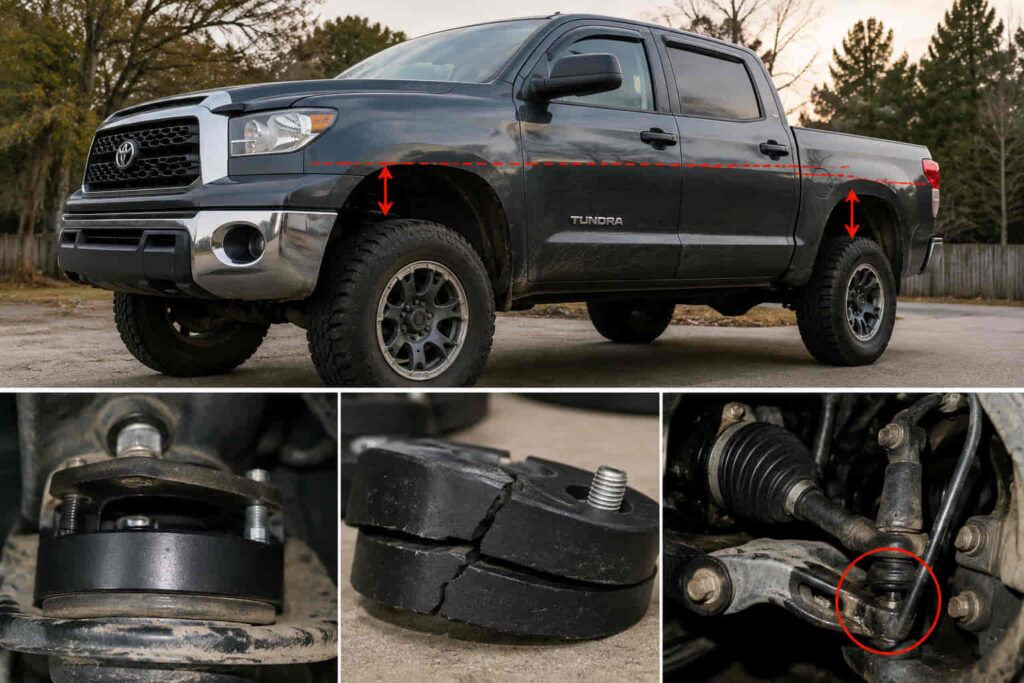
A Toyota Tundra leveling kit can create suspension, alignment, drivetrain, tire, and ride-quality problems when the increase in front ride height changes component geometry beyond an optimal operating range. However, installing a leveling kit does not automatically damage a Tundra. The actual risk depends on the Tundra generation, drivetrain, suspension configuration, amount of lift, leveling-kit design, wheel and tire setup, installation quality, and whether the truck receives a proper alignment after installation.
There are 7 Toyota Tundra leveling kit problems worth evaluating: alignment changes, increased CV axle and joint angles on applicable 4WD configurations, altered upper control arm and ball-joint geometry, changes in ride quality, tire rubbing, uneven tire wear, and reduced or altered usable suspension travel. These issues share the same underlying relationship: raising the front suspension changes where suspension and drivetrain components operate within their original geometry. A problem becomes more likely when the selected lift height or supporting setup pushes those components farther from their intended operating positions.
This guide explains the 7 Toyota Tundra leveling kit problems, why each problem can occur, which symptoms indicate that the setup needs attention, and how installation, alignment, suspension configuration, and wheel or tire fitment affect the result. It also explains how to diagnose and prevent leveling-related issues, whether upper control arms may be necessary, and whether a leveling kit is ultimately worth installing on a Toyota Tundra.
What Problems Can a Leveling Kit Cause on a Toyota Tundra?
A Toyota Tundra leveling kit can contribute to 7 main problem categories: alignment changes, increased CV axle and CV joint angles on applicable 4WD trucks, altered upper control arm and ball-joint geometry, changes in ride quality, tire rubbing, uneven tire wear, and reduced or altered usable suspension travel. These problems are not guaranteed consequences of leveling a Tundra. They become relevant when the additional front ride height changes suspension, steering, drivetrain, or wheel-and-tire geometry enough to move components away from their intended operating positions.
A leveling kit changes more than the visual stance of the truck because raising the front end changes the suspension’s static position. Control arms operate at different angles, alignment values can shift, and components connected between the chassis and wheels must operate from a new resting position. On applicable four-wheel-drive configurations, increasing front ride height can also change the operating angle of the front CV axles. The magnitude of these changes depends on the Tundra generation, suspension design, drivetrain, lift height, and method used to create the additional ride height.
The type of leveling kit also affects the result. A spacer-based system changes ride height differently from a replacement coilover or another suspension system designed around additional height. Two Tundras with a similar leveled appearance can therefore have different suspension travel, alignment capability, ride characteristics, and component angles. Treating every 2-inch or 3-inch leveling setup as mechanically identical ignores how the additional height is produced.
Wheel and tire changes add another variable because many owners install a leveling kit to accommodate a larger tire or change the truck’s stance. A problem attributed to the leveling kit can actually result from the combined setup. Tire diameter, width, wheel offset, steering angle, suspension compression, and alignment can determine whether a tire rubs even when the leveling kit provides additional static clearance.
The correct way to evaluate Toyota Tundra leveling kit problems is therefore to connect each symptom to the geometry or component condition that can produce it. A truck that develops uneven tire wear after leveling requires an alignment and tire-wear investigation, while vibration on a four-wheel-drive Tundra can require evaluation of drivetrain and suspension angles. The modification establishes a new operating configuration; diagnosis determines whether that configuration is actually responsible for the symptom.
Can a Toyota Tundra Leveling Kit Cause Alignment Problems?
A Toyota Tundra leveling kit can cause alignment values to change because increasing front ride height changes the position of suspension components relative to the chassis and wheels. Caster, camber, and toe are determined by suspension and steering geometry, so altering the suspension’s static position can move one or more alignment values away from their previous settings.
Camber describes the inward or outward inclination of the wheel when viewed from the front, while caster relates to the steering-axis angle when viewed from the side. Toe describes whether the front edges of the tires point toward or away from each other. These measurements affect different aspects of vehicle behavior, but all three are connected to the position and geometry of the suspension and steering components. Raising the front suspension can therefore make alignment correction necessary even when no component is damaged.
The practical problem is not simply that a leveling kit changes alignment; it is whether the modified suspension retains enough adjustment range to achieve appropriate alignment values. A moderate setup on one Tundra configuration may remain within the available adjustment range, while a more aggressive ride-height increase can make desired caster or camber settings harder to achieve with the original components. This is one reason lift height and Tundra generation matter when determining whether additional suspension components are necessary.
Incorrect alignment can affect both steering behavior and tire life. Excessive or inappropriate toe can accelerate tread wear, while camber outside an appropriate range can concentrate wear toward one side of the tread. Caster changes can influence steering feel, straight-line behavior, and how the steering returns toward center. A Tundra can also appear to drive reasonably straight while still having alignment values that contribute to premature tire wear.
An alignment should therefore be checked after installing a leveling kit rather than relying on steering feel alone. The objective is not merely to center the steering wheel but to verify the relevant alignment measurements after the truck has reached its new ride height. When the desired alignment cannot be achieved, the cause should be identified before assuming that installing aftermarket upper control arms or other components is automatically required.
Can a Leveling Kit Increase CV Axle and CV Joint Angles?
A leveling kit can increase CV axle and CV joint operating angles on applicable four-wheel-drive Toyota Tundra configurations because raising the front suspension changes the relationship between the wheel hub and the front drivetrain. The effect depends on the truck’s generation, suspension geometry, drivetrain configuration, and amount of additional front ride height, so it should not be treated as an identical problem across every Tundra.
A CV axle transfers torque while accommodating changes in suspension position and steering angle. At the original ride height, the axle and its joints operate within the geometry established by the suspension and drivetrain layout. Increasing front ride height can move the wheel hub farther from its original static relationship with the differential output, requiring the CV joints to operate at a different angle even while the truck is sitting on level ground.
A greater operating angle does not mean the CV axle will immediately fail. The relevant issue is that the joint and protective boot can spend more time operating at a geometry different from the original configuration. As lift height increases, joint articulation and boot position can become more significant considerations, particularly when suspension movement and steering input add further angular change beyond the static position.
Symptoms should be diagnosed rather than attributed automatically to the leveling kit. A torn CV boot, clicking or abnormal noise, vibration, or another front-drivetrain symptom can justify inspection of the axle and surrounding geometry, but the presence of a leveling kit does not prove that it caused the component failure. Existing wear, installation issues, wheel and tire changes, or an unrelated drivetrain problem can produce overlapping symptoms.
CV geometry is therefore one reason a moderate leveling setup and a more aggressive front lift should not be treated as equivalent modifications. The correct evaluation considers how much the front end was raised, how the specific Tundra suspension responds to that increase, and whether the resulting drivetrain angles remain appropriate throughout normal suspension and steering movement. This approach connects the potential problem to the actual mechanical change instead of assuming that every leveled four-wheel-drive Tundra will develop CV axle problems.
Read more: Toyota P0304
Can a Toyota Tundra Leveling Kit Cause Upper Control Arm or Ball Joint Problems?
A Toyota Tundra leveling kit can change upper control arm and ball-joint operating geometry because raising the front ride height moves the suspension away from its original static position. This does not mean that a leveling kit automatically damages the upper control arms or ball joints. The potential problem depends on the amount of lift, Tundra generation, suspension design, available joint articulation, alignment range, and how the truck is used after modification.
The upper control arm helps locate the steering knuckle as the suspension moves through compression and droop. Its ball joint must articulate through this movement while also accommodating steering input. When front ride height increases, the control arm can sit at a different angle at normal ride height, which also changes the starting position of the ball joint within its available range of movement.
This geometry becomes more important as the suspension approaches the limits of its travel. A ball joint that starts closer to the edge of its articulation range has less available movement in that direction before reaching its mechanical limit. Off-road suspension movement can make this relationship more relevant because the wheel may move through greater droop and compression than it does during normal paved-road driving. The amount of additional ride height therefore matters more than the visual fact that the truck has been “leveled.”
Upper control arm geometry also interacts with alignment. On some modified configurations, obtaining the desired caster and camber values can become more difficult as front ride height increases. An aftermarket upper control arm designed for a specific lifted application can change ball-joint position or suspension geometry to provide additional alignment capability, but this does not mean every leveled Tundra requires aftermarket upper control arms.
The need for a control-arm change should be determined from the actual setup. If the truck can achieve appropriate alignment, retains suitable ball-joint articulation, and operates through its intended suspension movement without binding or other geometry problems, replacing the upper control arms solely because a leveling kit is installed adds a component without proving that it is necessary. When alignment range or joint geometry becomes limiting, a compatible control-arm solution becomes more relevant.
Can a Leveling Kit Make a Toyota Tundra Ride Rougher?
A leveling kit can make a Toyota Tundra ride rougher or change how the front suspension responds to bumps, but the effect depends on how the kit creates additional ride height. A spacer, preload-based setup, replacement coilover, and other suspension solutions do not alter suspension behavior in exactly the same way, so ride quality should be evaluated according to kit design rather than lift height alone.
Ride height and suspension travel are separate attributes. Raising the front of the truck changes its static position, but it does not automatically increase the amount of suspension movement available. Depending on the design, the suspension can operate from a different point within its travel after leveling. This can change how much droop or compression remains available and how the suspension responds when the tire encounters a bump or depression.
Spring and damper behavior also influence the result. A leveling method that changes spring preload can alter the force required to move the suspension from its resting position, while a system using different shocks or coilovers can change damping characteristics as well as ride height. Two Tundras raised by a similar measured amount can consequently feel different because the suspension components controlling movement are not the same.
Larger wheels and tires can further complicate ride-quality comparisons. Owners frequently change tire dimensions at the same time they install a leveling kit, and differences in tire construction, sidewall height, inflation pressure, and unsprung mass can affect ride characteristics independently of suspension height. A harsher ride after modification therefore should not automatically be attributed to the leveling kit when several parts of the wheel and suspension setup changed simultaneously.
Diagnosing a ride-quality complaint requires identifying which modification changed the suspension’s behavior. Installation condition, shock operation, available travel, tire pressure, wheel and tire configuration, and suspension geometry all provide relevant context. This distinction prevents a ride problem caused by an incompatible component or tire setup from being treated as an unavoidable characteristic of every leveled Toyota Tundra.
Can a Toyota Tundra Leveling Kit Cause Tire Rubbing?
A Toyota Tundra leveling kit does not guarantee that larger tires will clear the body and suspension throughout the full range of steering and suspension movement. Leveling can increase clearance in certain positions by raising the front of the truck, but tire rubbing still depends on tire dimensions, wheel width and offset, Tundra generation, suspension geometry, steering angle, and the amount of compression or droop occurring at the wheel.
Static clearance and dynamic clearance are different. A larger tire can appear to fit correctly when the Tundra is parked with its wheels pointing straight ahead because the suspension is near its normal resting position. The relationship changes when the steering approaches full lock or the suspension compresses over a bump. The tire moves through an arc relative to nearby body panels and suspension components, which can reveal interference that is not visible during a stationary inspection.
Wheel offset plays an important role because it changes the tire’s position relative to both the suspension and body. Moving the wheel outward can create additional clearance from certain suspension components while simultaneously placing the tire closer to other areas during steering. Tire width and actual measured dimensions also matter, which means two tires marketed with the same nominal diameter do not necessarily occupy identical space inside the wheel well.
A leveling kit can therefore be part of a larger fitment solution without being the only factor that determines whether a tire rubs. Installing additional front ride height to fit a larger tire does not correct an incompatible wheel offset or guarantee clearance at full steering lock and suspension compression. This is why tire fitment should be evaluated as a complete relationship between ride height, wheel specifications, tire dimensions, suspension position, and body clearance.
Tire rubbing should be located before additional suspension parts are installed to solve it. Contact at a liner or body area requires a different solution from interference involving a suspension component, and rubbing that occurs only at full steering lock represents a different geometry condition from contact during suspension compression. Identifying exactly where and when the tire touches another component provides the information needed to determine whether ride height, wheel offset, tire size, or another part of the setup requires correction.
Can a Leveling Kit Cause Uneven or Faster Tire Wear on a Toyota Tundra?
A Toyota Tundra leveling kit can contribute to uneven or accelerated tire wear when the increased front ride height changes wheel alignment and the resulting caster, camber, or toe settings are not corrected appropriately. The leveling kit does not directly wear away the tire tread. The primary relationship is ride-height change → alignment geometry change → altered tire contact with the road → abnormal tread wear.
Toe and camber are particularly relevant to tire-wear patterns. When toe is outside an appropriate range, the tires do not roll perfectly parallel to the vehicle’s direction of travel and can scrub across the road surface as the truck moves. Camber changes the distribution of the tire’s contact across the tread. If the wheel operates with an inappropriate camber angle, one portion of the tread can carry more load and wear faster than another.
The effect can become more noticeable when a leveling kit is combined with larger or wider tires. A larger tire represents a different wheel-and-tire configuration and can change how alignment problems appear at the tread. Wheel offset, tire construction, inflation pressure, rotation practices, and driving conditions also affect wear, so abnormal tread wear after leveling should not automatically be attributed to the kit itself.
A truck that drives straight can still have alignment values that shorten tire life. Steering feel primarily tells the driver how the vehicle behaves on the road; it does not provide measurements of toe, camber, or caster. This is why evaluating alignment after changing front ride height provides stronger evidence than assuming the suspension is correctly adjusted because the steering wheel remains centered.
Existing tire wear should also be considered when diagnosing a leveled Tundra. Tires that developed an uneven pattern before alignment correction can continue to display that pattern after the suspension has been adjusted. The relevant diagnostic question is whether the current alignment and tire condition explain the wear, not simply whether the truck has a leveling kit installed.
Can a Leveling Kit Reduce Suspension Travel on a Toyota Tundra?
A leveling kit can alter the usable suspension travel of a Toyota Tundra when the additional front ride height changes where the suspension rests within its available range of movement. Raising the truck does not automatically create additional suspension travel. Ride height describes the vehicle’s static position, while suspension travel describes how far the wheel and suspension can move through compression and droop.
This distinction matters because the front suspension must move in both directions from its normal resting position. Compression allows the wheel to move upward relative to the chassis when encountering a bump, while droop allows it to move downward when the terrain falls away or the chassis rises relative to the wheel. Changing the static suspension position can change how much movement remains available in either direction.
The effect depends strongly on leveling-kit design. A spacer, preload adjustment, replacement coilover, or other suspension solution can achieve additional ride height through different mechanical relationships. Two setups that raise the front of a Tundra by a similar amount can therefore produce different shock positions, control-arm angles, droop characteristics, and ride behavior.
Reduced or altered usable travel can become more noticeable when the truck encounters uneven surfaces. A suspension operating closer to a movement limit has less available travel before reaching that limit, which can affect how the tire follows the road or terrain. This relationship can also contribute to ride-quality complaints because available travel and damper behavior influence how suspension movement is controlled.
Suspension travel should therefore be evaluated together with control-arm geometry, ball-joint articulation, shock operation, and intended vehicle use. A Tundra used primarily on paved roads does not place the suspension through the same range of articulation as a truck regularly driven off-road. The appropriate leveling setup must account for the movement the suspension needs rather than focusing only on the additional static height.
How Do You Know If a Tundra Leveling Kit Is Causing Problems?
Determine whether a Toyota Tundra leveling kit is causing a problem by connecting the symptom to a mechanical change created by the modified ride height. A problem appearing after installation establishes a useful timeline, but timing alone does not prove causation. The diagnosis should identify what changed, which component or geometry is affected, and whether that change can produce the observed symptom.
The symptom provides the first diagnostic direction. Uneven tire wear points toward tire condition and alignment geometry, while tire rubbing requires identifying the exact point of interference and the steering or suspension position in which contact occurs. A ride-quality complaint directs attention toward the suspension configuration, shocks, available travel, tire setup, and installation. A front-drivetrain symptom on an applicable four-wheel-drive Tundra requires a different investigation involving CV components and their operating geometry.
Installation condition should then be evaluated because a correctly designed kit can still create problems when components are assembled, positioned, or tightened incorrectly. The truck’s actual front ride-height change should also be considered rather than relying only on the advertised size of the kit. The mechanical effect comes from the final suspension position, not from the number printed on the product description.
Alignment measurements provide another important diagnostic relationship. When a symptom such as uneven tire wear, altered steering behavior, or poor straight-line stability appears after leveling, measured caster, camber, and toe values can establish whether suspension geometry is contributing to the problem. If appropriate alignment cannot be achieved within the available adjustment range, the investigation can then determine whether the lift height or suspension configuration requires a different solution.
Wheel and tire changes must be separated from leveling-kit effects when both modifications were performed together. A different tire diameter, width, wheel width, or offset can introduce rubbing, steering, ride, or vibration characteristics independently of the ride-height change. Attributing every post-installation symptom to the leveling kit can therefore lead to unnecessary suspension changes while leaving the actual wheel or tire fitment problem unresolved.
The strongest diagnosis connects the modification to a specific mechanism. For example, additional ride height followed by measurable alignment change and a corresponding tread-wear pattern creates a stronger relationship than tire wear occurring months after installation with no alignment data. Likewise, a tire contacting a specific body or suspension area at full steering lock provides more useful evidence than assuming larger tires should fit simply because the truck has been leveled.
A Toyota Tundra leveling kit should therefore be treated as one variable within the complete modified setup. Diagnosis determines whether the problem originates from the additional ride height, the kit design, installation, alignment, wheel and tire fitment, an affected suspension or drivetrain component, or an unrelated condition that happened to appear after the modification.
How Do You Fix Toyota Tundra Leveling Kit Problems?
Fix Toyota Tundra leveling kit problems by correcting the specific alignment, suspension geometry, drivetrain angle, tire-clearance, installation, or component condition responsible for the symptom. Removing or replacing the leveling kit is not automatically the correct solution because the problem can originate from alignment that was never corrected, incompatible wheel and tire fitment, improper installation, or another component that changed at the same time as the leveling kit.
Alignment-related problems require the suspension geometry to be measured at the truck’s modified ride height. If caster, camber, or toe is outside an appropriate range, the first objective is to determine whether the factory adjustment range can correct it. When suitable alignment cannot be achieved, the additional ride height and suspension configuration should be evaluated before installing more components. An upper control arm designed for the specific application becomes relevant when it addresses a verified alignment or ball-joint geometry limitation, not simply because the truck has been leveled.
A CV axle or joint concern on an applicable four-wheel-drive Tundra requires a different repair path. The axle, CV joints, boots, and resulting operating angles should be inspected to determine whether the symptom comes from an existing component failure, excessive geometry change, or another drivetrain condition. Replacing a CV axle without addressing an unsuitable operating angle can leave the underlying configuration unchanged, while changing suspension components unnecessarily will not correct a CV joint that was already damaged for an unrelated reason.
Tire rubbing should be corrected according to the exact interference point. A tire contacting an inner liner during steering requires a different solution from a tire interfering with a suspension component or contacting the body during compression. Tire diameter, actual tire width, wheel width, offset, steering angle, and suspension movement should be considered together. Adding more front height solely to eliminate rubbing can create additional suspension geometry changes without addressing an incompatible wheel or tire specification.
Ride-quality and suspension-travel complaints also require the complete setup to be evaluated. Shock operation, spring or coilover configuration, spacer design, available compression and droop, tire characteristics, and inflation pressure can all affect how the truck responds to road inputs. If the leveling method places the suspension in an unsuitable operating position, correcting the suspension configuration is more direct than attempting to mask the resulting behavior with unrelated modifications.
The repair is successful when the diagnosed mechanism has been corrected and the original symptom no longer occurs under the conditions that previously produced it. A leveled Tundra should therefore be evaluated as a complete suspension, steering, drivetrain, and wheel-and-tire system rather than as a truck with one isolated aftermarket part.
How Can You Prevent Toyota Tundra Leveling Kit Problems?
Prevent Toyota Tundra leveling kit problems by selecting a setup that matches the truck’s generation, drivetrain, suspension design, intended ride-height increase, wheel and tire configuration, and intended use before installation begins. Prevention is more effective when geometry and fitment are treated as design requirements rather than problems to correct after the truck has already been modified.
Lift height should be selected according to the mechanical requirements of the specific Tundra rather than appearance alone. Additional front height progressively changes the suspension’s static position, which can influence alignment range, control-arm position, ball-joint articulation, CV geometry on applicable four-wheel-drive configurations, and available suspension movement. A setup that achieves the desired stance with less geometry change can require fewer compromises than a more aggressive configuration.
Kit design should also match the intended use of the truck. A spacer-based leveling solution, preload adjustment, and replacement suspension system can produce additional ride height through different mechanisms. The appropriate choice depends on whether the owner prioritizes appearance, larger-tire clearance, road ride quality, suspension performance, or off-road movement. Selecting solely by advertised lift height ignores the mechanical characteristics that determine how the modified suspension behaves.
Installation should be followed by alignment verification and a complete clearance check. Tire clearance needs to be evaluated through steering movement and relevant suspension positions rather than only while the Tundra is parked with the wheels straight. On four-wheel-drive configurations, drivetrain components and CV boots should also be inspected in the context of the new suspension position when the lift changes their operating geometry.
Post-installation inspection provides another layer of prevention because the vehicle has established a new operating configuration. Tire-wear patterns, steering behavior, unusual noises, ride characteristics, component clearance, and visible suspension or drivetrain conditions can reveal a developing problem before it becomes more severe. The purpose is not to assume that the leveling kit will create a failure but to verify that the modified system continues to operate as intended.
A well-planned setup therefore prevents problems through compatibility rather than through one universal component. The appropriate relationship is Tundra configuration → intended ride height → compatible leveling method → correct installation → alignment and clearance verification → post-installation inspection.
How Much Leveling Is Safe for a Toyota Tundra?
There is no single leveling height that can be classified as universally safe for every Toyota Tundra because acceptable front ride-height increase depends on the truck’s generation, drivetrain, suspension design, kit type, alignment capability, wheel and tire setup, and intended use. A lift amount that works within suitable geometry on one Tundra configuration should not automatically be applied to another generation or suspension system.
The mechanical effect of leveling generally becomes more important as front ride height moves farther from the original suspension position. Control-arm angles change, ball joints operate from different starting positions, alignment correction can become more demanding, and applicable four-wheel-drive configurations can experience different CV axle angles. Available suspension movement can also change depending on how the additional height is created.
Advertised kit height should not be treated as a complete measurement of these effects. A nominal lift value describes the intended change in stance or ride height, but it does not describe caster, camber, ball-joint articulation, CV angle, shock position, or remaining suspension travel. These attributes determine whether a specific setup operates appropriately after installation.
Generation differences make a universal number particularly unreliable. Toyota has changed the Tundra’s chassis and suspension architecture across generations, so advice developed for one generation should not be transferred to another without confirming compatibility. The same principle applies to two-wheel-drive and four-wheel-drive configurations because their front drivetrain components and geometry are not identical.
The safest leveling amount is therefore the amount that achieves the intended goal while retaining appropriate alignment, suspension articulation, component clearance, drivetrain geometry, and usable travel for the specific truck. Manufacturer specifications for the selected suspension system and vehicle-specific installation requirements should establish the practical limit rather than a generic statement that every Tundra can safely accept the same number of inches.
If a desired ride height requires compromised alignment, restricted joint articulation, problematic CV geometry, insufficient suspension travel, or additional modifications simply to correct problems created by the initial change, the setup should be reconsidered as a complete suspension configuration rather than evaluated by lift height alone.
Do You Need Upper Control Arms With a Toyota Tundra Leveling Kit?
A Toyota Tundra does not automatically need aftermarket upper control arms simply because a leveling kit has been installed. The need for different upper control arms depends on the amount of front ride-height increase, suspension design, alignment range, ball-joint operating angle, available suspension travel, Tundra generation, and intended use. The correct decision should therefore come from the resulting suspension geometry rather than the presence of a leveling kit alone.
Raising the front suspension changes the static position of the upper control arm and steering knuckle. As ride height increases, achieving the desired caster and camber values can become more difficult if the original adjustment range cannot compensate for the new geometry. Ball-joint articulation can also become more relevant because the joint begins normal operation from a different position within its available range.
Aftermarket upper control arms designed for a specific lifted application can address particular geometry requirements by changing control-arm or joint positioning. This can provide additional alignment capability or improve joint operating geometry on an applicable setup. However, installing aftermarket control arms when the original suspension already achieves suitable alignment and articulation does not solve a demonstrated problem.
The decision should therefore follow measurable conditions. If the leveled Tundra can be aligned appropriately and its ball joints and control arms operate through the required suspension movement without binding or reaching unsuitable angles, the original upper control arms may remain adequate. If alignment range or articulation becomes limiting, a compatible upper control arm can become part of the suspension solution.
Does a Toyota Tundra Need an Alignment After a Leveling Kit?
A Toyota Tundra should have its wheel alignment checked and corrected as necessary after a leveling kit changes the front ride height. Raising the front suspension changes the static geometry that influences caster, camber, and toe, so the alignment that existed before installation should not be assumed to remain appropriate afterward.
Alignment verification serves two purposes. It determines whether the modified suspension can achieve suitable geometry and identifies values that can contribute to steering or tire-wear problems. A truck can appear to track straight while still having toe or camber conditions that shorten tire life, which means steering feel alone cannot substitute for measured alignment values.
The alignment also provides information about the compatibility of the complete leveling setup. If caster, camber, and toe can be corrected within the available adjustment range, the modification has a different geometry outcome from a setup in which the desired values cannot be achieved. Persistent alignment limitations can indicate that the amount of ride-height change or supporting suspension configuration requires further evaluation.
Alignment should therefore be treated as part of the installation process rather than as a repair performed only after uneven tire wear appears. Verifying geometry immediately after the ride-height change provides a baseline for evaluating future steering behavior, tire wear, and suspension performance.
Does a Leveling Kit Affect Toyota Tundra Towing?
A leveling kit does not increase the Toyota Tundra’s factory payload or towing rating simply because it changes the truck’s stance. Leveling raises the front ride height to reduce the factory front-to-rear height difference, but the modification does not by itself increase the rated capacity of the chassis, brakes, axles, tires, hitch, cooling system, or other components that determine vehicle load limits.
The visual effect of leveling can also interact with how the truck appears under load. A pickup is typically designed with a rear ride-height advantage when unloaded so that rear suspension compression under cargo or trailer tongue weight does not necessarily leave the vehicle with the same stance it had when empty. Reducing that front-to-rear difference can make rear suspension compression more visually noticeable after a trailer or heavy cargo is added.
This does not mean that leveling automatically makes a Tundra unsuitable for towing. The important distinction is between stance and load capacity. Trailer weight, tongue weight, payload, axle loading, tire limits, hitch requirements, and the vehicle’s applicable ratings remain the relevant constraints. A cosmetic change in front ride height does not replace those specifications.
Owners who regularly tow should therefore evaluate the leveling setup in the loaded condition as well as when the truck is empty. A configuration selected primarily to create a level unloaded stance can produce a different attitude when tongue weight compresses the rear suspension. The appropriate setup should account for how the Tundra is actually used rather than optimizing only its unloaded appearance.
Does a Leveling Kit Affect Toyota Tundra Warranty?
Installing an aftermarket leveling kit does not support a universal conclusion that every Toyota Tundra warranty coverage item is either automatically void or automatically unaffected. Warranty implications depend on the applicable warranty terms, the component that fails, the modification involved, the jurisdiction, and whether a relationship exists between the modification and the claimed failure.
This distinction matters because a vehicle warranty covers multiple systems rather than functioning as one indivisible component. A suspension modification and a later suspension-related failure create a different relationship from a modification followed by an unrelated problem elsewhere in the vehicle. The presence of aftermarket equipment alone does not explain the mechanical cause of every subsequent failure.
Owners should therefore review the warranty terms applicable to their specific Tundra and market before modifying the suspension. The leveling-kit manufacturer can also impose separate product warranty requirements concerning installation, compatible applications, or supporting components. Toyota coverage and aftermarket product coverage should not be treated as the same warranty relationship.
Warranty decisions should consequently remain vehicle-, failure-, and policy-specific. Claims such as “a leveling kit voids the Toyota warranty” remove the causal and contractual context required to determine whether a particular repair is covered.
What Is the Difference Between a Tundra Leveling Kit and Lift Kit?
A Toyota Tundra leveling kit primarily increases front ride height to reduce the factory difference between the front and rear stance, while a lift kit generally refers to a broader modification intended to raise more of the vehicle. The terms should not be used interchangeably because the components changed, total height increase, geometry effects, and intended outcomes can differ substantially between systems.
Leveling focuses on the relationship between front and rear ride height. Depending on the product, the additional front height can be created with spacers, spring or coilover changes, or another suspension-specific method. The resulting truck can sit closer to level when unloaded while retaining little or no intentional increase at the rear.
A lift kit can involve a wider set of changes. Depending on its design and lift amount, the system can modify front and rear suspension height and incorporate additional components intended to manage the resulting suspension, steering, or drivetrain geometry. The term “lift kit” still covers several different designs, so it does not identify one universal mechanical configuration.
The distinction is important when evaluating problems because similar-looking trucks can have very different component geometry. A modest front leveling setup should not automatically be assigned the same suspension consequences as a substantially taller lift system. Diagnosis and component requirements must correspond to the actual modification installed rather than the general appearance of the truck.
Is a Leveling Kit Worth It on a Toyota Tundra?
A leveling kit can be worth installing on a Toyota Tundra when the desired front ride height, stance, or wheel-and-tire fitment can be achieved without creating unacceptable compromises in alignment, suspension travel, component geometry, ride quality, or intended vehicle use. The value of the modification therefore depends on the complete setup rather than appearance alone.
For an owner primarily seeking a more level unloaded stance, a compatible and appropriately sized setup can accomplish that objective with a relatively focused change to front ride height. Owners seeking additional tire clearance can also gain useful space in certain areas, although leveling does not guarantee that every larger tire will clear through full steering and suspension movement.
The trade-offs become more important as the desired ride-height change becomes more aggressive. Increasing front height can place greater demands on alignment adjustment, control-arm and ball-joint geometry, CV angles on applicable four-wheel-drive trucks, and usable suspension movement. A setup that requires multiple corrective modifications simply to maintain suitable geometry should be evaluated as a complete suspension system rather than as a simple leveling kit.
Intended use should make the final decision. A primarily street-driven Tundra, an off-road truck requiring substantial suspension articulation, and a Tundra regularly carrying cargo or towing trailers impose different requirements on suspension behavior and stance. A setup that works well for one use case is not automatically optimal for another.
The most appropriate Toyota Tundra leveling setup is therefore determined by generation, drivetrain, lift height, suspension design, wheel and tire fitment, load requirements, and intended use. When those attributes are compatible and the truck can retain appropriate alignment, clearance, articulation, and suspension behavior, leveling can achieve its intended purpose without making the seven potential problems described above inevitable.