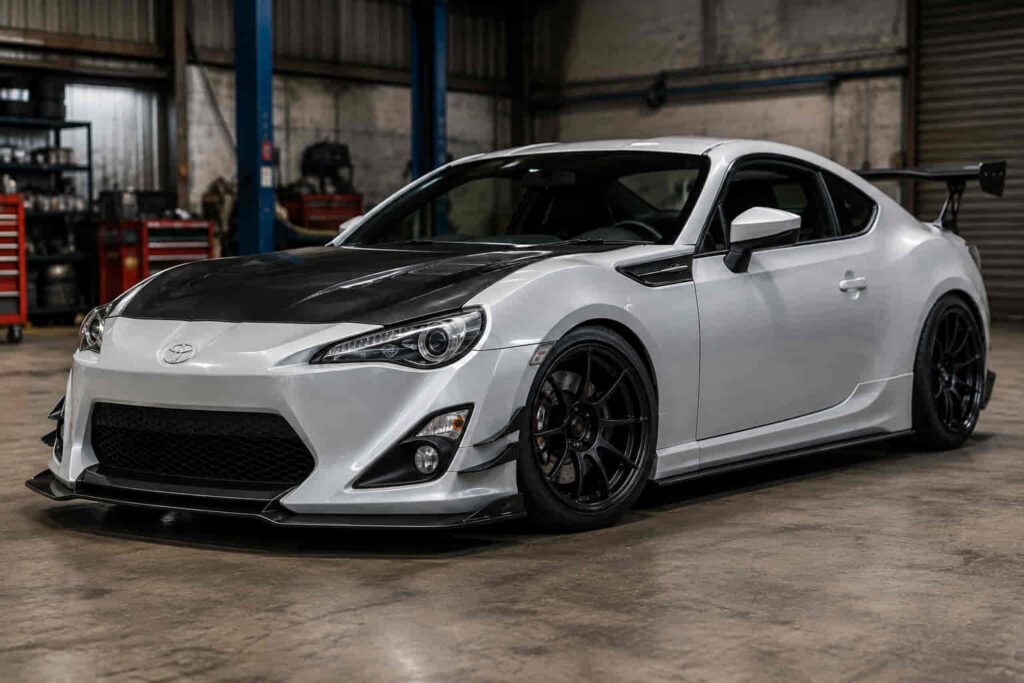
The best Toyota GT86 modifications improve grip, handling, braking consistency, engine response, or power by addressing a specific limitation in the car’s existing setup. The GT86 provides a strong platform for performance upgrades because its lightweight chassis, rear-wheel-drive layout, naturally aspirated FA20 engine, and balanced handling allow modifications to target distinct areas of vehicle performance. However, installing aftermarket parts does not automatically make a GT86 faster or better to drive. Each modification must match the intended use of the car and work with the rest of the setup.
There are 10 Toyota GT86 modifications worth considering for a performance-focused build, including performance tires, lightweight wheels, alignment changes, suspension upgrades, brake improvements, an aftermarket header, ECU tuning, an exhaust system, forced induction, and weight reduction. Their effects differ significantly. Tires can increase the grip available for acceleration, cornering, and braking, while suspension modifications change how that grip is controlled. Engine modifications target output and response, whereas turbocharger or supercharger systems introduce substantially greater power potential alongside additional thermal, calibration, and drivetrain demands.
This guide explains the 10 best Toyota GT86 modifications for performance, how each upgrade changes the car, and which modifications provide the most value for street or track use. It also explains modification priority, horsepower expectations, reliability trade-offs, and how to build a faster GT86 without treating horsepower as the only measure of performance.
What Are the 10 Best Toyota GT86 Modifications for Performance?
The 10 best Toyota GT86 modifications for performance are performance tires, lightweight wheels, performance-oriented alignment, suspension upgrades, brake pads and fluid, an aftermarket header, ECU tuning, an exhaust system, forced induction, and weight reduction. These modifications target different performance attributes, so they should not be ranked only by horsepower gain. A modification that increases available grip or braking consistency can produce a larger improvement for a particular use case than an engine part that adds a relatively small amount of power.
The correct modification priority depends on which attribute currently limits the car. Tires determine how effectively the GT86 transfers acceleration, braking, and cornering forces to the road. Alignment and suspension determine how effectively that available tire grip is used as vehicle load changes. Brake modifications improve repeated braking performance, while engine modifications change output, response, or both. Forced induction moves the engine into a substantially different performance and load context.
These modifications also interact. Wider or more capable tires require appropriate wheel fitment, while suspension changes can require a different alignment to use those tires effectively. A header can change engine operating characteristics, but its overall result also depends on ECU calibration and the remaining exhaust configuration. Increasing engine output substantially can expose limitations that were less important at stock power.
A performance build should therefore be treated as a connected system. The objective is not to install all 10 modifications but to identify the GT86’s current limitation, modify the relevant system, and ensure that the rest of the vehicle can use the improvement effectively.
Are Performance Tires the Best First Modification for a Toyota GT86?
Performance tires are one of the highest-value first modifications for a Toyota GT86 when the objective is to increase available grip. The tires form the physical interface between the car and the road, which means acceleration traction, cornering force, steering response, and braking capability all depend on the grip that the tire can generate under the operating conditions.
This relationship explains why tire performance affects several vehicle systems simultaneously. Increasing engine output does not improve acceleration effectively when the available traction cannot transfer that force to the road. Likewise, suspension and brake modifications cannot fully exploit their potential if the tire reaches its grip limit first. A more suitable performance tire raises that available grip envelope and allows other parts of the chassis to operate against a higher traction limit.
Tire selection should match the intended environment rather than simply choosing the most aggressive compound available. A tire designed around warm, dry performance conditions has different priorities from a tire intended for year-round street use. Temperature, wet-road performance, tread life, noise, and operating conditions therefore determine whether a particular tire category represents an actual improvement for a specific GT86.
Tire size also requires context. Increasing width can provide additional performance potential when the wheel, alignment, suspension clearance, and vehicle setup support it, but wider does not automatically mean faster. Excessive width or an unsuitable wheel-and-tire combination can add mass, create clearance problems, or change steering characteristics without producing a proportional performance benefit.
For a stock or lightly modified GT86, tires are therefore an effective starting point because they improve the interface used by acceleration, cornering, and braking rather than targeting only one output number. The correct tire is the one whose grip characteristics match the driver’s performance goal and operating conditions.
Do Lightweight Wheels Improve Toyota GT86 Performance?
Lightweight wheels can improve Toyota GT86 performance by reducing wheel mass while providing the width and fitment required for the intended tire setup. The performance value comes primarily from selecting a wheel that supports the complete chassis configuration rather than from changing wheel appearance or increasing diameter.
Wheel mass is both unsprung and rotational mass. Unsprung mass is located on the wheel side of the suspension rather than being fully supported by the springs, so changes in wheel and tire mass can influence how the suspension responds as the tire follows road irregularities. Rotational components also require energy to accelerate, although the real-world effect depends on the amount and distribution of the mass being changed.
Wheel diameter alone is therefore not a performance metric. Installing a larger wheel can increase mass and require a lower-profile tire, potentially changing ride characteristics and the ability of the tire to absorb surface irregularities. A performance-oriented wheel should instead be evaluated according to weight, strength, width, diameter, offset, brake clearance, and compatibility with the selected tire.
Width and offset are particularly important because they determine where the wheel and tire sit relative to the suspension and body. A wider performance tire provides little value if the chosen wheel creates rubbing or unsuitable clearance. Changing offset also alters fitment relationships, so an aggressive stance should not automatically be treated as an optimized performance setup.
The most effective GT86 wheel upgrade consequently combines appropriate mass with correct tire support and fitment. A lightweight wheel that allows the desired performance tire to operate without creating clearance or geometry compromises has more functional value than a wheel selected solely because it is larger or visually more aggressive.
Is Performance Alignment Worth It on a Toyota GT86?
Performance alignment is worth considering on a Toyota GT86 because camber, toe, and related suspension geometry influence how effectively the tires maintain useful contact with the road during cornering and straight-line driving. Alignment does not create tire grip by itself; it changes how the available grip is used as the wheels move and the chassis experiences load.
Camber is particularly relevant during cornering because body movement and suspension geometry change the relationship between the tire and road surface. An alignment intended for more aggressive cornering can use a different static camber strategy to improve tire behavior under lateral load. The appropriate setting depends on suspension configuration, tire characteristics, ride height, driving environment, and how aggressively the vehicle is used.
Toe influences both response and tire wear. Changes in toe can alter how quickly the vehicle responds to steering input and how stable it feels, but an aggressive setting can also increase tire wear or make the car less suitable for routine road use. This trade-off demonstrates why a track-oriented alignment should not automatically be copied onto a daily-driven GT86.
Alignment becomes even more important after suspension or ride-height changes because those modifications can alter the geometry present at the wheels. Installing springs or coilovers without evaluating the resulting alignment can leave the car with a different stance but without a chassis setup optimized for the new operating position.
The correct GT86 alignment is therefore use-specific rather than universal. A street car needs a balance between handling, stability, tire life, and normal driving behavior, while a track-focused car can prioritize cornering performance and tire utilization differently. Alignment creates the most value when its settings are chosen around the tire, suspension, and actual performance objective instead of applying one set of numbers to every modified GT86.
Read more: Toyota Tundra Leveling Kit Problems
Do Coilovers or Suspension Upgrades Improve Toyota GT86 Handling?
Coilovers or properly matched suspension upgrades can improve Toyota GT86 handling by controlling body movement, maintaining more consistent tire behavior, and allowing the chassis setup to be adjusted for a defined street or track objective. The improvement does not come simply from lowering the car. It comes from changing spring rates, damping characteristics, ride height, and suspension geometry in a way that helps the tires use their available grip more effectively.
Springs control how the chassis responds to vertical and lateral loads, while dampers control the rate of suspension movement. During braking, acceleration, and cornering, vehicle load transfers between the tires and causes the suspension to compress or extend. A properly matched spring-and-damper combination controls this movement so that the car responds predictably without allowing excessive body motion to disrupt tire behavior.
Coilovers add another variable because many systems combine adjustable ride height with different spring and damping characteristics. This allows the GT86 to be configured around a specific use case, but additional adjustment does not automatically produce better handling. Excessive spring rate can reduce compliance on uneven pavement, while unsuitable damping can prevent the tire from following the road effectively. A setup that feels stiff can therefore provide less usable grip than a more compliant but properly controlled suspension.
Ride height requires the same distinction. Lowering the GT86 reduces its static body height, but lower does not automatically mean better handling. Excessive lowering can reduce usable suspension travel and change suspension geometry beyond the range in which the complete system works effectively. If the car repeatedly reaches the limits of its available travel or operates with unsuitable alignment, the visual reduction in ride height can become a performance compromise rather than an improvement.
Suspension upgrades should consequently be selected around the tires, alignment, road surface, and intended use. A daily-driven GT86 requires enough compliance and travel for imperfect roads, while a track-focused setup can prioritize body control and repeatability differently. The best suspension modification is the configuration that keeps the tires working effectively throughout the conditions the car actually encounters.
Are Brake Pads and Brake Fluid Good Toyota GT86 Performance Mods?
Brake pads and appropriate brake fluid are valuable Toyota GT86 performance modifications when the objective is to improve braking consistency and resistance to performance loss during repeated hard braking. These upgrades do not automatically reduce every single stopping distance because maximum deceleration also depends heavily on tire grip. Their primary performance value becomes clearer as brake temperature rises during demanding driving.
Brake pads operate by generating friction against the brake rotor, and their friction characteristics change with temperature. A pad selected for more demanding use can maintain more consistent behavior within a higher operating-temperature range than a street-oriented pad that is being pushed beyond its intended conditions. This becomes relevant during repeated braking zones, where heat accumulates faster than it does during ordinary road driving.
Brake fluid addresses a different part of the same thermal problem. Braking converts vehicle kinetic energy into heat, and repeated high-energy stops increase temperatures throughout the braking system. Fluid that reaches an unsuitable thermal condition can compromise hydraulic braking consistency. Selecting brake fluid according to the expected temperature environment therefore supports repeatable brake operation rather than increasing engine or chassis performance directly.
The correct brake setup still depends on use. A track-oriented pad can introduce additional noise, dust, rotor wear, or cold-temperature behavior that is undesirable on a daily-driven GT86. Conversely, a street-focused pad selected primarily for quiet operation may not provide the same consistency when exposed to repeated high-temperature track braking. Performance must therefore be defined by the conditions in which the brake system is expected to operate.
A larger brake kit should not automatically be the first braking modification. Tires, pad characteristics, fluid condition, rotor condition, cooling, and the duration of repeated braking all influence the system’s performance. A big brake kit becomes more relevant when the existing system has a demonstrated thermal-capacity or hardware limitation that smaller supporting changes cannot adequately address.
The useful distinction is therefore braking force versus braking consistency. Tires strongly influence how much braking force can be transferred to the road, while pads, fluid, and thermal management influence how consistently the braking system can deliver the required performance over repeated stops.
Does an Aftermarket Header Improve Toyota GT86 Performance?
An aftermarket header can improve Toyota GT86 engine performance when its exhaust-flow and pressure-wave characteristics work effectively with the FA20 engine and the ECU calibration used by the vehicle. The header changes how exhaust gases leave the cylinders, so its performance effect should be understood as part of the engine’s airflow and calibration system rather than as an isolated bolt-on horsepower number.
The FA20 is a naturally aspirated engine, which means cylinder filling and exhaust evacuation are closely connected to intake and exhaust pressure relationships. Exhaust pulses travel through the header after the exhaust valves open, and header primary dimensions, runner configuration, collector design, and the remaining exhaust system influence how those pulses interact. A well-matched design can improve exhaust scavenging behavior within targeted engine-speed ranges and change the engine’s torque characteristics.
This is why two aftermarket headers should not be assumed to produce identical results simply because both reduce exhaust restriction. Header design can shift where an engine responds differently across the rpm range. The final outcome also depends on the rest of the vehicle configuration, including exhaust components, fuel, engine condition, and ECU calibration.
ECU calibration becomes particularly relevant because mechanical airflow changes and engine-control strategy operate together. Installing a header changes the physical exhaust system, while an appropriate calibration can adjust engine-control parameters for the resulting configuration. Evaluating the header and tune as related modifications therefore provides a more accurate performance context than assigning a universal horsepower gain to the header alone.
An aftermarket header can also introduce trade-offs beyond output. Exhaust noise, emissions-system configuration, heat, installation requirements, and road legality can differ according to header design and jurisdiction. A part that is suitable for a track-focused build may therefore be inappropriate for a road car that must comply with specific emissions or noise requirements.
The header is best treated as a naturally aspirated power-system modification, not as an independent guarantee of a fixed horsepower increase. Its value depends on how its exhaust characteristics, ECU calibration, remaining exhaust system, and intended operating range work together to improve the FA20’s performance.
Does an ECU Tune Improve Toyota GT86 Performance?
An ECU tune can improve Toyota GT86 performance by changing how the engine management system controls ignition timing, fueling, throttle behavior, and other calibration parameters for a specific engine configuration. The value of ECU tuning depends on the hardware installed, fuel used, operating conditions, and calibration strategy, so a tune should not be treated as a universal source of a fixed horsepower gain.
The ECU controls combustion by interpreting sensor information and determining how the engine should operate under different loads and engine speeds. Calibration changes can alter how the engine responds within those conditions. On an otherwise stock naturally aspirated FA20, the available improvement is constrained by the engine’s existing airflow and hardware. When a header or another airflow-related modification is installed, calibration becomes more important because the physical engine configuration has changed.
This creates an important distinction between tuning a stock engine and tuning an engine with supporting modifications. A stock GT86 tune primarily works within the mechanical capabilities already present, while a calibration for a modified engine must account for the changed airflow and operating characteristics created by those components. The same ECU calibration should therefore not be assumed to produce identical results across different GT86 setups.
ECU tuning becomes essential rather than optional when modifications fundamentally change engine operation, particularly with forced induction. A turbocharger or supercharger increases the amount of air available to the engine, which changes fueling, ignition, load, and thermal requirements. Calibration must correspond to the actual hardware and fuel configuration rather than relying on settings intended for a naturally aspirated engine.
The performance result should be evaluated through the complete engine configuration. Fuel quality, engine condition, header and exhaust design, intake characteristics, forced-induction hardware when applicable, and calibration all influence the final output. This is why claims that an ECU tune alone adds one specific amount of horsepower provide less useful information than understanding what the calibration is designed to optimize.
For a naturally aspirated GT86 build, ECU tuning has the strongest contextual value when it complements verified hardware changes and the desired engine behavior. For a forced-induction build, appropriate calibration becomes a fundamental part of controlling the modified engine rather than merely another performance accessory.
Is an Exhaust System Worth Upgrading on a Toyota GT86?
An aftermarket exhaust system can be worth upgrading on a Toyota GT86 when the objective includes changing exhaust sound, reducing system mass, altering exhaust-flow characteristics, or supporting a broader engine configuration. However, a cat-back exhaust should not automatically be treated as a major power modification because its effect on engine output depends on which parts of the exhaust system are changed and how restrictive the original configuration is relative to the engine’s airflow requirements.
The exhaust system performs several functions beyond producing sound. Exhaust gases must travel from the engine through the header and downstream exhaust components before leaving the vehicle. Pipe diameter, routing, resonators, mufflers, catalysts, and other components affect pressure, acoustic behavior, mass, and packaging. Changing these attributes can alter the character of the vehicle without necessarily creating a proportionally large change in engine output.
This distinction is especially important on a naturally aspirated GT86. A louder exhaust can make acceleration feel and sound more aggressive, but increased sound does not establish that the engine is producing substantially more power. The performance effect must be separated from the acoustic effect. A system selected primarily for sound should therefore be described as a sound-focused modification even if it also changes weight or flow characteristics.
An exhaust becomes more relevant to overall engine performance when it is part of a coordinated configuration. Header design, downstream exhaust flow, ECU calibration, and engine airflow requirements interact, which means a component that provides sufficient flow for a naturally aspirated FA20 may occupy a different performance context in a higher-output forced-induction build.
Exhaust selection also involves practical trade-offs. Increased volume, cabin drone, emissions-system changes, ground clearance, and local noise or emissions requirements can affect whether a particular system is suitable for a daily-driven GT86. A track-oriented exhaust configuration can therefore provide little practical value to an owner who primarily drives long distances on public roads.
The best GT86 exhaust upgrade is consequently one selected for a defined objective. If the priority is sound, the system should deliver the desired acoustic character without unacceptable drone. If the priority is performance, exhaust flow must be evaluated as part of the complete engine configuration rather than assuming that a larger or louder system automatically produces more power.
Is a Supercharger or Turbocharger the Best GT86 Power Upgrade?
A turbocharger or supercharger can produce a substantially larger increase in Toyota GT86 power potential than typical naturally aspirated bolt-on modifications because forced induction increases the mass of air available for combustion. More air allows the engine to burn more fuel under appropriate control, increasing the amount of energy released during combustion and therefore increasing potential engine output.
A naturally aspirated FA20 relies on atmospheric pressure and engine airflow dynamics to fill its cylinders. Forced induction changes this operating condition by compressing the intake charge before it enters the engine. This makes forced induction fundamentally different from a header, exhaust, or ECU tune on an otherwise naturally aspirated configuration. It changes the engine’s airflow and load environment rather than optimizing only the existing naturally aspirated system.
Turbochargers and superchargers achieve this objective through different mechanisms. A turbocharger uses exhaust-gas energy to drive a compressor, while a mechanically driven supercharger receives energy from the engine to operate its compressor. These differences affect response, packaging, heat management, power delivery, and system design, so turbo and supercharger setups should not be treated as interchangeable simply because both increase intake air mass.
The additional output also creates additional requirements. Fuel delivery and ECU calibration must support the increased airflow, while cooling and thermal management become more important as engine output and heat generation increase. The clutch, transmission, differential, tires, and other drivetrain components can also experience higher loads because the engine is producing more torque than in its original operating context.
Reliability therefore cannot be separated from the desired power level and complete system design. Forced induction does not automatically make a GT86 unreliable, but increasing cylinder output changes mechanical and thermal loads. Engine condition, boost level, fuel quality, calibration, cooling capability, maintenance, driving conditions, and supporting hardware all influence the resulting reliability context. This is why one universal “safe horsepower” figure should not be applied to every GT86.
Forced induction is consequently one of the strongest options when the primary goal is a substantial increase in GT86 engine output, but it is not automatically the best first modification. A car with inadequate tires, braking consistency, suspension setup, or maintenance can gain horsepower without becoming a better balanced performance vehicle. For a power-focused build, a turbocharger or supercharger should be treated as a complete engine-system change that requires compatible calibration, fueling, thermal management, and chassis capability rather than as a standalone bolt-on part.
Does Weight Reduction Improve Toyota GT86 Performance?
Weight reduction can improve Toyota GT86 performance because reducing vehicle mass improves the relationship between the engine’s available output and the mass it must accelerate. Lower mass also reduces the inertia that the tires, brakes, and chassis must manage during acceleration, braking, and directional changes. Unlike an engine modification, weight reduction does not create additional horsepower; it allows the existing power and chassis capability to move less mass.
The acceleration benefit is explained by power-to-weight ratio. If engine output remains unchanged while vehicle mass decreases, each unit of power is responsible for accelerating less mass. The effect is not limited to straight-line acceleration because mass also influences the forces involved when the GT86 decelerates or changes direction. Reducing unnecessary weight can therefore contribute to a more responsive overall performance package rather than targeting only one vehicle system.
The location and type of mass being removed also matter. Reducing rotating or unsprung mass through an appropriately selected wheel-and-tire setup has a different mechanical context from removing static mass elsewhere in the vehicle. Likewise, eliminating unnecessary cargo from a track car is fundamentally different from removing components that affect comfort, noise isolation, practicality, or occupant protection.
This distinction becomes particularly important on a street-driven GT86. Removing interior components can reduce measured vehicle mass while simultaneously increasing cabin noise and decreasing daily usability. Modifications involving safety-related equipment introduce additional considerations and should not be treated as routine weight-reduction recommendations. A lower scale number does not automatically represent a better road-car configuration.
Weight reduction is therefore most valuable when it removes unnecessary mass without compromising the functions required for the car’s intended use. On a dedicated performance build, weight can receive greater priority. On a daily-driven GT86, lightweight wheels and carefully selected components can provide a more balanced approach than stripping the vehicle simply to achieve the lowest possible mass.
Which Toyota GT86 Modifications Should You Do First?
The Toyota GT86 modifications you should do first depend on the performance limitation you want to correct, but tires, vehicle condition, alignment, and chassis setup generally deserve consideration before major power increases on a balanced performance build. Modification order should follow goal → current limitation → upgrade → supporting system, rather than installing parts according to popularity.
A stock or lightly modified street GT86 benefits most when the driver can use more of the chassis capability without introducing unnecessary compromises. Performance tires can increase available grip, while an appropriate alignment determines how effectively that grip is used. Lightweight wheels can support the desired tire configuration, and a well-matched suspension setup can improve body and tire control when the original setup no longer meets the driver’s objective.
A track-focused GT86 changes the priority because repeated high-load operation becomes more important. Tire performance remains fundamental, but brake pads, brake fluid, alignment, suspension behavior, and thermal consistency receive greater emphasis because the car repeatedly accelerates, corners, and decelerates at elevated loads. A modification that performs well during a short street drive does not necessarily provide the same consistency over repeated track sessions.
A power-focused build requires another sequence. A header and ECU calibration can form part of a naturally aspirated configuration, while a major increase in engine output generally moves the build toward forced induction. At that point, calibration, fuel delivery, cooling, thermal management, drivetrain capacity, tire grip, and braking capability become interconnected requirements. Increasing engine output without considering these systems can create a fast engine configuration without producing a balanced performance car.
Maintenance condition should also precede performance modification. An existing engine, cooling, braking, suspension, tire, or drivetrain problem is not corrected by adding an aftermarket performance component. Establishing a mechanically sound baseline allows later changes in performance or behavior to be attributed more accurately to the modification itself.
The best first GT86 modification is consequently the one that addresses the car’s current limitation for its intended use. A daily driver, autocross car, track build, and forced-induction GT86 do not require identical modification sequences because each places different demands on grip, braking, chassis control, engine output, and durability.
How Much Horsepower Can Toyota GT86 Modifications Add?
The amount of horsepower Toyota GT86 modifications can add depends on whether the FA20 remains naturally aspirated or is converted to forced induction, as well as the hardware combination, fuel, ECU calibration, engine condition, measurement method, and operating environment. There is no single horsepower gain that accurately represents every modified GT86.
Naturally aspirated modifications work within the airflow potential of an engine that still relies on atmospheric pressure for cylinder filling. Headers, exhaust changes, intake-related modifications, and ECU calibration can alter airflow and engine operation, but their effects are interconnected. Adding the claimed gains of several individual aftermarket parts together is unreliable because one component can change the operating conditions under which another component was originally measured.
Dyno results also require context. Wheel horsepower and engine horsepower are not the same measurement, and results from different dynamometers, test conditions, correction methods, fuels, and vehicle configurations should not be compared as though they were produced under identical conditions. A before-and-after measurement performed under controlled, comparable conditions provides stronger evidence of a modification’s effect than an isolated peak number.
Forced induction creates a different output range because a turbocharger or supercharger increases the air mass available for combustion. Potential output then depends on variables such as boost, compressor characteristics, fuel delivery, calibration, thermal control, engine condition, and supporting hardware. Higher potential output also increases mechanical and thermal demands, which means horsepower cannot be evaluated separately from durability and system capacity.
For this reason, a GT86 build should establish a target based on intended use before selecting power modifications. A responsive naturally aspirated street car and a substantially higher-output forced-induction build solve different performance goals and require different supporting systems. The meaningful question is not simply how much horsepower modifications can add, but how much usable output the complete vehicle can support for the way it will be driven.
Can Modifying a Toyota GT86 Reduce Reliability?
Modifying a Toyota GT86 can reduce reliability when a modification increases thermal, mechanical, or drivetrain loads, creates unsuitable operating conditions, or is poorly calibrated or installed. Modification itself is not a single reliability condition. A tire or alignment change has a fundamentally different relationship with engine durability from a forced-induction system that substantially increases cylinder output.
Engine modifications illustrate this relationship clearly. Increasing the amount of air and fuel burned during combustion can increase engine output, but higher output also changes cylinder pressures, heat generation, cooling requirements, and loads transmitted through the drivetrain. Reliability risk therefore depends on how far the modified operating condition moves from the original configuration and whether calibration and supporting systems are appropriate for that change.
Suspension modifications create a different set of durability relationships. Excessive lowering, unsuitable spring and damper combinations, poor alignment, or incorrect wheel fitment can increase tire wear, reduce usable suspension travel, or place components in less favorable operating positions. These consequences do not mean that suspension modification inherently makes the GT86 unreliable; they show why geometry and component compatibility must be considered as part of the modification.
Installation and calibration quality can be as important as the selected component. A correctly designed part operating within an appropriate system can produce a different reliability outcome from the same modification installed incorrectly or used with incompatible supporting hardware. Maintenance requirements can also change after modification, particularly when the vehicle is subjected to greater loads or more frequent track use.
Reliability should therefore be evaluated through the relationship modification → changed operating condition → additional load or geometry change → affected component → potential consequence. A well-planned GT86 build defines the performance objective first and then controls the additional mechanical, thermal, and chassis demands created while achieving it. This approach produces a more useful performance car than maximizing individual modification specifications without considering how the complete vehicle operates.
What Are the Best Toyota GT86 Mods for Daily Driving?
The best Toyota GT86 modifications for daily driving improve grip, response, chassis control, and driver engagement without creating excessive noise, harshness, maintenance requirements, or reduced usability. A daily-driven GT86 operates across changing road surfaces, temperatures, traffic conditions, and weather, so modifications should provide usable performance across a broader operating range than a dedicated track setup.
Performance tires are one of the strongest starting points when they match the climate and driving conditions. The tire determines how effectively acceleration, braking, and cornering forces reach the road, but an aggressive track-oriented tire is not automatically the best street choice. Operating temperature, wet grip, tread life, road noise, and cold-weather behavior can matter more on a daily driver than maximum dry grip under ideal conditions.
Lightweight wheels and a street-oriented alignment can complement the tire setup. The wheels should provide appropriate tire support, brake clearance, strength, and body or suspension clearance without adding unnecessary mass. Alignment can then optimize tire behavior while retaining acceptable stability and tread life. Extreme alignment settings designed around track cornering loads can create unnecessary tire wear or less desirable road behavior during normal commuting.
Suspension modifications should follow the same principle. A well-matched spring-and-damper package or properly configured coilover system can improve body control and response, but excessive spring rates or lowering can reduce compliance and suspension travel on uneven roads. A daily GT86 benefits from suspension that controls chassis movement while still allowing the tires to follow imperfect pavement.
Engine and exhaust modifications should also account for daily usability. A header and compatible ECU calibration can support a naturally aspirated performance build, while an exhaust can change sound and potentially reduce mass. However, excessive exhaust volume, cabin drone, emissions implications, or aggressive calibration can create trade-offs that become more noticeable during everyday use than during short performance driving sessions.
The best daily GT86 build therefore prioritizes usable performance rather than maximum modification intensity. Tires, fitment, alignment, suspension, braking condition, and carefully selected powertrain changes can make the car more responsive without removing the characteristics that allow it to function comfortably and consistently as a road car.
What Are the Best Toyota GT86 Mods for Track Driving?
The best Toyota GT86 modifications for track driving prioritize grip, braking consistency, chassis control, thermal management, and repeatable performance before maximizing engine output. Track driving subjects the car to repeated acceleration, cornering, and braking loads, which means a modification must continue working as temperatures and component loads increase rather than provide an improvement for only one short acceleration or braking event.
Tires establish the available grip envelope, while alignment determines how effectively that grip is used under sustained cornering loads. A track-oriented setup can use alignment priorities different from a daily street car because tire temperature, lateral load, tread wear, and cornering performance receive greater emphasis. Suspension changes should then support tire control without unnecessarily restricting travel or making the chassis difficult to manage.
Braking consistency becomes particularly important because track driving repeatedly converts vehicle speed into heat. Pads and brake fluid must operate within the temperatures generated by repeated braking zones. When braking limitations persist despite appropriate pads, fluid, tires, and system condition, additional cooling or brake hardware can become relevant according to the demonstrated limitation.
Thermal management also extends beyond the brakes. Engine, coolant, oil, transmission, differential, and forced-induction temperatures can become more important as session duration and output increase. A GT86 that performs strongly for a short period but cannot maintain suitable operating conditions throughout repeated laps does not provide the same functional performance as a car capable of producing consistent results over an entire session.
Power modifications should therefore follow the chassis and thermal requirements of the build. Additional horsepower can increase acceleration, but it also raises the demands placed on tires, brakes, cooling, and drivetrain components. A balanced track GT86 uses modification as a system: grip establishes capability, chassis and brakes control it, thermal management sustains it, and additional power expands it when the supporting systems can accommodate the increased load.
Should You Modify the GT86 Engine Before the Suspension?
You should modify the Toyota GT86 engine before the suspension only when engine output is the primary limitation for the intended build and the existing tires, brakes, and chassis setup can support the additional performance. There is no universal requirement to modify either system first because engine and suspension upgrades solve different limitations.
Engine modifications primarily affect output, torque characteristics, throttle behavior, and acceleration potential. Suspension modifications affect body control, tire behavior, steering response, and how effectively available grip is used. Adding horsepower cannot correct unsuitable damping or poor tire utilization, just as installing coilovers does not increase engine output.
For a handling-focused street, autocross, or track build, improving tires, alignment, braking consistency, and chassis behavior before pursuing substantial engine power creates a logical development sequence. The driver can establish how the GT86 behaves at its existing output level and identify which limitation actually needs correction next.
A power-focused build can justify a different sequence. If the objective is specifically to create a turbocharged or supercharged GT86, engine-system planning becomes central from the beginning. However, the increased output still creates requirements for tire grip, braking capability, cooling, calibration, and drivetrain condition. Engine modification therefore cannot be planned independently from the chassis that must use the additional power.
The correct order is determined by the performance objective rather than a fixed rule. The useful sequence remains define the goal → identify the limiting attribute → modify that system → verify the result → address the next limitation. This produces a coherent GT86 build instead of accumulating modifications whose effects do not support the same objective.
Is a Modified Toyota GT86 Still Good for Daily Driving?
A modified Toyota GT86 can remain a good daily driver when its tires, suspension, alignment, exhaust, engine calibration, and power level are selected around normal road use. Daily drivability declines when modifications optimize the car for conditions it rarely encounters while sacrificing ride compliance, noise control, tire life, clearance, fuel requirements, or maintenance convenience.
Suspension configuration provides a clear example. A moderate setup with appropriate damping and usable travel can improve body control while preserving road compliance. A much more aggressive configuration can perform effectively on a smooth circuit but become unnecessarily harsh on broken pavement. The same modification category can therefore produce very different daily-driving outcomes depending on specification and setup.
Tires and alignment create similar trade-offs. A highly specialized tire can provide substantial grip in its intended temperature and surface conditions but perform less appropriately outside them. Aggressive alignment can improve tire utilization during hard cornering while accelerating tread wear during routine driving. Daily performance should therefore be measured across the conditions the vehicle actually encounters rather than by peak cornering capability alone.
Powertrain modifications can preserve drivability when calibration, fuel requirements, thermal management, and power delivery are compatible with regular use. Forced induction introduces a larger change than naturally aspirated bolt-ons because it substantially changes engine output and load. The more extensively the operating conditions change, the more important supporting systems and maintenance become.
A daily-driven GT86 does not need to remain completely stock to remain practical. It needs modifications whose benefits are available frequently enough to justify their compromises. The most successful street build increases the performance attributes the driver values while retaining the reliability, comfort, clearance, noise level, and operating range required for everyday driving.
Is Modifying a Toyota GT86 Worth It?
Modifying a Toyota GT86 is worth it when each upgrade addresses a defined performance goal and the resulting improvement justifies its cost, maintenance requirements, reliability implications, and effect on daily usability. The GT86 provides multiple modification paths because grip, chassis behavior, braking consistency, naturally aspirated engine response, power output, and vehicle mass can be changed independently or developed as part of a coordinated build.
For a handling-focused owner, performance tires, suitable wheels, alignment, and suspension can provide greater value than pursuing engine output immediately. These modifications work directly with the lightweight rear-wheel-drive chassis and improve how the car uses its existing performance. A driver experiencing repeated high-temperature braking can obtain more value from brake-system preparation than from a modification that adds power.
A naturally aspirated performance build has a different objective. Header, exhaust, and ECU calibration can be developed as related components rather than evaluated as isolated horsepower products. A forced-induction build changes the context further because substantially increasing airflow and output also increases calibration, fueling, cooling, drivetrain, tire, and braking requirements.
The financial value of modification is equally goal-dependent. Installing parts because they are popular can create a more expensive GT86 without creating a coherent performance improvement. Defining the intended use first allows each modification to solve an identified limitation and prevents conflicting choices, such as combining a daily-driving objective with suspension, tire, or exhaust specifications intended primarily for competition.
The best Toyota GT86 modifications are therefore not necessarily the parts that produce the largest horsepower number or the most aggressive appearance. They are the upgrades that improve the specific attributes required by the build while allowing the tires, chassis, brakes, engine, and drivetrain to function as a coordinated system. A well-planned GT86 modification strategy follows performance goal → current limitation → appropriate modification → supporting systems → verified result, then repeats that process only when another limitation becomes relevant.