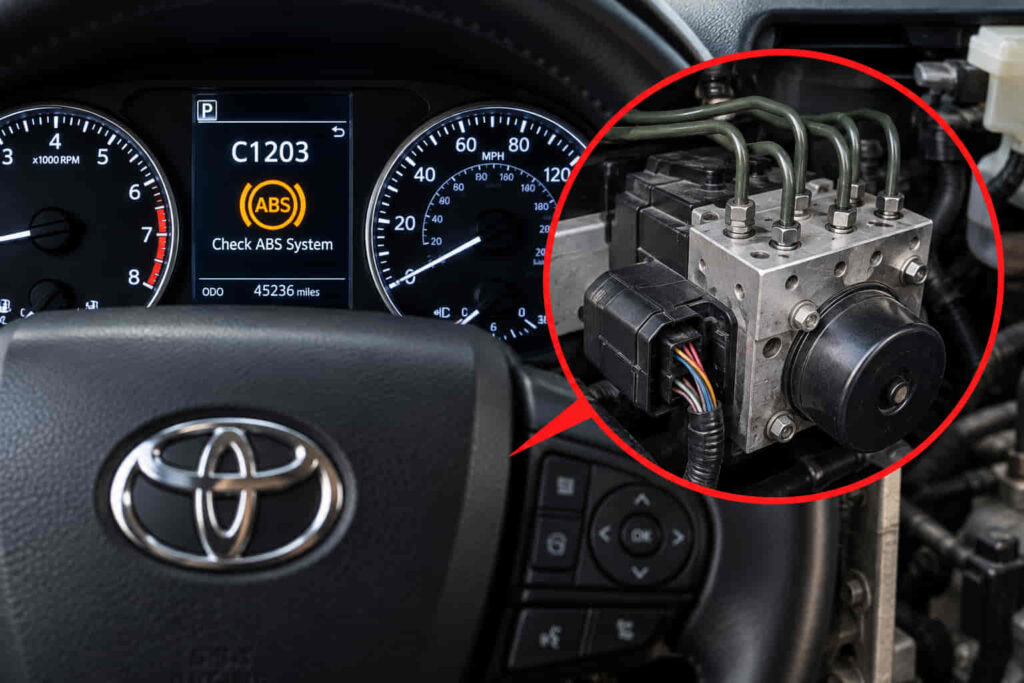
The Toyota C1203 code is a diagnostic trouble code associated with the vehicle’s stability and engine control systems. When C1203 is stored, the problem should not be diagnosed by replacing an ABS, VSC, or electronic control component based on the code alone. The correct diagnostic process is to identify which control system recorded the code, check for accompanying trouble codes, and determine the underlying condition that caused C1203 to appear.
A Toyota with C1203 may display the ABS, VSC, traction control, or Check Engine warning light, depending on the model, model year, and other faults stored in the vehicle. In some cases, the car may continue to drive without an obvious change in engine performance while stability or traction-control functions are limited. This makes a complete system scan more useful than simply clearing the code and waiting to see whether it returns.
Diagnosing Toyota C1203 requires checking related DTCs, electrical connections, wiring, power conditions, and relevant control-module data before replacing parts. This guide explains what Toyota C1203 means, what causes it, which symptoms can appear, how serious it is, and how to diagnose and fix the underlying fault correctly.
What Does the C1203 Code Mean on a Toyota?
The Toyota C1203 code indicates that the vehicle’s skid control system has detected an engine control system malfunction or related abnormal condition. C1203 therefore needs to be interpreted in the context of communication between the skid control ECU and the engine control system rather than as direct evidence that one ABS or VSC component has failed. When an engine-control problem affects information required by the stability-control system, C1203 can be stored alongside the diagnostic trouble code that identifies the underlying fault.
This relationship explains why C1203 should not be used as a standalone instruction to replace a skid control ECU, ABS actuator, or engine control module. The diagnostic process needs to identify other stored DTCs first because an accompanying engine-control code may provide more specific information about the original malfunction. For example, when an engine-related DTC and C1203 are stored together, diagnosing the engine-related DTC can identify the fault that caused the stability-control system to record C1203.
The exact diagnostic context also depends on the Toyota model, model year, powertrain, and control-system configuration. A Camry, Corolla, Prius, or RAV4 does not necessarily use an identical diagnostic procedure simply because each vehicle displays C1203. Toyota repair information for the specific vehicle should therefore determine the applicable inspection procedure, connector terminals, wiring checks, and confirmation steps. This model-specific approach prevents a generic code definition from being mistaken for a confirmed component failure.
C1203 is also different from a code that directly identifies a failed wheel-speed sensor or another individual ABS component. Its diagnostic value comes from the relationship between control systems. A complete scan of the relevant modules is therefore more informative than reading C1203 alone because the additional codes and control-module data provide the context needed to identify the root cause.
How Serious Is the Toyota C1203 Code?
Toyota C1203 should be diagnosed promptly because the condition associated with the code can affect the operation of the vehicle’s VSC or traction-control functions. The code does not automatically mean that the conventional braking system has failed, but it should not be ignored simply because the engine starts normally and the vehicle remains drivable. The actual severity depends on the underlying DTC, the warning lights that are active, and which vehicle functions have been disabled or restricted.
A vehicle can appear to drive normally while an electronic stability function is unavailable. VSC and traction control depend on information exchanged among vehicle control systems to detect and respond to conditions such as wheel slip or loss of directional stability. When the system cannot rely on required engine-control information, it may limit an associated control function and illuminate a warning indicator. The absence of obvious drivability symptoms therefore does not confirm that every driver-assistance function is operating normally.
The warning-light combination provides important diagnostic context. C1203 accompanied by VSC, traction-control, ABS, or Check Engine warnings requires the stored codes in the corresponding modules to be read before the vehicle’s condition can be assessed accurately. An additional engine-control DTC may indicate a problem that needs to be repaired first, while a brake-system warning or a noticeable change in braking behavior requires greater urgency than an isolated stability-control warning with otherwise normal braking.
The safest decision is based on the vehicle’s actual behavior rather than the C1203 number alone. A Toyota that brakes normally but has a VSC-related warning still requires diagnosis because electronic stability assistance may be limited. A vehicle showing abnormal braking, a brake warning light, significant engine-performance problems, or other safety-related symptoms should not be treated as a routine C1203 case. Those additional conditions change the risk assessment and should be diagnosed before normal driving continues.
Read more: Toyota P0430
What Symptoms Can Appear With Toyota Code C1203?
The main symptoms associated with Toyota code C1203 are illuminated VSC, traction-control, ABS, or Check Engine warning lights and the possible loss of electronic stability or traction-control functions. The exact symptoms depend on the underlying malfunction and the control systems installed on the specific Toyota. C1203 itself may not cause a noticeable change in how the engine runs or how the vehicle feels during normal driving, which is why warning indicators and stored diagnostic data are important when identifying the problem.
The VSC or traction-control warning is particularly relevant because C1203 is associated with the interaction between the skid control system and engine control system. Vehicle Stability Control uses information from multiple vehicle systems and can request changes in engine output when the vehicle begins to lose traction or directional stability. When a related engine-control malfunction prevents the system from operating as expected, the vehicle can illuminate the VSC or traction-control warning and restrict the corresponding function. The driver may notice no difference on a dry road even though electronic intervention is unavailable when traction is reduced.
The Check Engine Light can appear when C1203 is accompanied by an engine-control DTC. In this situation, the additional DTC is diagnostically important because it can provide more specific information about the malfunction that caused C1203 to be stored. Engine symptoms such as rough running, reduced performance, unstable idle, or other drivability problems should therefore be evaluated according to the accompanying engine code rather than attributed directly to C1203.
An ABS warning light requires the same contextual approach. C1203 alone does not prove that an ABS sensor, actuator, or skid control ECU has failed. If an ABS warning is illuminated, the ABS or skid control system should be scanned for additional codes before a component is identified as defective. This distinction prevents a visible warning light from being treated as proof that the component named by the system has failed.
Some Toyota vehicles can store C1203 without producing an obvious mechanical symptom. The engine may start, acceleration may feel normal, and conventional braking may remain available. This does not make the code irrelevant. It means the malfunction is being communicated electronically and may primarily affect a control function that becomes noticeable only under conditions where stability or traction assistance is required.
What Causes the C1203 Code on a Toyota?
Toyota C1203 is most commonly triggered by an engine-control malfunction recognized by the skid control system, although electrical, communication, wiring, and control-module problems can also be involved depending on the vehicle. For this reason, the root cause cannot be identified from C1203 alone. The other DTCs stored in the vehicle provide the first evidence needed to determine why the code was set.
An accompanying engine-control DTC is one of the most important causes to investigate. The skid control system depends on information and control functions shared with the engine management system. When the engine control system records a malfunction that affects this relationship, the skid control ECU can store C1203 as part of its response. In that situation, C1203 functions as evidence of a related system problem rather than as a precise identification of the failed engine component. Repairing the malfunction represented by the primary engine DTC can therefore resolve the condition associated with C1203.
Electrical communication problems are another diagnostic path when the expected control information is missing, inconsistent, or unavailable. Modern Toyota control modules exchange data electronically, so a fault affecting the relevant circuit or communication path can prevent one system from receiving the information it expects from another. The diagnostic evidence for this type of problem comes from additional communication DTCs, abnormal scan-tool data, circuit test results, or a combination of these findings. A communication problem should be confirmed through testing rather than assumed from C1203 alone.
Damaged wiring and poor electrical connections can create similar symptoms because control systems depend on stable power, ground, signal, and communication circuits. An open circuit, short circuit, corrosion, loose terminal, damaged connector, or compromised wiring harness can interrupt the electrical conditions required for normal system operation. The location of the inspection should be determined by the accompanying DTC and the wiring diagram for the exact Toyota model rather than by visually checking unrelated connectors throughout the vehicle.
Abnormal power conditions can also interfere with electronic control systems. Low or unstable system voltage can affect module operation and communication, particularly when other voltage-related DTCs or electrical symptoms are present. Battery condition and charging-system voltage are therefore relevant diagnostic factors when the evidence points toward a power-supply problem. Replacing a battery solely because C1203 is stored, however, is not a valid repair strategy without supporting voltage measurements or related diagnostic information.
A failed control module remains a possible cause only when the applicable diagnostic procedure supports that conclusion. Replacing the skid control ECU, ECM, ABS actuator, or another expensive electronic component before testing related DTCs, circuits, connectors, power supplies, and communication paths can result in an unnecessary repair. Module replacement belongs near the end of a structured diagnosis because a DTC identifies a detected condition; it does not automatically identify the component responsible for creating that condition.
The practical distinction is between the code that reports the system condition and the fault that originally produced it. C1203 provides useful information about the relationship between Toyota control systems, while accompanying DTCs and circuit tests narrow that relationship to a specific malfunction. Diagnosis should therefore move from stored codes to system evidence and from system evidence to the failed circuit or component, rather than moving directly from C1203 to parts replacement.
What Other Trouble Codes Should You Check With C1203?
Check all additional engine, ABS, VSC, communication, and voltage-related trouble codes stored with C1203 before deciding which component needs repair. C1203 does not provide enough information by itself to identify the root cause. An accompanying DTC can describe the original malfunction more specifically and should therefore become part of the diagnostic sequence rather than being treated as an unrelated code.
Engine-control codes deserve particular attention because C1203 can be stored when the skid control system recognizes a malfunction associated with the engine control system. If the ECM contains another DTC, that code should be interpreted according to the repair information for the exact Toyota model and model year. The resulting diagnosis may lead to an engine-management circuit, sensor, actuator, electrical supply, or another system involved in the primary malfunction. C1203 should then be reevaluated after that fault has been corrected.
ABS and VSC codes provide a different layer of diagnostic information. When C1203 appears together with another chassis-related DTC, the additional code can identify a condition within the braking or stability-control system that requires its own inspection. This is especially important when the ABS warning light is illuminated because C1203 alone does not establish that a wheel-speed sensor, ABS actuator, or skid control ECU is defective. The complete set of codes determines which system needs to be tested.
Communication and voltage-related DTCs also change the direction of diagnosis. A communication code can indicate that required information is not being exchanged correctly between control modules, while a voltage-related code can point toward an unstable electrical supply. These conditions require circuit and electrical testing before an ECU is condemned. Replacing a module while a power, ground, wiring, or communication fault remains present can leave C1203 unchanged after the repair.
The order in which the codes appeared can provide additional context when the scan tool and vehicle support relevant diagnostic records. Freeze-frame information and other stored data can show operating conditions associated with a malfunction and help distinguish a primary fault from codes recorded as consequences of that fault. The objective is not simply to erase every DTC. It is to determine which malfunction occurred first, repair its cause, and then verify whether C1203 returns.
How Do You Diagnose Toyota Code C1203?
Diagnosing Toyota C1203 requires a complete module scan, identification of accompanying DTCs, inspection of the relevant electrical circuits, repair of the confirmed primary fault, and a final verification scan. This sequence is more reliable than replacing parts based on C1203 because it moves from diagnostic evidence to the affected system and then to the actual circuit or component responsible for the malfunction.
Diagnosis starts by scanning the vehicle without immediately clearing its stored codes. The scan should retrieve C1203 and the available DTCs from the engine, ABS, VSC, and other relevant control modules. A scan tool capable of communicating only with the generic engine-control system may provide incomplete information because C1203 belongs to a diagnostic context involving chassis and stability-control functions. Access to the relevant Toyota systems is therefore important when the initial scan does not reveal enough information to explain the code.
The next diagnostic decision is based on the accompanying DTCs. When an engine-control code is stored with C1203, the engine code should be investigated according to the applicable Toyota diagnostic procedure. When communication or electrical codes are present, the inspection should instead follow the circuits implicated by those codes. This prevents C1203 from becoming the sole basis for diagnosis when another code provides a more precise path toward the root cause.
Stored diagnostic data should be reviewed before physical parts are replaced. Freeze-frame information, relevant live data, module communication status, and electrical measurements can show whether the fault is currently active or was recorded under a specific operating condition. For example, a voltage-related code combined with abnormal measured system voltage creates a stronger basis for investigating the power supply than C1203 alone. Diagnostic evidence should determine which test comes next.
Wiring and connectors should then be inspected where the diagnostic path identifies a relevant circuit. The inspection needs to look for conditions that can change electrical continuity or signal integrity, including damaged wiring, loose terminals, corrosion, poor grounds, open circuits, and short circuits. A visual inspection can identify obvious damage, but electrical measurements are necessary when the fault cannot be confirmed visually. The wiring diagram and connector information for the exact model and year should determine which terminals and circuits are tested.
Control-module replacement should occur only after the related circuits, power supplies, grounds, communication paths, and primary DTCs have been tested according to the applicable procedure. An ECU can record a malfunction generated elsewhere in the vehicle, so the presence of a code in that module does not prove that the module itself has failed. This distinction is particularly important with C1203 because replacing an ABS actuator, skid control ECU, or ECM without diagnostic confirmation can add substantial repair cost without eliminating the original fault.
After the confirmed malfunction has been repaired, the stored DTCs can be cleared and the vehicle should be tested under the conditions required for verification. The system should then be scanned again to determine whether C1203 or any accompanying code returns. A repair is confirmed when the triggering condition has been corrected and the relevant systems complete their verification without resetting the fault. Clearing C1203 before diagnosis only removes stored information; clearing it after a documented repair provides a way to verify that the root cause has actually been eliminated.
How Do You Fix the C1203 Code on a Toyota?
Fixing Toyota C1203 requires repairing the underlying malfunction that caused the skid control system to store the code rather than replacing a component based on C1203 alone. The correct repair depends on the accompanying DTCs and the results of electrical and system testing. Once the primary fault has been identified, that condition should be corrected first and C1203 should then be cleared and checked again.
When an accompanying engine-control DTC identifies the primary malfunction, the repair should follow the diagnostic path for that code. This is important because C1203 can represent the skid control system’s response to a problem detected within the engine control system. Repairing the engine-related fault restores the condition required by the interconnected systems and can eliminate C1203 without replacing a component in the ABS or VSC system.
A wiring or connector fault requires repair of the affected electrical circuit rather than replacement of the control module connected to that circuit. Damaged wiring should be restored so that the circuit has the required continuity and insulation, while loose, corroded, or damaged terminals need to be corrected according to the appropriate repair procedure. Power and ground circuits also need to meet the specified electrical conditions. A module cannot communicate or operate correctly when its power supply, ground, or signal circuit remains defective.
An abnormal electrical supply should be corrected when voltage measurements and related DTCs confirm that it contributes to the malfunction. The battery, charging system, power connections, and grounds can be tested according to the diagnostic evidence present on the vehicle. A battery should not be replaced merely because C1203 is stored, just as an alternator should not be replaced without confirming a charging-system fault. The repair must correspond to a measured electrical problem.
Control-module repair or replacement is appropriate only when the applicable diagnostic procedure has eliminated external causes and identified the module as faulty. This includes confirming relevant wiring, connectors, power supplies, grounds, communication circuits, and other DTCs before replacing an ECM, skid control ECU, ABS actuator, or related electronic component. Module replacement may also require initialization, calibration, programming, or another model-specific procedure before the system operates correctly.
The final part of the repair is verification. After the confirmed fault has been corrected, stored DTCs should be cleared and the vehicle should be rescanned after the appropriate operating or test conditions have been completed. If C1203 does not return and the associated warning indicators remain off, the repair has stronger diagnostic confirmation. If C1203 returns, the vehicle still contains an active or recurring condition and further diagnosis is required.
Can You Clear Toyota C1203 Without Repairing the Problem?
Toyota C1203 can be cleared from diagnostic memory with an appropriate scan tool, but clearing the code does not repair the condition that caused it. If the underlying malfunction remains active, the control system can detect the same condition again and store C1203 after the relevant monitoring criteria are met. Code clearing is therefore a diagnostic and verification action, not a substitute for repair.
Clearing the code before recording other DTCs and diagnostic information can also remove useful evidence. The combination of C1203 with engine, ABS, VSC, communication, or voltage-related codes helps determine which system should be inspected first. Stored operating information can provide additional context about when the malfunction occurred. Reading and documenting this information before erasing codes preserves evidence that can shorten the diagnostic process.
Disconnecting the battery should not be treated as a standard C1203 repair. Removing battery power may erase or reset information on some vehicles, but it does not repair a damaged circuit, correct an engine-control malfunction, restore a poor electrical connection, or replace a failed component. Battery disconnection can also affect vehicle settings or systems that require initialization, depending on the Toyota model and model year.
Clearing C1203 becomes useful after the underlying problem has been repaired. The technician can erase the stored codes, operate the vehicle under the appropriate verification conditions, and scan the systems again. If the relevant monitors and control systems operate without resetting C1203 or its accompanying DTCs, the result supports the effectiveness of the repair. If the code returns, diagnosis should continue rather than repeatedly clearing the code.
A code that does not immediately return should not automatically be considered permanently fixed either. Intermittent wiring, connector, voltage, or communication faults can disappear temporarily and recur when vibration, temperature, moisture, or operating conditions change. The objective is therefore not simply to obtain a scan showing no current C1203. The objective is to identify and eliminate the condition responsible for storing the code.
Can You Drive a Toyota With the C1203 Code?
A Toyota with the C1203 code may remain drivable, but whether it is safe to continue driving depends on the underlying fault, the active warning lights, and the vehicle’s braking and engine behavior. C1203 alone does not prove that the conventional braking system has failed. However, the code can appear in a diagnostic context where VSC or traction-control functions are restricted, so a vehicle that still moves normally should not automatically be considered fully functional.
The distinction between “drivable” and “safe to drive normally” is important. A Toyota may start, accelerate, steer, and brake without an obvious problem while an electronic stability function is unavailable. VSC and traction control become particularly relevant when the tires begin to lose grip, such as during abrupt maneuvers or on slippery road surfaces. The driver may therefore notice little difference during ordinary driving even though the vehicle has lost part of its electronic assistance.
The accompanying warning lights provide more useful information than C1203 alone. If the VSC or traction-control warning is illuminated while conventional braking and engine operation remain normal, the vehicle still requires diagnosis even if it can be moved. If an ABS warning is also present, the ABS system should be scanned for additional DTCs to determine whether anti-lock braking functionality is affected. The presence of another warning changes the diagnostic context and should not simply be attributed to C1203 without checking the corresponding control module.
A brake warning light, abnormal brake-pedal behavior, reduced braking performance, severe engine problems, or another significant drivability symptom requires greater caution. These conditions can represent faults beyond the limited stability-control functionality associated with the C1203 diagnostic context. Continuing normal driving based solely on the assumption that C1203 is a minor code can therefore overlook a separate safety-related malfunction.
The practical decision should be based on the complete vehicle condition. A Toyota that operates normally with only stability-related warnings still needs prompt diagnosis because electronic assistance may be unavailable when it is needed. A vehicle with abnormal braking, substantial loss of engine performance, or additional safety warnings should be inspected before normal driving continues. Reading all stored DTCs is the most reliable way to determine which condition is responsible for the warning indicators.
How Much Does It Cost to Fix Toyota Code C1203?
The cost to fix Toyota C1203 depends on the underlying fault because C1203 does not identify one specific component that must be replaced. The final repair can involve diagnostic labor, an engine-control fault, wiring or connector repair, an electrical-supply problem, or a control module if testing confirms that the module itself has failed. A single universal C1203 repair price would therefore be misleading.
Diagnostic cost is the first variable because the vehicle needs to be scanned beyond simply retrieving the C1203 number. A technician may need access to engine, ABS, VSC, and other relevant modules, followed by electrical testing based on the additional DTCs. The amount of diagnostic labor increases when the fault is intermittent or requires wiring inspection because the technician must reproduce or electrically confirm the condition rather than replace a component based on an assumption.
Wiring and connector faults can produce a substantially different repair cost from electronic-module failures. A damaged wire, corroded terminal, loose connection, or poor ground may require localized electrical repair once the affected circuit has been identified. The cost depends on the location and extent of the damage because an accessible connector repair requires different labor from tracing an intermittent fault through a larger wiring harness.
An accompanying engine-control DTC can shift the repair cost toward the system represented by that code. The actual expense then depends on the component or circuit confirmed during diagnosis rather than C1203 itself. This is why two Toyota vehicles displaying the same C1203 code can require completely different repairs: one vehicle may need an electrical connection corrected while another may have a separate engine-management fault that first triggered the stability-system code.
Control-module replacement generally represents a more complex repair path because the part can be expensive and the vehicle may require programming, initialization, calibration, or other model-specific procedures after installation. An ECM, skid control ECU, or ABS-related electronic assembly should therefore not be included automatically in a C1203 repair estimate. Its replacement cost becomes relevant only after diagnostic testing has confirmed the component as the source of the malfunction.
The most accurate estimate is produced after the accompanying DTCs and root cause have been identified. An estimate based only on “Toyota C1203” combines several fundamentally different repairs into one number and can create unrealistic expectations. Diagnosis should first determine whether the problem originates from another DTC, an electrical circuit, a communication condition, or a control component; parts and labor can then be estimated for the confirmed repair.
Does Toyota C1203 Have Different Causes on Camry, Corolla, Prius, and RAV4?
Toyota C1203 should be diagnosed according to the specific model, model year, powertrain, and control-system configuration because the applicable circuits and diagnostic procedures can differ between a Camry, Corolla, Prius, RAV4, and other Toyota vehicles. The same C1203 code does not establish that every Toyota has failed in the same way. Vehicle-specific repair information is necessary to determine what the code represents within the configuration being diagnosed.
The difference matters because Toyota models do not all use identical powertrain and stability-control architectures. A conventional gasoline vehicle and a hybrid vehicle, for example, contain different combinations of control systems and can provide different accompanying diagnostic information. The technician should therefore identify the exact vehicle before interpreting wiring diagrams, connector terminals, communication paths, inspection procedures, or control-module relationships.
Model year is equally important. A diagnostic procedure applicable to one generation of Toyota Camry or Corolla should not automatically be transferred to another generation simply because both vehicles store C1203. Control modules, electrical architecture, connector arrangements, and diagnostic logic can change during a model’s production history. Using repair information matched to the vehicle prevents an accurate code definition from being combined with an incorrect testing procedure.
The accompanying DTCs remain more useful for finding the root cause than the Toyota model name alone. If a Camry stores C1203 with an engine-control code, the additional code provides a diagnostic direction that should be investigated. If a RAV4 stores C1203 with communication or voltage-related faults, those codes can lead diagnosis toward a different system. Two Toyota models can therefore display the same C1203 while requiring different tests and repairs.
The Prius deserves particular attention because a hybrid powertrain adds control systems that are not present in a conventional gasoline-only vehicle. This does not mean C1203 automatically indicates a hybrid-system failure. It means diagnosis must respect the vehicle’s specific electronic architecture and the complete set of stored DTCs. A generic C1203 repair procedure should not replace Toyota-specific diagnostic information for the vehicle being serviced.
The correct approach is consequently vehicle-specific but evidence-driven. Identify the Toyota model and year, scan the relevant control modules, record all DTCs, and then follow the applicable diagnostic information for the primary fault. This method preserves the meaning of C1203 without assuming that a repair successful on one Toyota will correct every vehicle displaying the same code.
How Can You Prevent Toyota C1203 From Returning?
Preventing Toyota C1203 from returning requires eliminating the original fault, verifying the repaired circuits or systems, completing any required initialization or calibration, and confirming the repair with a final scan. Repeatedly clearing the code does not prevent recurrence because the control system can store C1203 again when the conditions responsible for the malfunction are detected.
The first requirement is an accurate root-cause repair. If C1203 was associated with another engine-control DTC, the condition represented by that code needs to be corrected rather than temporarily erased. If testing identified damaged wiring, a loose terminal, corrosion, an unstable power supply, or another electrical fault, that condition needs to be repaired so the affected systems receive reliable power, ground, signals, and communication. Eliminating the initiating fault removes the reason for C1203 to return.
Electrical repairs should also be verified rather than considered complete after a visual correction. A connector that appears secure can still have poor terminal contact, and damaged wiring can create an intermittent fault that occurs only with vibration, temperature changes, or movement of the harness. Appropriate circuit testing after the repair helps confirm that electrical continuity and connection integrity have been restored.
Replacement of an electronic component may require additional procedures before the vehicle returns to normal operation. Depending on the model, year, and component involved, Toyota repair information may specify initialization, calibration, programming, or another post-repair operation. Completing the physical replacement without the required procedure can leave the system unable to operate or verify itself correctly.
The final confirmation comes from clearing the repaired vehicle’s DTCs and checking whether the malfunction can be reproduced. The vehicle should be operated or tested according to the conditions appropriate for the repaired system and then scanned again. C1203 and its accompanying DTCs should remain absent, and the affected warning indicators should operate normally after successful verification.
A returning C1203 indicates that diagnosis is not complete. The remaining problem may be an active fault that was not corrected or an intermittent condition that was not present during the first inspection. Repeated code clearing should therefore be replaced by another review of the stored diagnostic evidence. A successful C1203 repair is defined by elimination of the triggering condition and successful system verification, not simply by a warning light that temporarily turns off.